CapitalConnectorAI vs LeadsForge: 2026 B2B Lead Tool Showdown
CapitalConnectorAI vs LeadsForge compared on data quality, workflow, pricing, and real outbound results — plus the contact-data layer that decides whether either tool actually performs.
Choosing between two AI-branded lead platforms usually comes down to one question nobody markets honestly: does the data actually connect? CapitalConnectorAI and LeadsForge both promise to turn intent signals into booked meetings, but they take different roads to get there — and both lean on a contact-data layer that you, the buyer, end up paying for whether you notice it or not.
This is a neutral, hands-on breakdown of where each tool fits, where each one falls short, and how to avoid paying premium prices for stale records.
TL;DR#
- CapitalConnectorAI leans toward signal-and-intent workflows — it's strongest when you want the platform to surface accounts and warm intros, weakest when you need clean, exportable contact records at scale.
- LeadsForge leans toward volume list-building and sequencing — strongest for high-throughput outbound teams, weakest on data freshness and catch-all handling.
- Neither tool's bundled email data is good enough to skip verification — plan for a dedicated email verifier regardless of which you pick.
- Pricing is the trap: both bury contact-credit limits inside higher tiers, so the "cheap" plan rarely survives contact with a real campaign.
- If raw contact accuracy is the deciding factor, a focused finder like Tomba (free tier: 25 searches/mo, Starter $49/mo) often beats the data baked into either suite.
What are CapitalConnectorAI and LeadsForge?#
Both are B2B go-to-market tools that sit between "I have an ideal customer profile" and "I have a reply in my inbox." The difference is philosophy.
CapitalConnectorAI positions itself around connection intelligence — mapping relationships, intent, and account signals so reps spend time on accounts that are already leaning in. Think of it as a matchmaker that watches the room before introducing you.
LeadsForge positions itself around manufacturing pipeline — building large targeted lists, enriching them, and pushing them into sequences fast. Think of it as an assembly line: raw ICP in, contacted leads out.
Here's the everyday analogy: CapitalConnectorAI is a concierge who hands you three warm names; LeadsForge is a bulk supplier who delivers a pallet and lets you sort it. Both can work — but they fail in opposite ways. The concierge runs out of names; the supplier delivers some spoilage.
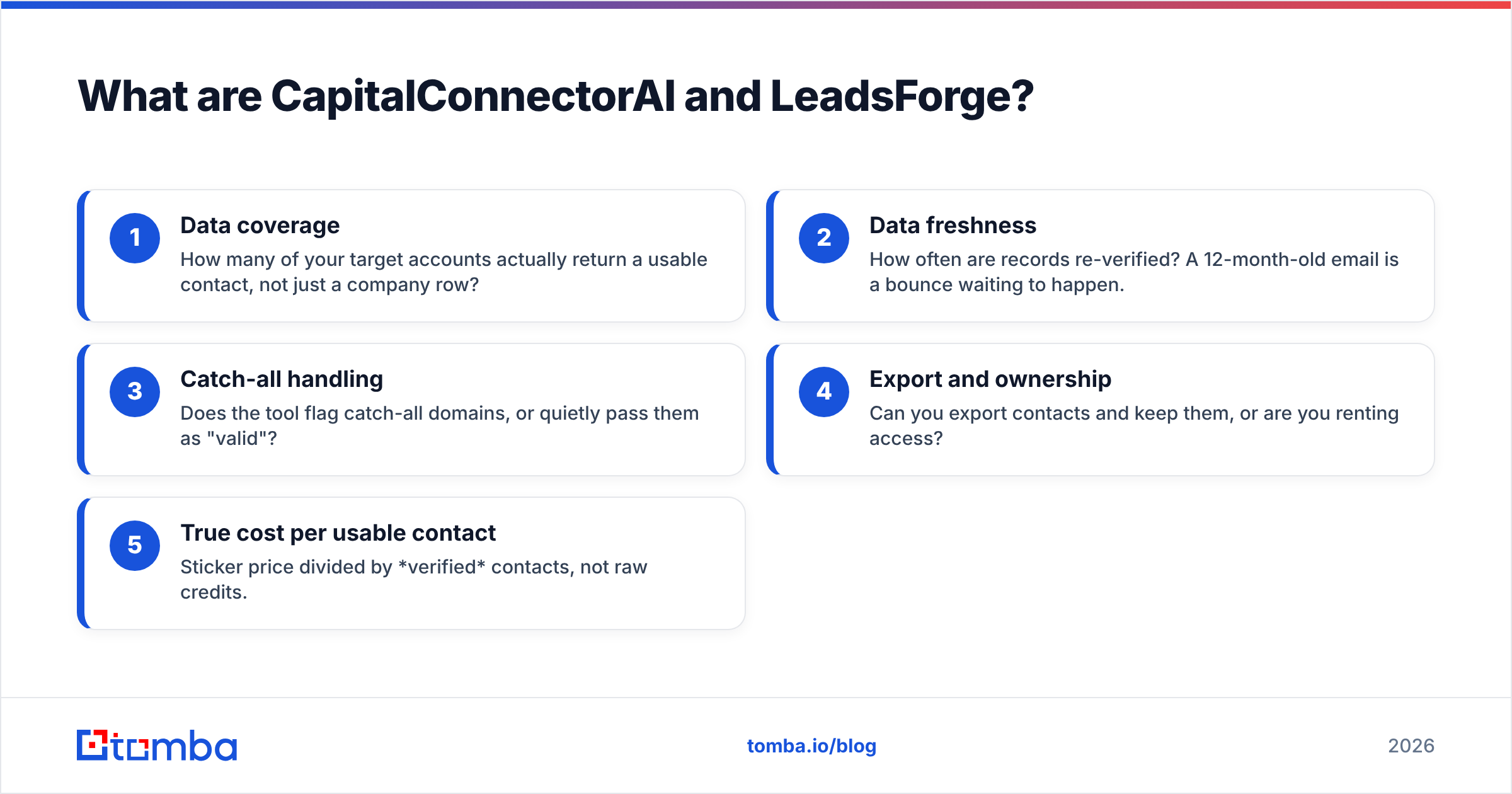
When you evaluate either, judge them on five concrete dimensions rather than the homepage copy:
- Data coverage — How many of your target accounts actually return a usable contact, not just a company row?
- Data freshness — How often are records re-verified? A 12-month-old email is a bounce waiting to happen.
- Catch-all handling — Does the tool flag catch-all domains, or quietly pass them as "valid"?
- Export and ownership — Can you export contacts and keep them, or are you renting access?
- True cost per usable contact — Sticker price divided by verified contacts, not raw credits.

How do CapitalConnectorAI and LeadsForge compare?#
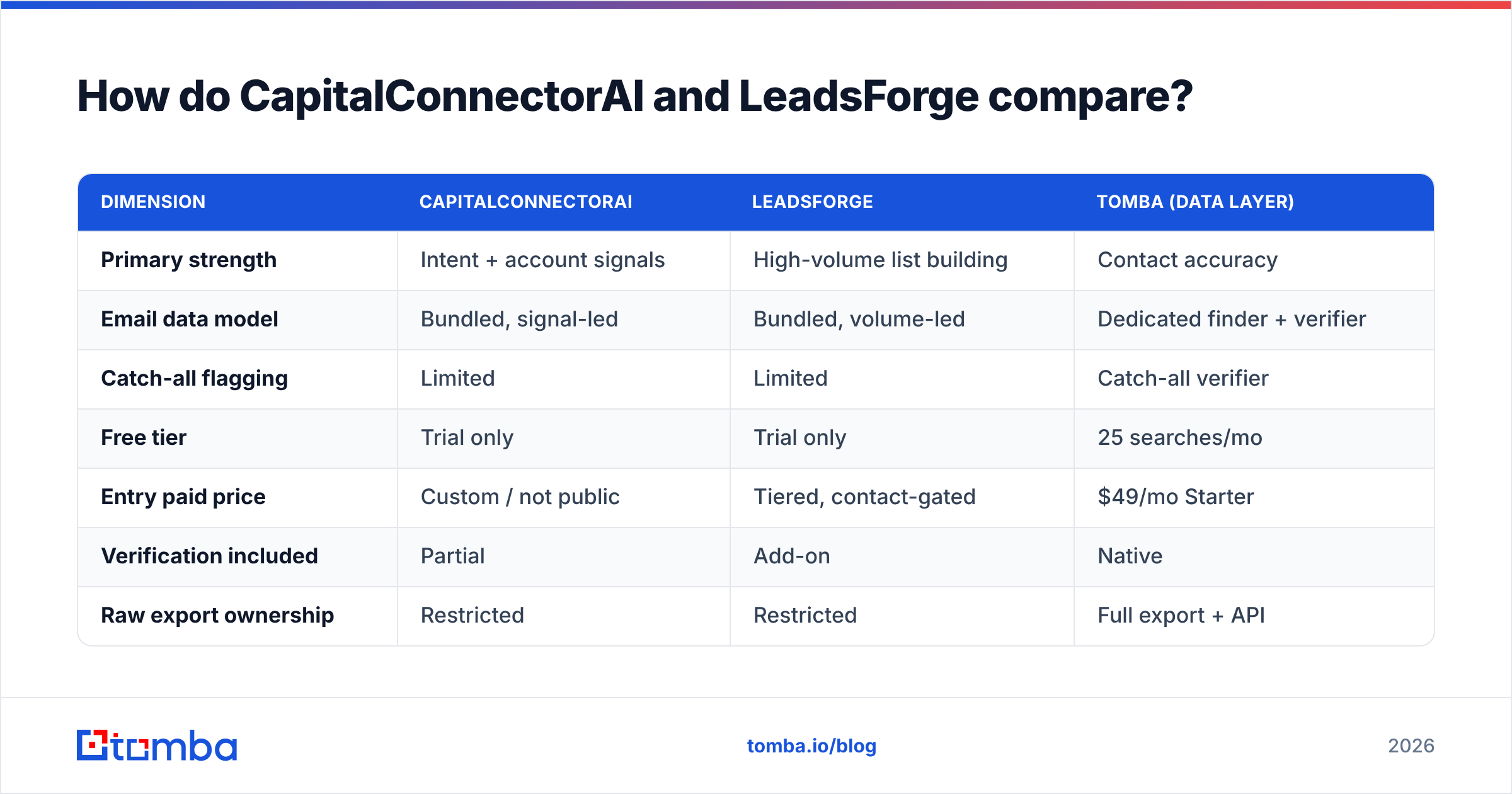
The table below maps both platforms against the dimensions that actually move reply rates. Where a vendor does not publish a number, it's marked as such — guessing helps no one.
| Dimension | CapitalConnectorAI | LeadsForge | Tomba (data layer) |
|---|---|---|---|
| Primary strength | Intent + account signals | High-volume list building | Contact accuracy |
| Email data model | Bundled, signal-led | Bundled, volume-led | Dedicated finder + verifier |
| Catch-all flagging | Limited | Limited | Catch-all verifier |
| Free tier | Trial only | Trial only | 25 searches/mo |
| Entry paid price | Custom / not public | Tiered, contact-gated | $49/mo Starter |
| Verification included | Partial | Add-on | Native |
| Raw export ownership | Restricted | Restricted | Full export + API |
| Best for | Relationship-led ABM | Throughput outbound | Clean data under any tool |
Two honest takeaways from this comparison:
- Neither suite is a verification tool. Both enrich, but enrichment without re-verification at send time is how good lists rot. Run exports through a bulk verify step before any sequence.
- The bundled-data convenience has a price. You pay for contact data twice — once in the platform fee, and again in deliverability damage when unverified records bounce.
Which tool has better data accuracy?#
Accuracy is where most "AI lead platform" comparisons go quiet, because it's the hardest thing to fake and the easiest thing to measure. Here's the test that cuts through marketing: take 100 target accounts, pull contacts from each tool, then independently verify every email.
In practice, suite-bundled data tends to optimize for coverage (a contact for every row) over correctness (a contact that's actually deliverable). That's a rational product choice — an empty cell looks like failure, a wrong email looks like success until the bounce report lands a week later.
CapitalConnectorAI's signal-first approach often returns fewer contacts but with better account-level relevance. LeadsForge's volume-first approach returns more rows, but a larger share are guesses, role accounts, or catch-all domains passed as valid. Neither pattern is "wrong" — they serve different buyers — but both mean you should treat bundled emails as candidates, not confirmed sends.
This is exactly why a standalone email finder with transparent confidence scoring and SMTP-level verification matters. When you can see why an address is rated deliverable — and re-check catch-alls explicitly — you stop guessing and your sender reputation stops absorbing the damage. Independent review sites like G2 are a good sanity check here: read the 3-star reviews, not the 5-star ones, because that's where data-quality complaints live.
Which tool is better for cold outbound?#
For high-volume cold outbound, LeadsForge is the more natural fit — it's built to push large lists into sequences quickly. But "fast" is only an advantage if the underlying addresses are clean. Sending 5,000 emails where 18% bounce is slower than sending 4,000 clean ones, because the bounces drag your domain reputation down and quietly route the good emails to spam.
For relationship-led or ABM-style outbound, CapitalConnectorAI wins. When you're working 50–200 high-value accounts, signal quality beats list size every time, and the warm-intro angle is genuinely useful.
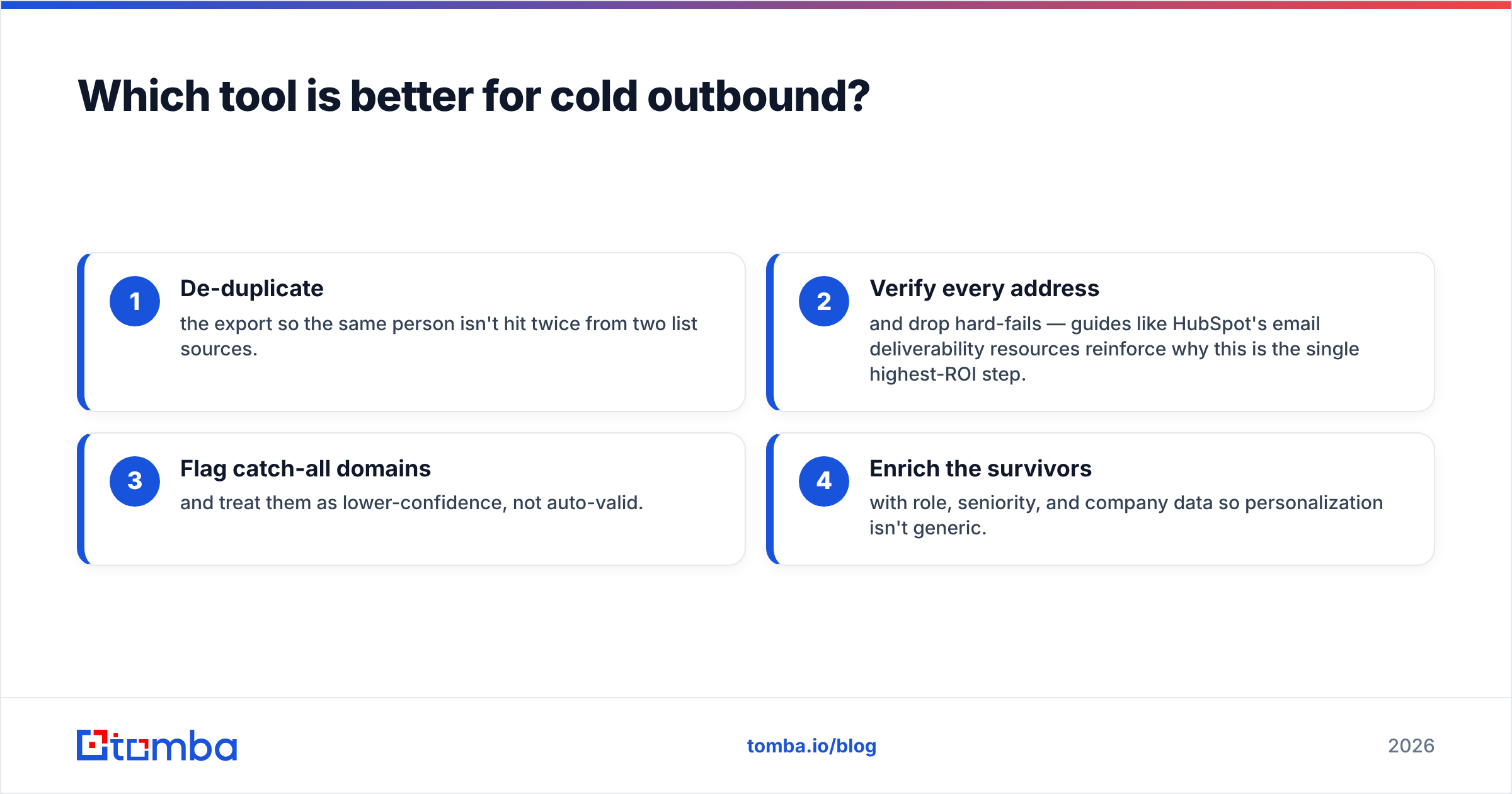
The non-negotiable for either path: hygiene before send. A practical pre-send checklist:
- De-duplicate the export so the same person isn't hit twice from two list sources.
- Verify every address and drop hard-fails — guides like HubSpot's email deliverability resources reinforce why this is the single highest-ROI step.
- Flag catch-all domains and treat them as lower-confidence, not auto-valid.
- Enrich the survivors with role, seniority, and company data so personalization isn't generic.

If you run that checklist, the gap between the two platforms narrows sharply — because most of the real performance difference was never the sequencer or the signal engine. It was the data underneath.
What about pricing and total cost?#
The sticker price on either tool tells you almost nothing. What matters is cost per usable contact, and that number depends on three multipliers the pricing page won't show you:
- Credit gating — entry tiers often cap contact reveals low enough that a single campaign exhausts them, forcing an upgrade.
- Bounce tax — every undeliverable address you paid to reveal is wasted spend plus reputation cost.
- Re-verification spend — if you have to run a separate verifier anyway (you do), that's a line item the bundle hid.
A quick way to compare apples to apples:
| Cost factor | What to ask the vendor |
|---|---|
| Reveal credits per tier | How many verified contacts, not raw rows? |
| Overage pricing | What's the per-contact cost past the cap? |
| Verification | Included, add-on, or BYO? |
| Export rights | Do I keep contacts if I cancel? |
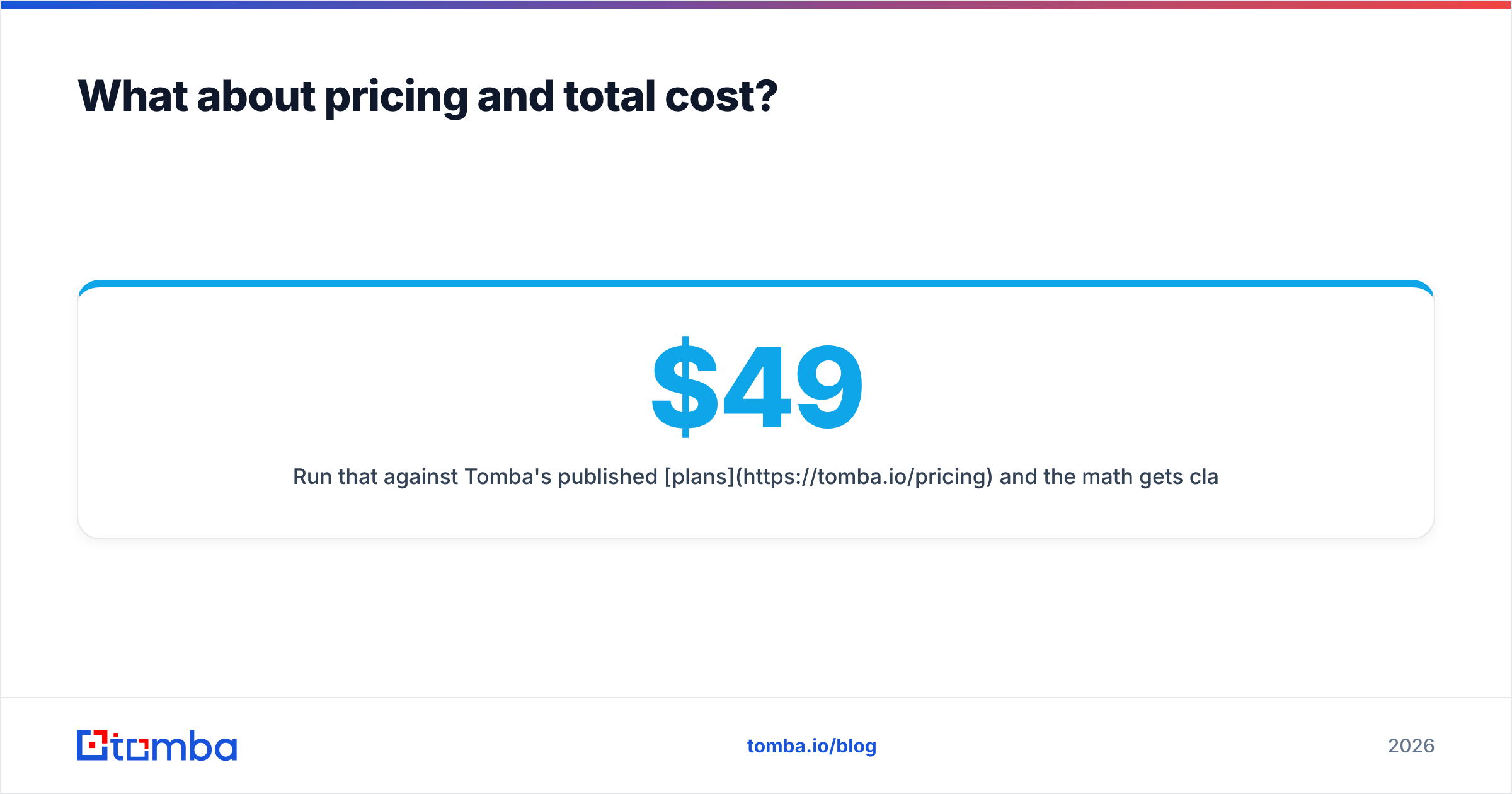
Run that against Tomba's published plans and the math gets clarifying. A Free tier of 25 searches/mo lets you test accuracy before paying anything; Starter at $49/mo, Growth at $99/mo, and Pro at $249/mo scale predictably, with verification native rather than bolted on. You can also pull contacts directly into your stack with the Tomba API, a Chrome extension, or Google Sheets — so the data layer travels with you instead of being locked inside one suite.
Do you have to choose just one?#
No — and that's the most useful realization in this whole comparison. CapitalConnectorAI, LeadsForge, and a dedicated contact-data provider aren't mutually exclusive. The strongest setups treat them as layers:
- Signal / targeting layer — whichever platform best surfaces the right accounts for your motion (signal-led or volume-led).
- Contact-data layer — a focused finder and verifier that guarantees the emails you actually send are deliverable.
- Enrichment layer — data enrichment to add the context that makes personalization land.
Decoupling these protects you from vendor lock-in. If you outgrow LeadsForge's sequencer or CapitalConnectorAI's signal model, you swap that layer without re-buying your contact database. For background on why this layered, operations-first thinking is becoming standard, the concept of revenue operations on Wikipedia is a solid primer.
The verdict: CapitalConnectorAI vs LeadsForge#
- Pick CapitalConnectorAI if you run focused, relationship-led ABM on a finite set of high-value accounts and want signal over volume.
- Pick LeadsForge if you run high-throughput outbound and need to build and sequence large lists fast.
- Pick neither for your data — bundle convenience is real, but bundled accuracy isn't, and your sender reputation pays the difference.
The honest conclusion: this matchup is decided less by the platform you choose and more by the contact data you feed it. Get that layer right and either tool performs; get it wrong and the best signal engine or sequencer in the world is just automating bounces.
Get the data layer right with Tomba#
Before you commit budget to either suite, pressure-test the part that actually decides results. Start free with the Tomba Email Finder — 25 searches a month, no card — and run your real target accounts through it. Compare the verified-contact rate against whatever CapitalConnectorAI or LeadsForge hands you, then scale on a plan that charges you for accuracy instead of guesses. Whichever platform wins your evaluation, make sure the emails underneath it are real.
// get started
Find, verify and enrich your first contacts today
Start on the free plan with 25 searches a month, then scale when your team is ready.
Free plan · No credit card required · GDPR & CCPA
Get the Tomba newsletter
Product and data updates
// about the author