CapitalConnectorAI vs Oceanio: B2B Data Showdown 2026
CapitalConnectorAI and Ocean.io both promise smarter B2B targeting, but they solve different jobs. Here's a neutral 2026 breakdown of features, pricing, data quality, and the gap a dedicated email finder fills.
You typed two tool names into the same search bar and got the same vague answer everywhere: "both are great B2B platforms." That's not useful when you have a budget to defend and a pipeline to fill. So let's be specific.
CapitalConnectorAI and Ocean.io get lumped together because both wave the "AI-powered B2B intelligence" flag. In practice they aim at different buyers, surface different data, and leave different gaps. This guide walks through what each one actually does, where they overlap, what they cost, and the one job neither does well on its own.
TL;DR — CapitalConnectorAI vs Oceanio at a glance#
- They solve different jobs. CapitalConnectorAI leans toward capital, investor, and relationship matching; Ocean.io is a B2B company-and-account data platform built around lookalike targeting.
- Ocean.io is stronger for sales prospecting at the account level — firmographics, lookalikes, and total-addressable-market mapping.
- CapitalConnectorAI is narrower and more relationship-driven, which is great for fundraising and partnership intros but thin for high-volume outbound.
- Neither is a dedicated email-finding or verification engine. Both hand you companies and signals; you still need verified, deliverable contact data to act.
- Pricing is quote-based on both sides, so total cost is hard to predict — a transparent per-credit tool like Tomba is easier to budget.
What is CapitalConnectorAI?#
CapitalConnectorAI positions itself as an AI layer for connecting people to capital and the right counterparties — think founders to investors, dealmakers to partners, and warm-intro discovery across a network. The pitch is relationship intelligence: instead of cold lists, it tries to surface who you should talk to and why, scoring fit based on profile, stage, and signal.
That framing matters. A tool built for capital introductions optimizes for quality of match over volume of contacts. If you're raising a round or hunting strategic partnerships, that's the right priority. If you're a 12-rep outbound team that needs 5,000 net-new accounts this quarter, it's the wrong shape of tool.
Where it tends to fall short for traditional go-to-market teams: it isn't designed as a bulk data exporter, and it doesn't replace a prospecting database or an email-verification step. You get curated direction, not a firehose you can pour into a sequencer.
What is Ocean.io?#
Ocean.io is a B2B prospecting and company-data platform best known for lookalike search. You feed it your best customers, and it finds companies that resemble them across industry, size, tech stack, and growth signals. It's a market-mapping and account-discovery engine more than a contact-level dialer list.
Ocean.io's strengths are firmographic depth and total-addressable-market work. For account-based marketing (ABM) and territory planning, the lookalike model is genuinely useful — it answers "who else looks like our winners?" faster than manual list-building. It also surfaces contacts within target accounts, though contact-level coverage and deliverability are where most company databases get graded hardest.
Where it gets thinner: like most account-data platforms, the email addresses it returns are only as good as the last refresh, and it isn't built as a standalone, real-time email verifier. That's a category gap, not a knock on Ocean.io specifically — it's why so many teams pair a data platform with a dedicated email verifier.

CapitalConnectorAI vs Oceanio: how do they compare?#
Here's the head-to-head on the attributes that actually change your buying decision. Pricing rows reflect that both vendors use quote-based plans rather than public price cards, so treat exact numbers as "contact sales."
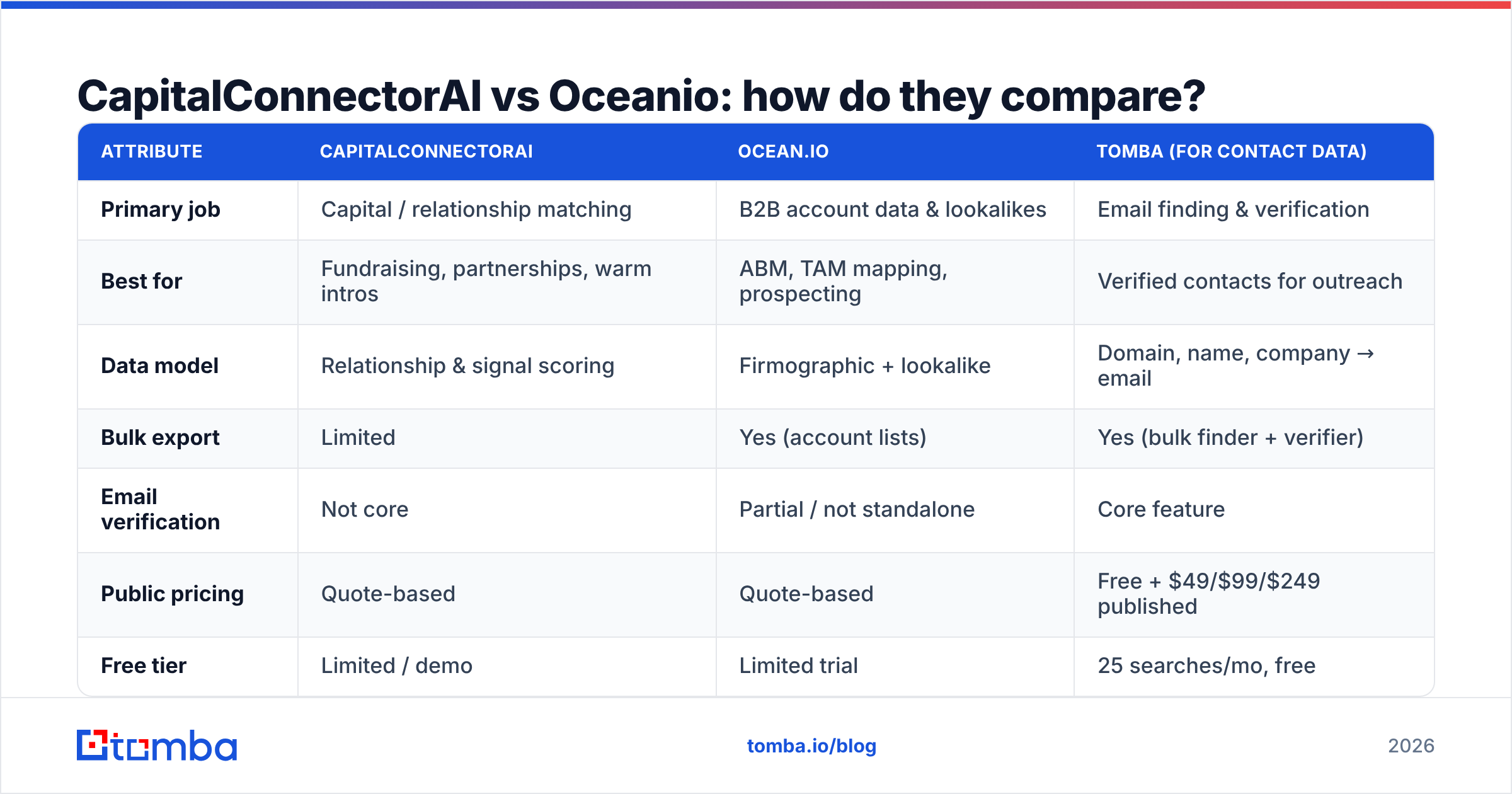
| Attribute | CapitalConnectorAI | Ocean.io | Tomba (for contact data) |
|---|---|---|---|
| Primary job | Capital / relationship matching | B2B account data & lookalikes | Email finding & verification |
| Best for | Fundraising, partnerships, warm intros | ABM, TAM mapping, prospecting | Verified contacts for outreach |
| Data model | Relationship & signal scoring | Firmographic + lookalike | Domain, name, company → email |
| Bulk export | Limited | Yes (account lists) | Yes (bulk finder + verifier) |
| Email verification | Not core | Partial / not standalone | Core feature |
| Public pricing | Quote-based | Quote-based | Free + $49/$99/$249 published |
| Free tier | Limited / demo | Limited trial | 25 searches/mo, free |
| API access | Varies | Yes | Yes (REST API + SDKs) |
The pattern is clear: CapitalConnectorAI and Ocean.io are targeting tools. They tell you who and which accounts. Neither is engineered to reliably deliver a verified, inbox-safe email at scale — and that's the step that decides whether your outreach lands or bounces.
Which one is better for sales prospecting?#
For sales prospecting at scale, Ocean.io is the stronger of the two. Its lookalike engine and firmographic filters are built for the exact motion a sales or RevOps team runs: define your ideal customer profile, expand it into a ranked account list, and push that into a CRM.
CapitalConnectorAI can absolutely support a relationship-led sales motion — enterprise deals, strategic alliances, or anything where one warm intro beats a hundred cold emails. But for repeatable, high-volume outbound, its relationship-first design becomes a ceiling rather than a launchpad.
Run through this quick fit test before you commit:
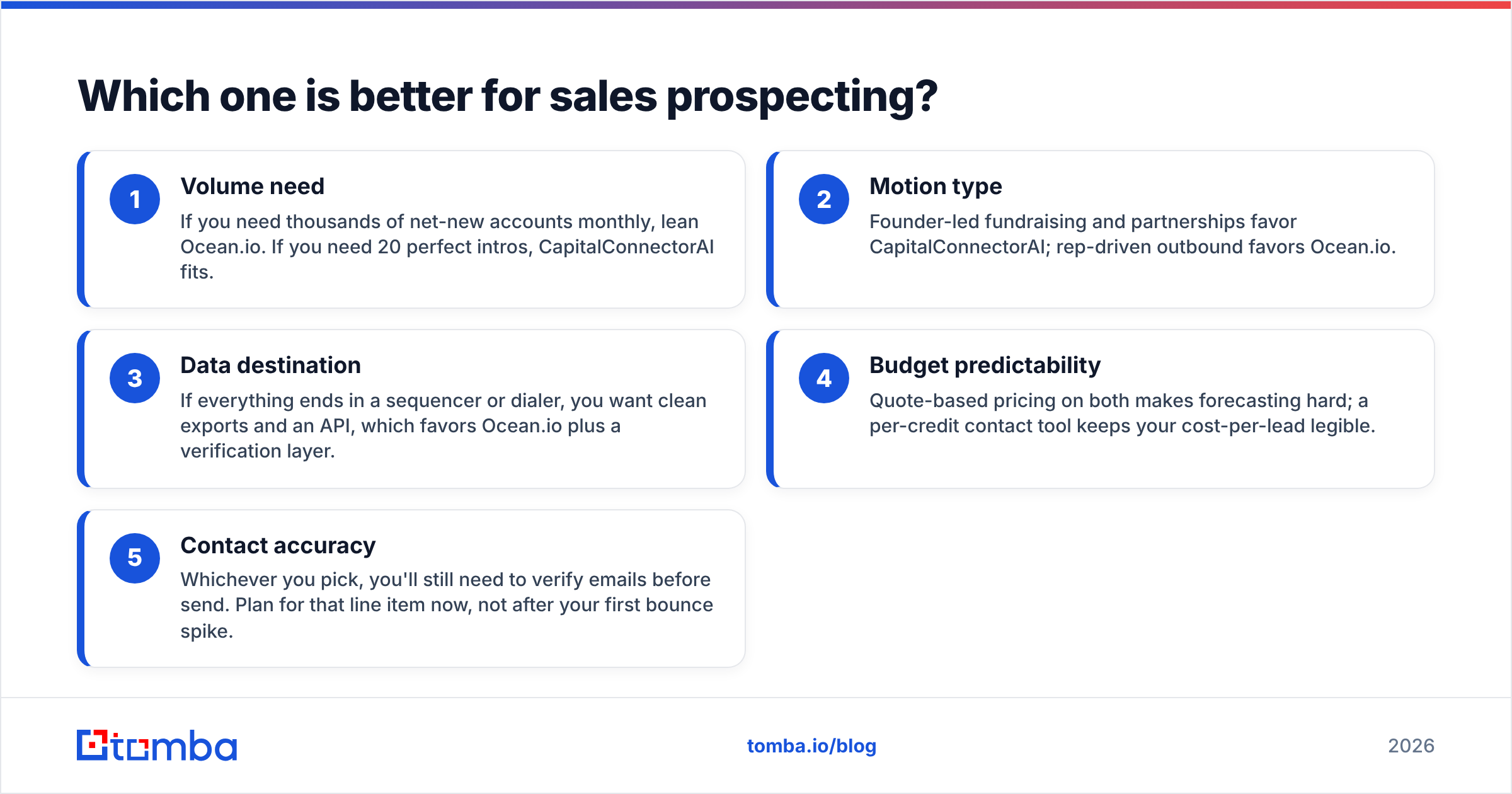
- Volume need — If you need thousands of net-new accounts monthly, lean Ocean.io. If you need 20 perfect intros, CapitalConnectorAI fits.
- Motion type — Founder-led fundraising and partnerships favor CapitalConnectorAI; rep-driven outbound favors Ocean.io.
- Data destination — If everything ends in a sequencer or dialer, you want clean exports and an API, which favors Ocean.io plus a verification layer.
- Budget predictability — Quote-based pricing on both makes forecasting hard; a per-credit contact tool keeps your cost-per-lead legible.
- Contact accuracy — Whichever you pick, you'll still need to verify emails before send. Plan for that line item now, not after your first bounce spike.
The honest takeaway: these tools find the target. They are not the deliverability layer. Treating an account-data platform as your email source is the single most common reason cold campaigns underperform.
How accurate is the contact data?#
This is where most comparisons get hand-wavy, so let's be blunt: account-level data ages fast, and contact-level data ages faster. People change jobs, domains migrate, and catch-all servers accept everything then silently drop it. Any platform that returns an email without a fresh SMTP check is handing you a probability, not a fact.
CapitalConnectorAI's relationship focus means contact accuracy is bound to network freshness. Ocean.io's firmographic depth is solid for company attributes, but contact emails are a secondary output, not the core promise. In both cases, the smart move is to treat their emails as candidates and run them through real verification.
That's exactly the role a tool like Tomba plays. The email finder resolves a verified address from a name and domain, and the verifier confirms deliverability before you ever hit send. For teams running lists through a platform like Ocean.io, layering data enrichment and a verification pass turns a decent list into a campaign-safe one. You can compare credit costs directly on the Tomba pricing page instead of waiting on a sales quote.
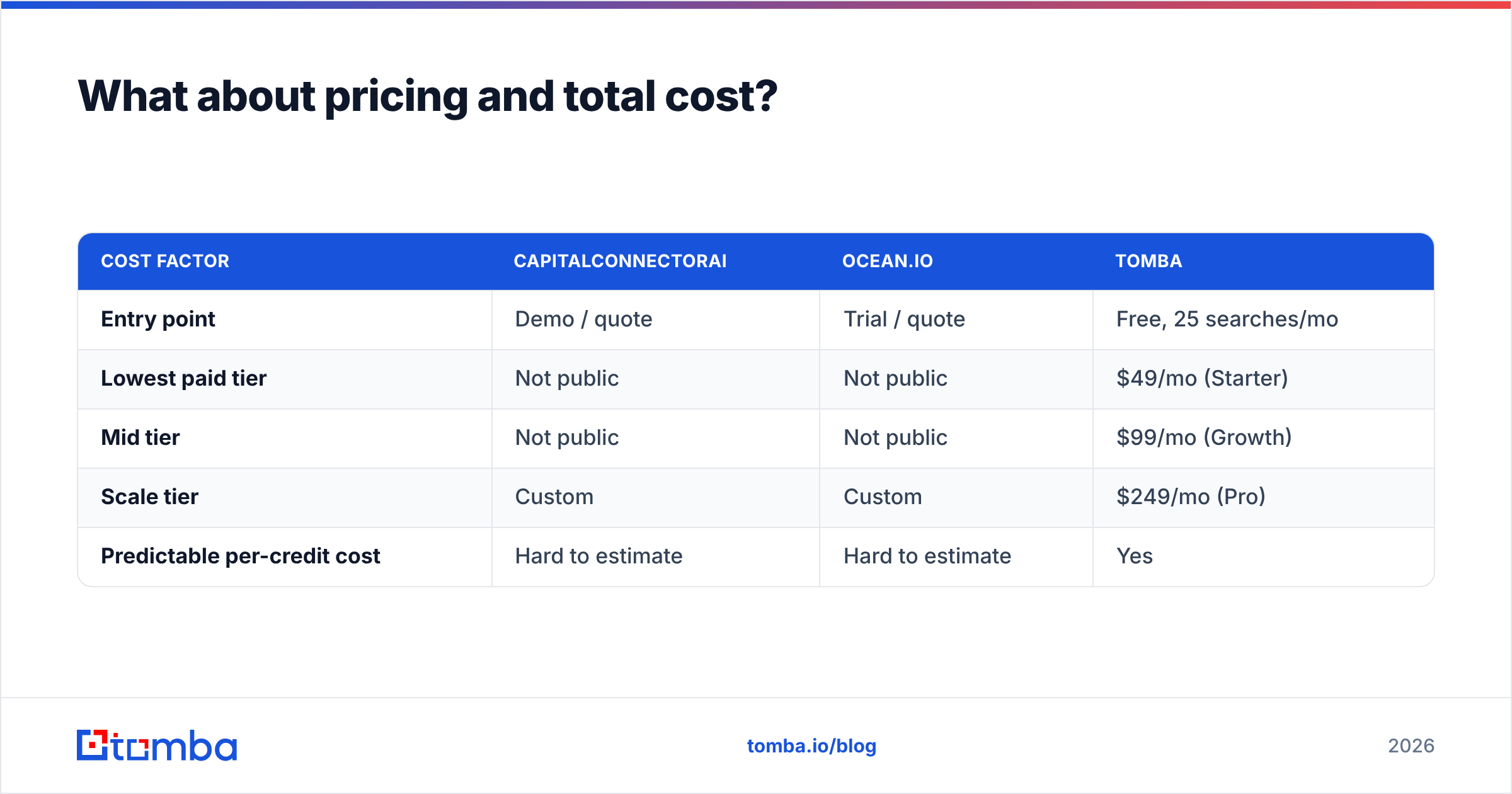
What about pricing and total cost?#
Both CapitalConnectorAI and Ocean.io use quote-based pricing, which means your real cost depends on seats, data volume, and a sales conversation. That's fine for enterprise procurement and frustrating for a lean team that just wants to know cost-per-lead.
Here's a simplified cost-shape comparison:
| Cost factor | CapitalConnectorAI | Ocean.io | Tomba |
|---|---|---|---|
| Entry point | Demo / quote | Trial / quote | Free, 25 searches/mo |
| Lowest paid tier | Not public | Not public | $49/mo (Starter) |
| Mid tier | Not public | Not public | $99/mo (Growth) |
| Scale tier | Custom | Custom | $249/mo (Pro) |
| Predictable per-credit cost | Hard to estimate | Hard to estimate | Yes |
If budget transparency matters, the gap is obvious. You can start free on Tomba, see exactly what a search costs, and scale tiers without renegotiating. For platforms that map markets, you'll often pay a meaningful annual commitment before you've validated fit. According to peer reviews on G2, buyers in this category consistently flag opaque pricing and seat minimums as the top friction — worth raising on any demo call.
Can you use them together?#
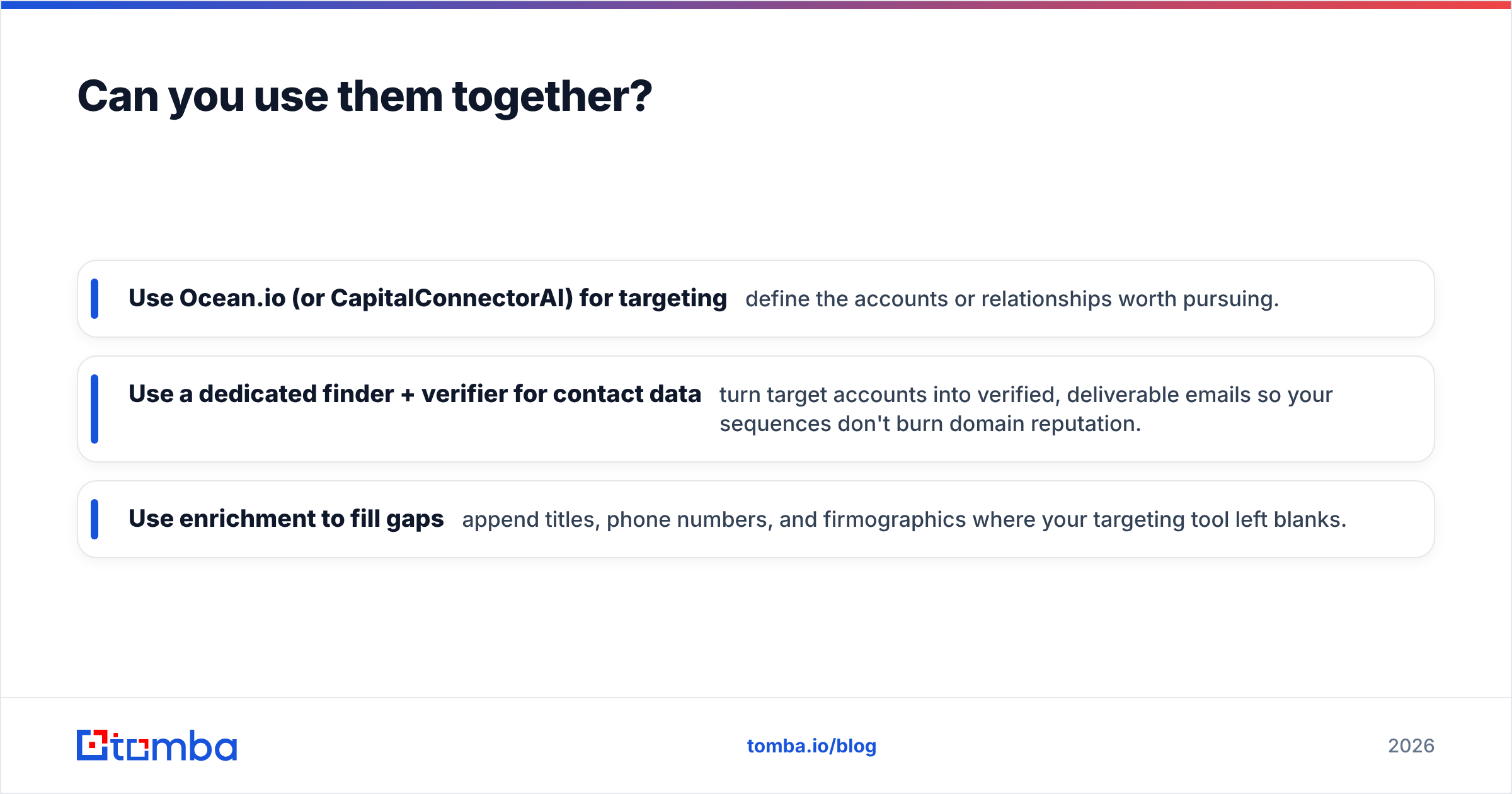
Yes, and for many teams that's the right answer rather than picking a single winner. A clean stack looks like this:
- Use Ocean.io (or CapitalConnectorAI) for targeting — define the accounts or relationships worth pursuing.
- Use a dedicated finder + verifier for contact data — turn target accounts into verified, deliverable emails so your sequences don't burn domain reputation.
- Use enrichment to fill gaps — append titles, phone numbers, and firmographics where your targeting tool left blanks.
That layered approach is also more resilient. If you churn off one data vendor, your outreach engine doesn't collapse — you swap the targeting layer and keep your verified-contact workflow intact. For high-volume runs, a bulk email finder plus the Tomba API lets you automate the find-and-verify step directly inside your existing pipeline, so the data your reps touch is already clean.
For more on how data freshness affects deliverability, the basics of email deliverability are worth a five-minute read before you scale any campaign.
So which should you choose?#
Decide by job, not by brand:
- Raising capital or building strategic partnerships? CapitalConnectorAI's relationship-first model is the better starting point.
- Mapping a market or running ABM at the account level? Ocean.io's lookalike engine is the stronger pick.
- Need verified emails and phone numbers to actually reach those targets? Neither tool is built for that job — pair your choice with a dedicated finder and verifier.
The mistake teams make is expecting one platform to do targeting and deliverability. Targeting tools point you at the right doors. A verification layer makes sure you knock on real ones. Get both right and your reply rate stops being a mystery.
The bottom line#
CapitalConnectorAI vs Oceanio isn't really a duel — it's two tools for two motions. CapitalConnectorAI fits relationship-led capital and partnership work. Ocean.io fits account-based prospecting and market mapping. Both leave the same gap: turning targets into verified, sendable contacts.
That's the layer to nail down before you spend on either. Start with Tomba's email finder on the free tier (25 searches a month, no card), verify a sample of any list you're already working, and watch your bounce rate before you commit to a quote-based annual contract. Clean contact data is the cheapest insurance your outbound program will ever buy — and it's the one thing the big targeting platforms quietly leave to you.
// get started
Find, verify and enrich your first contacts today
Start on the free plan with 25 searches a month, then scale when your team is ready.
Free plan · No credit card required · GDPR & CCPA
// about the author