CapitalConnectorAI vs SalesIntel: 2026 B2B Data Showdown
A neutral, hands-on breakdown of CapitalConnectorAI vs SalesIntel in 2026 — data coverage, accuracy, pricing, and which one fits your outbound motion.
Choosing between CapitalConnectorAI and SalesIntel comes down to one question most vendor pages dodge: do you need broad, human-verified company data or a leaner, API-first way to find and confirm the exact people you're emailing? This guide compares both honestly, then shows where a focused tool like Tomba slots in.
TL;DR#
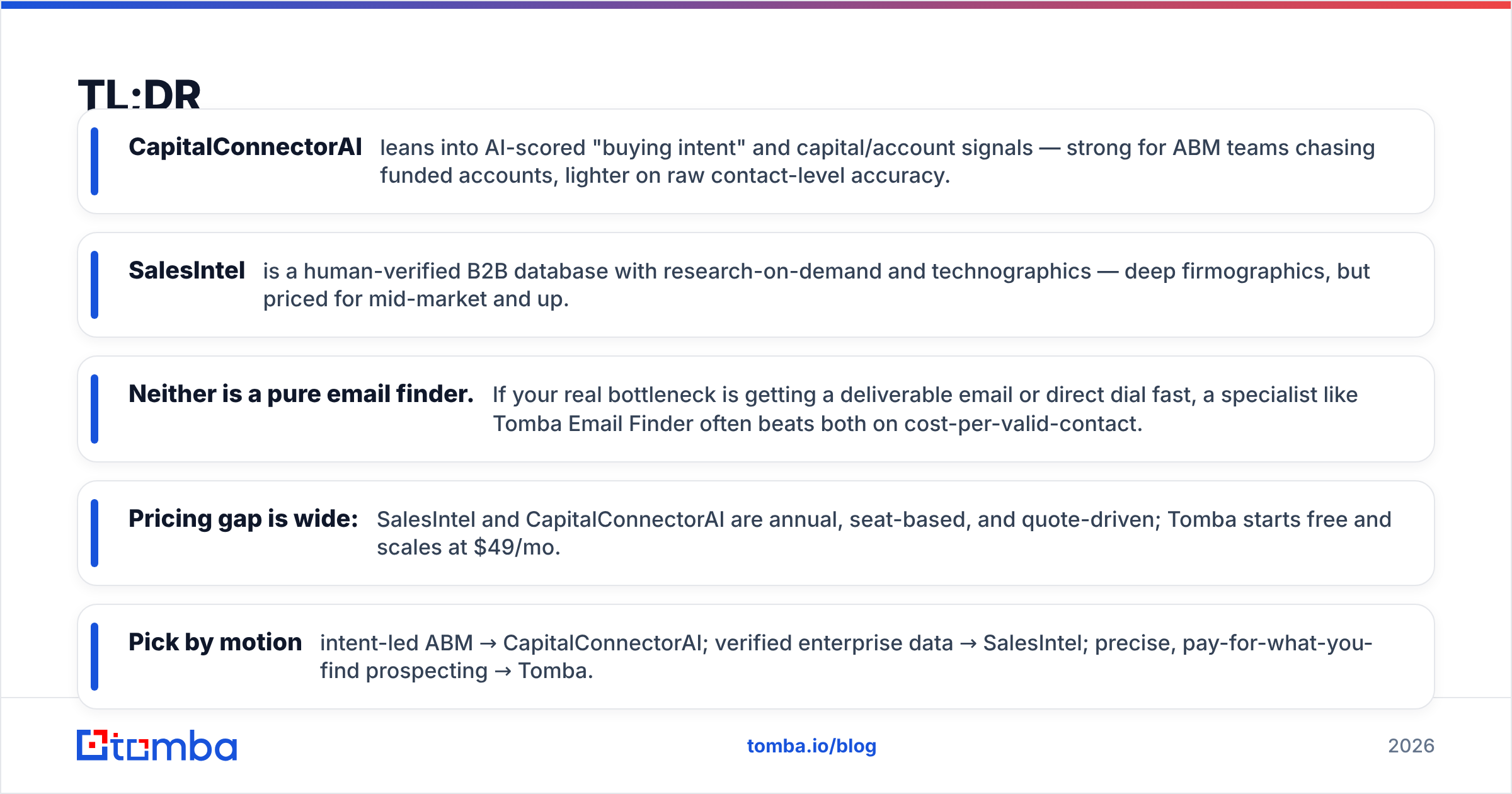
- CapitalConnectorAI leans into AI-scored "buying intent" and capital/account signals — strong for ABM teams chasing funded accounts, lighter on raw contact-level accuracy.
- SalesIntel is a human-verified B2B database with research-on-demand and technographics — deep firmographics, but priced for mid-market and up.
- Neither is a pure email finder. If your real bottleneck is getting a deliverable email or direct dial fast, a specialist like Tomba Email Finder often beats both on cost-per-valid-contact.
- Pricing gap is wide: SalesIntel and CapitalConnectorAI are annual, seat-based, and quote-driven; Tomba starts free and scales at $49/mo.
- Pick by motion: intent-led ABM → CapitalConnectorAI; verified enterprise data → SalesIntel; precise, pay-for-what-you-find prospecting → Tomba.
What is CapitalConnectorAI?#
CapitalConnectorAI positions itself as an AI-driven account intelligence platform. Its pitch is signal-first: it watches funding rounds, hiring spikes, tech adoption, and engagement to score which accounts are "in-market" right now, then surfaces contacts attached to those accounts.
Think of it like a weather radar for your pipeline. It won't hand you every raindrop, but it tells you which region is about to storm so you point your reps there. That's genuinely useful when your problem is prioritization — too many accounts, not enough hours.
The trade-off is that intent scoring is probabilistic. A high score is a hypothesis, not a guarantee, and contact-level data (the actual email and phone you'll use) is often the weakest layer in signal-first platforms. You still need a reliable way to confirm the address before you hit send.
What is SalesIntel?#
SalesIntel is a B2B contact and company data provider best known for human-verified records and a "research on demand" model — if a contact you need isn't verified, their team will research it for you. It bundles firmographics, technographics, intent (via partnerships), and direct dials.
SalesIntel's reputation, reflected across reviews on G2 and its own site at salesintel.io, is accuracy through human checks rather than pure automation. For enterprise teams that lose deals to bad data, that re-verification cadence is the headline feature.
The catch is the commercial model: annual contracts, credit caps, and per-seat pricing that climbs quickly. It's a strong system of record for a funded RevOps team, and overkill for a two-person outbound squad that just needs emails this week.
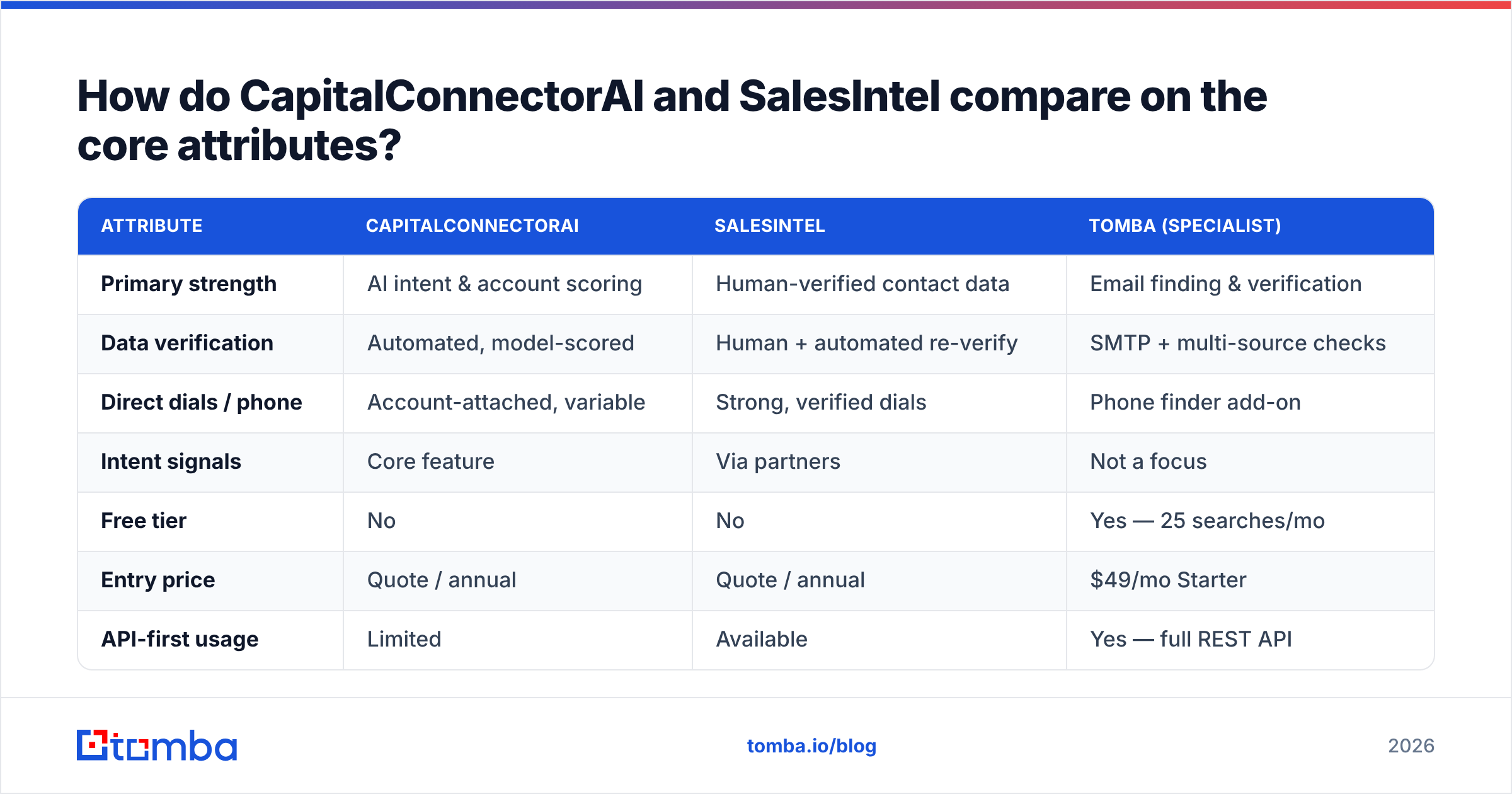
How do CapitalConnectorAI and SalesIntel compare on the core attributes?#
Here's the honest side-by-side. Treat published pricing as directional — both vendors quote based on seats, credits, and contract length.
| Attribute | CapitalConnectorAI | SalesIntel | Tomba (specialist) |
|---|---|---|---|
| Primary strength | AI intent & account scoring | Human-verified contact data | Email finding & verification |
| Data verification | Automated, model-scored | Human + automated re-verify | SMTP + multi-source checks |
| Direct dials / phone | Account-attached, variable | Strong, verified dials | Phone finder add-on |
| Intent signals | Core feature | Via partners | Not a focus |
| Free tier | No | No | Yes — 25 searches/mo |
| Entry price | Quote / annual | Quote / annual | $49/mo Starter |
| API-first usage | Limited | Available | Yes — full REST API |
| Best for | Intent-led ABM | Enterprise RevOps | Precise outbound at any size |
The pattern is clear: the two platforms compete on coverage and signals, while a focused tool competes on cost-per-valid-contact. Those are different jobs, and conflating them is how teams overpay.

Which tool is more accurate?#
Accuracy depends on which layer you mean — and this is where buyers get burned.
- Firmographic accuracy (company size, industry, location): both platforms are solid. SalesIntel's human verification gives it a slight edge on hard-to-source mid-market companies.
- Intent accuracy (is this account actually in-market?): CapitalConnectorAI is built for this, but no vendor can promise intent is real demand. Validate with a reply, not a score.
- Contact accuracy (will this email actually land?): this is the layer that decides your bounce rate, and it's where bundled platforms are weakest. Stale records and catch-all domains slip through.
For that third layer, a dedicated email verifier and catch-all verifier catch problems a coverage-first database won't flag. Many teams run their CapitalConnectorAI or SalesIntel exports through a verification pass before loading a sequence — and watch bounces drop. Protecting your sender reputation is cheaper than rebuilding it.
The uncomfortable truth: a database can be "95% accurate" at the company level and still feed you a 12% bounce rate at the inbox level, because verification was done weeks ago. Freshness, not headline accuracy, is the metric that matters on send day.
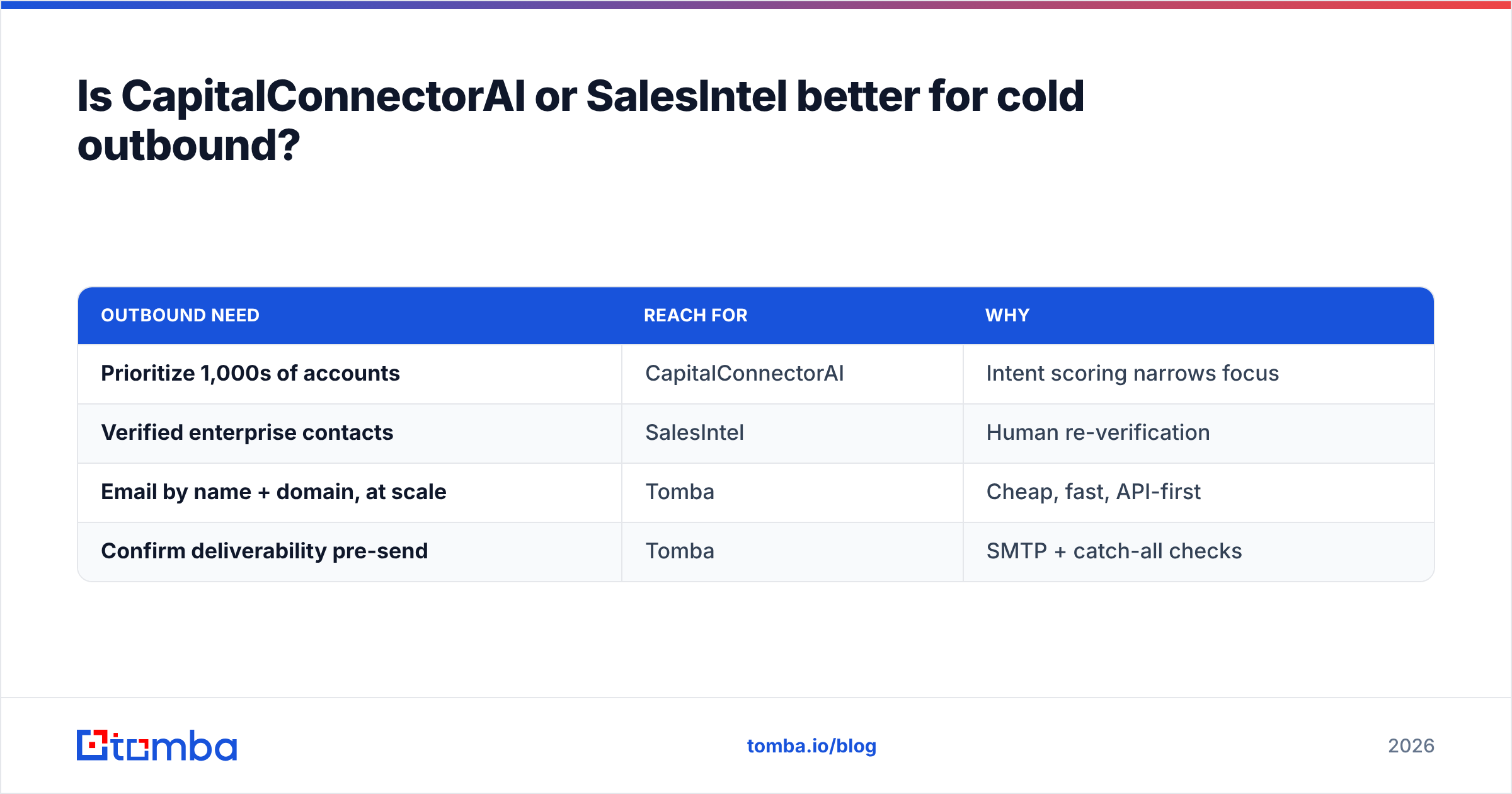
Is CapitalConnectorAI or SalesIntel better for cold outbound?#
For pure cold outbound — find the person, confirm the email, send — both are heavier than you need.
CapitalConnectorAI shines when you run account-based plays: it tells you which accounts to attack and gives a starting roster. SalesIntel shines when you need verified depth on a known target list and have budget for research-on-demand. But if your day looks like "I have 500 companies, get me the head of marketing's email at each," you're paying for a platform to do a job a bulk email finder does faster and cheaper.
This is why a lot of outbound teams run a hybrid stack: one platform for signals or system-of-record data, and a specialist for the find-and-verify step that actually feeds the sequence.
| Outbound need | Reach for | Why |
|---|---|---|
| Prioritize 1,000s of accounts | CapitalConnectorAI | Intent scoring narrows focus |
| Verified enterprise contacts | SalesIntel | Human re-verification |
| Email by name + domain, at scale | Tomba | Cheap, fast, API-first |
| Confirm deliverability pre-send | Tomba | SMTP + catch-all checks |
How does pricing really compare?#
Conclusion first: the two platforms are enterprise-priced and quote-driven; the specialist is transparent and starts free.
CapitalConnectorAI and SalesIntel both follow the classic data-vendor model — annual commitment, seat licenses, and credit ceilings you can blow through mid-quarter. That's defensible for a 20-rep team with a RevOps budget. It's painful for founders, agencies, and lean SDR pods who want to pay for results, not seats.
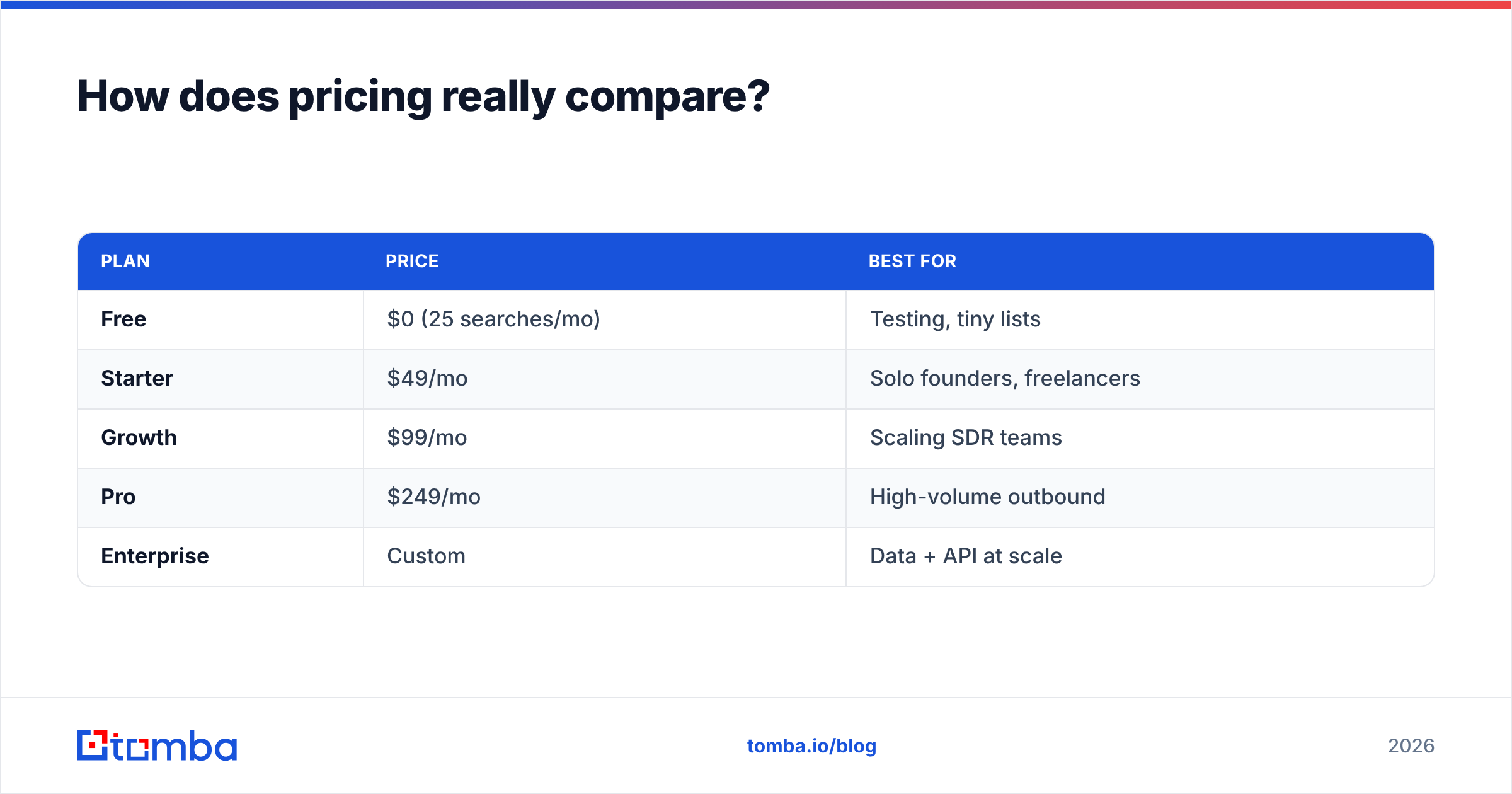
For reference, transparent Tomba pricing looks like this:
| Plan | Price | Best for |
|---|---|---|
| Free | $0 (25 searches/mo) | Testing, tiny lists |
| Starter | $49/mo | Solo founders, freelancers |
| Growth | $99/mo | Scaling SDR teams |
| Pro | $249/mo | High-volume outbound |
| Enterprise | Custom | Data + API at scale |
The strategic point isn't "Tomba is cheapest." It's that you should match spend to the job. Paying enterprise data prices to solve an email-finding problem is the most common budget leak in outbound. Where the data comes from matters too — review each vendor's data sources before you commit.
When should you choose each tool?#
Choose CapitalConnectorAI if your bottleneck is focus. You have more accounts than your team can work and you want an AI layer to tell you where demand is heating up. Intent-led ABM teams get the most from it. Just budget separately for verifying the contacts it surfaces.
Choose SalesIntel if bad data has cost you real deals and you'll pay for human verification and research-on-demand. It's a strong system of record for mid-market and enterprise RevOps, especially when direct dials matter for a calling motion. Validate the contract's credit caps against your actual monthly pull.
Choose a specialist like Tomba if your core job is finding and verifying contacts — by name, by domain search, or in bulk — and you want an email finder API you can wire into your own workflow without an annual commitment. It pairs well with either platform: let them handle signals or system-of-record, let Tomba handle the find-and-verify step that feeds your sequences.
What's the smartest stack in 2026?#
The teams winning at outbound rarely rely on one monolith. A common, effective 2026 setup:
- Signals layer — an intent or account-scoring tool (CapitalConnectorAI's lane) to decide who to target.
- System of record — a verified database (SalesIntel's lane) for accounts you commit to, when budget allows.
- Find & verify layer — a specialist like Tomba for cheap, accurate, on-demand contact data and data enrichment that keeps your CRM fresh.
- Hygiene layer — ongoing verification so your list quality doesn't decay between campaigns.
This separates the expensive question ("which accounts?") from the cheap-but-critical one ("what's the deliverable email?"), so you don't overpay for the latter.
The bottom line#
CapitalConnectorAI and SalesIntel are good at different things, and neither is primarily an email finder. CapitalConnectorAI sells focus through intent; SalesIntel sells trust through human verification. Both are premium, annual commitments aimed at funded teams. If your actual pain is finding and confirming the right contact at the right company — fast, accurately, and without a yearly contract — start with the layer that solves exactly that.
Tomba Email Finder gives you verified professional emails by name, company, or domain, backed by an SMTP-checked verifier and a free tier (25 searches/mo) so you can test against your own list before paying a cent. Plug it alongside whatever signals or database tool you already run, and stop paying enterprise prices to answer a $49 question. Try Tomba free and benchmark the deliverability yourself.
// get started
Find, verify and enrich your first contacts today
Start on the free plan with 25 searches a month, then scale when your team is ready.
Free plan · No credit card required · GDPR & CCPA
// about the author