CapitalConnectorAI vs Zintlr: 2026 Sales Data Showdown
CapitalConnectorAI vs Zintlr compared on data accuracy, pricing, coverage, and workflow fit — plus where a dedicated email finder beats both for cold outreach in 2026.
CapitalConnectorAI vs Zintlr usually comes down to one question a pricing page can't answer: when your reps export a list, how many of those contacts are real, reachable, and worth a sequence? Both platforms promise enriched B2B data and faster prospecting. But they get there in different ways. And the gap shows up in your bounce rate, not their marketing.
This breakdown compares the two on data accuracy, coverage, pricing, and day-to-day workflow. It is also honest about where a focused tool beats a bundled suite for cold outreach.
TL;DR#
- CapitalConnectorAI leans toward AI-assisted account targeting and intent-style signals, pitched at teams that want a "find accounts, then contacts" flow in one place.
- Zintlr positions as a B2B contact database with a personality-insight angle and a browser-first prospecting motion.
- Neither is primarily an email-verification engine — both surface contacts, but you still pay for bounces if you skip a verification step.
- For cold email specifically, a dedicated finder-plus-verifier like Tomba is cheaper per validated contact and has a real free tier (25 searches/month) to test accuracy before you commit.
- Best move: match the tool to your motion — account-based vs. high-volume outbound — and always verify before you send.
CapitalConnectorAI vs Zintlr: what are they?#
CapitalConnectorAI is a sales-intelligence platform built around AI-assisted prospecting. You describe an ideal account, and the system surfaces matching companies and their contacts. It often layers in signals meant to flag who is worth approaching now. The promise is fewer manual searches and more "here is a list, go."
Zintlr is a B2B contact and company database with a prospecting layer that lives partly in your browser. Its differentiator has historically been "Intros" and personality-insight features. That context is meant to help you tailor a first message, not just hand you a raw email. You can review both vendors' current positioning on their own sites (zintlr.com) and on third-party review hubs like G2 and Capterra before trusting any single claim.
Here is the important framing: both tools are discovery platforms. They help you find and contextualize prospects. That is different from deliverability — the job of making sure the email you found actually lands. Ever wondered why a "verified" list still bounced? It is usually because discovery and verification got treated as the same step. They are not.

How do CapitalConnectorAI and Zintlr compare on features?#
Think of these platforms like two grocery delivery services. One specializes in picking the right aisles for you — that is account targeting. The other hands you a richly labeled basket with notes on each item — that is contact context. Both still need you to check expiration dates. That check is verification.
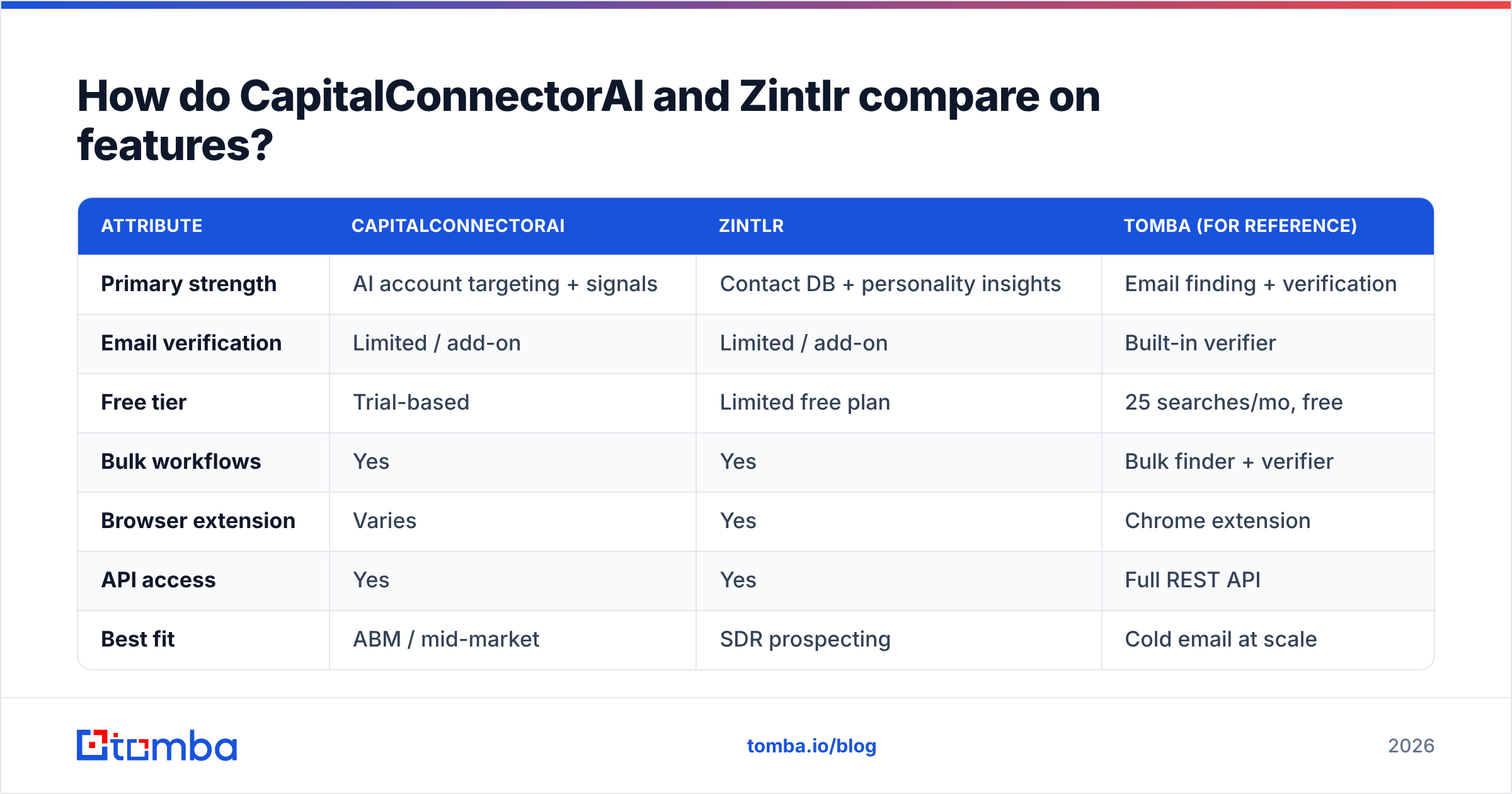
| Attribute | CapitalConnectorAI | Zintlr | Tomba (for reference) |
|---|---|---|---|
| Primary strength | AI account targeting + signals | Contact DB + personality insights | Email finding + verification |
| Email verification | Limited / add-on | Limited / add-on | Built-in verifier |
| Free tier | Trial-based | Limited free plan | 25 searches/mo, free |
| Bulk workflows | Yes | Yes | Bulk finder + verifier |
| Browser extension | Varies | Yes | Chrome extension |
| API access | Yes | Yes | Full REST API |
| Best fit | ABM / mid-market | SDR prospecting | Cold email at scale |
A few things to read carefully in that table.
- Verification is the recurring asterisk. Both suites surface contacts, but neither leads with verification as the headline capability. If your outbound depends on a clean sender reputation, that asterisk is your single biggest risk. Run found contacts through a dedicated email verifier before they hit a sequence.
- Free access shapes how you can evaluate. Trial-gated tools force a sales call before you see accuracy on your domains. A standing free tier lets you test the only metric that matters — hit rate on accounts you actually sell to.
- "Insights" are not "deliverability." Personality notes and intent signals help you write a better first line. They do nothing for whether the address resolves. Keep those two value props separate in your evaluation.
- API depth decides automation. If you plan to enrich inside your own workflows, look past the UI to the email finder API or each vendor's equivalent — rate limits and response schemas matter more than dashboard polish.
Is CapitalConnectorAI more accurate than Zintlr?#
The honest answer: accuracy is database- and segment-specific, and no vendor wins everywhere. CapitalConnectorAI tends to perform well when its account-matching surfaces mid-market and enterprise targets, where firmographic data is dense. Zintlr's contact coverage can be strong in specific regions and roles where its sources run deep, and weaker outside them.
What you should not do is trust a global "97% accuracy" badge. Accuracy is meaningless as an aggregate. The number that decides your campaign is the hit rate on your ICP — say, VPs of Engineering at 50-500 person SaaS companies in North America. That figure can swing 30 points between vendors for the same headline claim.
The practical test is boring but decisive. Pull the same 100 target accounts through each tool, then run every returned email through one neutral verification pass. Count how many come back valid, catch-all, or invalid. Catch-all domains are their own trap — they accept everything at the SMTP layer, so a "valid" result there is really "unknown." A dedicated catch-all verifier is the only way to resolve those honestly, and it is exactly the step bundled suites tend to gloss over.
For background on why deliverability is downstream of data quality, the concept of email deliverability is worth understanding before you blame any single vendor for bounces.
How do CapitalConnectorAI and Zintlr pricing compare?#
Both vendors use tiered, often quote-based pricing that scales with credits, seats, and feature access. CapitalConnectorAI's AI-targeting and signal features typically push it toward the higher end for full functionality. Zintlr offers a more accessible entry point with a limited free plan, then scales by credits and team size.
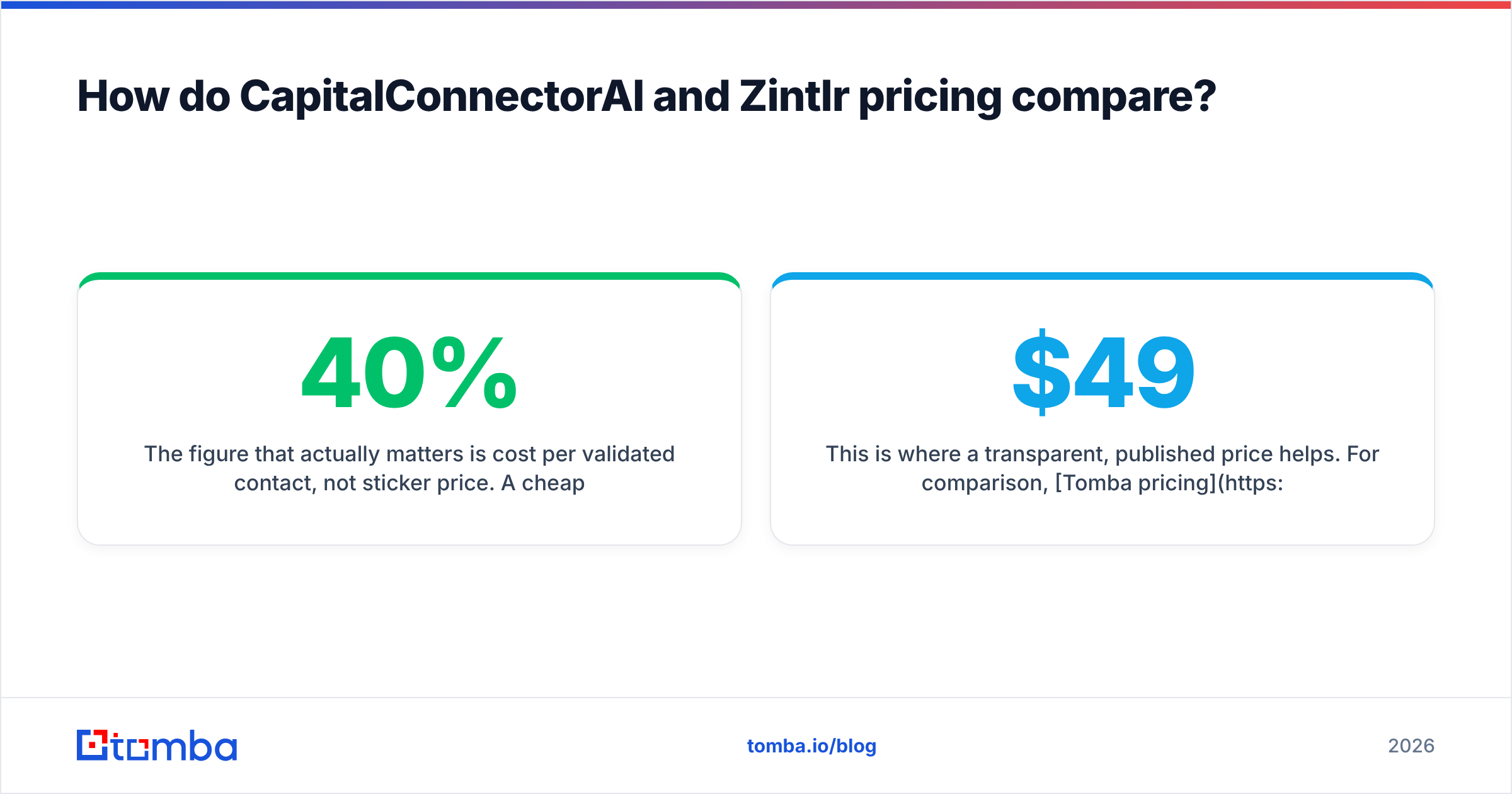
The figure that actually matters is cost per validated contact, not sticker price. A cheaper plan that returns 40% unusable addresses is more expensive than a pricier one at 80% valid. The waste lands in your reps' time and your domain reputation, not just the invoice.
This is where a transparent, published price helps. For comparison, Tomba pricing is public and predictable: a free tier with 25 searches/month, then Starter at $49/mo, Growth at $99/mo, Pro at $249/mo, and custom Enterprise. You can model cost-per-contact before you ever talk to sales — which is the opposite of a quote-gated evaluation.

Which tool is better for cold email outreach?#
For pure cold email at volume, neither CapitalConnectorAI nor Zintlr is the most economical engine — and that is not a knock, it is positioning. They are built to help you decide who to contact, with discovery, signals, and context as the headline. Cold email at scale needs the opposite emphasis: high-throughput finding, ironclad verification, and a low cost per send-ready address.
That is the lane a focused tool owns. A dedicated email finder plus a built-in verifier is optimized for one job — get a clean, deliverable address fast — and it shows in the cost structure. If your motion is "build a 5,000-contact list this week and sequence it," the math favors the specialist.
If your motion is account-based — a few hundred high-value targets, heavy research per account, multi-threaded outreach — then the context layer in CapitalConnectorAI or Zintlr earns its price. The personality and signal features help reps personalize where personalization actually moves the needle.
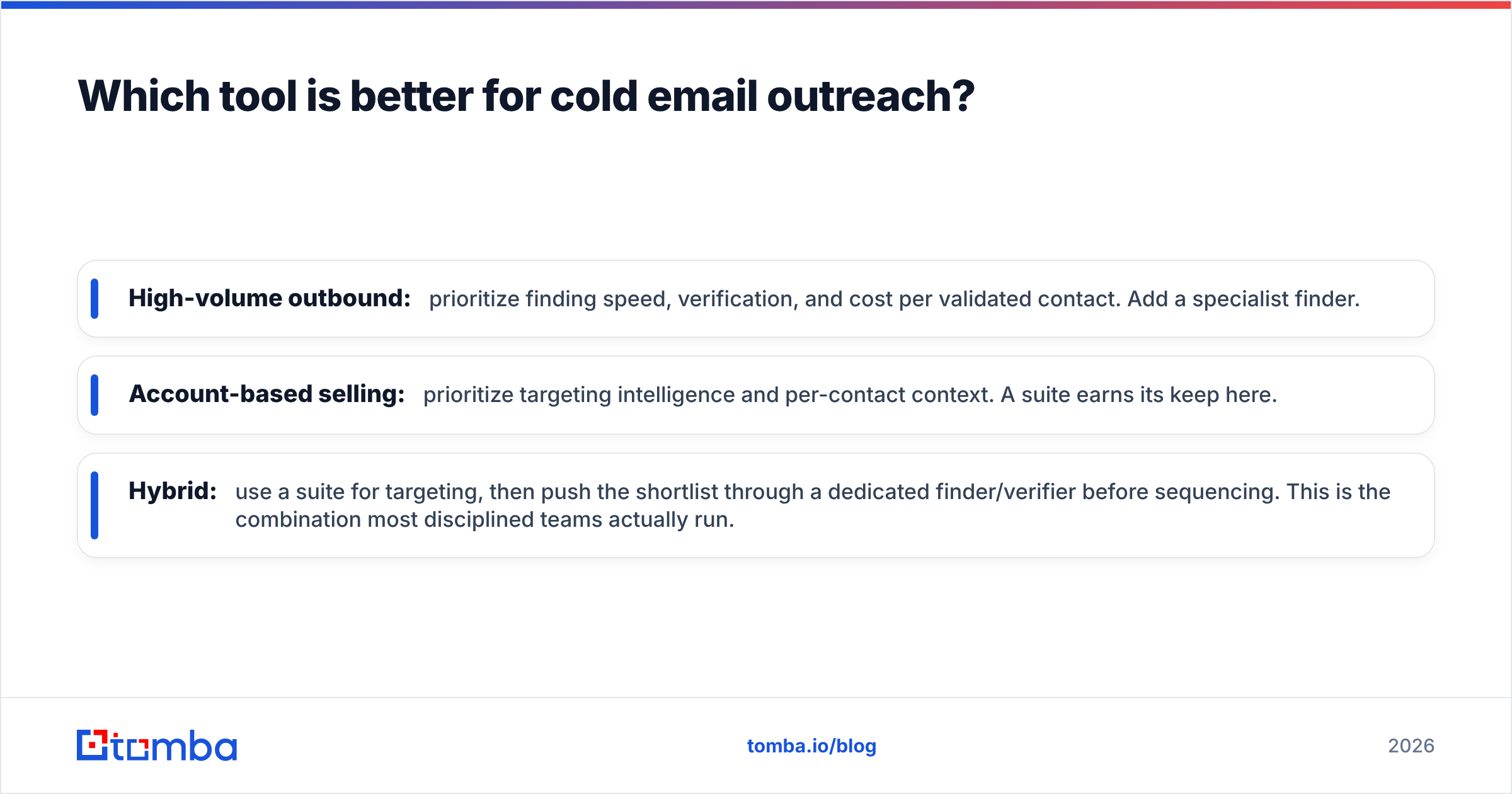
So the real comparison is not "which tool is better" but "which motion are you running":
- High-volume outbound: prioritize finding speed, verification, and cost per validated contact. Add a specialist finder.
- Account-based selling: prioritize targeting intelligence and per-contact context. A suite earns its keep here.
- Hybrid: use a suite for targeting, then push the shortlist through a dedicated finder/verifier before sequencing. This is the combination most disciplined teams actually run.
You can also enrich whatever list you build — adding role, company size, or phone numbers — using a separate data enrichment step, so you are not locked into one vendor's coverage gaps.
What about coverage, compliance, and data sourcing?#
Coverage is the quiet differentiator. CapitalConnectorAI and Zintlr each pull from their own blend of sources. Each has regions, industries, and seniority bands where they are strong or thin. Ask both vendors a direct question: where does this data come from, and how often is it refreshed? Stale data is the silent killer of "accurate" databases — a correct address from 18 months ago is wrong if your prospect changed jobs.
Compliance matters more every year. If you sell into the EU or handle consumer-adjacent data, confirm GDPR posture and opt-out handling in writing. Neither a slick UI nor an AI label substitutes for a clear data-processing answer. General frameworks like those summarized on Wikipedia's GDPR overview are a reasonable baseline for the questions to ask.
For transparency on the sourcing question specifically, it is fair to expect any vendor to be as open as Tomba is about where its data comes from. If a vendor will not explain sourcing and refresh cadence, treat the accuracy claims as marketing, not fact.
How should you actually decide between them?#
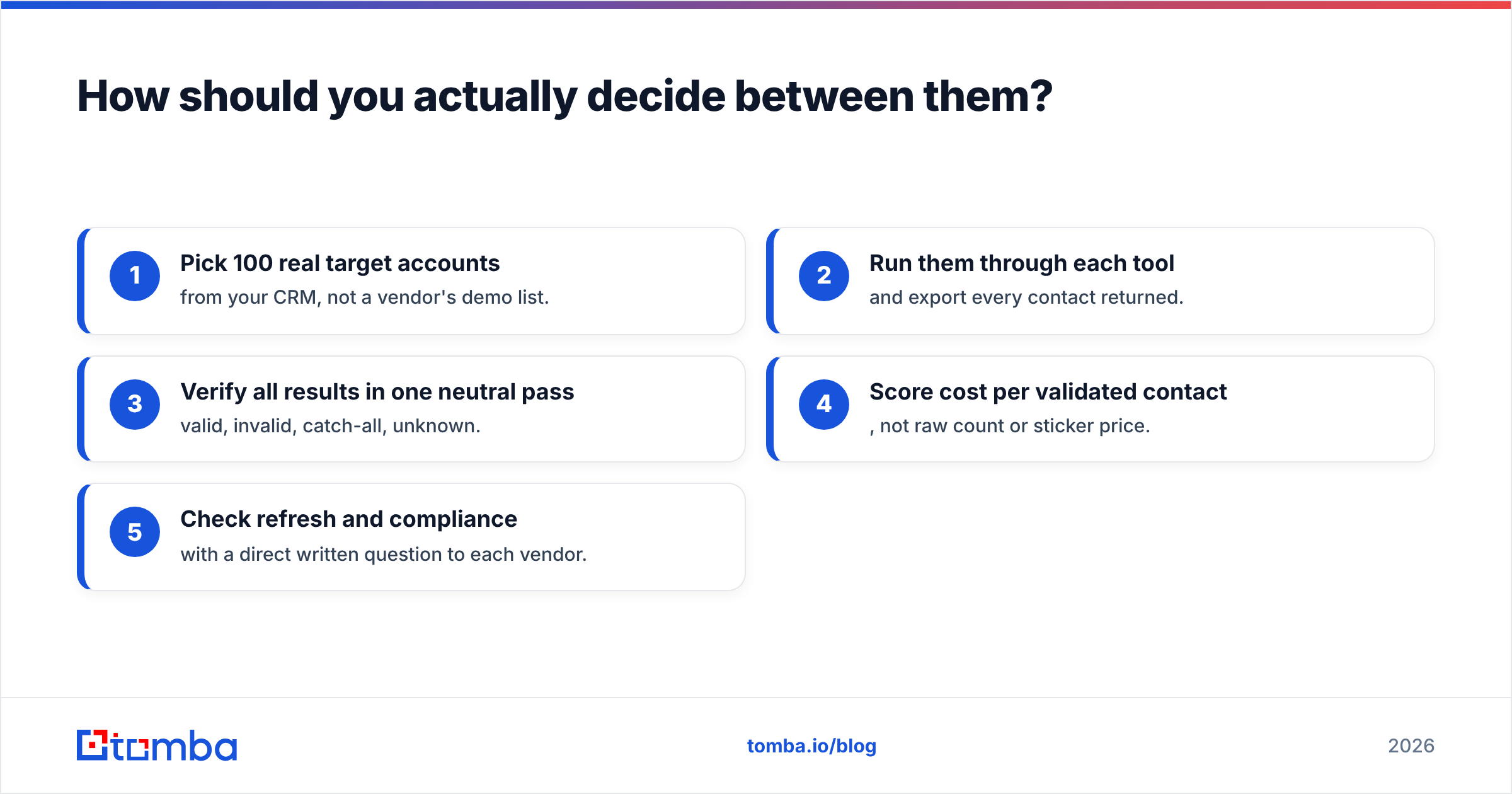
Run a 60-minute bake-off instead of reading another comparison page — including this one.
- Pick 100 real target accounts from your CRM, not a vendor's demo list.
- Run them through each tool and export every contact returned.
- Verify all results in one neutral pass — valid, invalid, catch-all, unknown.
- Score cost per validated contact, not raw count or sticker price.
- Check refresh and compliance with a direct written question to each vendor.
Whichever tool wins your bake-off wins, regardless of brand. The point is that the decision is measurable. And the measurement hinges on a verification step neither suite is built around. If you want a cleaner read on response likelihood, pair the exercise with a baseline understanding of response rate. That way you judge deliverability and engagement separately, rather than blaming the database for a weak first line.
The bottom line#
CapitalConnectorAI is the stronger pick when AI-driven account targeting and signals are central to your motion. Zintlr is compelling when contact context and a browser-first SDR flow matter most, and its limited free plan lowers the barrier to a real test. In the CapitalConnectorAI vs Zintlr decision, both are discovery platforms first — and both leave verification as the step you must own.
If your priority is cold email at scale, the most economical path is a focused finder-and-verifier with transparent pricing and a free tier you can test today. Start with the Tomba Email Finder — find professional email addresses by domain, name, or company, verify them in the same workflow, and run your first 25 searches free before you spend a dollar. Prove the hit rate on your own accounts, then scale on a plan whose cost per validated contact you can predict in advance. That is the number that decides your pipeline, not the logo on the dashboard.
// get started
Find, verify and enrich your first contacts today
Start on the free plan with 25 searches a month, then scale when your team is ready.
Free plan · No credit card required · GDPR & CCPA
// about the author