CapitalConnectorAI vs ZoomInfo: B2B Data Compared (2026)
CapitalConnectorAI vs ZoomInfo: which B2B data platform actually fits your pipeline and budget in 2026? A neutral breakdown of pricing, coverage, accuracy, and the cheaper way to get contact data.
You are picking between a niche, AI-led capital-network tool and the heavyweight that defines the B2B data category. The two could not be more different in scope, price, or contract terms — and that difference is the whole decision.
TL;DR#
- CapitalConnectorAI is a narrow, AI-driven tool aimed at investor/capital matchmaking and relationship mapping. It is light, fast to start, and cheap — but its contact data is thin compared to a full sales-intelligence suite.
- ZoomInfo is the enterprise standard for B2B contact and company data, with intent signals, org charts, and deep integrations — but it ships with annual contracts, seat minimums, and pricing that routinely lands in the five figures.
- Most teams overpay. If you mainly need accurate emails, phone numbers, and firmographics to fill a CRM, you do not need a $15K+ ZoomInfo contract or a single-purpose capital tool.
- A focused email finder like Tomba covers the 80% use case (find and verify contacts) for a fraction of the cost, starting free.
- Read on for a side-by-side on pricing, accuracy, coverage, contracts, and which buyer each tool actually fits.
What is CapitalConnectorAI?#
CapitalConnectorAI is a specialist tool built around one job: connecting people to capital. Think founders looking for investors, dealmakers mapping warm intros, and capital-raise teams trying to shortcut the "who knows whom" problem. It leans on AI to score relationship paths and surface likely-relevant contacts inside a defined niche — venture, private equity, and adjacent finance circles.
The strength is focus. A tool with a narrow target can build features that a generalist never will: capital-stage tagging, fund-thesis matching, and intro-path scoring. The trade-off is equally narrow. Outside its lane, the dataset gets thin fast. If you sell SaaS to mid-market RevOps leaders, a capital-matchmaking engine is the wrong shape of data.
That is the core tension of any vertical tool. It is excellent at the thing it was built for and unhelpful for everything else.
What is ZoomInfo?#
ZoomInfo is the 800-pound gorilla of B2B data intelligence. It maintains one of the largest commercial databases of company and contact records, layered with buyer-intent data, technographics, org charts, news triggers, and a workflow suite (Engage, SalesOS, Copilot AI). Most enterprise sales orgs have evaluated it, and many run on it.
You can confirm the breadth on their own site at zoominfo.com or read peer reviews on G2. What you will not find easily is transparent pricing — ZoomInfo sells annual contracts through sales reps, with cost driven by seats, credits, data modules, and add-ons.
ZoomInfo's advantage is completeness. When you need an org chart for a 5,000-person enterprise, intent signals on a target account, and a direct dial for a VP, it is hard to beat. Its disadvantage is the commitment: long contracts, real onboarding, and a budget line that needs executive sign-off.

CapitalConnectorAI vs ZoomInfo: how do they compare?#
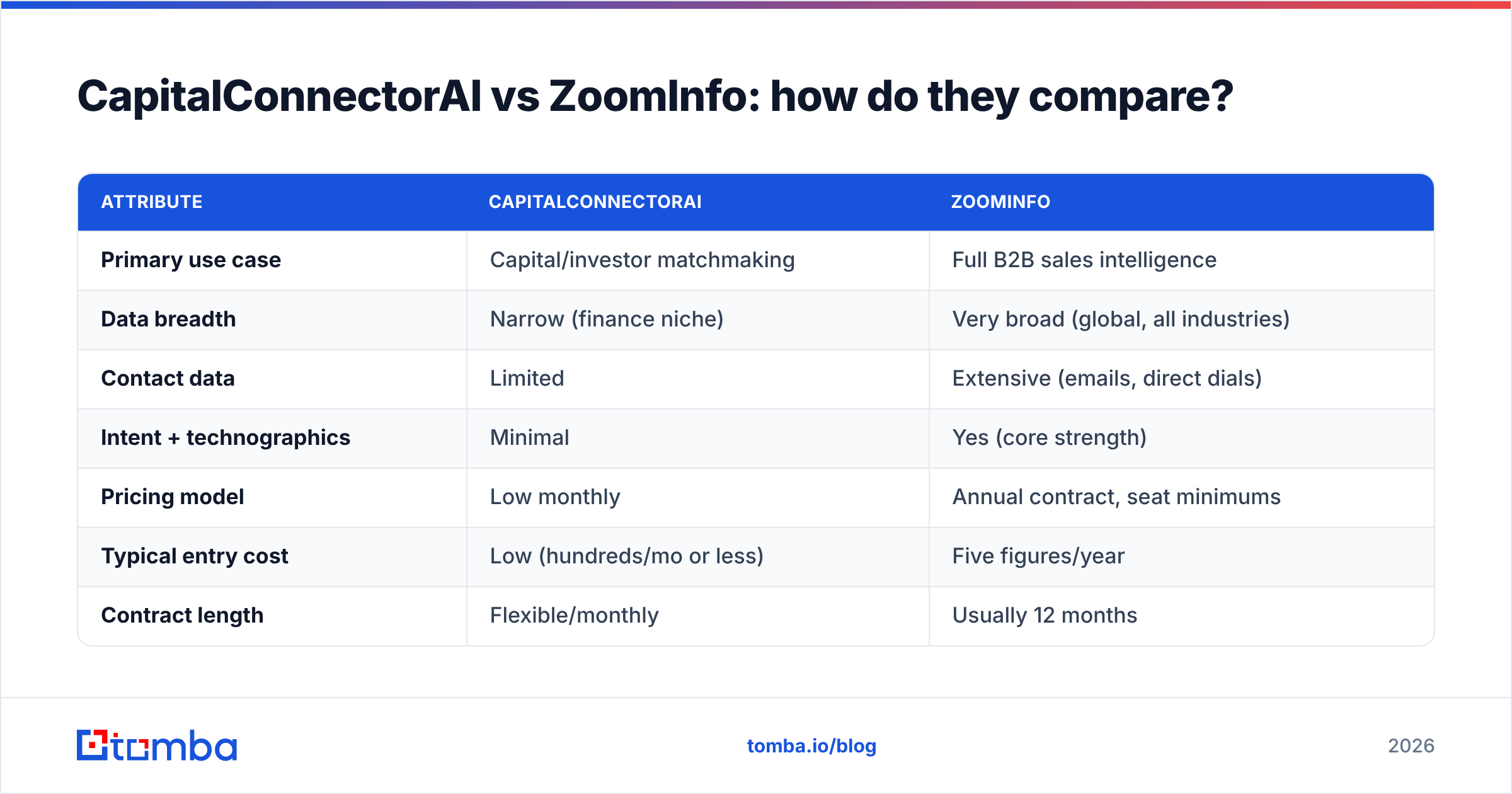
Here is the head-to-head on the attributes that actually drive the decision.
| Attribute | CapitalConnectorAI | ZoomInfo |
|---|---|---|
| Primary use case | Capital/investor matchmaking | Full B2B sales intelligence |
| Data breadth | Narrow (finance niche) | Very broad (global, all industries) |
| Contact data | Limited | Extensive (emails, direct dials) |
| Intent + technographics | Minimal | Yes (core strength) |
| Pricing model | Low monthly | Annual contract, seat minimums |
| Typical entry cost | Low (hundreds/mo or less) | Five figures/year |
| Contract length | Flexible/monthly | Usually 12 months |
| Best for | Fundraising, deal sourcing | Enterprise outbound at scale |
| Time to value | Fast | Slower (onboarding, training) |
The pattern is clear: these tools rarely compete for the same buyer. CapitalConnectorAI wins on focus and price within finance. ZoomInfo wins on breadth and depth everywhere else — at a cost.
The more useful question for most readers is not "which of these two," but "do I need either of these for the job I actually have?"
Which one is more accurate?#
Accuracy depends entirely on the use case, so compare within scope.
Inside its niche, CapitalConnectorAI can be sharp because the dataset is small and curated. A focused tool maintaining a few hundred thousand finance contacts can keep them fresher than a generalist maintaining hundreds of millions. But push it outside finance and accuracy collapses, because the records simply are not there.
ZoomInfo's accuracy is strong on company-level firmographics and improving on contact data, but no large database escapes decay. B2B data goes stale at roughly 30% per year as people change jobs, so even the biggest provider serves records that need re-verification before you send. This is why a separate email verifier step matters regardless of where the data came from — the source is only as good as your last verification pass.
The practical takeaway: do not trust any provider's "verified" label at face value. Run a verification check before a campaign, especially on phone numbers and on catch-all domains where a standard check returns "unknown." A dedicated catch-all verifier closes that gap that both larger and smaller tools tend to leave open.

What does each one cost in 2026?#
Cost is where this comparison gets real.
CapitalConnectorAI follows the modern SaaS pattern: low monthly entry, self-serve signup, cancel when you want. That is friendly to founders and small deal teams who want to test and move on.
ZoomInfo follows the enterprise playbook. There is no public price page because cost is negotiated per deal. Public reviews and procurement reports consistently put annual spend in the five figures once you add seats, credits, and data modules — and the contract is typically a 12-month commitment with auto-renewal clauses worth reading carefully.
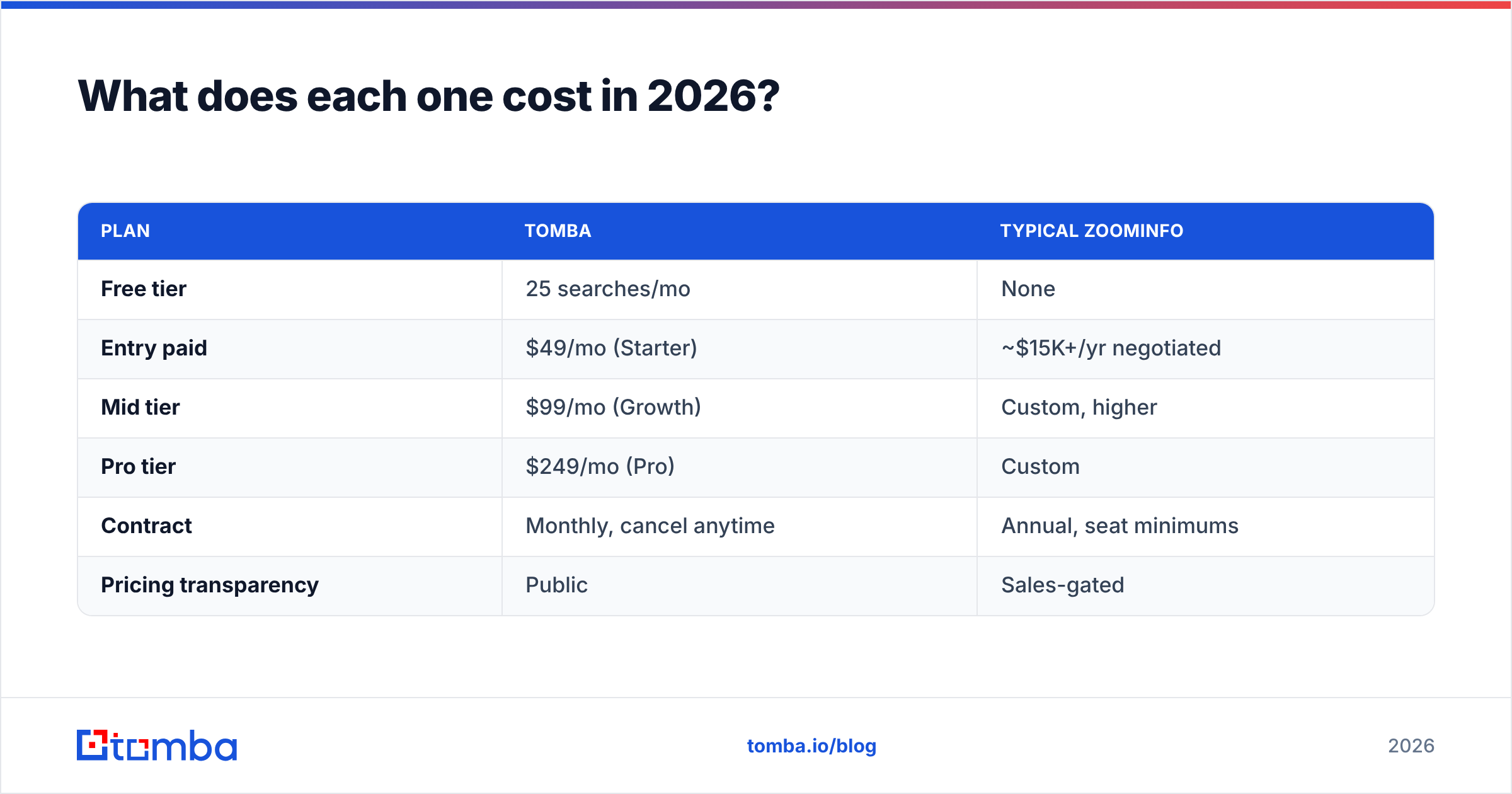
For comparison, here is how a focused email-and-data tool stacks up on transparent pricing. Tomba publishes its Tomba pricing openly:
| Plan | Tomba | Typical ZoomInfo |
|---|---|---|
| Free tier | 25 searches/mo | None |
| Entry paid | $49/mo (Starter) | ~$15K+/yr negotiated |
| Mid tier | $99/mo (Growth) | Custom, higher |
| Pro tier | $249/mo (Pro) | Custom |
| Contract | Monthly, cancel anytime | Annual, seat minimums |
| Pricing transparency | Public | Sales-gated |
The math is straightforward. If your real need is "find and verify contacts to fill a pipeline," paying enterprise rates — or buying a single-purpose niche tool — is often the wrong allocation. You are paying for breadth or specialization you will not use.
Who should pick which tool?#
Match the tool to the job. Here is the honest breakdown.
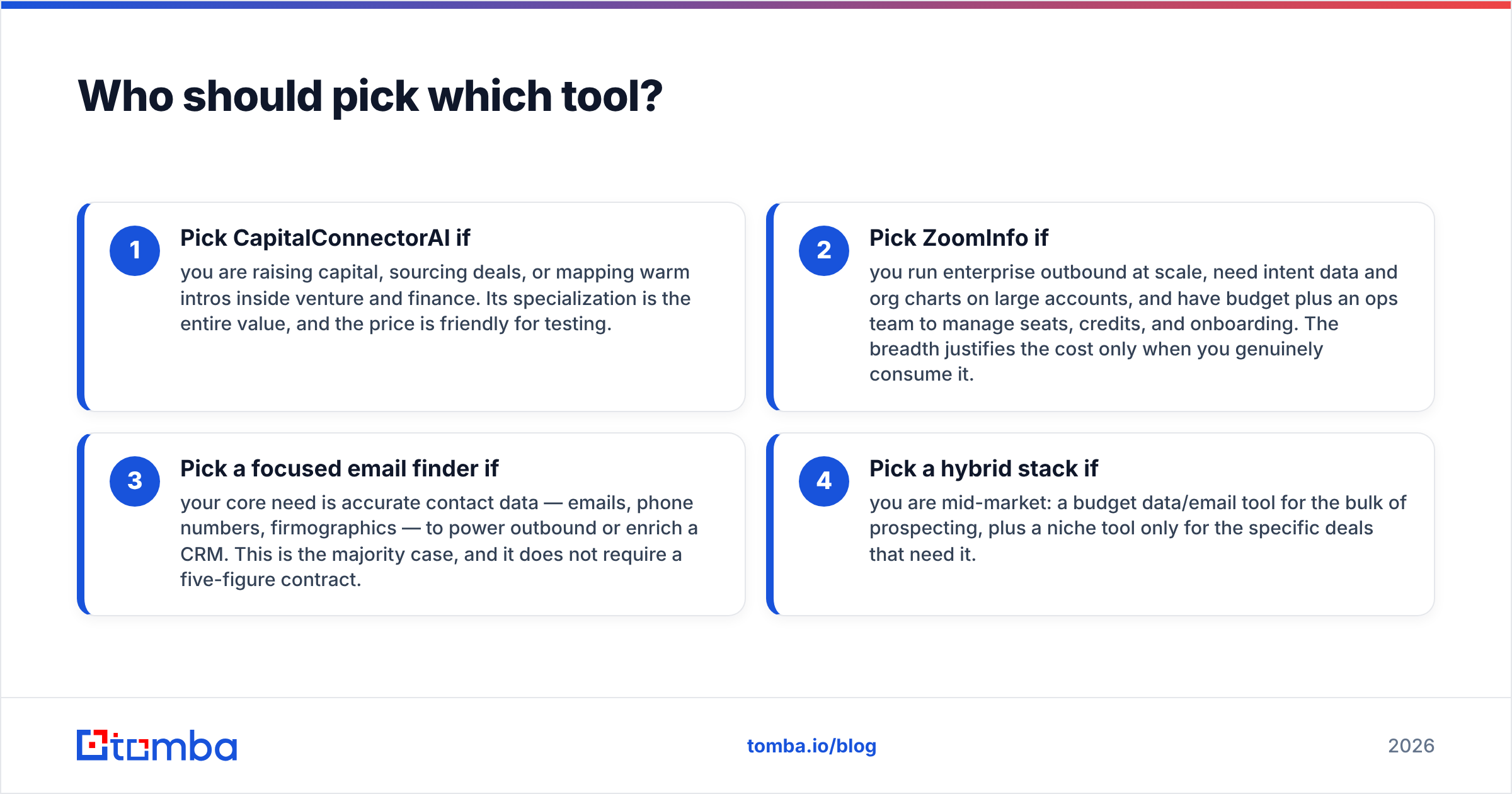
- Pick CapitalConnectorAI if you are raising capital, sourcing deals, or mapping warm intros inside venture and finance. Its specialization is the entire value, and the price is friendly for testing.
- Pick ZoomInfo if you run enterprise outbound at scale, need intent data and org charts on large accounts, and have budget plus an ops team to manage seats, credits, and onboarding. The breadth justifies the cost only when you genuinely consume it.
- Pick a focused email finder if your core need is accurate contact data — emails, phone numbers, firmographics — to power outbound or enrich a CRM. This is the majority case, and it does not require a five-figure contract.
- Pick a hybrid stack if you are mid-market: a budget data/email tool for the bulk of prospecting, plus a niche tool only for the specific deals that need it.
Most teams who think they are choosing between two big platforms actually belong in bucket three. They have been sold breadth they do not use or specialization they only need occasionally.
Is there a better-value alternative for contact data?#
Yes — if your job is finding and verifying contacts rather than capital matchmaking or enterprise intent modeling, a focused tool is the better value.
Tomba is built around the contact-data core that both tools touch but neither makes cheap or transparent. The email finder locates professional addresses by name, company, or domain; the domain search pulls every public address on a company in one query; and the bulk email finder handles list-scale work. Coverage spans the same firmographic basics you would pay enterprise rates for elsewhere, and you can read exactly where Tomba gets data instead of guessing.
Where Tomba differs from a generalist suite:
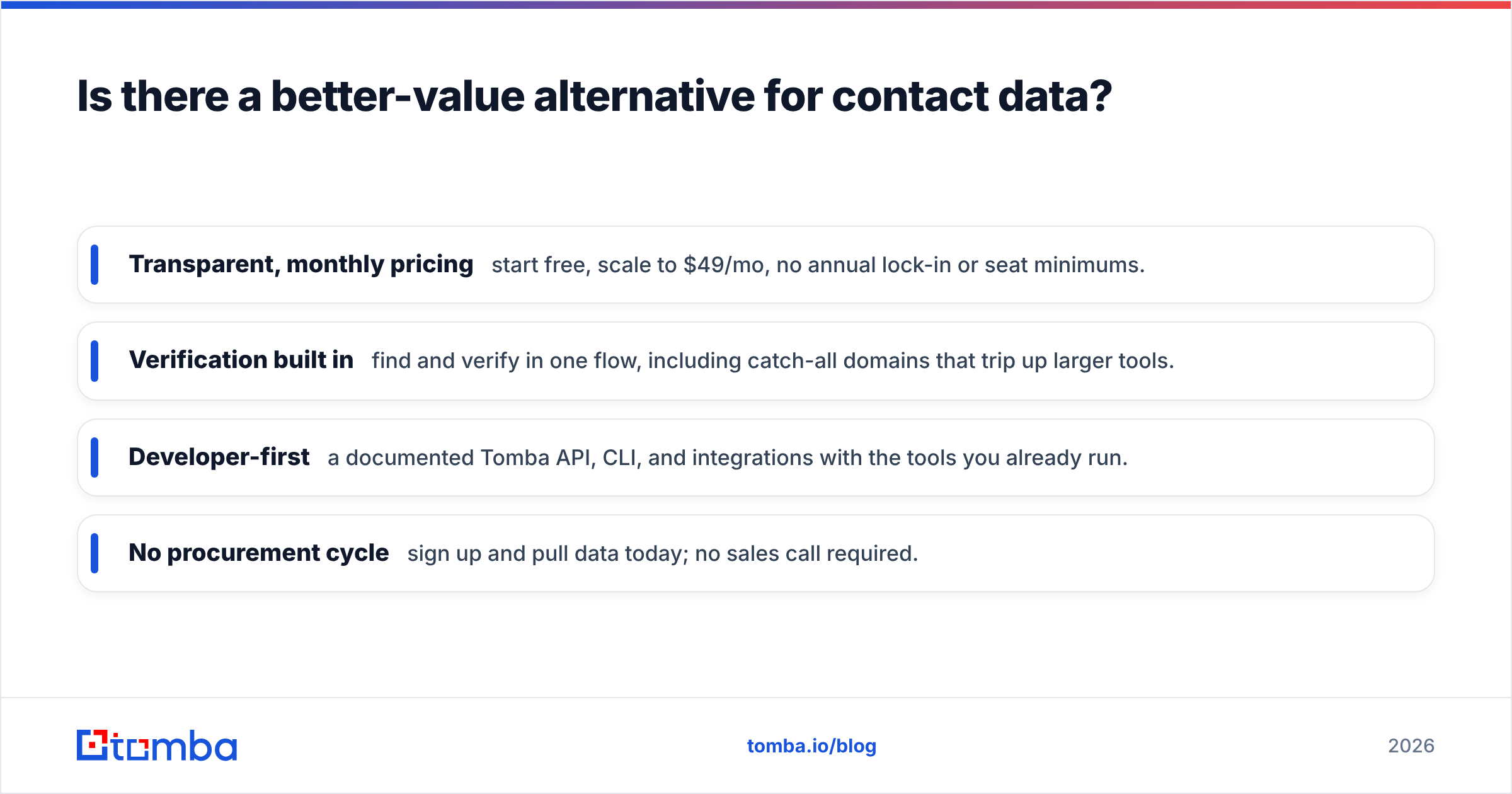
- Transparent, monthly pricing — start free, scale to $49/mo, no annual lock-in or seat minimums.
- Verification built in — find and verify in one flow, including catch-all domains that trip up larger tools.
- Developer-first — a documented Tomba API, CLI, and integrations with the tools you already run.
- No procurement cycle — sign up and pull data today; no sales call required.
Tomba is not an enterprise intent platform and does not pretend to be. If you need 6sense-style buying signals across thousands of accounts, ZoomInfo (or a dedicated intent vendor) is the right call. But if "I just need correct emails and phones that pass verification," the value gap is large and obvious.
For teams already running a CRM, it connects directly — see the HubSpot integration and the Salesforce integration to enrich records in place rather than exporting CSVs between tools.
How should you decide?#
Run a three-question test before you sign anything.
First, what is the actual job? If it is capital matchmaking, CapitalConnectorAI is purpose-built. If it is enterprise outbound with intent, ZoomInfo earns its price. If it is contact data, neither is the cost-efficient answer.
Second, what is your contract tolerance? A 12-month enterprise commitment is a serious decision for a small team. If you want to test, fail fast, and switch, monthly tools win on flexibility alone.
Third, what will you actually use? Buyers routinely pay for breadth or specialization they touch once a quarter. Audit your last 90 days of data pulls. If 80% were "find an email, verify it, push to CRM," you have your answer — and it is the cheaper one.
A smart sequence for most teams: start with a free or low-cost email finder, prove the workflow, and only graduate to an enterprise platform when intent data and org charts become a real, recurring need — not a hypothetical one.
The bottom line#
CapitalConnectorAI and ZoomInfo solve different problems at opposite ends of the price and scope spectrum. CapitalConnectorAI is a sharp niche tool for capital and deal sourcing. ZoomInfo is the broad, deep, expensive enterprise standard. Neither is the value choice for the most common B2B need: accurate, verified contact data to fill a pipeline.
If that is your job, start with the Tomba Email Finder. Find professional emails by name, company, or domain, verify them before you send, and skip the annual contract entirely. Sign up free for 25 searches a month, scale to $49/mo when you are ready, and put the budget you saved toward actually working your pipeline instead of feeding a five-figure data bill.
// get started
Find, verify and enrich your first contacts today
Start on the free plan with 25 searches a month, then scale when your team is ready.
Free plan · No credit card required · GDPR & CCPA
// about the author