Captain Verify vs DealSignal 2026: Honest Comparison
Captain Verify is a low-cost email verifier; DealSignal is a full B2B data platform. Here's which one fits your stack in 2026 — and where a single tool beats both.
You are comparing two tools that barely overlap. That is the first thing to get straight before you spend a dollar on either one.
Captain Verify is a cheap, no-frills email verification service. You upload a list, it tells you which addresses are deliverable. DealSignal is a full B2B data platform — contacts, firmographics, intent signals, and enrichment built for revenue teams. Putting them head to head is like comparing a tire-pressure gauge to a whole pit crew. Both are useful; they solve different problems.
This guide breaks down where each one wins, what they actually cost, and why a lot of teams end up replacing both with a single tool that finds, verifies, and enriches in one place.
TL;DR#
- Captain Verify wins on price for one job: cleaning an existing email list. Pay-as-you-go credits, no data generation.
- DealSignal wins on data depth — it builds and enriches contact records with intent signals, but it carries enterprise pricing and a learning curve.
- They are not direct competitors. Captain Verify verifies emails you already have; DealSignal sources contacts you don't.
- If you need both sourcing and verification without two contracts, a unified platform like Tomba covers find + verify emails + enrich in one workflow.
- Choose by job-to-be-done: list hygiene → Captain Verify, enterprise data ops → DealSignal, all-in-one prospecting → Tomba.
What is Captain Verify?#
Captain Verify is a French-built email validation service that has been around since the mid-2010s. Its entire value proposition is simple: take a list of email addresses, check each one against syntax rules, MX records, and SMTP responses, and return a status — valid, invalid, risky, or unknown.
It does a few adjacent things — duplicate removal, a basic API, and some phone validation — but verification is the core. There is no contact database. Captain Verify will never find you an email; it only tells you whether the ones you bring are likely to bounce.
That focus is a feature. The pricing is pay-as-you-go (you buy credit packs rather than a monthly seat), the interface is minimal, and the turnaround on a list is fast. For a marketer who just imported 40,000 newsletter signups and wants to protect their sender reputation before the next send, it does the job cheaply.

Where it falls short is anything beyond cleaning a list. No enrichment, no firmographics, no real-time API depth, and catch-all domains often come back as "unknown" — which leaves you guessing. If your problem is "I have addresses and want fewer bounces," it fits. If your problem is "I need contacts at 500 target accounts," Captain Verify is the wrong aisle entirely.
What is DealSignal?#
DealSignal is a B2B data platform aimed at marketing and sales operations teams. Instead of validating lists you already own, it generates them. You define an ideal customer profile — industry, company size, job titles, technologies used — and DealSignal returns matching contacts with verified emails, direct dials, and company data.
Its differentiator is on-demand verification combined with intent data. Rather than serving stale records from a static database, DealSignal refreshes contact data at the point of delivery and layers in buying signals, so RevOps teams can prioritize accounts that are actually in-market. That puts it closer to platforms like ZoomInfo or Clearbit than to a verifier.
The trade-offs are predictable for this category: pricing is quote-based and lands in enterprise territory, onboarding takes real effort, and the value only shows up if you have the volume and process to use a data platform properly. A two-person startup will drown in features it never touches. A 30-rep outbound org with a defined ICP and a CRM to feed will get its money's worth.
For context on how data platforms fit a go-to-market motion, DealSignal's own positioning leans heavily on revenue operations workflows — enrichment at scale, CRM hygiene, and lead routing — not one-off list cleaning.
Captain Verify vs DealSignal: how do they compare?#
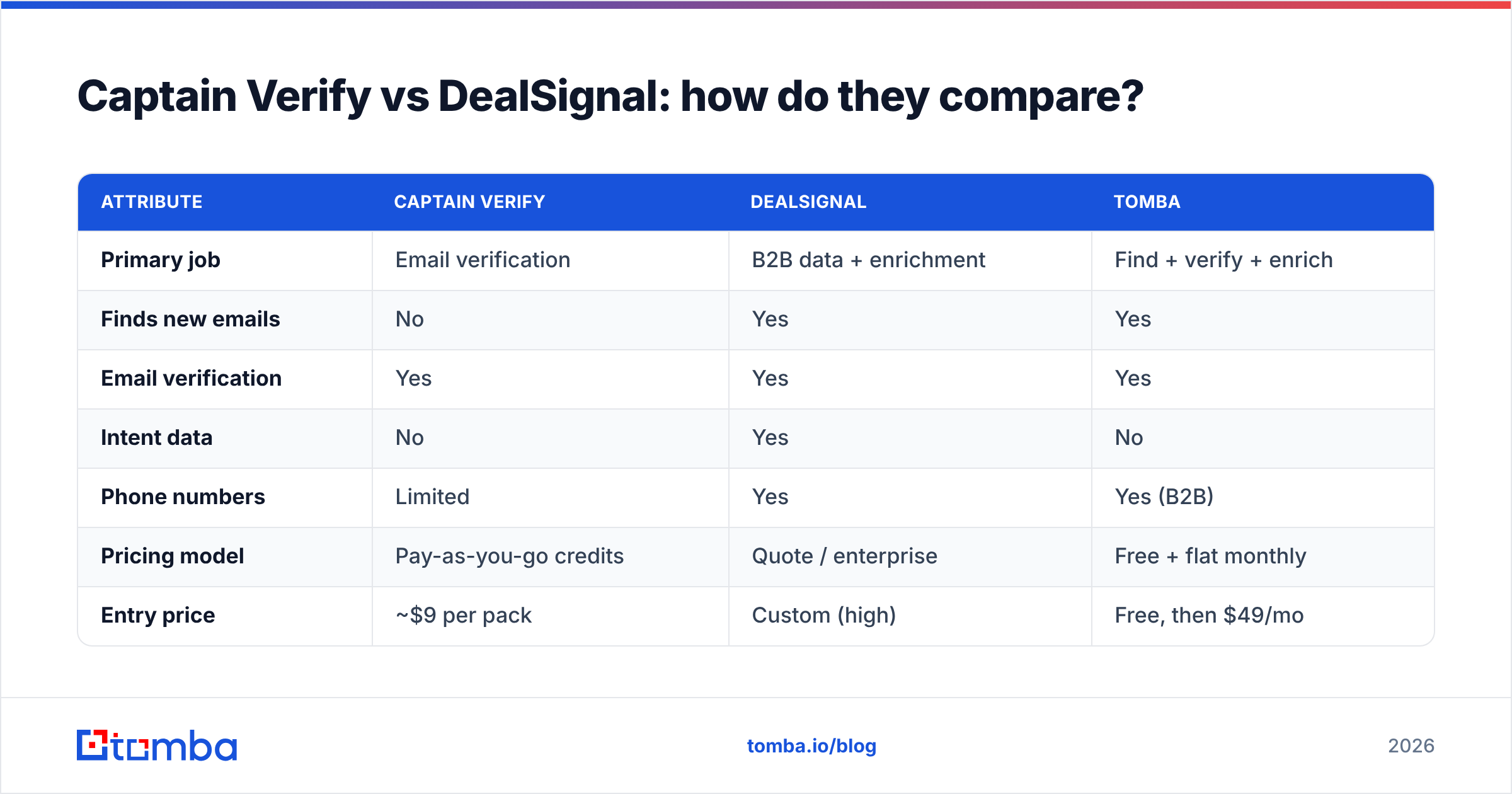
Here is the honest side-by-side. Notice how few rows actually overlap — that gap is the whole story.
| Attribute | Captain Verify | DealSignal | Tomba |
|---|---|---|---|
| Primary job | Email verification | B2B data + enrichment | Find + verify + enrich |
| Finds new emails | No | Yes | Yes |
| Email verification | Yes | Yes | Yes |
| Intent data | No | Yes | No |
| Phone numbers | Limited | Yes | Yes (B2B) |
| Pricing model | Pay-as-you-go credits | Quote / enterprise | Free + flat monthly |
| Entry price | ~$9 per pack | Custom (high) | Free, then $49/mo |
| Free tier | Trial credits | No | 25 searches/mo |
| Best for | List hygiene | Enterprise data ops | SMB to mid-market prospecting |
| Setup effort | Minutes | Weeks | Minutes |
The takeaway: if all you do is clean lists, DealSignal is overkill and Captain Verify is the rational choice. If you need to build pipeline from scratch with intent signals and have the budget, DealSignal earns its keep. But most teams sit in the middle — they need to find contacts and verify them without paying enterprise rates or stitching two vendors together.
Which one is more accurate?#
Accuracy means different things for each tool, so compare them on their own turf.
For verification accuracy, Captain Verify performs well on standard mailboxes — it correctly flags hard bounces and syntax errors most of the time. Its weakness is catch-all domains, where the SMTP server accepts everything and the tool returns "unknown." That is an industry-wide hard problem, not a Captain Verify defect, but it does mean a chunk of your B2B list comes back inconclusive.
For data accuracy, DealSignal's pitch is point-of-delivery verification — it re-checks records before handing them over rather than serving cached data that decayed months ago. In a market where B2B contact data goes stale at roughly 2–3% per month, that freshness genuinely matters, and it is the main reason teams pay enterprise prices.

The practical question is which kind of accuracy your workflow depends on. If you generate lists from scratch, source-data accuracy is everything and a verifier alone won't save you. If you already have lists, verification accuracy is what protects your domain. A unified tool that handles both — sourcing with a verification layer baked in — sidesteps the trade-off, which is exactly the model Tomba and a few others have moved toward. You can read more about where contact data comes from and why source quality drives everything downstream.
What does each one cost in 2026?#
Pricing is where the two tools diverge most sharply, and where buyers get surprised.
Captain Verify uses credits. You buy a pack — say, 5,000 verifications — and burn through it as you validate. Small packs start around $9, and the per-email cost drops as you buy bigger. There is no monthly commitment, which is ideal for occasional list cleaning but inefficient if you verify continuously.
DealSignal is quote-based. There is no public self-serve tier; you talk to sales, and pricing scales with credits, seats, and the data modules you enable. Expect a commitment that fits an annual software budget, not a side experiment. That is normal for the data-platform category — ZoomInfo and Clearbit work the same way — but it prices out small teams.
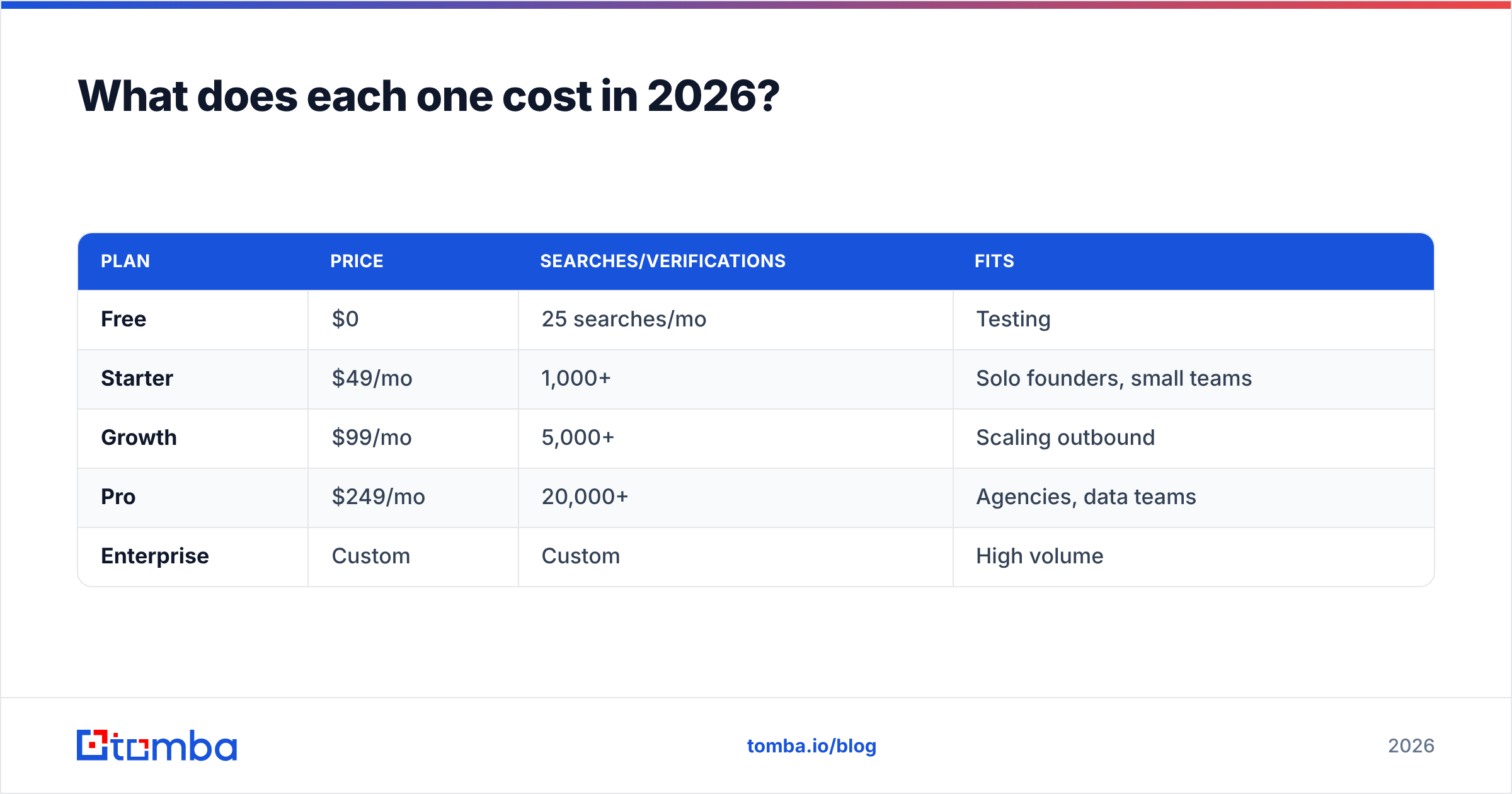
For a transparent middle path, here is how Tomba pricing compares against both models:
| Plan | Price | Searches/Verifications | Fits |
|---|---|---|---|
| Free | $0 | 25 searches/mo | Testing |
| Starter | $49/mo | 1,000+ | Solo founders, small teams |
| Growth | $99/mo | 5,000+ | Scaling outbound |
| Pro | $249/mo | 20,000+ | Agencies, data teams |
| Enterprise | Custom | Custom | High volume |
The point is not that one model is universally better. Credits suit sporadic use; flat monthly suits steady prospecting; enterprise quotes suit big data ops. Match the model to your actual cadence, not to the lowest sticker price.

When should you use a single platform instead?#
Most teams comparing Captain Verify and DealSignal are quietly asking a different question: do I really need two tools?
Here is the pattern. You sign up for a data platform to source contacts, then realize its verification is lighter than you want, so you bolt on a dedicated verifier. Or you start with a cheap verifier, then realize you have no way to find contacts in the first place, so you add a data tool. Two contracts, two logins, two CSV exports to reconcile.
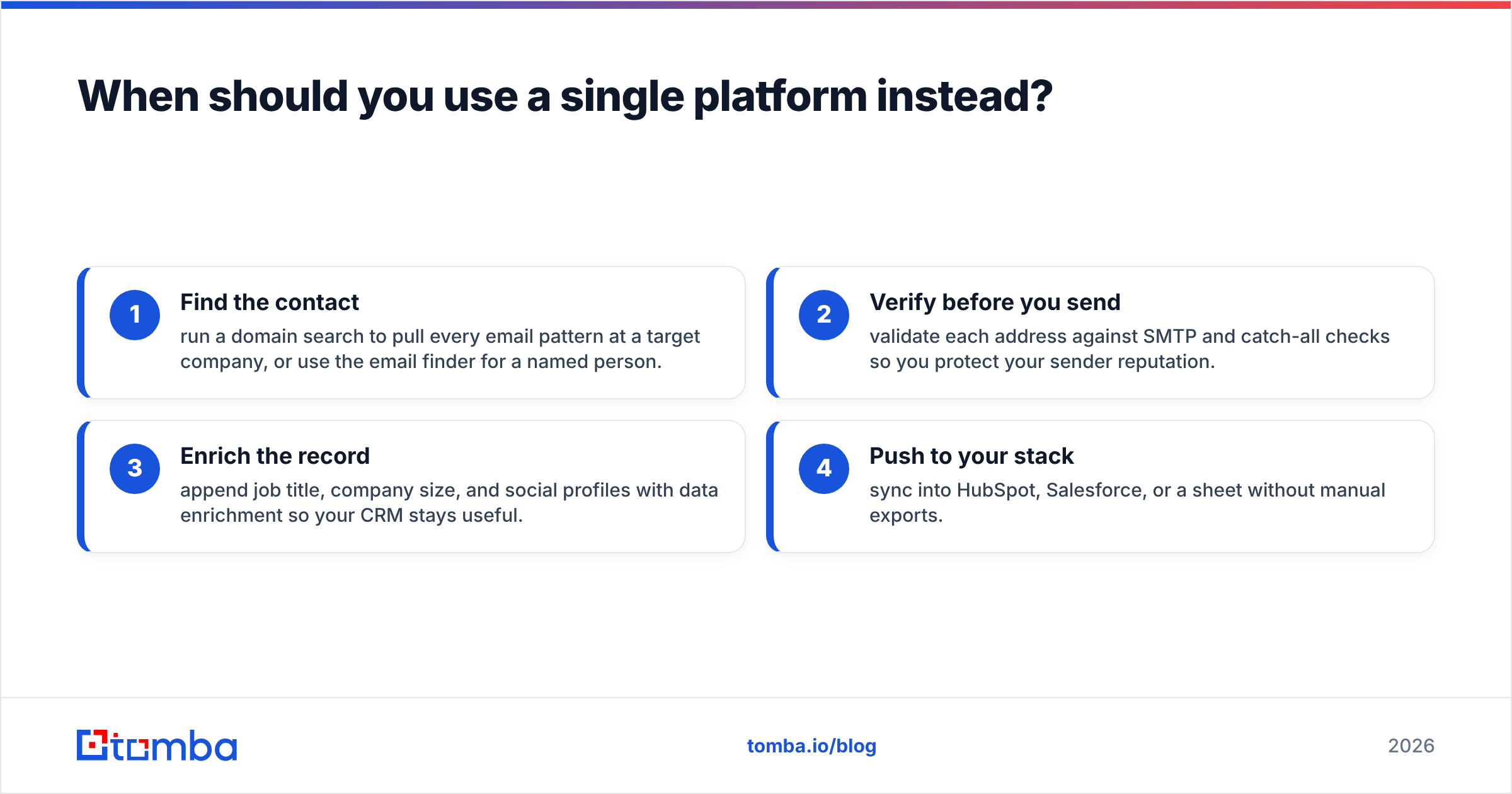
A consolidated platform collapses that. Consider this sequence for a single workflow:
- Find the contact — run a domain search to pull every email pattern at a target company, or use the email finder for a named person.
- Verify before you send — validate each address against SMTP and catch-all checks so you protect your sender reputation.
- Enrich the record — append job title, company size, and social profiles with data enrichment so your CRM stays useful.
- Push to your stack — sync into HubSpot, Salesforce, or a sheet without manual exports.
That is one tool doing what Captain Verify and DealSignal do separately. You lose DealSignal's deep intent-signal layer — if buying intent is core to your motion, the platform still has an edge. But for the majority of SMB and mid-market teams, intent data is a nice-to-have they never operationalize, while find-and-verify is the daily grind.
For independent reviews of how these tools stack up across real user feedback, G2's data-quality category is a reasonable place to sanity-check vendor claims, and HubSpot's research on data decay explains why freshness — not just volume — should drive your choice.
Which tool should you choose?#
Decide by your dominant job, not by feature lists.
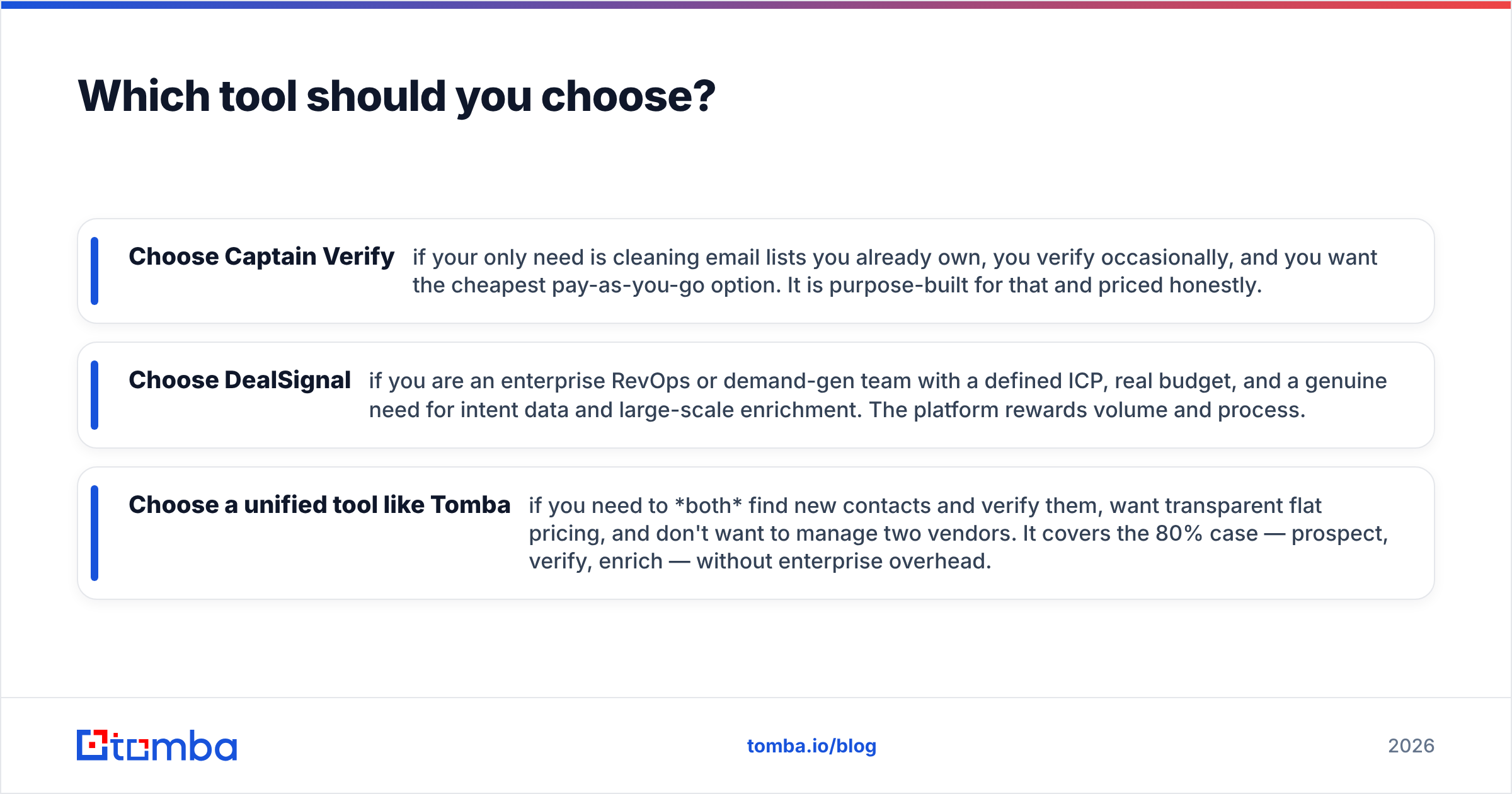
- Choose Captain Verify if your only need is cleaning email lists you already own, you verify occasionally, and you want the cheapest pay-as-you-go option. It is purpose-built for that and priced honestly.
- Choose DealSignal if you are an enterprise RevOps or demand-gen team with a defined ICP, real budget, and a genuine need for intent data and large-scale enrichment. The platform rewards volume and process.
- Choose a unified tool like Tomba if you need to both find new contacts and verify them, want transparent flat pricing, and don't want to manage two vendors. It covers the 80% case — prospect, verify, enrich — without enterprise overhead.
Be honest about which bucket you fall in. Buying DealSignal to clean a 10,000-row list is wasteful. Buying Captain Verify when you actually need contacts you don't have yet leaves you with nothing to verify. And paying for two narrow tools when one covers both jobs is the most common — and most avoidable — mistake.
The bottom line#
Captain Verify and DealSignal are not rivals; they are different tools for different stages of the same funnel. Captain Verify cleans, DealSignal sources, and the choice between them depends entirely on which problem is keeping you up at night.
If your real need is the full loop — finding the right contacts, confirming their emails are deliverable, and enriching the record before it hits your CRM — you don't have to choose between a verifier and a data platform. Start free with the Tomba Email Finder: 25 searches a month, no credit card, find-verify-enrich in one flow. Run your toughest target account through it and compare the result against whatever you're paying for two tools today. The math usually makes the decision for you.
Ready to find emails that actually work?
Join 150,000+ professionals who stopped guessing and started sending. Free credits on signup — no credit card required.
Get the Tomba newsletter
Practical outbound tactics and product updates — once every two weeks.
About the author