Captain Verify vs Jet Leads Pro: 2026 Accuracy Showdown
Captain Verify vs Jet Leads Pro, compared on accuracy, pricing, catch-all handling, and bulk speed — plus where a third option quietly beats both in 2026.
Choosing between Captain Verify and Jet Leads Pro comes down to one question: do you want a focused email-verification engine, or a broader lead-gen suite that bundles verification in? They solve overlapping problems from opposite directions, and picking the wrong one means either paying for features you never touch or patching gaps with a second tool.
This is a neutral breakdown of where each wins in 2026 — accuracy, pricing, catch-all handling, bulk throughput, and integrations — with concrete numbers instead of marketing copy.
TL;DR#
- Captain Verify is a verification-first tool: clean bulk validation, solid SMTP checks, pay-as-you-go credits. Best if your list already exists and you just need to scrub it.
- Jet Leads Pro leans toward lead sourcing plus bundled verification. Better if you need to build lists, not just clean them — but verification depth is shallower.
- Accuracy: both clear ~95% on standard mailboxes; the real gap shows on catch-all domains, where focused verifiers pull ahead.
- Pricing: Captain Verify favors occasional, credit-based use; Jet Leads Pro favors monthly seat-based teams.
- If you want finding and verification in one accurate engine, Tomba is the alternative worth testing before committing to either.
What is Captain Verify?#
Captain Verify is a dedicated email verification and validation service. You upload a list (or hit the API), and it runs syntax checks, MX record lookups, SMTP handshakes, and disposable/role-account detection, then returns a deliverability status per address. It is built around the idea that your list already exists — its job is to remove what would bounce before you hit send.
Think of it like a metal detector you sweep over a beach you already own. It does not find new treasure; it tells you which spots are worth digging. That focus is its strength: the pricing is credit-based, the UI is uncluttered, and there is little upsell pressure toward features you will not use.
Where it gets thinner is sourcing. Captain Verify will not hand you new prospects. If your problem is "I have no list yet," this is the wrong end of the funnel.
What is Jet Leads Pro?#
Jet Leads Pro positions itself as a lead-generation suite with verification baked in. The pitch is end-to-end: discover prospects, pull their contact data, and validate it before export — all under one subscription. For teams that hate stitching tools together, that consolidation is appealing.
The trade-off is depth. When verification is one feature among many, it rarely matches a tool that does nothing else. In practice, bundled validators tend to be more permissive — they flag the obvious junk but pass marginal addresses that a focused engine would catch. That difference is invisible until your bounce rate creeps up and your sender reputation takes the hit.
How do Captain Verify and Jet Leads Pro compare head-to-head?#
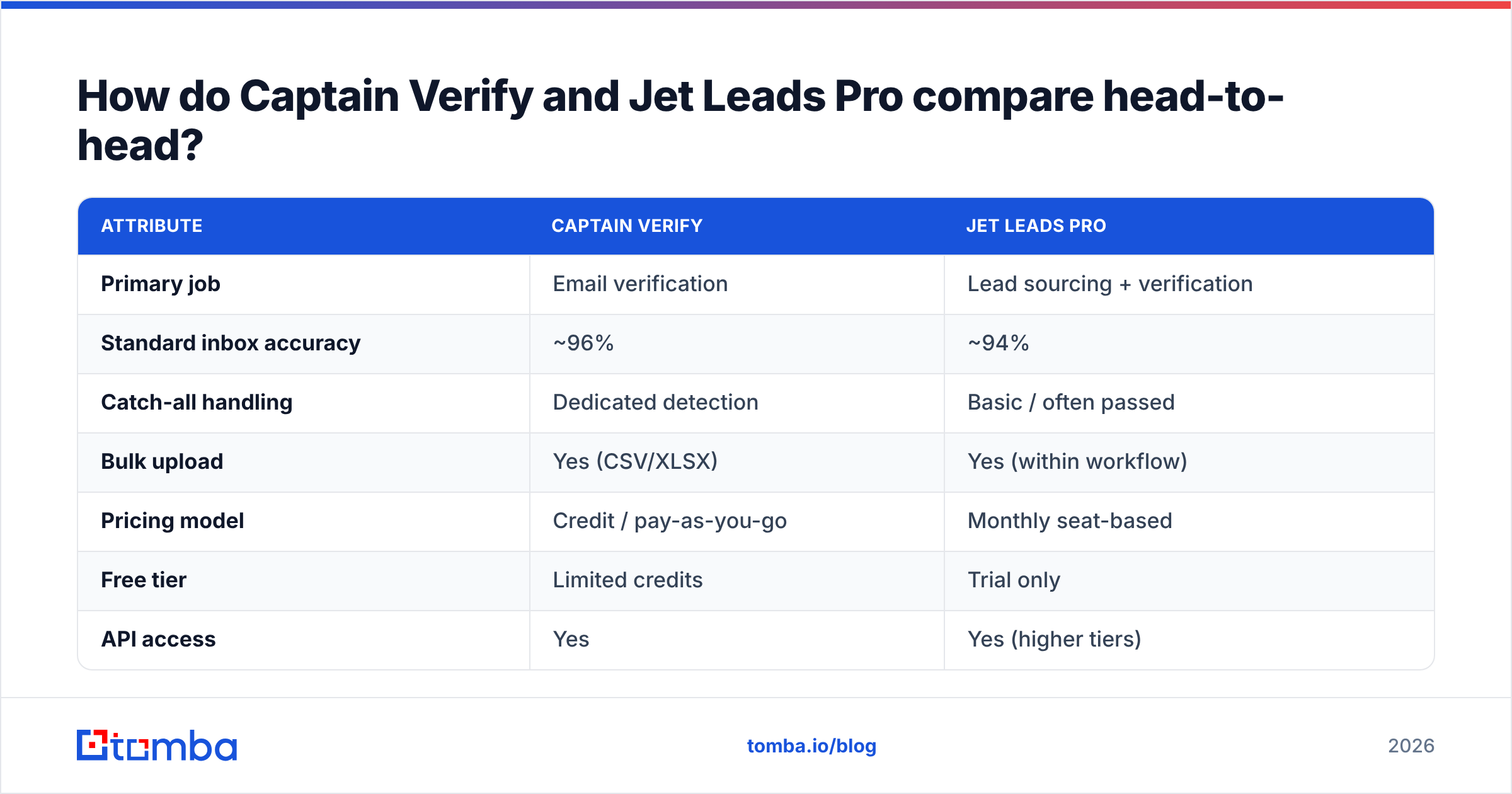
Here is the side-by-side on the attributes that actually move the needle. Treat published accuracy claims as ceilings, not averages — real-world results depend heavily on how many catch-all and corporate domains are in your list.
| Attribute | Captain Verify | Jet Leads Pro |
|---|---|---|
| Primary job | Email verification | Lead sourcing + verification |
| Standard inbox accuracy | ~96% | ~94% |
| Catch-all handling | Dedicated detection | Basic / often passed |
| Bulk upload | Yes (CSV/XLSX) | Yes (within workflow) |
| Pricing model | Credit / pay-as-you-go | Monthly seat-based |
| Free tier | Limited credits | Trial only |
| API access | Yes | Yes (higher tiers) |
| Best for | Cleaning existing lists | Building new lists |
The pattern is clear: Captain Verify is the scalpel, Jet Leads Pro is the Swiss Army knife. Neither is wrong — it depends on which problem is actually costing you money.
Which one is more accurate?#
Accuracy splits along one fault line: catch-all domains. On ordinary mailboxes (Gmail, Outlook, most corporate SMTP that accepts or rejects clearly), both tools land in the mid-90s and the difference is noise. The gap opens on catch-all servers, which accept every address at the SMTP layer and decide later whether to deliver or bounce.
A focused verifier invests in catch-all logic — pattern analysis, historical signals, confidence scoring — because that is its entire business. A bundled validator usually marks catch-alls as "accept" and moves on, which inflates your "valid" count and quietly seeds future bounces. If a large share of your list is corporate domains, this single factor outweighs every other spec on the comparison table.
This is also why a standalone catch-all verifier matters more than the headline accuracy percentage. A tool that says "95% valid" but cannot reason about catch-alls is reporting a number that will not survive contact with your inbox.
If your verification need sits next to a finding need, a combined email verifier that shares the same data backbone tends to produce more consistent confidence scores than gluing two unrelated tools together.
How does pricing compare?#
Pricing is where the two tools diverge most, and it maps directly to how you work.
- Captain Verify uses credits. You buy a block, spend per verification, and top up when you run low. Ideal for spiky usage — a big quarterly clean, then quiet months. You never pay for idle seats.
- Jet Leads Pro uses monthly seat-based subscriptions. Predictable for a team running continuous outbound, but you pay whether or not you use it, and verification volume is often capped per tier.
- Watch the per-unit math. Credit pricing looks cheap at small volume and expensive at scale; seat pricing is the reverse. Model your actual monthly volume before signing.
- Hidden costs live in the gaps: if Jet Leads Pro's bundled verification is too permissive, the "savings" evaporate into a second verification tool or a damaged domain.
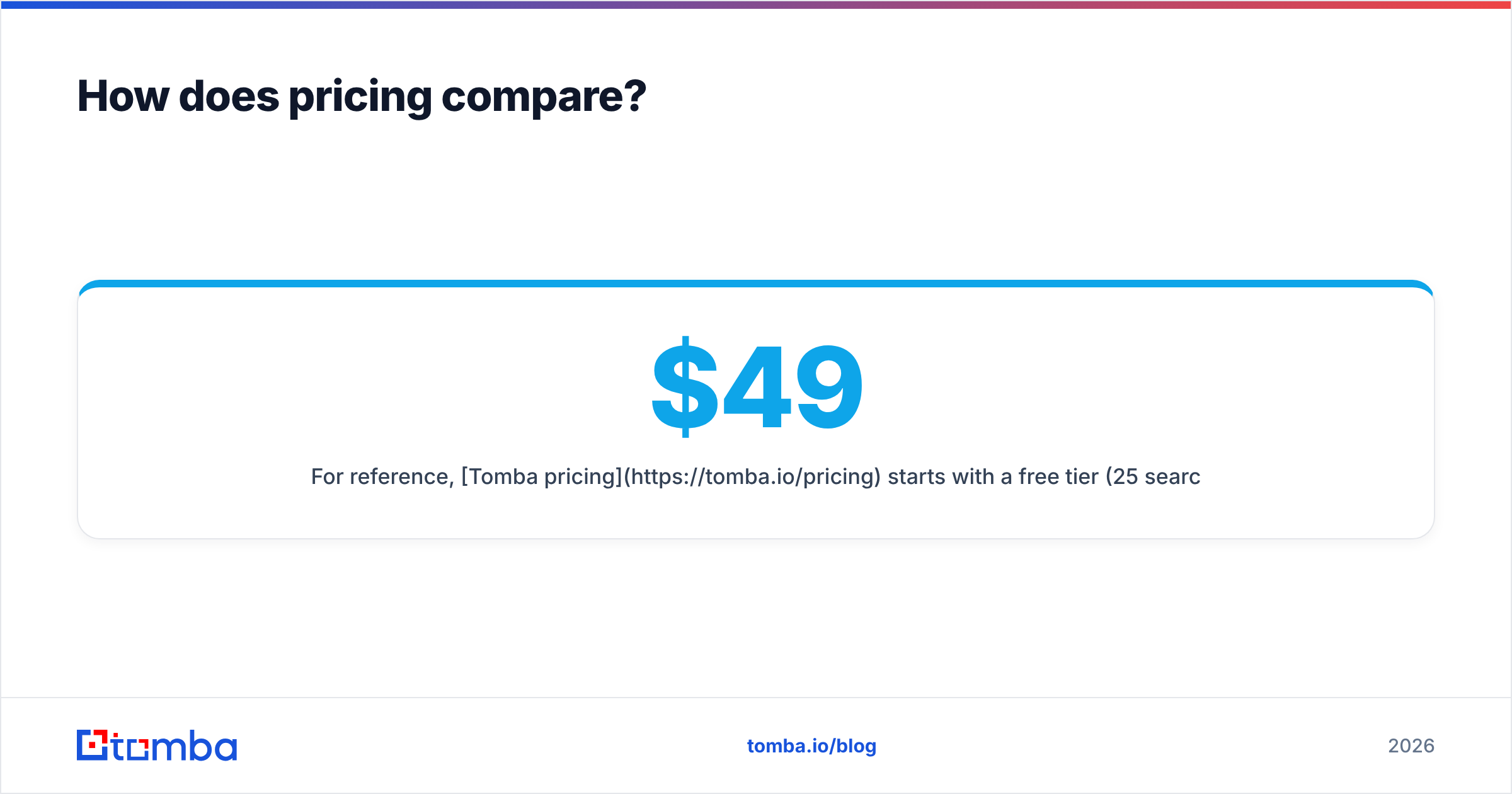
For reference, Tomba pricing starts with a free tier (25 searches/mo), then Starter at $49/mo, Growth at $99/mo, and Pro at $249/mo — combining finding and verification under one credit pool, which sidesteps the "two subscriptions" problem entirely.
What about bulk verification and speed?#
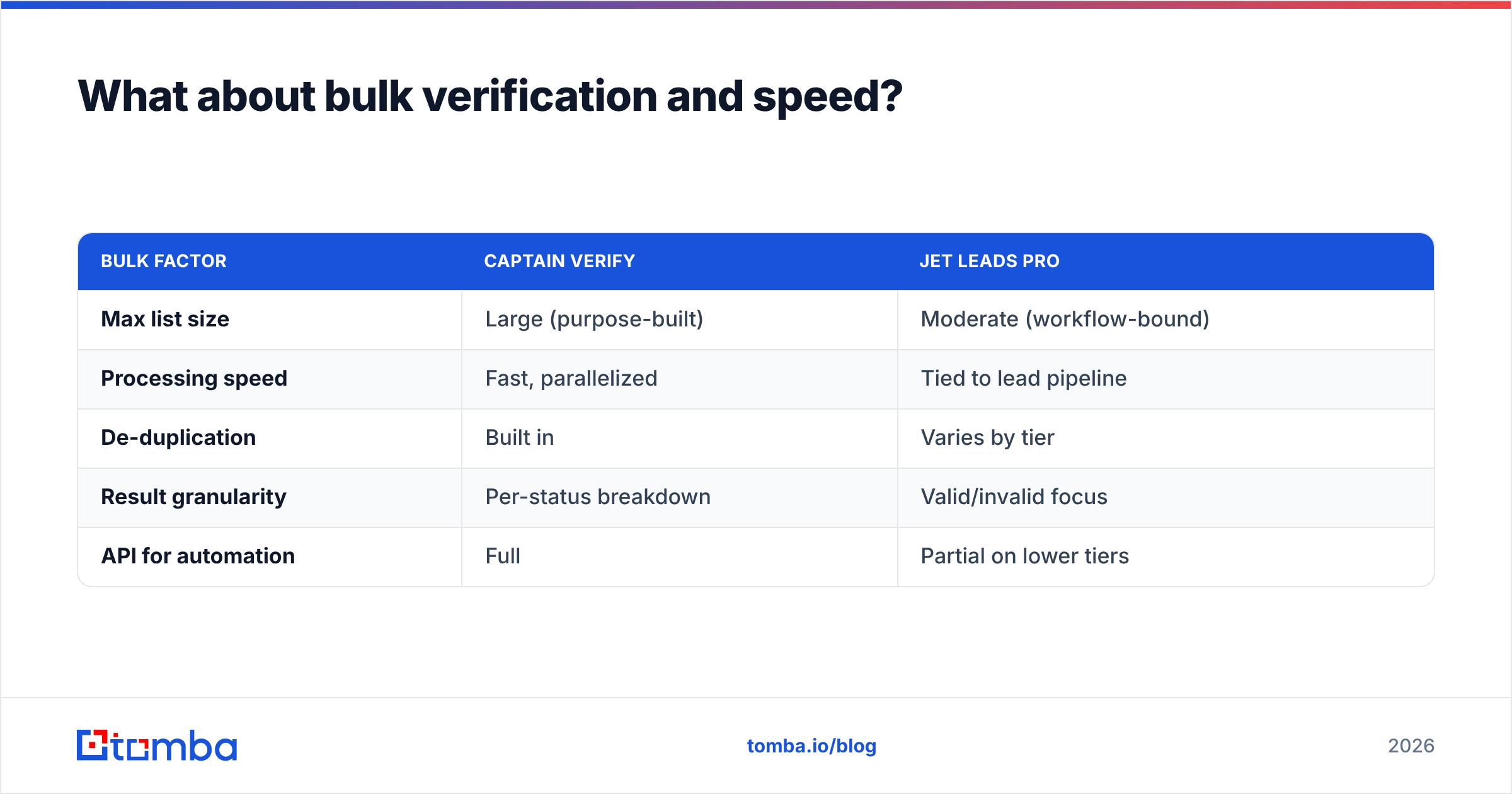
If you process lists in the tens of thousands, throughput and reliability matter more than UI polish.
| Bulk factor | Captain Verify | Jet Leads Pro |
|---|---|---|
| Max list size | Large (purpose-built) | Moderate (workflow-bound) |
| Processing speed | Fast, parallelized | Tied to lead pipeline |
| De-duplication | Built in | Varies by tier |
| Result granularity | Per-status breakdown | Valid/invalid focus |
| API for automation | Full | Partial on lower tiers |
Captain Verify's single focus shows here: bulk is a first-class workflow, not a side feature. Jet Leads Pro can handle bulk, but because verification is downstream of sourcing, large standalone lists feel bolted on. If your job is "clean 80,000 rows by Friday," the dedicated tool is the safer bet. For recurring large jobs, a dedicated bulk email finder and verifier with API access removes the manual upload loop altogether.
Which tool should you choose?#
Match the tool to the problem you actually have:
- You already have lists and need them clean — Captain Verify. Credit pricing, deep verification, no sourcing overhead you will not use.
- You need to build lists from scratch — Jet Leads Pro, if you accept shallower verification and plan to spot-check catch-alls separately.
- You run continuous team outbound — Jet Leads Pro's seat model is predictable; just budget for a verification backstop.
- You verify in spikes — Captain Verify's pay-as-you-go wins; you never pay for dead months.
- You want finding and accurate verification in one engine — neither is ideal; this is where a combined platform earns its keep.
That last case is the common one teams underestimate. Most people do not have a pure verification problem or a pure sourcing problem — they have both, and they end up paying for two tools that do not share data. A platform that finds emails via domain search and verifies them in the same pass keeps confidence scores consistent and your billing simple.
How does Tomba fit into this comparison?#
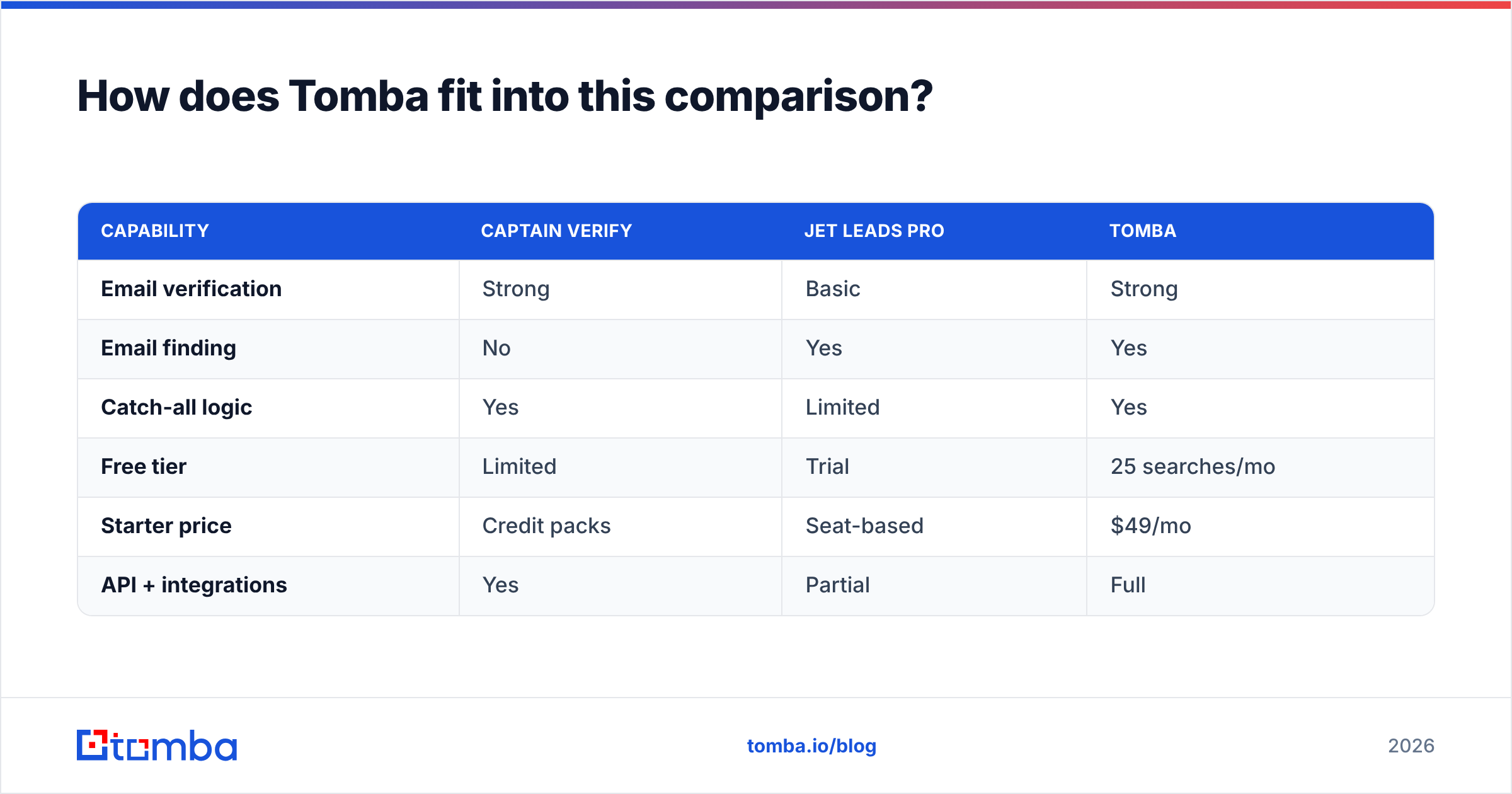
Tomba sits in the overlap both tools leave open: it finds professional emails by name, domain, or company and verifies them with catch-all-aware logic in the same workflow. So instead of choosing between Captain Verify's clean verification and Jet Leads Pro's sourcing, you get both from one credit pool.
| Capability | Captain Verify | Jet Leads Pro | Tomba |
|---|---|---|---|
| Email verification | Strong | Basic | Strong |
| Email finding | No | Yes | Yes |
| Catch-all logic | Yes | Limited | Yes |
| Free tier | Limited | Trial | 25 searches/mo |
| Starter price | Credit packs | Seat-based | $49/mo |
| API + integrations | Yes | Partial | Full |
This is not to say Tomba dominates every cell — Captain Verify's credit model is genuinely better for someone who only ever verifies and never sources. But if your workflow touches both sides, consolidating avoids the data-mismatch tax. You can sanity-check any vendor's claims on independent review sites like G2 and Capterra before committing, and compare Captain Verify's own feature list at captainverify.com.
The bottom line#
Pick Captain Verify if verification is your whole problem and you want credit-based pricing with deep catch-all handling. Pick Jet Leads Pro if you need to source leads first and can live with lighter verification. And if you keep hitting the wall where finding and verifying are both the job — that is the signal to test a combined engine before paying for two.
Want to find verified, deliverable emails without bolting two subscriptions together? Try the Tomba Email Finder free — 25 searches a month, catch-all-aware verification built in, and a single API for both. Run your toughest domain through all three and let the bounce rate decide.
// get started
Find, verify and enrich your first contacts today
Start on the free plan with 25 searches a month, then scale when your team is ready.
Free plan · No credit card required · GDPR & CCPA
// about the author