Captain Verify vs Lead411 (2026): Which B2B Tool Wins?
Captain Verify cleans lists; Lead411 builds them. We compare pricing, accuracy, and data coverage for 2026 — and show where one tool does both.
Captain Verify vs Lead411: The 2026 Comparison
You are comparing two tools that barely belong in the same sentence. Captain Verify is an email-list cleaner. Lead411 is a B2B sales-intelligence database. One tells you whether an address you already have is deliverable; the other hands you the contact in the first place. So "Captain Verify vs Lead411" is really a question about which half of your prospecting stack you are missing — and whether you can collapse both jobs into one tool.
This guide breaks down what each platform actually does, where the pricing lands in 2026, and how to decide without buying two subscriptions you only half-use.
TL;DR#
- Captain Verify is a pure email-verification tool: bulk list cleaning, single checks, an API, and syntax/MX/SMTP validation. It does not source new contacts.
- Lead411 is a sales-intelligence platform: a B2B contact and company database with intent data, triggers, and emails/phones — built to find leads, not just clean them.
- They solve different problems, so "which is better" depends on whether your bottleneck is finding contacts or validating them.
- Pricing models differ sharply: Captain Verify sells verification credits; Lead411 sells annual seats with export caps.
- If you want one workflow that finds and verifies in the same place, a combined platform like Tomba covers both jobs at a lower entry price.
What is Captain Verify?#
Captain Verify is an email-verification service. You upload a list — or hit the API — and it returns a deliverability verdict for each address: valid, invalid, risky, or unknown. Under the hood it runs the standard checks: syntax validation, domain and MX-record lookups, SMTP handshake, plus disposable-address and role-account detection (think info@, sales@).
Its job starts after you already have email addresses. If a teammate scraped 10,000 contacts and you need to know which ones will bounce before you send, Captain Verify is the kind of tool you reach for. It is priced on volume: you buy credits and burn one per verification.
What it does not do is generate contacts. It has no company database, no "find the CMO at this domain" function, and no intent signals. It is a cleaning station, not a source.

What is Lead411?#
Lead411 is a B2B sales-intelligence platform. Instead of cleaning a list you bring, it is the list. You search by industry, title, location, company size, or technology, and it returns verified business emails and direct-dial phone numbers, wrapped in company firmographics.
Its differentiators are intent data and growth triggers — signals like a company raising funding, hiring aggressively, or researching a category. That lets reps time outreach to when a buyer is actually in-market. Lead411 also pushes contacts into your CRM and sequencing tools through native integrations.
The trade-off is the commercial model. Lead411 is sold as annual seats with export limits, and like most data platforms its real coverage and per-seat cost depend on a sales conversation. It is a heavier, find-first system — closer to ZoomInfo's category than to a list cleaner. You can read independent user reviews on G2 to gauge data freshness for your region.
Captain Verify vs Lead411: how do they compare?#
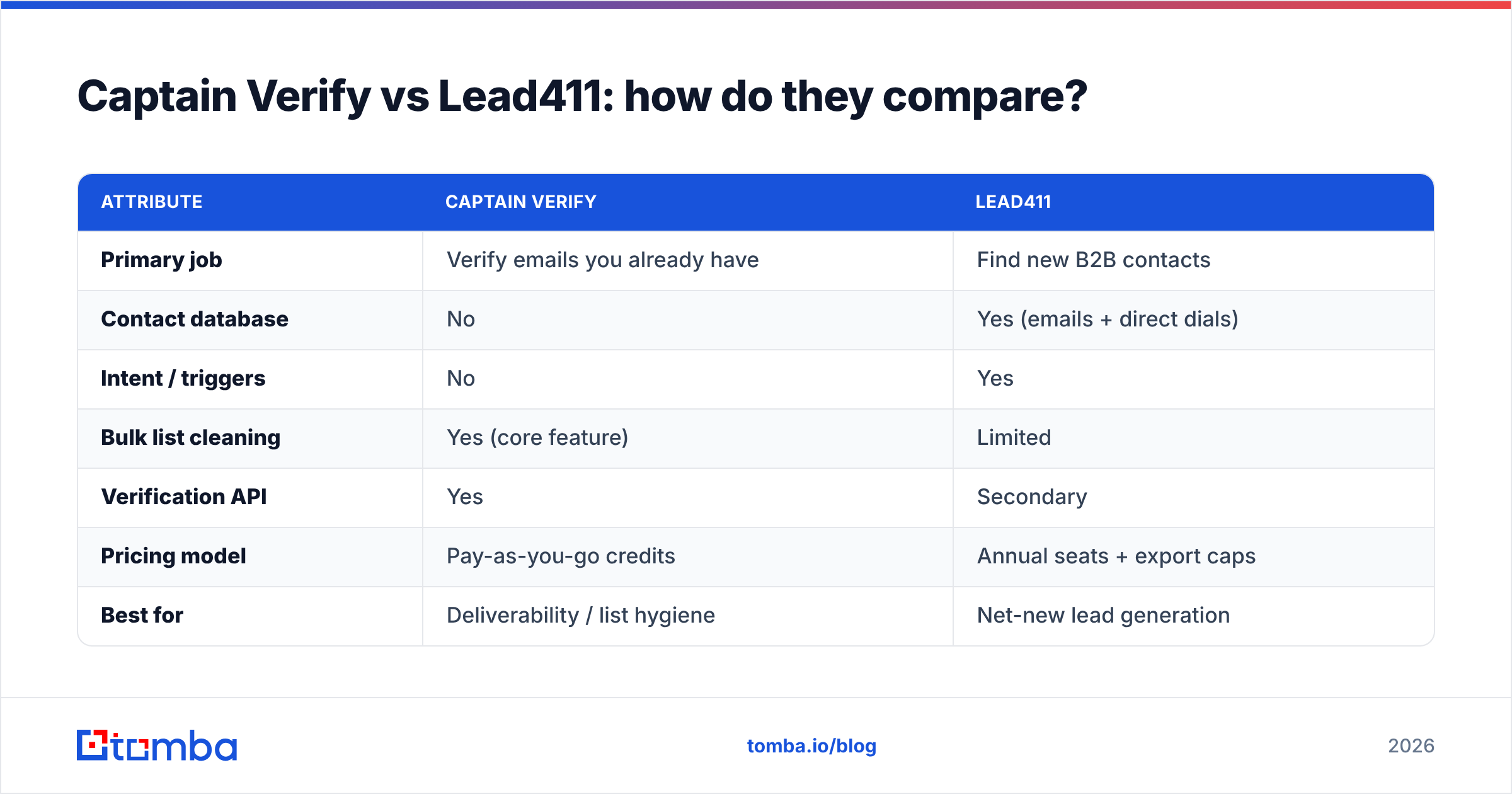
The cleanest way to see the gap is side by side. These two tools sit at opposite ends of the prospecting pipeline.
| Attribute | Captain Verify | Lead411 |
|---|---|---|
| Primary job | Verify emails you already have | Find new B2B contacts |
| Contact database | No | Yes (emails + direct dials) |
| Intent / triggers | No | Yes |
| Bulk list cleaning | Yes (core feature) | Limited |
| Verification API | Yes | Secondary |
| Pricing model | Pay-as-you-go credits | Annual seats + export caps |
| Best for | Deliverability / list hygiene | Net-new lead generation |
| CRM push | Via API | Native integrations |
The takeaway: these are complements, not substitutes. A full outbound motion needs both capabilities — sourcing and validation. Buying only one leaves a hole you fill manually.
Which problem are you actually solving?#
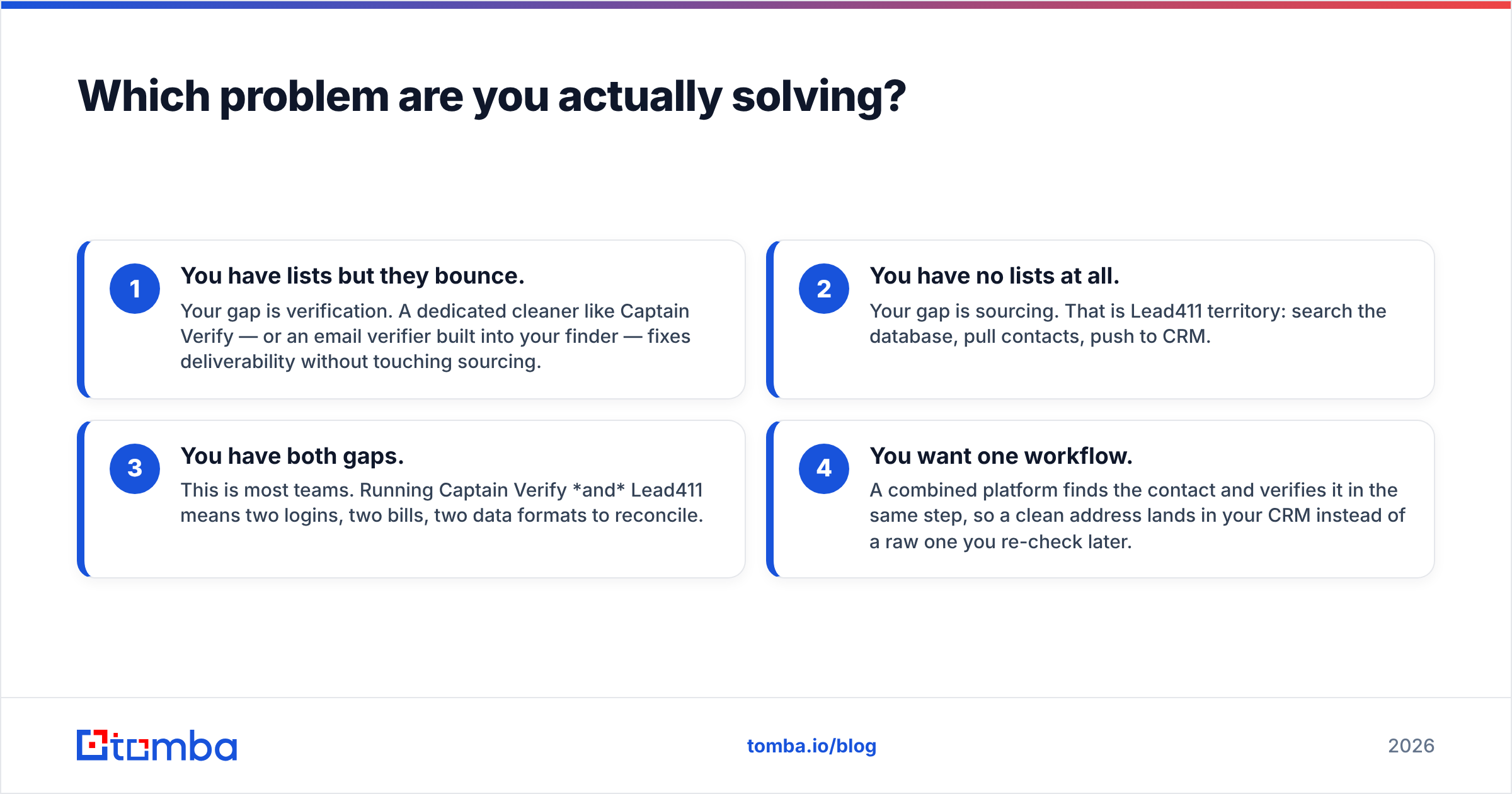
Pick based on your real bottleneck, not the brand name. Here is the decision in four moves:
- You have lists but they bounce. Your gap is verification. A dedicated cleaner like Captain Verify — or an email verifier built into your finder — fixes deliverability without touching sourcing.
- You have no lists at all. Your gap is sourcing. That is Lead411 territory: search the database, pull contacts, push to CRM.
- You have both gaps. This is most teams. Running Captain Verify and Lead411 means two logins, two bills, two data formats to reconcile.
- You want one workflow. A combined platform finds the contact and verifies it in the same step, so a clean address lands in your CRM instead of a raw one you re-check later.
That fourth path is where most buyers actually end up, because maintaining two specialized tools is more overhead than the problem deserves.
How does verification accuracy compare?#
Verification accuracy comes down to one hard problem: catch-all domains. A catch-all server accepts mail to any address at the domain, so a naive SMTP check returns "valid" for addresses that don't exist. Captain Verify, like most cleaners, flags these as "risky" or "unknown" rather than guessing — which is honest but leaves you to decide.
Lead411's emails are pre-verified at the database level, so in theory you skip the cleaning step. In practice, B2B contact data decays roughly 2–3% per month as people change jobs, so any database email is only as fresh as its last refresh. That is exactly why a verification pass still matters even on "verified" data.
If catch-all handling is your sticking point, a dedicated catch-all verifier resolves those addresses instead of dumping them in an "unknown" bucket — the difference between a usable lead and a coin flip. For background on why bounces wreck campaigns, see Tomba's note on email deliverability.
What about pricing in 2026?#
The two tools price on completely different axes, which makes a straight dollar comparison misleading. Captain Verify charges per verification credit, so a one-time list clean is cheap and predictable. Lead411 charges per seat per year and caps how many contacts you can export, so cost scales with team size and usage, not list size.
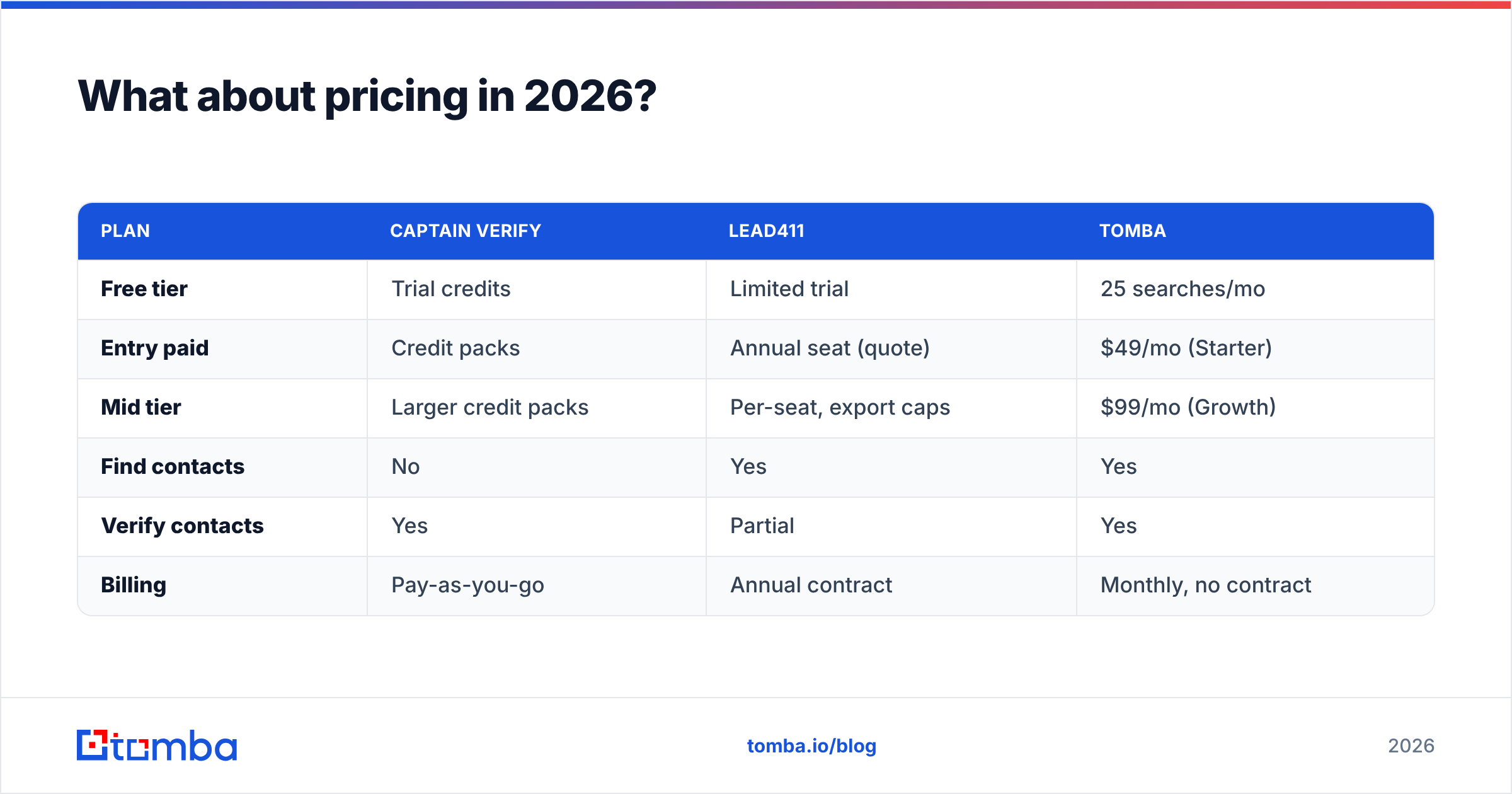
Here is how a combined platform stacks up against running both, using transparent published numbers:
| Plan | Captain Verify | Lead411 | Tomba |
|---|---|---|---|
| Free tier | Trial credits | Limited trial | 25 searches/mo |
| Entry paid | Credit packs | Annual seat (quote) | $49/mo (Starter) |
| Mid tier | Larger credit packs | Per-seat, export caps | $99/mo (Growth) |
| Find contacts | No | Yes | Yes |
| Verify contacts | Yes | Partial | Yes |
| Billing | Pay-as-you-go | Annual contract | Monthly, no contract |
You can check the current Tomba pricing directly; the point is that a single subscription that both finds and verifies often costs less than one specialized data seat plus a verification credit pack. Lead411's seat-and-export model also means a single power user can hit limits fast, while a credit model like Captain Verify's is hard to budget when volume spikes.
Can one tool replace both?#
Yes — and that is usually the smarter buy. The reason teams end up with Captain Verify and Lead411 is historical: verification tools and data tools grew up as separate categories. But the modern stack collapses them.
A platform built around an email finder with verification baked in gives you the Lead411 job (find the contact by name, company, or domain) and the Captain Verify job (confirm it's deliverable) in one pass. Tomba adds the pieces both single-purpose tools leave out:
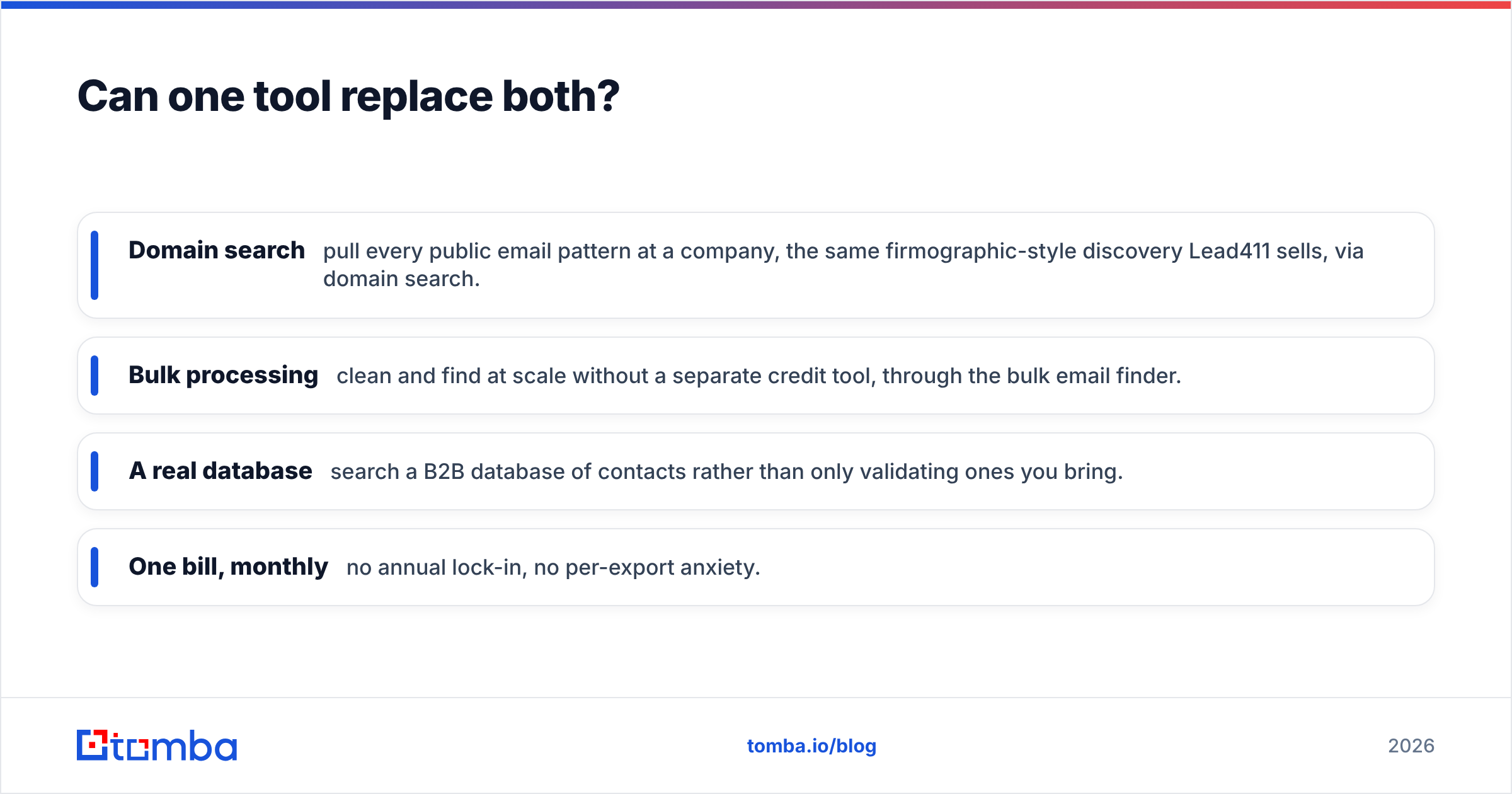
- Domain search — pull every public email pattern at a company, the same firmographic-style discovery Lead411 sells, via domain search.
- Bulk processing — clean and find at scale without a separate credit tool, through the bulk email finder.
- A real database — search a B2B database of contacts rather than only validating ones you bring.
- One bill, monthly — no annual lock-in, no per-export anxiety.
That does not make Captain Verify or Lead411 bad tools. If you only ever clean lists, a focused verifier is fine. If you have enterprise budget and live in intent data, Lead411's triggers are genuinely strong. The combined route wins for the large middle of teams who need both jobs done and don't want two contracts to manage.
How to choose: a quick rubric#
Match the tool to the sentence that sounds most like your week:
- "My emails bounce and hurt my sender reputation." → Start with verification (Captain Verify or a built-in verifier).
- "I can't find decision-makers to email." → Start with sourcing (Lead411 or a finder + database).
- "Both, and I hate juggling tools." → Choose a combined finder-plus-verifier and consolidate.
- "I need intent signals and have the budget." → Lead411 earns its seat price here.
Most outbound teams fall into the third bucket, which is why the single-platform answer keeps winning.
The bottom line#
Captain Verify and Lead411 aren't really rivals — they're two halves of the same pipeline. Captain Verify keeps your lists clean; Lead411 fills them. The expensive mistake is buying both and stitching them together by hand when one workflow can find the contact and verify it in the same motion.
If your goal in 2026 is fewer tools, lower spend, and clean contacts that land in your CRM ready to use, start with Tomba's Email Finder. Find the address, verify it on the spot, and push it forward — without paying for a data seat and a credit pack to do one job. Spin up the free tier (25 searches a month, no card) and test it against your hardest accounts before you commit.
// get started
Find, verify and enrich your first contacts today
Start on the free plan with 25 searches a month, then scale when your team is ready.
Free plan · No credit card required · GDPR & CCPA
// about the author