Captain Verify vs Leadzenai: 2026 Data & Email Showdown
Captain Verify cleans lists, Leadzenai builds them — but which one actually moves your pipeline in 2026? A neutral, feature-by-feature breakdown.
You typed "Captain Verify vs Leadzenai" into a search bar because something in your outbound stack is leaking — bounces are creeping up, or your lead list is thin, and you want to know which of these two tools fixes it. Here is the short answer before the long one: they fix different problems, and most teams that compare them are actually missing a third piece entirely.
TL;DR#
- Captain Verify is an email verification tool. It cleans lists you already have and lowers bounce rates. It does not find new contacts.
- Leadzenai (Leadzen.ai) is a lead intelligence platform. It builds prospect lists from a B2B database and enriches records. Its verification is a side feature, not the main act.
- Comparing them head-to-head is a bit like comparing a water filter to a well — you likely need both functions, not one or the other.
- For pricing, Captain Verify is pay-as-you-go credit based; Leadzenai is subscription-tiered around data access and is India-data heavy.
- If you want finding + verifying + enriching in one place with transparent pricing, a combined platform like Tomba usually beats stitching two single-purpose tools together.

What does Captain Verify actually do?#
Captain Verify is a French-built email and phone verification service. You upload a list, it pings each address through SMTP checks, syntax validation, MX record lookups, and disposable/role-account detection, then hands back a clean file flagged as valid, invalid, risky, or unknown.
Think of it like a bouncer at a club door. It does not invite anyone — it only decides who already on your list is allowed through. That is genuinely useful: dirty lists wreck your sender reputation, and a single bad send can tank an entire domain's deliverability for weeks.
What Captain Verify is good at:
- Bulk list cleaning — drag in a CSV of 50,000 addresses and get a categorized result.
- Pay-as-you-go credits — no forced monthly subscription; you buy what you burn.
- Phone validation alongside email, which many pure email tools skip.
- GDPR-friendly hosting in the EU, a real selling point for European teams.
What it does not do: find a single new email address. If your list is empty, Captain Verify has nothing to work with. That is the boundary that trips up buyers who think verification and discovery are the same job.
What does Leadzenai actually do?#
Leadzen.ai sits on the opposite side of the funnel. It is a lead generation and B2B data intelligence platform that lets you search a contact database, apply filters (industry, role, geography, company size), and pull out prospect lists with emails, phone numbers, and firmographic data attached.
If Captain Verify is the bouncer, Leadzenai is the talent scout — it goes out and brings you names you did not have before. It leans heavily on Indian market data, real-time search, and a Chrome extension for pulling contacts off LinkedIn-style profiles. Verification exists inside Leadzenai, but it is a checkbox feature riding on top of the core discovery engine, not a dedicated, tunable verification pipeline.
The trade-off: data platforms live or die on coverage and freshness. Leadzenai's strength in one region can be a weakness in another. If your ICP is US or EU mid-market SaaS, you will want to test its match rate before committing, because regional databases vary wildly outside their home turf.
Captain Verify vs Leadzenai: how do they compare directly?#
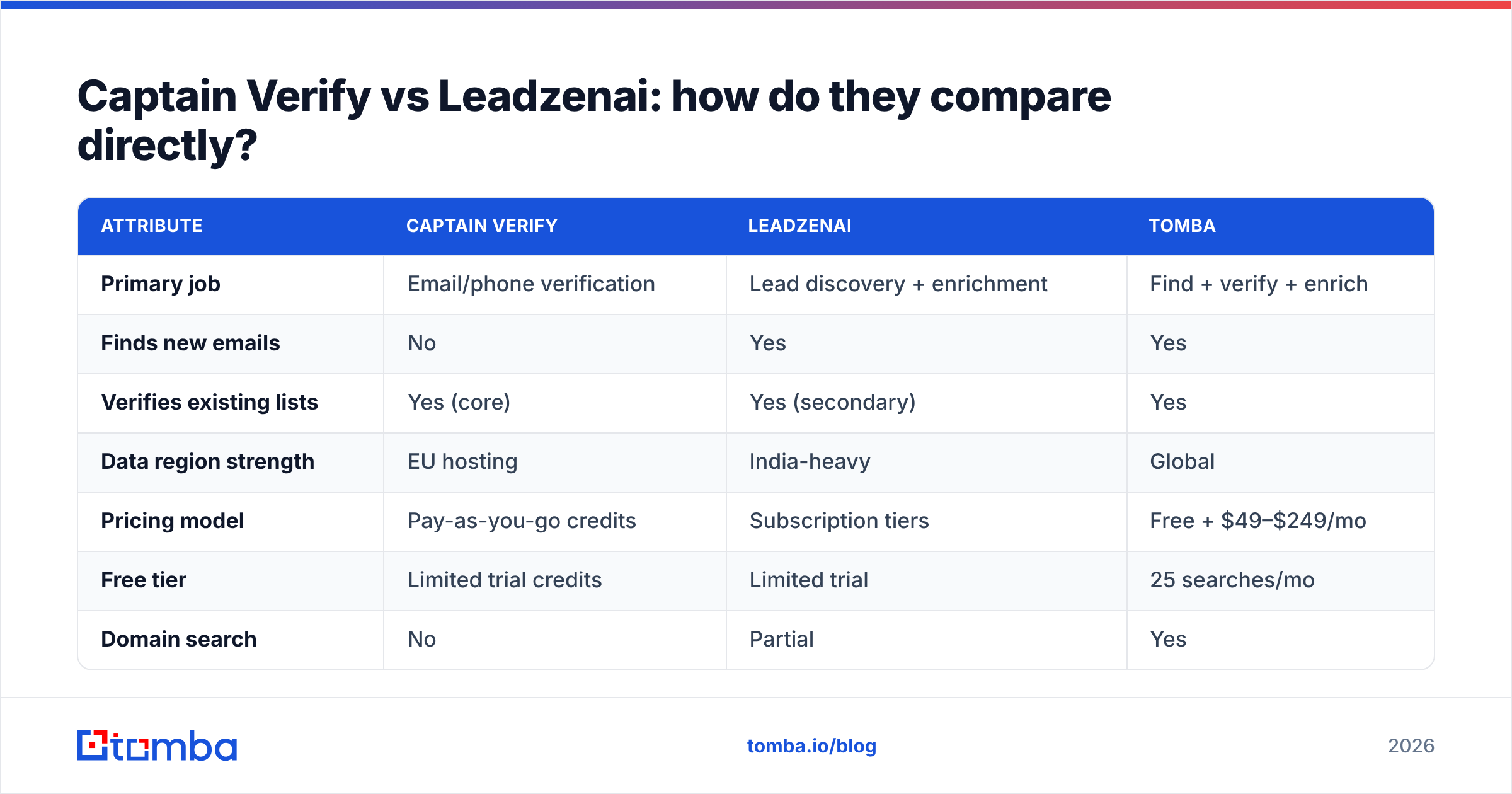
Here is the honest side-by-side. Notice that most rows are not "better vs worse" — they are "different job entirely."
| Attribute | Captain Verify | Leadzenai | Tomba |
|---|---|---|---|
| Primary job | Email/phone verification | Lead discovery + enrichment | Find + verify + enrich |
| Finds new emails | No | Yes | Yes |
| Verifies existing lists | Yes (core) | Yes (secondary) | Yes |
| Data region strength | EU hosting | India-heavy | Global |
| Pricing model | Pay-as-you-go credits | Subscription tiers | Free + $49–$249/mo |
| Free tier | Limited trial credits | Limited trial | 25 searches/mo |
| Domain search | No | Partial | Yes |
| API access | Yes | Yes | Yes |
| Catch-all handling | Basic flag | Basic flag | Dedicated verifier |
The pattern is clear. Captain Verify is a specialist at the back end of list hygiene. Leadzenai is a specialist at the front end of list building. Neither covers the full motion alone, which is why teams often end up paying for two subscriptions plus a third enrichment tool — and managing three credit balances, three APIs, and three support queues.
Which one is more accurate?#
Accuracy means two different things here, so the question has two answers.
For verification accuracy (does this email actually exist and accept mail?), Captain Verify performs well on standard mailbox checks. Its weakness, shared by nearly every verifier, is catch-all domains — servers configured to accept everything, where SMTP gives no honest yes/no. Captain Verify flags these as "risky/unknown" and leaves you to guess. A dedicated catch-all verifier that uses pattern analysis and historical signals will resolve more of those grey-area addresses than a basic flag.
For data accuracy (is this the right person's current email?), Leadzenai's number depends entirely on region and recency. Database tools decay constantly as people change jobs; a record that was perfect six months ago may now bounce. This is why discovery and verification belong together — finding an email and confirming it is live in the same step is the only way to stop stale data from reaching your sequencer.
If you want to dig into where contact data even comes from and why match rates differ between vendors, Tomba publishes its data sources openly, which is a useful benchmark when you are auditing any provider's claims.
What does each one cost?#
Pricing philosophy is where these two diverge most.
Captain Verify uses credits. You buy a block — say 5,000 or 100,000 verifications — and draw them down with no monthly lock-in. That suits teams who clean lists occasionally and hate recurring charges. The catch: credits expire, and heavy continuous users pay more per check than they would on a subscription.
Leadzenai uses subscription tiers gated by data volume and feature access. You commit monthly for a quota of lookups and exports. That suits teams generating leads constantly, but you pay whether or not you hit your quota, and overages can sting.
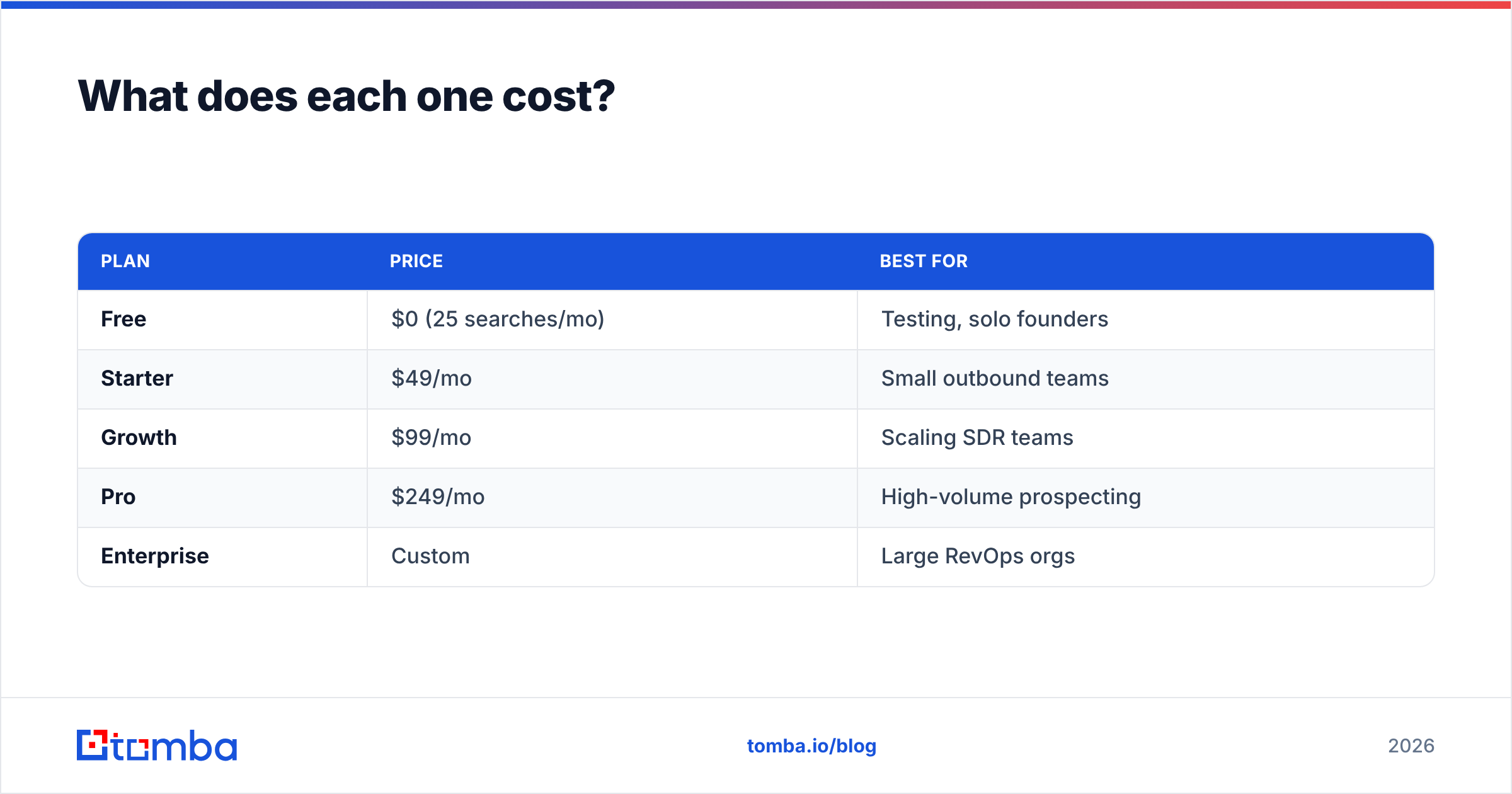
For reference, here is how a combined platform prices the same scope so you can sanity-check value:
| Plan | Price | Best for |
|---|---|---|
| Free | $0 (25 searches/mo) | Testing, solo founders |
| Starter | $49/mo | Small outbound teams |
| Growth | $99/mo | Scaling SDR teams |
| Pro | $249/mo | High-volume prospecting |
| Enterprise | Custom | Large RevOps orgs |
Full Tomba pricing bundles finding, verifying, and enrichment under one credit pool, which removes the "do I have verification credits left but no discovery credits?" headache that comes from running two separate vendors.
When should you pick Captain Verify?#
Pick Captain Verify when all three of these are true:
- You already have lead lists from somewhere else (a CRM export, a partner list, an event scan).
- Your only problem is bounce rate and deliverability, not list size.
- You are EU-based or have a hard requirement for European data hosting and GDPR posture.
In that narrow lane, Captain Verify is a clean, focused, no-nonsense tool. You are not paying for discovery features you will never touch. If verification is genuinely the only gap and you never need to source contacts, a dedicated verifier — whether Captain Verify or an email verifier built into a broader suite — is the right call.
When should you pick Leadzenai?#
Pick Leadzenai when:
- Your ICP skews toward the Indian market or APAC regions where its database is densest.
- You need net-new contacts and your current bottleneck is list volume, not list quality.
- Real-time profile-based lookup (the Chrome extension flow) matches how your reps actually prospect.
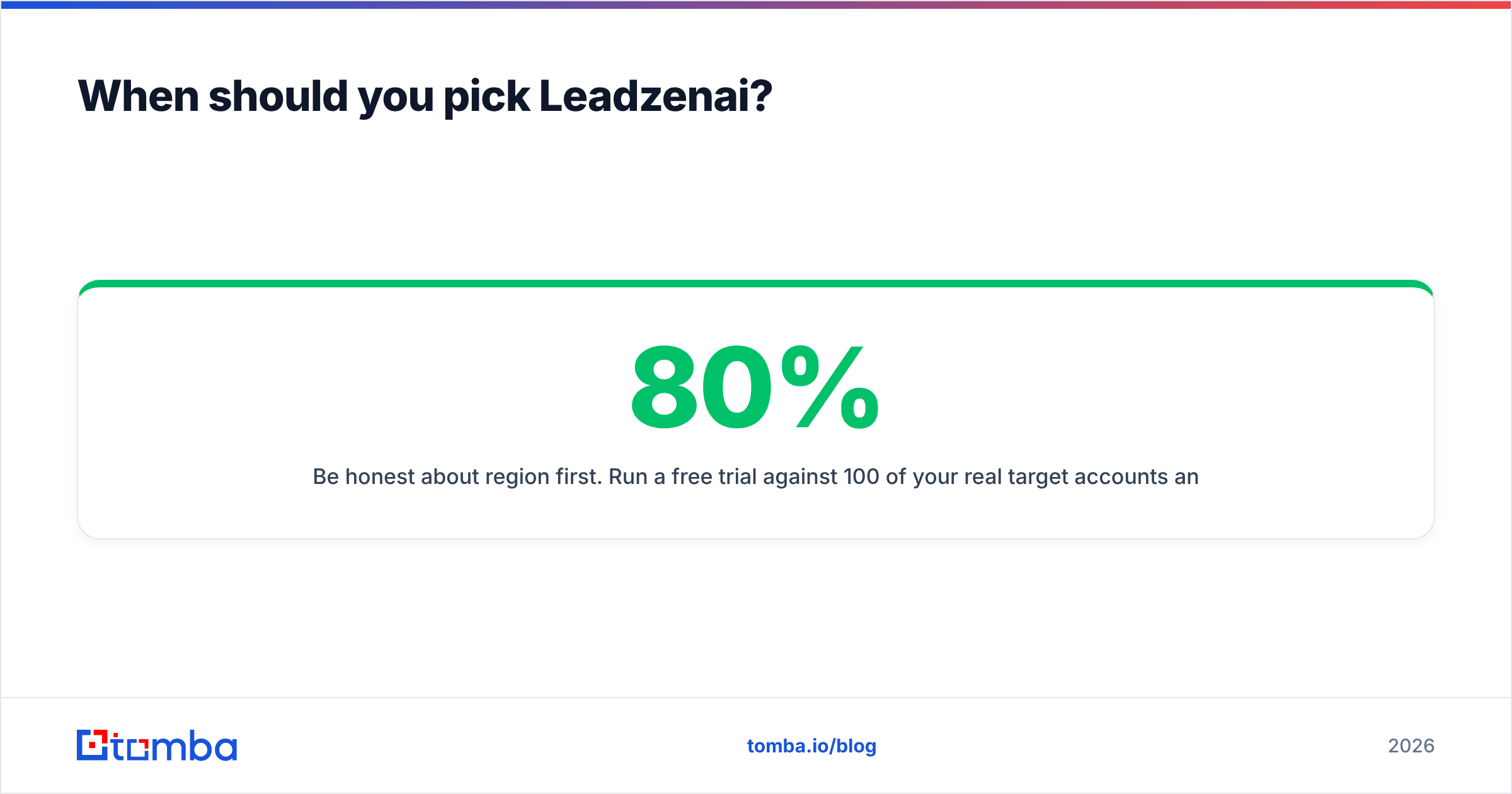
Be honest about region first. Run a free trial against 100 of your real target accounts and measure the match rate before you sign anything. A data tool that hits 80% in its home market and 30% in yours is a 30% tool for you, regardless of the headline numbers on the pricing page. That single test will save you more money than any feature comparison.
Is there a better option than choosing between them?#
For most B2B teams: yes — because the real workflow is find, then verify, then enrich, in one pass.
When you split that across Captain Verify (verify) and Leadzenai (find), you create seams. Data leaves one system as a CSV, gets cleaned in another, then re-imported somewhere to enrich. Every export and re-import is a place where fields drop, duplicates breed, and freshness rots. You also juggle two billing models, two rate limits, and two support teams pointing at each other when something breaks.
A consolidated platform collapses that. With Tomba you run a domain search to pull every contact at a target company, the results come pre-verified, and you push them straight to your CRM through native integrations — no CSV relay race. The bulk email finder handles the same list-scale work Captain Verify does for cleaning, except it finds and validates in the same job.
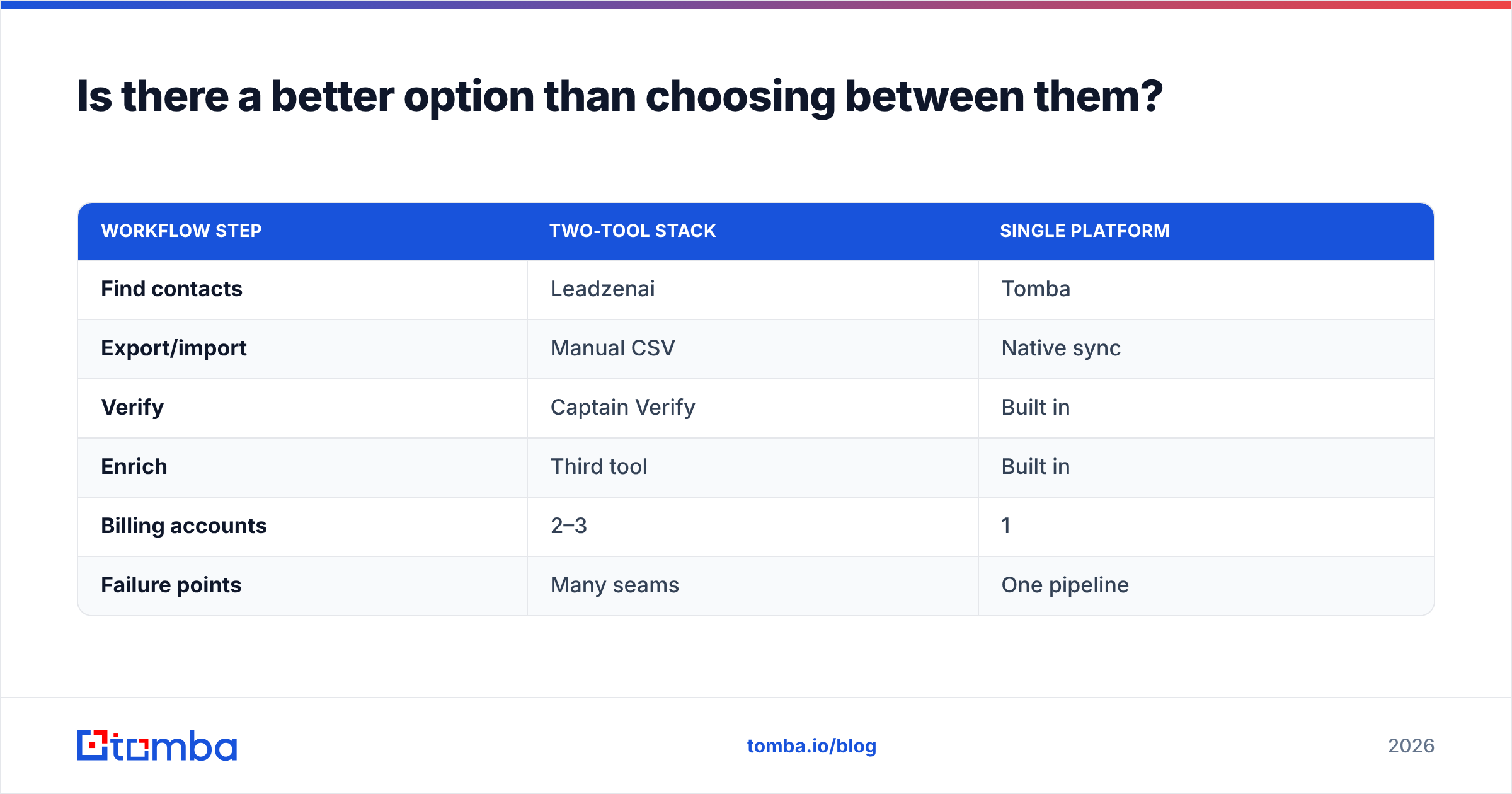
Here is the practical comparison of the workflow, not just the tools:
| Workflow step | Two-tool stack | Single platform |
|---|---|---|
| Find contacts | Leadzenai | Tomba |
| Export/import | Manual CSV | Native sync |
| Verify | Captain Verify | Built in |
| Enrich | Third tool | Built in |
| Billing accounts | 2–3 | 1 |
| Failure points | Many seams | One pipeline |
None of this means Captain Verify or Leadzenai are bad products. They are competent specialists. The argument is structural: paying two vendors to do two halves of one job usually costs more and breaks more than paying one vendor to do the whole job.
How should you actually decide?#
Run this quick decision filter against your own situation:
- Do you have lists but they bounce? → Verification problem. Captain Verify or a built-in verifier solves it.
- Are your lists empty or too small? → Discovery problem. Leadzenai or a finder solves it.
- Is your ICP outside India/APAC? → Test Leadzenai's match rate hard before buying; consider a global-data alternative.
- Do you do this every week at scale? → Subscriptions beat credits; a unified platform beats two subscriptions.
- Do you hate managing multiple tools? → Consolidate.
Most teams that start at "Captain Verify vs Leadzenai" end up realizing they were comparing two-thirds of a workflow and missing the third. The clean exit is a platform that does all three steps with one credit pool and one API.
External sanity checks worth doing before any purchase: read recent buyer reviews on G2 and Capterra for both tools — pay attention to complaints about data freshness and support response, since those are the two things feature pages never tell you. And if deliverability is your core worry, study the fundamentals of email deliverability so you know whether a verifier alone will even move your numbers.
The bottom line#
Captain Verify cleans, Leadzenai finds, and the workflow you actually run needs both plus enrichment. If your problem is narrow and regional, the specialists are fine. If you want one system that finds professional emails, verifies them on the spot, and enriches the record before it hits your sequencer, start with the Tomba Email Finder — there is a free tier with 25 searches a month, so you can benchmark it against both tools above on your own real accounts before spending a cent. Test the match rate, check the bounce rate, and let the numbers from your own ICP make the call.
// get started
Find, verify and enrich your first contacts today
Start on the free plan with 25 searches a month, then scale when your team is ready.
Free plan · No credit card required · GDPR & CCPA
// about the author