Captain Verify vs SalesIntel: Full 2026 Comparison
Captain Verify cleans your list; SalesIntel builds it. Here's how the two tools actually compare in 2026 — pricing, accuracy, use cases, and the gap a single email finder fills.
You are comparing two tools that barely overlap. That is the first thing to understand before you spend a dollar on either Captain Verify or SalesIntel.
Captain Verify is an email verification service: you feed it a list, it tells you which addresses are deliverable. SalesIntel is a B2B data intelligence platform: it hands you contacts, firmographics, and intent signals to build that list in the first place. People search "Captain Verify vs SalesIntel" because they want one tool to do both jobs — and neither was built to.
This guide breaks down what each tool actually does, where it wins, where it leaves a gap, and how to think about the full prospecting workflow instead of forcing one vendor to cover all of it.
TL;DR#
- Captain Verify is a focused, pay-as-you-go email verifier — strong for cleaning existing lists, weak as a source of new contacts.
- SalesIntel is an enterprise B2B data platform with human-verified contacts and intent data — powerful but priced for teams, not solo reps.
- They solve different stages of the same funnel: SalesIntel finds the lead, Captain Verify (or any verifier) confirms the address is safe to send.
- Most teams overpay by buying both when a single email finder with built-in verification covers the middle ground.
- If you mainly need accurate emails by domain or name, a combined finder + email verifier is cheaper and simpler than stitching two specialists together.
What is Captain Verify?#
Captain Verify is a French-built email verification and validation tool. Its core promise is simple: upload a list of email addresses and get back a clean version with invalid, risky, and undeliverable addresses flagged. It checks syntax, domain and MX records, runs SMTP probes, and detects disposable addresses, role accounts (like info@ or sales@), and catch-all domains.
It also offers a few adjacent features — a bulk verification interface, an API, and basic SMS/phone validation — but verification is the heart of the product. Pricing is credit-based and pay-as-you-go, which makes it attractive for one-off list cleaning before a campaign.
What Captain Verify does not do is generate contacts. It cannot tell you the email of a VP of Marketing at a company you've never contacted. You have to bring the addresses; it only judges them. If your problem is "I have a messy 50,000-row list and I'm scared of bouncing," Captain Verify is a reasonable answer. If your problem is "I have no list," it does nothing for you.

What is SalesIntel?#
SalesIntel sits at the opposite end of the funnel. It is a B2B data and sales intelligence platform aimed at marketing and sales teams that need volume and depth: direct dials, verified business emails, firmographic and technographic filters, and buyer intent data sourced through partners.
Its differentiator is "human-verified" contacts — SalesIntel markets a research-on-demand model where a team re-verifies records so accuracy stays high over time. That matters because B2B data decays fast; people change jobs constantly, and a contact accurate in January can be dead by June.
SalesIntel is built for revenue operations and demand-gen teams running account-based plays. You filter by industry, company size, technology stack, and intent, then push contacts into your CRM. It is genuinely strong at what it does — and it is priced accordingly, with annual contracts that put it out of reach for individual founders or small teams testing outbound.
The catch: SalesIntel is a database, not a precision lookup. When you need the single correct email for one specific person at one specific company — not a filtered list of 800 lookalikes — a large database is the wrong shape of tool.

Captain Verify vs SalesIntel: how do they compare?#
Here is the head-to-head on the attributes that actually drive a buying decision. Note how rarely the two tools compete on the same row — that is the whole point.
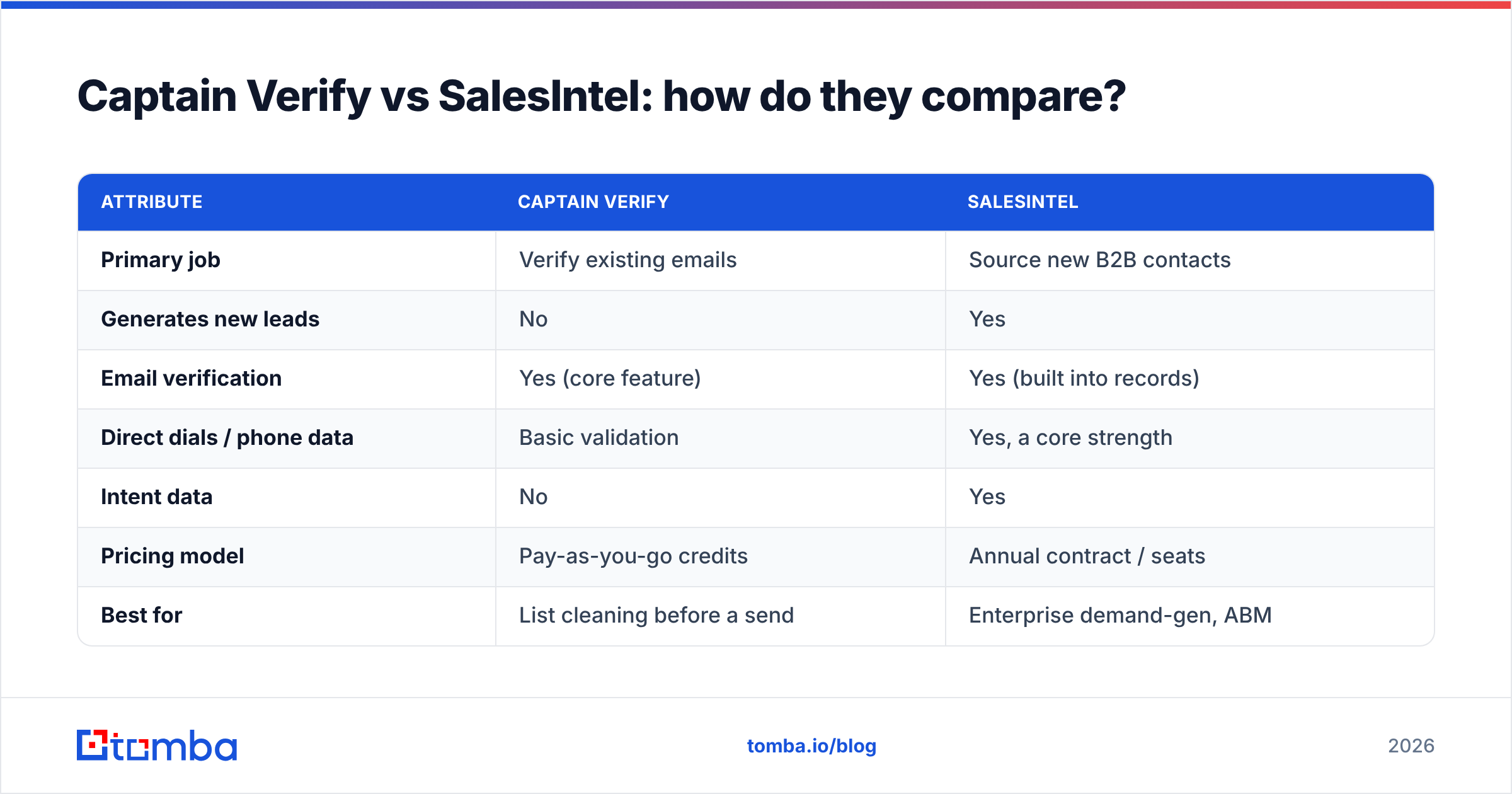
| Attribute | Captain Verify | SalesIntel |
|---|---|---|
| Primary job | Verify existing emails | Source new B2B contacts |
| Generates new leads | No | Yes |
| Email verification | Yes (core feature) | Yes (built into records) |
| Direct dials / phone data | Basic validation | Yes, a core strength |
| Intent data | No | Yes |
| Pricing model | Pay-as-you-go credits | Annual contract / seats |
| Best for | List cleaning before a send | Enterprise demand-gen, ABM |
| Solo / small-team friendly | Yes | No |
| Free trial / tier | Free credits to start | Demo / sales-led |
Read the table top to bottom and the verdict writes itself: this is not "which is better," it's "which problem do you have." Captain Verify is a scalpel for deliverability. SalesIntel is a firehose for pipeline. Buying one expecting it to do the other's job is how teams end up frustrated and over-budget.
Which one should you choose?#
Choose based on the bottleneck in your funnel, not on feature lists.
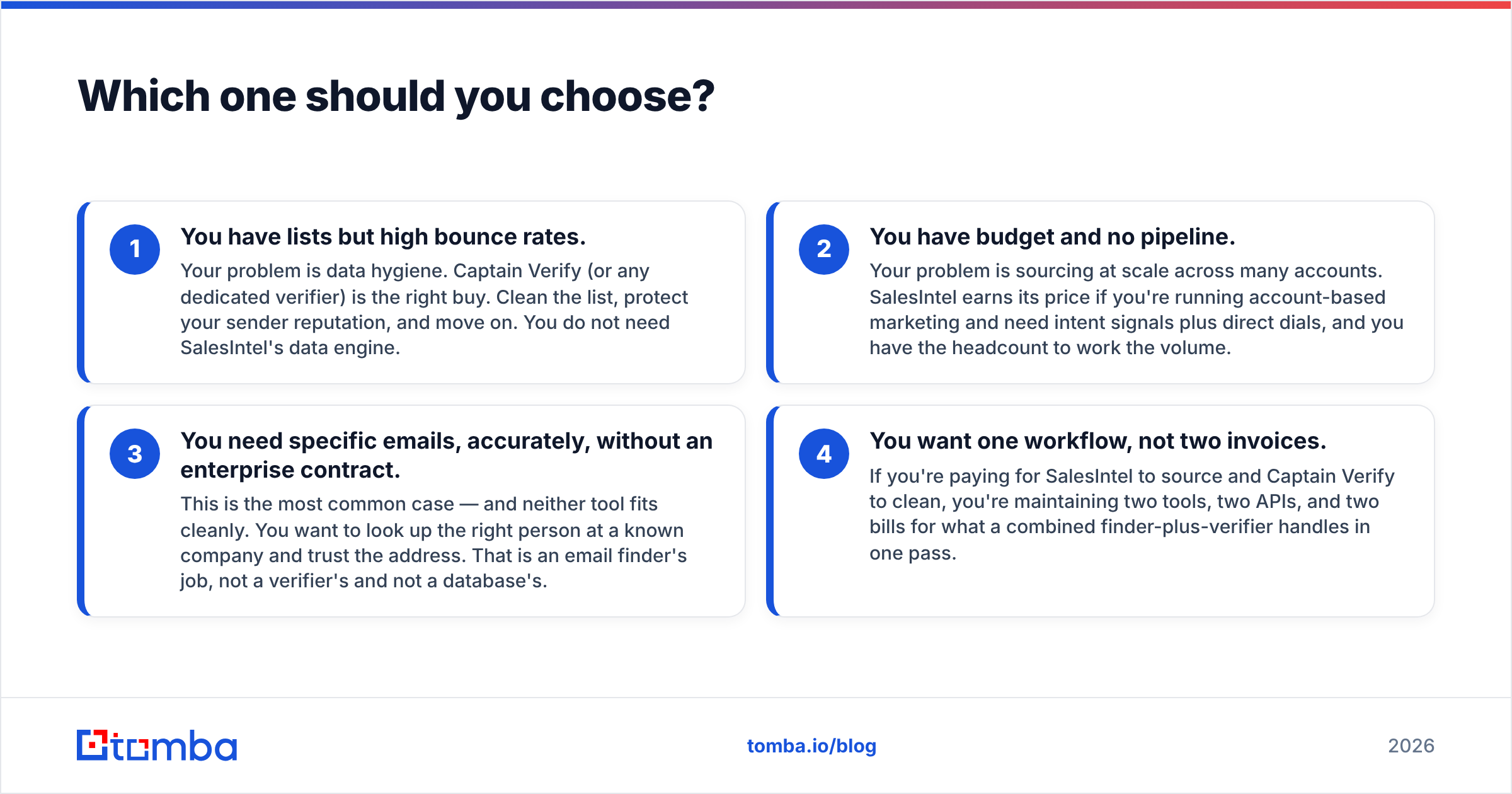
- You have lists but high bounce rates. Your problem is data hygiene. Captain Verify (or any dedicated verifier) is the right buy. Clean the list, protect your sender reputation, and move on. You do not need SalesIntel's data engine.
- You have budget and no pipeline. Your problem is sourcing at scale across many accounts. SalesIntel earns its price if you're running account-based marketing and need intent signals plus direct dials, and you have the headcount to work the volume.
- You need specific emails, accurately, without an enterprise contract. This is the most common case — and neither tool fits cleanly. You want to look up the right person at a known company and trust the address. That is an email finder's job, not a verifier's and not a database's.
- You want one workflow, not two invoices. If you're paying for SalesIntel to source and Captain Verify to clean, you're maintaining two tools, two APIs, and two bills for what a combined finder-plus-verifier handles in one pass.
The third and fourth cases describe most small and mid-sized B2B teams. They don't have SalesIntel money, and a standalone verifier solves only half the problem.

Where does an email finder fit in?#
An email finder closes the gap between "I know who I want to reach" and "I have a verified address for them." It is the missing middle that the Captain-Verify-vs-SalesIntel framing ignores.
Here's the practical workflow most teams actually need:
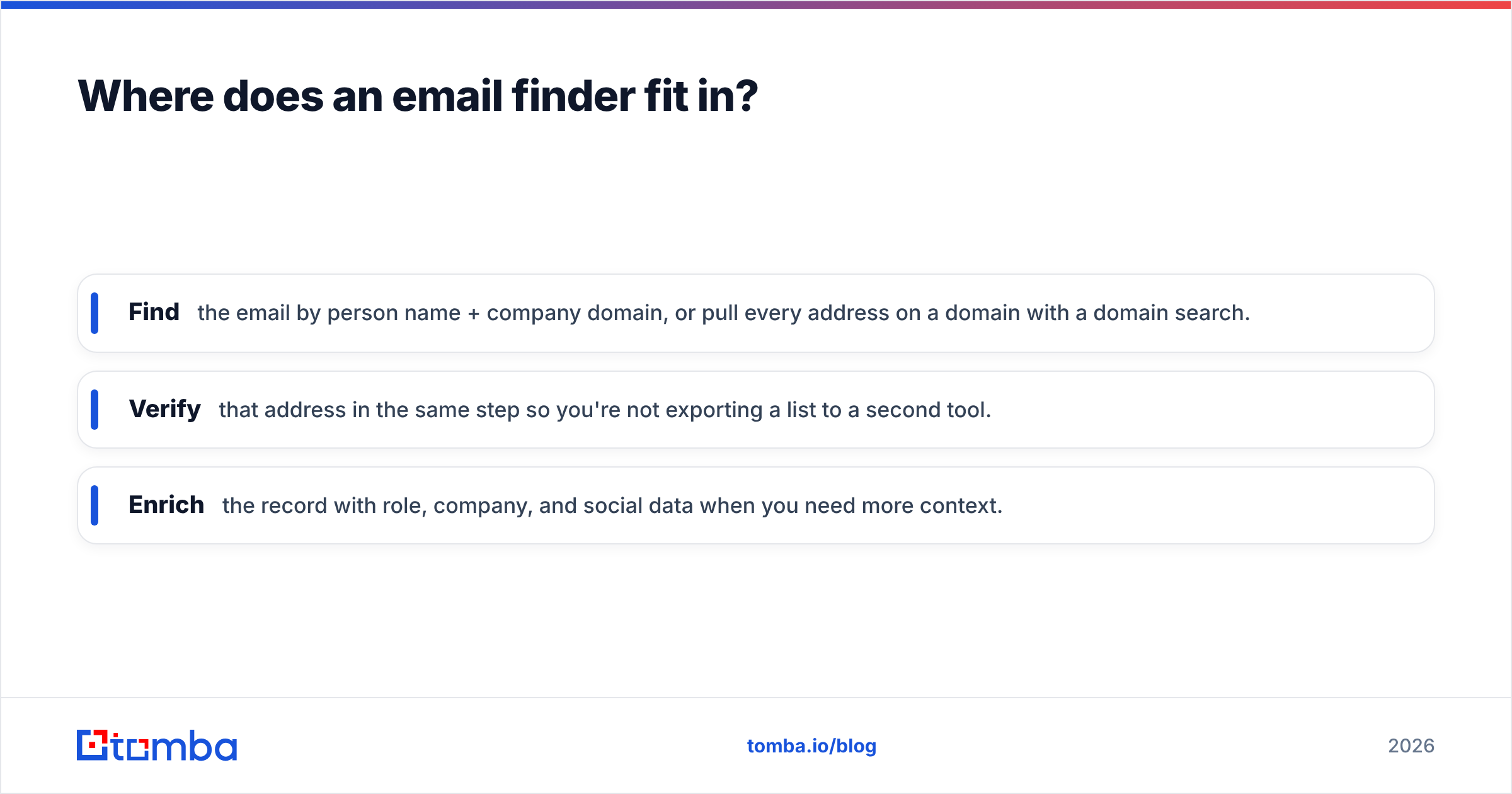
- Find the email by person name + company domain, or pull every address on a domain with a domain search.
- Verify that address in the same step so you're not exporting a list to a second tool.
- Enrich the record with role, company, and social data when you need more context.
Tomba is built around exactly this loop. The email finder locates professional addresses by name or domain, and an integrated verifier confirms deliverability before the contact ever reaches your sequence — so you get SalesIntel-style sourcing precision and Captain-Verify-style hygiene without running two subscriptions. For larger jobs, a bulk email finder processes thousands of names at once, and the Tomba API drops the same capability into your own stack.
This doesn't make SalesIntel or Captain Verify bad tools. It means that for the common case — accurate emails for known targets, without an enterprise contract — a single finder is the more efficient shape.
How accurate is each option, really?#
Accuracy is where buyers get burned, so be precise about what each tool measures.
Captain Verify measures deliverability — will this address bounce? That's valuable, but it assumes you already have the address. A verifier can confirm an email is live and still leave you with the wrong person if your source data was bad.
SalesIntel measures freshness and coverage — is this contact current, and do we have it? Its human-verification model is a genuine strength here, but coverage on smaller companies, niche industries, and non-US markets is uneven, as it is for every large B2B database. Independent reviews on G2 and Capterra reflect this: strong on enterprise US data, thinner outside it.
An email finder is judged on a third metric: match rate and confidence per lookup — for this exact person, do we return the right address, and how sure are we? The strongest finders pair a confidence score with an immediate verification check. If accuracy is your top concern, look at how a vendor sources and confirms data; Tomba documents its approach on its data sources page. Treat any single "97% accurate" headline number skeptically — accuracy always depends on the segment you're searching.
For reference on the deliverability side of the equation, HubSpot's research on email engagement is a useful reminder that a verified address is necessary but not sufficient — your targeting and copy still decide whether the email works.
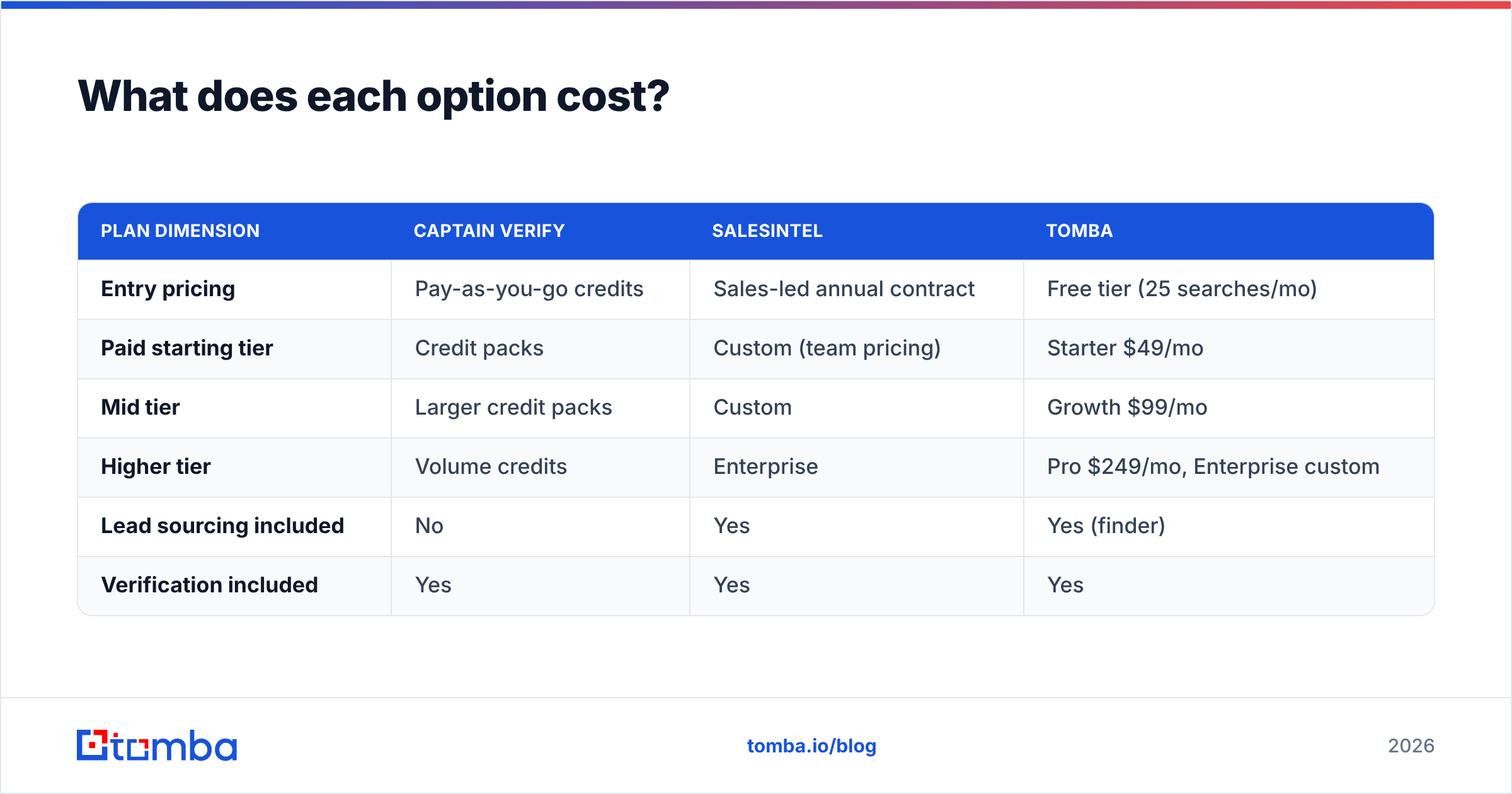
What does each option cost?#
Cost only makes sense relative to the job, so compare the spend against the outcome you need.
| Plan dimension | Captain Verify | SalesIntel | Tomba |
|---|---|---|---|
| Entry pricing | Pay-as-you-go credits | Sales-led annual contract | Free tier (25 searches/mo) |
| Paid starting tier | Credit packs | Custom (team pricing) | Starter $49/mo |
| Mid tier | Larger credit packs | Custom | Growth $99/mo |
| Higher tier | Volume credits | Enterprise | Pro $249/mo, Enterprise custom |
| Lead sourcing included | No | Yes | Yes (finder) |
| Verification included | Yes | Yes | Yes |
SalesIntel's annual commitment makes sense for funded teams running ABM at scale. Captain Verify's credit model is fair for occasional cleanups. But if you want predictable monthly pricing that bundles finding and verifying, a combined tool is usually the lowest total cost — see full Tomba pricing for the per-plan breakdown. The trap is paying for two specialists when one generalist closes your actual gap.
Can you combine them?#
Yes, and some teams do — but be honest about whether you need to.
A maximal stack looks like: SalesIntel for sourcing and intent, Captain Verify for a final deliverability pass, and a CRM to hold it all. That's three tools, three integrations, and three renewal dates. For a large enterprise demand-gen org, the redundancy can be worth it.
For everyone else, the combination is overkill. A single email finder with built-in verification covers sourcing-by-target and hygiene in one workflow, and you can still layer a verifier later if your volume justifies a second deliverability check. Start lean. Add specialists only when a specific, measured problem demands one — not because a comparison article listed two product categories side by side.
If your bottleneck is genuinely enterprise-scale intent data, SalesIntel is the better fit and a finder won't replace it. If your bottleneck is "I keep guessing email formats and hoping they land," that's the exact problem a finder solves, and neither Captain Verify nor SalesIntel was designed for it.
The bottom line#
Captain Verify and SalesIntel aren't really competitors — they're two ends of the same funnel. Captain Verify cleans the list; SalesIntel builds it. The reason "Captain Verify vs SalesIntel" is a confusing search is that most people typing it actually need the piece in the middle: accurate emails for the specific people they already want to reach.
That's the job an email finder does best. Tomba's Email Finder locates professional email addresses by name, company, or domain and verifies them in the same step — so you skip the two-tool, two-invoice setup and get clean, ready-to-send contacts from a single workflow. Start on the free tier with 25 searches a month, and only reach for a heavyweight database or a standalone verifier when your pipeline actually outgrows it. Build your list right the first time, and you'll spend far less time cleaning it later.
Ready to find emails that actually work?
Join 150,000+ professionals who stopped guessing and started sending. Free credits on signup — no credit card required.
Get the Tomba newsletter
Practical outbound tactics and product updates — once every two weeks.
About the author