Captain Verify vs Seamless.AI 2026: Which Email Tool Wins?
Captain Verify cleans lists; Seamless.AI builds them. We break down accuracy, pricing, and use cases so you pick the right B2B tool in 2026 — plus a faster, cheaper third option.
You typed "Captain Verify vs Seamless.AI" into a search bar, and you probably already sense the problem: these two tools barely do the same job. One scrubs the email list you already have. The other tries to build that list from scratch. Comparing them head-to-head is like comparing a dishwasher to a grocery store — both touch your dinner, but they solve different halves of the problem.
This guide cuts through that confusion. You'll see what each tool actually does, where each one wins, what they cost in 2026, and how to decide which (if either) belongs in your stack.
TL;DR#
- Captain Verify is an email verification tool. It takes a list you already own and tells you which addresses are valid, risky, or dead. It does not find new contacts.
- Seamless.AI is a sales-intelligence and lead database. It finds emails and phone numbers in real time and pushes them into your CRM — but its data accuracy and aggressive sales contracts are common complaints.
- They are complements, not competitors. A realistic stack uses a finder to source contacts and a verifier to clean them before you send.
- Pricing models are wildly different. Captain Verify is pay-as-you-go credits; Seamless.AI is a per-seat annual contract that often runs into the thousands.
- If you want both jobs in one affordable tool, a combined finder-plus-verifier like Tomba covers sourcing and validation from a transparent $49/mo plan.
What is Captain Verify?#
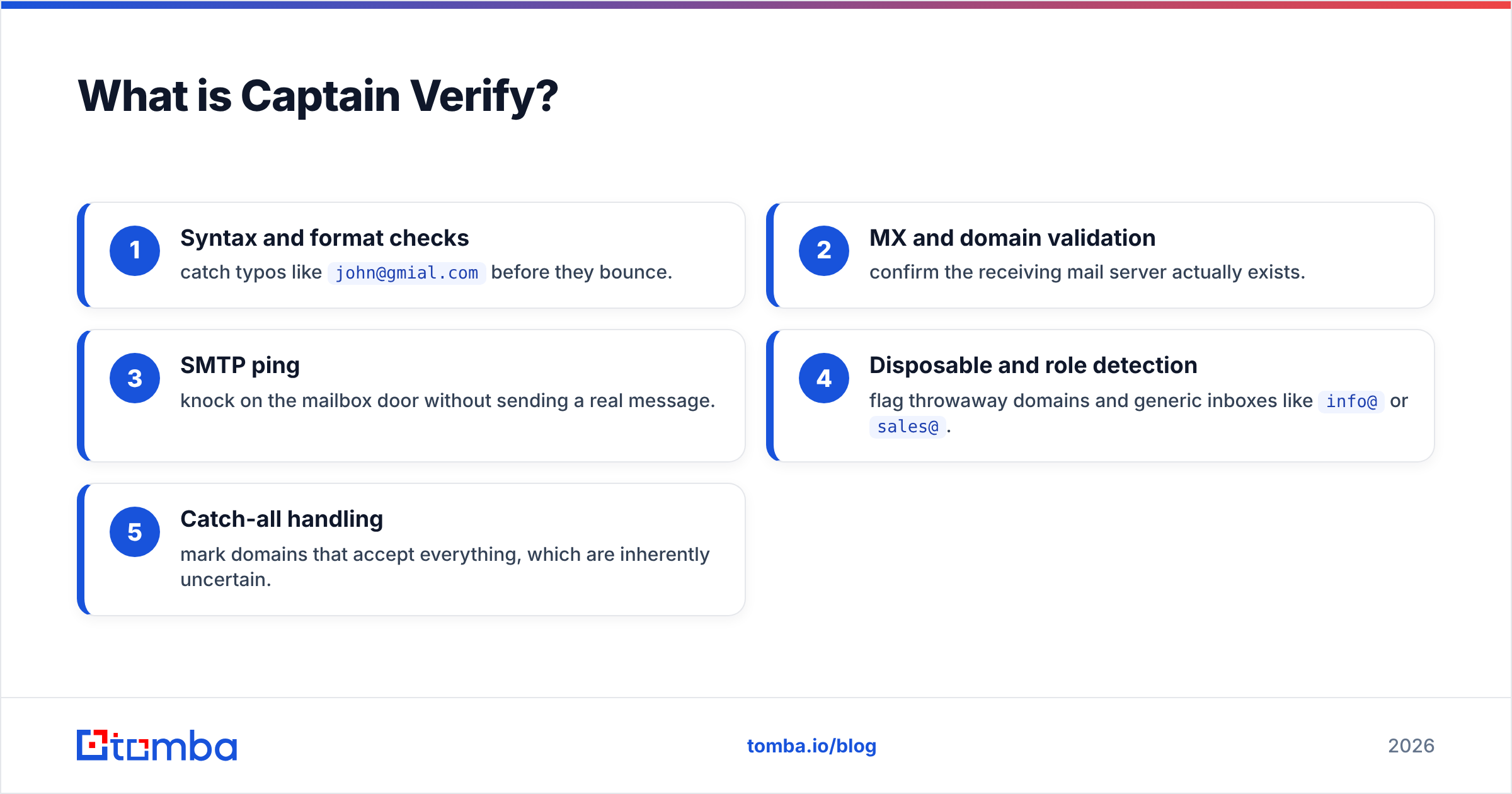
Captain Verify is a bulk email verification service. Think of it as spell-check for your contact list: you feed it a CSV of addresses, and it checks each one against syntax rules, domain records, and SMTP responses, then hands back a clean file with each address labeled deliverable, risky, or invalid.
Its core jobs are narrow and well-defined:
- Syntax and format checks — catch typos like
john@gmial.combefore they bounce. - MX and domain validation — confirm the receiving mail server actually exists.
- SMTP ping — knock on the mailbox door without sending a real message.
- Disposable and role detection — flag throwaway domains and generic inboxes like
info@orsales@. - Catch-all handling — mark domains that accept everything, which are inherently uncertain.
What Captain Verify deliberately does not do is find new people. If you have no list, Captain Verify has nothing to work on. It's a cleaning tool, full stop — and a competent one. For teams whose only pain is high bounce rates, that focus is a feature, not a limitation.
What is Seamless.AI?#
Seamless.AI sits at the opposite end of the workflow. It's a sales-intelligence platform that searches the web in real time to assemble contact records — names, job titles, company data, emails, and direct-dial phone numbers — and feeds them into your outreach tools.
Where a verifier validates what you have, Seamless.AI tries to generate what you don't. You search by company, role, or industry, build a list of prospects, and export. It leans heavily on AI-driven "research engines" that scrape and stitch data together at query time, which is why coverage can feel impressively broad on one search and thin on the next.
The trade-off shows up in two places that buyers consistently flag on review sites like G2: data accuracy (real-time scraping produces stale or wrong emails more often than a maintained database) and contracts (annual per-seat pricing with credit caps and renewal terms that surprise people). Seamless.AI is powerful when its data is right; the question is how often it's right for your segment.
Captain Verify vs Seamless.AI: how do they actually compare?#
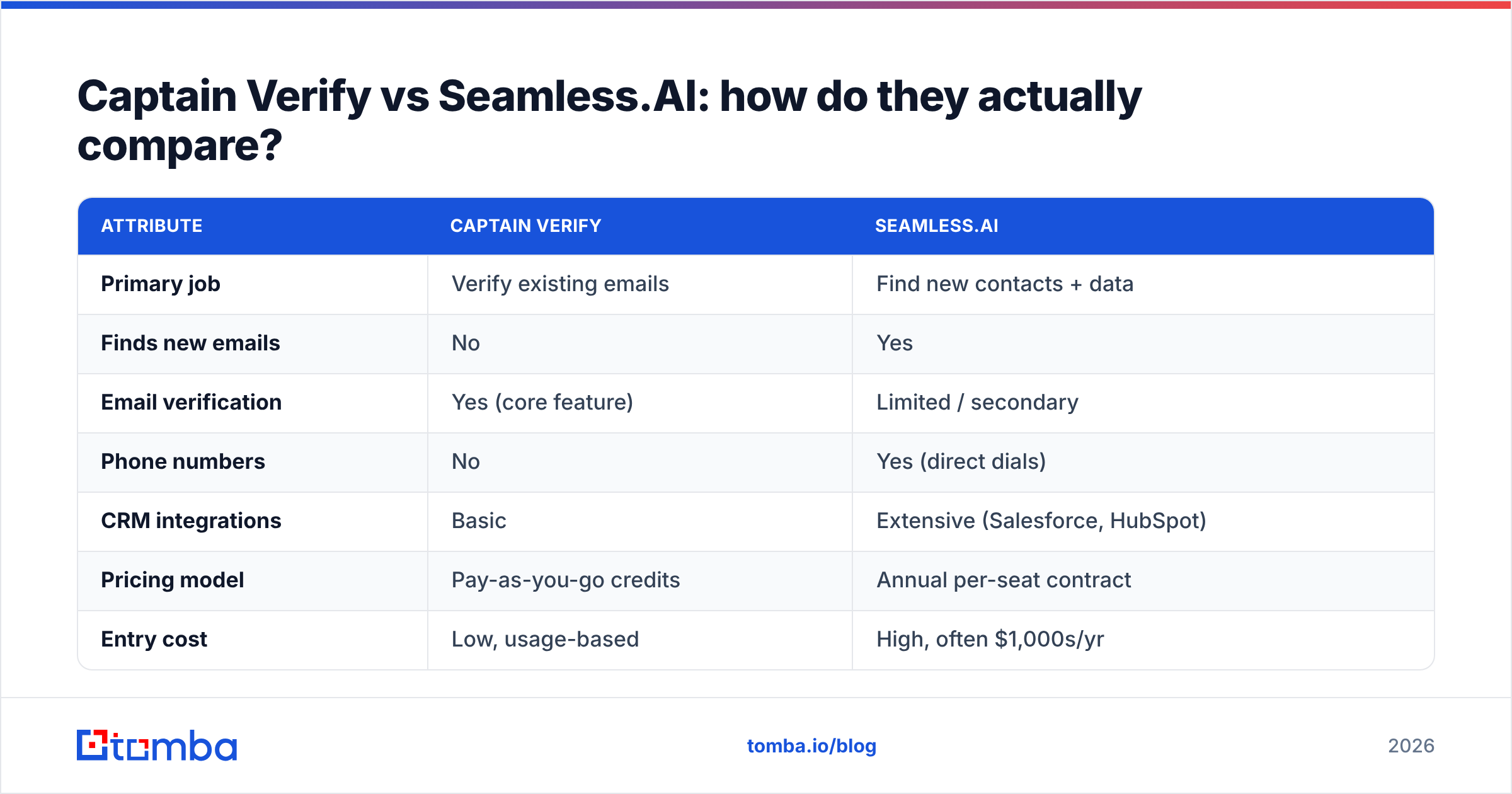
Here's the honest side-by-side. Notice that most rows aren't "better/worse" — they're "different job entirely."
| Attribute | Captain Verify | Seamless.AI |
|---|---|---|
| Primary job | Verify existing emails | Find new contacts + data |
| Finds new emails | No | Yes |
| Email verification | Yes (core feature) | Limited / secondary |
| Phone numbers | No | Yes (direct dials) |
| CRM integrations | Basic | Extensive (Salesforce, HubSpot) |
| Pricing model | Pay-as-you-go credits | Annual per-seat contract |
| Entry cost | Low, usage-based | High, often $1,000s/yr |
| Best for | Cleaning lists | Building lists |
| Common complaint | No sourcing | Data accuracy, contracts |
The takeaway: if you ask "which is better," you're asking the wrong question. Ask "which job do I need done." If your lists bounce, you need a verifier. If your pipeline is empty, you need a finder. Most growing teams eventually need both — which is exactly why running these two tools side by side gets expensive fast.
Which one do you actually need?#
Match the tool to your bottleneck. Use this quick decision framework:
- Your bounce rate is above 3% and sender reputation is slipping → You have a list hygiene problem. A verifier like Captain Verify (or a built-in email verifier) is the fix. Sourcing more bad data won't help.
- Your reps have no one to call → You have a sourcing problem. You need a finder that returns fresh contacts, and Seamless.AI is built for that.
- You're scaling outbound and need volume → You need both jobs handled, ideally in one place so you're not paying two vendors and reconciling two exports.
- You care about predictable cost → Avoid annual per-seat lock-in until your volume justifies it. Credit-based or flat monthly plans keep spend tied to usage.
This is the gap most "X vs Y" comparisons miss. The real competitor to both Captain Verify and Seamless.AI is a platform that finds and verifies in a single workflow, so you're not duct-taping a scraper to a scrubber.
Where does Tomba fit in this comparison?#
Tomba collapses the two jobs into one tool. It's primarily an email finder — give it a domain, a name, or a company and it returns professional addresses — but every result runs through verification before it lands in your export. So you get sourcing (Seamless.AI's strength) and validation (Captain Verify's strength) without buying two products.
That matters for the accuracy concern. A finder that doesn't verify hands you guesses; a verifier with no finder hands you a clean version of a list you still had to source elsewhere. Pairing the two at the point of discovery is what keeps bounce rates down and reps productive.
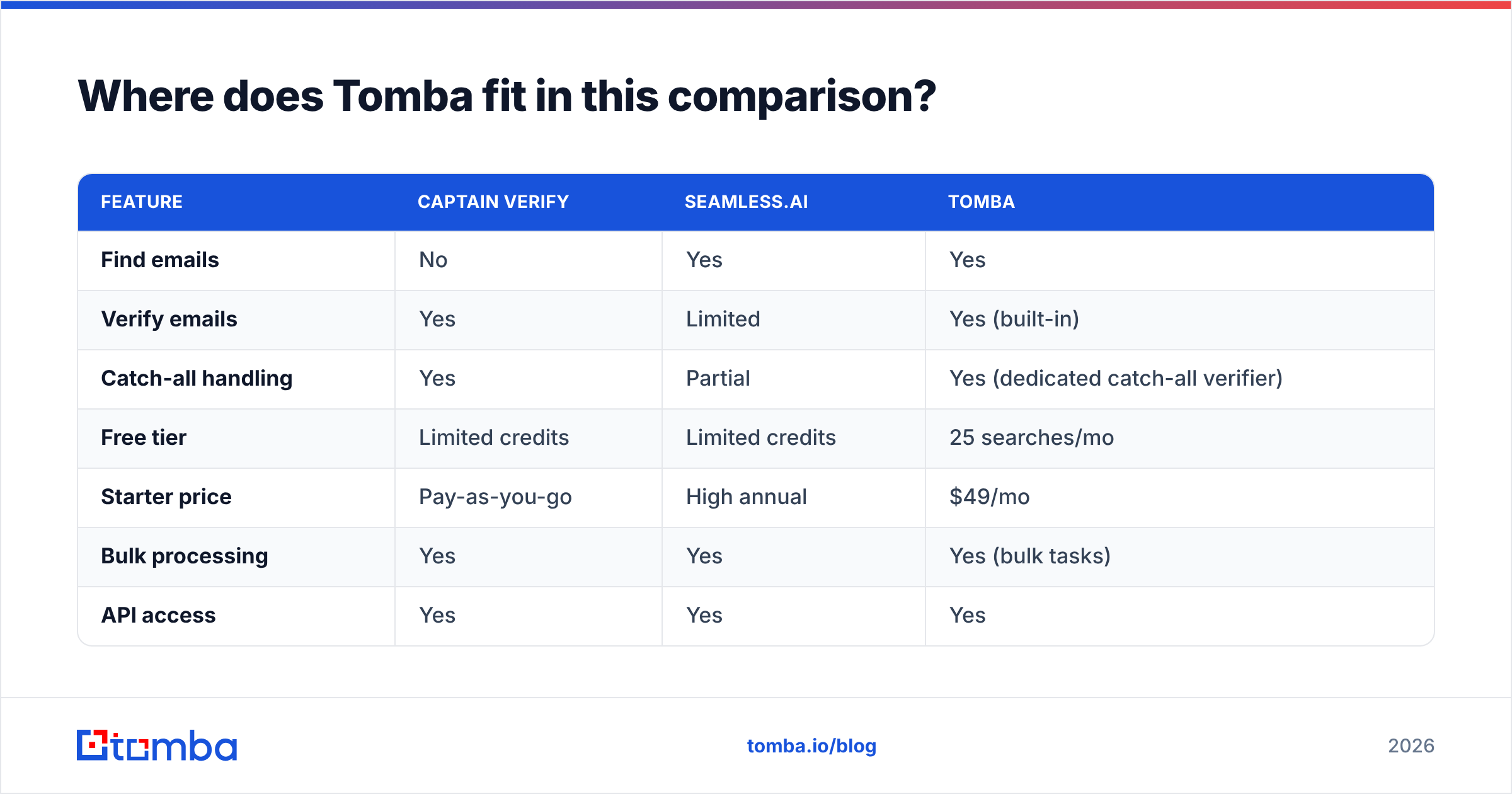
Here's how the three stack up on the dimensions buyers care about most:
| Feature | Captain Verify | Seamless.AI | Tomba |
|---|---|---|---|
| Find emails | No | Yes | Yes |
| Verify emails | Yes | Limited | Yes (built-in) |
| Catch-all handling | Yes | Partial | Yes (dedicated catch-all verifier) |
| Free tier | Limited credits | Limited credits | 25 searches/mo |
| Starter price | Pay-as-you-go | High annual | $49/mo |
| Bulk processing | Yes | Yes | Yes (bulk tasks) |
| API access | Yes | Yes | Yes |
| Contract lock-in | No | Often annual | No |
If you're specifically shopping to replace Seamless.AI's contract model, Tomba publishes a direct Seamless.AI alternative breakdown worth reading before you renew.
How accurate is each tool's data?#
Accuracy splits along the find-vs-verify line, and it's the single biggest driver of wasted send volume.
Captain Verify's accuracy is verification accuracy — how reliably it labels an address valid or invalid. Because it's checking addresses you already have, its job is constrained and generally dependable. The ceiling is that it can only judge the data you give it; it can't improve coverage or fill gaps.
Seamless.AI's accuracy is sourcing accuracy — how often the contact it surfaces is real, current, and reachable. Real-time scraping is the double-edged sword here: it can find very recent records, but it also serves stale or stitched-together data, which is the most frequent theme in critical reviews. You often won't know a Seamless.AI email is wrong until it bounces.
The combined approach is why find-then-verify wins. When sourcing and verification happen in the same pass, bad guesses get caught before they ever reach your sequence. If you want to understand where contact data comes from and how it's validated, Tomba documents its data sources openly — a useful contrast to the black-box feel of pure scraping engines.
A practical rule: never trust a found email until it's been verified. Whatever combination of tools you choose, that two-step is non-negotiable for protecting deliverability.
What about pricing in 2026?#
This is where the two tools diverge most sharply, and where budget-conscious teams feel the difference.
- Captain Verify uses pay-as-you-go credits. You buy a block of verifications and burn them as needed. Low commitment, costs scale with usage, and there's no seat tax. The catch: it's verification only, so it's one line item in a larger stack.
- Seamless.AI uses annual, per-seat contracts. Public pricing is famously opaque, and real-world deals frequently land in the thousands of dollars per year with credit caps and renewal clauses. Powerful, but a heavy commitment for small teams — and the contract terms are a recurring source of buyer frustration.
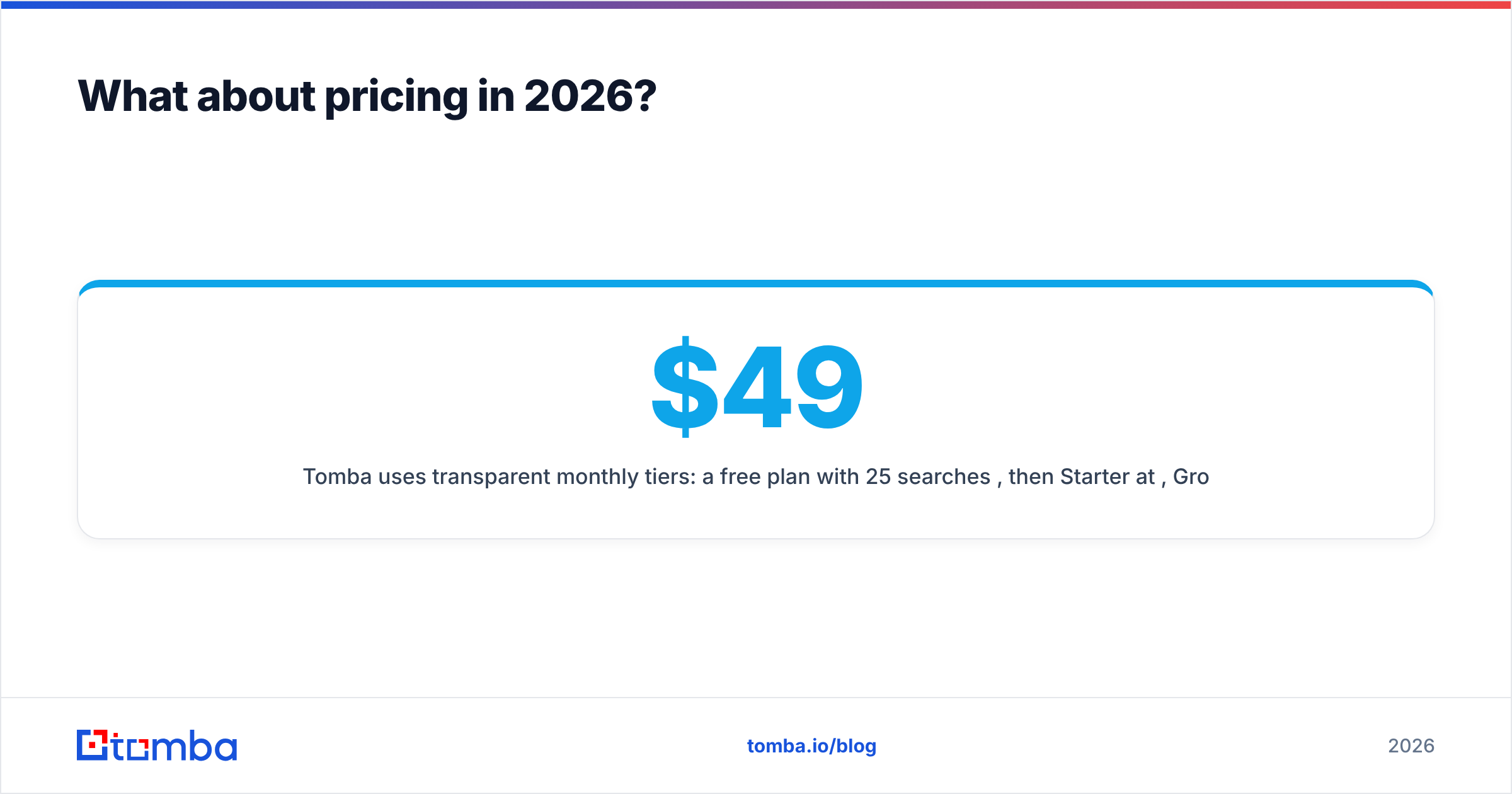
- Tomba uses transparent monthly tiers: a free plan with 25 searches/mo, then Starter at $49/mo, Growth at $99/mo, Pro at $249/mo, and custom Enterprise. Both finding and verifying are included, with no seat lock-in. Full Tomba pricing is public, so you can model cost before you commit.
The strategic point: if you'd otherwise pay for Captain Verify and a finder like Seamless.AI, a combined tool usually costs less than either contract alone — and removes the reconciliation headache of merging two exports.
Can you use Captain Verify and Seamless.AI together?#
Yes, and for some teams that's the intended setup: Seamless.AI sources the contacts, Captain Verify cleans them before you send. It works. The downsides are cost (two subscriptions), workflow friction (export, import, re-export), and the accuracy lag — you're verifying after sourcing, so you pay to scrape records you'll then throw away as invalid.
A single platform that verifies at the moment of discovery avoids paying for data you can't use. That's the core efficiency argument for consolidating, and it gets stronger the higher your volume climbs. You can confirm the official capabilities of each tool on their own sites — Seamless.AI and Captain Verify — but for most outbound teams, the math favors one tool that does both jobs cleanly.
So which should you choose?#
Decide by your dominant pain, not by feature count:
- Choose Captain Verify if your only problem is list hygiene, you already source contacts elsewhere, and you want pure pay-as-you-go verification with zero commitment.
- Choose Seamless.AI if you need high-volume sourcing with direct-dial phone numbers and deep Salesforce/HubSpot integration, your segment is well-covered by its database, and you can absorb an annual per-seat contract.
- Choose a combined tool like Tomba if you want both sourcing and verification in one transparent, monthly-billed product — without contract lock-in and without paying two vendors for two halves of the same job.
For the majority of B2B teams running outbound, the consolidated path is the pragmatic choice. You find verified emails in one step, keep bounce rates low by design, and keep spend predictable.
Get verified B2B emails without the contract#
If "Captain Verify vs Seamless.AI" was really a search for one tool that finds clean, sendable contacts, start with the Tomba Email Finder. Search by domain, name, or company, get addresses that are verified before they ever hit your export, and run it all from a free tier (25 searches/mo) or a flat $49/mo Starter plan — no per-seat annual contract, no separate verification bill. Source and scrub in one workflow, protect your sender reputation, and put your reps back in front of real prospects.
// get started
Find, verify and enrich your first contacts today
Start on the free plan with 25 searches a month, then scale when your team is ready.
Free plan · No credit card required · GDPR & CCPA
// about the author