Captain Verify vs Warpleads: Which Tool Wins in 2026?
Captain Verify nails email verification but stops there. Warpleads sells bulk lead lists. Here's how the two compare in 2026 — and why a finder-plus-verifier stack often beats either one on its own.
Captain Verify vs Warpleads: Which Tool Wins in 2026?
Pitting Captain Verify vs Warpleads is a bit like comparing a quality-control inspector with a wholesale parts supplier. One checks that what you already have is good. The other hands you a giant pile of raw material. They sit at opposite ends of the outbound pipeline, and most teams who shortlist both eventually realize they were never true substitutes.
This guide breaks down what each tool actually does, where each one is strong, where each leaves a gap, and how to decide which (if either) belongs in your stack for 2026.
TL;DR#
- Captain Verify is a focused email verification service: upload a list, get back valid/invalid/risky results, pay per credit.
- Warpleads is a lead-generation platform built around exporting large volumes of B2B contacts, often on an unlimited-export model.
- They solve different problems — verification vs sourcing — so "which is better" depends entirely on whether your bottleneck is bad data you have or no data at all.
- Neither finds emails by name and domain on demand the way a dedicated finder does, and Warpleads-style bulk lists still need independent verification before you send.
- For most B2B teams, a combined find → verify → enrich workflow (like Tomba's) removes the need to stitch two single-purpose tools together.
What is Captain Verify?#
Captain Verify is a French email verification tool. You feed it an email list and it runs syntax checks, domain and MX record checks, SMTP pings, and role/disposable detection, then returns a status for each address: valid, invalid, unknown, or risky. Pricing is credit-based and pay-as-you-go, which appeals to teams that verify in bursts rather than continuously. You can read more on the official Captain Verify site.
Think of it as a spell-checker for your mailing list. It does not write the list and it does not find new contacts — it tells you which of the addresses you already own are safe to send to. That single-purpose focus is its biggest strength and its biggest limit.
Where Captain Verify fits:
- Cleaning an existing CRM or newsletter list before a big send.
- One-off bulk cleans when you bought or inherited a questionable list.
- Reducing bounce rate to protect sender reputation and stay under your ESP's bounce threshold.
What is Warpleads?#
Warpleads is a lead-generation and data-export platform. Its pitch centers on volume: search a B2B database by filters (industry, title, geography, company size) and export contacts in bulk, frequently marketed with an unlimited-export angle. You can see the positioning on the Warpleads homepage. The promise is "stop paying per lead — export as many as you want."
That model is attractive when your motion is high-volume cold outreach and you burn through contacts fast. But unlimited export quietly shifts a cost onto you: data quality control. Large scraped or aggregated databases always contain stale, duplicated, and catch-all addresses, so a big export still has to be verified before it touches your sending domain.
Where Warpleads fits:
- High-volume outbound where you need thousands of raw contacts per month.
- Filling a top-of-funnel list fast when you have no existing data.
- Teams that already own a verification step and can absorb the cleanup.

Captain Verify vs Warpleads: how do they compare?#
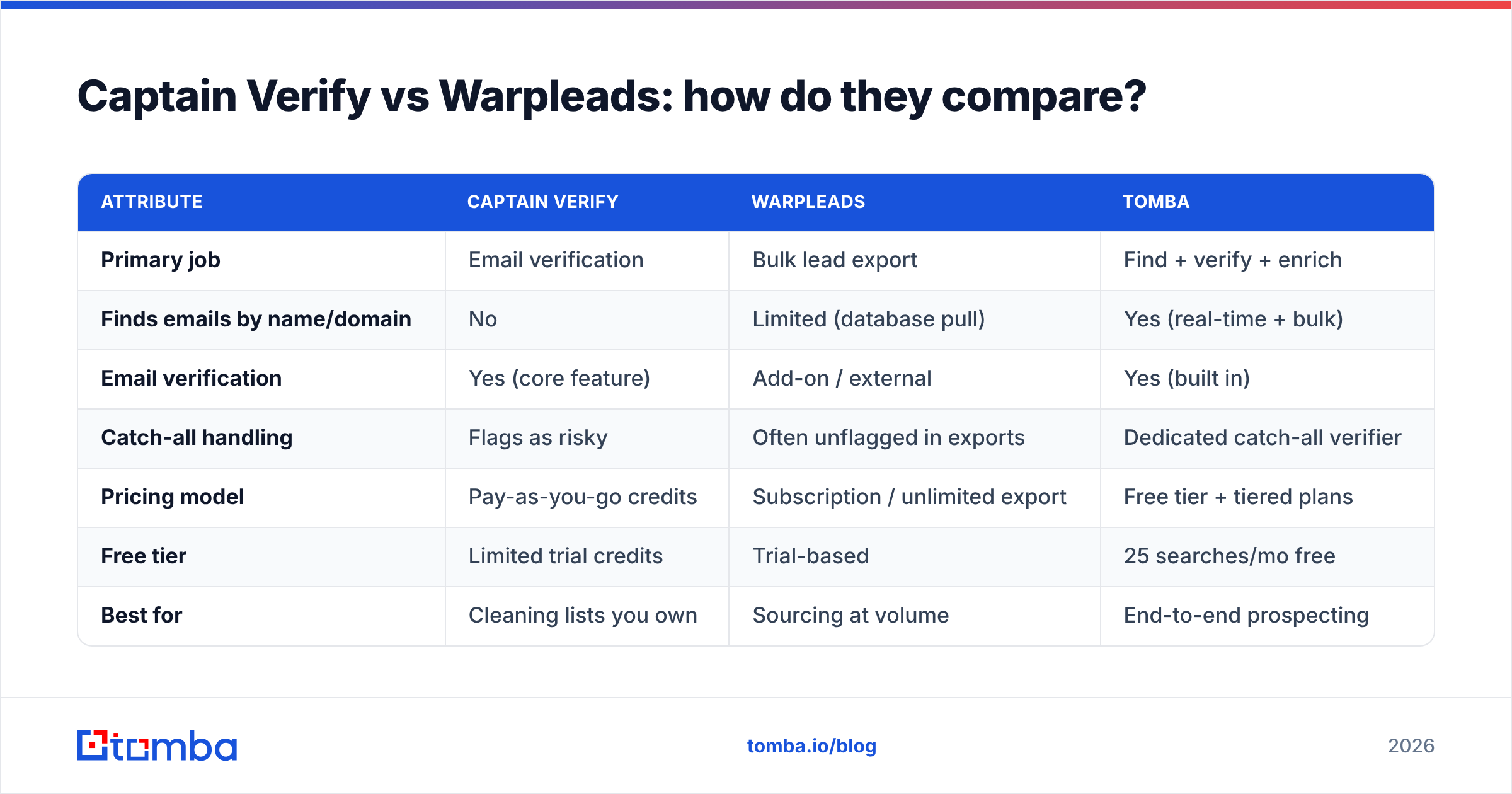
The honest answer is that they barely overlap. One is verification-only; the other is sourcing-first. Here is the side-by-side, with Tomba added as the all-in-one reference point:
| Attribute | Captain Verify | Warpleads | Tomba |
|---|---|---|---|
| Primary job | Email verification | Bulk lead export | Find + verify + enrich |
| Finds emails by name/domain | No | Limited (database pull) | Yes (real-time + bulk) |
| Email verification | Yes (core feature) | Add-on / external | Yes (built in) |
| Catch-all handling | Flags as risky | Often unflagged in exports | Dedicated catch-all verifier |
| Pricing model | Pay-as-you-go credits | Subscription / unlimited export | Free tier + tiered plans |
| Free tier | Limited trial credits | Trial-based | 25 searches/mo free |
| Best for | Cleaning lists you own | Sourcing at volume | End-to-end prospecting |
| API access | Yes | Yes | Yes |
A few things stand out. Captain Verify cannot generate a single new lead, so if your problem is "I have nobody to email," it is the wrong tool. Warpleads can hand you volume, but its exports still need a verification pass — which means a Warpleads-only setup is incomplete unless you bolt on something like Captain Verify anyway. That is exactly how teams end up paying for two tools to do one job.
Which problem are you actually solving?#
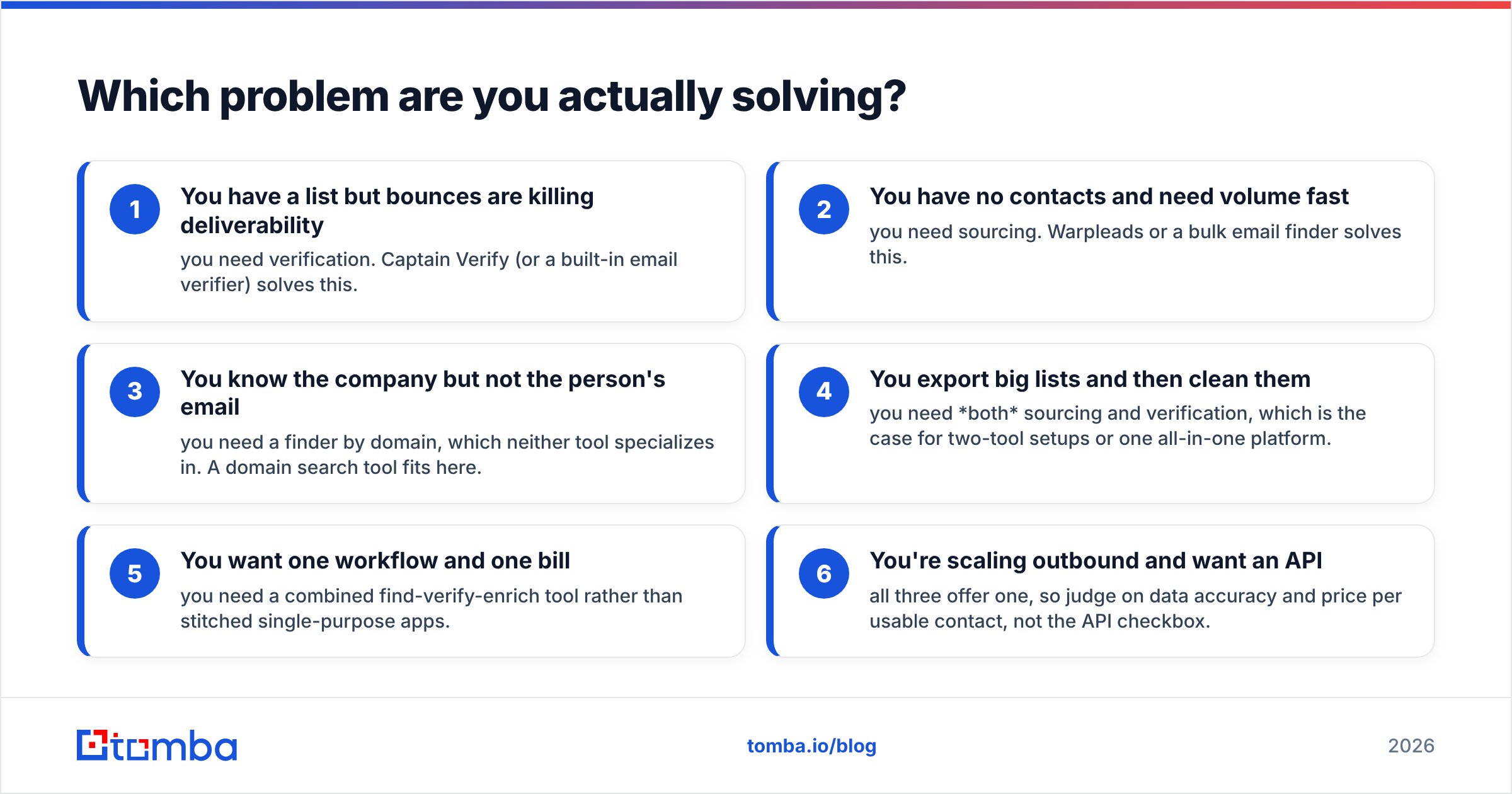
Conclusion first: pick by your bottleneck, not by feature count. Use this checklist to self-diagnose before you buy anything.
- You have a list but bounces are killing deliverability — you need verification. Captain Verify (or a built-in email verifier) solves this.
- You have no contacts and need volume fast — you need sourcing. Warpleads or a bulk email finder solves this.
- You know the company but not the person's email — you need a finder by domain, which neither tool specializes in. A domain search tool fits here.
- You export big lists and then clean them — you need both sourcing and verification, which is the case for two-tool setups or one all-in-one platform.
- You want one workflow and one bill — you need a combined find-verify-enrich tool rather than stitched single-purpose apps.
- You're scaling outbound and want an API — all three offer one, so judge on data accuracy and price per usable contact, not the API checkbox.
Most teams answer "yes" to items 3, 4, and 5 at once. That is the signal that two narrow tools will cost you more time and money than one platform that does the whole chain.
Is bulk export the same as good data?#
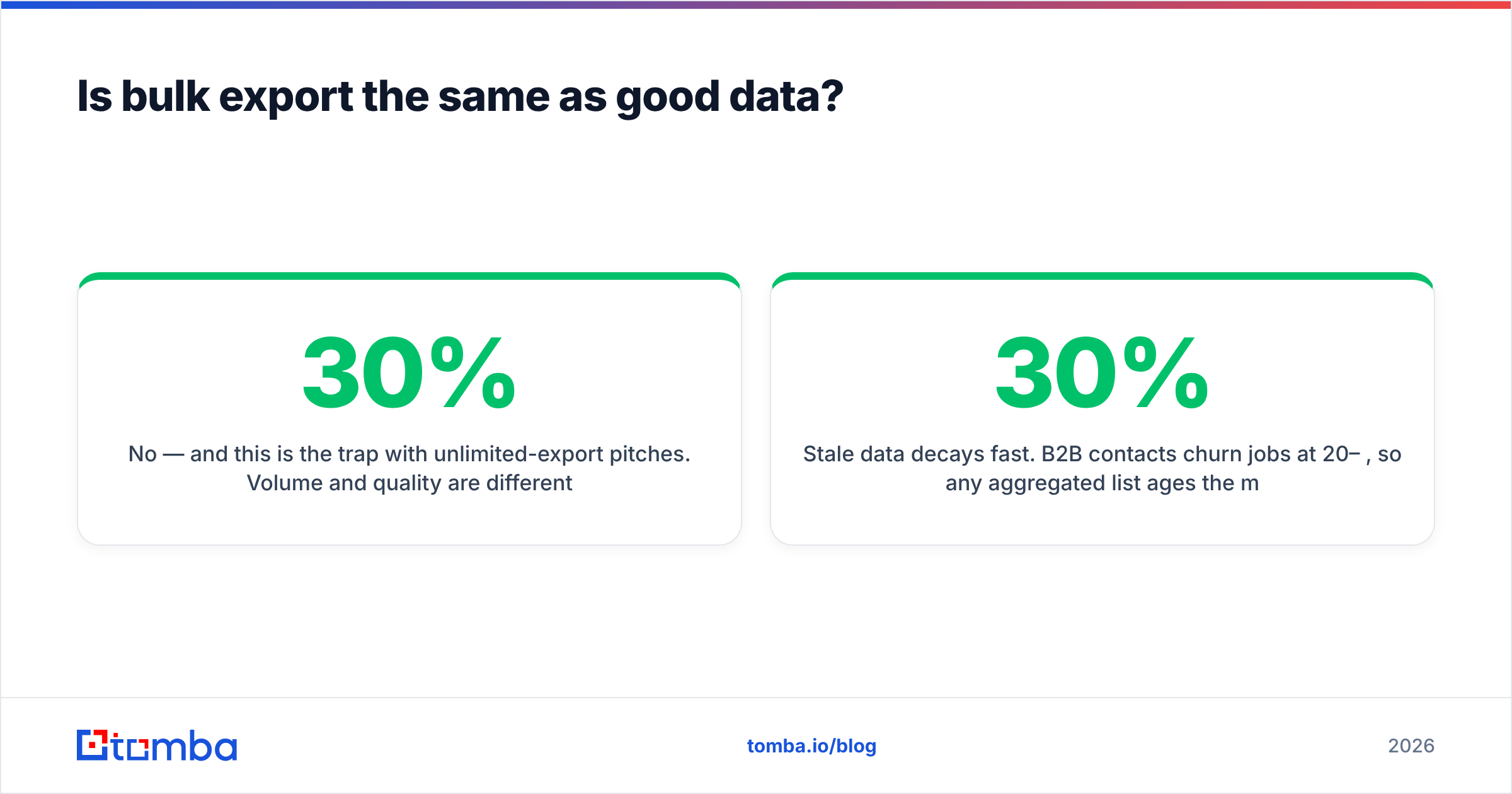
No — and this is the trap with unlimited-export pitches. Volume and quality are different axes. A database that lets you export 50,000 contacts is worthless if 30% bounce, because bounces above roughly 2–3% start damaging your email deliverability and can land your domain on blocklists. The cost of a bad list is not just wasted credits; it is a burned sending domain.
This is why the "find first, verify second" sequence matters regardless of which vendor you pick:
- Stale data decays fast. B2B contacts churn jobs at 20–30% per year, so any aggregated list ages the moment it is exported.
- Catch-all domains hide failures. Many corporate domains accept every address at the server, so they look "valid" until the message silently disappears. A real catch-all verifier is the only way to separate deliverable from accept-all.
- Duplicates inflate your counts. Unlimited export tools rarely deduplicate across sessions, so your "10,000 leads" might be 7,000 unique people.
According to peer reviews aggregated on G2, the verification tools that score highest are the ones that combine SMTP-level checks with catch-all logic — which is a feature, not a volume metric. Bigger exports do not move that needle.

What does a complete workflow look like?#
A complete outbound data workflow has three stages, and the Captain-Verify-vs-Warpleads debate only ever covers one stage each.
Stage 1 — Find. Start from a target account list and resolve the right person's email by name and domain. This is where an email finder earns its keep, and it is the stage Captain Verify skips entirely and Warpleads only approximates with database pulls.
Stage 2 — Verify. Run every address through syntax, MX, SMTP, role, disposable, and catch-all checks before it enters your sequencer. This is Captain Verify's whole product — and it is also a built-in step in an all-in-one tool.
Stage 3 — Enrich. Add firmographics, job titles, and phone numbers so your messaging can be personalized and your reps can call as well as email. Neither tool in this comparison treats enrichment as a first-class feature; a dedicated data enrichment layer does.
When these three live in one platform, you avoid CSV juggling, format mismatches, and the double billing of "a sourcing tool plus a verifier." When they live in two single-purpose tools, you become the integration glue — manually exporting from one and importing into the other every cycle.
How does pricing compare for 2026?#
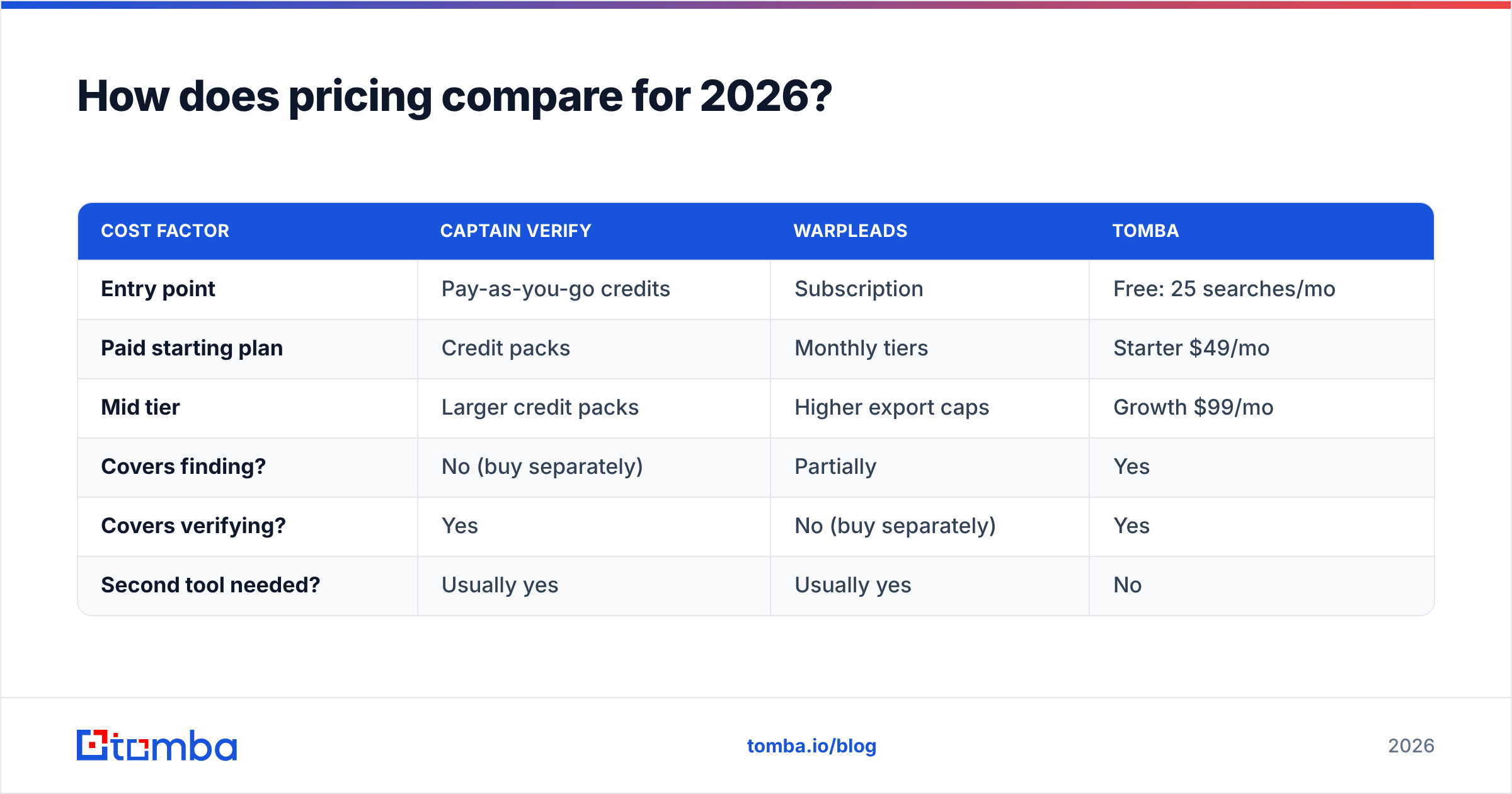
Captain Verify uses pay-as-you-go credits, which is genuinely the cheapest option if verification is the only thing you ever need. Warpleads leans on subscription tiers with high or unlimited export caps, which can pencil out for pure volume plays. The hidden cost in both cases is the other half of the job you still have to buy.
Here is how the economics frame up against a combined tool:
| Cost factor | Captain Verify | Warpleads | Tomba |
|---|---|---|---|
| Entry point | Pay-as-you-go credits | Subscription | Free: 25 searches/mo |
| Paid starting plan | Credit packs | Monthly tiers | Starter $49/mo |
| Mid tier | Larger credit packs | Higher export caps | Growth $99/mo |
| Covers finding? | No (buy separately) | Partially | Yes |
| Covers verifying? | Yes | No (buy separately) | Yes |
| Second tool needed? | Usually yes | Usually yes | No |
The note that matters: Tomba's paid plans start at $49/mo (not $39), with a free tier of 25 searches per month, and the higher tiers — Growth at $99/mo and Pro at $249/mo — fold finding, verification, catch-all checks, and enrichment into one bill. You can see the full breakdown on the Tomba pricing page. The point is not that one is universally cheaper; it is that "cheap verification" plus "cheap sourcing" from two vendors often costs more than one platform once you count your own integration time.
So who should pick what?#
- Pick Captain Verify if your only job is cleaning lists you already own, you verify in occasional bursts, and you are happy to source contacts elsewhere. It is a clean, focused verifier and it does that one thing well.
- Pick Warpleads if you run extremely high-volume outbound, you already have a trusted verification step in place, and raw export volume is your binding constraint.
- Pick an all-in-one if you recognize yourself in stages 1–3 above — needing to find, verify, and enrich — and you would rather not maintain two subscriptions and a manual CSV bridge between them.
There is no shame in a two-tool stack if your volumes justify it. But for the majority of B2B teams in 2026, the find-verify-enrich chain is the actual job, and splitting it across a verifier and a bulk exporter recreates the work an integrated platform already solved.
The bottom line#
Captain Verify and Warpleads are not really competitors — they are two halves of a workflow, each missing the other half. Captain Verify verifies but cannot source. Warpleads sources but does not truly verify. Buy both and you are running a manual pipeline; buy one and you have a gap.
If you want the whole chain in one place — finding the right email by name and domain, verifying it (catch-alls included), and enriching it with firmographics and phone numbers — start with the Tomba Email Finder. The free tier gives you 25 searches a month to test accuracy on your own target accounts before you commit, and paid plans from $49/mo replace both a standalone verifier and a standalone exporter. Try it on a real list this week and compare your usable-contact rate against whatever two-tool setup you are running today.
// get started
Find, verify and enrich your first contacts today
Start on the free plan with 25 searches a month, then scale when your team is ready.
Free plan · No credit card required · GDPR & CCPA
// about the author