Captiwate Pricing, Reviews, Pros and Cons (2026 Guide)
A neutral 2026 breakdown of Captiwate pricing, real user reviews, and the honest pros and cons before you commit to this multichannel outbound platform.
Captiwate Pricing, Reviews, Pros and Cons (2026 Guide)
Deciding whether Captiwate belongs in your outbound stack comes down to three questions: what does it cost, what do real users actually say, and where does it fall short? This guide answers all three without the marketing gloss.
TL;DR#
- Captiwate is a multichannel outbound platform built around buyer engagement signals, calling, and email — not a standalone email-finder or database tool.
- Pricing is quote-based in 2026, with seat-based plans that scale by team size and channel usage; expect a per-user monthly fee plus add-ons for calling minutes and integrations.
- Reviews are positive but thin — early adopters praise the engagement-signal approach and live-call features, while noting a smaller data footprint than incumbents.
- Biggest pro: real-time buyer intent and conversation tooling that lifts connect and reply rates. Biggest con: you still need a separate source for accurate contact data.
- Pair it with a dedicated email finder so your sequences run on verified addresses instead of guesswork.
What is Captiwate?#
Captiwate is a sales engagement platform that focuses on the moment a prospect actually interacts with your outreach. Think of it less like a contact database and more like a control tower: it watches for buyer signals — opens, clicks, website visits, replies — and helps reps jump on the warm ones with calls, emails, and live messaging while interest is still hot.
That positioning matters for pricing. Captiwate competes with sequencing and engagement tools rather than data providers. It assumes you already have contacts to work; its job is to help you work them better. If you walk in expecting a built-in well of verified emails and phone numbers, you will be disappointed — and you will overpay for features you can't fully use.
The platform's core modules typically include multichannel sequencing (email plus calling), real-time engagement alerts, a built-in dialer, and analytics that tie activity to pipeline. It leans on integrations with your CRM and data tools to fill in the gaps.

How much does Captiwate cost in 2026?#
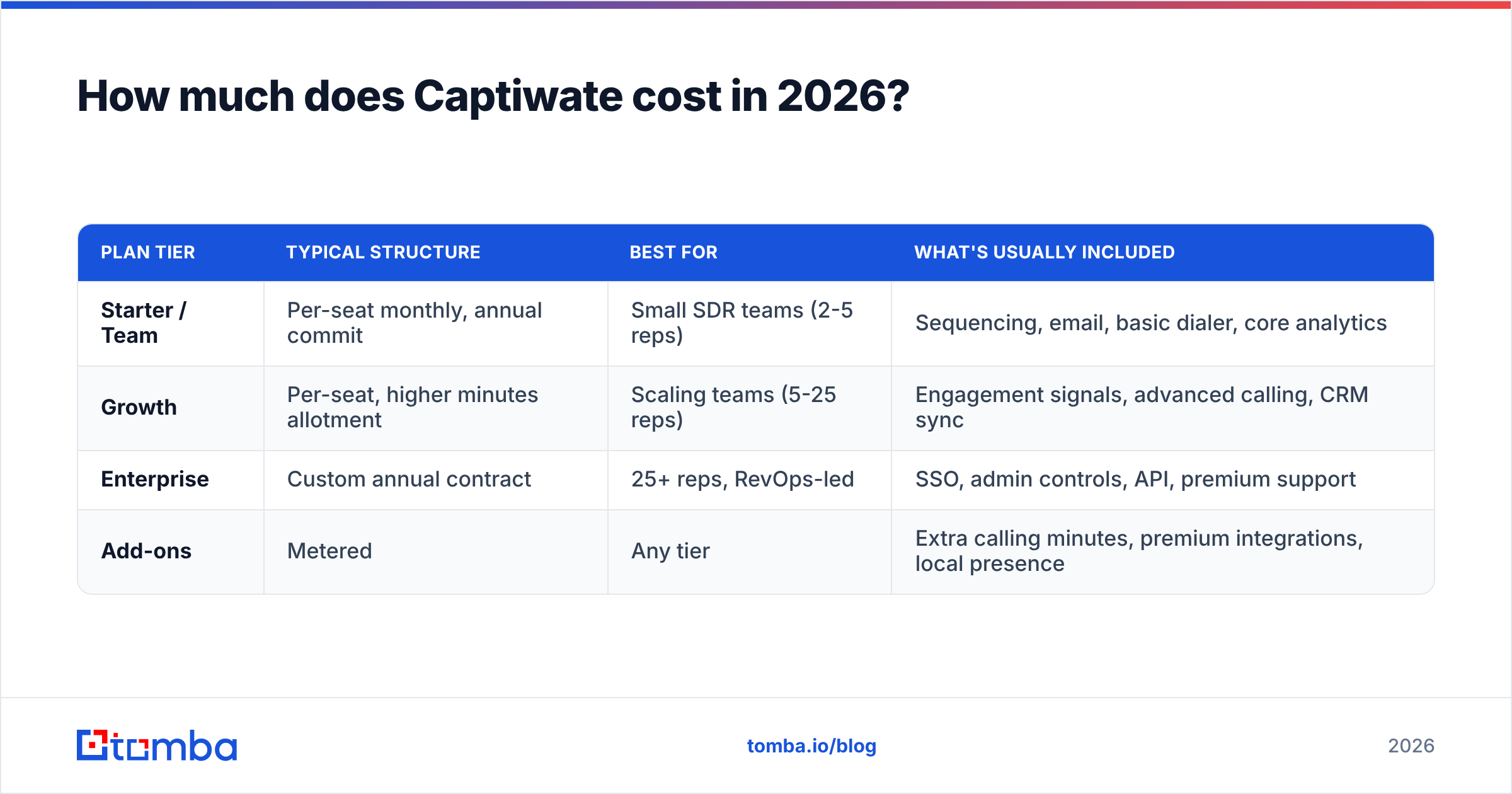
Captiwate uses quote-based, per-seat pricing in 2026 — there is no public self-serve price list. Like most engagement platforms aimed at teams (Outreach and Salesloft follow the same playbook), the published rate depends on seat count, contract length, and which channels you turn on.
Based on how comparable platforms structure deals and what reviewers report, here is a realistic expectation rather than a fabricated number. Always confirm directly with the vendor.
| Plan tier | Typical structure | Best for | What's usually included |
|---|---|---|---|
| Starter / Team | Per-seat monthly, annual commit | Small SDR teams (2-5 reps) | Sequencing, email, basic dialer, core analytics |
| Growth | Per-seat, higher minutes allotment | Scaling teams (5-25 reps) | Engagement signals, advanced calling, CRM sync |
| Enterprise | Custom annual contract | 25+ reps, RevOps-led | SSO, admin controls, API, premium support |
| Add-ons | Metered | Any tier | Extra calling minutes, premium integrations, local presence |
A few honest caveats on the table above:
- Numbers are not listed publicly, so treat any "$X/month" figure you see on third-party blogs with suspicion unless it links to a quote.
- Calling minutes are often metered separately — a heavy phone team can see the bill climb fast.
- Annual commitment is the norm for the lower effective rate; month-to-month, if offered, costs more.
- Data is not bundled, so factor in a separate line item for contact discovery and verification.
That last point is where most buyers underestimate total cost. An engagement platform is only as good as the contacts you feed it. If half your list bounces, you're paying premium per-seat rates to send mail into the void.

What do Captiwate reviews say?#
Captiwate reviews in 2026 skew positive but come from a smaller sample than legacy tools. On directories like G2 and Capterra, the recurring themes are consistent enough to summarize fairly.
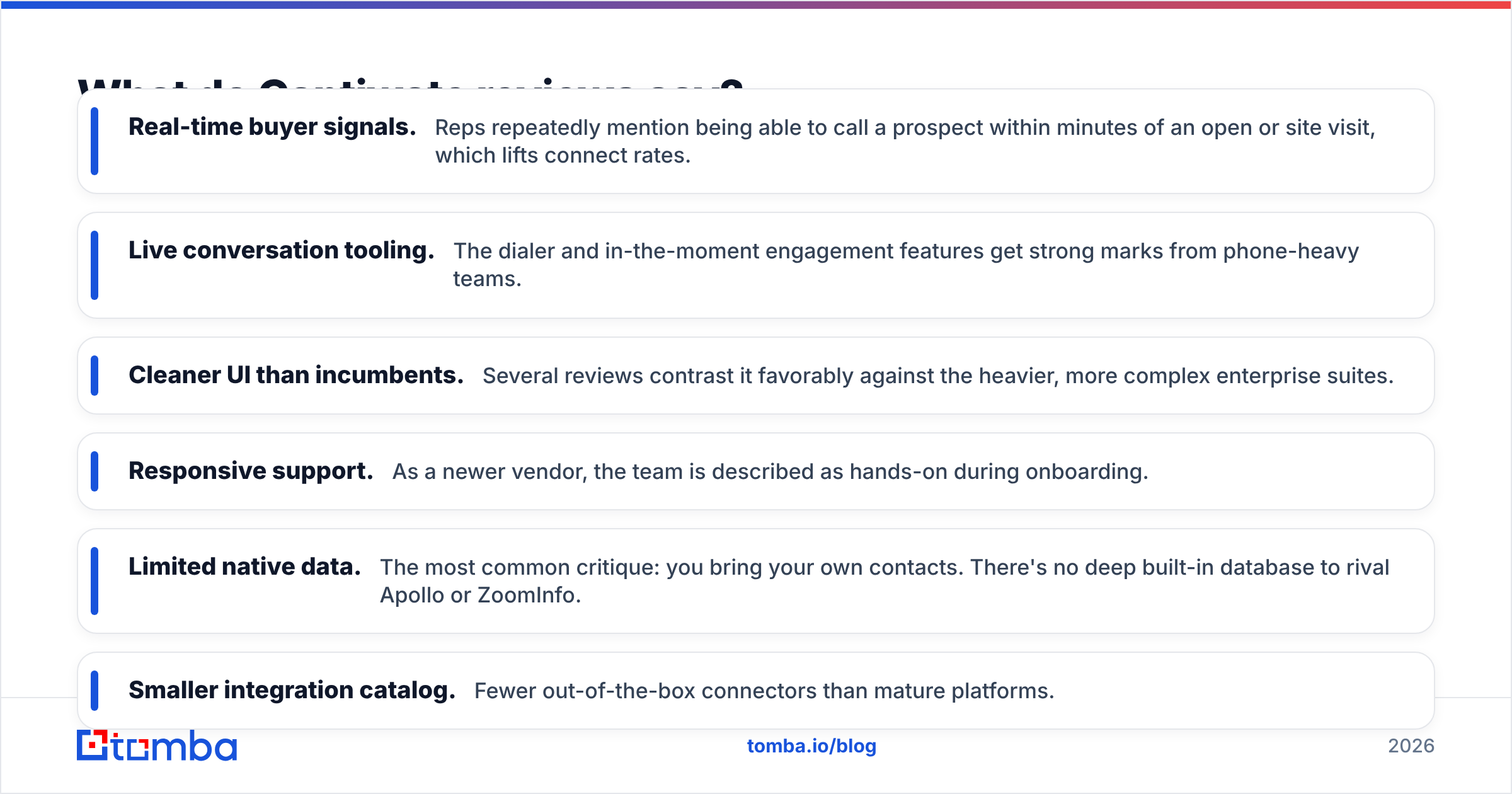
What reviewers consistently praise:
- Real-time buyer signals. Reps repeatedly mention being able to call a prospect within minutes of an open or site visit, which lifts connect rates.
- Live conversation tooling. The dialer and in-the-moment engagement features get strong marks from phone-heavy teams.
- Cleaner UI than incumbents. Several reviews contrast it favorably against the heavier, more complex enterprise suites.
- Responsive support. As a newer vendor, the team is described as hands-on during onboarding.
What reviewers flag as weaknesses:
- Limited native data. The most common critique: you bring your own contacts. There's no deep built-in database to rival Apollo or ZoomInfo.
- Smaller integration catalog. Fewer out-of-the-box connectors than mature platforms.
- Maturity gaps. A handful of reviews mention missing reporting depth or occasional rough edges expected from a younger product.
- Pricing opacity. Buyers dislike not seeing rates upfront and having to book a call to get a number.
The pattern is clear: people who adopt Captiwate for its engagement-and-calling strengths are happy. People who expected an all-in-one prospecting-plus-data suite feel the data gap. Knowing which camp you're in before you sign is the whole game.
What are the pros and cons of Captiwate?#
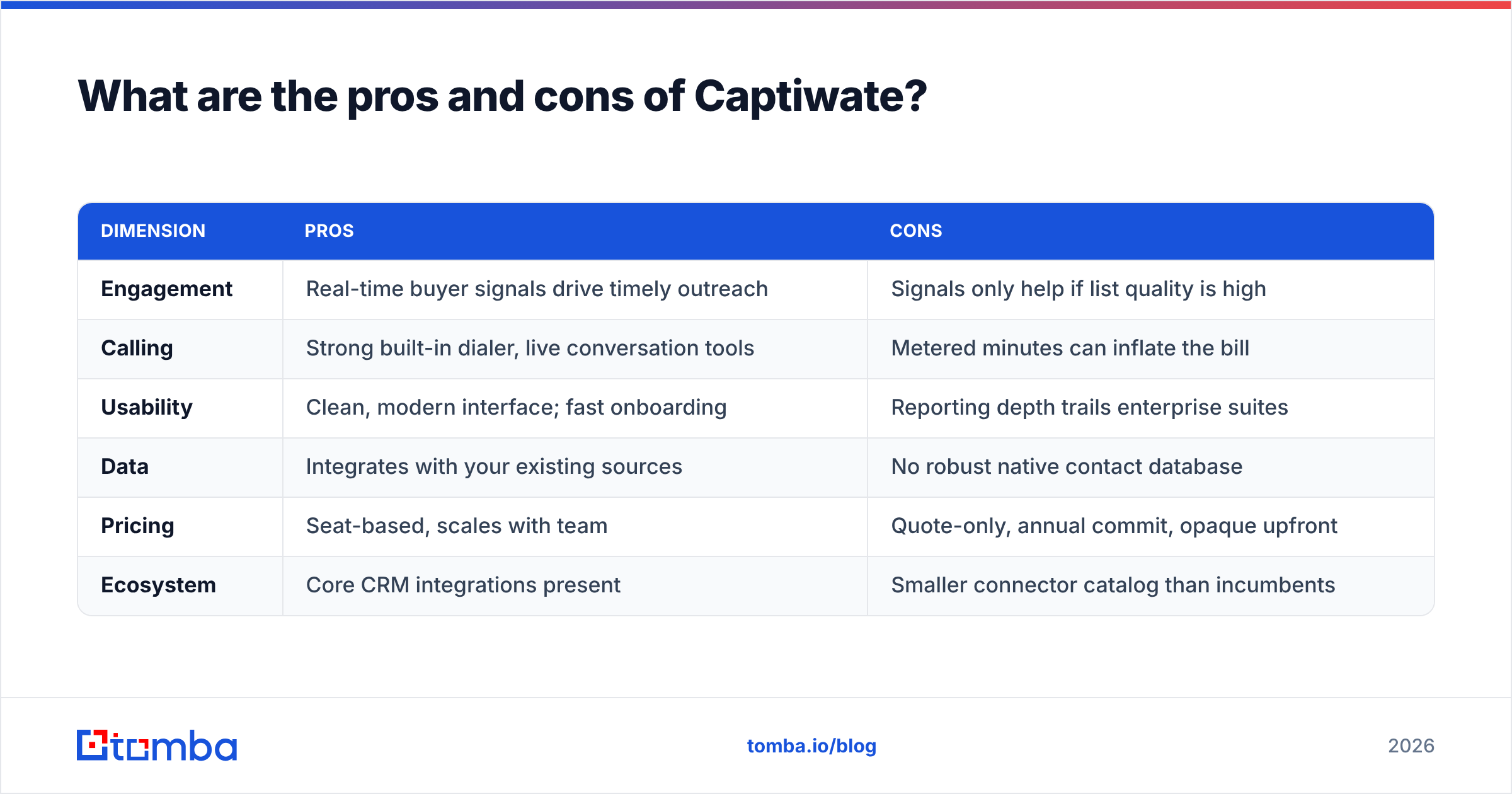
Here's the balanced view, distilled. Use it as a checklist against your own workflow.
| Dimension | Pros | Cons |
|---|---|---|
| Engagement | Real-time buyer signals drive timely outreach | Signals only help if list quality is high |
| Calling | Strong built-in dialer, live conversation tools | Metered minutes can inflate the bill |
| Usability | Clean, modern interface; fast onboarding | Reporting depth trails enterprise suites |
| Data | Integrates with your existing sources | No robust native contact database |
| Pricing | Seat-based, scales with team | Quote-only, annual commit, opaque upfront |
| Ecosystem | Core CRM integrations present | Smaller connector catalog than incumbents |
The honest summary: Captiwate is a strong engagement layer and a weak data layer. That's not a flaw if you already solve data elsewhere — it's a design choice. The mistake is treating it as a complete prospecting solution and skipping the contact-sourcing step.
Is Captiwate worth it for your team?#
Captiwate is worth it if you have a phone-forward outbound motion and a reliable source of accurate contacts already. It is not worth it if you expect it to find and verify leads for you.
Map it to your situation:
- Good fit: SDR teams that live on the phone, value buyer-intent timing, and already run a data tool or database. The engagement features genuinely move connect and reply numbers.
- Poor fit: Lean teams without a contact-sourcing solution, or anyone hoping for a single bill that covers data, sending, and dialing. You'll end up assembling a stack anyway.
- Depends: Marketing-led orgs that want signal-based outreach but lack the SDR headcount to act on alerts in real time — the core benefit goes unused.
Whatever you decide, the deliverability math doesn't change: tools that improve your response rate still depend on reaching real inboxes. Bounces hurt sender reputation regardless of how slick the engagement layer is.

How does Captiwate compare to alternatives?#
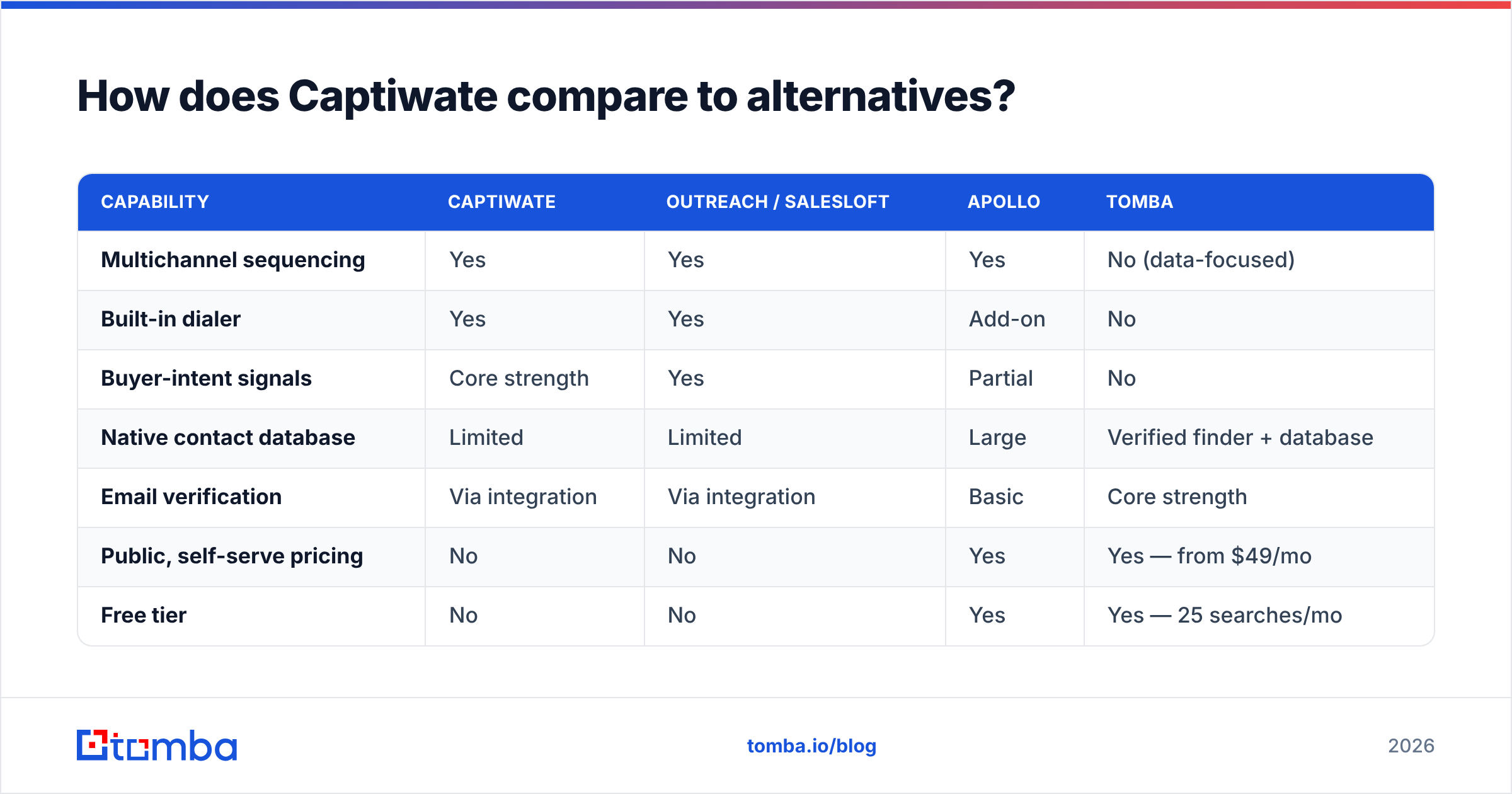
No outbound tool is an island. The real decision is which combination you run. Captiwate handles engagement; you still need data and verification. Here's how the pieces fit against common alternatives.
| Capability | Captiwate | Outreach / Salesloft | Apollo | Tomba |
|---|---|---|---|---|
| Multichannel sequencing | Yes | Yes | Yes | No (data-focused) |
| Built-in dialer | Yes | Yes | Add-on | No |
| Buyer-intent signals | Core strength | Yes | Partial | No |
| Native contact database | Limited | Limited | Large | Verified finder + database |
| Email verification | Via integration | Via integration | Basic | Core strength |
| Public, self-serve pricing | No | No | Yes | Yes — from $49/mo |
| Free tier | No | No | Yes | Yes — 25 searches/mo |
The takeaway: Captiwate and a data tool are complements, not competitors. If your weak spot is engagement and live calling, Captiwate fills it. If your weak spot is finding and verifying who to contact — which it is for most teams — that's a different tool entirely.
For transparent pricing comparison, you can review Tomba pricing against the quote-only model: a published Free tier (25 searches/month), Starter at $49/mo, Growth at $99/mo, and Pro at $249/mo. The point isn't that one replaces the other — it's that data costs are knowable upfront in a way engagement-platform seats often aren't.
If you also work the phones, sourcing direct dials from a dedicated phone finder gives Captiwate's dialer something accurate to call, instead of stale numbers that burn rep time.
What hidden costs should you budget for?#
Beyond the per-seat quote, three line items routinely surprise buyers:
- Contact data and enrichment. Captiwate doesn't ship a deep database. Budget for a finder and a database or enrichment source separately.
- Email verification. Every unverified address you load risks a bounce. A bounce above ~2-3% drags your domain reputation down and reduces inbox placement. Run lists through an email verifier before they ever enter a sequence.
- Calling minutes and local presence. Metered telephony and local-number features are typically add-ons, not included.
Skip these and the "affordable" engagement seat quietly becomes the cheapest part of a much larger bill.
How to validate Captiwate before you buy#
Don't sign on a demo alone. Run a structured trial:
- Define one metric. Pick connect rate or reply rate, not "vibes." Measure it for two weeks before and during the trial.
- Feed it clean data. Use verified contacts so you're testing the platform, not your list quality. This isolates whether Captiwate's engagement features actually help.
- Push on integrations. Confirm your CRM sync works both directions on day one, not in a roadmap promise.
- Get the full quote in writing. Seat price, minute overages, integration fees, and contract length — all of it.
If connect and reply rates climb on a clean, verified list, you've found signal. If they don't move even with good data, the engagement layer isn't your bottleneck and the spend won't pay back.
The bottom line#
Captiwate is a capable, modern engagement and calling platform with genuine strengths in buyer-intent timing — held back by quote-only pricing and a thin native data layer. The pros and cons net out simply: great at acting on signals, dependent on you for the contacts that generate them.
Whatever engagement tool you choose, your outreach is only as good as the addresses behind it. Start by making sure every contact is real and reachable with Tomba's Email Finder — find professional emails by name, company, or domain, verify them before they hit a sequence, and feed your dialer accurate numbers. Pair an honest engagement platform with honest data, and the rest of the stack actually earns its keep.
Ready to find emails that actually work?
Join 150,000+ professionals who stopped guessing and started sending. Free credits on signup — no credit card required.
Get the Tomba newsletter
Practical outbound tactics and product updates — once every two weeks.
About the author