CAS Software Pricing, Reviews, Pros and Cons (2026 Guide)
A neutral breakdown of CAS Software pricing, real user reviews, and the honest pros and cons of CAS genesisWorld and SmartWe CRM in 2026 — plus who it actually fits.
CAS Software Pricing, Reviews, Pros and Cons
Short version: CAS Software is a credible, German-engineered CRM choice for mid-market B2B teams that value data privacy and deep customization — but its quote-based pricing and on-premise heritage make it a poor fit if you want transparent, self-serve SaaS costs. This guide walks through what you actually pay, what users say, and where it wins or loses.
TL;DR#
- CAS Software (the maker of CAS genesisWorld and the cloud CRM SmartWe) targets the European Mittelstand — mid-sized B2B companies that want a configurable, GDPR-friendly CRM hosted in Germany.
- Pricing is quote-based, not published. SmartWe lists an entry cloud price per user/month, while CAS genesisWorld is sold through partners with setup, modules, and licensing layered on top.
- Biggest pros: deep customization, strong data privacy, on-premise option, and serious mid-market features (project, marketing, and service modules).
- Biggest cons: opaque pricing, partner-dependent setup, a dated interface in places, and a steeper learning curve than modern SaaS CRMs.
- The data problem CAS doesn't solve: any CRM is only as good as the contact data inside it. Pair it with a dedicated email finder and data enrichment layer or you'll automate a database full of stale records.
What is CAS Software?#
CAS Software AG is a German CRM vendor based in Karlsruhe, founded in 1986. Think of it as the dependable regional bank of the CRM world: not the flashiest brand, but trusted for decades by companies that care more about control and compliance than about chasing the newest feature.
The company sells two main products:
- CAS genesisWorld — the flagship CRM platform. It runs on-premise or in a private cloud, and is built for mid-sized organizations that need contact management, sales pipelines, marketing, project coordination, and service desks in one customizable system.
- SmartWe — a cloud-native, subscription CRM aimed at smaller teams that want something lighter and faster to deploy.
CAS positions itself heavily around data sovereignty: servers in Germany, GDPR alignment baked in, and the option to keep everything behind your own firewall. For European buyers in regulated industries, that's the headline selling point. You can confirm the current product lineup on the official CAS Software homepage.
If you're still mapping out what a CRM even needs to do, the CRM glossary entry is a quick primer before you compare vendors.
How much does CAS Software cost? (Pricing breakdown)#
Here's the honest answer: CAS does not publish full, transparent pricing, and you should treat any specific number you see online as indicative rather than guaranteed. CAS genesisWorld is sold and implemented largely through certified partners, which means your real cost depends on modules, user count, hosting choice, and implementation scope.
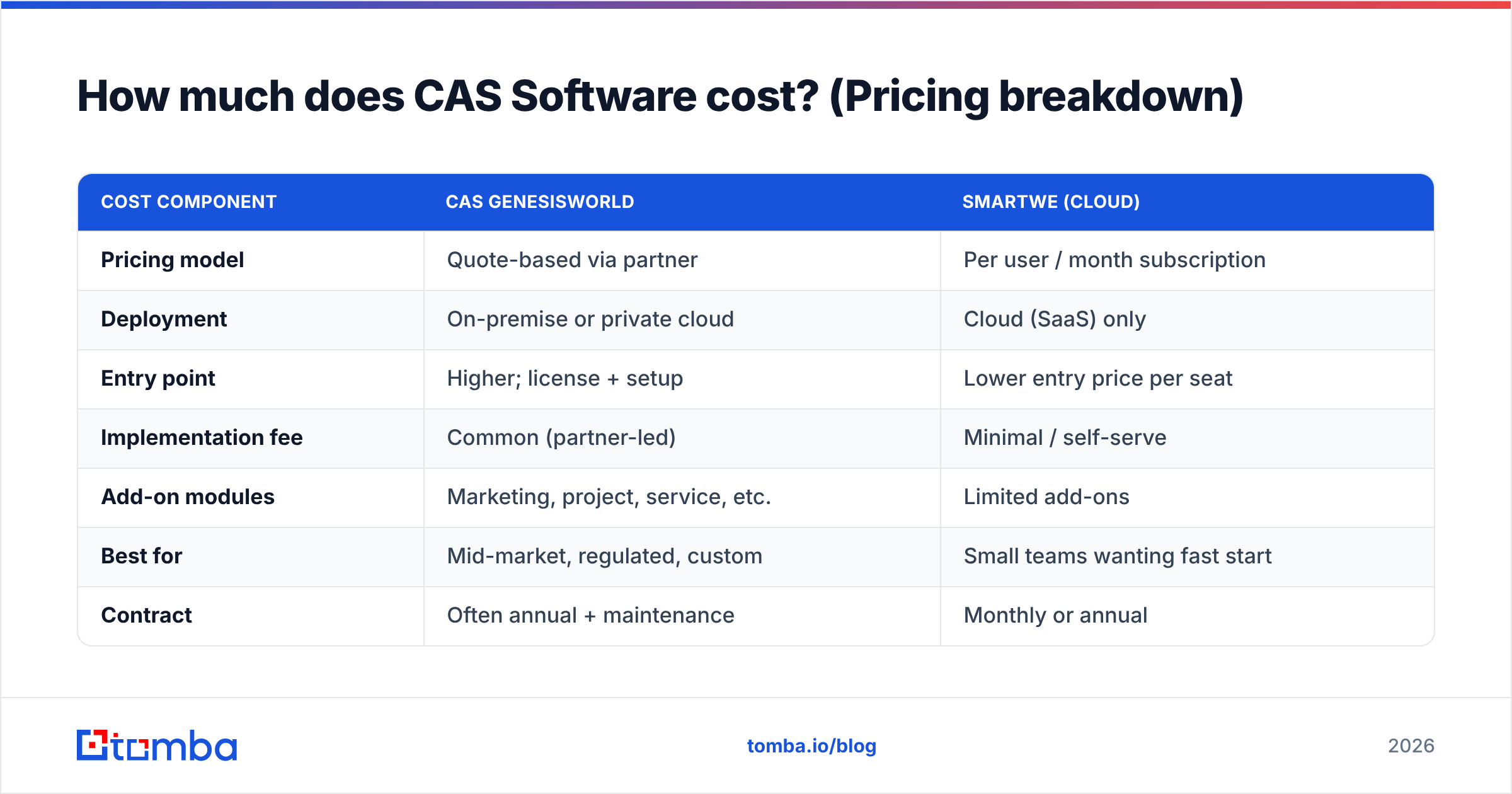
Below is a realistic structure of what you're paying for — not a fabricated price sheet, but the cost components you'll be quoted on.
| Cost component | CAS genesisWorld | SmartWe (cloud) |
|---|---|---|
| Pricing model | Quote-based via partner | Per user / month subscription |
| Deployment | On-premise or private cloud | Cloud (SaaS) only |
| Entry point | Higher; license + setup | Lower entry price per seat |
| Implementation fee | Common (partner-led) | Minimal / self-serve |
| Add-on modules | Marketing, project, service, etc. | Limited add-ons |
| Best for | Mid-market, regulated, custom | Small teams wanting fast start |
| Contract | Often annual + maintenance | Monthly or annual |
The practical takeaway: SmartWe is the predictable, low-friction option, while genesisWorld is an investment where total cost of ownership includes licensing, hosting, modules, and a partner's professional-services hours. Budget for the implementation, not just the seats.
If transparent, self-serve pricing matters to you, this is where CAS frustrates buyers used to a public pricing page. Tools like Tomba's plans — Free, Starter at $49/mo, Growth at $99/mo, Pro at $249/mo — show every tier upfront; CAS deliberately routes you through a sales conversation instead.
What do CAS Software reviews say?#
Aggregated sentiment from public review platforms like G2 and Capterra paints a consistent picture. CAS genesisWorld tends to score well on flexibility and support, and less well on modern UX and ease of onboarding.
Recurring themes from reviewers:
- Praised: breadth of features, customizability, German data hosting, and responsive partner support.
- Praised: stability — it's the kind of system companies run for ten-plus years.
- Criticized: the interface feels dated next to cloud-first competitors.
- Criticized: setup complexity and dependence on a partner for meaningful changes.
- Criticized: mobile experience lags the desktop product.
In other words, the reviews reward CAS for being a deep, durable enterprise-grade tool and penalize it for not feeling like a 2026-era SaaS app out of the box. That trade-off is the whole story of this product.
What are the pros of CAS Software?#
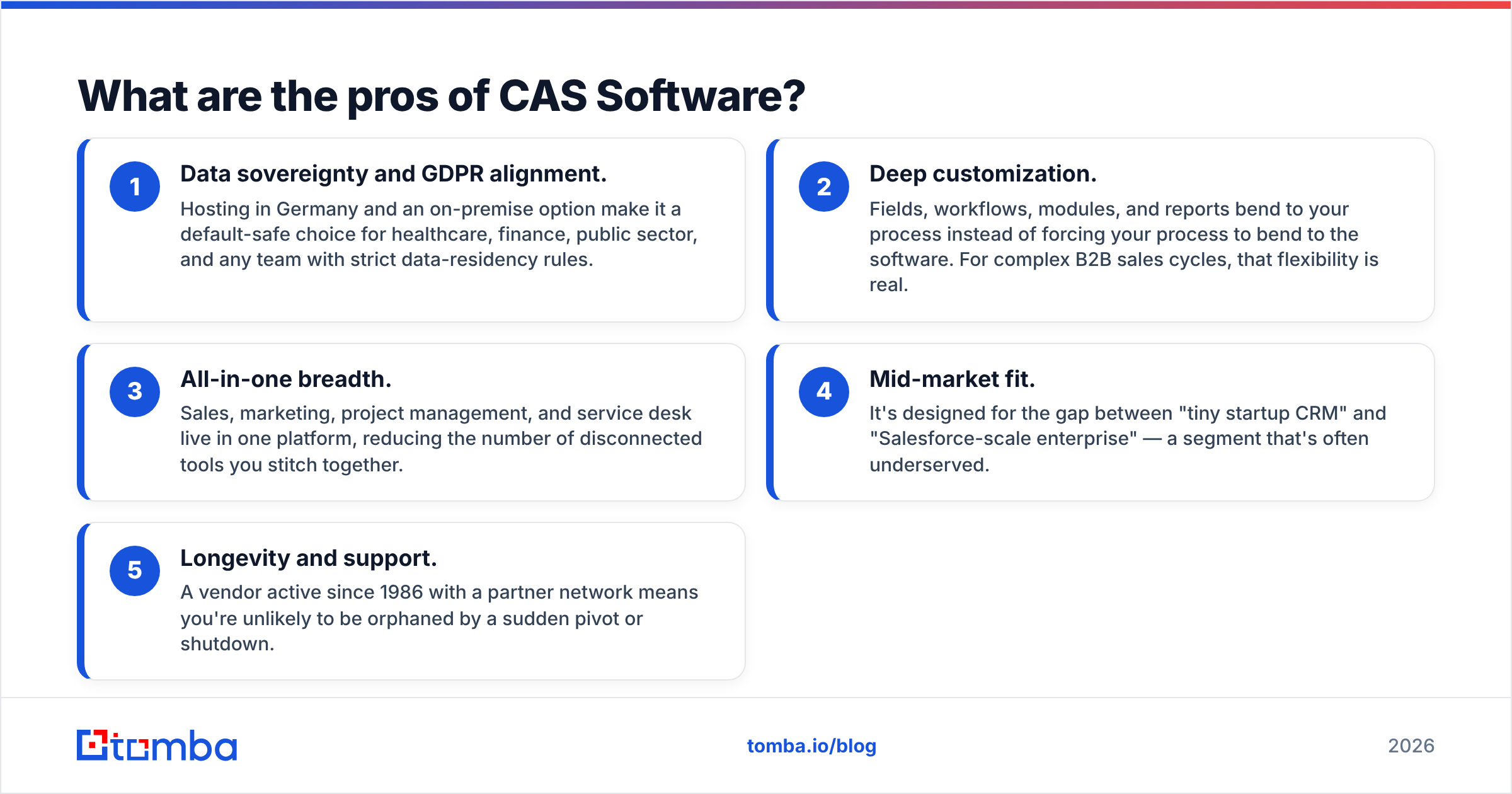
Here's where CAS genuinely earns its place on a shortlist:
- Data sovereignty and GDPR alignment. Hosting in Germany and an on-premise option make it a default-safe choice for healthcare, finance, public sector, and any team with strict data-residency rules.
- Deep customization. Fields, workflows, modules, and reports bend to your process instead of forcing your process to bend to the software. For complex B2B sales cycles, that flexibility is real.
- All-in-one breadth. Sales, marketing, project management, and service desk live in one platform, reducing the number of disconnected tools you stitch together.
- Mid-market fit. It's designed for the gap between "tiny startup CRM" and "Salesforce-scale enterprise" — a segment that's often underserved.
- Longevity and support. A vendor active since 1986 with a partner network means you're unlikely to be orphaned by a sudden pivot or shutdown.
What are the cons of CAS Software?#
And here's what should give you pause:
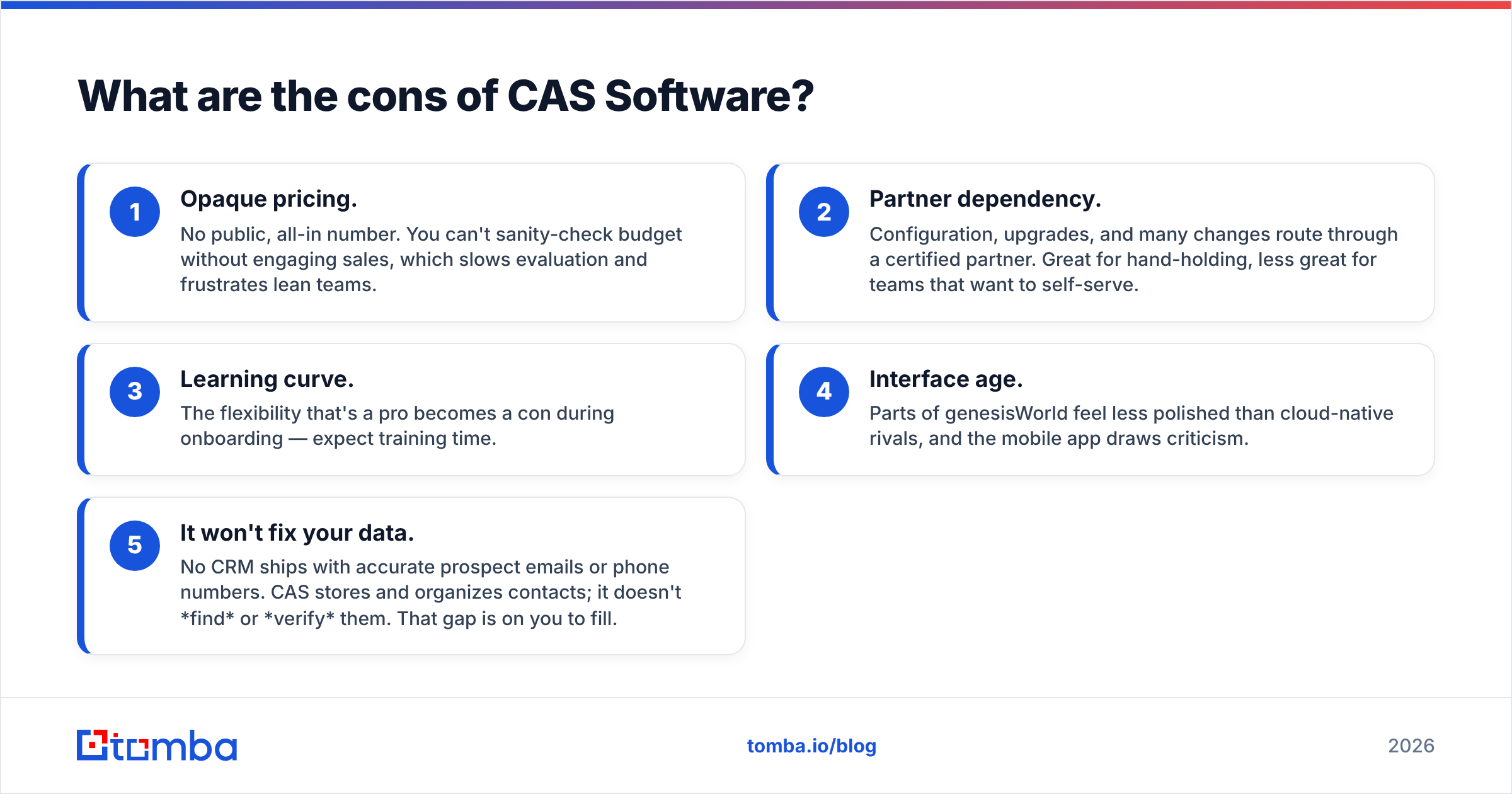
- Opaque pricing. No public, all-in number. You can't sanity-check budget without engaging sales, which slows evaluation and frustrates lean teams.
- Partner dependency. Configuration, upgrades, and many changes route through a certified partner. Great for hand-holding, less great for teams that want to self-serve.
- Learning curve. The flexibility that's a pro becomes a con during onboarding — expect training time.
- Interface age. Parts of genesisWorld feel less polished than cloud-native rivals, and the mobile app draws criticism.
- It won't fix your data. No CRM ships with accurate prospect emails or phone numbers. CAS stores and organizes contacts; it doesn't find or verify them. That gap is on you to fill.
How does CAS Software compare to other CRMs?#
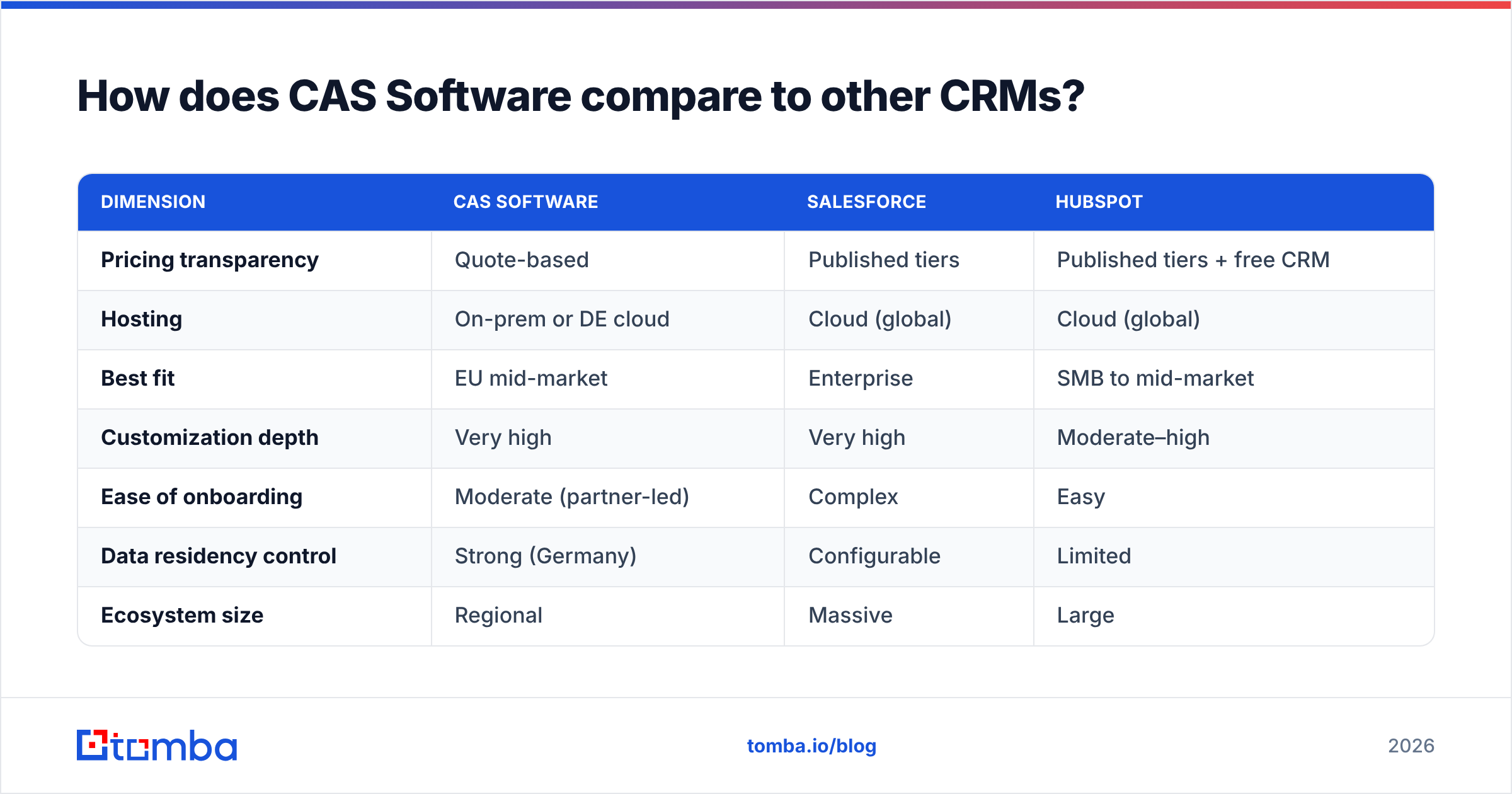
CAS doesn't compete head-on with every CRM — it occupies a specific lane. Here's how its positioning stacks up against the broad categories of competitors.
| Dimension | CAS Software | Salesforce | HubSpot |
|---|---|---|---|
| Pricing transparency | Quote-based | Published tiers | Published tiers + free CRM |
| Hosting | On-prem or DE cloud | Cloud (global) | Cloud (global) |
| Best fit | EU mid-market | Enterprise | SMB to mid-market |
| Customization depth | Very high | Very high | Moderate–high |
| Ease of onboarding | Moderate (partner-led) | Complex | Easy |
| Data residency control | Strong (Germany) | Configurable | Limited |
| Ecosystem size | Regional | Massive | Large |
The pattern is clear. Choose CAS when European data residency, deep customization, and a private deployment outrank ecosystem size and self-serve speed. Choose a global SaaS CRM like Salesforce when you need a vast app marketplace, or HubSpot when you want fast onboarding and transparent pricing.
Whichever you pick, the integration layer matters: a CRM that connects cleanly to your data tools beats a "better" CRM that stands alone. If you go the global-SaaS route, note that enrichment tools plug straight into both — for example via a Salesforce integration or HubSpot integration.
Who should actually use CAS Software?#
CAS is the right call if you are:
- A mid-sized B2B company in Europe (especially the DACH region) where GDPR and data residency are non-negotiable.
- A team with complex, non-standard sales or service processes that off-the-shelf CRMs can't model.
- An organization that prefers on-premise or private-cloud control over multi-tenant SaaS.
- Comfortable working with an implementation partner and willing to invest in setup.
CAS is the wrong call if you are:
- A small team or startup that wants to sign up, pay a published price, and be live this afternoon.
- A buyer who needs transparent, predictable per-seat pricing with no sales call.
- A US-centric company without specific data-residency requirements, where a global SaaS ecosystem matters more.
Why your CRM choice is only half the decision#
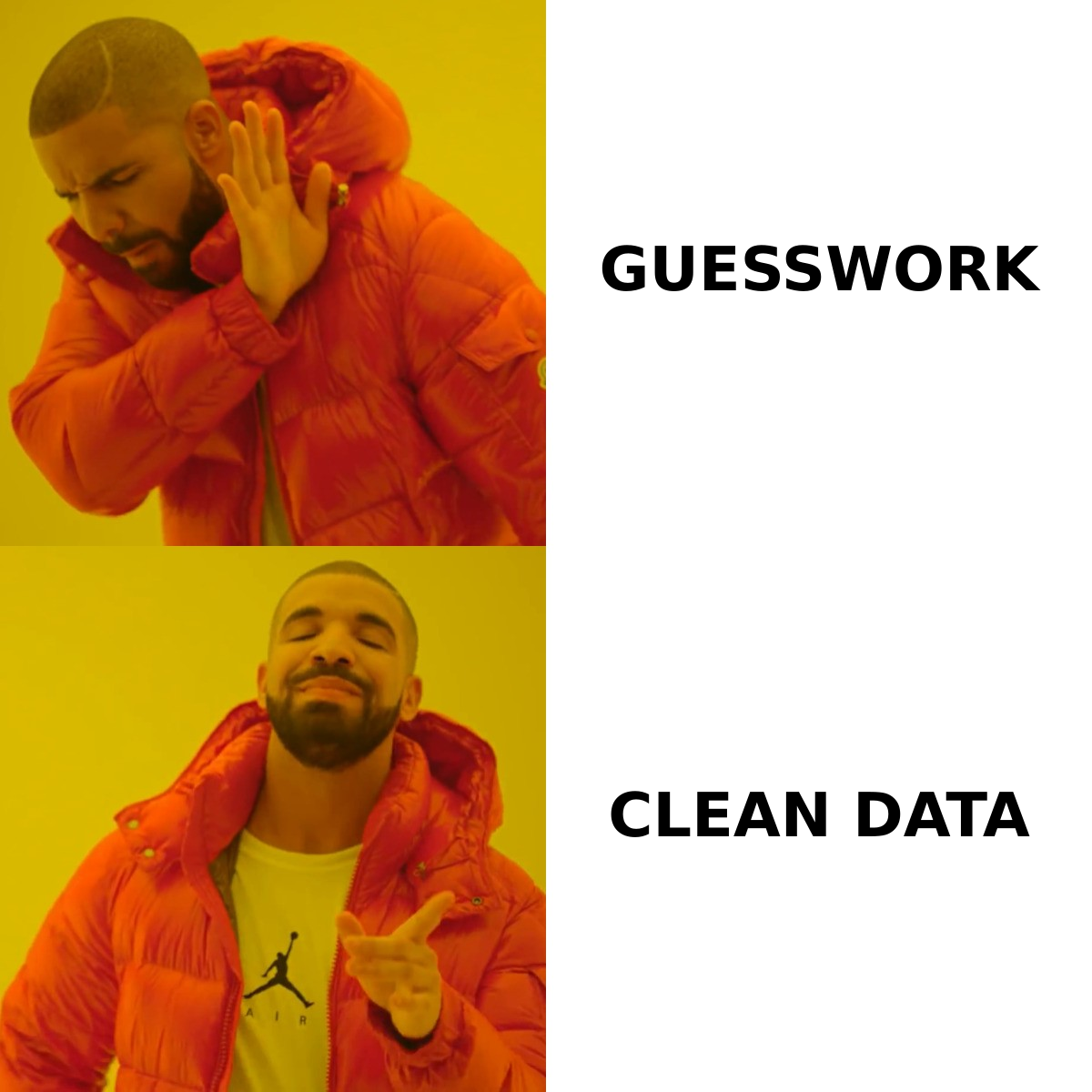
Here's the part most CRM comparison articles skip: the software is the container, but the data is what generates revenue. You can deploy the most customizable, compliant CRM on the market and still lose deals because half your contact records have bounced emails, missing phone numbers, or outdated job titles.
This is the failure mode behind "we bought a CRM and nothing improved." Garbage in, garbage out. A CRM doesn't manufacture accurate prospect data — it just stores whatever you feed it.
That's why high-performing teams treat lead data as a separate, dedicated layer:
- Find the right contacts with an email finder that returns verified professional addresses by name or domain.
- Verify before you send using an email verifier so bounces don't wreck your sender reputation.
- Enrich existing records with data enrichment to fill missing firmographics, titles, and contact channels.
- Scale it through bulk lead generation when you're populating a fresh pipeline.
Do that, and your CAS deployment — or any CRM — runs on clean fuel instead of stale records. Skip it, and you've automated the distribution of bad data.
Final verdict: Is CAS Software worth it in 2026?#
CAS Software is a strong, specialized choice rather than a universal one. If you're a European mid-market B2B company that values data sovereignty, deep customization, and a private deployment — and you can stomach quote-based pricing and partner-led setup — it's a genuinely good CRM with a long track record. If you want transparent SaaS pricing, instant onboarding, and a massive app ecosystem, you'll be happier elsewhere.
Either way, remember the lesson that outlasts any vendor comparison: the CRM is only as valuable as the data inside it.
Before you commit budget to any CRM, fix the data layer first. Start free with the Tomba Email Finder — find and verify professional email addresses by name, company, or domain, then push clean, enriched contacts straight into CAS, Salesforce, HubSpot, or whatever you choose. The Free tier gives you 25 searches a month to test it, and paid plans start at $49/mo when you're ready to scale. Your CRM decision matters; your data decision matters more.
// get started
Find, verify and enrich your first contacts today
Start on the free plan with 25 searches a month, then scale when your team is ready.
Free plan · No credit card required · GDPR & CCPA
// about the author