Case Study Email Template: 7 Proven Examples for 2026
Stop sending pitches that get ignored. Here are 7 case study email templates that turn customer proof into booked meetings, plus the structure behind each one.
TL;DR
- A case study email template works because it replaces "trust me" with "here's what happened to a company like yours" — proof does the selling.
- The winning structure is five parts: a relevant hook, the prospect's pain, the result a peer achieved, one hard number, and a low-friction ask.
- Lead with the metric, not the customer logo. "Cut onboarding from 14 days to 3" outperforms "We helped Acme Corp."
- Segment by industry and company size so the proof actually mirrors the reader — a generic case study email converts worse than a plain cold email.
- The seven templates below cover cold outreach, warm follow-up, renewals, upsells, and re-engagement. Swap the brackets and send.
What is a case study email and why does it convert?#
A case study email is a sales or marketing message built around a real customer result instead of a list of features. It is like showing a before-and-after photo at the gym: nobody believes the treadmill pitch, but everyone believes the person who lost 30 pounds on it.
That is the entire psychology. Buyers discount claims you make about yourself and inflate claims a peer makes on your behalf. When you write "our platform improves response rates," a prospect reads marketing. When you write "a 40-person agency in your city lifted reply rates from 4% to 11% in six weeks," they read evidence. According to HubSpot's research on social proof, buyers consistently rank peer results and reviews above vendor claims when evaluating a purchase.
The case study email template wins because it does three jobs at once: it proves the problem is real, proves your solution works, and proves it worked for someone the reader recognizes themselves in. A normal cold email only ever asserts the third.
)
What does a high-converting case study email template look like?#
Every email below follows the same five-part skeleton. Memorize the skeleton, not the wording.
- Relevance hook — one line that proves you know who they are (industry, role, recent trigger event). This earns the next sentence.
- Mirrored pain — name the specific problem the peer company had before. The reader should think "that's us."
- The result — what the peer achieved, stated as a transformation, not a feature.
- One hard number — a single, concrete metric. One. Not a paragraph of stats.
- Low-friction ask — a question or a soft offer ("worth a 10-minute look?"), never "book a 30-minute demo."
Here is the skeleton as a fill-in-the-blank template you can copy right now:
Subject: How [Peer Company] [achieved result] in [timeframe]
Hi [First Name],
Noticed [relevance trigger — recent funding, hiring, launch, tech stack].
[Peer Company], a [industry] team about your size, was stuck with [specific pain]. After [your solution], they [transformation] — [one hard number] in [timeframe].
Given [reader's likely situation], thought the play might transfer. Want me to send the one-page breakdown?
[Your name]
The reason this beats a feature dump is altitude: you are operating at the level of outcomes the buyer cares about, and you are spending your one hard number wisely instead of drowning it in five.
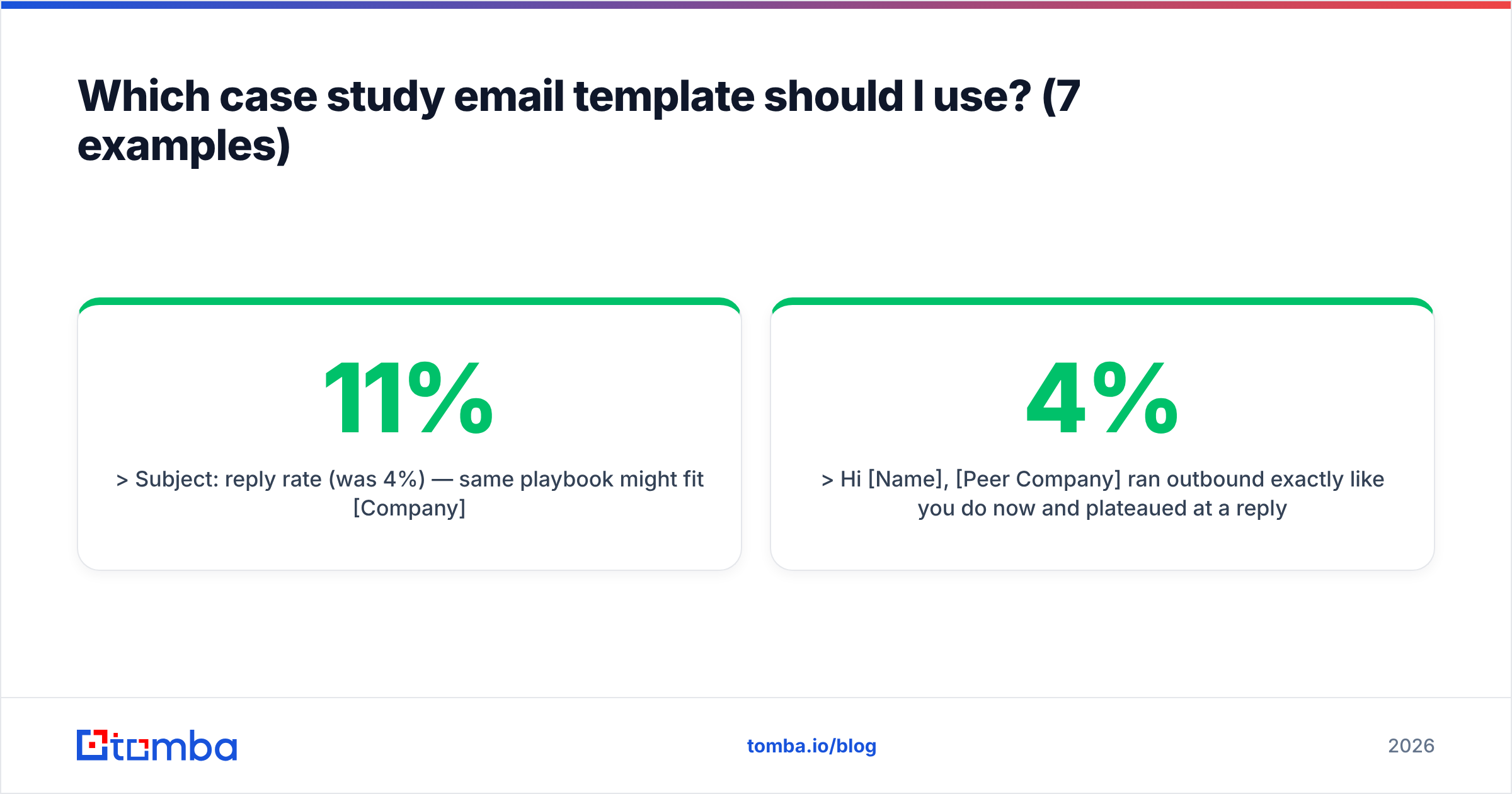
Which case study email template should I use? (7 examples)#
Below are seven variants for the most common moments in a B2B cycle. Replace every bracket and cut anything that does not earn its place.
1. Cold outreach — metric-first
Subject: 11% reply rate (was 4%) — same playbook might fit [Company]
Hi [Name], [Peer Company] ran outbound exactly like you do now and plateaued at a 4% reply rate. We rebuilt their targeting and their first line; six weeks later they're at 11% and booked 9 meetings off one list. You're hiring two SDRs right now, so the timing tracks. Want the one-pager?
2. Warm follow-up after no reply
Subject: forgot to mention the [Peer Company] number
Hi [Name], last note from me. The detail I left out: [Peer Company] hit that result without adding headcount — same team, better data. If that's interesting, reply "send it" and I'll forward the breakdown.
3. Industry-specific (vertical proof)
Subject: what worked for 3 other [industry] teams
Hi [Name], we now work with three [industry] companies your size, and the pattern is identical: [shared pain], fixed by [solution], averaging [metric]. Happy to share which one looks closest to your setup.
4. Renewal / expansion
Subject: your year-one numbers vs. [Peer Company]'s year two
Hi [Name], you're tracking almost exactly where [Peer Company] was 12 months ago. In year two they [expansion result] by turning on [feature/module]. Worth 10 minutes to map the same path?
5. Re-engagement (closed-lost)
Subject: you passed in [month] — here's what changed
Hi [Name], when we last spoke, [objection] was the blocker. [Peer Company] had the same hesitation and [how it was resolved]; they're now at [metric]. Has anything shifted on your side?
6. Referral request
Subject: who at [Company] owns [problem]?
Hi [Name], [Peer Company]'s [title] saw [result] in [timeframe]. If [problem] sits with someone else on your team, mind pointing me their way?
7. Newsletter / nurture (one-to-many)
Subject: from 14-day onboarding to 3
One story this week: [Peer Company] cut onboarding from 14 days to 3. Here's the exact change they made — [link]. Reply if you want the template they used.
If you want a fuller library to adapt from, our cold email templates collection pairs well with these, and a quick pass through a subject line generator will tighten the lines above before you send.
How is a case study email different from a normal cold email?#
The difference is what carries the weight. In a cold email, you are the evidence — your claim, your confidence, your CTA. In a case study email, a third party carries it. That shift changes tone, length, and the metric you lead with.
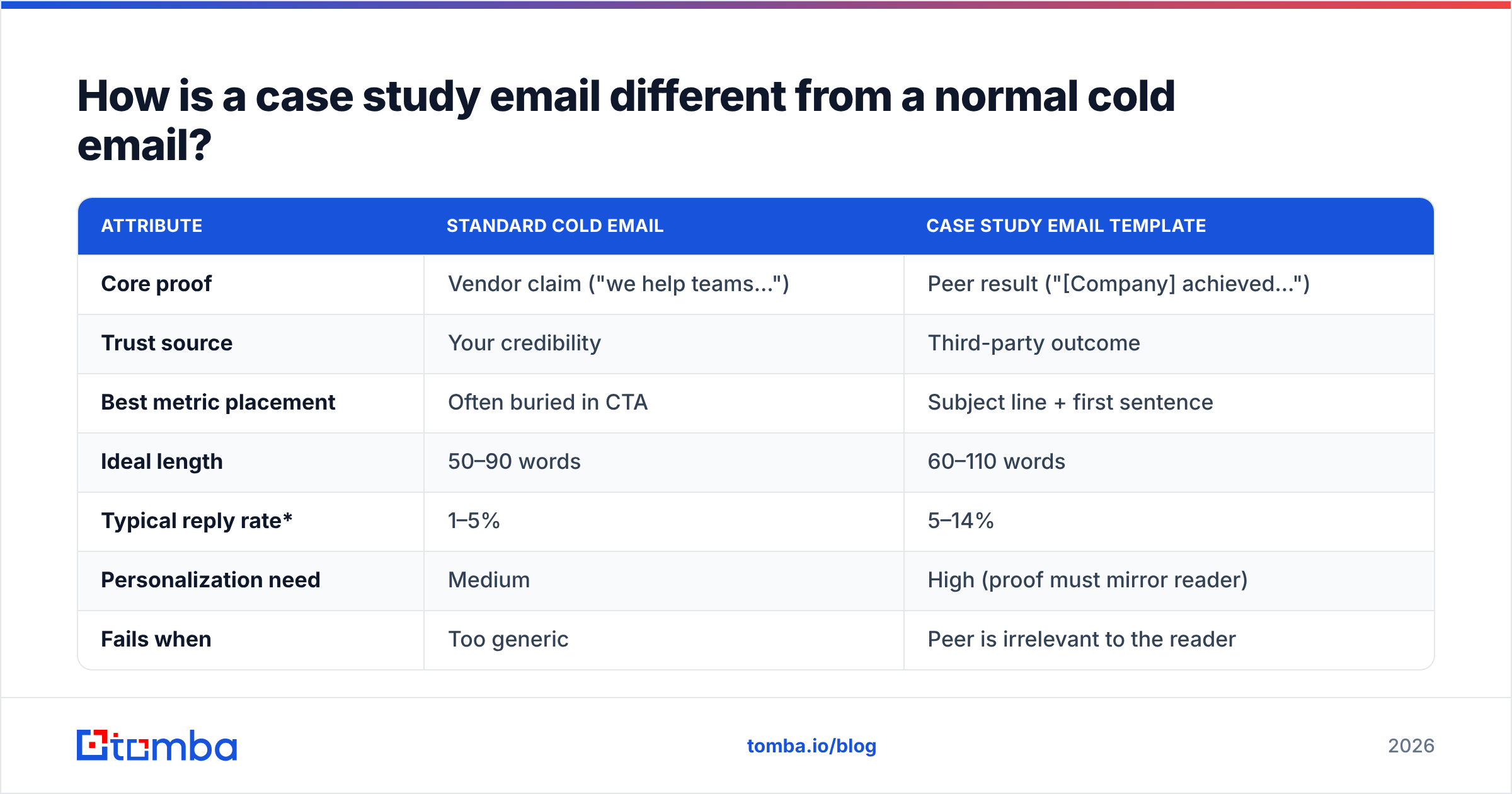
| Attribute | Standard cold email | Case study email template |
|---|---|---|
| Core proof | Vendor claim ("we help teams…") | Peer result ("[Company] achieved…") |
| Trust source | Your credibility | Third-party outcome |
| Best metric placement | Often buried in CTA | Subject line + first sentence |
| Ideal length | 50–90 words | 60–110 words |
| Typical reply rate* | 1–5% | 5–14% |
| Personalization need | Medium | High (proof must mirror reader) |
| Fails when | Too generic | Peer is irrelevant to the reader |
*Ranges reflect commonly reported B2B outbound benchmarks; your numbers depend on list quality and offer. Public benchmark roundups on G2 and vendor reports vary widely, so treat these as directional, not promises.
The takeaway: a case study email is not just a cold email with a logo glued on. The proof has to be relevant or it actively underperforms a plain message, because an irrelevant case study signals you didn't bother to understand the reader.
)
What metrics make a case study email believable?#
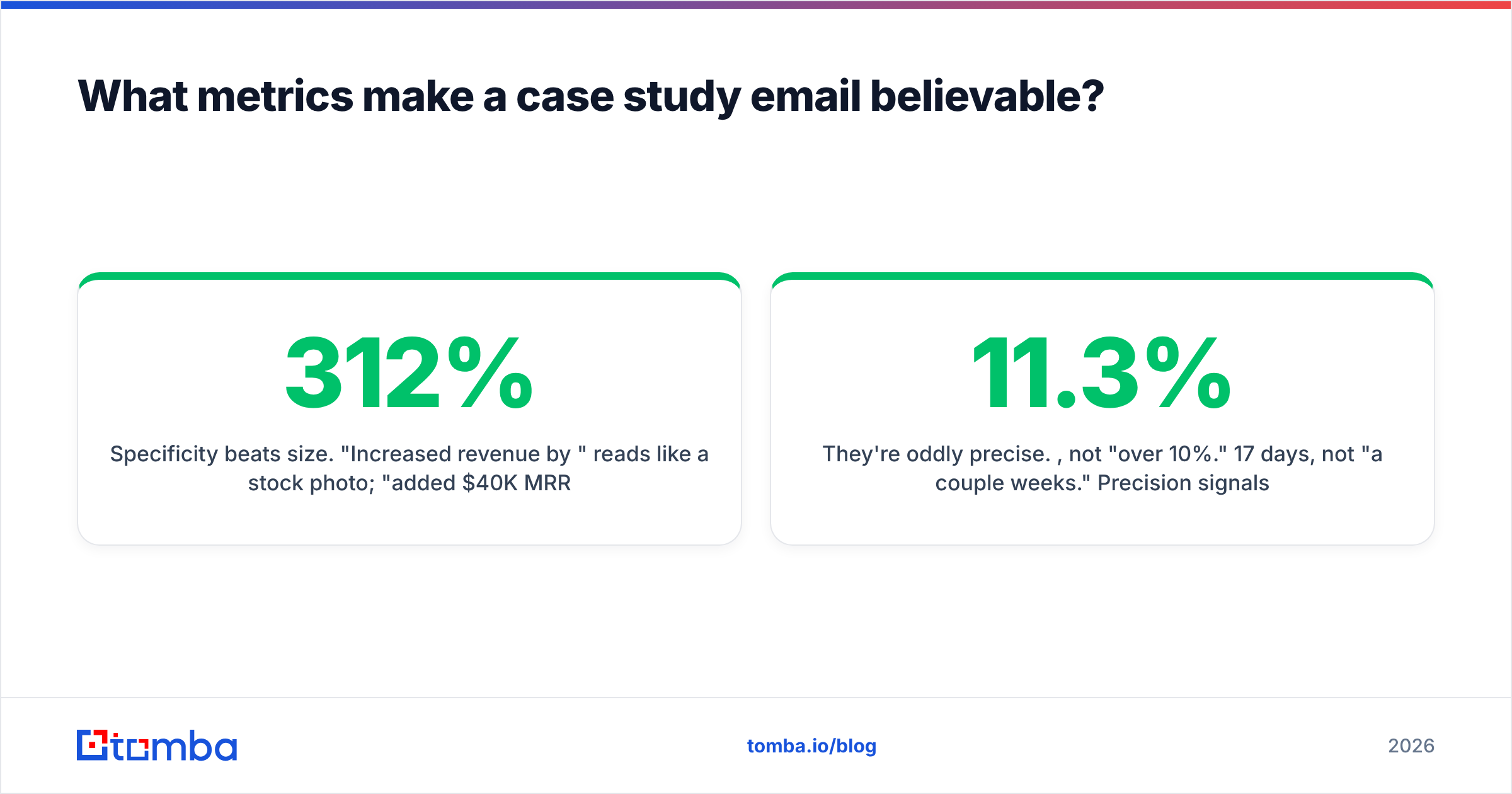
Specificity beats size. "Increased revenue by 312%" reads like a stock photo; "added $40K MRR in one quarter on a 6-person team" reads like a real Tuesday. Believable numbers share three traits:
- They're oddly precise. 11.3%, not "over 10%." 17 days, not "a couple weeks." Precision signals you pulled it from data, not a brochure.
- They include the constraint. "Without adding headcount," "on the existing CRM," "in their first 30 days." The constraint is what makes the result repeatable in the reader's mind.
- They name the unit that matters to the buyer. A VP of Sales cares about meetings booked and pipeline; a RevOps lead cares about data accuracy and time saved. Match the metric to the inbox.
One number per email. The moment you stack three metrics, each one borrows credibility from the others and the reader trusts none of them. Save the rest for the one-pager you offer in the CTA.
Tie this back to deliverability, too. A perfect case study email that lands in spam converts at zero. Before any campaign, clean your list with an email verifier so bounces don't tank your sender reputation — a high bounce rate poisons even your best-written templates, and it's the fastest way to wreck email response rate across a whole sequence.
How do I personalize a case study email at scale?#
Conclusion first: segment your proof library by industry and company size, then match each prospect to the closest case before you write a word. Personalization at scale is a routing problem, not a writing problem.
Build a small grid. On one axis, your customer outcomes (cut onboarding time, lifted reply rates, reduced churn). On the other, the segments you sell into (agencies, SaaS, e-commerce, by headcount band). Each cell holds one proof point. When a prospect comes in, you drop them into a cell and the template writes itself.
The bottleneck is usually not the copy — it's having accurate contact data to send it to. You can't personalize by company size if half your list is guesses. Tools like an email finder and bulk domain search let you build segmented lists with real firmographic context, so the case study you attach actually mirrors the reader. Pull the right contacts, slot them into the grid, and the "personalization" is already done by the time you hit send.
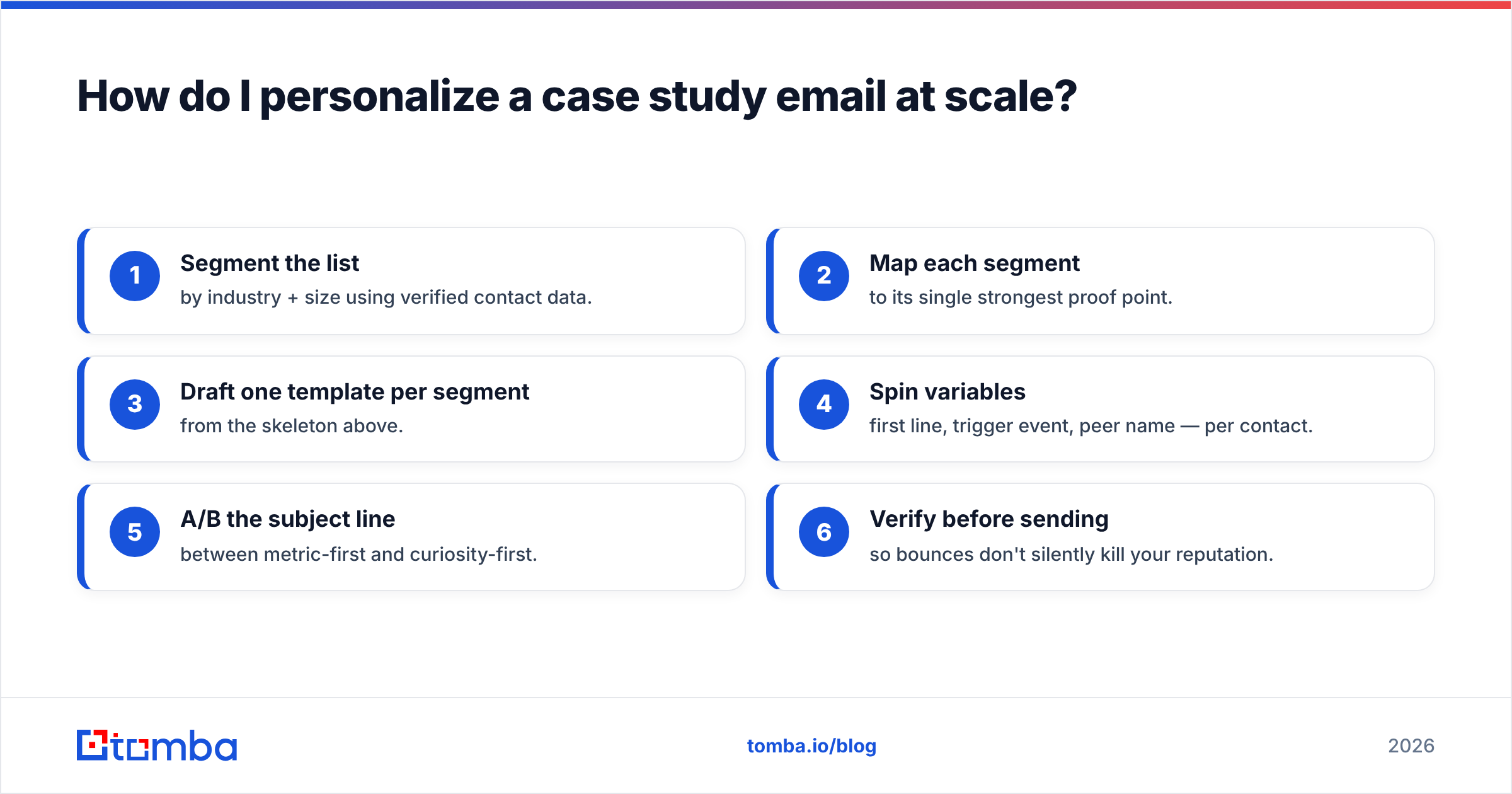
A practical workflow:
- Segment the list by industry + size using verified contact data.
- Map each segment to its single strongest proof point.
- Draft one template per segment from the skeleton above.
- Spin variables — first line, trigger event, peer name — per contact.
- A/B the subject line between metric-first and curiosity-first.
- Verify before sending so bounces don't silently kill your reputation.
This is the same logic Salesforce outlines for account-based outreach — relevance to the segment beats volume every time.
What are the most common case study email mistakes?#
- Leading with your logo, not their outcome. Nobody opens an email to admire your customer's brand. They open it for a result they want.
- Stacking metrics. Three numbers dilute to zero. Pick one.
- Irrelevant proof. A 500-person enterprise case sent to a 10-person startup says "I didn't read your company." It's worse than no case study.
- Heavy CTA. "Book a 30-minute demo" after one email is asking for marriage on a first date. Offer the one-pager instead.
- No verification. Sending to a stale list means your best template bounces, your domain reputation drops, and the next campaign underperforms too.
- Walls of text. If the case needs three paragraphs, you've written a blog post, not an email. Tease it; link the rest.
Fix these six and your case study email template will outperform whatever you're sending now, often by a wide margin.
Ready to send case study emails that actually land?#
Great proof is wasted on the wrong address. Before you load these templates into your sequencer, build a clean, segmented list so every case study reaches a person it actually mirrors. Tomba's Email Finder lets you find verified professional emails by name, company, or domain — the Free tier covers 25 searches a month to test it, and paid plans start at $49/mo with bulk and API access as you scale. Match the right peer story to the right buyer, send to addresses that don't bounce, and let the results do the selling. Start free, then check Tomba pricing when you're ready to run a full campaign.
// get started
Find, verify and enrich your first contacts today
Start on the free plan with 25 searches a month, then scale when your team is ready.
Free plan · No credit card required · GDPR & CCPA
// about the author