Catch Up Meeting Email Templates That Get Replies (2026)
Your catch up meeting email is the difference between a warm reply and a dead thread. Here are templates, subject lines, and timing rules that actually book the call in 2026.
You sent a great first call. Then the deal went quiet. Or a client you closed last year stopped replying. The fix is rarely a flashy new pitch — it is a well-timed catch up meeting email that gives the other person an easy reason to say yes.
This guide breaks down what actually moves the needle: timing, subject lines, structure, and nine copy-paste templates you can adapt today.
TL;DR#
- A catch up meeting email works when it leads with their benefit and ends with one specific ask — not a vague "let's reconnect."
- Send it Tuesday–Thursday, mid-morning. Keep it under 120 words with a single, low-friction call to action.
- Always propose two concrete time slots (or a booking link). "When works for you?" kills reply rates.
- Templates below cover prospects, dormant clients, ghosted deals, post-event follow-ups, and internal 1:1s.
- A reply is worthless if the email never lands — verify the address first so you are not writing to a dead inbox.
What is a catch up meeting email?#
A catch up meeting email is a short message whose only job is to book a conversation with someone you already have a relationship with — a prospect who went cold, a customer you onboarded months ago, a colleague, or a contact you met at an event. Think of it like texting an old friend to grab coffee: you are not selling the coffee, you are lowering the cost of saying "sure, when?"
That framing matters because the most common mistake is treating it like a fresh cold pitch. It is not. The recipient knows you. So you skip the long introduction, reference shared context, and get to the ask fast. According to HubSpot sales research, follow-up emails that reference a previous interaction consistently outperform generic outreach on reply rate — relationship beats novelty.
A strong catch up email does three things in order:
- Anchor the relationship — one line that proves you remember them ("Since our Q1 call about onboarding speed…").
- Give a reason now — a trigger, update, or relevant insight that makes this week the right time.
- Make the ask trivial — two time options or a scheduling link, not an open-ended question.
Why do most catch up emails get ignored?#
Because they ask the reader to do work. "Would love to reconnect — let me know if you have time!" forces the recipient to check their calendar, pick a slot, propose it, and hope it suits you. Every extra decision is a chance to close the tab.
The other silent killers:
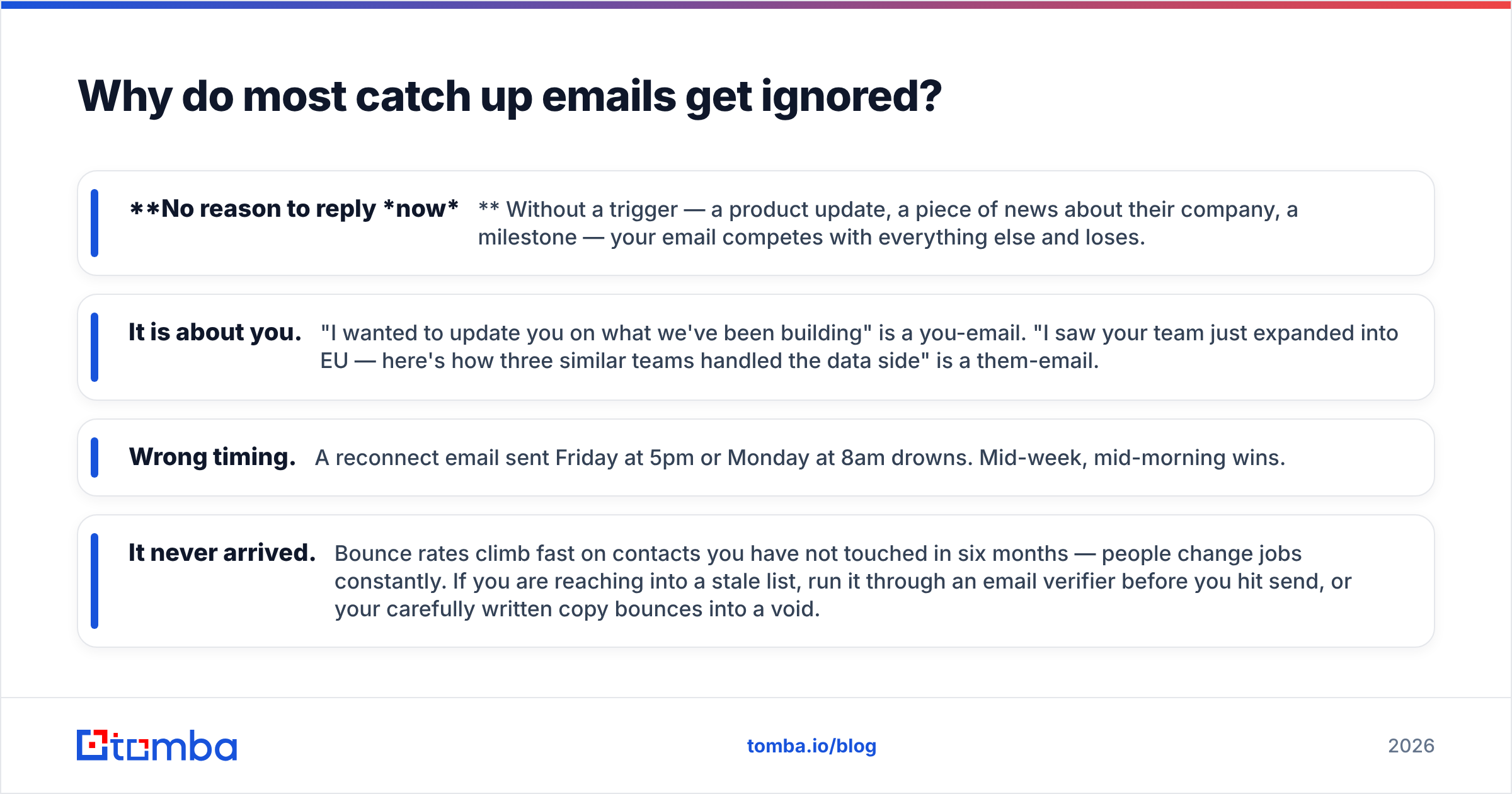
- No reason to reply now. Without a trigger — a product update, a piece of news about their company, a milestone — your email competes with everything else and loses.
- It is about you. "I wanted to update you on what we've been building" is a you-email. "I saw your team just expanded into EU — here's how three similar teams handled the data side" is a them-email.
- Wrong timing. A reconnect email sent Friday at 5pm or Monday at 8am drowns. Mid-week, mid-morning wins.
- It never arrived. Bounce rates climb fast on contacts you have not touched in six months — people change jobs constantly. If you are reaching into a stale list, run it through an email verifier before you hit send, or your carefully written copy bounces into a void.
What should a catch up meeting email include?#
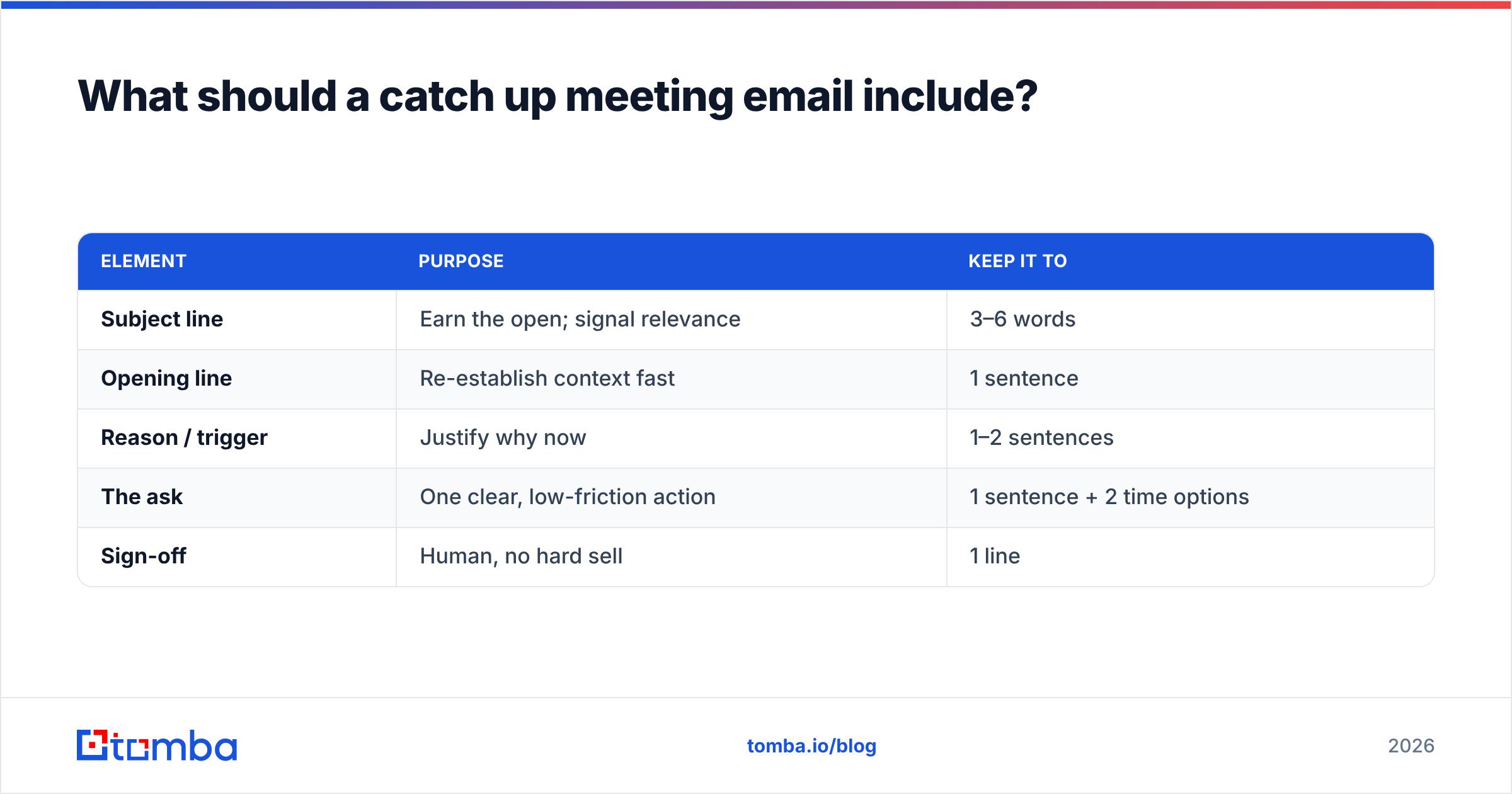
Keep it to five parts. Anything more and you have written an essay, not an invitation.
| Element | Purpose | Keep it to |
|---|---|---|
| Subject line | Earn the open; signal relevance | 3–6 words |
| Opening line | Re-establish context fast | 1 sentence |
| Reason / trigger | Justify why now | 1–2 sentences |
| The ask | One clear, low-friction action | 1 sentence + 2 time options |
| Sign-off | Human, no hard sell | 1 line |
The single biggest lever is the ask. Compare these two endings:
- Weak: "Let me know if you'd be open to chatting sometime."
- Strong: "Are you free Wednesday at 11am or Thursday at 2pm ET for 15 minutes? If neither works, here's my calendar: [link]."
The strong version removes every decision except yes/no. Tools like Calendly make the booking link frictionless, but two named slots in the email body convert even better because they require zero clicks.
What are the best catch up meeting email subject lines?#
Your subject line is a promise about what is inside. For warm contacts, lean on familiarity and brevity. Avoid anything that smells like a mass blast ("Touching base!!!") — those tank your open rate and your sender reputation.
Proven patterns:
- Name + context: "Sarah — quick follow-up on Q1"
- Curiosity + relevance: "An idea for your EU rollout"
- Direct ask: "15 minutes next week?"
- Reference shared moment: "Following up from SaaStr"
- Mutual benefit: "Worth a quick call — saw your new hire post"
If you write a lot of these, an email subject line generator can give you ten variations in seconds so you can A/B test instead of guessing. Test one variable at a time — subject line first, since it gates everything downstream.
9 catch up meeting email templates you can steal#
Adapt the brackets, keep the structure. Each is built to be under 120 words.
1. The cold-prospect revival#
Subject: Quick follow-up on [topic]
Hi [Name],
When we spoke in [month], you mentioned [specific pain]. I just helped [similar company] cut that by [result], and the playbook is almost identical to your setup.
Worth 15 minutes to walk you through it? I'm open Wednesday 11am or Thursday 2pm ET.
[Your name]
2. The dormant client check-in#
Subject: [Name] — checking in on [goal]
Hi [Name],
It's been a few months since we got [project] live. I'd love to hear how it's performing and share two things other [role]s are doing in 2026 to push results further.
Free for a quick call Tuesday or Thursday afternoon?
[Your name]
3. The ghosted-deal nudge#
Subject: Should I close your file?
Hi [Name],
I haven't heard back, so I want to make sure I'm not chasing the wrong moment. Totally fine if priorities shifted.
If it's still on your radar, I have Wednesday 10am or Friday 1pm open. If not, just reply "later" and I'll check back next quarter.
[Your name]
4. The post-event follow-up#
Subject: Following up from [event]
Hi [Name],
Great chatting at [event] about [topic]. You said [specific thing] was a priority — I pulled together a quick example of how we'd approach it for [their company].
Got 15 minutes next week? Monday 3pm or Wednesday 11am work on my end.
[Your name]
The hardest part of an event follow-up is having the right address. Business cards get lost and badge scans are messy. If you only have a name and company, a domain search gets you the verified work email so the follow-up actually lands.
5. The "no-pressure" reconnect#
Subject: No agenda — just checking in
Hi [Name],
No pitch here. I've been following [their company]'s move into [area] and thought of you. Curious how it's going.
If you're up for catching up over a 20-minute call, I'm around most of next week — Tuesday or Thursday morning?
[Your name]
6. The trigger-based reconnect#
Subject: Saw the news about [trigger]
Hi [Name],
Congrats on [funding / new role / launch]. That usually means [predictable next challenge] lands on your plate fast.
We help teams at exactly that stage. Open to a quick call Wednesday 1pm or Thursday 10am to see if it's relevant?
[Your name]
7. The mutual-value share#
Subject: Thought this might help your team
Hi [Name],
I came across [resource / benchmark] and immediately thought of our chat about [topic]. Happy to send it over — and if useful, walk you through how it applies to [their company].
15 minutes Tuesday or Thursday?
[Your name]
8. The internal 1:1 / manager catch-up#
Subject: Quick sync this week?
Hi [Name],
Want to make sure we're aligned on [project] before the next sprint. Nothing urgent — just a 20-minute catch-up.
I'm free Wednesday after 2pm or Thursday before noon. Grab whatever works: [link].
[Your name]
9. The final breakup-but-open-door#
Subject: Closing the loop
Hi [Name],
I don't want to keep landing in your inbox if the timing's off. This is my last note for now.
If anything changes, my calendar's always open: [link]. Wishing you a strong rest of 2026.
[Your name]
How do you time and follow up on a catch up email?#
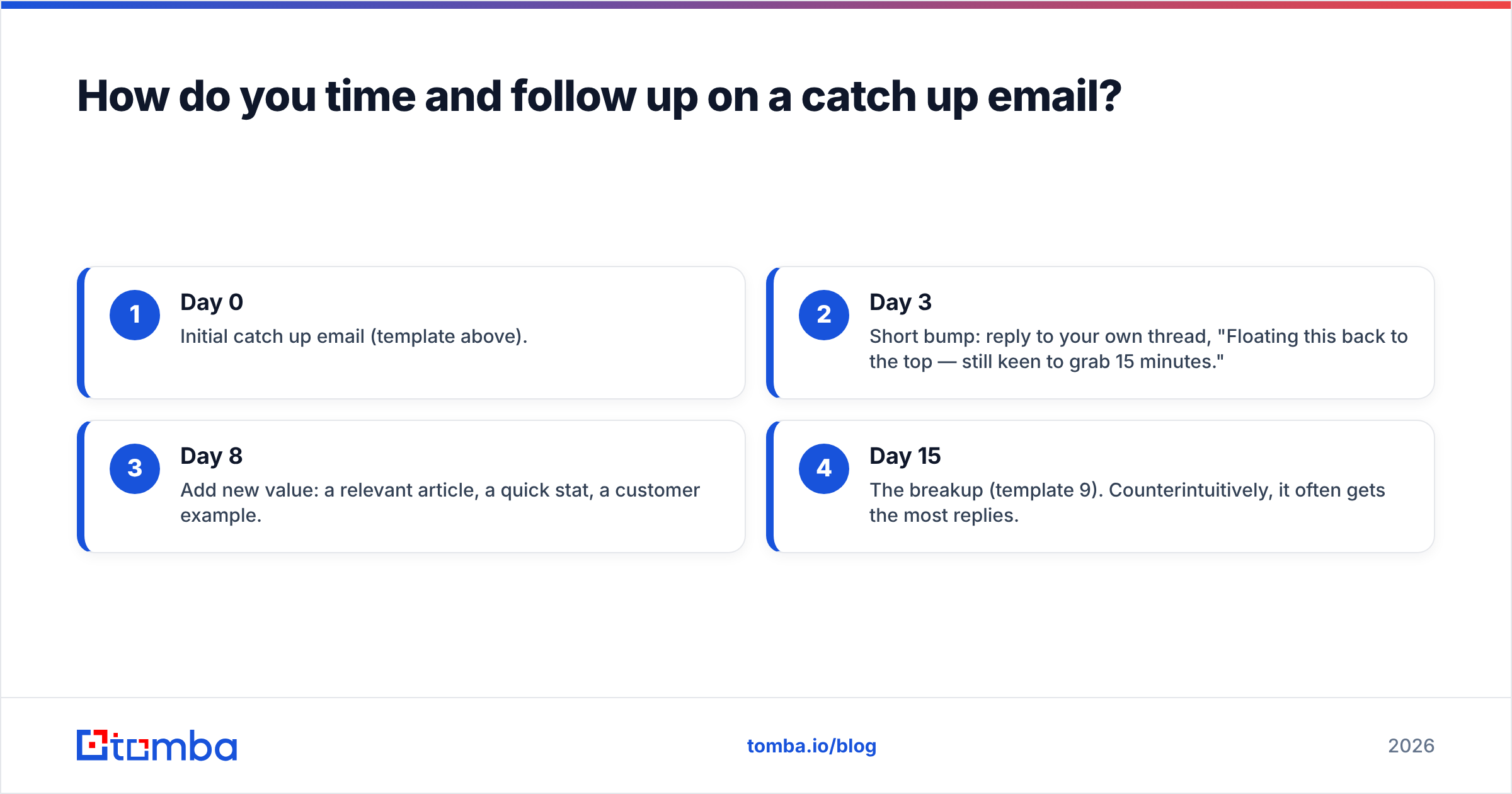
Send the first email Tuesday, Wednesday, or Thursday between 9am and 11am in the recipient's time zone. Then follow a patient cadence — most replies to reconnect emails come on the second or third touch, not the first.
A reliable sequence:
- Day 0 — Initial catch up email (template above).
- Day 3 — Short bump: reply to your own thread, "Floating this back to the top — still keen to grab 15 minutes."
- Day 8 — Add new value: a relevant article, a quick stat, a customer example.
- Day 15 — The breakup (template 9). Counterintuitively, it often gets the most replies.
Two rules keep this from feeling like nagging. First, never send the same email twice — each touch adds something new. Second, stop the moment they respond, even if the answer is "not now." Pushing past a soft no damages the relationship and your reply data. If you track outreach seriously, watch your response rate per template and retire the ones that underperform.
Catch up email vs. cold email: what's different?#
People blur these two, and the copy suffers for it. They are not the same job.
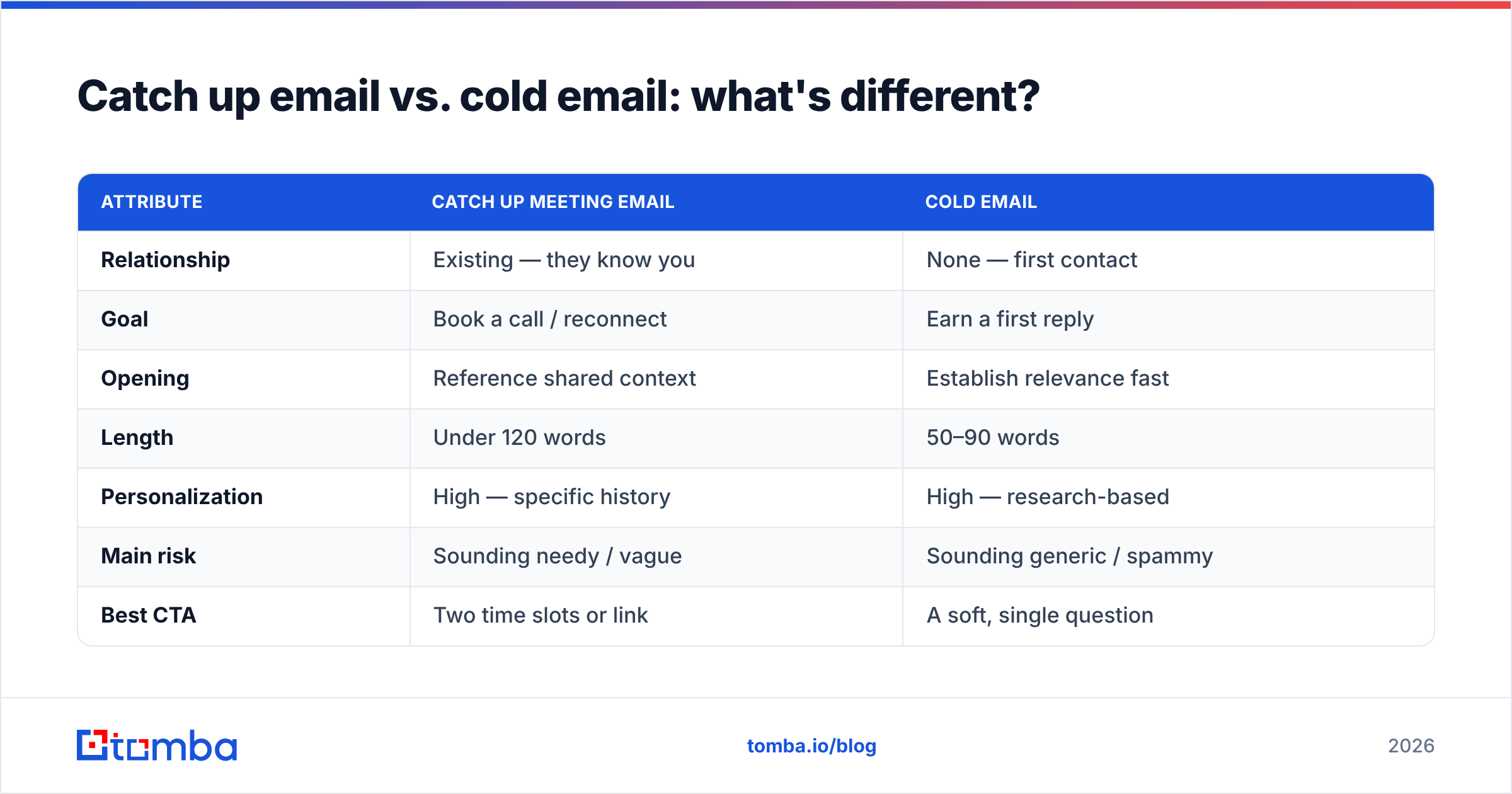
| Attribute | Catch up meeting email | Cold email |
|---|---|---|
| Relationship | Existing — they know you | None — first contact |
| Goal | Book a call / reconnect | Earn a first reply |
| Opening | Reference shared context | Establish relevance fast |
| Length | Under 120 words | 50–90 words |
| Personalization | High — specific history | High — research-based |
| Main risk | Sounding needy / vague | Sounding generic / spammy |
| Best CTA | Two time slots or link | A soft, single question |
The takeaway: a catch up email can be warmer and more direct because you have earned the right. Lean into the history. If you need a starting library for both, Tomba's free email templates cover reconnects, follow-ups, and cold opens you can fork.
How do you make sure the email actually reaches them?#
This is the step most people skip, and it quietly wastes every other improvement. The average B2B contact list decays at roughly 22–30% per year as people switch jobs — a number widely cited across data vendors and analyst write-ups like those on G2. A catch up email to a six-month-old contact has a real chance of bouncing.
Two safeguards:
- Verify before you send. Run older addresses through verification so you are not torching your domain reputation on hard bounces.
- Re-find movers. If your contact changed companies, the old address is dead but the person is still reachable. Look them up at their new domain and pick the relationship right back up.
That second move — catching someone who switched jobs and reconnecting at their new role — is one of the highest-converting plays in B2B, because you arrive as a familiar face during a chaotic transition.
Put it together#
Strong reconnect outreach is simple, not easy: remember them, give a reason now, ask for one specific thing, and make sure the email lands. Skip the filler, propose two time slots, and follow a patient four-touch cadence that ends with a graceful breakup.
When you are reaching back out to contacts who may have moved — or building a fresh list of people worth catching up with — start by getting a verified, current email for each one. The Tomba Email Finder pulls accurate professional addresses by name and company, with verification built in, so your perfectly written catch up meeting email reaches a real inbox instead of bouncing. Try it on the free tier (25 searches a month), and check the full Tomba pricing when you are ready to scale — Starter runs $49/mo. Write the email once; just make sure it gets delivered.
// get started
Find, verify and enrich your first contacts today
Start on the free plan with 25 searches a month, then scale when your team is ready.
Free plan · No credit card required · GDPR & CCPA
// about the author