Catchy Cold Email Subject Lines That Get Opens in 2026
Steal the formulas, structures, and 30+ examples behind catchy cold email subject lines that actually get opened in 2026 — plus the mistakes that send you to spam.
Catchy Cold Email Subject Lines That Get Opens in 2026
Your subject line is doing 80% of the work and getting 20% of the attention. Before a prospect reads a single word of your pitch, they make a sub-second decision in a crowded inbox: open, ignore, or delete. This guide breaks down exactly how to write catchy cold email subject lines that win that split-second — with formulas, real examples, and the data behind what works in 2026.
TL;DR#
- Short and specific beats clever. Subject lines of 3–7 words and under ~45 characters consistently outperform long, salesy hooks.
- Personalization is the multiplier. Referencing a company, role, or trigger event can lift open rates well beyond a generic blast.
- Curiosity > hype. A question or a half-told story pulls opens; "FREE!!!", "ACT NOW", and fake "Re:" lines kill them and trigger spam filters.
- Your list quality caps your ceiling. Even a perfect subject line fails if it lands in the wrong inbox — start with verified, accurate contacts.
- Test everything. A/B test two variants per send, measure open rate, and keep a swipe file of winners.
Why do cold email subject lines matter so much?#
The subject line is the price of admission. Think of it like the headline on a newspaper rack: nobody reads the article if the headline doesn't earn a glance. In cold outreach, where the recipient never asked to hear from you, that glance is even harder to win.
Industry benchmarks from email platforms like HubSpot and Mailchimp consistently put average cold open rates between 15% and 40%, depending on industry and list quality. The single biggest lever inside that range isn't your offer — it's whether the subject line feels relevant and human.
There's a second, less obvious reason: subject lines affect deliverability. Spammy phrasing ("guaranteed", excessive punctuation, all caps) gets flagged by filters before a human ever sees it. A great subject line protects both your open rate and your sender reputation.
What makes a cold email subject line "catchy"?#
Catchy doesn't mean gimmicky. It means the line earns a click because it's relevant, low-effort to process, and slightly incomplete. Five attributes show up in nearly every high-performing subject line:
- Specific — It references something true about the recipient (their company, role, a recent event), not a vague benefit.
- Short — Mobile inboxes truncate around 35–45 characters. The whole line should be readable at a glance.
- Curiosity-driven — It opens a loop the reader wants to close, often with a question or a partial detail.
- Low-pressure — It reads like a note from a colleague, not a billboard. No hype words, no fake urgency.
- Honest — It accurately previews the email. Bait-and-switch subject lines crush reply rates and trust.
If a subject line nails three of these five, it's already above average. Nail all five and you're in the top tier.
What are the best catchy cold email subject line formulas?#
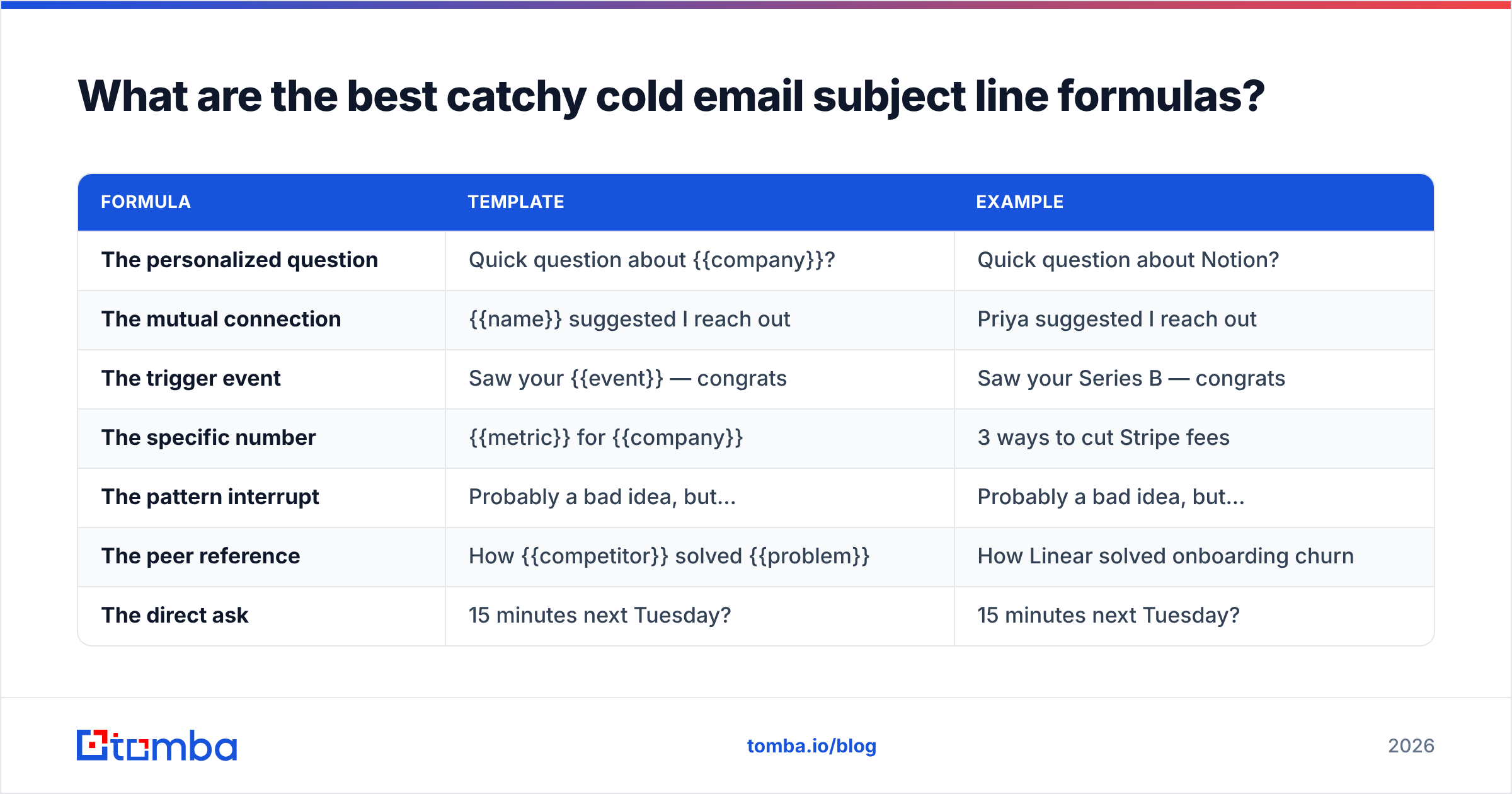
You don't need to be a copywriter to write strong subject lines — you need repeatable formulas. Here are the seven that perform most reliably, each with a fill-in-the-blank template and an example.
| Formula | Template | Example |
|---|---|---|
| The personalized question | Quick question about {{company}}? | Quick question about Notion? |
| The mutual connection | {{name}} suggested I reach out | Priya suggested I reach out |
| The trigger event | Saw your {{event}} — congrats | Saw your Series B — congrats |
| The specific number | {{metric}} for {{company}} | 3 ways to cut Stripe fees |
| The pattern interrupt | Probably a bad idea, but… | Probably a bad idea, but… |
| The peer reference | How {{competitor}} solved {{problem}} | How Linear solved onboarding churn |
| The direct ask | 15 minutes next Tuesday? | 15 minutes next Tuesday? |
Notice what's missing: no exclamation points, no "FREE", no ALL CAPS. The power comes from specificity, not volume. Swap in real details and these become genuinely personal rather than mail-merge filler.
Which subject line styles should you avoid?#
Some patterns feel clever but actively hurt you. Avoid these:
- Fake replies — Starting with "Re:" or "Fwd:" on a first-touch email is deceptive and increasingly flagged by filters.
- Hype and urgency — "ACT NOW", "Last chance", "Don't miss out" read as mass marketing and tank trust.
- Over-personalization creep — "I noticed you live in Austin and have two kids" feels like surveillance, not relevance.
- Vague benefit claims — "Grow your revenue 10x" is unbelievable and unmemorable.
- Clickbait that doesn't match the body — A curiosity gap is fine; a lie is not. The body must deliver on the promise.
The rule of thumb: if you'd be embarrassed to have a respected peer see the subject line, rewrite it.
How long should a cold email subject line be?#
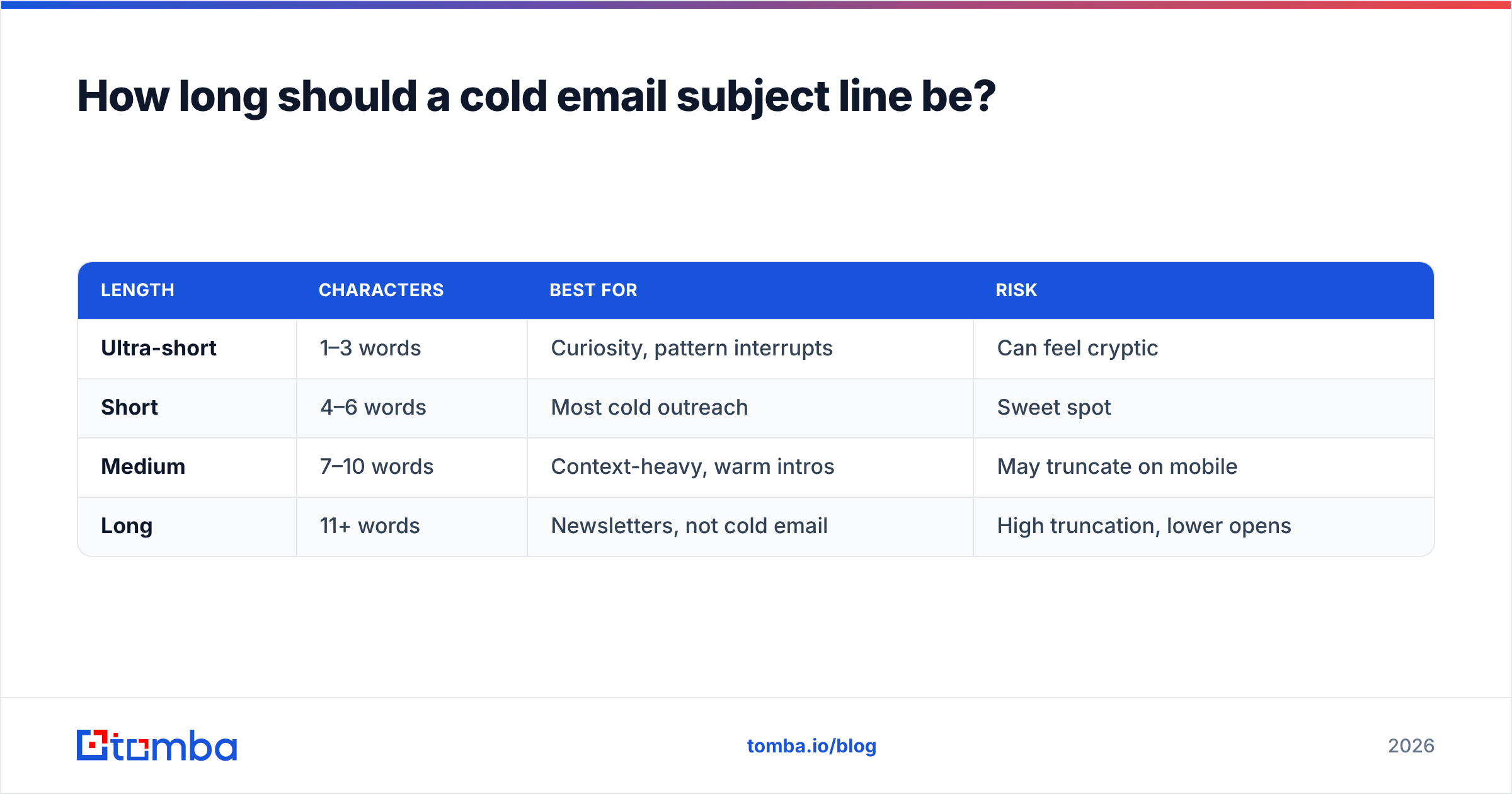
Shorter than you think. Aim for 3–7 words and under roughly 45 characters so the full line survives mobile truncation, where most B2B email is now first previewed.
Here's a quick reference for how length maps to context:
| Length | Characters | Best for | Risk |
|---|---|---|---|
| Ultra-short | 1–3 words | Curiosity, pattern interrupts | Can feel cryptic |
| Short | 4–6 words | Most cold outreach | Sweet spot |
| Medium | 7–10 words | Context-heavy, warm intros | May truncate on mobile |
| Long | 11+ words | Newsletters, not cold email | High truncation, lower opens |
When in doubt, cut a word. "Quick question about your onboarding flow" becomes the tighter, stronger "Question about onboarding." Brevity reads as confidence.
30+ catchy cold email subject line examples by use case#
Steal these directly, then personalize. Generic templates are a starting point — the more specific you make them, the better they convert.
Cold outreach to a new prospect
- Quick question, {{first_name}}
- Idea for {{company}}'s Q3
- Worth a 10-minute look?
- {{company}} + {{your_company}}?
- Mind if I send something over?
Trigger-based / timely
- Saw the {{award}} news — nice
- Your new {{role}} hire got me thinking
- Noticed you're hiring SDRs
- Congrats on the {{milestone}}
- Following your move into {{market}}
Curiosity / pattern interrupt
- This might be too direct
- Bad timing?
- A weird idea for {{company}}
- Permission to be blunt?
- You'll probably ignore this
Value-led
- 3 ways {{competitor}} beat you to it
- Cut {{cost}} by next quarter
- The metric your dashboard hides
- One change, fewer no-shows
- {{number}} hours back per rep
Mutual connection / social proof
- {{name}} said we should talk
- How {{peer_company}} fixed this
- {{name}} from {{company}} sent me
- We both know {{name}}
- Following up on {{event}}
Re-engagement / follow-up
- Should I close your file?
- Still relevant?
- One last idea
- Bumping this up
- Did this get buried?
Build a swipe file from the ones that fit your motion, then rotate them so your sends don't look templated across an account. For ready-to-use frameworks, our cold email templates library pairs these subject lines with matching bodies, and the subject line generator can spin variations when you're stuck.
How do you A/B test cold email subject lines?#
Test one variable at a time, measure open rate, and keep score. Treat it like a science experiment: change the subject line, hold everything else constant, and compare.
A simple, repeatable process:
- Write two variants that differ on a single dimension — say, a question versus a statement.
- Split your batch evenly — send variant A to half the segment, variant B to the other half. Keep send time and body identical.
- Use a meaningful sample — aim for at least 100 sends per variant before drawing conclusions; smaller samples are noise.
- Measure open rate as the primary metric, but watch reply rate too. A subject line that wins opens but loses replies was probably misleading.
- Log the winner in your swipe file and feed it into the next test.
You can validate subject-line ideas before you ever send by running them through a subject line tester, which flags spam triggers and predicts readability. That catches obvious losers before they cost you real deliverability.
Why does list quality matter more than the subject line?#
Because the best subject line in the world fails if it lands in the wrong inbox — or no inbox at all. This is the part most "catchy subject line" articles skip.
Picture two senders with identical, beautifully written subject lines. Sender A bought a scraped list riddled with outdated and invalid addresses. Sender B used verified, accurate contacts. Sender A's open rate craters, bounces spike, and their domain reputation degrades until even valid recipients stop seeing their mail. Sender B's catchy line actually gets a chance to work.
That's why deliverability and data quality sit underneath every subject-line decision:
- High bounce rates from bad addresses signal mailbox providers that you're a spammer, suppressing every future send.
- Catch-all domains can quietly swallow your email or bounce it later — verify them with a catch-all verifier before sending.
- Role-based and stale addresses drag down engagement metrics that providers use to score you.
Run your list through an email verifier before any campaign. Clean data is the foundation that lets a great subject line do its job — and it protects the email deliverability you've worked to build.
How do you find the right contacts to send to?#
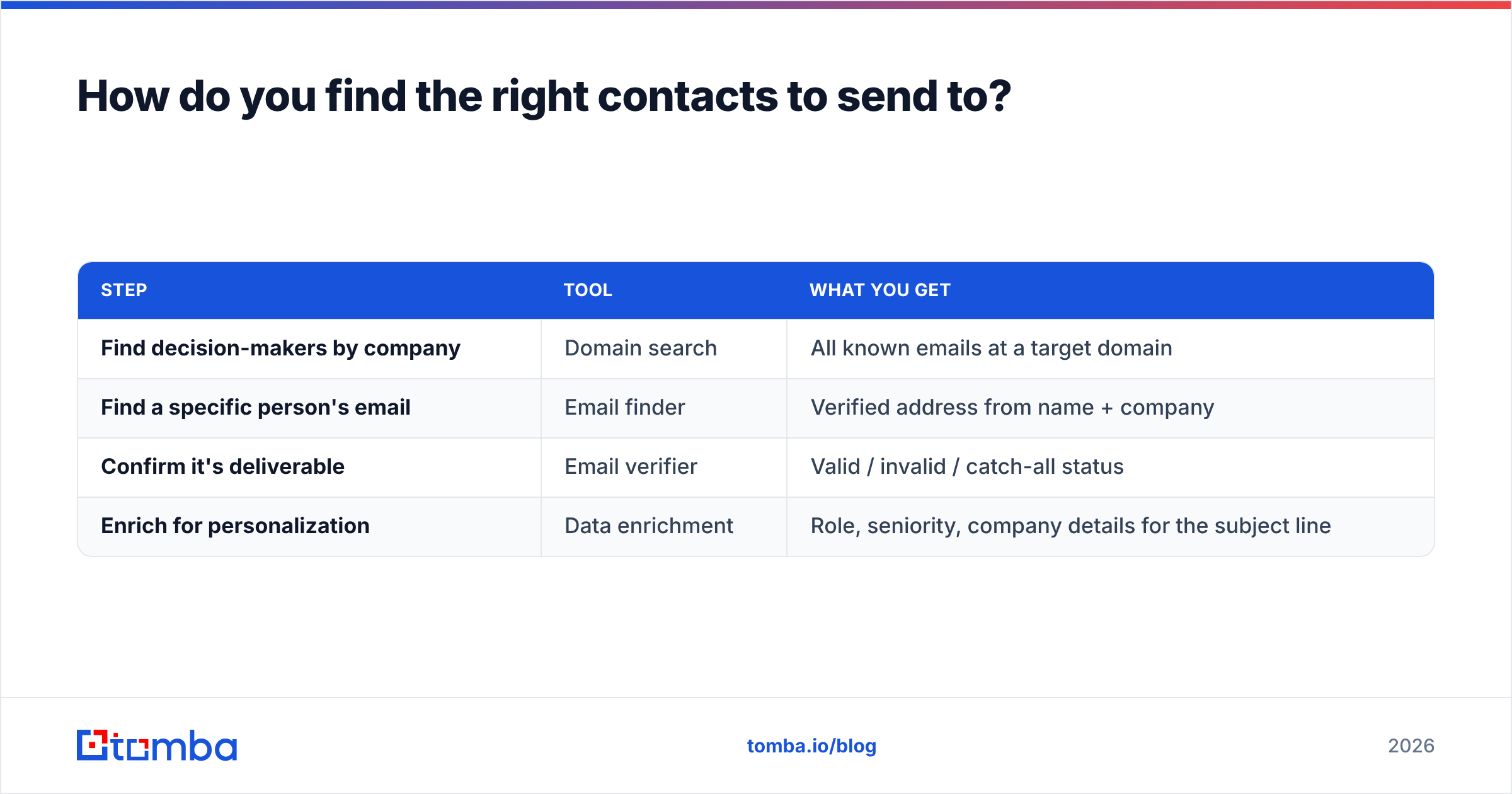
Start with accurate, role-targeted contact data — a clever subject line aimed at the wrong person still misses. The workflow looks like this:
| Step | Tool | What you get |
|---|---|---|
| Find decision-makers by company | Domain search | All known emails at a target domain |
| Find a specific person's email | Email finder | Verified address from name + company |
| Confirm it's deliverable | Email verifier | Valid / invalid / catch-all status |
| Enrich for personalization | Data enrichment | Role, seniority, company details for the subject line |
That last step closes the loop: enrichment data — job title, company size, recent funding — is exactly the raw material that makes the personalized formulas above feel handwritten instead of mail-merged.
For teams sending at scale, a bulk email finder handles whole lists at once, and the Tomba API plugs verification directly into your sequencing tool so every contact is validated before a subject line ever reaches it.
How does Tomba's pricing compare for outreach teams?#
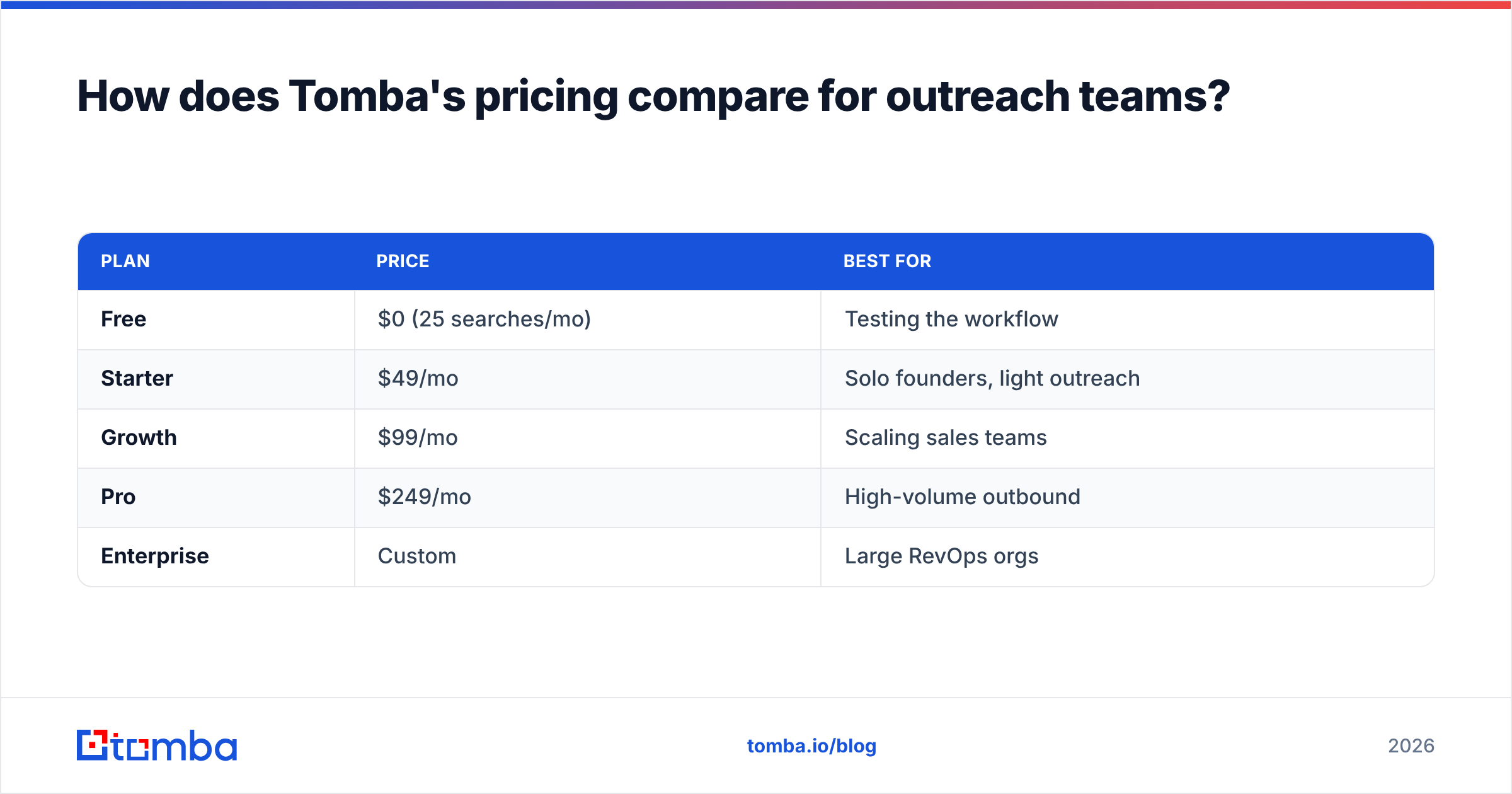
Subject-line testing means volume, and volume means you need enough search and verification credits without overpaying. Tomba's plans scale with your sending:
| Plan | Price | Best for |
|---|---|---|
| Free | $0 (25 searches/mo) | Testing the workflow |
| Starter | $49/mo | Solo founders, light outreach |
| Growth | $99/mo | Scaling sales teams |
| Pro | $249/mo | High-volume outbound |
| Enterprise | Custom | Large RevOps orgs |
See full Tomba pricing for credit limits and per-plan features. The free tier is enough to verify a small test list and prove the approach before you commit.
Putting it all together#
Catchy cold email subject lines come down to a simple stack: write short, specific, curiosity-driven lines using proven formulas; avoid hype and fake-reply tricks; A/B test relentlessly; and — most importantly — send to a clean, verified, well-targeted list. The cleverest line in the world can't outrun bad data.
Get the foundation right and every subject line you test from here gets a fair shot.
Ready to make your subject lines actually land? Start with accurate contacts. Use the Tomba Email Finder to find and verify decision-maker emails by name, company, or domain — so your catchy subject lines reach real inboxes instead of bouncing into spam. Sign up free for 25 searches a month and see how much your open rates climb when the data underneath them is solid.
// get started
Find, verify and enrich your first contacts today
Start on the free plan with 25 searches a month, then scale when your team is ready.
Free plan · No credit card required · GDPR & CCPA
// about the author