Catchy Email Subject Lines That Get Opens (2026 Guide)
Catchy email subject lines decide whether your message gets opened or buried. Here are the formulas, 60+ examples, and tests that lift open rates in 2026.
Your email can be perfectly written, deeply researched, and aimed at exactly the right person — and still die unread because the subject line was forgettable. The subject line is the doorman. It decides who gets in.
This guide breaks down what makes catchy email subject lines actually work in 2026, with formulas you can copy, 60+ examples by use case, and a testing routine that turns guesses into data.
TL;DR#
- Catchy email subject lines win on curiosity, relevance, and specificity — not gimmicks or ALL CAPS.
- Keep it 4–7 words (under ~45 characters) so it survives mobile truncation and the inbox preview.
- Personalization beats cleverness. A name, company, or trigger event lifts opens more than a pun.
- Test everything. Send the same email with two subject lines to small splits, then scale the winner.
- A great subject line on a bad list is wasted — accurate contact data is the multiplier behind every open.
What makes an email subject line "catchy"?#
A catchy subject line earns a click by creating a small, honest tension the reader needs to resolve. It is not about tricking anyone — clickbait that overpromises tanks your reply rate and your sender reputation. It is about being the most relevant, most specific, slightly-curiosity-inducing line in a crowded inbox.
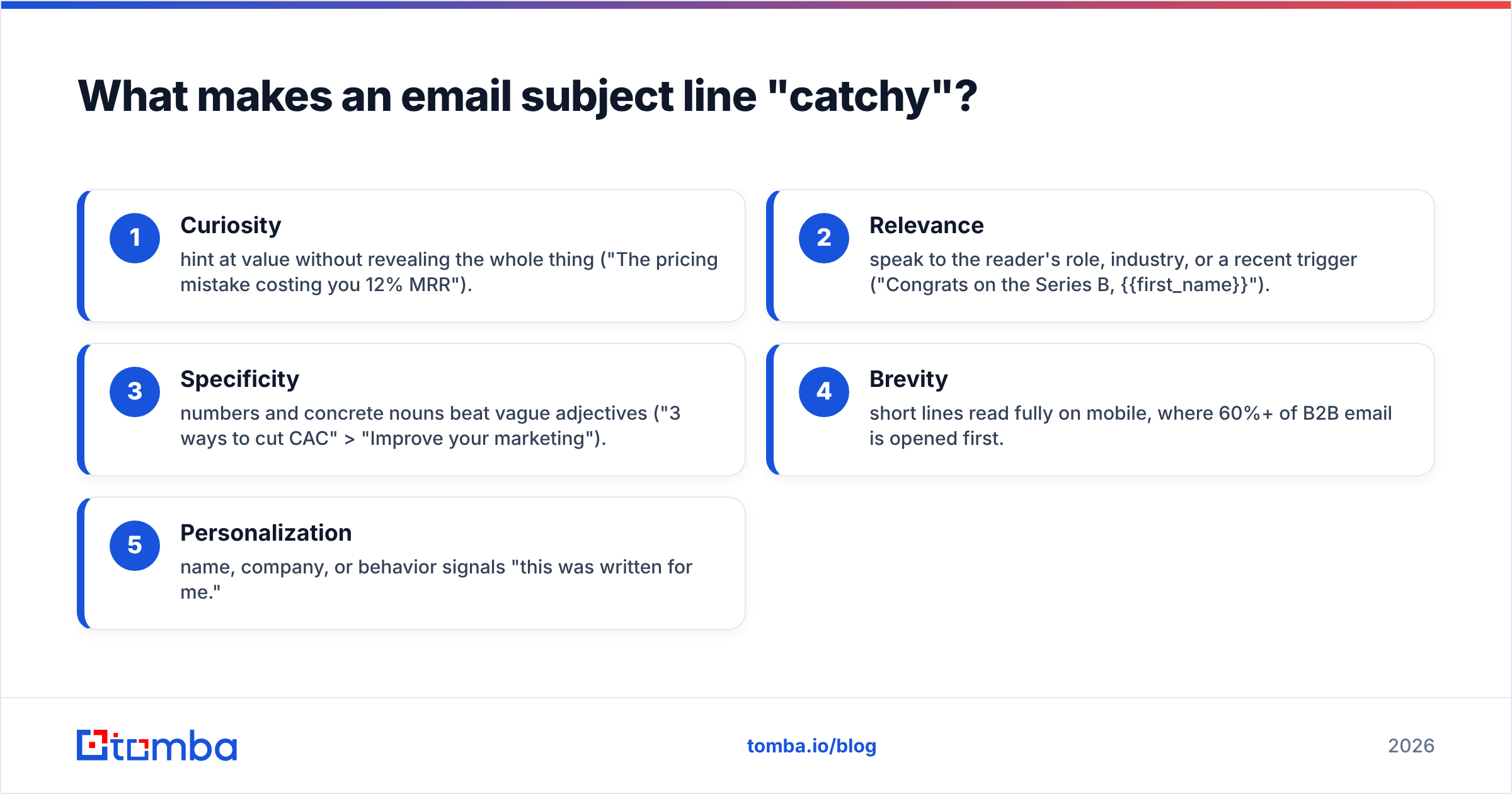
The five levers that consistently move open rates:
- Curiosity — hint at value without revealing the whole thing ("The pricing mistake costing you 12% MRR").
- Relevance — speak to the reader's role, industry, or a recent trigger ("Congrats on the Series B, {{first_name}}").
- Specificity — numbers and concrete nouns beat vague adjectives ("3 ways to cut CAC" > "Improve your marketing").
- Brevity — short lines read fully on mobile, where 60%+ of B2B email is opened first.
- Personalization — name, company, or behavior signals "this was written for me."
Get two or three of these into a single line and you have something genuinely catchy. Force all five and it reads like a billboard.
How long should a catchy email subject line be?#
Short. Mobile inboxes cut subject lines at roughly 35–45 characters, and most readers triage on a phone before they ever sit at a desk. If your hook lives in word nine, it never gets seen.
Aim for 4–7 words and 30–45 characters. That forces you to lead with the most interesting word and drop the filler ("Just checking in to see if…"). When a line must run longer, front-load the payload so the truncated version still makes sense.
Preview text — the gray snippet next to or under the subject — is your second subject line. Treat it as an extension of the hook, not a dumping ground for "View in browser" boilerplate.
What are the best subject line formulas?#
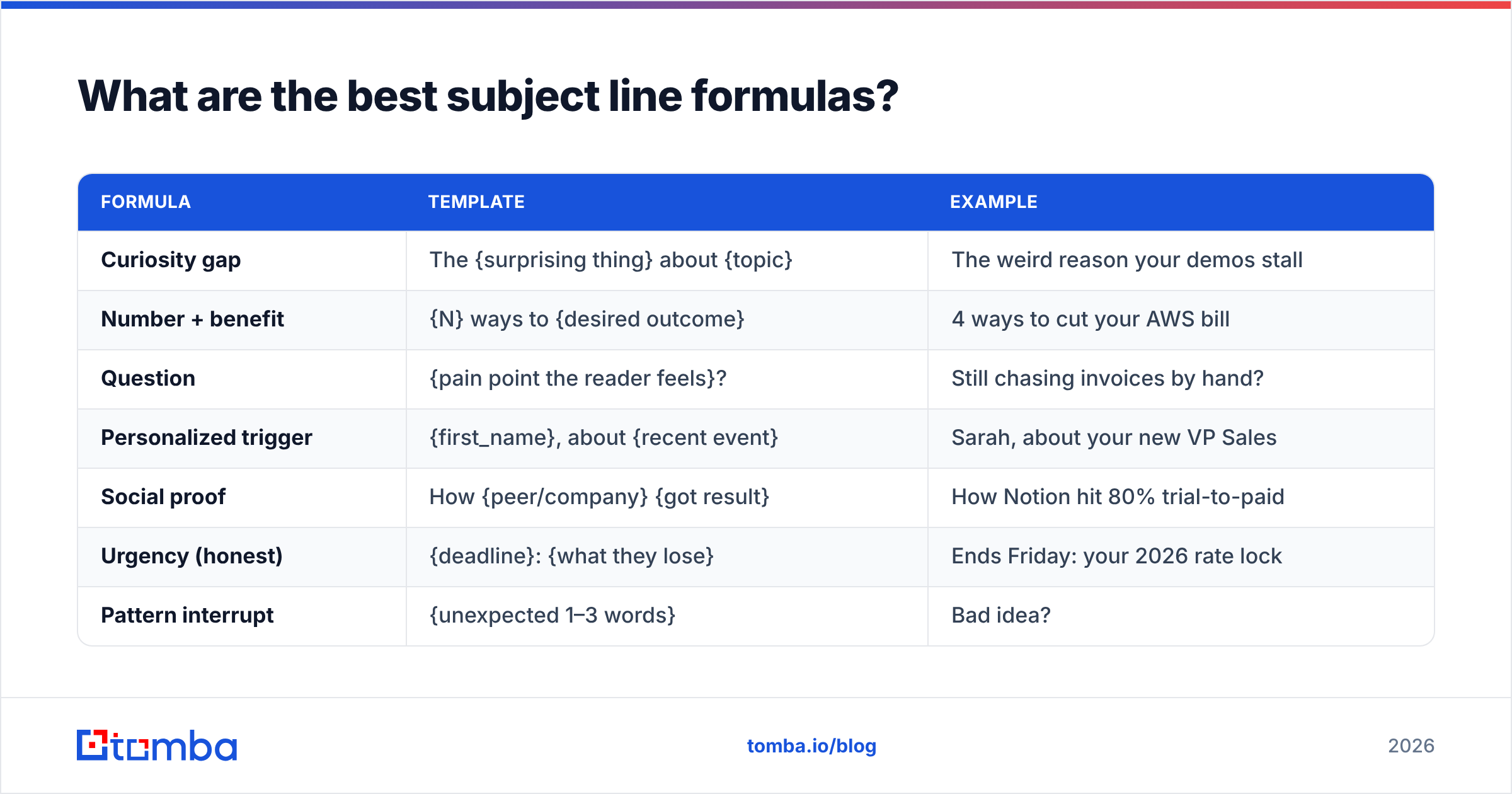
Formulas remove the blank-page problem. Here are nine that scale across cold outreach, newsletters, and nurture, each with a template and a filled example.
| Formula | Template | Example |
|---|---|---|
| Curiosity gap | The {surprising thing} about {topic} | The weird reason your demos stall |
| Number + benefit | {N} ways to {desired outcome} | 4 ways to cut your AWS bill |
| Question | {pain point the reader feels}? | Still chasing invoices by hand? |
| Personalized trigger | {first_name}, about {recent event} | Sarah, about your new VP Sales |
| Social proof | How {peer/company} {got result} | How Notion hit 80% trial-to-paid |
| Urgency (honest) | {deadline}: {what they lose} | Ends Friday: your 2026 rate lock |
| Pattern interrupt | {unexpected 1–3 words} | Bad idea? |
| "Quick" ask | Quick {topic} question | Quick onboarding question |
| Direct value | {outcome} in {timeframe} | More replies in 7 days |
Rotate formulas across a campaign so your audience never sees the same shape twice. If every email is a number list, "5 ways…" stops feeling fresh fast. You can spin variations fast with an email subject line generator and then trim by hand.
What are examples of catchy email subject lines by use case?#
Different contexts reward different tones. Cold outreach needs to feel one-to-one; newsletters can be playful; re-engagement leans on loss aversion. Steal and adapt these.
Cold outreach (B2B)
- "{first_name}, quick idea for {company}"
- "Should I close your file?"
- "Saw your post on churn"
- "12 minutes to fix {pain}?"
- "Worth a look before Q3?"
Newsletter / content
- "The metric everyone tracks wrong"
- "We tested 50 CTAs so you don't have to"
- "Unpopular opinion: SQLs are a vanity metric"
- "Your competitor read this last week"
Re-engagement / win-back
- "Did we lose you, {first_name}?"
- "Before you go…"
- "This was waiting in your account"
- "One click to stay subscribed"
Promotional / offer
- "Ends Friday: 2026 pricing locked"
- "Your 30% is about to expire"
- "Last 24 hours (no extensions)"
Follow-up
- "Re: {original thread}"
- "Bumping this to the top"
- "Did this get buried?"
- "Closing the loop"
Notice how few of these use exclamation points, emojis, or hype words. Restraint reads as confidence. For ready-to-send frameworks around each line, browse Tomba's cold email templates and adapt the body to match the promise in the subject.
Which subject line words and tactics hurt opens?#
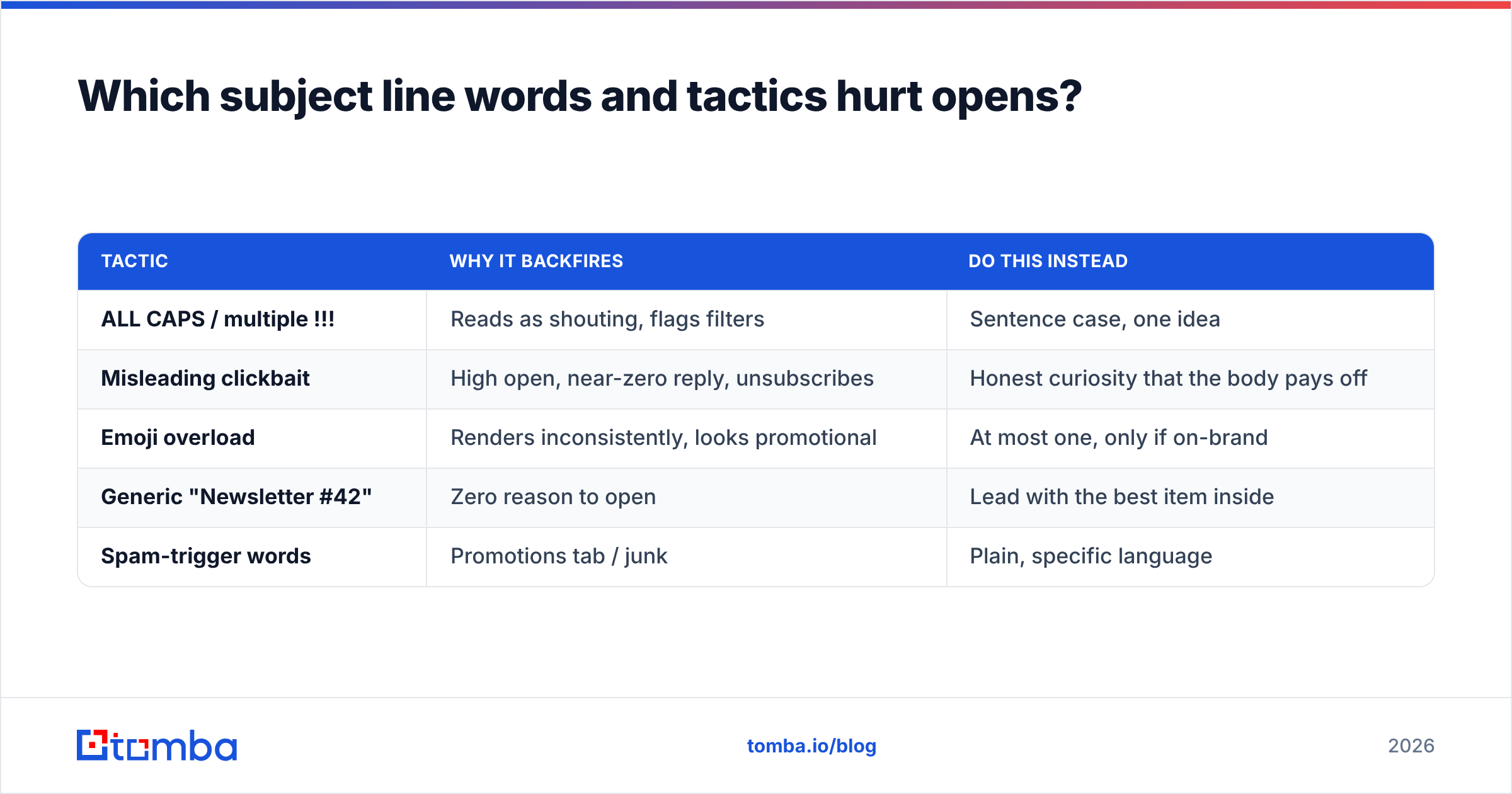
Some words and habits don't just underperform — they trigger spam filters and erode trust. Spam-trigger language ("FREE!!!", "ACT NOW", "100% guaranteed"), excessive punctuation, and ALL CAPS push you toward the promotions tab or the junk folder, which quietly destroys email deliverability before anyone reads a word.
| Tactic | Why it backfires | Do this instead |
|---|---|---|
| ALL CAPS / multiple !!! | Reads as shouting, flags filters | Sentence case, one idea |
| Misleading clickbait | High open, near-zero reply, unsubscribes | Honest curiosity that the body pays off |
| Emoji overload | Renders inconsistently, looks promotional | At most one, only if on-brand |
| Generic "Newsletter #42" | Zero reason to open | Lead with the best item inside |
| Spam-trigger words | Promotions tab / junk | Plain, specific language |
Before a send, run your draft through a spam checker to catch trigger words and formatting that will route you out of the primary inbox. A clever line that lands in spam is worth nothing.
How do you test catchy email subject lines?#
You don't guess — you split-test. A/B testing subject lines is the single highest-ROI habit in email, because the variable is cheap to change and the impact compounds across every future send.
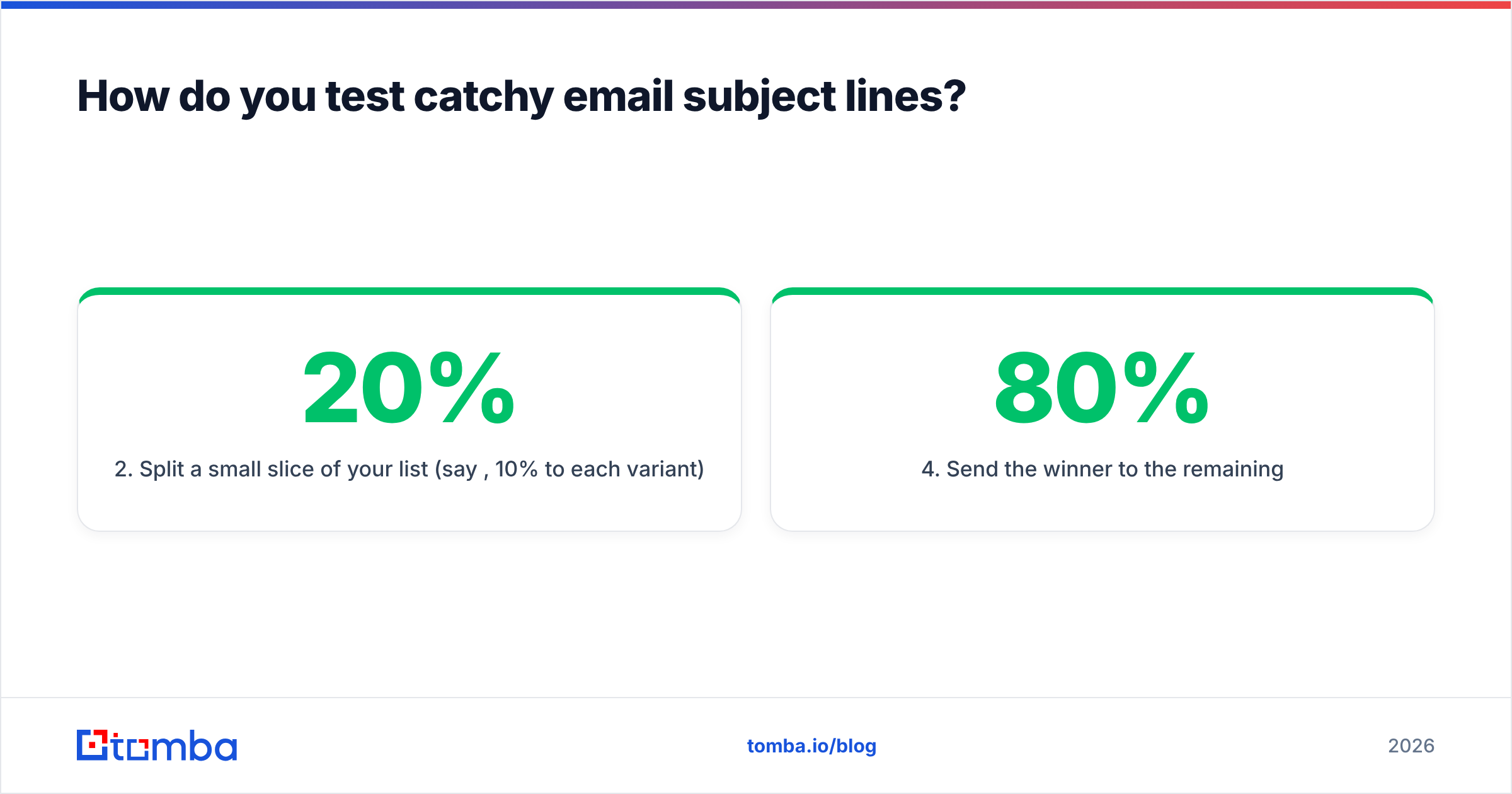
The basic loop:
- Write two distinct variants — not "5 tips" vs "Five tips," but different angles (curiosity vs. social proof).
- Split a small slice of your list (say 20%, 10% to each variant).
- Pick one metric — usually open rate, but watch reply rate for outreach, since opens alone can mislead.
- Send the winner to the remaining 80%.
- Log the result so you build a library of what your audience responds to.
Tools like a subject line tester score length, word choice, and spam risk before you ever hit send, so you walk into the A/B test with two already-decent options instead of one good line and one dud.
A word on sample size: with a list of a few hundred, a "winner" can be statistical noise. Treat small tests as directional, and only trust differences that repeat across multiple sends. Major ESPs document their built-in A/B mechanics well — Mailchimp's testing guide and HubSpot's research on subject lines are solid starting points for benchmarks.
How does personalization make subject lines catchier?#
Personalization is the cheat code, because relevance beats cleverness almost every time. "{first_name}, about your Q3 hiring plan" outperforms a witty pun because it signals research and intent. The catch: personalization only works when the underlying data is correct.
Levels of personalization, from weakest to strongest:
- Token swap — first name or company name. Easy, but everyone does it.
- Segment-level — role, industry, or company size ("For SaaS founders under 50 employees").
- Trigger-based — a recent event: funding, a job change, a published article, a product launch.
- Behavioral — what the reader did: visited pricing, opened the last three emails, abandoned a trial.
Trigger and behavioral personalization win, but they collapse the moment your data is stale — emailing "Congrats on the new role" to someone who left six months ago does more harm than a generic line. That is why the catchiest subject line in the world still depends on a clean, current list. Enriching contacts with accurate titles, companies, and verified addresses through data enrichment is what makes trigger-based subjects possible at scale.
How do catchy subject lines fit into the bigger picture?#
A subject line is the tip of a system. Behind every opened email sits a verified address, an accurate name, a correct company, and a sender domain in good standing. Optimize the line and ignore the list, and you are polishing the doorknob on a house with no foundation.
Here is the order that actually compounds:
- Accurate, verified contact data — right person, right address, deliverable.
- Healthy sending infrastructure — authenticated domain, warmed inbox, low complaint rate.
- A catchy, honest subject line — the hook this guide is about.
- A body that pays off the promise — so opens turn into replies.
- Tight follow-up — most replies come after the first email, not from it.
Skip step one and even a 70% open rate is 70% of the wrong people. That is the quiet reason high-effort subject lines underperform: the list, not the copy, was the bottleneck. Tools rated highly on G2's email marketing category all assume you start with deliverable contacts.
What's the fastest workflow to write 10 subject lines?#
When you need volume without losing quality, batch it:
- Pick one offer and one audience. Don't write for "everyone."
- Run three formulas from the table above against that offer.
- Draft 10 raw lines — quantity first, no editing.
- Cut anything over 7 words or that needs a comma to make sense.
- Score the survivors in a subject line tester for length and spam risk.
- A/B the top two. Ship, log, repeat.
If you'd rather start from a prompt than a blank page, an AI writer like Tomba's cold email AI can generate the first ten in seconds — you bring the judgment and the trimming.
Frequently asked questions#
What is the ideal length for a catchy email subject line? Four to seven words, roughly 30–45 characters, so it reads fully on mobile where most opens happen.
Do emojis improve open rates? Sometimes, in B2C and newsletters — but they render inconsistently and can look promotional. Use at most one, and only if it fits your brand. In B2B cold outreach, skip them.
Should subject lines be different for cold outreach vs. newsletters? Yes. Cold outreach should feel one-to-one and lowercase-casual ("quick idea for {company}"). Newsletters can be bolder and more playful because the reader already opted in.
How many subject lines should I test? Two per send is the practical sweet spot. More variants split your sample too thin to read a clear winner unless your list is very large.
Why are my catchy subject lines still getting low opens? Usually it's the list, not the line. Stale or unverified addresses, a cold sending domain, or spam-trigger words can cap opens no matter how good the copy is.
Start with a list worth writing for#
The best subject line in your drafts folder is wasted on an address that bounces. Before you obsess over word nine versus word ten, make sure every email is going to a real, current, deliverable inbox.
Tomba's Email Finder locates verified professional email addresses by name, company, or domain — so your catchy subject lines reach actual humans instead of dead mailboxes. Pair it with Tomba's email verifier to scrub your list before every send, and check Tomba pricing (free tier included, Starter at $49/mo) to find the plan that matches your volume. Write the hook — we'll make sure it lands.
// get started
Find, verify and enrich your first contacts today
Start on the free plan with 25 searches a month, then scale when your team is ready.
Free plan · No credit card required · GDPR & CCPA
// about the author