27 Catchy Follow Up Email Subject Lines That Win Replies (2026)
Your follow-up gets ignored because the subject line is boring. Here are 27 catchy follow up email subject lines, tested formulas, and a copy-paste table for 2026.
You sent a great first email. Then silence. So you sent a follow-up with the subject line "Just following up" — and watched it die in the inbox too. The problem usually is not your offer. It is the seven words people read before they decide whether you exist.
This guide gives you 27 catchy follow up email subject lines, the formulas behind them, and a copy-paste comparison table you can use today.
TL;DR#
- Boring beats clever, but specific beats both. "Quick question about [X]" outperforms "Just checking in" almost every time.
- Match the subject to the follow-up number. Your second touch should not look like your first.
- Keep it under 50 characters so it survives mobile truncation, where most opens happen.
- Personalization is the multiplier, but it only works when your contact data is accurate — bad emails never get the chance to open.
- Steal the 27 examples and the formula table below, then test two variants per send.
Why do most follow-up subject lines fail?#
Most follow-up subject lines fail because they announce that the email is a chore. "Following up," "Touching base," and "Circling back" all tell the reader the same thing: I want something and I have nothing new to say. That is a reason to ignore you, not open you.
A good follow-up subject line does one of three jobs. It adds new value, it reduces friction, or it creates a small, honest reason to respond now. Everything in this guide is built on those three levers.
There is also a deliverability angle people forget. If your subject line screams "mass cold sequence" — all caps, fake "RE:", emoji pileups — spam filters notice the pattern across thousands of sends, not just yours. Clean, human subject lines protect your sender reputation as much as they protect your open rate.
What makes a follow-up subject line catchy?#
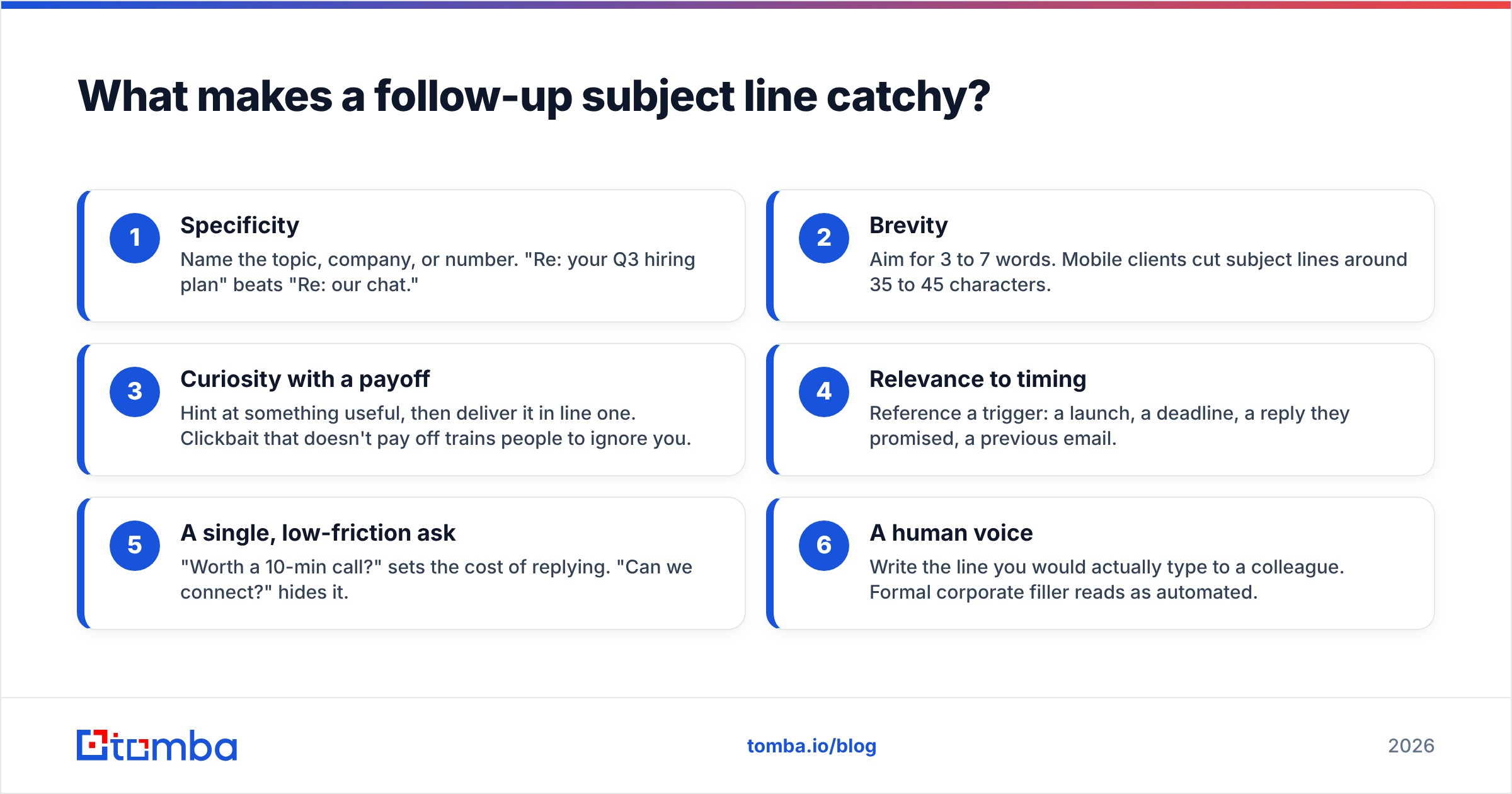
Catchy does not mean gimmicky. A catchy follow up subject line earns the open because it feels relevant, fast, and low-risk. Here are the six traits that show up in nearly every high-performing line:
- Specificity — Name the topic, company, or number. "Re: your Q3 hiring plan" beats "Re: our chat."
- Brevity — Aim for 3 to 7 words. Mobile clients cut subject lines around 35 to 45 characters.
- Curiosity with a payoff — Hint at something useful, then deliver it in line one. Clickbait that doesn't pay off trains people to ignore you.
- Relevance to timing — Reference a trigger: a launch, a deadline, a reply they promised, a previous email.
- A single, low-friction ask — "Worth a 10-min call?" sets the cost of replying. "Can we connect?" hides it.
- A human voice — Write the line you would actually type to a colleague. Formal corporate filler reads as automated.
If you want to pressure-test a draft before you send, run it through a subject line tester to catch spam triggers, length problems, and weak word choices.
What are the best catchy follow up email subject lines for 2026?#
Here are 27 lines grouped by situation. Swap the brackets for real details — generic versions perform worse.
After a first cold email (no reply):
- Quick question about [Company]'s [process]
- Did this get buried, [First name]?
- One idea for [team/goal]
- Should I close your file?
- Re: helping [Company] with [outcome]
After a meeting or demo:
- Next steps from our call
- The [resource] I promised you
- [First name] + [Your company]: recap
- Loved our chat — one follow-up
- Quick recap + the pricing you asked for
After sending a proposal or quote:
- Any blockers on the proposal?
- Two quick options for [Company]
- Worth a 10-minute call this week?
- Still the right time for [project]?
- Want me to revise the proposal?
The "breakup" / last attempt:
- Permission to close your file?
- Should I stop reaching out?
- Last one from me, [First name]
- Closing the loop on [topic]
- Bad timing? No problem
Value-add follow-ups (give before you ask):
- Saw this and thought of [Company]
- A [stat/benchmark] for your [team]
- [Competitor] just did this — worth a look
- Free [template/teardown] for you
- Idea: [specific outcome] in 30 days
Re-engaging a cold contact:
- It's been a while, [First name]
- Still working on [goal]?
For full email bodies to pair with these, browse the cold email templates library so the subject line and message stay consistent.
Which subject line style wins by scenario?#
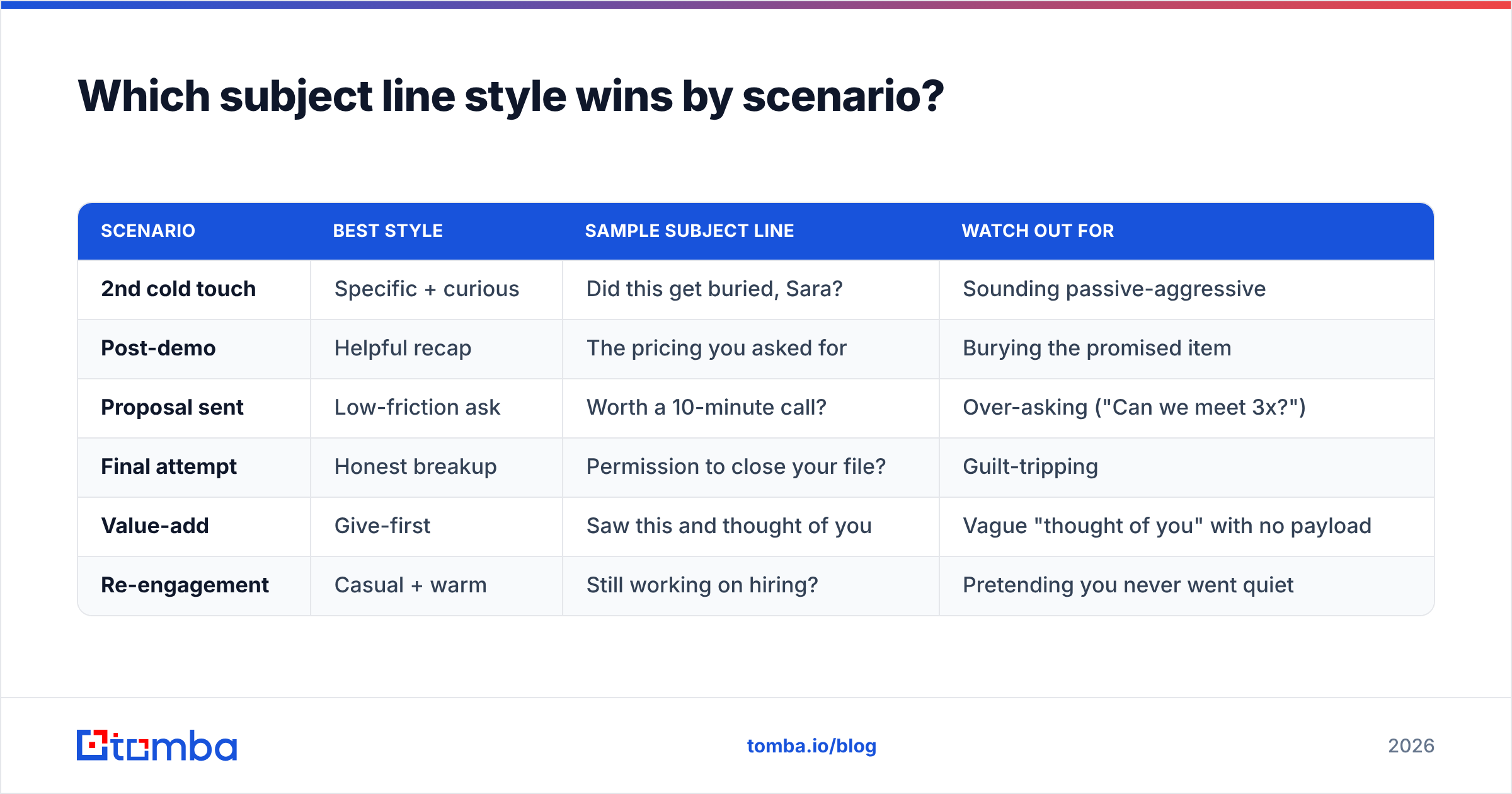
Different follow-up moments need different tones. This table maps the style to the situation, with a sample line and the main risk to avoid.
| Scenario | Best style | Sample subject line | Watch out for |
|---|---|---|---|
| 2nd cold touch | Specific + curious | Did this get buried, Sara? | Sounding passive-aggressive |
| Post-demo | Helpful recap | The pricing you asked for | Burying the promised item |
| Proposal sent | Low-friction ask | Worth a 10-minute call? | Over-asking ("Can we meet 3x?") |
| Final attempt | Honest breakup | Permission to close your file? | Guilt-tripping |
| Value-add | Give-first | Saw this and thought of you | Vague "thought of you" with no payload |
| Re-engagement | Casual + warm | Still working on hiring? | Pretending you never went quiet |
Notice the pattern: the ask gets smaller and more concrete as the thread ages. Early on you can lead with curiosity; late in the sequence, honesty and brevity win.
How long should a follow-up subject line be?#
Keep follow-up subject lines between 30 and 50 characters, which is roughly 3 to 7 words. Most inboxes are read on phones, and mobile mail apps truncate subject lines aggressively — often after about 35 characters. If your hook lands in the part that gets cut, it never existed.
According to HubSpot's email research, shorter, personalized subject lines consistently correlate with higher open rates, and the same holds for follow-ups. The discipline is simple: write your line, then delete every word that is not doing a job. "Just wanted to quickly follow up on the proposal I sent" becomes "Any blockers on the proposal?"
A quick length sanity check:
- 1 to 3 words: punchy, great for breakups ("Closing the loop?")
- 4 to 7 words: the sweet spot for most follow-ups
- 8+ words: only if every word is specific and the front-load is strong
Should you reply in the same thread or start fresh?#
Reply in the same thread for the first two or three follow-ups, then consider a fresh subject line if the thread has gone fully cold. Staying in-thread keeps context attached and signals continuity, which raises the odds of a quick "sorry, swamped — yes" reply. When you reply in-thread, your client shows the original subject prefixed with "Re:", and that familiarity is an asset.
But a dead thread is dead. If three replies in the same chain got nothing, a new subject line with a new angle ("Idea: cut your bounce rate in 30 days") gives the reader a fresh reason to look. The mistake is faking a "Re:" on an email that was never part of a real conversation — that erodes trust the moment they open it, and it is one of the patterns spam filters flag.

How do you personalize follow-up subject lines at scale?#
Personalize on the variable that matters most to the reader — their company, their role, their stated goal — not on a token that proves you ran a mail merge. "Quick question, [First name]" is barely personalization. "Quick question about [Company]'s onboarding flow" shows you did homework.
The catch: personalization at scale only works if the underlying data is right. A perfectly crafted subject line means nothing if it lands at john@old-company.com or bounces on a typo. That is why your subject-line work and your data hygiene are the same project. Before a sequence goes out, you want verified, current addresses so every clever line actually gets a chance to open.
This is where accurate sourcing earns its keep. Tools like Tomba's email finder let you pull verified professional addresses by name and domain, and the matching email verifier strips out invalid or risky contacts before they hurt your delivery. Clean list in, catchy subject line on top, and your open rate has somewhere to go.
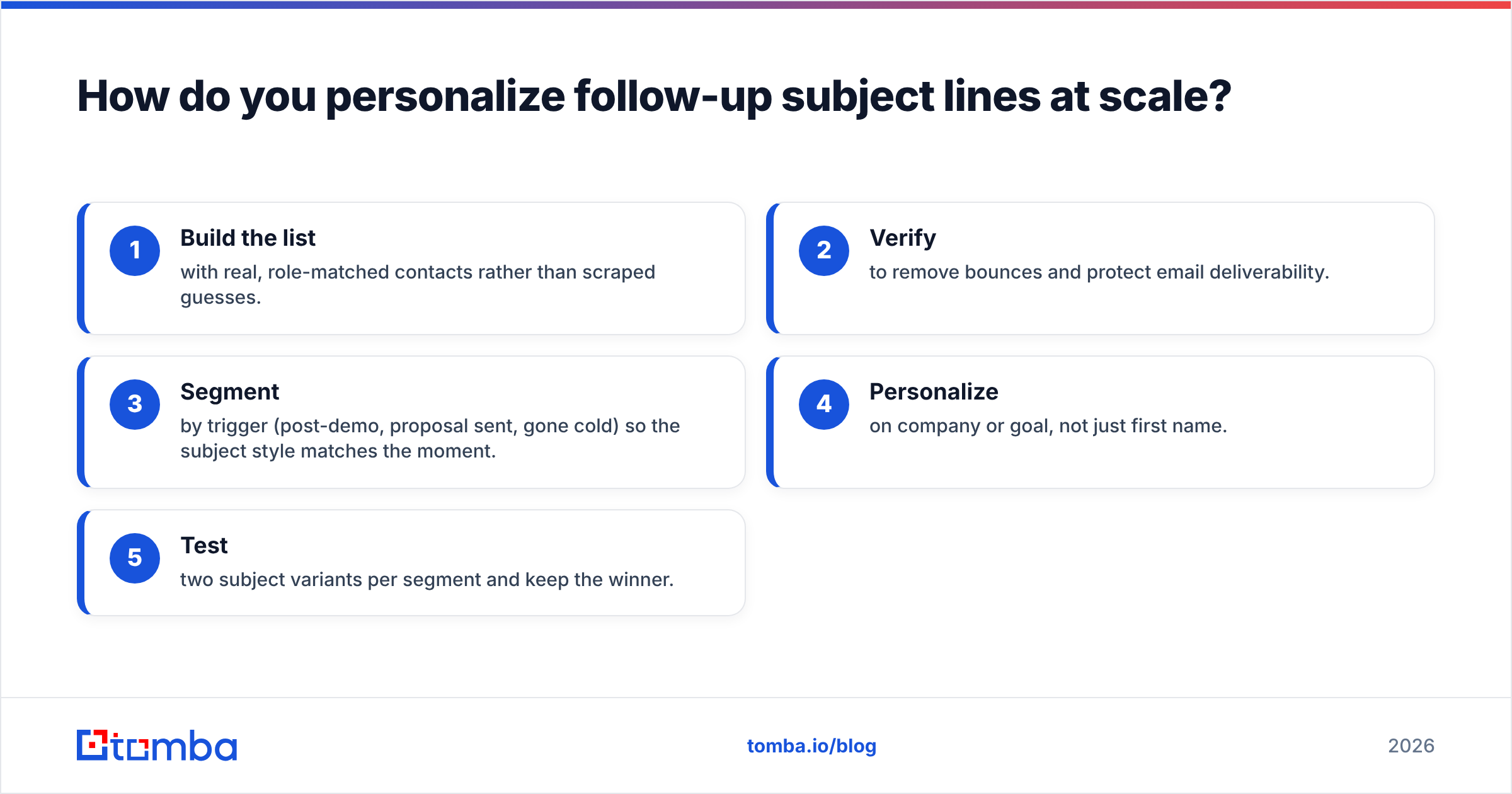
A practical workflow:
- Build the list with real, role-matched contacts rather than scraped guesses.
- Verify to remove bounces and protect email deliverability.
- Segment by trigger (post-demo, proposal sent, gone cold) so the subject style matches the moment.
- Personalize on company or goal, not just first name.
- Test two subject variants per segment and keep the winner.
What follow-up subject line mistakes kill your reply rate?#
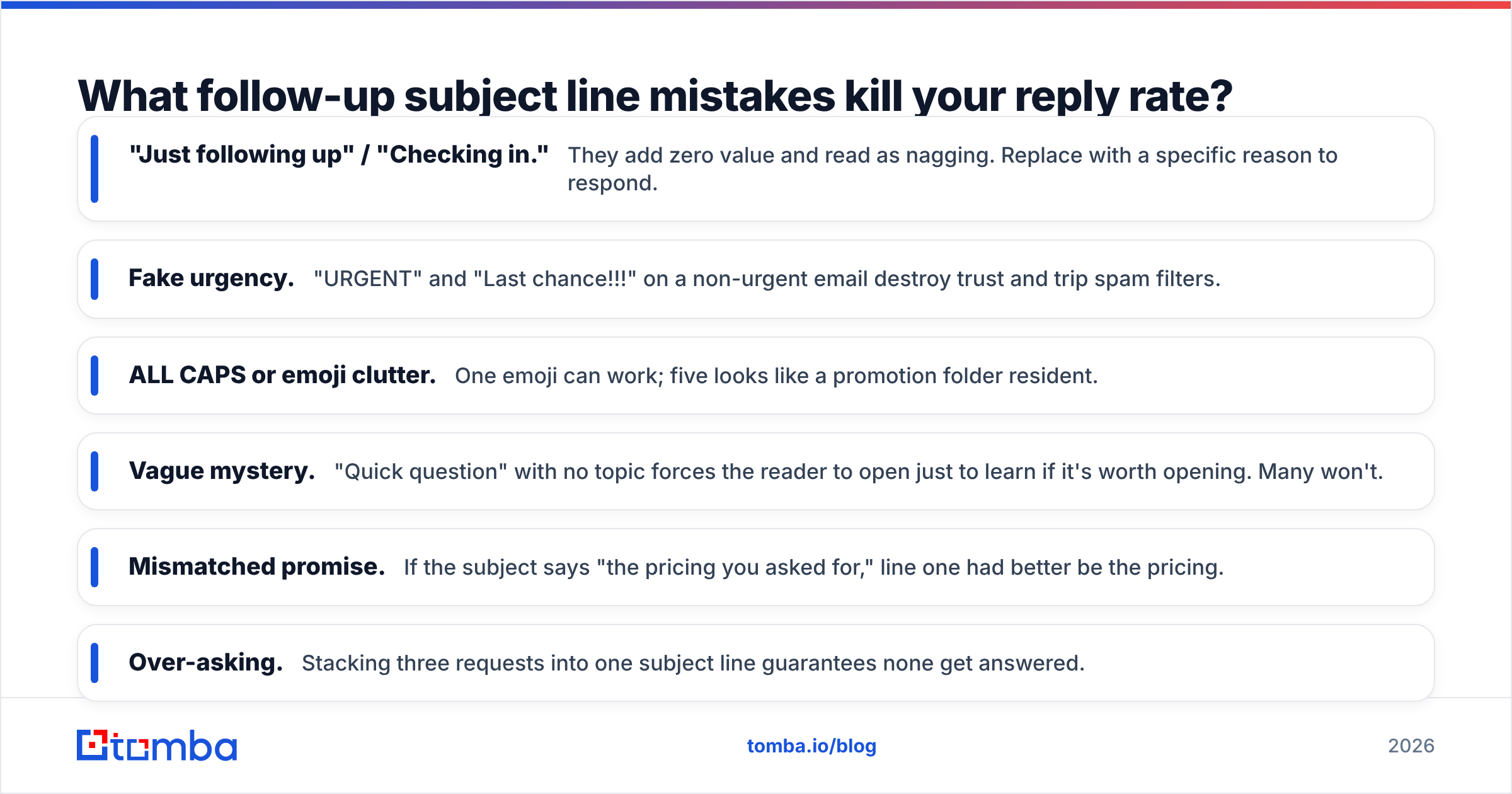
Avoid these and you are already ahead of most senders:
- "Just following up" / "Checking in." They add zero value and read as nagging. Replace with a specific reason to respond.
- Fake urgency. "URGENT" and "Last chance!!!" on a non-urgent email destroy trust and trip spam filters.
- ALL CAPS or emoji clutter. One emoji can work; five looks like a promotion folder resident.
- Vague mystery. "Quick question" with no topic forces the reader to open just to learn if it's worth opening. Many won't.
- Mismatched promise. If the subject says "the pricing you asked for," line one had better be the pricing.
- Over-asking. Stacking three requests into one subject line guarantees none get answered.
If your replies are still flat after fixing these, the issue may be upstream — measure your email response rate by segment to find where the drop-off actually happens, rather than guessing.
How do you test which subject lines work?#
Run a simple A/B test on every meaningful send: same audience segment, same email body, two subject lines, split 50/50. Send to a sample first if your list is large, declare a winner on open rate (and ideally reply rate), then roll the winner out to the rest.
Keep a running swipe file of your top performers by scenario. Over a few months you will build a personal benchmark that beats any generic "best subject lines" listicle, because it is trained on your audience. If you need fresh angles to test against your control, a subject line generator is a fast way to produce variants without staring at a blank line.
You can read more on subject-line testing methodology from independent sources like Mailchimp's resource library and vetted reviews on G2 before committing to a tool stack.
Final word: the subject line is only half the equation#
The best catchy follow up email subject lines do three things — add value, lower friction, or create an honest reason to reply now — in seven words or fewer, matched to where you are in the sequence. Steal the 27 examples above, kill the "just checking in" reflex, and A/B test relentlessly.
But remember the multiplier: a great subject line on a bad address opens nothing. Build your outreach on verified, current contacts first. Start free with Tomba's email finder — the free tier covers 25 searches a month, and paid plans begin at $49/mo on Tomba pricing — so every catchy line you write actually lands in a real inbox and gets the open it deserves.
// get started
Find, verify and enrich your first contacts today
Start on the free plan with 25 searches a month, then scale when your team is ready.
Free plan · No credit card required · GDPR & CCPA
// about the author