Catchy Sales Email Subject Lines That Get Opens in 2026
100+ catchy sales email subject lines plus the open-rate formulas behind them. Learn what actually lifts opens in 2026 — and the words that kill deliverability.
Your subject line is the only part of your email most prospects will ever read. If it does not earn the open, the body copy you spent an hour crafting may as well not exist. This guide gives you a working library of catchy sales email subject lines, the formulas behind them, and the deliverability rules that decide whether they ever reach the inbox.
TL;DR#
- The subject line is a gate, not a headline. Its only job is to win the open — relevance and curiosity beat cleverness almost every time.
- Short wins. Subject lines of 3–7 words (under ~45 characters) consistently outperform long ones, especially on mobile where ~60% of B2B email is opened.
- Personalization lifts opens when it is specific (a trigger, a number, a mutual connection) — not just "{{FirstName}}" stapled to a generic line.
- Spam-trigger words and false promises tank deliverability. "FREE," "guaranteed," all-caps, and excessive punctuation route you straight to the junk folder.
- Your sender reputation matters more than your wording. A clean list verified with an email verifier protects the open rates that good subject lines earn.
What makes a sales email subject line "catchy"?#
A catchy subject line earns the open by creating a small, specific gap between what the reader knows and what they want to know — then making it obvious the answer is relevant to them. That is it. "Catchy" does not mean clever, loud, or gimmicky; it means worth clicking right now.
Think of the inbox like a crowded hallway at a conference. People are walking fast, half-listening. You get two seconds and a handful of words. The line that works is not the one shouting the loudest — it is the one that says something the listener was already thinking about. That is why "Quick question about your Q3 hiring" beats "🔥 UNLOCK 10X PIPELINE GROWTH 🔥" every single time in B2B.
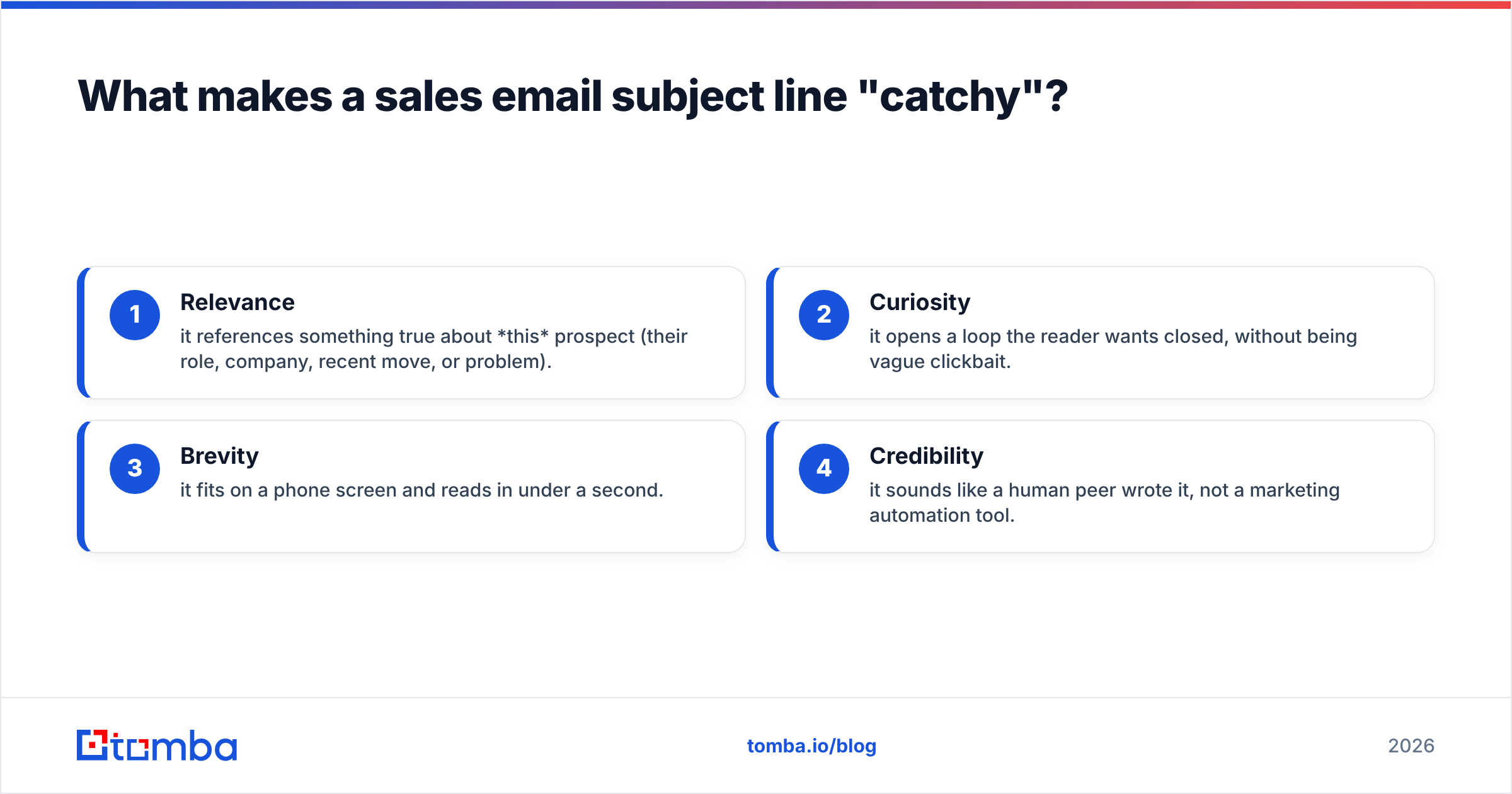
Four levers make a subject line catchy:
- Relevance — it references something true about this prospect (their role, company, recent move, or problem).
- Curiosity — it opens a loop the reader wants closed, without being vague clickbait.
- Brevity — it fits on a phone screen and reads in under a second.
- Credibility — it sounds like a human peer wrote it, not a marketing automation tool.
What are the best catchy sales email subject line formulas?#
You do not need to invent a new line for every prospect. Strong subject lines follow repeatable patterns. Here are the formulas that hold up across thousands of cold and warm sends, with fill-in examples.
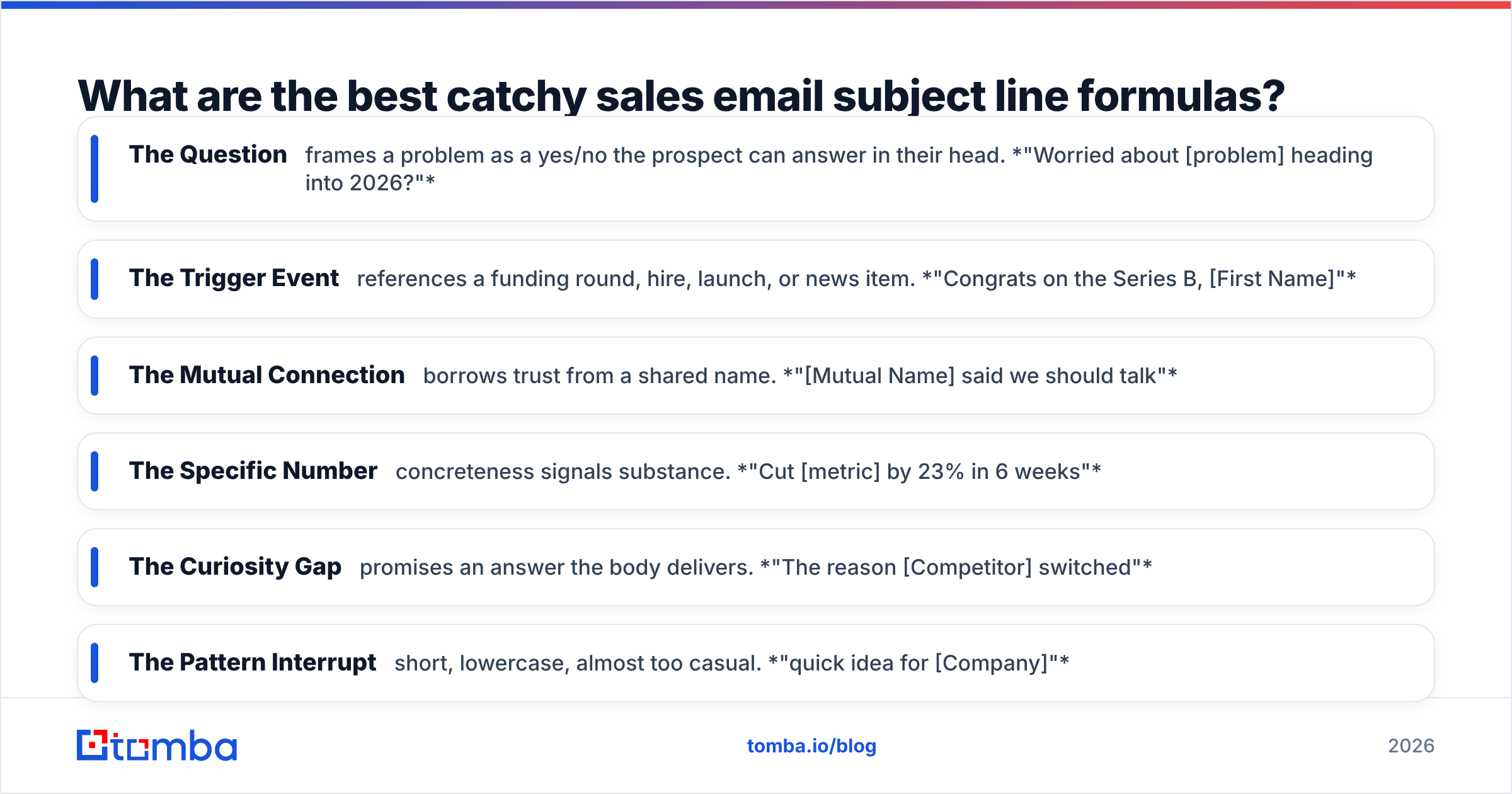
- The Question — frames a problem as a yes/no the prospect can answer in their head. "Worried about [problem] heading into 2026?"
- The Trigger Event — references a funding round, hire, launch, or news item. "Congrats on the Series B, [First Name]"
- The Mutual Connection — borrows trust from a shared name. "[Mutual Name] said we should talk"
- The Specific Number — concreteness signals substance. "Cut [metric] by 23% in 6 weeks"
- The Curiosity Gap — promises an answer the body delivers. "The reason [Competitor] switched"
- The Pattern Interrupt — short, lowercase, almost too casual. "quick idea for [Company]"
- The Direct Ask — radical clarity beats coyness with busy execs. "15 min next Tuesday?"
A practical rule: lead with the prospect, not yourself. Lines starting with the recipient's company, role, or problem outperform lines starting with your product or "I/we" by a wide margin.
50 catchy sales email subject lines you can adapt#
Cold outreach
- "Quick question, [First Name]"
- "[Company] + [Your Company]?"
- "Saw your post on [topic]"
- "idea for the [team] team"
- "Should I stop emailing you?"
- "[Competitor] vs [Company]"
- "Re: your 2026 roadmap"
- "Worth a 10-minute look?"
- "Noticed something on [Company]'s site"
- "[Mutual Name] suggested I reach out"
Trigger / event based
- "Congrats on the new role"
- "Saw the funding news — quick thought"
- "Your job post for [Role]"
- "Welcome to [City] — quick intro"
- "Post-[Conference] follow-up"
Curiosity
- "This surprised me about [industry]"
- "You're probably losing [X] here"
- "The 90-second version"
- "One number that changed our pipeline"
- "Don't open this if [X] is sorted"
Follow-up
- "Bumping this up, [First Name]"
- "Still the right person?"
- "Closing the loop"
- "One more idea before I go"
- "Last try, promise"
Value / proof
- "How [Customer] cut [metric] 30%"
- "A template that saved us 6 hours"
- "[Result] in [timeframe]"
- "Benchmark: how [Company] compares"
- "3 ways teams like yours fix [problem]"
Mix these with your own voice. The list is a starting grid, not a script — the moment a subject line sounds copy-pasted, it dies.
Which subject line styles actually lift open rates?#
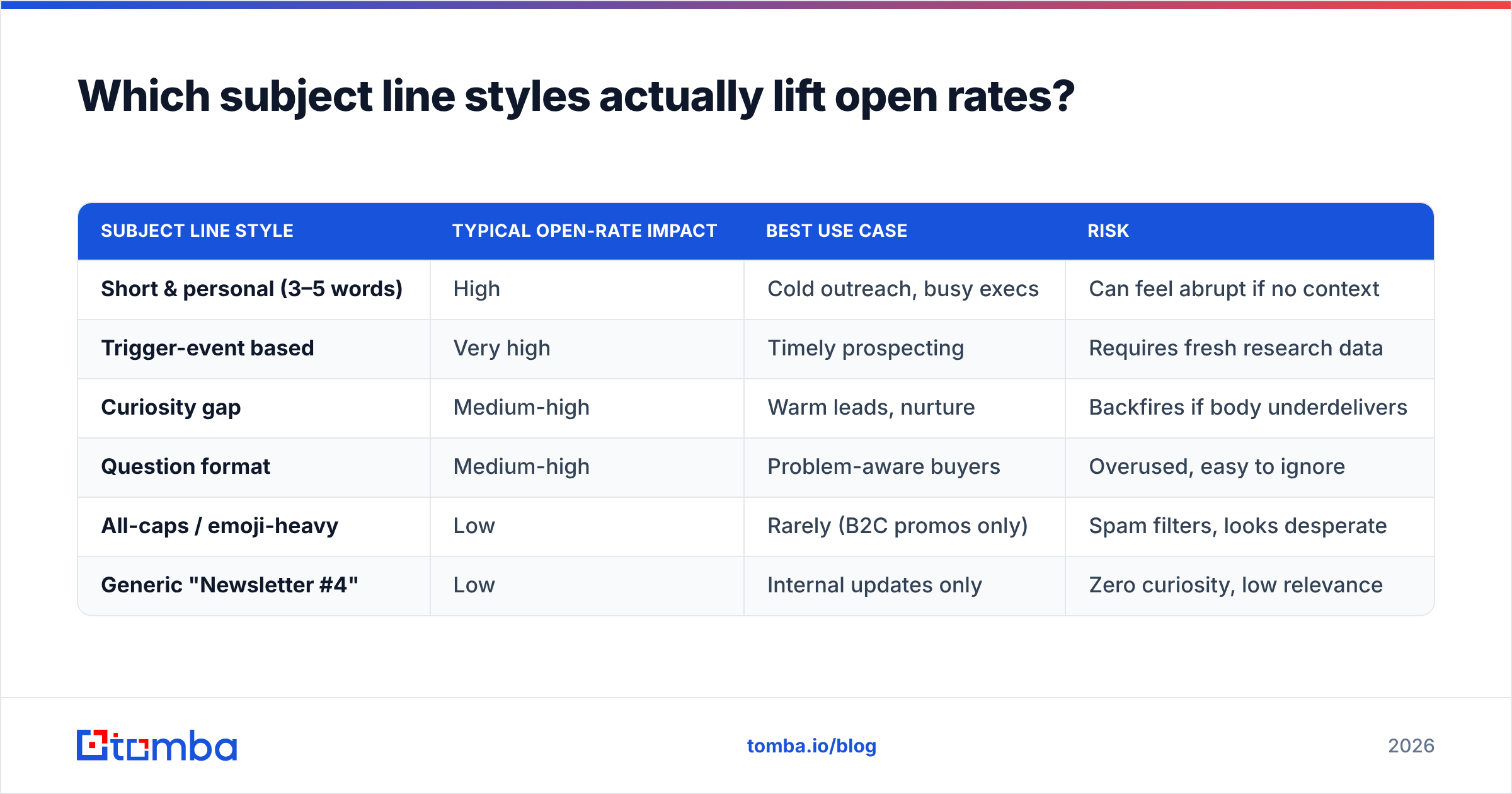
Not all "catchy" styles perform equally. Here is how the main approaches stack up on the metrics that matter, based on widely reported B2B benchmarks and the trade-offs each one carries.
| Subject line style | Typical open-rate impact | Best use case | Risk |
|---|---|---|---|
| Short & personal (3–5 words) | High | Cold outreach, busy execs | Can feel abrupt if no context |
| Trigger-event based | Very high | Timely prospecting | Requires fresh research data |
| Curiosity gap | Medium-high | Warm leads, nurture | Backfires if body underdelivers |
| Question format | Medium-high | Problem-aware buyers | Overused, easy to ignore |
| All-caps / emoji-heavy | Low | Rarely (B2C promos only) | Spam filters, looks desperate |
| Generic "Newsletter #4" | Low | Internal updates only | Zero curiosity, low relevance |
The pattern is clear: styles that depend on information about the prospect win, and styles that depend on volume and shouting lose. That is also why your data layer matters as much as your copy — a trigger-event subject line is only possible if you know the trigger, and a personalized line is only deliverable if the address is real.
What kills a sales email subject line?#
Three things quietly destroy open rates: spam triggers, broken promises, and bad data.
Spam-trigger language. Words like "free," "guarantee," "act now," "100%," "$$$," and "limited time," especially in combination or in all caps, raise your spam score before a human ever sees the line. Excessive punctuation ("!!!"), ALL CAPS, and misleading "Re:" or "Fwd:" prefixes do the same. Mailbox providers like Google publish guidance in Gmail's sender guidelines, and ignoring it costs you the inbox. Run a draft through a spam checker before a big send.
Broken promises. A curiosity-gap subject line that the body does not pay off trains the reader to ignore you — and to mark you as spam, which compounds across your whole domain. Catchy is a contract: the open must be rewarded.
Bad data. This is the silent killer. The most brilliant subject line in the world earns nothing if it lands on a dead mailbox or a spam trap. Bounces above ~2–3% signal mailbox providers that you are careless, and your deliverability drops for every recipient — even the valid ones. This is why list hygiene is part of subject-line strategy, not separate from it. Understanding email deliverability is the foundation everything else sits on.

How do you write and test catchy subject lines step by step?#
Treat subject lines as a process, not a flash of inspiration. Here is a repeatable workflow.
- Research the trigger. Before writing, find one specific, true thing about the prospect — a role, a recent hire, a tech stack, a post. This single fact powers your best lines.
- Write five variants per email. Use different formulas from the list above: one question, one trigger, one curiosity, one direct, one pattern-interrupt.
- Cut every line to under 45 characters. Open your draft on a phone. If it truncates before the hook lands, shorten it.
- Scrub spam words. Remove anything from the trigger-word list. Read it aloud — if it sounds like an ad, rewrite it.
- Verify the address. Confirm the mailbox is real and the domain accepts mail. Clean data is what lets a good line actually perform.
- A/B test two finalists. Send variant A to 10% of the list, variant B to another 10%, then send the winner to the rest. Test one variable — the subject line — at a time.
- Track and log. Record open rates against the formula used. Over a few weeks you will see which patterns work for your audience, which is the only benchmark that matters.
The third step deserves emphasis. Tools from HubSpot and others confirm that mobile-first reading has only intensified — your subject line competes in a preview pane two inches wide. Length discipline is non-negotiable.
How does data quality change your subject-line ROI?#
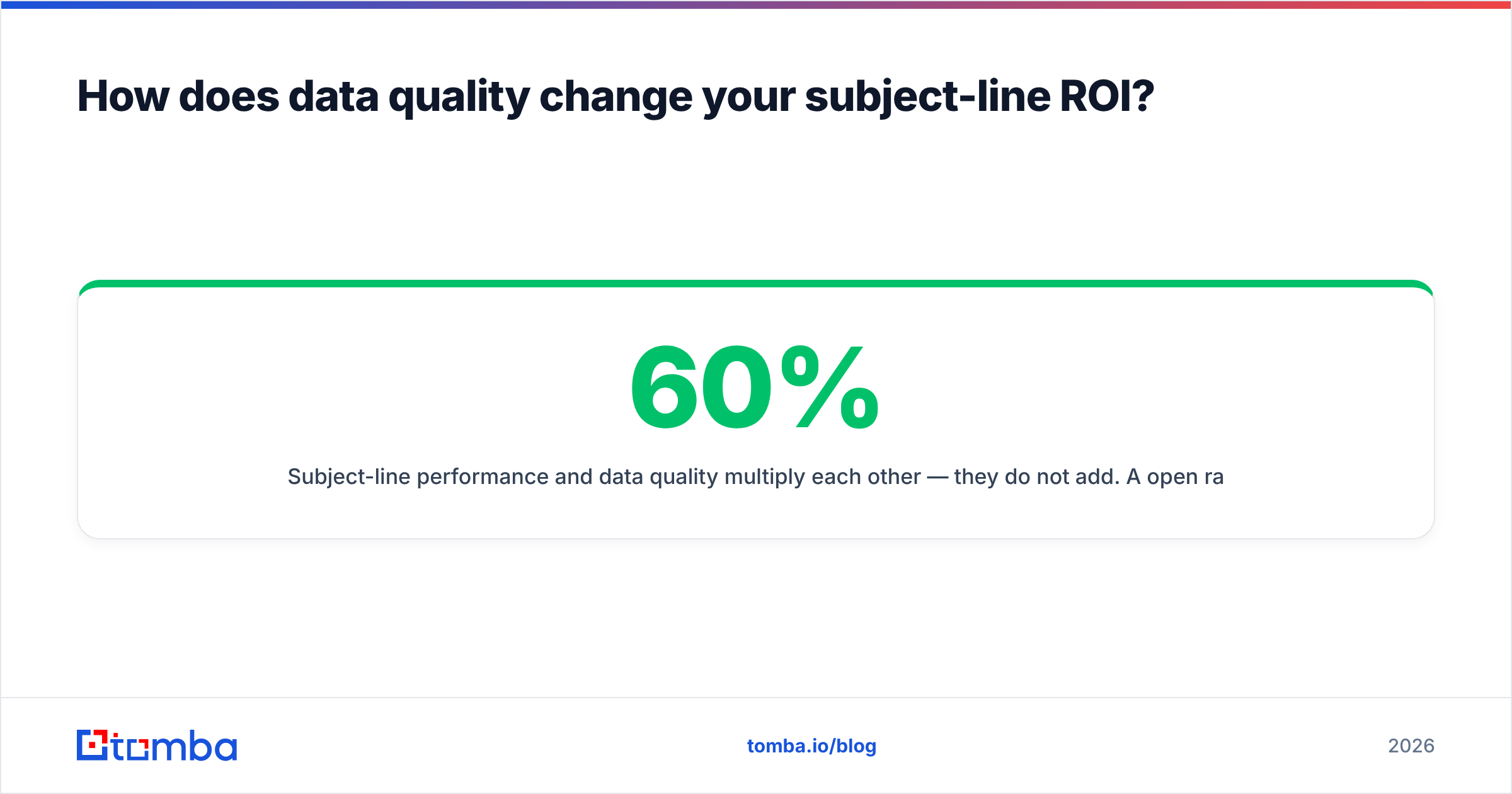
Subject-line performance and data quality multiply each other — they do not add. A 60% open rate on a list that is 50% invalid still reaches fewer real humans than a 40% open rate on a clean list. And because mailbox providers judge your sending reputation on bounces and complaints, dirty data drags down the open rates of your good contacts too.
This is the part most "catchy subject line" articles skip. You can copy every formula here perfectly and still see flat results if your list is stale. The fix is upstream:
- Find accurate addresses in the first place. Use a reliable email finder so the names on your list correspond to real, current mailboxes.
- Verify before you send. Catch typos, role accounts, and dead boxes with an email verifier to keep bounce rates low.
- Enrich for personalization. Pull the role, company, and trigger data that powers your best subject lines via data enrichment.
When the data is solid, the subject-line formulas in this guide do what they are supposed to do. When it is not, you are optimizing wording on a leaky bucket.
Frequently asked questions#
How long should a sales email subject line be? Aim for 3–7 words and under roughly 45 characters. Most B2B email is opened on mobile, where longer lines get truncated before the hook lands. Shorter consistently outperforms longer in cold outreach.
Do emojis help or hurt open rates? In B2B, they usually hurt. Emojis can read as promotional and nudge spam filters, and they clash with the peer-to-peer tone that wins replies from professionals. Reserve them for B2C or established nurture audiences, and test before scaling.
Should I personalize every subject line? Personalize with specifics, not just a first name. A trigger event, a number, or a mutual connection lifts opens far more than "{{FirstName}}" bolted onto a generic line. Generic merge-tag personalization is now so common it barely moves the needle.
Why are my open rates low even with good subject lines? The most common cause is data and deliverability, not copy. Stale lists cause bounces, bounces hurt sender reputation, and poor reputation routes you to spam regardless of wording. Verify your list and check your sender reputation before blaming the subject line.
How many subject lines should I A/B test? Test two at a time on small segments (around 10% each), then send the winner to the remainder. Testing more than two variables at once makes it impossible to learn which change drove the result.
Put your subject lines on a foundation that converts#
Catchy subject lines are the visible half of cold email; accurate, verified contact data is the invisible half that decides whether anyone sees them. The fastest way to lift open rates is to pair the formulas in this guide with a list of real, current decision-maker addresses — not guesses. Start free with the Tomba Email Finder (25 searches a month on the free tier, paid plans from $49/mo) to source accurate emails, verify them before you send, and give every clever subject line the clean inbox it deserves. Write the line, but earn the open with the data behind it.
// get started
Find, verify and enrich your first contacts today
Start on the free plan with 25 searches a month, then scale when your team is ready.
Free plan · No credit card required · GDPR & CCPA
// about the author