CB Insights vs Crunchbase: 2026 Data Platform Comparison
CB Insights vs Crunchbase: which market-intelligence platform actually fits your team in 2026? A neutral breakdown of data depth, pricing, coverage, and the gaps both leave for B2B prospecting.
CB Insights vs Crunchbase
Choosing between CB Insights and Crunchbase comes down to one question: do you need deep predictive analytics on private markets, or do you need broad, affordable company and funding data you can act on today? Both pull from the same broad universe of startups, investors, and deals, but they price, package, and predict very differently.
This is a neutral breakdown for analysts, founders, VCs, and B2B sales teams trying to pick the right market-intelligence stack in 2026 — including where each tool stops short and what you bolt on to fill the gap.
TL;DR#
- CB Insights is the premium analyst platform — deep private-market intelligence, predictive scoring (Mosaic), and curated research, priced for enterprises (often $30k+/year, custom quotes only).
- Crunchbase is the accessible data layer — company profiles, funding rounds, and people data starting around $99/user/month, with a free public tier.
- Pick CB Insights if you're an investor or strategy team that needs forecasting, market maps, and analyst reports. Pick Crunchbase if you need wide, cheap, queryable company data for prospecting and research.
- Neither is a contact-data tool. Both tell you which companies matter; neither reliably hands you the verified work email or phone of the decision-maker you want to reach.
- For outbound teams, the smart play is pairing one of these for targeting with a dedicated email finder for contact data.
What is CB Insights?#
CB Insights is a market-intelligence platform built for analysts and corporate strategy teams. Think of it as a research department in software form: it doesn't just store data about private companies, it interprets it.
Its signature features are the Mosaic score (an algorithmic health rating for private companies), market maps that cluster competitors by category, and a steady stream of analyst-written reports on emerging tech trends. The platform leans heavily on prediction — it wants to tell you which startups are likely to raise, exit, or fail before it happens.
That depth comes at a price. CB Insights uses custom enterprise quotes, and real-world contracts commonly land in the tens of thousands of dollars per year. You can confirm the positioning on the CB Insights site, but you won't find a public price list — that alone tells you who it's built for.
What is Crunchbase?#
Crunchbase is the widely-used company and funding database that most people in tech have already touched. It started as a public wiki of startups and funding rounds and grew into a paid product with search, alerts, and an API.
Its strength is breadth and accessibility. You can look up almost any company, see its funding history, investors, headcount range, and recent news, then build saved searches to surface companies matching your criteria. The data is broad and refreshed frequently, and the public profiles give you a free on-ramp before you ever pay.
Crunchbase publishes transparent pricing — Starter and Pro tiers built around per-user monthly fees, typically starting near $99/user/month. You can review current plans on the Crunchbase pricing page. That transparency is the whole point: it's a tool you can adopt without a procurement cycle.

CB Insights vs Crunchbase: How do they compare?#
Here's the head-to-head on the attributes that actually drive a buying decision.
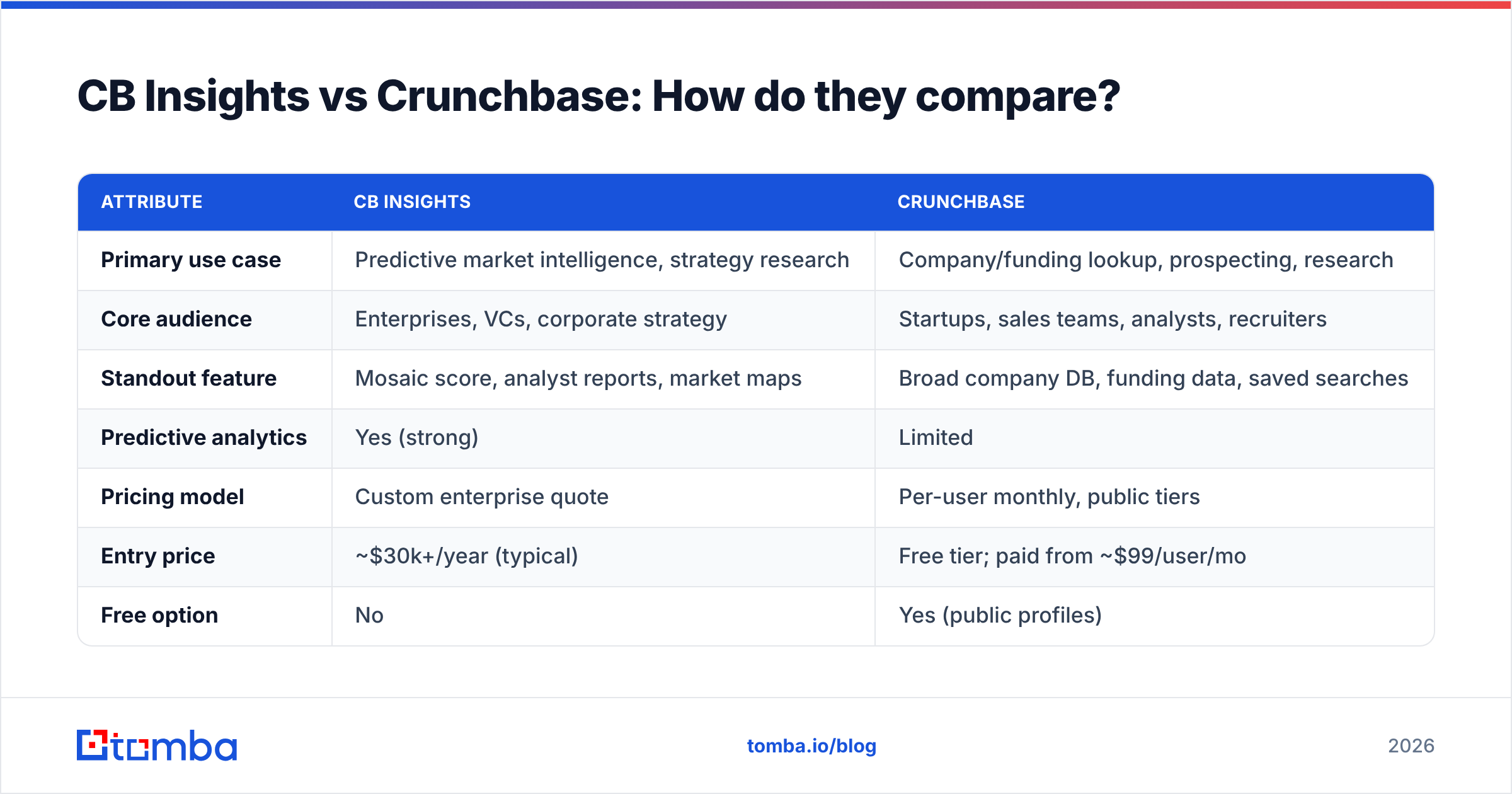
| Attribute | CB Insights | Crunchbase |
|---|---|---|
| Primary use case | Predictive market intelligence, strategy research | Company/funding lookup, prospecting, research |
| Core audience | Enterprises, VCs, corporate strategy | Startups, sales teams, analysts, recruiters |
| Standout feature | Mosaic score, analyst reports, market maps | Broad company DB, funding data, saved searches |
| Predictive analytics | Yes (strong) | Limited |
| Pricing model | Custom enterprise quote | Per-user monthly, public tiers |
| Entry price | ~$30k+/year (typical) | Free tier; paid from ~$99/user/mo |
| Free option | No | Yes (public profiles) |
| API access | Enterprise add-on | Available on higher tiers |
| Contact data (verified email/phone) | No | Limited / no verified emails |
| Time to value | Slower (onboarding, training) | Fast (self-serve) |
The pattern is clear. CB Insights sells insight — interpreted, scored, forecasted. Crunchbase sells access — broad, queryable, affordable. Neither sells the thing an outbound team needs most: a verified way to actually contact the people inside those companies.
Is CB Insights better than Crunchbase?#
Better for whom? That's the only honest framing.
CB Insights wins when the question is strategic. If you're a VC deciding which sub-sector to back, a corp-dev team scanning acquisition targets, or a strategy lead building a market thesis, the predictive scoring and analyst research justify the spend. You're paying for synthesis you'd otherwise hire people to produce.
Crunchbase wins when the question is operational. If you're building a target account list, qualifying inbound leads, or researching a company before a call, Crunchbase gives you 90% of what you need at a fraction of the cost and zero onboarding. For most sales and marketing teams, that's the better fit.
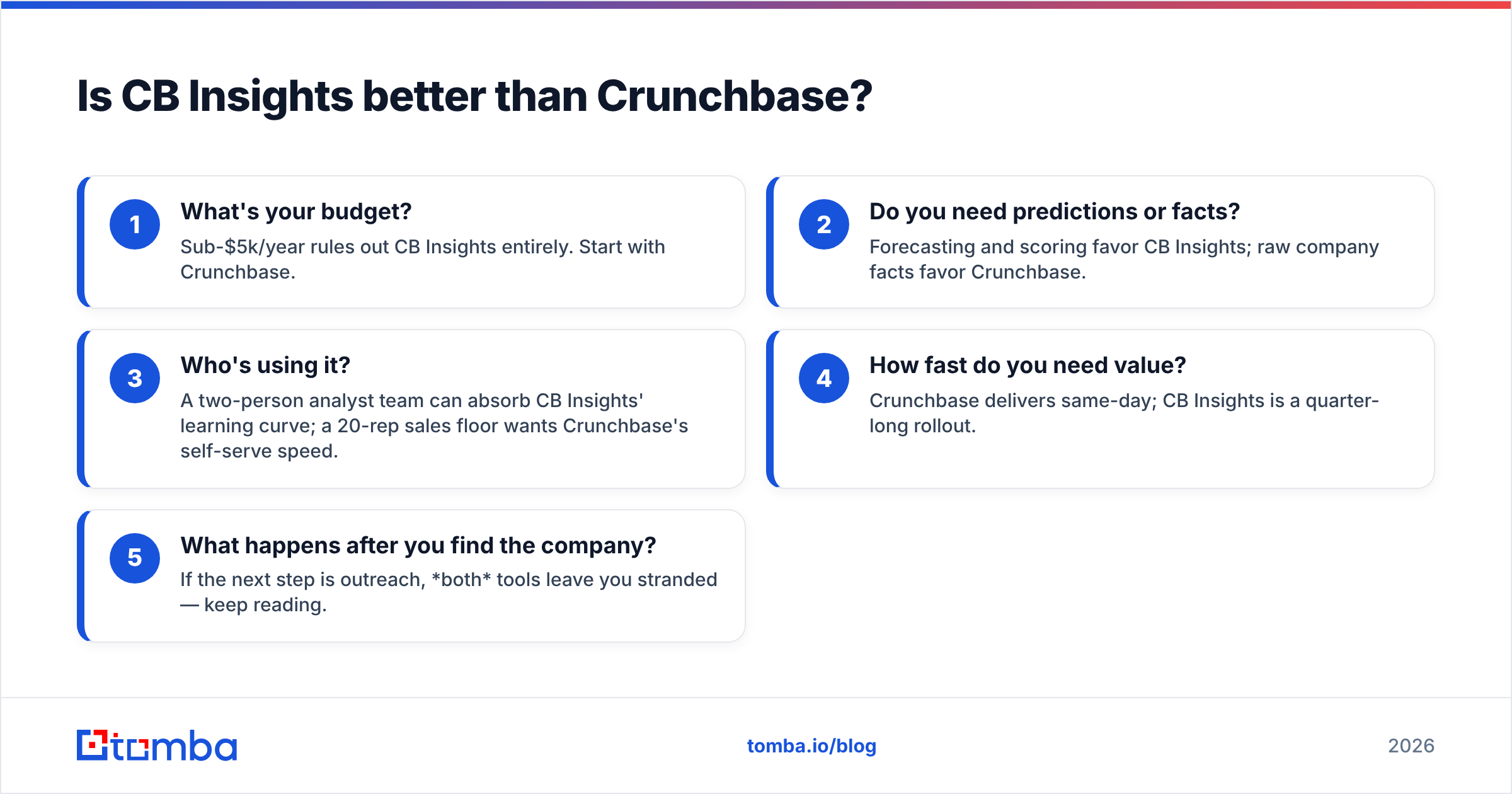
Decide with these five questions:
- What's your budget? Sub-$5k/year rules out CB Insights entirely. Start with Crunchbase.
- Do you need predictions or facts? Forecasting and scoring favor CB Insights; raw company facts favor Crunchbase.
- Who's using it? A two-person analyst team can absorb CB Insights' learning curve; a 20-rep sales floor wants Crunchbase's self-serve speed.
- How fast do you need value? Crunchbase delivers same-day; CB Insights is a quarter-long rollout.
- What happens after you find the company? If the next step is outreach, both tools leave you stranded — keep reading.
What do both tools miss for outbound and prospecting?#
Both platforms answer "which companies should I care about?" Neither reliably answers "how do I email the right person there?"
That's the gap that quietly kills outbound campaigns. You can build a flawless target list in Crunchbase, export it, and then discover you have company domains but no verified contacts — or worse, stale emails that bounce and torch your sender reputation. CB Insights, focused on market-level intelligence, isn't built to hand you individual contact records at all.
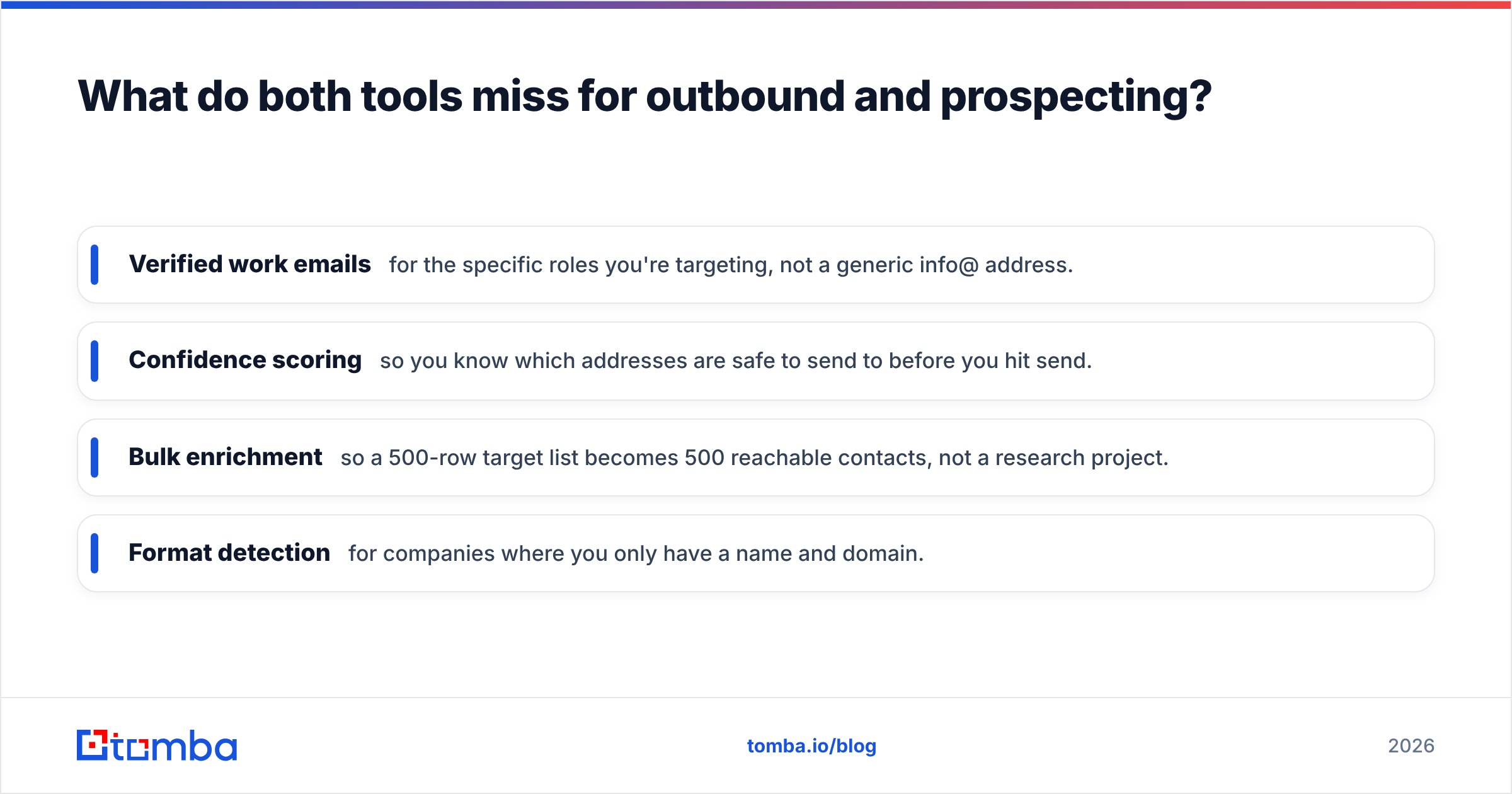
This is where a dedicated contact-data layer earns its place. Once you know the accounts, you need:
- Verified work emails for the specific roles you're targeting, not a generic info@ address.
- Confidence scoring so you know which addresses are safe to send to before you hit send.
- Bulk enrichment so a 500-row target list becomes 500 reachable contacts, not a research project.
- Format detection for companies where you only have a name and domain.
A purpose-built domain search turns a company domain from your CB Insights or Crunchbase list into the actual email patterns and named contacts inside that company. Run those through an email verifier and your bounce rate stays low enough to protect deliverability.
How does pricing really compare?#
Pricing is the cleanest line between these two tools — and the place buyers get surprised.
Crunchbase is honest and predictable. You see the tiers, you pick one, you pay per user. Even the Pro tier stays in the low-thousands-per-year range for a small team, and the free public profiles mean you can validate the data before committing.
CB Insights operates on the enterprise model: book a demo, get scoped, receive a custom quote. Public reports and user reviews on sites like G2 consistently place contracts well into five figures annually. That's not a criticism — it's correctly priced for the analyst-grade value it delivers. But it does mean CB Insights is rarely an impulse purchase or a tool a single rep expenses.
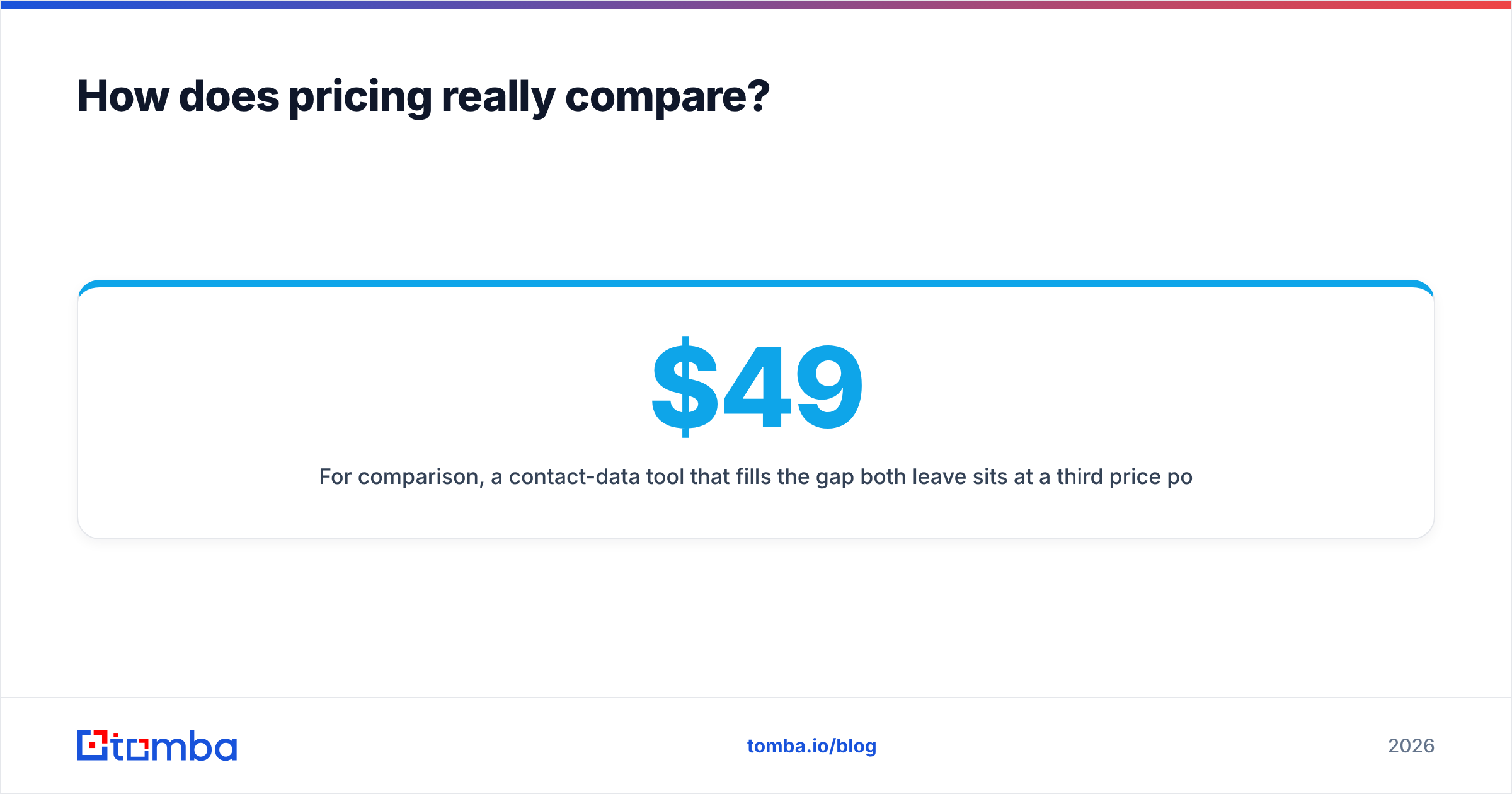
For comparison, a contact-data tool that fills the gap both leave sits at a third price point entirely. Tomba's plans run a free tier (25 searches/month), Starter at $49/month, Growth at $99/month, and Pro at $249/month, with enterprise custom — you can see the full breakdown on the Tomba pricing page. The point isn't that it replaces market intelligence; it's that the missing outbound layer costs far less than either platform and slots in alongside whichever you choose.
Which should B2B sales and marketing teams choose?#
For revenue teams specifically, here's the decision in plain terms.
- Most SMB and mid-market sales teams should start with Crunchbase. It's affordable, self-serve, and gives you enough company and funding signal to build smart account lists. Pair it with a contact-data tool and you have a complete prospecting stack.
- Enterprise strategy, RevOps, and investment teams that need to size markets, track competitive landscapes, and forecast should invest in CB Insights — and likely still keep Crunchbase or an enrichment tool for day-to-day contact work.
- No one should expect either tool to be their source of verified emails or phone numbers. That's a separate, specialized job.
If your workflow is "find the right accounts, then reach the right people," you're really assembling two layers: an intelligence layer (CB Insights or Crunchbase) and a contact layer. Tomba's data enrichment and bulk email finder handle the second layer, taking the company lists you build in either platform and converting them into reachable, verified contacts ready for your sequencer or CRM.
What's the bottom line?#
CB Insights and Crunchbase aren't really competing for the same buyer. CB Insights is a premium analyst engine for strategy and investment teams with enterprise budgets. Crunchbase is a broad, affordable data layer for everyone who needs solid company and funding facts without a procurement cycle.
Choose CB Insights for prediction and synthesis. Choose Crunchbase for breadth, speed, and price. But whichever you pick, plan for the contact-data gap before it stalls your outbound — because knowing the right company means nothing if you can't reach the right person.
Turn target accounts into reachable contacts#
Once CB Insights or Crunchbase tells you which companies to chase, the Tomba Email Finder tells you who to contact — with verified, confidence-scored professional emails by name, company, or domain. Start free with 25 searches a month, then scale on a plan that costs a fraction of an enterprise data contract. Build the list anywhere; make it actionable with Tomba.
// get started
Find, verify and enrich your first contacts today
Start on the free plan with 25 searches a month, then scale when your team is ready.
Free plan · No credit card required · GDPR & CCPA
// about the author