Cell Phone Number Finder: How to Find B2B Mobile Numbers in 2026
A cell phone number finder turns a name and company into a dialable mobile number. Here is how the tools work, what accuracy to expect, and how to pick one in 2026.
Cell Phone Number Finder: How to Find B2B Mobile Numbers in 2026
Connect rates on office desk lines have collapsed. Hybrid work, spam-blocking carriers, and abandoned voicemail boxes mean the number sitting in most CRMs no longer reaches a human. A cell phone number finder closes that gap: you feed it a name and a company, and it returns a verified mobile number you can actually dial.
This guide explains how these tools work, the accuracy you should realistically expect, the compliance rules that matter, and how to choose one without overpaying.
TL;DR#
- A cell phone number finder maps a person's name and employer to their direct mobile number using contributed data, partnerships, and live validation.
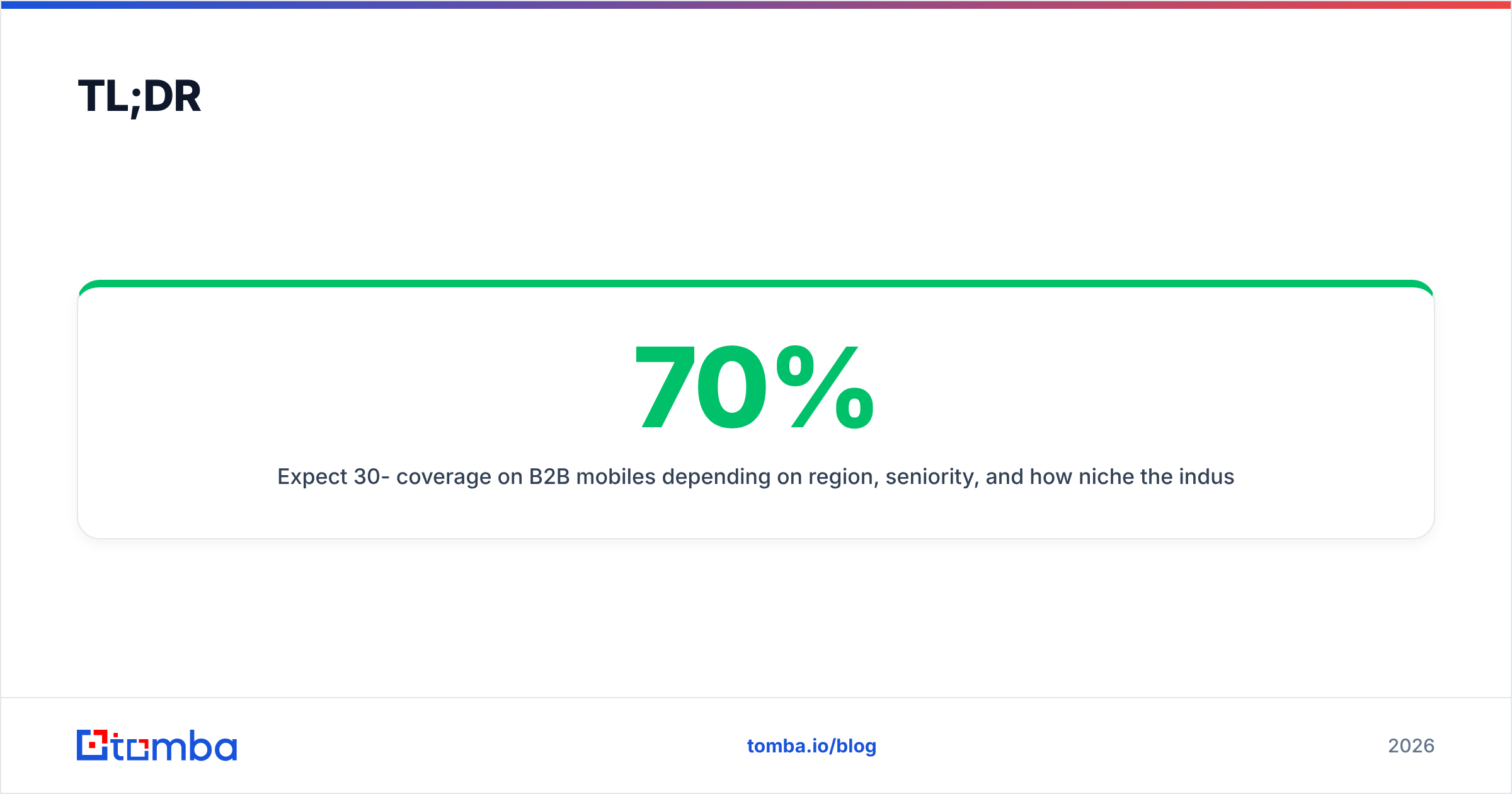
- Expect 30-70% coverage on B2B mobiles depending on region, seniority, and how niche the industry is — anyone promising 95% is rounding up.
- Mobile connect rates beat desk-line connect rates by roughly 3x for cold outreach, which is why direct dials are worth the credit cost.
- Compliance (TCPA, GDPR, DNC lists) is your responsibility, not the vendor's — scrub before you dial.
- Pair number lookup with email so you have a multi-channel fallback; tools like Tomba's phone finder sit alongside email search in one workflow.
What Is a Cell Phone Number Finder?#
A cell phone number finder is a lookup tool that returns a person's mobile phone number from a small amount of input — usually a full name plus a company domain, or a LinkedIn profile URL. Think of it like a reverse phone book that runs in the other direction: instead of "whose number is this," you ask "what is this person's number."
The everyday version of this is asking a mutual contact, "Hey, do you have Sarah's cell?" The software version does the same thing at scale, pulling from a database of contributed and licensed contact records instead of your personal network.
These tools are distinct from consumer "people search" sites that focus on landlines and personal records. A B2B cell phone number finder is tuned for working professionals — decision-makers, buyers, and operators you want to reach during a sales cycle. The output is meant to be dialed by an SDR, an account executive, or a recruiter.
How Does a Cell Phone Number Finder Work?#
Under the hood, a quality finder blends several data streams and then validates the result before handing it to you. The core concept breaks down into five layers:
- Contributed data — Users sync contacts (via opt-in apps, extensions, or CRM connectors), creating a constantly refreshed pool of real numbers tied to real people.
- Licensed and partner data — Aggregated datasets from telecom partners, public filings, and compliant data brokers fill gaps the contributed pool misses.
- Identity matching — The engine resolves "Sarah Chen at Acme Corp" to a single canonical person, deduplicating across spelling variants, role changes, and company moves.
- Live validation — Before returning a number, the system pings carrier networks (HLR/line-type lookups) to confirm the line is active and is genuinely a mobile, not a disconnected landline.
- Confidence scoring — Each result ships with a score so you can prioritize high-confidence numbers and skip the guesses.
That validation step is what separates a usable tool from a list of stale digits. A number that was correct two years ago is worthless if the person switched carriers or left the company. This is the same principle behind data enrichment generally: raw data decays, so the freshness of the pipeline matters more than the raw size of the database.

Why Use a Cell Phone Number Finder for Sales?#
Direct dials change the math of outbound. According to widely cited sales benchmarks compiled by tools vendors and analysts on G2, reps reach decision-makers far more often on mobile than on a switchboard line that routes to a gatekeeper or a dead extension.
Here is why teams invest credits in finding mobiles:
- Higher connect rates. A cell goes straight to the person. No "press 4 for the directory," no receptionist screening.
- Faster cycles. A two-minute live conversation surfaces objections that ten unanswered emails never will.
- Multi-channel sequencing. Pairing a call with email and LinkedIn touches lifts overall reply rates — a well-documented pattern in modern outbound playbooks from HubSpot and similar sources.
- Better data hygiene. Validated numbers keep your dialer efficient and protect your caller reputation from being flagged as spam for hammering dead lines.
The catch: a mobile number is a more personal channel than a work email, so relevance and timing matter more. A bad cold call on someone's cell burns goodwill faster than a deleted email.
How Accurate Are Cell Phone Number Finders?#
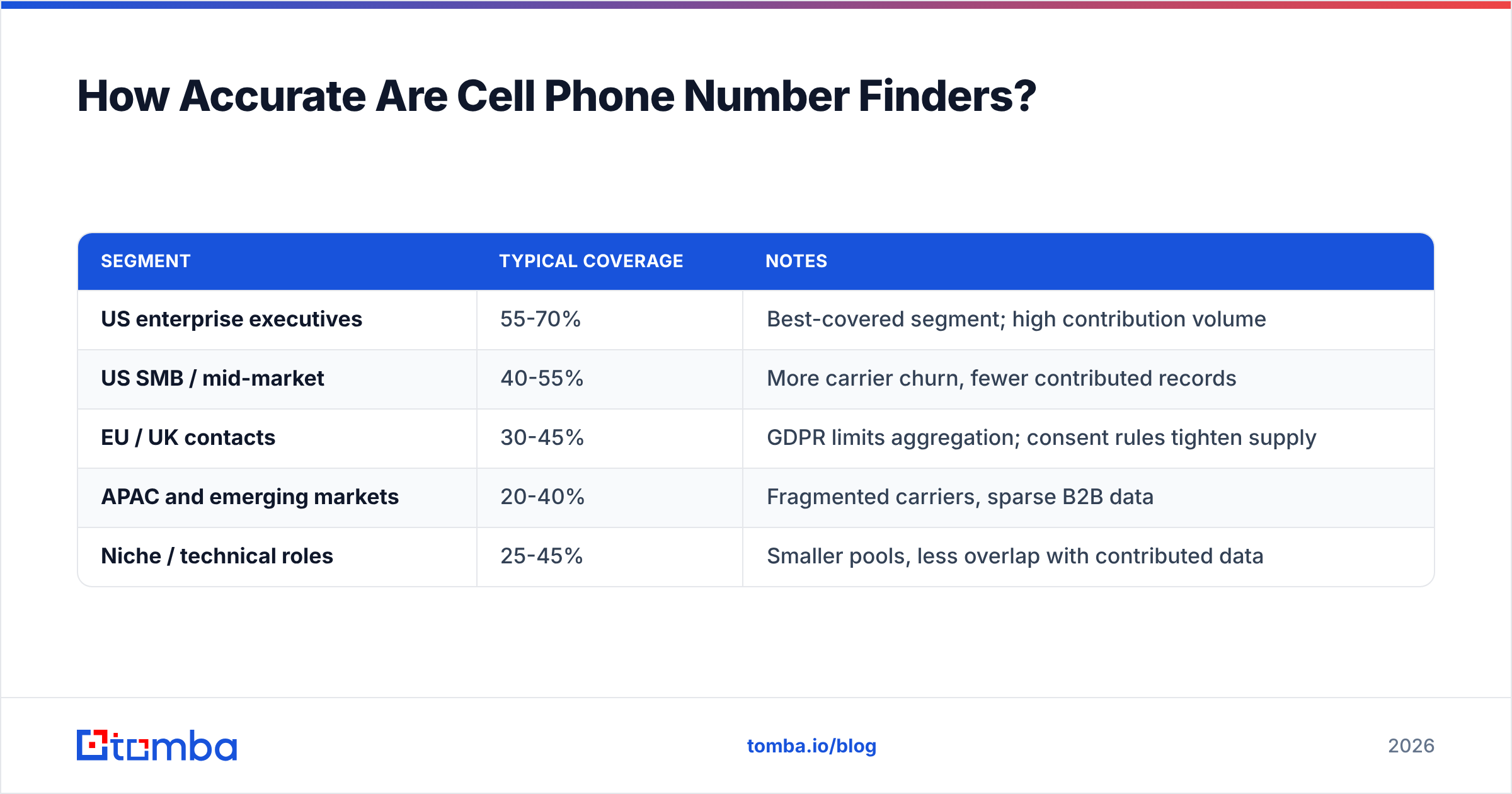
Honest answer: less accurate than email finders, and the gap is structural. Email follows predictable patterns (firstname.lastname@company.com); mobile numbers do not. There is no formula to guess a cell, so coverage depends entirely on whether the number exists in a database and is still current.
Realistic expectations for B2B mobiles in 2026:
| Segment | Typical coverage | Notes |
|---|---|---|
| US enterprise executives | 55-70% | Best-covered segment; high contribution volume |
| US SMB / mid-market | 40-55% | More carrier churn, fewer contributed records |
| EU / UK contacts | 30-45% | GDPR limits aggregation; consent rules tighten supply |
| APAC and emerging markets | 20-40% | Fragmented carriers, sparse B2B data |
| Niche / technical roles | 25-45% | Smaller pools, less overlap with contributed data |
Two numbers to watch when you evaluate a vendor: coverage (what share of your list returns any number) and accuracy (what share of returned numbers actually connect to the right person). A tool can have high coverage and low accuracy by returning stale guesses, so always run a paid pilot on your own list before committing. Validating returned numbers with a phone validator step catches disconnected lines before your reps waste dials.
What Should You Look for in a Cell Phone Number Finder?#
Not all finders solve the same problem. Match the tool to how your team actually works.
- Validation built in. A finder that returns numbers without a live line-type check is shipping you raw risk. Insist on validated, mobile-tagged output.
- Bulk and API access. If you enrich lists, you need bulk processing or a phone finder API — not one-off manual lookups.
- Transparent confidence scores. You should be able to filter by confidence and only dial high-probability numbers.
- Email as a fallback. When no mobile exists, a paired email lookup keeps the contact reachable. Single-channel tools leave gaps.
- Clear data sourcing. Vendors that publish where their data comes from are easier to trust and easier to defend in a compliance review.
- Fair credit model. You should only burn a credit when a number is actually returned, not on empty searches.
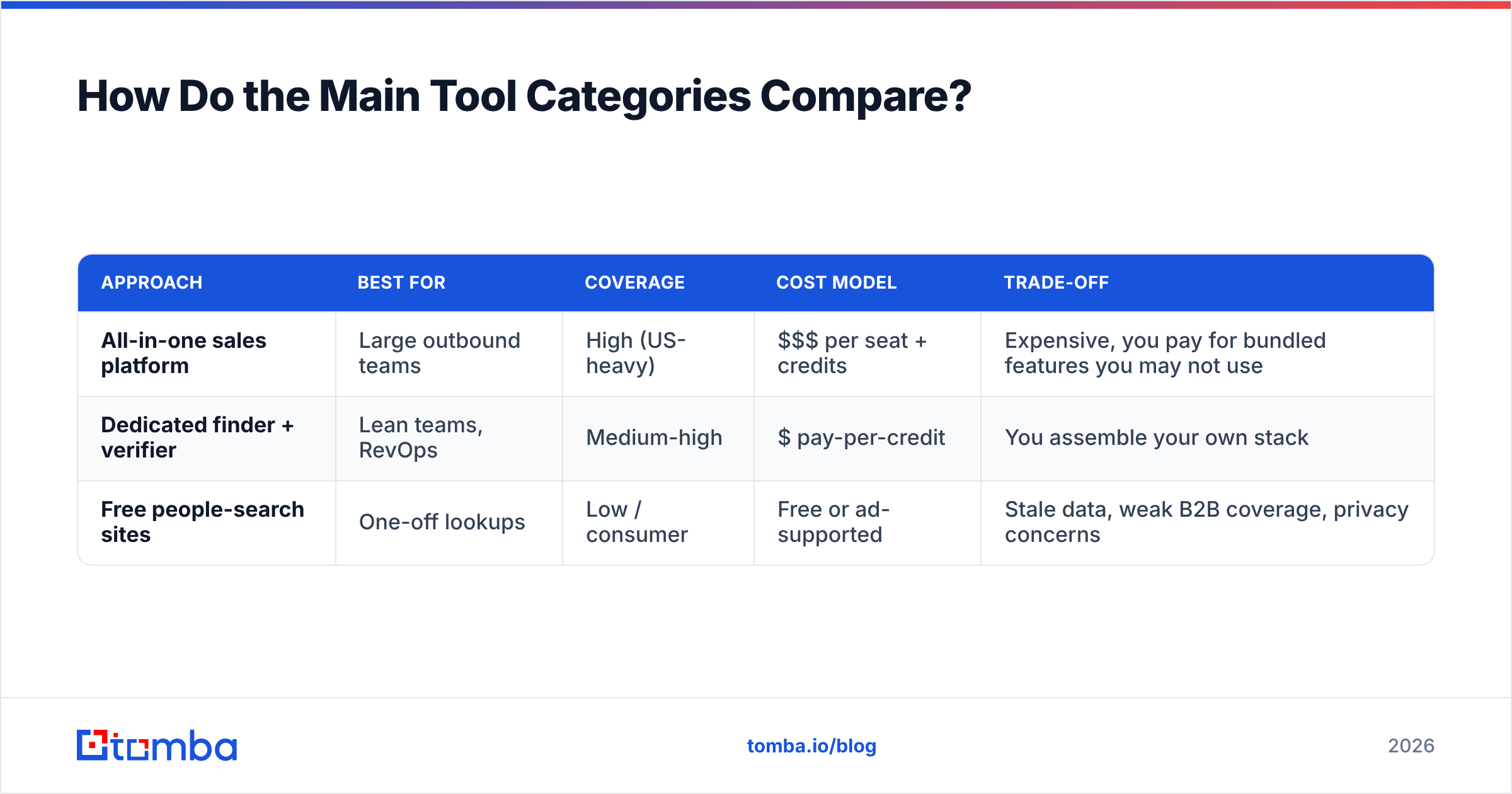
How Do the Main Tool Categories Compare?#
Cell phone number finders fall into three buckets. Each has a different price-to-coverage trade-off.
| Approach | Best for | Coverage | Cost model | Trade-off |
|---|---|---|---|---|
| All-in-one sales platform | Large outbound teams | High (US-heavy) | $$$ per seat + credits | Expensive, you pay for bundled features you may not use |
| Dedicated finder + verifier | Lean teams, RevOps | Medium-high | $ pay-per-credit | You assemble your own stack |
| Free people-search sites | One-off lookups | Low / consumer | Free or ad-supported | Stale data, weak B2B coverage, privacy concerns |
For most B2B teams, the dedicated finder model wins on cost efficiency: you pay for the numbers you actually pull rather than a per-seat platform fee. Combining a finder with a verifier and an email tool under one provider — the way Tomba's pricing bundles phone, email, and enrichment — avoids the integration tax of stitching three vendors together.
How Does Tomba Approach Phone Number Finding?#
Tomba started as an email finder and extended into phone and enrichment because customers wanted one place to build a complete contact record. The phone finder returns mobile numbers tied to a verified person, and the phone validator confirms the line is live before it reaches your dialer.
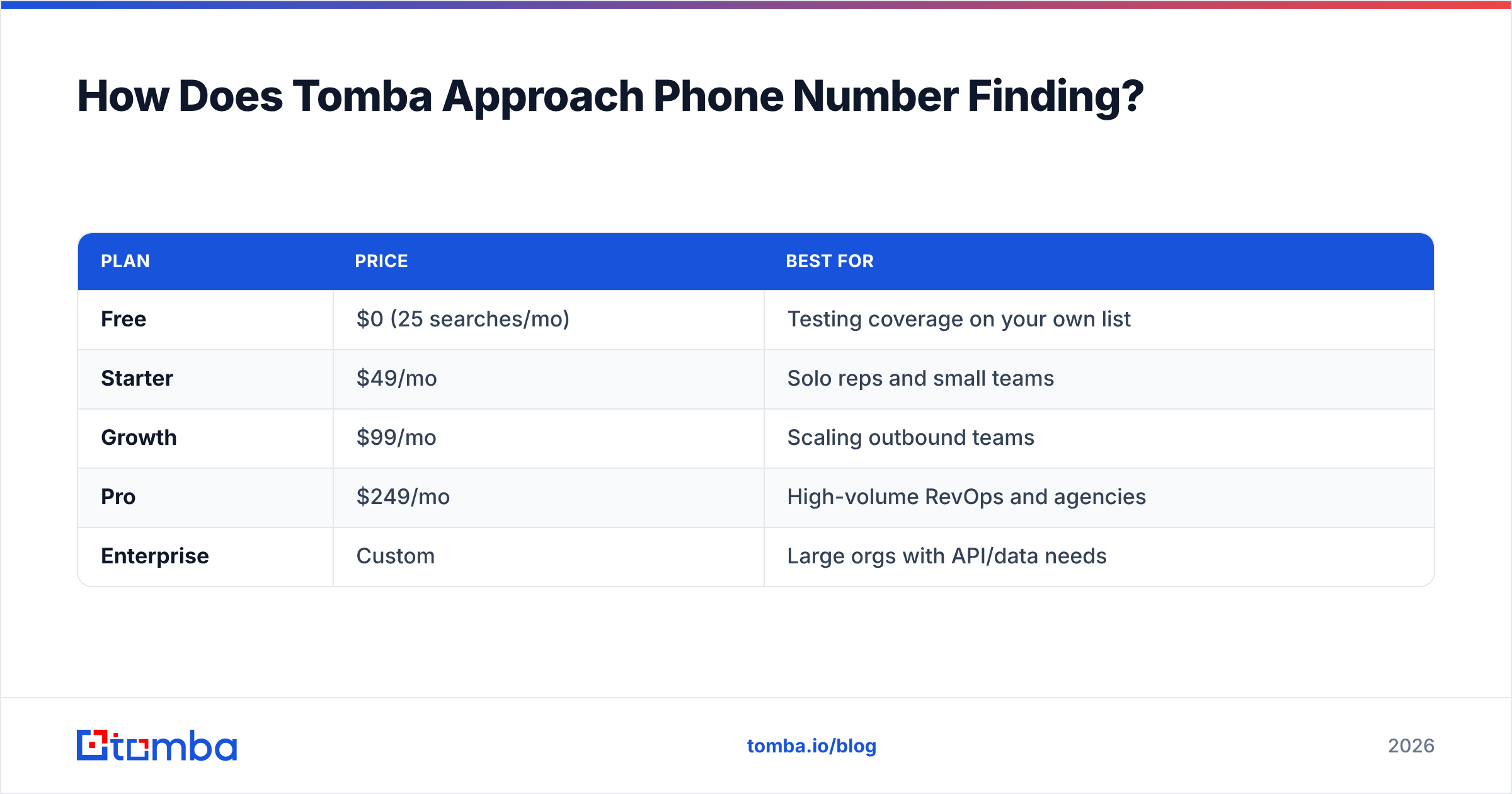
Tomba's pricing is credit-based and starts free:
| Plan | Price | Best for |
|---|---|---|
| Free | $0 (25 searches/mo) | Testing coverage on your own list |
| Starter | $49/mo | Solo reps and small teams |
| Growth | $99/mo | Scaling outbound teams |
| Pro | $249/mo | High-volume RevOps and agencies |
| Enterprise | Custom | Large orgs with API/data needs |
Because the phone finder shares the same identity layer as the email tools, you can resolve a contact once and pull both a mobile number and a verified email in a single workflow — then push the enriched record straight into your CRM via the integrations. That single-record approach is the practical version of multi-channel outreach: one lookup, multiple ways to reach the buyer.
Is It Legal to Use a Cell Phone Number Finder?#
Finding a number is generally legal; how you use it is where the rules bite. Compliance is your responsibility as the caller, not the vendor's.
Key frameworks to know:
- TCPA (US) governs calls and texts to mobile numbers. Autodialed or pre-recorded calls to cells carry strict consent requirements and real financial penalties. Manual B2B dials have more leeway, but read the current rules — they change.
- DNC lists. Scrub against the National Do Not Call Registry and any internal suppression lists before dialing.
- GDPR / ePrivacy (EU/UK). Processing personal data, including phone numbers, requires a lawful basis. Legitimate interest can apply to B2B outreach, but you must document it and honor opt-outs.
- State laws. Several US states layer additional restrictions on top of TCPA.
A useful primer on the underlying telecom concepts lives on Wikipedia's telemarketing entry, but treat that as background — not legal advice. When in doubt, route your outbound motion past counsel. The safe operating principle: use mobile numbers for relevant, consented, manually-dialed B2B conversations, and suppress anyone who asks out.
How Do You Get the Most Out of a Cell Phone Number Finder?#
Buying the tool is step one. Getting return on it takes process.
- Pilot on real data. Run 100-200 of your actual target contacts through a paid trial and measure connect rate, not just coverage.
- Validate before you dial. Push returned numbers through a validation step so reps spend time talking, not redialing dead lines.
- Enrich the whole record. Pull email and firmographic data alongside the number so reps walk into the call with context.
- Sequence the channel. Use the call as one touch in a cadence with email and LinkedIn, not a standalone hail-mary.
- Feed results back. Log which numbers connected and which bounced so your data stays clean and your provider's confidence scores stay meaningful.
Teams that treat the finder as part of a data enrichment pipeline — rather than a one-off lookup — see the credits pay for themselves in booked meetings.
The Bottom Line#
A cell phone number finder is one of the highest-leverage tools in a 2026 outbound stack, because the direct dial is now the channel most likely to reach a busy decision-maker. Just go in clear-eyed: coverage is partial, accuracy depends on freshness, and compliance is on you.
Pick a tool that validates numbers, scores confidence, pairs phone with email, and is transparent about its data. Start with a free pilot on your own list and let the connect rate decide.
Ready to build complete, dialable contact records? Start free with the Tomba Email Finder and add direct mobile numbers from the same dashboard with Tomba's phone finder — 25 free searches a month, no credit card, and every result validated before it reaches your team.
// get started
Find, verify and enrich your first contacts today
Start on the free plan with 25 searches a month, then scale when your team is ready.
Free plan · No credit card required · GDPR & CCPA
// about the author