CentraHub CRM Pricing, Reviews, Pros and Cons (2026)
An honest 2026 breakdown of CentraHub CRM pricing, real user reviews, and the pros and cons that matter before you commit budget and a migration.
You are about to spend real money on a CRM, and migration alone can eat up weeks. So the question is simple: is CentraHub CRM worth it, and what does it really cost once the marketing gloss is gone? Here is a neutral look at CentraHub CRM pricing, reviews, pros and cons. We weigh the tiers, the user feedback, and the trade-offs that decide whether it fits your sales team.
TL;DR#
- CentraHub CRM is a configurable, industry-vertical CRM (real estate, automotive, field service, and general B2B). Sales, marketing, and service modules live under one roof.
- Pricing is per-user, per-month and tiered (Starter, Standard, Professional, Enterprise). Annual billing brings real discounts. But several "must-have" features sit in higher tiers.
- Reviews praise the customization and value for money. They are more mixed on support speed and the learning curve.
- Best fit: mid-market teams that want deep vertical customization without Salesforce-level cost. Weak fit: very small teams wanting plug-and-play simplicity.
- A CRM only performs as well as the contact data inside it. Pair any CRM with a reliable email finder so reps aren't selling to dead inboxes.
What is CentraHub CRM?#
CentraHub CRM is a cloud-based platform for managing customer relationships, with an on-premise option too. It is built by CentraHub, based in Hyderabad, India. Think of it as a modular toolkit, not a single rigid app. You switch on the modules your business needs — sales automation, marketing campaigns, service tickets, and field-service management. Then you configure workflows around them.
New to the category? A CRM is your system of record for every customer touch: leads, deals, emails, calls, and support history in one searchable place. CentraHub leans hard on verticalization. It ships pre-built editions for real estate, automotive dealerships, and field service. So you spend less time bending a generic tool to your industry.
The trade-off is simple. "Configurable" also means you have to configure it. Out of the box, it feels more like a platform than a finished product. That shapes both the pros and the cons below.
How much does CentraHub CRM cost in 2026?#
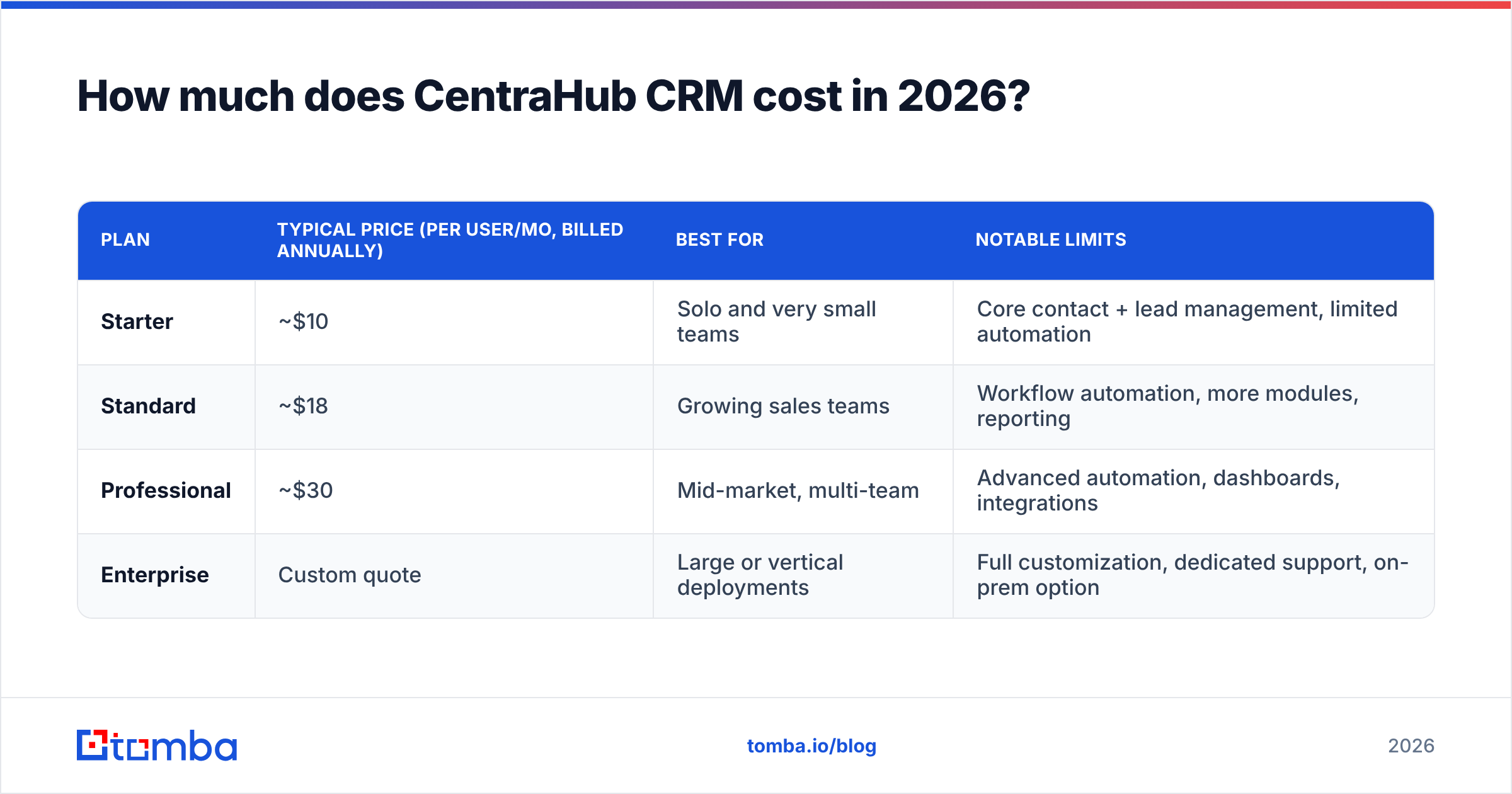
CentraHub CRM uses per-user, per-month pricing across four main tiers. You can bill monthly or annually, and annual is cheaper. Exact numbers shift by region and currency. They also change based on whether you buy the sales-only CRM or a bundled vertical edition. So always confirm current figures on the official site before you budget. The table below shows the typical published shape.
| Plan | Typical price (per user/mo, billed annually) | Best for | Notable limits |
|---|---|---|---|
| Starter | ~$10 | Solo and very small teams | Core contact + lead management, limited automation |
| Standard | ~$18 | Growing sales teams | Workflow automation, more modules, reporting |
| Professional | ~$30 | Mid-market, multi-team | Advanced automation, dashboards, integrations |
| Enterprise | Custom quote | Large or vertical deployments | Full customization, dedicated support, on-prem option |
A few things to watch on cost:
- Annual vs monthly. Month-to-month pricing costs more. The discounts vendors advertise usually assume an annual commitment.
- Module stacking. Sales, marketing, and service can be priced as separate modules. A full CRM setup may cost more than the headline sales tier.
- Implementation and training. Vertical editions often add onboarding or setup fees. This is common for real estate and field-service rollouts.
- Seat minimums. Some plans set a minimum user count. That is fine for a 15-person team, but awkward for a 3-person startup.
That mid-market position is deliberate. It sits between cheap-and-simple tools and pricey enterprise suites. It helps to compare this structure with transparent, usage-based vendors. You can see a clean example on the Tomba pricing page. Tiers and credits are listed there without a sales call.
What do CentraHub CRM reviews actually say?#
Pull from public review platforms and the sentiment clusters into a few themes. Aggregate ratings on sites like G2 and Capterra sit in the solid-but-not-spotless range. Most land around 4 out of 5.
What reviewers praise:
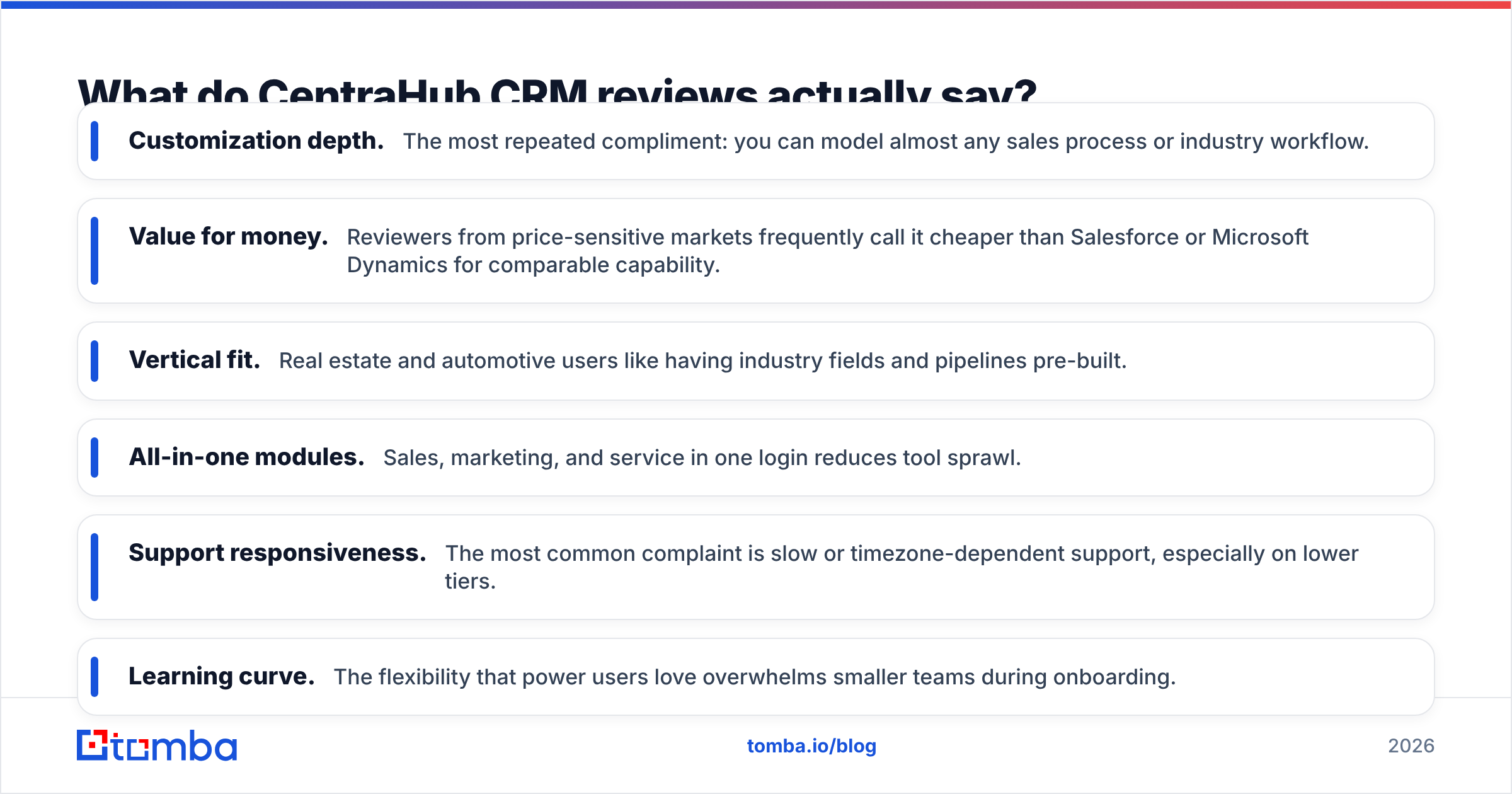
- Customization depth. The top compliment: you can model almost any sales process or industry workflow.
- Value for money. Many reviewers call it cheaper than Salesforce or Microsoft Dynamics for similar capability.
- Vertical fit. Real estate and automotive users like the pre-built fields and pipelines.
- All-in-one modules. Sales, marketing, and service share one login, so there is less tool sprawl.
What reviewers criticize:
- Support responsiveness. The most common gripe is slow or timezone-bound support, especially on lower tiers.
- Learning curve. The flexibility power users love can overwhelm smaller teams at onboarding.
- UI dated in spots. Some screens feel less modern than newer SaaS-native rivals.
- Documentation gaps. Self-serve setup can stall without hands-on help.
Treat reviews as directional, not gospel. Weight them toward businesses that look like yours. A 200-agent real estate brokerage and a 4-person SaaS startup will have opposite experiences with the same product.
What are the pros and cons of CentraHub CRM?#
Here is the honest balance sheet. Treat each con as a question to raise during a demo, not an automatic dealbreaker.
| Pros | Cons |
|---|---|
| Deep, code-light customization of fields, workflows, and pipelines | Steeper learning curve than plug-and-play CRMs |
| Strong vertical editions (real estate, automotive, field service) | Support quality reported as inconsistent across tiers/regions |
| Competitive per-user pricing vs. enterprise incumbents | Best features gated behind Professional/Enterprise tiers |
| Sales + marketing + service modules in one platform | Some UI screens feel dated compared to newer rivals |
| On-premise option for data-residency-sensitive industries | Implementation/onboarding effort can be significant |
| Scales from SMB to enterprise seat counts | Smaller add-on/integration marketplace than the giants |
The pattern is clear. CentraHub rewards teams that invest in setup. It punishes teams expecting instant magic.
Who should buy CentraHub CRM — and who shouldn't?#
Strong fit:
- Mid-market companies (roughly 20–500 users) that need real customization without enterprise prices.
- Vertical businesses — real estate brokerages, car dealerships, and field-service operators who benefit from purpose-built editions.
- Teams with an admin who can own configuration, workflows, and rollout.
- Data-residency-sensitive orgs that value an on-premise option.
Weak fit:
- Tiny teams (1–5 people) who want something that works in an afternoon. A lighter, more opinionated CRM will frustrate you less.
- Teams that prize a modern, minimal UI over deep configurability.
- Buyers who need a huge third-party app marketplace on day one.
How does CentraHub CRM compare to the alternatives?#
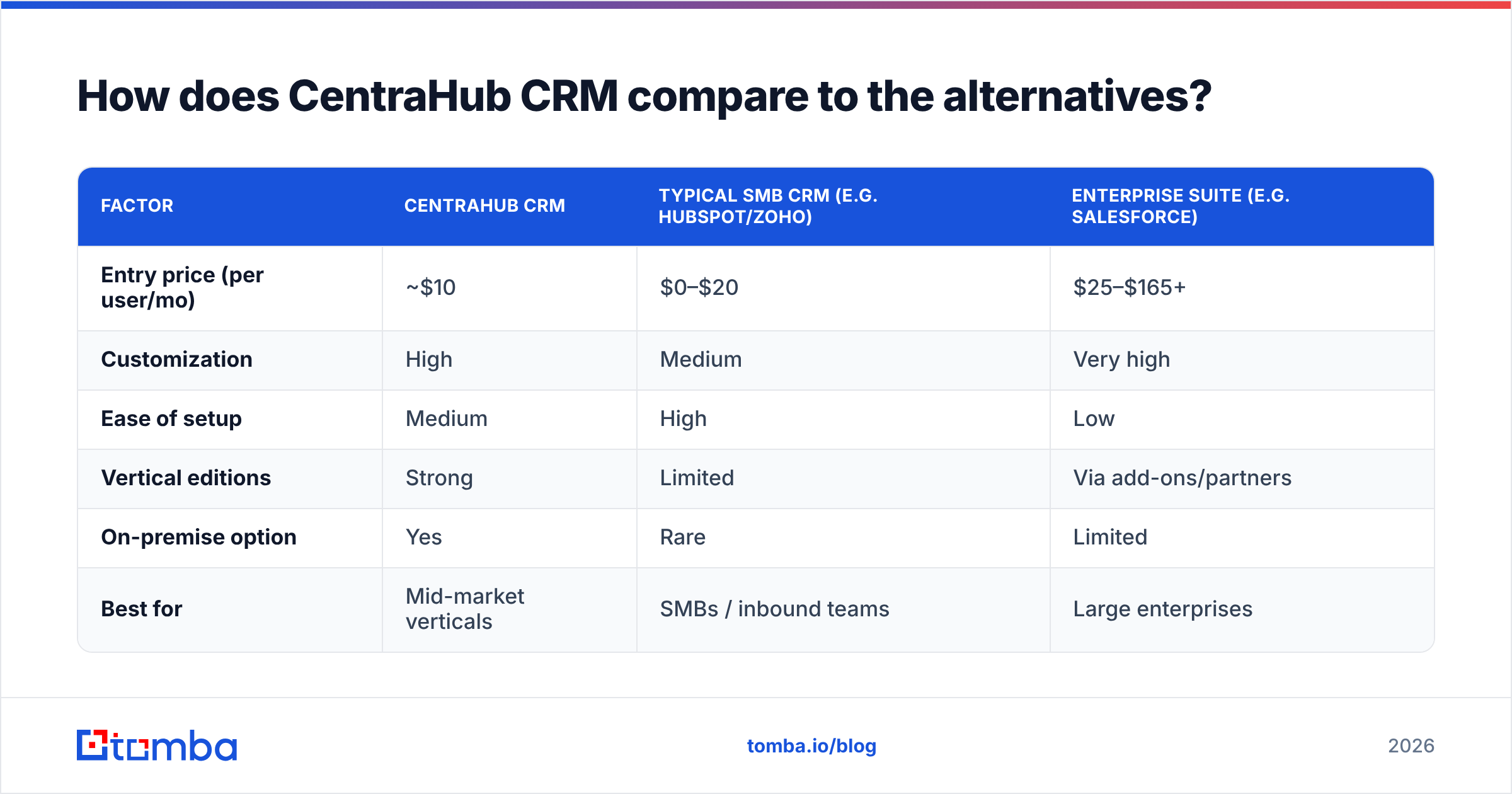
No CRM exists in a vacuum. The grid below positions CentraHub against common comparison points buyers raise. Prices are indicative entry points and change often, so verify before deciding.
| Factor | CentraHub CRM | Typical SMB CRM (e.g. HubSpot/Zoho) | Enterprise suite (e.g. Salesforce) |
|---|---|---|---|
| Entry price (per user/mo) | ~$10 | $0–$20 | $25–$165+ |
| Customization | High | Medium | Very high |
| Ease of setup | Medium | High | Low |
| Vertical editions | Strong | Limited | Via add-ons/partners |
| On-premise option | Yes | Rare | Limited |
| Best for | Mid-market verticals | SMBs / inbound teams | Large enterprises |
The takeaway: CentraHub sits in the value-customization middle. If your shortlist includes the big players, weigh total cost of ownership. That means implementation, admin time, and add-ons, not just the sticker price. Tools like HubSpot publish helpful CRM education on hubspot.com if you want a baseline for comparison.
What about the data inside the CRM?#
A CRM is just a container. Its value depends on what you put in it. The most common failure point is bad contact data. Reps waste hours chasing bounced emails, stale phone numbers, and broken records. No CentraHub workflow can fix that on its own.
Two habits keep any CRM healthy:
- Find verified contacts before they enter the pipeline. Use an email finder to pull accurate professional emails by name or domain. New leads then land valid.
- Enrich and clean continuously. Run data enrichment to fill missing job titles, companies, and phone numbers. Then route the clean records into CentraHub.
CentraHub supports integrations and an API. So you can wire enrichment and verification into your lead-capture flow. That beats letting reps hand-key data. Want to see how a data layer connects to downstream tools? Browse the available integrations patterns — the same idea applies to feeding a CRM. CentraHub's own integration ecosystem is smaller than the market leaders'. Confirm your specific stack is supported during evaluation.
CentraHub CRM pricing, reviews, pros and cons: is it worth it in 2026?#
Conclusion first: yes, for mid-market and vertical teams willing to invest in setup — and no, for tiny teams chasing instant simplicity. Weigh the CentraHub CRM pricing, reviews, pros and cons together, and the picture is consistent. The pricing is genuinely competitive. The customization is real. The vertical editions are a differentiator most cheaper CRMs can't match. The recurring caveats — support consistency, learning curve, tier-gated features — are manageable. Go in with eyes open, and negotiate implementation support into your contract.
Before you sign:
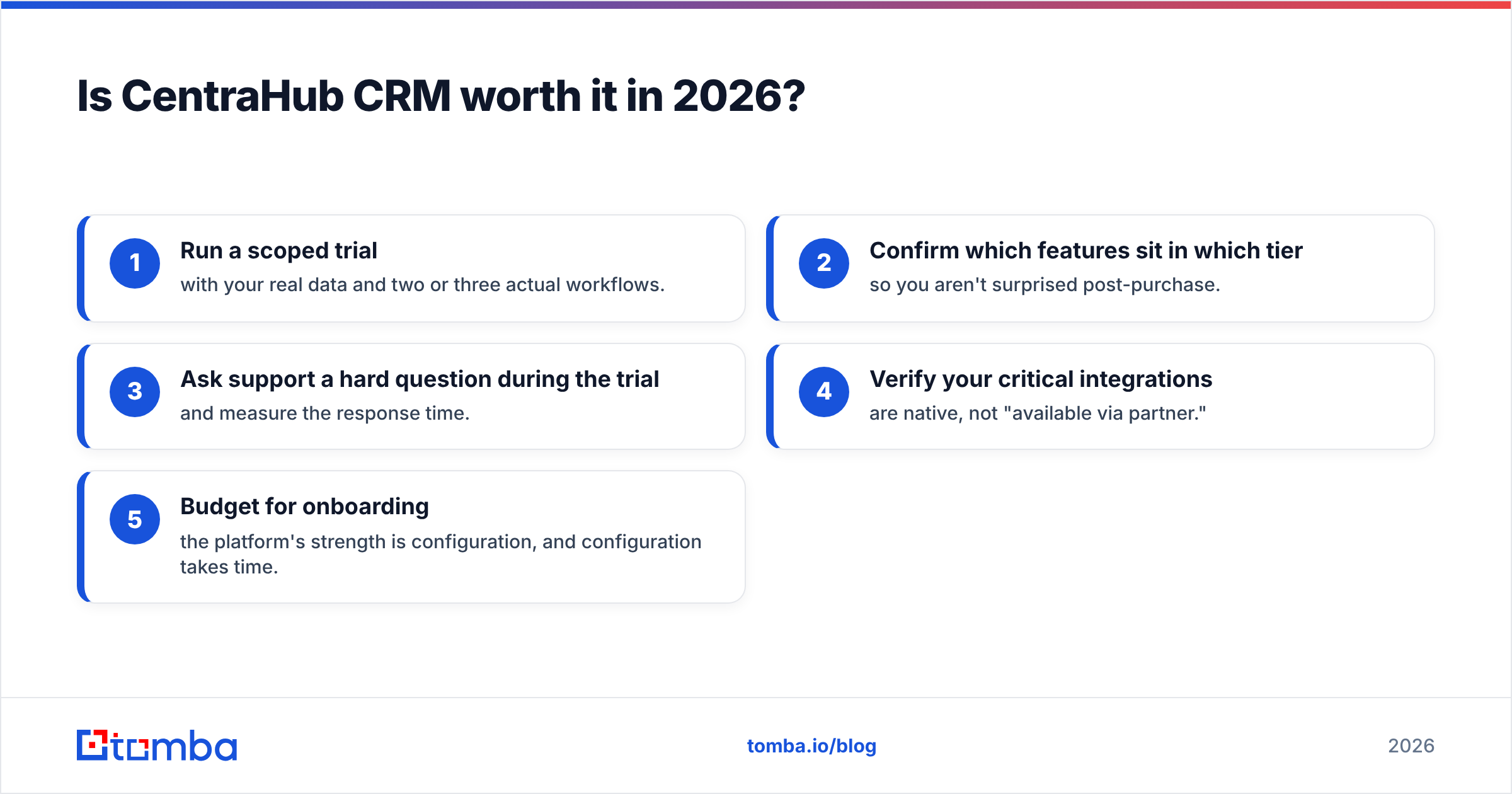
- Run a scoped trial with your real data and two or three actual workflows.
- Confirm which features sit in which tier so nothing surprises you after purchase.
- Ask support a hard question during the trial and time the response.
- Verify your critical integrations are native, not "available via partner."
- Budget for onboarding. The platform's strength is configuration, and configuration takes time.
Final verdict and next step#
CentraHub CRM is a credible, cost-aware choice. It suits teams that value flexibility over out-of-the-box simplicity. For the right buyer, the pros — customization, vertical fit, and pricing — outweigh the cons. Smaller or impatient teams should look at lighter tools. That is the short version of the CentraHub CRM pricing, reviews, pros and cons debate.
Whatever CRM you pick, protect it from the silent killer of every sales pipeline: bad data. Start your contacts clean. Run every new lead through the Tomba Email Finder to capture verified, deliverable professional emails before they ever hit CentraHub. Your reps spend their time selling, not bouncing. And your shiny new CRM finally earns its price tag.
// get started
Find, verify and enrich your first contacts today
Start on the free plan with 25 searches a month, then scale when your team is ready.
Free plan · No credit card required · GDPR & CCPA
// about the author