Champify vs UserGems 2026: Job-Change Signal Tools Compared
Champify and UserGems both turn job changes into pipeline, but they fit different teams. Here's an honest 2026 breakdown of features, pricing, and where each one wins.
TL;DR
- Champify and UserGems both mine your CRM for job changes and warm relationships, then hand sales a list of "people who already know you" at new companies.
- UserGems is the more mature, enterprise-leaning platform with deeper signal coverage (job changes, buyer tracking, new hires, AI agents). Champify is leaner, Salesforce-native, and priced for fast-growing mid-market teams.
- Pick UserGems if you run a large RevOps motion across HubSpot and Salesforce and want signal automation plus AI agents. Pick Champify if you live in Salesforce, want CRM hygiene baked in, and prefer a simpler setup.
- Neither tool is a contact-data provider. They tell you who to chase; you still need accurate, verified emails and phone numbers to actually reach them.
- That last gap is where an email finder and email verifier pay for themselves, no matter which signal tool you choose.
What do Champify and UserGems actually do?#
Both tools solve the same core problem: your best buyers move jobs, and nobody tells you. A champion who bought your product at Company A lands at Company B six months later, ready to buy again, and your reps never notice because the CRM still lists their old email.
Champify and UserGems sit on top of your CRM and watch for these moments. Think of it like a security camera pointed at your customer list: when a known contact changes companies, gets promoted, or a former user shows up somewhere new, the system flags it and routes a fresh play to the right rep.
The category is usually called signal-based selling or relationship intelligence. The promise is simple: warm pipeline from people who already trust you, instead of cold lists nobody asked for.
Here is the catch that no vendor leads with. A "signal" is only a name plus a new logo. To act on it you need a deliverable email address and ideally a direct phone number, and that data decays the moment someone switches jobs. So the signal tool and the contact-data layer are two different jobs.

How are Champify and UserGems different?#
The headline difference is scope and maturity. UserGems has been in market longer, supports more CRMs, and has pushed hard into AI "go-to-market" agents that draft outreach and qualify signals automatically. Champify is younger, tighter, and built first for Salesforce shops that also want their CRM cleaned up as a side effect.
Here is the practical breakdown:
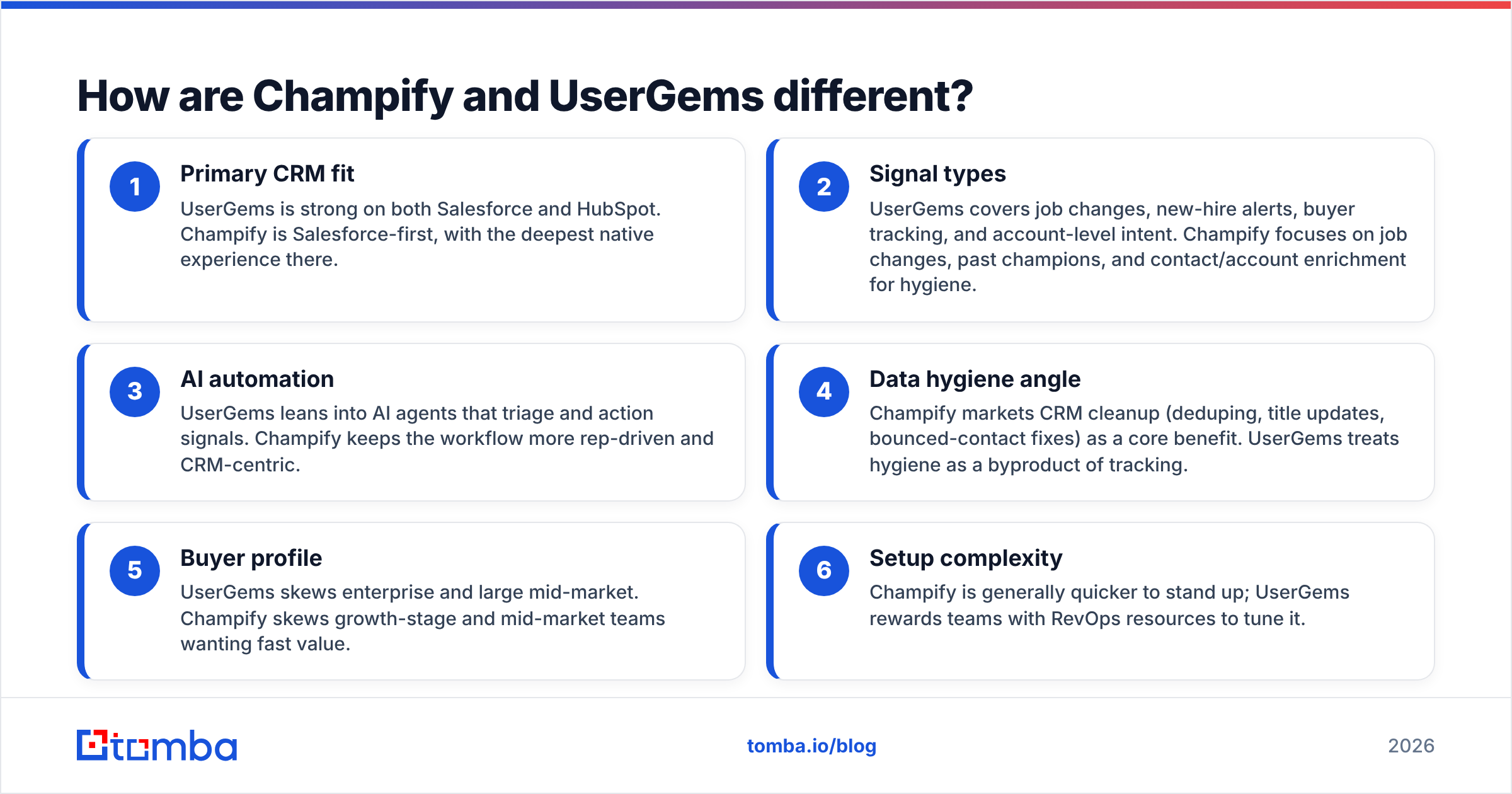
- Primary CRM fit — UserGems is strong on both Salesforce and HubSpot. Champify is Salesforce-first, with the deepest native experience there.
- Signal types — UserGems covers job changes, new-hire alerts, buyer tracking, and account-level intent. Champify focuses on job changes, past champions, and contact/account enrichment for hygiene.
- AI automation — UserGems leans into AI agents that triage and action signals. Champify keeps the workflow more rep-driven and CRM-centric.
- Data hygiene angle — Champify markets CRM cleanup (deduping, title updates, bounced-contact fixes) as a core benefit. UserGems treats hygiene as a byproduct of tracking.
- Buyer profile — UserGems skews enterprise and large mid-market. Champify skews growth-stage and mid-market teams wanting fast value.
- Setup complexity — Champify is generally quicker to stand up; UserGems rewards teams with RevOps resources to tune it.
Neither is "better" in the abstract. They are tuned for different team sizes and operating models.
Champify vs UserGems: feature and pricing comparison#
Pricing for both tools is quote-based and scales with contacts tracked, seats, and add-ons, so treat the figures below as directional rather than published rate cards. Always confirm current numbers on each vendor's site.
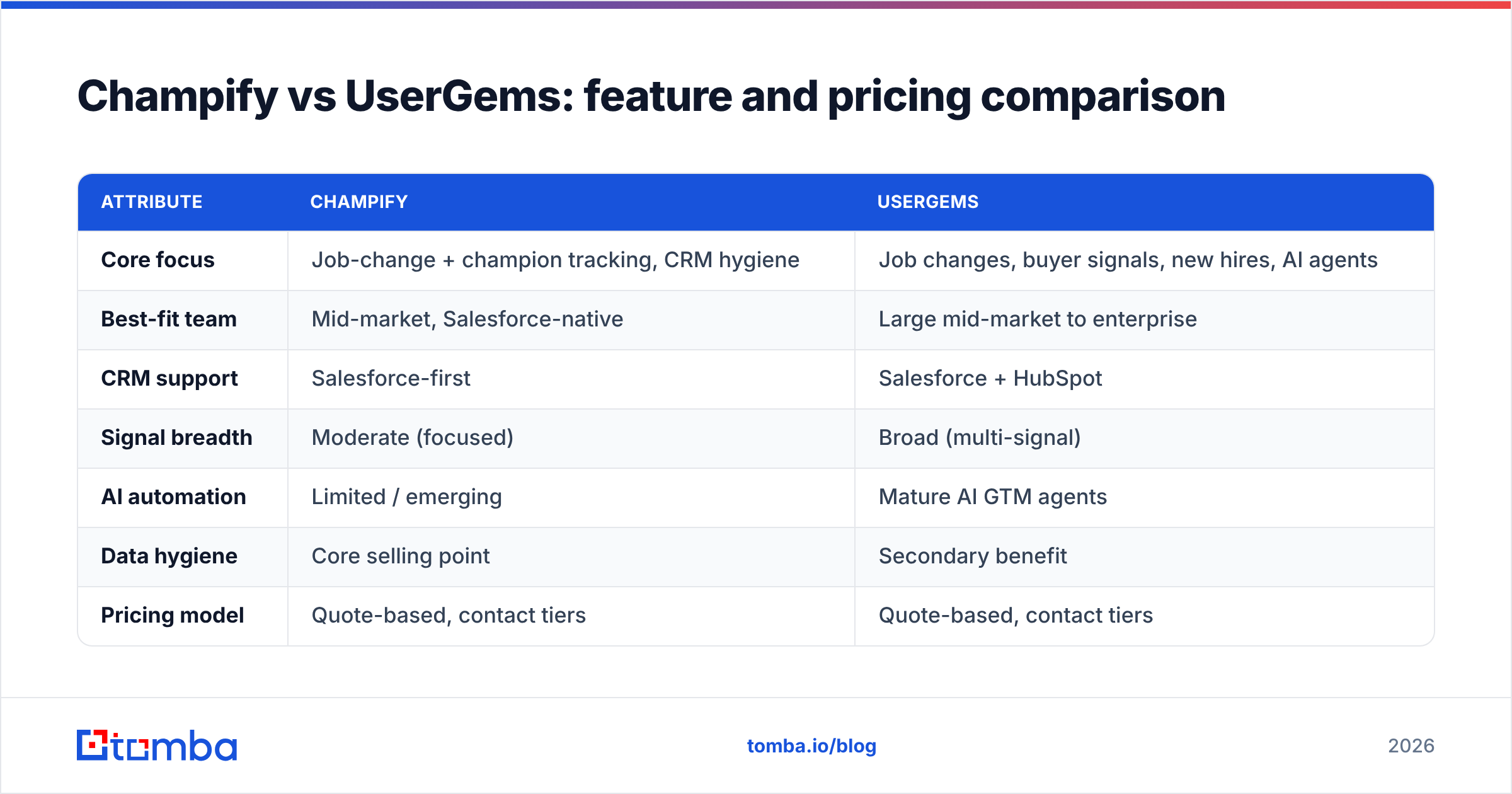
| Attribute | Champify | UserGems |
|---|---|---|
| Core focus | Job-change + champion tracking, CRM hygiene | Job changes, buyer signals, new hires, AI agents |
| Best-fit team | Mid-market, Salesforce-native | Large mid-market to enterprise |
| CRM support | Salesforce-first | Salesforce + HubSpot |
| Signal breadth | Moderate (focused) | Broad (multi-signal) |
| AI automation | Limited / emerging | Mature AI GTM agents |
| Data hygiene | Core selling point | Secondary benefit |
| Pricing model | Quote-based, contact tiers | Quote-based, contact tiers |
| Typical entry cost | Lower, mid-market friendly | Higher, enterprise oriented |
| Free trial | Demo / pilot | Demo / pilot |
| Contact data included | Limited enrichment | Limited enrichment |
The last row is the one to underline. Both platforms enrich contacts to some degree, but neither is built to be your primary email-and-phone source. Their enrichment exists to keep the signal accurate, not to deliver verified, send-ready contact records at scale.
Is UserGems better than Champify?#
For a large, multi-CRM revenue org, UserGems is usually the stronger fit. It carries more signal types, deeper integrations, and AI agents that reduce the manual triage tax that kills most signal programs. If you have a RevOps function that can configure plays and route signals into sequences, UserGems gives you more surface area to automate.
UserGems also has a longer track record and a larger base of public reviews. You can sanity-check both vendors on a neutral source like G2 before committing, since category leaders shift year to year.
But "more features" is not free. UserGems costs more, takes more tuning, and can overwhelm a small team that just wants job-change alerts wired into Salesforce. If you are a 15-rep team, half of UserGems' capability may sit unused while you pay for it.
That is exactly the gap Champify targets.
When is Champify the smarter pick?#
Champify wins when you live in Salesforce, want fast time-to-value, and care as much about CRM cleanliness as about new signals. Its hygiene-first framing means you get a cleaner database as you track job changes: bounced contacts get flagged, titles get refreshed, and duplicate records get reconciled.
For a mid-market team without a dedicated RevOps staff, that bundled cleanup can matter more than UserGems' broader signal menu. You are not just buying alerts; you are buying a tidier system of record.
Champify is also generally easier to roll out. Fewer moving parts means reps actually adopt it, and an adopted simple tool beats an ignored powerful one every time.
The trade-off: less signal breadth, lighter AI automation, and a Salesforce-centric world that is less friendly if your stack is HubSpot-heavy.
Which should you choose: Champify or UserGems?#
Match the tool to your operating model, not to a feature checklist:
- Choose UserGems if you are enterprise or upper mid-market, run Salesforce and/or HubSpot, have RevOps bandwidth, and want AI agents handling signal triage.
- Choose Champify if you are mid-market, Salesforce-native, want CRM hygiene baked in, and value simplicity and speed over signal volume.
- Choose neither yet if you have not solved contact data first. A perfect signal with a dead email is still a dead signal.
That third point is the one most teams skip, and it quietly wrecks the ROI of either platform.

Why contact data quality decides your ROI either way#
Here is the uncomfortable math. Say UserGems or Champify surfaces 500 job-change signals a quarter. If 20% of the auto-pulled emails are stale, mistyped, or catch-all guesses, that is 100 wasted touches, plus the bounce damage to your sender reputation that drags down every other campaign you run.
Job changes are the single worst moment for contact accuracy. The person just moved, the new email pattern is unconfirmed, and the old record is now garbage. Signal tools flag the move; they rarely guarantee the new address is real and inbox-deliverable.
This is where a dedicated data layer earns its keep. A workflow that holds up:
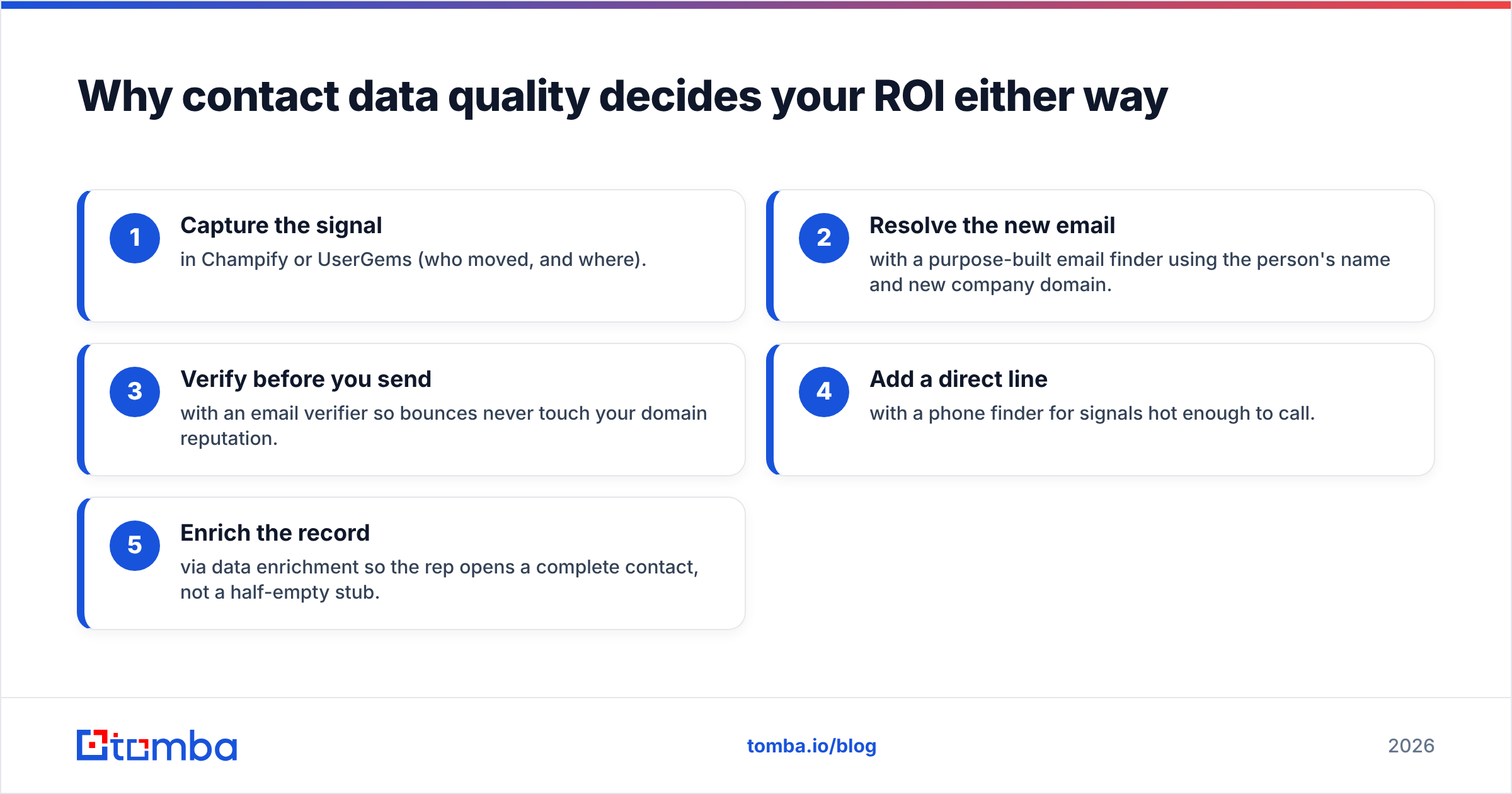
- Capture the signal in Champify or UserGems (who moved, and where).
- Resolve the new email with a purpose-built email finder using the person's name and new company domain.
- Verify before you send with an email verifier so bounces never touch your domain reputation.
- Add a direct line with a phone finder for signals hot enough to call.
- Enrich the record via data enrichment so the rep opens a complete contact, not a half-empty stub.
Run this and your signal tool stops being a list of names and starts being a list of reachable buyers. That is the difference between a demo-day metric and actual pipeline.
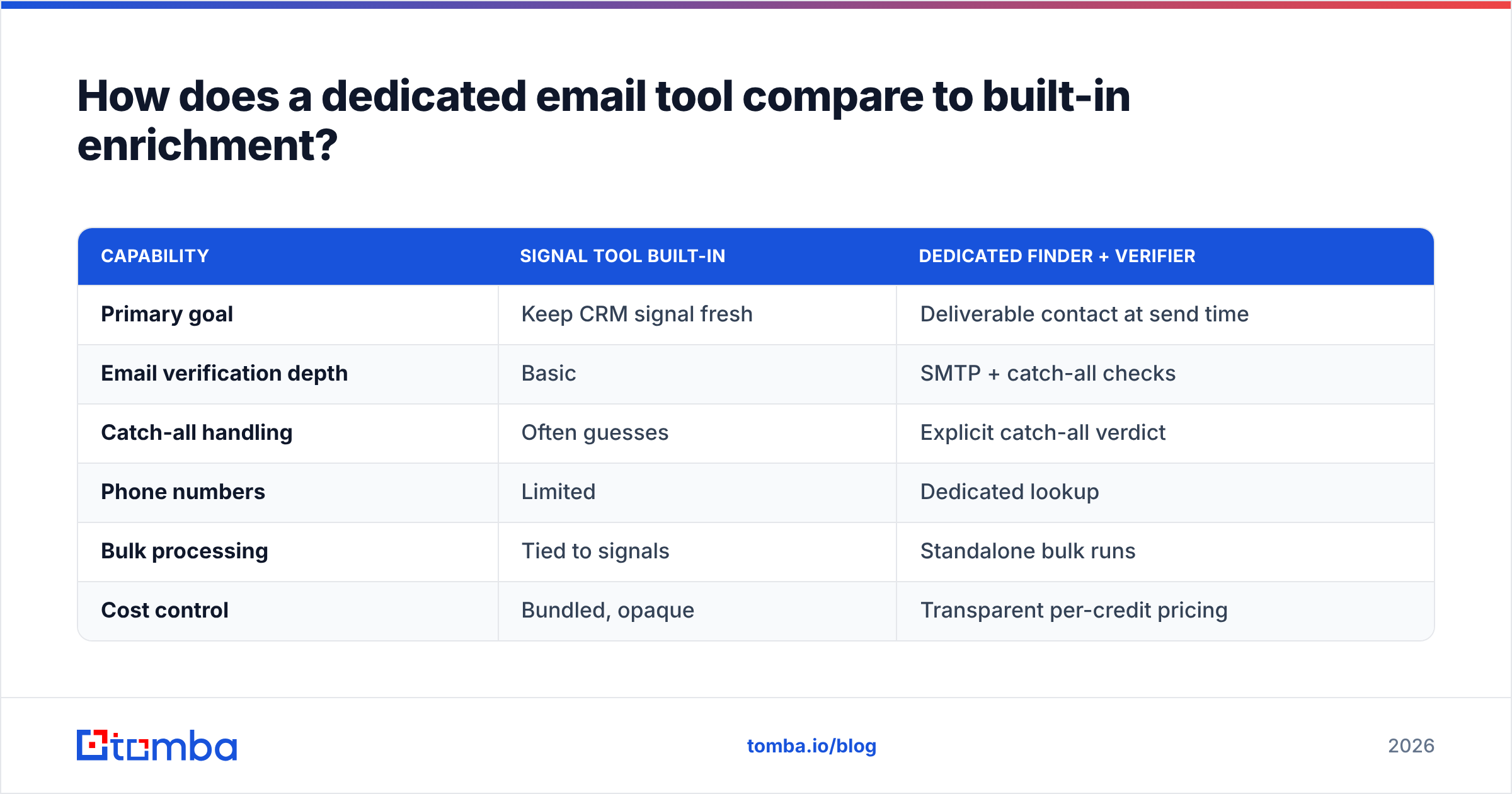
How does a dedicated email tool compare to built-in enrichment?#
Built-in enrichment inside a signal platform is convenient, but it is optimized for keeping signals current, not for accuracy at the moment of outreach. A specialized finder-and-verifier stack is built around one job: returning a deliverable address with a confidence score.
| Capability | Signal tool built-in | Dedicated finder + verifier |
|---|---|---|
| Primary goal | Keep CRM signal fresh | Deliverable contact at send time |
| Email verification depth | Basic | SMTP + catch-all checks |
| Catch-all handling | Often guesses | Explicit catch-all verdict |
| Phone numbers | Limited | Dedicated lookup |
| Bulk processing | Tied to signals | Standalone bulk runs |
| Cost control | Bundled, opaque | Transparent per-credit pricing |
You do not have to choose one or the other. The strongest setups pair a signal tool for who with a contact-data tool for how to reach them. For teams that want to automate that second step, Tomba's email finder API plugs verification straight into the moment a job-change signal fires, so reps never copy a stale address into a sequence.
If you want to test the gap yourself, run a sample of your own surfaced contacts through a free email check and watch how many "enriched" addresses fail validation. The number is usually higher than anyone expects, and it explains a lot of quiet bounce problems.
Final verdict on Champify vs UserGems#
There is no universal winner in Champify vs UserGems, only the right fit for your team. UserGems is the broader, more automated, enterprise-grade choice; Champify is the leaner, Salesforce-native, hygiene-focused option for mid-market teams that want value fast. Read current reviews on each official site (usergems.com and champify.io) before you commit, because both ship features quickly.
But whichever you choose, remember that a signal is only as good as the contact data behind it. The vendors compete on surfacing the who; almost none of that ROI lands if the email bounces or the phone number is wrong.
Close the data gap before you scale your signals. Start with Tomba's Email Finder to turn every job-change alert into a verified, send-ready contact, then layer in email verification and enrichment so your reps reach real inboxes on the first try. The free tier covers 25 searches a month, and paid plans start at $49/mo, so you can pressure-test the workflow against your own surfaced contacts before rolling it out team-wide. See full Tomba pricing to match a plan to your signal volume.
// get started
Find, verify and enrich your first contacts today
Start on the free plan with 25 searches a month, then scale when your team is ready.
Free plan · No credit card required · GDPR & CCPA
// about the author