ChampSignal Pricing, Reviews, Pros and Cons (2026 Guide)
A neutral 2026 breakdown of ChampSignal pricing, real user reviews, and the honest pros and cons — plus where a pure data tool fits better.
ChampSignal Pricing, Reviews, Pros and Cons
If you are evaluating ChampSignal, you want three things up front: what it costs, whether real users like it, and where it falls short. This guide answers all three without the marketing gloss — and shows you where a signal tool ends and a contact-data tool begins.
TL;DR#
- ChampSignal is a signal-based sales intelligence tool built around tracking champions, job changes, and buying intent — not a general email-finding database.
- Pricing is quote-based. ChampSignal does not publish a transparent per-seat price list, so expect a sales call and an annual contract for most plans.
- Reviews are generally positive on signal quality but flag onboarding effort, CRM-data dependence, and contract friction.
- Its biggest gap is contact data. Signals tell you when to reach out; they rarely hand you a verified email or phone number to act on.
- Pair it (or replace part of it) with a dedicated data layer. A focused tool like the Tomba Email Finder fills the "now find the address" gap at a transparent price.
What is ChampSignal?#
ChampSignal sits in the "buyer signals" category of B2B sales tools. Think of it like a smoke detector for your pipeline: it does not start the fire or put it out, it just tells you something is happening right now so you can act before the moment passes.
In practice, that means watching for events that correlate with revenue — a past champion changing jobs, an account showing renewed engagement, or a known contact landing at a new company that fits your ICP. When one of those triggers fires, ChampSignal surfaces it so your reps can run a timely play instead of cold-dialing a static list.
This is a fundamentally different job from a database tool. A signal platform answers who and when. A data platform answers what is their actual email and phone number. You almost always need both, and conflating them is the single most common mistake teams make when they buy one and expect the other.
)
Where ChampSignal fits in the stack#
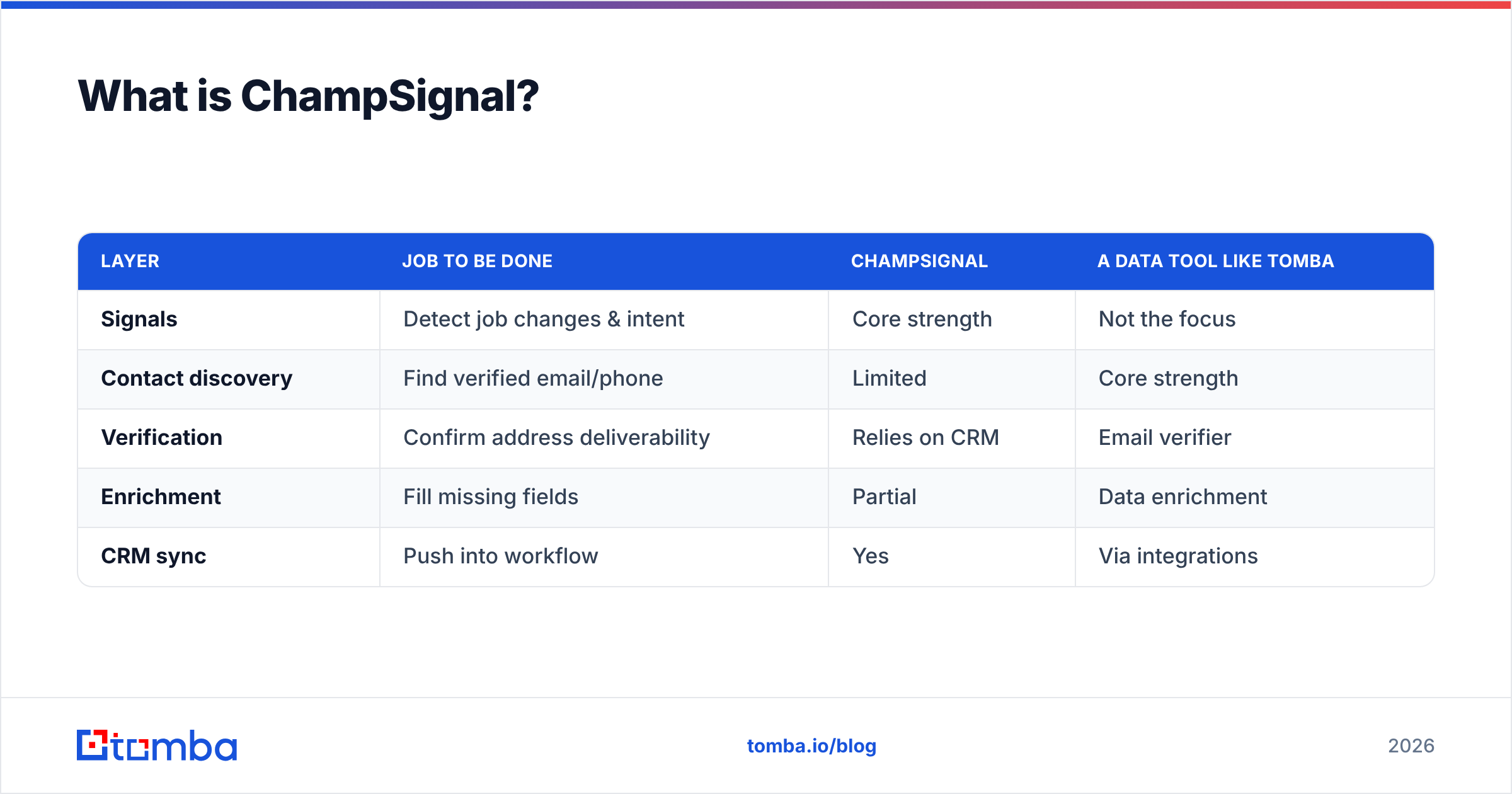
| Layer | Job to be done | ChampSignal | A data tool like Tomba |
|---|---|---|---|
| Signals | Detect job changes & intent | Core strength | Not the focus |
| Contact discovery | Find verified email/phone | Limited | Core strength |
| Verification | Confirm address deliverability | Relies on CRM | Email verifier |
| Enrichment | Fill missing fields | Partial | Data enrichment |
| CRM sync | Push into workflow | Yes | Via integrations |
The takeaway: ChampSignal is strongest at the top of that table and thinner at the bottom. The bottom is exactly where a dedicated finder earns its keep.
How much does ChampSignal cost?#
Short answer: ChampSignal uses quote-based pricing, so there is no public per-seat number you can budget against without talking to sales. That is normal for signal and intent platforms, but it matters for how you evaluate it.
When pricing is not published, three things tend to be true, and ChampSignal's category fits the pattern:
- Plans are annual. Month-to-month is rare; expect a 12-month commitment.
- Price scales with seats and signal volume. The more contacts you track and the more users you onboard, the higher the tier.
- There is a floor. Signal tools in this space typically start in the four-figures-per-year range for small teams and climb quickly for mid-market and enterprise.
Because the exact figures are gated, treat any specific dollar amount you see quoted online as unverified until ChampSignal confirms it for your seat count. Always ask three questions on the call: what is the annual minimum, what counts as a "tracked contact," and what happens to pricing at renewal.
ChampSignal pricing vs. transparent alternatives#
Here is how an opaque, quote-based model compares to a tool that lists prices openly. Tomba is included because it represents the transparent end of the spectrum — you can see Tomba pricing before you ever speak to anyone.
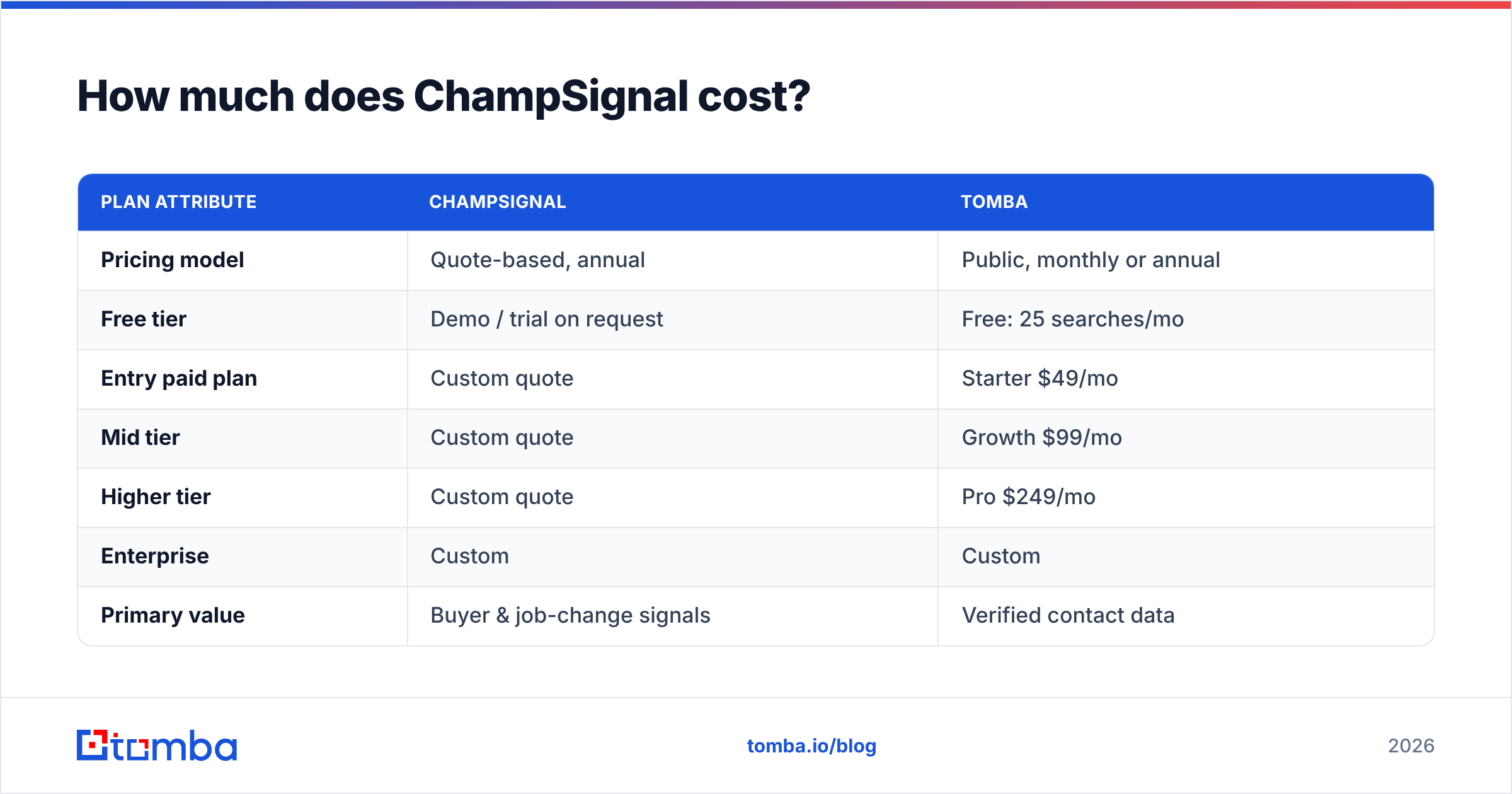
| Plan attribute | ChampSignal | Tomba |
|---|---|---|
| Pricing model | Quote-based, annual | Public, monthly or annual |
| Free tier | Demo / trial on request | Free: 25 searches/mo |
| Entry paid plan | Custom quote | Starter $49/mo |
| Mid tier | Custom quote | Growth $99/mo |
| Higher tier | Custom quote | Pro $249/mo |
| Enterprise | Custom | Custom |
| Primary value | Buyer & job-change signals | Verified contact data |
The point is not that one is cheaper than the other — they do different jobs. The point is that you can scope Tomba's cost in thirty seconds, while ChampSignal requires a sales motion to even get a number. For a small team that wants predictable spend, that difference is real.
What do ChampSignal reviews say?#
Public review coverage for newer signal tools is thinner than for established players, so weigh individual reviews carefully and check recency on sites like G2 and Capterra. That said, the themes that recur across signal-platform feedback — and the early sentiment around ChampSignal — break down cleanly.
What users praise:
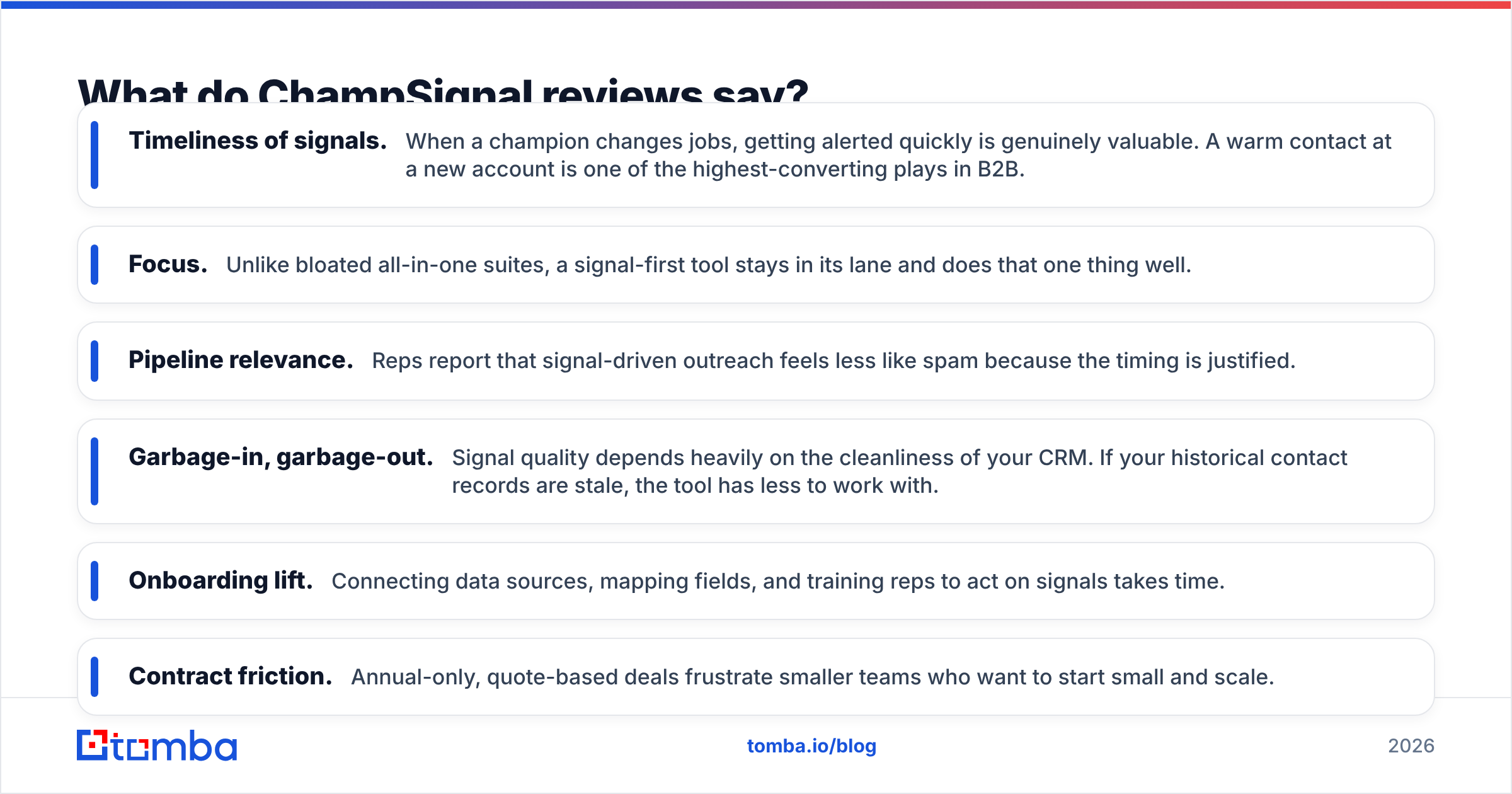
- Timeliness of signals. When a champion changes jobs, getting alerted quickly is genuinely valuable. A warm contact at a new account is one of the highest-converting plays in B2B.
- Focus. Unlike bloated all-in-one suites, a signal-first tool stays in its lane and does that one thing well.
- Pipeline relevance. Reps report that signal-driven outreach feels less like spam because the timing is justified.
What users criticize:
- Garbage-in, garbage-out. Signal quality depends heavily on the cleanliness of your CRM. If your historical contact records are stale, the tool has less to work with.
- Onboarding lift. Connecting data sources, mapping fields, and training reps to act on signals takes time.
- Contract friction. Annual-only, quote-based deals frustrate smaller teams who want to start small and scale.
- The "now what?" gap. A signal tells you a champion moved — but if you do not have their new verified email, you are stuck. This is the complaint we see most often, and it is exactly where a find email addresses workflow closes the loop.
What are the pros and cons of ChampSignal?#
Here is the honest balance sheet. Use it as a checklist against your own situation rather than a verdict.
Pros#
- Best-in-class at timing. If your motion lives or dies on reaching people at the right moment — renewals, expansions, champion job changes — this is the right category of tool.
- Reduces wasted outreach. Signals concentrate rep effort on accounts that are actually moving, which lifts your response rate.
- Compounds with a good CRM. The more clean history you feed it, the smarter it gets.
- Narrow and deep. It does not pretend to be your dialer, your sequencer, and your database all at once.
Cons#
- Opaque pricing. No public list means slower evaluation and a mandatory sales call.
- Annual commitment. Hard to "try before you scale."
- Thin on contact data. Signals without verified emails or phone numbers leave reps half-equipped.
- CRM-dependent quality. Weak underlying data weakens the signals.
- Smaller review corpus. Less third-party validation than incumbent platforms.
)
Is ChampSignal worth it in 2026?#
ChampSignal is worth it if timing is your bottleneck — and not worth it if data is. That distinction is the whole decision.
Ask yourself which sentence describes your team:
- "We know who to call, we just call them too late." → A signal tool like ChampSignal earns its price.
- "We get great signals but can't find half these people's emails." → You have a data problem, and a signal tool will not solve it.
Most teams discover they have both problems, in which case the smart build is a thin, transparent data layer underneath whatever signal tool you choose. When a champion-moved signal fires, you immediately run that name and new domain through a domain search or email finder, verify it, and the rep has an actionable, deliverable contact in seconds. The signal told you when; the finder told you how to reach them.
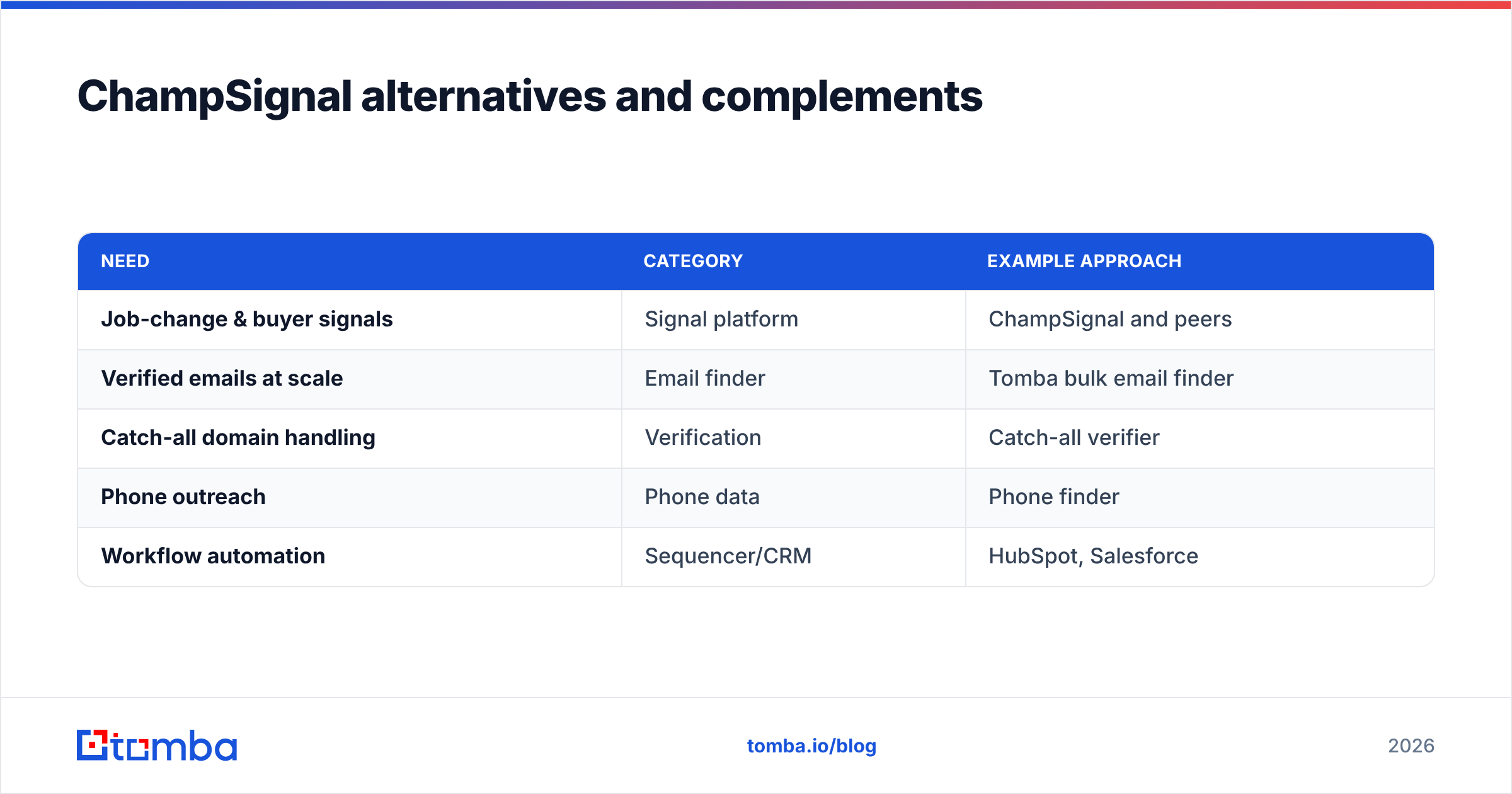
ChampSignal alternatives and complements#
Depending on which half of the problem you are solving, your shortlist changes.
| Need | Category | Example approach |
|---|---|---|
| Job-change & buyer signals | Signal platform | ChampSignal and peers |
| Verified emails at scale | Email finder | Tomba bulk email finder |
| Catch-all domain handling | Verification | Catch-all verifier |
| Phone outreach | Phone data | Phone finder |
| Workflow automation | Sequencer/CRM | HubSpot, Salesforce |
If you are committed to a signal-first motion, you do not have to replace ChampSignal — you have to complete it. The cheapest, fastest completion is a transparent data tool that you can turn on today without a contract. You can wire the discovery step directly into your workflow through the Tomba API, so every signal automatically triggers a contact lookup. For broader stack context, vendor-neutral directories like G2's sales intelligence category and platforms such as HubSpot are useful for mapping where each tool overlaps.
How to evaluate ChampSignal before you sign#
Run this short due-diligence pass on the sales call so you are not surprised at renewal:
- Get the annual minimum in writing. Quote-based means negotiable — and means it creeps.
- Clarify what a "tracked contact" is. Volume-based pricing hinges on this definition.
- Audit your CRM first. If your records are stale, fix data quality before paying for signals on top of bad data. A quick data enrichment and verify emails pass pays for itself.
- Plan the post-signal step. Decide now how a rep turns a signal into a verified email and phone number, not after you have already signed.
- Pilot the play, not the platform. Pick one motion (champion job changes) and measure booked meetings, not vanity alert counts.
Do this and you will know whether ChampSignal's pricing, reviews, pros and cons net out in your favor — for your team, not for a generic buyer.
The bottom line#
ChampSignal is a focused, capable signal tool with one structural weakness baked into its category: it tells you when to act but rarely hands you the verified contact you need to act. Its quote-based pricing adds friction, and its reviews reflect both the value of good timing and the frustration of the "now what?" gap.
The fix is not to abandon signals — it is to put accurate, affordable contact data underneath them. Start with the Tomba Email Finder. Spin up the free tier (25 searches a month, no contract), and the next time a signal fires, you will already have the verified email ready to send. Pair transparent data with smart signals, and your outreach stops being a guess and starts being a play you can win.
Ready to find emails that actually work?
Join 150,000+ professionals who stopped guessing and started sending. Free credits on signup — no credit card required.
Get the Tomba newsletter
Practical outbound tactics and product updates — once every two weeks.
About the author