Chaser Email Guide: Follow-Up Templates That Get Replies in 2026
A chaser email is the polite nudge that rescues a stalled deal. Learn the timing, structure, and copy-paste templates that turn silence into replies in 2026.
Most replies you will ever get come after the first email — not from it. The single message that quietly rescues stalled deals is the chaser email: the polite, well-timed nudge you send when a prospect goes quiet. Done right, it doubles your reply rate. Done wrong, it lands you in spam and burns the relationship.
This guide breaks down exactly how to write a chaser email in 2026 — the timing, the structure, the templates, and the mistakes that get you ignored.
TL;DR#
- A chaser email is a follow-up sent to prompt a response after your previous message went unanswered. It is not a new pitch — it is a reminder with a reason.
- Timing beats wording. Send your first chaser 2–3 business days after the original, then space subsequent ones 4–7 days apart.
- 3 to 5 touches is the sweet spot. Most positive replies arrive on follow-ups 2 through 4, not the first email.
- Every chaser needs a fresh angle — new value, a new question, or a new piece of context — never just "bumping this up."
- Deliverability is non-negotiable: a chaser only works if it reaches the inbox, which starts with a clean, verified list.
What is a chaser email?#
A chaser email is a short follow-up message designed to re-engage someone who did not reply to your previous email. Think of it like knocking a second time on a door — the person may have been in the kitchen, missed the first knock, or simply forgot to answer. You are not breaking the door down; you are giving a gentle, reasonable reminder that you are still there.
In sales and outreach, "chaser" is the British-English cousin of "follow-up." The two are interchangeable, but "chaser" carries a useful nuance: it implies persistence with purpose. You are chasing a specific outcome — a reply, a meeting, a signed contract — not just refreshing the prospect's memory.
The reason chasers matter is mathematical. According to widely cited sales research compiled by HubSpot, the majority of deals require five or more touchpoints to close, yet most salespeople stop after one or two attempts. That gap is the single biggest source of wasted pipeline. The chaser email is how you close it.
Why do chaser emails work so well?#
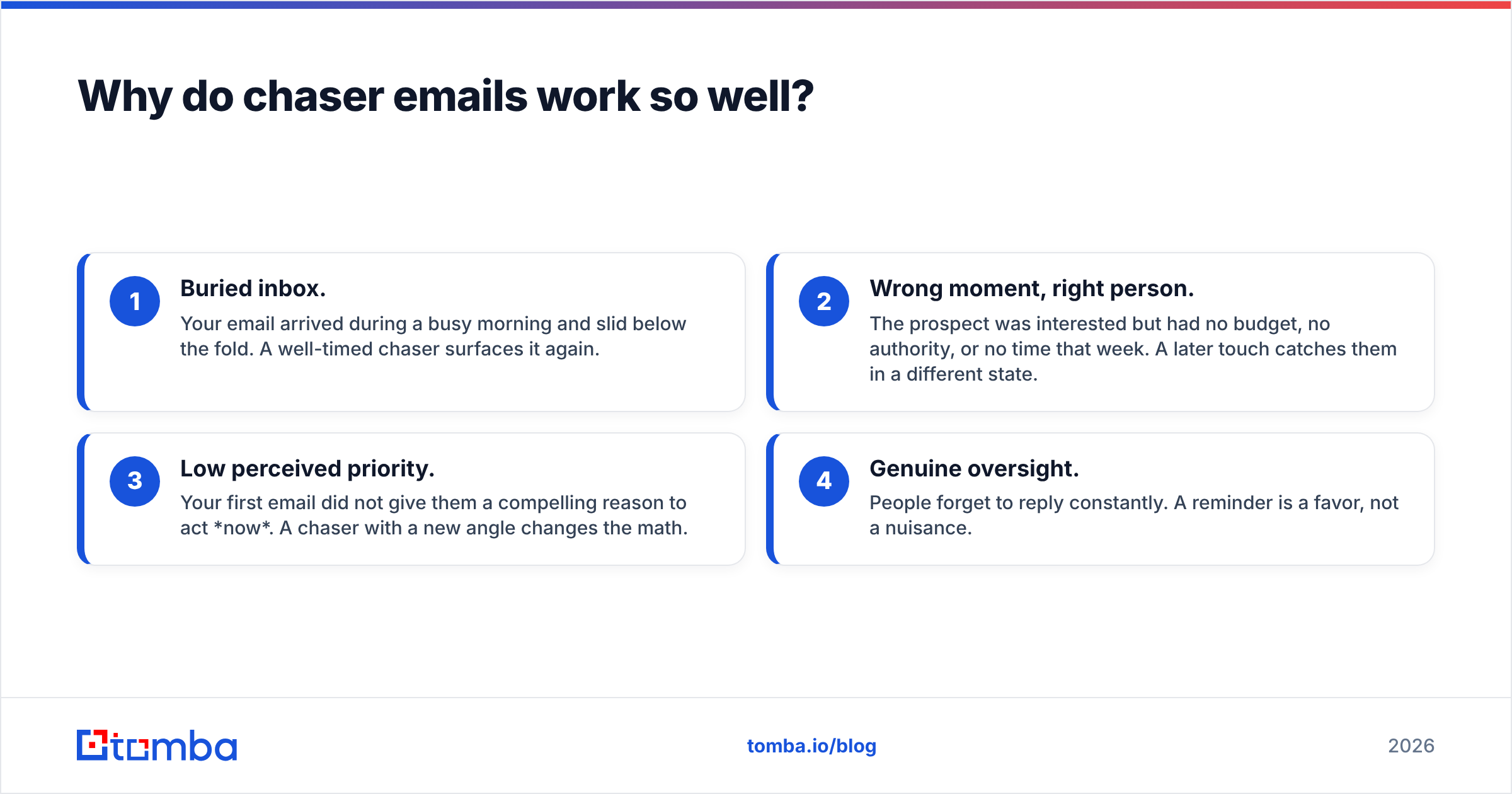
Chasers convert because silence rarely means "no." It usually means one of these:
- Buried inbox. Your email arrived during a busy morning and slid below the fold. A well-timed chaser surfaces it again.
- Wrong moment, right person. The prospect was interested but had no budget, no authority, or no time that week. A later touch catches them in a different state.
- Low perceived priority. Your first email did not give them a compelling reason to act now. A chaser with a new angle changes the math.
- Genuine oversight. People forget to reply constantly. A reminder is a favor, not a nuisance.
The key insight: each chaser is a fresh roll of the dice with a prospect whose circumstances change weekly. That is why the second, third, and fourth emails so often outperform the first.
How many chaser emails should you send?#
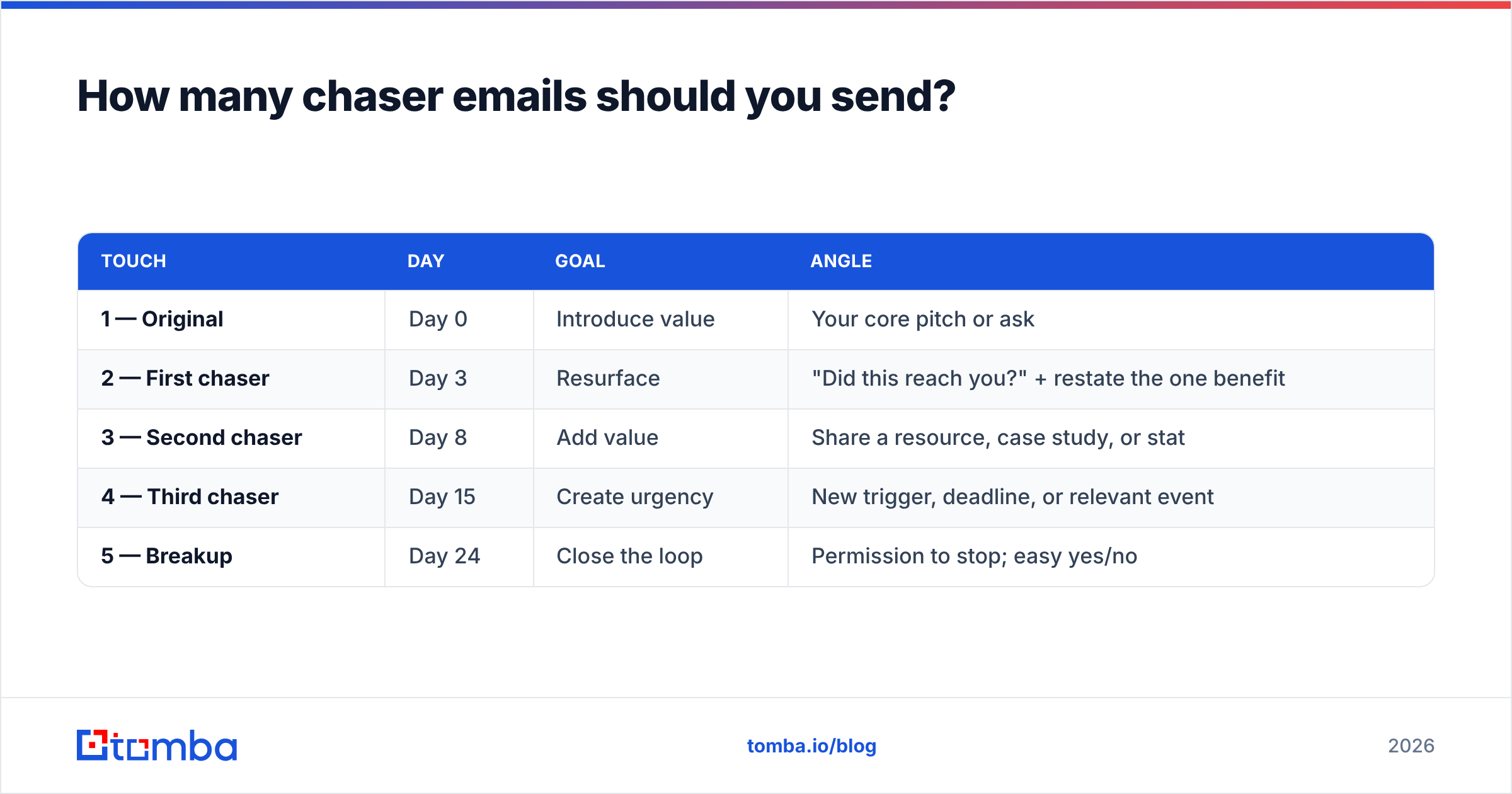
Send between three and five total touches in a sequence, including the original. Beyond five, reply rates fall sharply and unsubscribe and spam-complaint rates climb. Below three, you leave most of your potential replies on the table.
Here is a sequence framework that balances persistence with respect:
| Touch | Day | Goal | Angle |
|---|---|---|---|
| 1 — Original | Day 0 | Introduce value | Your core pitch or ask |
| 2 — First chaser | Day 3 | Resurface | "Did this reach you?" + restate the one benefit |
| 3 — Second chaser | Day 8 | Add value | Share a resource, case study, or stat |
| 4 — Third chaser | Day 15 | Create urgency | New trigger, deadline, or relevant event |
| 5 — Breakup | Day 24 | Close the loop | Permission to stop; easy yes/no |
Notice that no two emails repeat the same message. Each one earns its place by adding something — a new question, a new proof point, or a graceful exit. This is what separates a sequence that feels helpful from one that feels like nagging.
What does a good chaser email look like?#
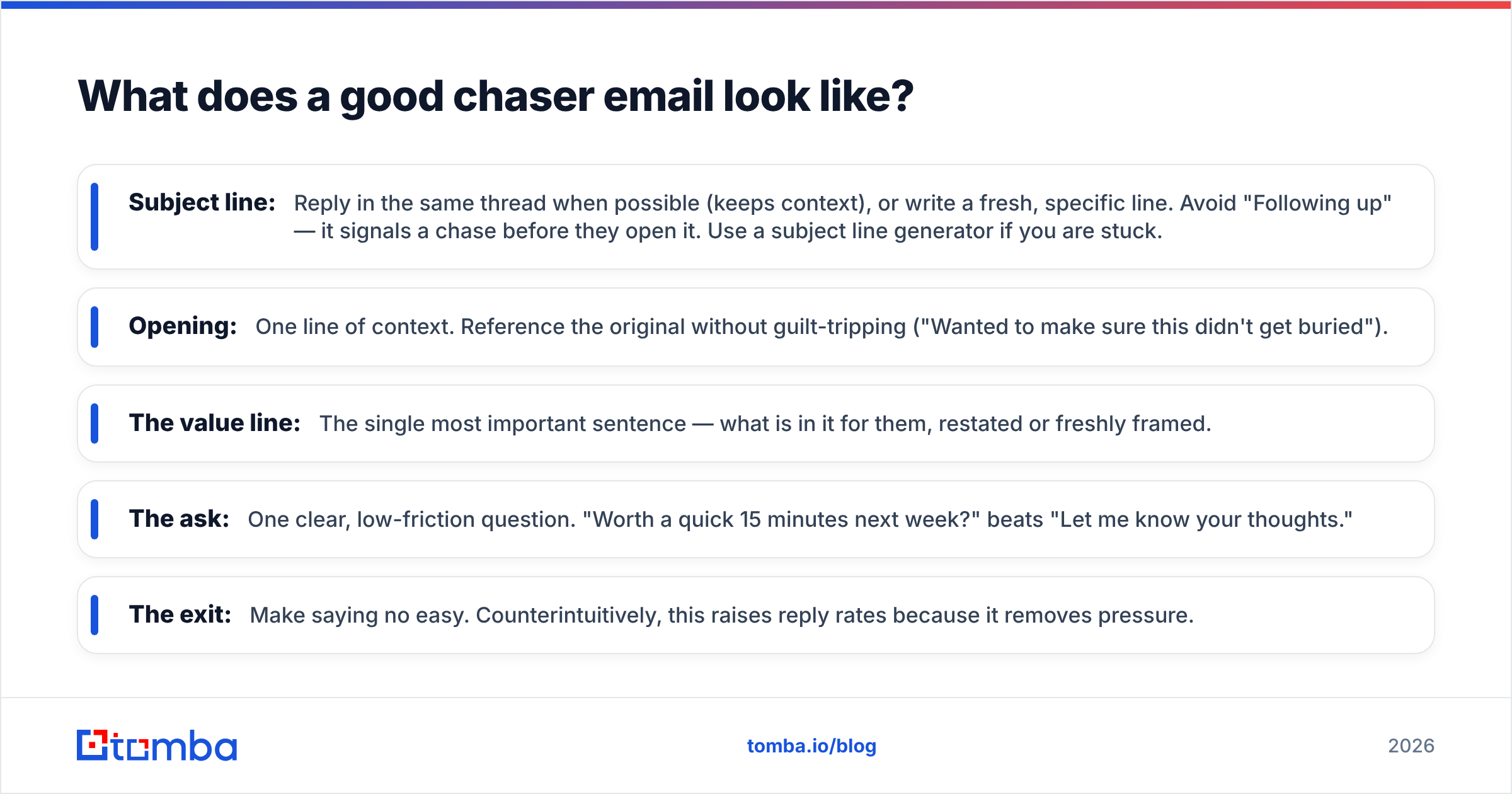
A strong chaser email follows a tight structure. Keep the whole thing under 90 words — the shorter it is, the more likely it gets read on a phone between meetings.
- Subject line: Reply in the same thread when possible (keeps context), or write a fresh, specific line. Avoid "Following up" — it signals a chase before they open it. Use a subject line generator if you are stuck.
- Opening: One line of context. Reference the original without guilt-tripping ("Wanted to make sure this didn't get buried").
- The value line: The single most important sentence — what is in it for them, restated or freshly framed.
- The ask: One clear, low-friction question. "Worth a quick 15 minutes next week?" beats "Let me know your thoughts."
- The exit: Make saying no easy. Counterintuitively, this raises reply rates because it removes pressure.
A chaser that buries one clear ask under three paragraphs of re-explanation will lose to a two-sentence note every time. Brevity is not laziness — it is respect for the reader's time.
Chaser email templates you can copy#
These five templates map to the sequence above. Swap the brackets and keep your own voice — robotic copy is easy to spot. For a larger library, browse Tomba's cold email templates.
Template 1 — The gentle resurface (Day 3)#
Subject: Re: [original subject]
Hi [First name],
Floating this back to the top of your inbox in case it slipped through. The short version: [one-sentence benefit].
Is this worth a quick look, or should I check back later in the quarter?
[Your name]
Template 2 — The value-add (Day 8)#
Subject: Thought this might help, [First name]
Hi [First name],
No reply needed — just sharing [resource / stat / case study] since you [relevant context about their company].
If it sparks anything, I'm around for a 15-minute call this week.
[Your name]
Template 3 — The trigger-based nudge (Day 15)#
Subject: [Trigger event] + a quick idea
Hi [First name],
Saw that [company] just [funding round / hire / product launch]. Teams in that moment usually run into [specific problem] — which is exactly what I reached out about.
Open to a short chat to see if it's relevant?
[Your name]
Template 4 — The breakup (Day 24)#
Subject: Should I close your file?
Hi [First name],
I haven't heard back, which usually means now isn't the right time — totally understand.
I'll stop here unless you'd like me to circle back next quarter. Just reply "later" and I'll do exactly that.
[Your name]
The breakup email is the highest-converting chaser most people never send. The fear of losing the conversation entirely prompts replies that three "just checking in" notes never would.
What are the most common chaser email mistakes?#
Avoid these and you will outperform the majority of outreach you compete with for attention.
- "Just bumping this up." It adds zero value and signals you have nothing new to say. Every chaser needs a reason to exist.
- Sending too fast. A chaser one day after the original reads as desperate. Give it 2–3 business days.
- Guilt-tripping. "I've emailed you three times now" makes the prospect the villain. Stay warm and assume the best.
- The wall of text. Re-explaining your entire pitch is the fastest way to get ignored. Trim ruthlessly.
- No exit ramp. Without an easy "no," prospects who aren't interested simply stay silent — and you never reclaim that pipeline slot.
- Ignoring deliverability. If your chasers land in spam, none of the above matters.
How does deliverability affect your chasers?#
Your chaser sequence is only as good as your inbox placement. Sending repeated emails to invalid, outdated, or risky addresses tanks your sender reputation — and once your domain reputation drops, even your good emails to real prospects start landing in spam.
Two habits protect you:
- Verify before you send. Bounces from dead addresses are the single fastest way to damage sender reputation. Run every list through an email verifier before the first touch — and remember that a chaser sequence hits the same address three to five times, so one bad address does multiplied damage.
- Source clean data in the first place. The cleanest list is one built from accurate contact data, not scraped guesses. Pulling verified, role-matched addresses up front means fewer bounces across the entire sequence.
You can read more on how inbox placement works in this overview of email deliverability. The short version: clean list in, replies out.
Chaser email vs. a full sales sequence: what's the difference?#
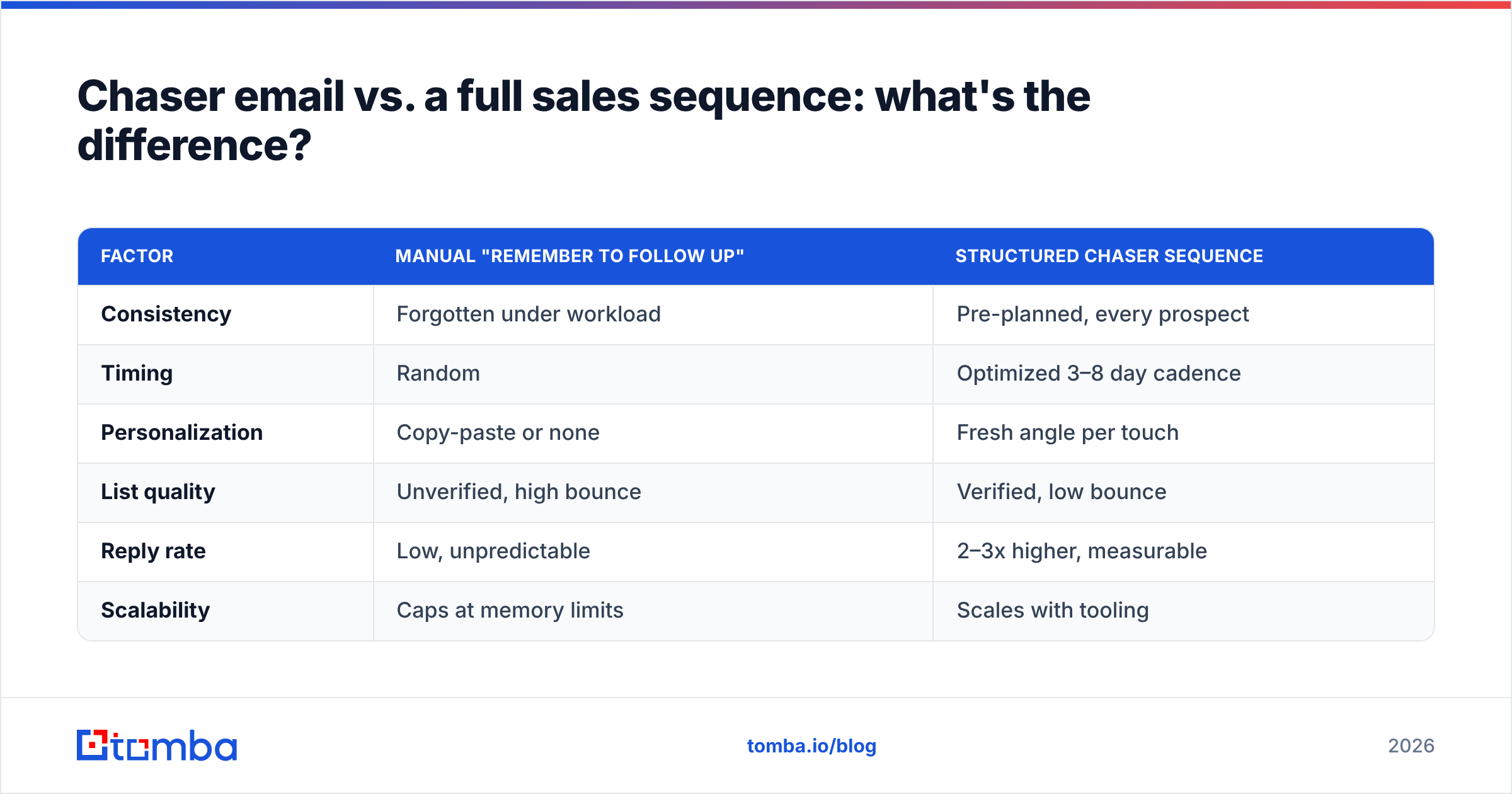
A chaser is one tactic; a sales sequence is the system it lives inside. Here is how a manual, ad-hoc chasing habit compares to a structured, data-backed approach:
| Factor | Manual "remember to follow up" | Structured chaser sequence |
|---|---|---|
| Consistency | Forgotten under workload | Pre-planned, every prospect |
| Timing | Random | Optimized 3–8 day cadence |
| Personalization | Copy-paste or none | Fresh angle per touch |
| List quality | Unverified, high bounce | Verified, low bounce |
| Reply rate | Low, unpredictable | 2–3x higher, measurable |
| Scalability | Caps at memory limits | Scales with tooling |
The lesson is not that one email is better than another — it is that a deliberate system beats good intentions every time. Tracking your response rate across each touch tells you which chasers to keep and which to cut.
How do you scale chaser emails without losing the personal touch?#
Scaling chasers comes down to separating the parts that must be human from the parts that should be automated:
- Automate the timing. Use a sequencing tool to schedule your 3-, 8-, and 15-day touches so nothing slips. Compare options on a review site like G2 before committing.
- Automate the data. Build and verify your contact list programmatically so every send starts clean.
- Keep the angle human. The opening line and the value line should reference something real about the prospect. This is the 20% of effort that drives 80% of replies.
The trap to avoid is automating personalization itself into generic mush. A sequence that mentions "your industry" and "your company's goals" reads as a template because it is one. Specific beats clever.
Frequently asked questions#
How long should I wait before sending a chaser email? Wait 2–3 business days after the original for the first chaser, then space subsequent ones 4–7 days apart. Same-day or next-day chasers read as pushy.
How many chaser emails are too many? More than five total touches in a single sequence usually does more harm than good. End with a breakup email rather than going silent or pushing a sixth.
Should a chaser be in the same thread or a new email? Replying in the same thread preserves context and often improves open rates. Switch to a fresh subject line only when you have a genuinely new angle worth a new opening.
Do chaser emails hurt my sender reputation? Only if you send to invalid addresses or get spam complaints. Verify your list first and always include an easy opt-out, and chasers help rather than hurt.
Start your next sequence with a clean list#
Great chaser copy is wasted on a bad address. Before you write a single follow-up, make sure every contact is real, reachable, and correctly matched to the person you intend to chase. The Tomba Email Finder pulls verified professional emails by name, domain, or company — so your entire sequence starts on a clean foundation, your bounce rate stays low, and your chasers actually reach the inbox where they can do their job. Start free with 25 searches a month, and check the full Tomba pricing when you are ready to scale your outreach.
// get started
Find, verify and enrich your first contacts today
Start on the free plan with 25 searches a month, then scale when your team is ready.
Free plan · No credit card required · GDPR & CCPA
// about the author