Chat GPT for Sales in 2026: Workflows That Close Deals
ChatGPT can draft outreach, research accounts, and prep calls in seconds—but only if you feed it clean data. Here are the 2026 workflows that actually move pipeline.
Sales reps were among the first people to open ChatGPT and ask, "write me a cold email." Three years later the hype has cooled into something more useful: a set of repeatable workflows that save hours a week—if you know where the tool is strong and where it quietly invents things.
This guide skips the "AI will replace SDRs" theater. Instead, you get concrete prompts, a workflow-by-workflow breakdown, and an honest map of where Chat GPT for sales falls apart so you can patch the gaps.
TL;DR#
- ChatGPT is a drafting and research accelerator, not a data source. It writes, summarizes, and reformats brilliantly; it does not know your prospect's real email, current job title, or last funding round.
- The highest-ROI use cases in 2026 are account research synthesis, first-draft outreach, call prep, and CRM note cleanup—not autonomous selling.
- Garbage in, garbage out. Pair it with verified contact data (an email finder and email verifier) or your personalization will be confidently wrong.
- Custom GPTs and the API turn one-off prompts into team-wide playbooks that stay on-brand.
- Treat every factual claim as a draft. Hallucinated stats, fake case studies, and invented contacts are the fastest way to torch sender reputation.
What is ChatGPT for sales, really?#
ChatGPT is a large language model from OpenAI that predicts text. For sales, that means it is exceptionally good at turning messy inputs—notes, transcripts, web copy, bullet points—into clean, structured, persuasive output. Think of it as the world's fastest junior rep: tireless, fluent in every framework, and completely dependent on you for facts.
The mistake most teams make is asking it to know things. It doesn't know whether jane@acme.com is a real, deliverable address. It doesn't know that your prospect changed jobs last month. It generates plausible text, and plausible is not the same as true. That distinction defines every workflow below.

Where does ChatGPT actually help in the sales process?#
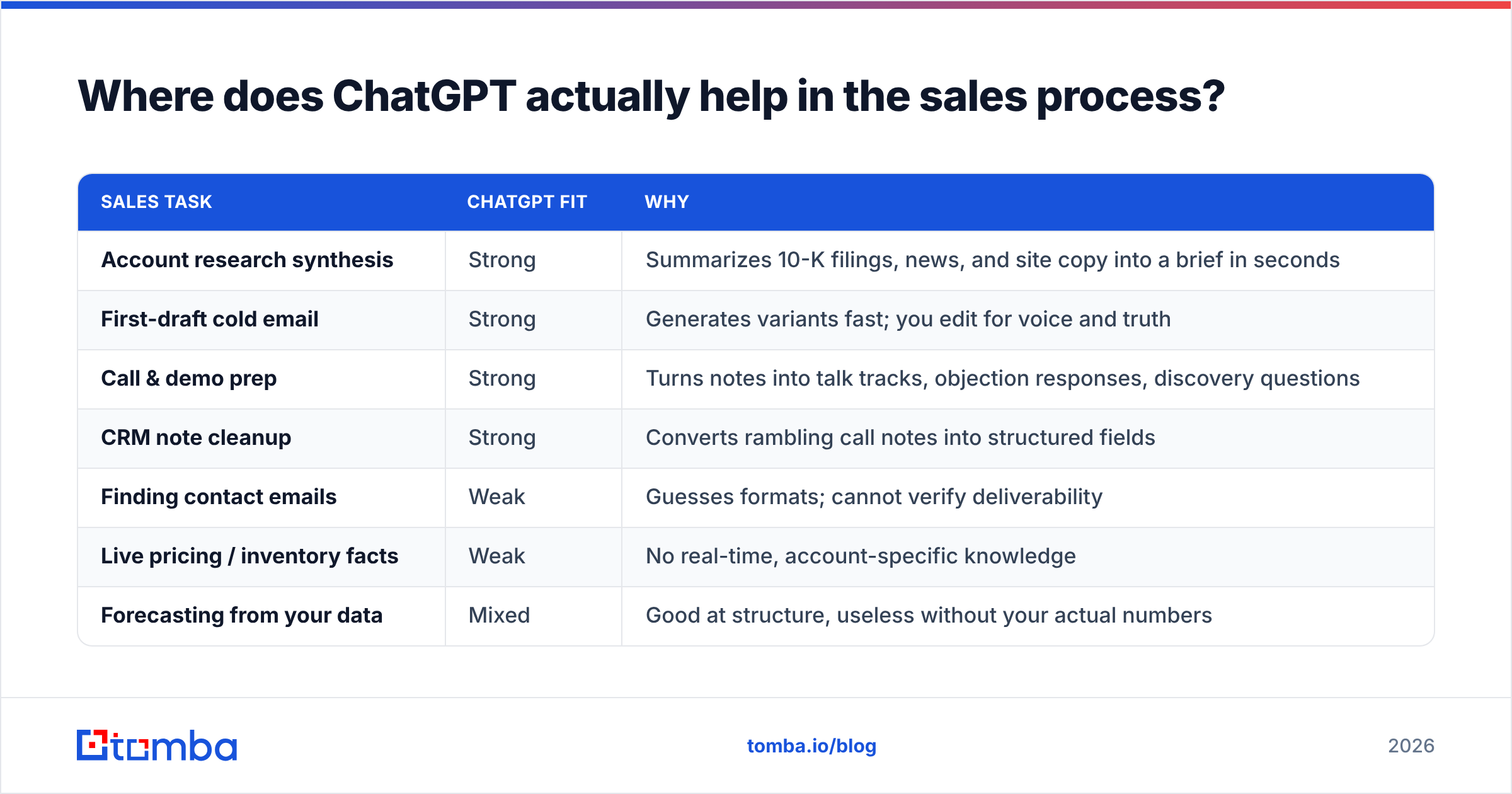
Here is the honest breakdown of where the tool earns its keep versus where it creates expensive cleanup work.
| Sales task | ChatGPT fit | Why |
|---|---|---|
| Account research synthesis | Strong | Summarizes 10-K filings, news, and site copy into a brief in seconds |
| First-draft cold email | Strong | Generates variants fast; you edit for voice and truth |
| Call & demo prep | Strong | Turns notes into talk tracks, objection responses, discovery questions |
| CRM note cleanup | Strong | Converts rambling call notes into structured fields |
| Finding contact emails | Weak | Guesses formats; cannot verify deliverability |
| Live pricing / inventory facts | Weak | No real-time, account-specific knowledge |
| Forecasting from your data | Mixed | Good at structure, useless without your actual numbers |
The pattern is clear: ChatGPT shines when the facts come from you and the writing comes from it. Reverse that and you get hallucinations.
How do you write better sales prompts?#
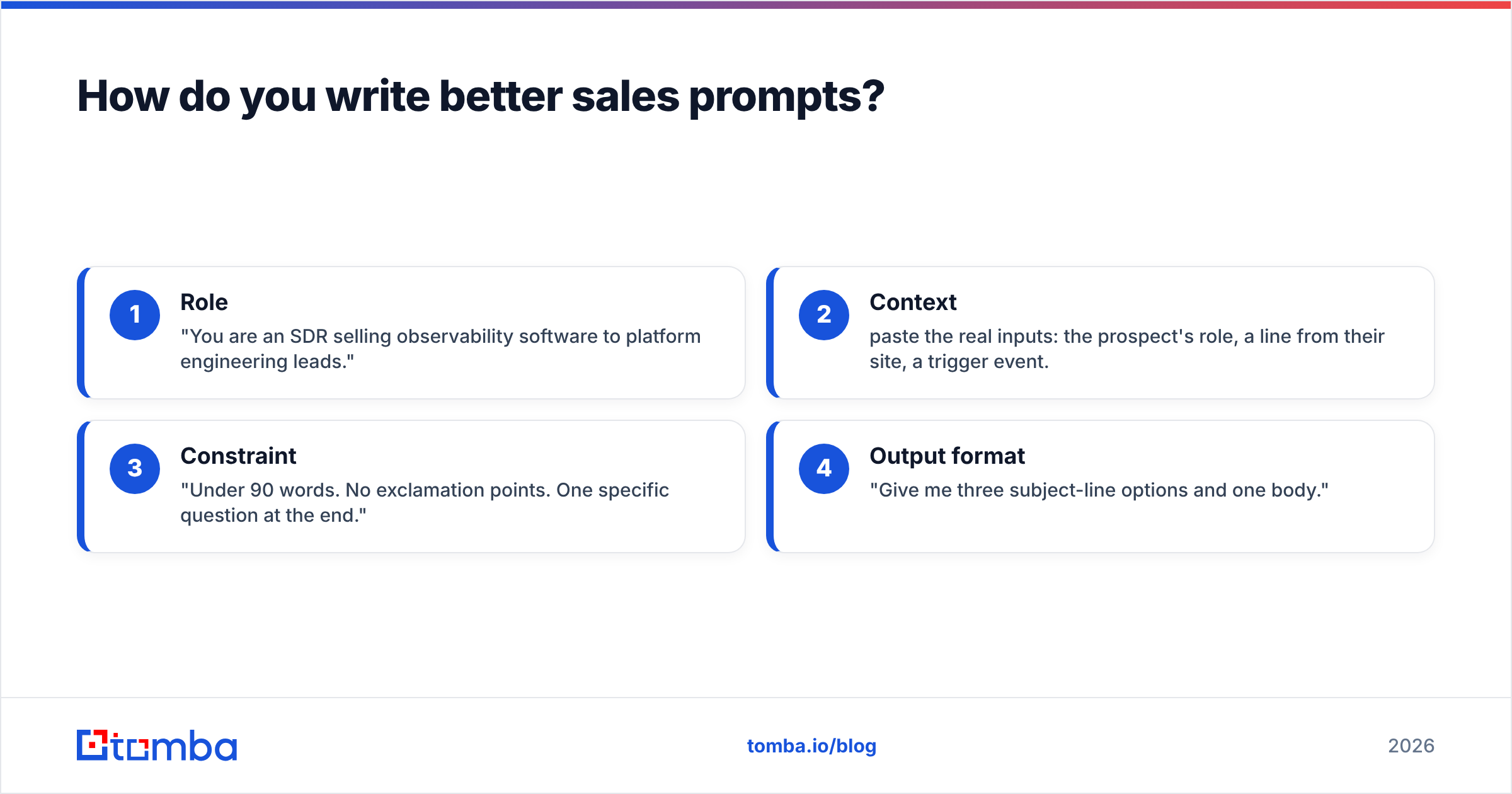
The difference between a useless reply and a usable one is almost always the prompt. A good sales prompt has four parts:
- Role — "You are an SDR selling observability software to platform engineering leads."
- Context — paste the real inputs: the prospect's role, a line from their site, a trigger event.
- Constraint — "Under 90 words. No exclamation points. One specific question at the end."
- Output format — "Give me three subject-line options and one body."
Compare a lazy prompt ("write a cold email to a CTO") with a loaded one that includes the company's recent migration to Kubernetes, the rep's product angle, and a word limit. The second produces something you can almost send; the first produces filler you've read a hundred times.
For repeatable plays, save your best prompts as templates. Better yet, build a Custom GPT with your ICP, tone rules, and product facts baked in so every rep starts from the same foundation. If you want a head start on messaging, our cold email templates and subject line generator pair well with AI drafting.
Can ChatGPT find and verify prospect emails?#
No—and this is the single most important limitation to internalize. When you ask ChatGPT for someone's email, it pattern-matches common formats (first.last@, firstinitiallast@) and hands you a guess dressed up as an answer. Some of those guesses bounce. Bounces hurt your sender reputation, and a damaged domain quietly tanks deliverability for your whole team.
This is exactly where a purpose-built tool belongs in the stack. Use ChatGPT to decide who to contact and what to say; use a dedicated finder to get the actual, verified address.

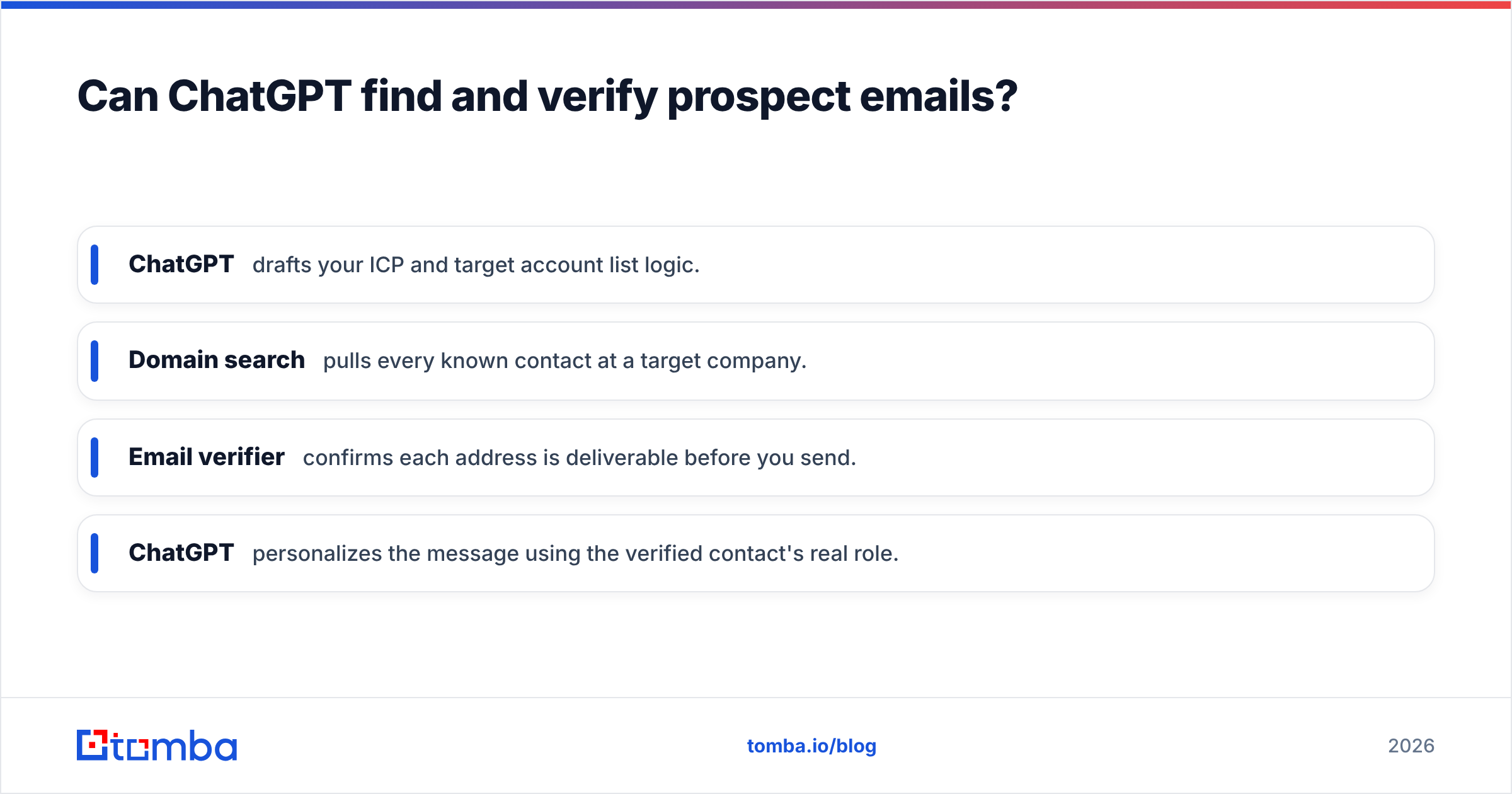
A clean handoff looks like this:
- ChatGPT drafts your ICP and target account list logic.
- Domain search pulls every known contact at a target company.
- Email verifier confirms each address is deliverable before you send.
- ChatGPT personalizes the message using the verified contact's real role.
That sequence keeps the creative work with the AI and the factual work with systems built to be right.
What does a full ChatGPT sales workflow look like?#
Here's an end-to-end play a rep can run in under 20 minutes.
Step 1 — Build the target brief. Paste a prospect's homepage, recent press, and LinkedIn "about" into ChatGPT. Ask for a one-page brief: their likely priorities, probable tech stack, and three pain points your product addresses.
Step 2 — Get verified contacts. Run the company through Tomba's domain search to find decision-makers, then verify the emails so nothing bounces. The AI told you who matters; the data tells you how to reach them.
Step 3 — Draft outreach. Feed the verified contact's real title and the brief back into ChatGPT. Ask for a three-touch sequence: an intro email, a value-add follow-up, and a breakup note. Specify word count and tone.
Step 4 — Personalize at the edges. Replace any AI-generated "fact" with something you actually verified. Generic personalization is worse than none—prospects smell it instantly.
Step 5 — Prep for the reply. Ask ChatGPT to predict the top five objections for this persona and draft crisp responses. Now you're ready before they hit send.
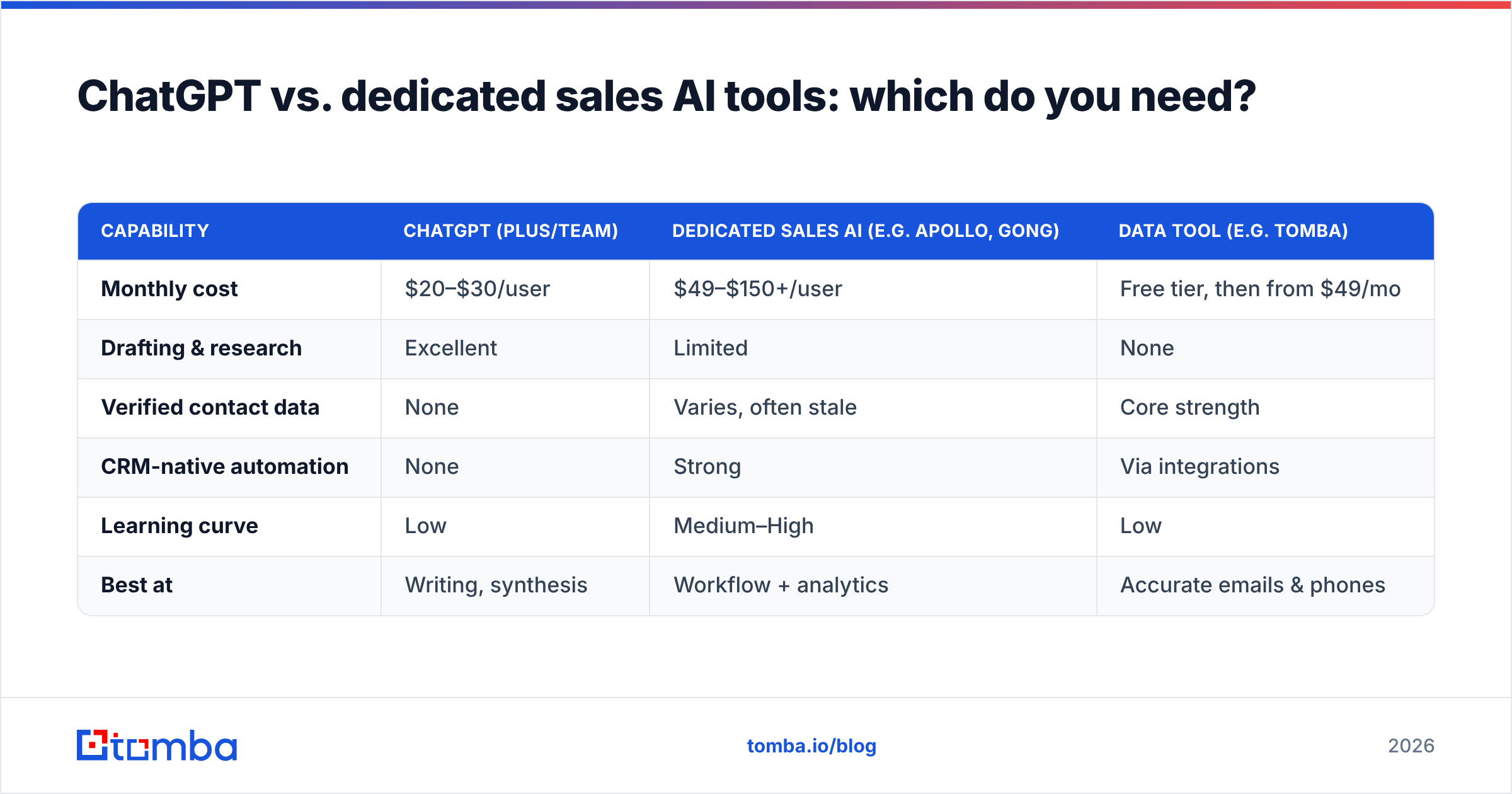
ChatGPT vs. dedicated sales AI tools: which do you need?#
ChatGPT is horizontal; sales platforms are vertical. The right answer for most teams is "both," but it helps to see the trade-offs.
| Capability | ChatGPT (Plus/Team) | Dedicated sales AI (e.g. Apollo, Gong) | Data tool (e.g. Tomba) |
|---|---|---|---|
| Monthly cost | $20–$30/user | $49–$150+/user | Free tier, then from $49/mo |
| Drafting & research | Excellent | Limited | None |
| Verified contact data | None | Varies, often stale | Core strength |
| CRM-native automation | None | Strong | Via integrations |
| Learning curve | Low | Medium–High | Low |
| Best at | Writing, synthesis | Workflow + analytics | Accurate emails & phones |
A small team can get remarkably far with ChatGPT for the words plus a focused data tool for the contacts, skipping a heavy all-in-one until volume justifies it. Larger orgs layer a conversation-intelligence platform like Gong on top for coaching and forecasting. The point: don't buy a $150/seat platform to do what a $20 subscription and a verified email list already cover.
How do you keep ChatGPT from hallucinating in sales?#
Hallucination is the deal-killer. A made-up statistic in a proposal or a fabricated "customer like you" reference destroys trust the moment a prospect checks. Guardrails that work:
- Never let it assert facts you can't verify. If it cites a number, find the source or cut it.
- Feed it your facts. Paste real case studies, real pricing, real product specs. It will use what you give it instead of inventing.
- Separate creative from factual. Use AI for phrasing; use your CRM and a data tool for names, titles, and numbers.
- Add a verification step. Every email address gets checked. Every claim gets a source. Build it into the workflow, not the rep's memory.
Treat ChatGPT output the way a good editor treats a junior writer's draft: useful raw material that nobody ships unread.
What about the API and custom GPTs for sales teams?#
Once a workflow proves itself, scale it. The two paths:
- Custom GPTs let you bake in your ICP, tone, objection library, and product facts so every rep gets consistent output without re-prompting. Great for non-technical teams.
- The OpenAI API lets you wire ChatGPT into your own tooling—auto-summarizing call transcripts, drafting follow-ups from CRM triggers, or scoring inbound replies. This is where a Tomba API call to verify and enrich contacts slots in naturally, so the AI always works from clean data.
Teams that win with AI in 2026 aren't the ones with the cleverest prompts. They're the ones who turned a few good prompts into systems—and wired real data underneath so the output is trustworthy at scale. According to buyer-review sites like G2, the tools with the highest satisfaction are consistently the ones that integrate cleanly rather than the flashiest standalone bots.
Frequently asked questions#
Is ChatGPT good for cold email? For drafting, yes—it produces solid first drafts fast. For sending, only after you verify the address and replace generic claims with real personalization. The model writes; you fact-check.
Can ChatGPT replace my SDR? No. It accelerates research and writing, but it can't run discovery, build trust, or verify a contact is real. It makes a good rep faster, not unnecessary.
Does ChatGPT know my prospect's email? No. It guesses formats. Use a dedicated email finder for verified addresses.
Which plan should a sales team use? ChatGPT Team gives you shared Custom GPTs and a workspace, which is worth it once more than a couple of reps rely on the same plays.
The bottom line#
ChatGPT is the best writing and research assistant your sales team has ever had, and it is a terrible source of facts. Keep those two truths separate and it becomes a genuine force multiplier: faster briefs, sharper outreach, better call prep, cleaner notes.
The missing half is data. AI personalization is only as good as the contact behind it, and a confident message to a bounced address costs you more than no message at all. Pair your prompts with the Tomba Email Finder to get verified, deliverable emails for every account your AI helps you target—start on the free tier and scale into the paid plans when the pipeline justifies it. Let ChatGPT write the words. Let Tomba make sure they actually land.
// get started
Find, verify and enrich your first contacts today
Start on the free plan with 25 searches a month, then scale when your team is ready.
Free plan · No credit card required · GDPR & CCPA
// about the author