12 Best Chatfuel Alternatives for 2026 (Compared & Ranked)
Chatfuel is solid for Messenger bots, but pricing, channel limits, and lead-data gaps push many teams to look elsewhere. Here are the best Chatfuel alternatives for 2026, compared on price, channels, and ROI.
Chatfuel built its name on Facebook Messenger bots, and for a while that was enough. In 2026 it is not. Buyers expect WhatsApp, Instagram, web chat, and AI agents that actually resolve tickets — and they expect to pay a fair price for it. If you have hit Chatfuel's channel limits, its per-conversation pricing, or its thin lead-data story, you are in the right place.
This guide ranks the strongest chatfuel alternatives for 2026, compares them on the things that move revenue, and shows where a chatbot ends and your lead-data stack begins.
TL;DR — The Quick Verdict#
- Best all-round Chatfuel alternative: ManyChat for SMB social commerce, Tidio for web + AI support, and Intercom for product-led SaaS.
- Cheapest credible swap: Tidio and Botpress both have usable free tiers; Chatfuel's own pricing climbs fast once conversations scale.
- Best for WhatsApp-first teams: Wati and Respond.io beat Chatfuel on native WhatsApp Business API depth.
- The gap no chatbot fills: bots capture intent, but they don't tell you who the visitor is or how to reach them by email. Pair any platform with an email finder and data enrichment to turn chats into pipeline.
- Skip the rip-and-replace if you only need more channels — most teams switch for pricing predictability and AI quality, not features.
Why Look for a Chatfuel Alternative in 2026?#
Chatfuel is still a competent Messenger and Instagram automation tool, and its official site leans hard into Meta-native commerce. But three recurring complaints push teams to shop around.
1. Channel lock-in. Chatfuel is strongest inside the Meta ecosystem. If your buyers live on your website, in WhatsApp, or in Slack, you end up bolting on extra tools.
2. Pricing that scales with conversations, not value. Per-conversation and per-contact billing is fine until a campaign goes well — then your "cheap" bot becomes a line item you have to defend.
3. AI that lags the leaders. The 2025–2026 wave of LLM-powered agents raised the bar. Generic keyword flows feel dated next to tools that resolve open-ended questions.
There is also a quieter problem: a chatbot captures a conversation, not a contact record. You learn what someone wants, but not their work email, company size, or role — the fields your CRM and sales team actually need. That gap is why the smartest stacks pair a bot with enrichment, and we'll come back to it.
What Should a Chatfuel Alternative Actually Do?#
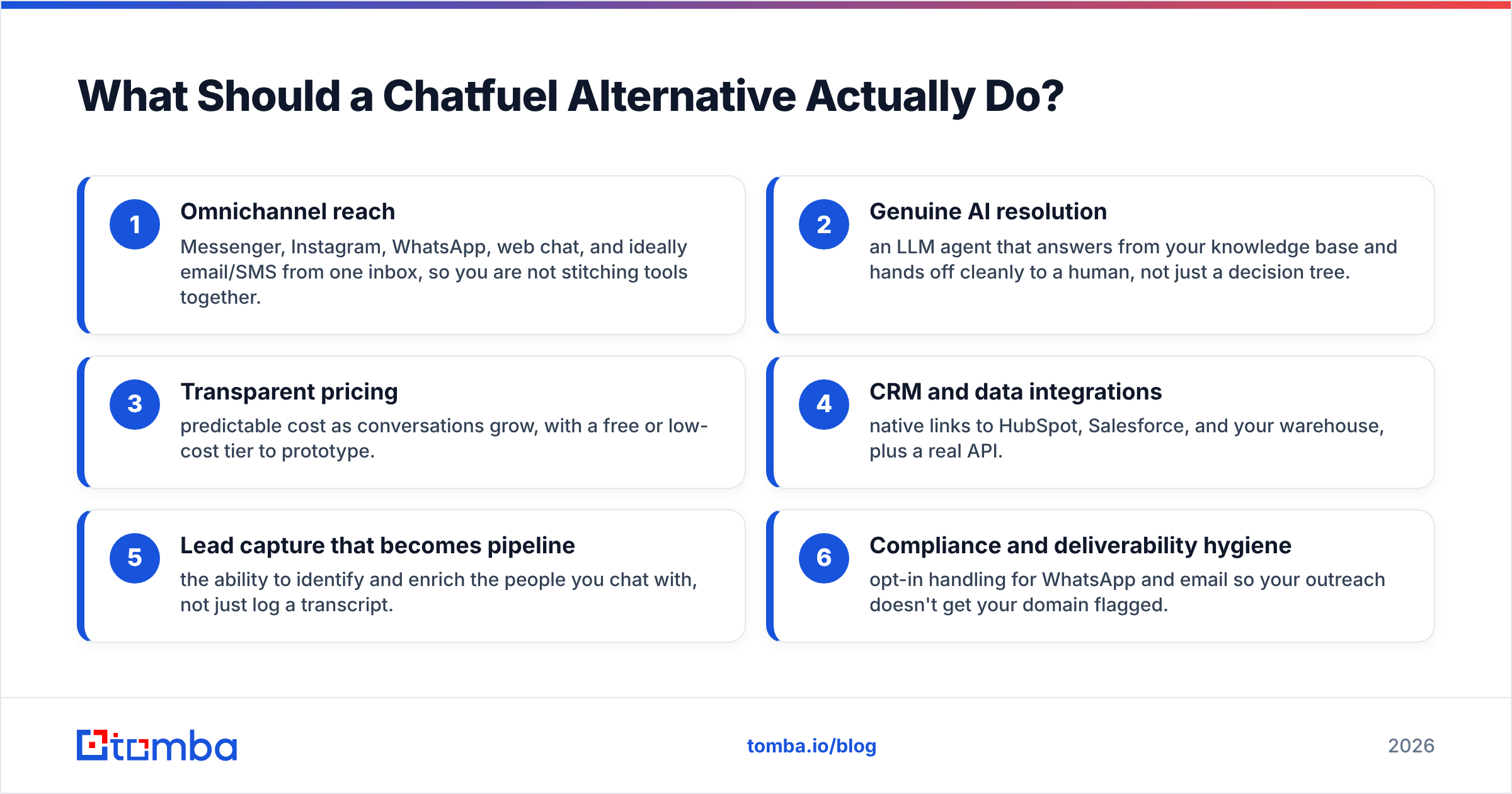
Before comparing logos, get clear on the jobs a modern conversational platform has to cover. Use this as your shortlist filter:
- Omnichannel reach — Messenger, Instagram, WhatsApp, web chat, and ideally email/SMS from one inbox, so you are not stitching tools together.
- Genuine AI resolution — an LLM agent that answers from your knowledge base and hands off cleanly to a human, not just a decision tree.
- Transparent pricing — predictable cost as conversations grow, with a free or low-cost tier to prototype.
- CRM and data integrations — native links to HubSpot, Salesforce, and your warehouse, plus a real API.
- Lead capture that becomes pipeline — the ability to identify and enrich the people you chat with, not just log a transcript.
- Compliance and deliverability hygiene — opt-in handling for WhatsApp and email so your outreach doesn't get your domain flagged.
A tool that nails the first three but ignores the last two will still leave your sales team guessing. Keep that in mind as you read the rankings.
Which Are the Best Chatfuel Alternatives?#
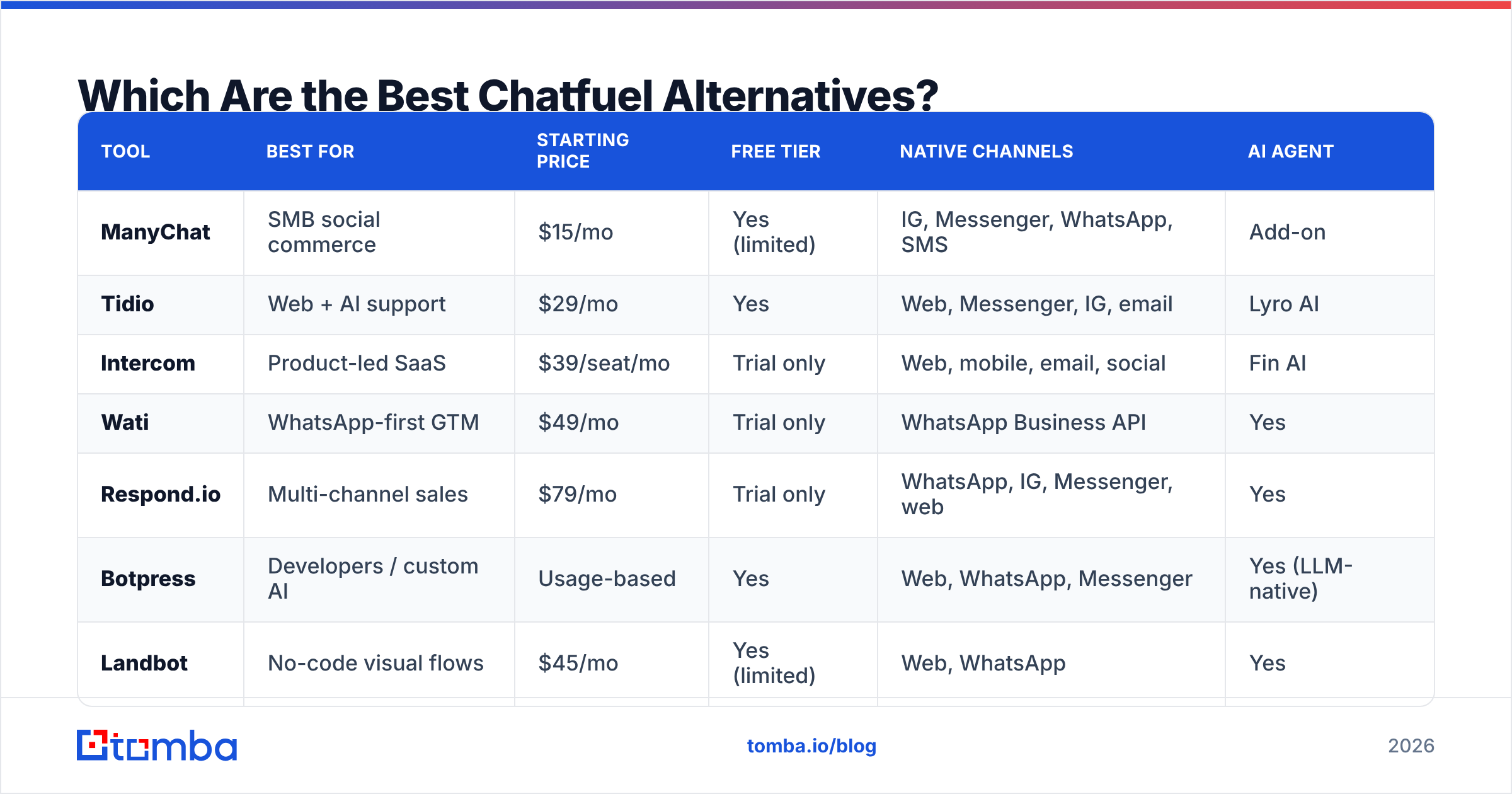
Here is the head-to-head. Prices are entry paid tiers as published in mid-2026; always confirm on the vendor's own page, since conversational pricing changes often.
| Tool | Best for | Starting price | Free tier | Native channels | AI agent |
|---|---|---|---|---|---|
| ManyChat | SMB social commerce | $15/mo | Yes (limited) | IG, Messenger, WhatsApp, SMS | Add-on |
| Tidio | Web + AI support | $29/mo | Yes | Web, Messenger, IG, email | Lyro AI |
| Intercom | Product-led SaaS | $39/seat/mo | Trial only | Web, mobile, email, social | Fin AI |
| Wati | WhatsApp-first GTM | $49/mo | Trial only | WhatsApp Business API | Yes |
| Respond.io | Multi-channel sales | $79/mo | Trial only | WhatsApp, IG, Messenger, web | Yes |
| Botpress | Developers / custom AI | Usage-based | Yes | Web, WhatsApp, Messenger | Yes (LLM-native) |
| Landbot | No-code visual flows | $45/mo | Yes (limited) | Web, WhatsApp | Yes |
| Chatfuel (baseline) | Meta-native bots | $23.99/mo | Trial only | Messenger, IG, WhatsApp | Limited |
A few takeaways from the table:
- ManyChat is the closest like-for-like swap if you want Meta + WhatsApp without leaving the social-commerce comfort zone. Its G2 reviews skew positive for ease of use.
- Tidio wins on website chat and has the friendliest free tier for testing AI on real traffic.
- Intercom is the premium pick — overkill for a Messenger bot, ideal if support and product onboarding are the real job.
- Botpress is for teams that want to build a custom LLM agent and own the logic.
Is ManyChat or Tidio the Better Swap?#
For most teams leaving Chatfuel, the decision narrows to ManyChat or Tidio, so it is worth a direct comparison.
Choose ManyChat if your growth engine is Instagram and Messenger — comment automation, story replies, and WhatsApp broadcasts. It keeps the Chatfuel "marketing bot" mental model but with a lower entry price ($15/mo) and a more active template ecosystem. If your audience already lives in Meta apps, the migration is nearly painless.
Choose Tidio if your website is the primary touchpoint. Tidio's Lyro AI handles open-ended support questions, and the free tier lets you prove value before paying. It also folds in email and live chat, so a single inbox covers more of the funnel.
The honest answer: neither is "better" in the abstract. ManyChat is a social-commerce tool; Tidio is a website-support tool. Pick based on where your buyers actually message you. If you are not sure, run both free tiers for two weeks and measure resolved conversations per channel.
What About WhatsApp-First and Enterprise Needs?#
If WhatsApp is your main channel — common in LATAM, India, the Middle East, and parts of Europe — Chatfuel's WhatsApp support feels like an add-on rather than the main event. Two alternatives are built for it:
- Wati is purpose-built on the WhatsApp Business API, with broadcast campaigns, team inboxes, and CRM sync. Better template management and approval workflows than Chatfuel.
- Respond.io treats WhatsApp as one of many sales channels and adds routing, lifecycle stages, and reporting that look more like a sales tool than a marketing bot.
On the enterprise end, Intercom (with Fin AI) and HubSpot's own conversational tools win when chat has to live inside a broader CRM and service suite. HubSpot's free CRM and chat is a credible starting point if you are consolidating tools rather than adding one. The trade-off is cost and complexity — these are platforms, not point solutions.

What Do Chatbots Miss — and How Do You Fix It?#
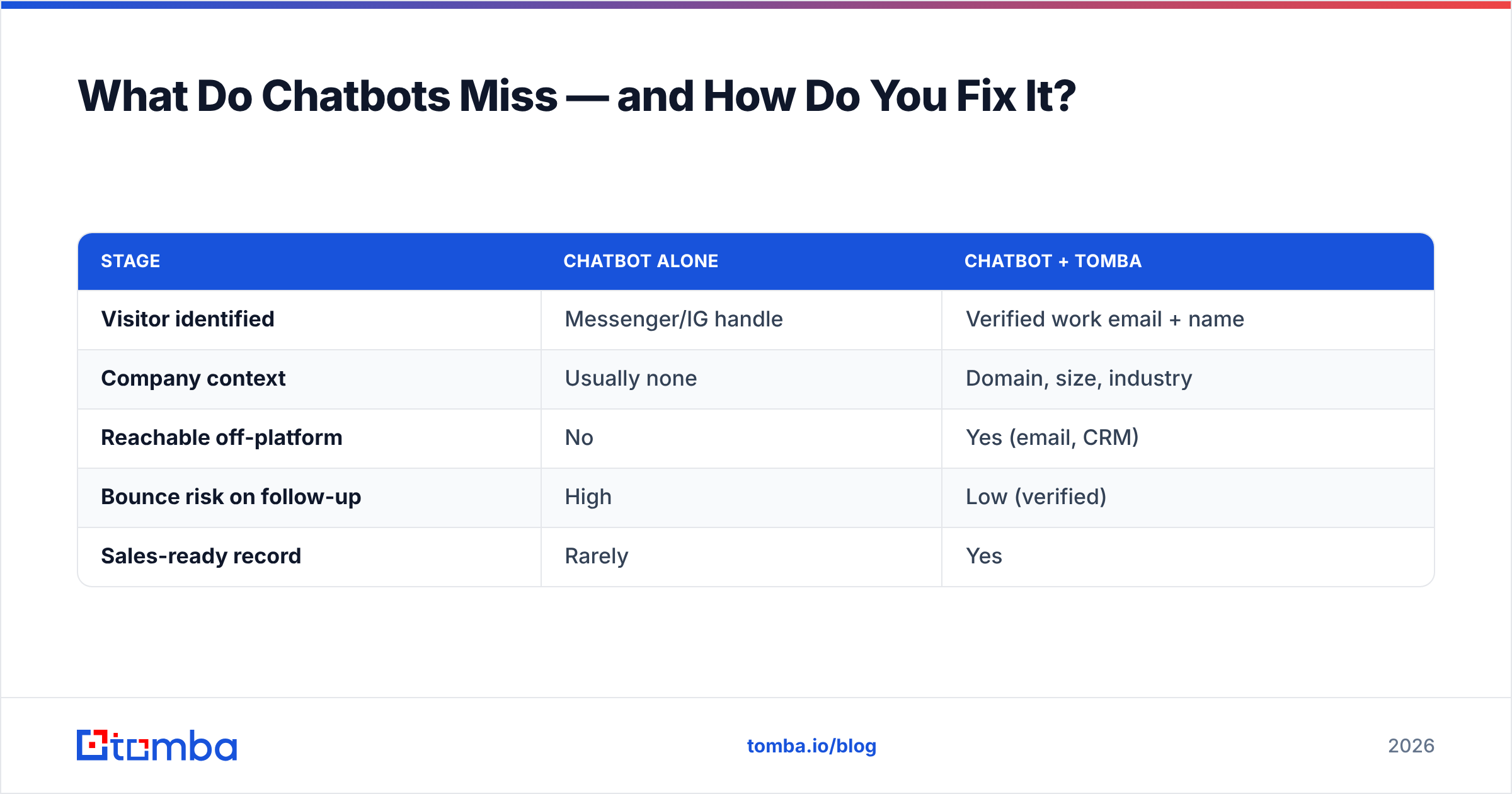
Here is the part most "best Chatfuel alternatives" lists skip: a chatbot is a capture layer, not a data layer. No matter which platform you pick, you end up with conversations and maybe a first name and a Messenger ID. That is not a sellable lead.
To turn a chat into pipeline, you need three things the bot won't give you:
- A real, verified work email — so you can follow up outside the chat window and add the person to nurture.
- Firmographic context — company, size, role, and industry, so sales knows whether the lead is worth a call.
- Clean data hygiene — verified addresses that won't bounce and hurt your sender reputation.
That is where Tomba fits alongside — not instead of — your chatbot. The workflow looks like this:
- The bot captures intent and, where possible, a name and company or domain.
- You pass the domain to domain search or a name to the email finder to recover the verified work email.
- You enrich the lead with role, company size, and other fields.
- You push the complete record into your CRM via native integrations or the Tomba API.
Compare that to the typical "bot only" outcome:
| Stage | Chatbot alone | Chatbot + Tomba |
|---|---|---|
| Visitor identified | Messenger/IG handle | Verified work email + name |
| Company context | Usually none | Domain, size, industry |
| Reachable off-platform | No | Yes (email, CRM) |
| Bounce risk on follow-up | High | Low (verified) |
| Sales-ready record | Rarely | Yes |
The bot tells you someone is interested. The data stack tells you who they are and how to close them. Both Chatfuel and every alternative on this list share the same blind spot, which is why your tool choice and your data choice are separate decisions.
How Much Should You Expect to Pay?#
Budget for two line items, not one: the conversational platform and the data layer.
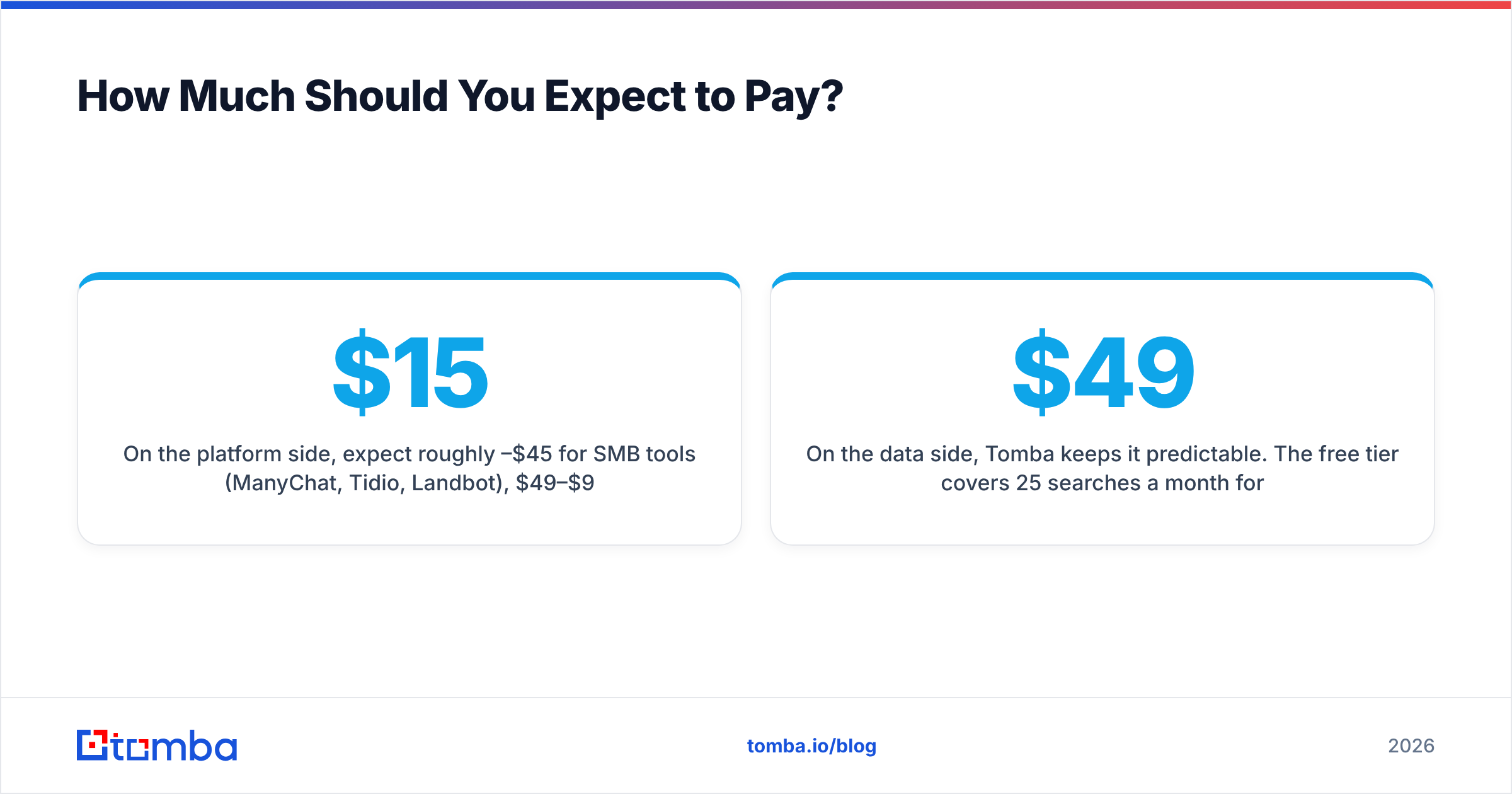
On the platform side, expect roughly $15–$45/mo for SMB tools (ManyChat, Tidio, Landbot), $49–$99/mo for WhatsApp-first and multichannel sales tools (Wati, Respond.io), and seat- or resolution-based pricing for enterprise suites (Intercom, HubSpot) that can run into the hundreds or thousands monthly.
On the data side, Tomba keeps it predictable. The free tier covers 25 searches a month for testing, Starter is $49/mo, Growth is $99/mo, and Pro is $249/mo, with Enterprise custom. Full numbers are on the Tomba pricing page. The point is that enriching the leads your bot captures should cost a fraction of the bot itself — and it is the part that turns conversations into revenue.
A sensible 2026 stack for a growing SMB: Tidio or ManyChat for the bot, Tomba Starter or Growth for the email finding and verification, and HubSpot's free CRM to hold it all. That trio covers capture, identity, and pipeline for well under the cost of a single enterprise seat.
How Do You Migrate Off Chatfuel Without Breaking Flows?#
Switching tools is where good intentions die. Keep the cutover surgical:
- Audit your live flows first. Export every active automation and tag the ones that actually drive revenue. Most accounts have a handful that matter and dozens that don't.
- Rebuild the top flows in the new tool, not all of them. Migrate the 20% that drive 80% of results; archive the rest.
- Run both in parallel for two weeks. Keep Chatfuel live while the replacement proves it handles real traffic.
- Wire up data capture from day one. Connect your email finder and enrichment before you scale, so you are not retrofitting lead quality later.
- Verify deliverability. If the bot now triggers email follow-ups, verify addresses and check your sender setup so the new volume doesn't trip spam filters.
Migration is mostly discipline. The teams that struggle are the ones that try to recreate every legacy flow on day one instead of rebuilding only what earns its keep.
Which Chatfuel Alternative Is Right for You?#
To close the loop on a single recommendation:
- You sell on Instagram and Messenger: ManyChat. Same playbook as Chatfuel, lower entry price, bigger ecosystem.
- Your website is the main channel: Tidio. Best free tier and strong AI support out of the box.
- WhatsApp is your business: Wati or Respond.io.
- You are a product-led SaaS: Intercom with Fin AI, or HubSpot if you are consolidating.
- You want to build a custom AI agent: Botpress.
But remember the larger point: the tool you pick is only half the system. Every option here captures conversations and none of them, on their own, hands sales a verified, enriched contact.
Turn Bot Conversations Into Real Pipeline#
Pick whichever Chatfuel alternative fits your channels — then make those conversations worth something. Tomba's Email Finder takes the names and domains your bot captures and returns verified, deliverable work emails, so interest turns into reachable leads instead of lost transcripts. Pair it with enrichment and your CRM, start free with 25 searches, and scale on a plan that costs a fraction of your chatbot. Your bot starts the conversation; Tomba makes sure you can finish it.
// get started
Find, verify and enrich your first contacts today
Start on the free plan with 25 searches a month, then scale when your team is ready.
Free plan · No credit card required · GDPR & CCPA
Get the Tomba newsletter
Product and data updates
// about the author