Chatfuel Pricing Reviews Pros and Cons: 2026 Guide
A neutral breakdown of Chatfuel pricing, real user reviews, and the pros and cons of running Messenger, Instagram, and WhatsApp bots in 2026 — plus where it fits a B2B stack.
TL;DR
- Chatfuel is a no-code chatbot builder focused on Meta channels — Messenger, Instagram, and WhatsApp — with AI agents layered on top in 2026.
- Pricing is conversation- and MAU-based (monthly active users / dialogs), so your bill scales with audience size, not seats. Entry plans start around $23.99–$34.99/mo and climb fast at scale.
- Pros: fast setup, strong native Instagram/WhatsApp support, solid e-commerce flows, and a genuine free trial.
- Cons: costs balloon as MAU grows, the WhatsApp tier is pricier, analytics are shallow, and it is locked to Meta channels.
- Chatfuel handles conversations, not contact data. Pair it with a dedicated email finder so the leads your bot captures become outreach-ready records.
What is Chatfuel and who is it for?#
Chatfuel is a no-code platform for building automated chat experiences on Meta-owned channels. Think of it as a drag-and-drop flowchart: you wire up triggers ("user comments on a post"), conditions, and responses, and the bot runs the conversation without a developer. In 2026 the product leans hard into AI agents — GPT-powered assistants that answer free-text questions instead of only following rigid button menus.
The typical buyer is a direct-to-consumer e-commerce brand, a social-media-heavy marketing team, or an agency managing client inboxes. If most of your audience lives in Instagram DMs and Messenger, Chatfuel is built for you. If your motion is outbound B2B email and cold calls, it solves a narrower slice of the funnel — useful, but not the whole engine.
You can confirm the current feature set on the official chatfuel.com site, since Meta channel rules and AI features change often.
How much does Chatfuel cost in 2026?#
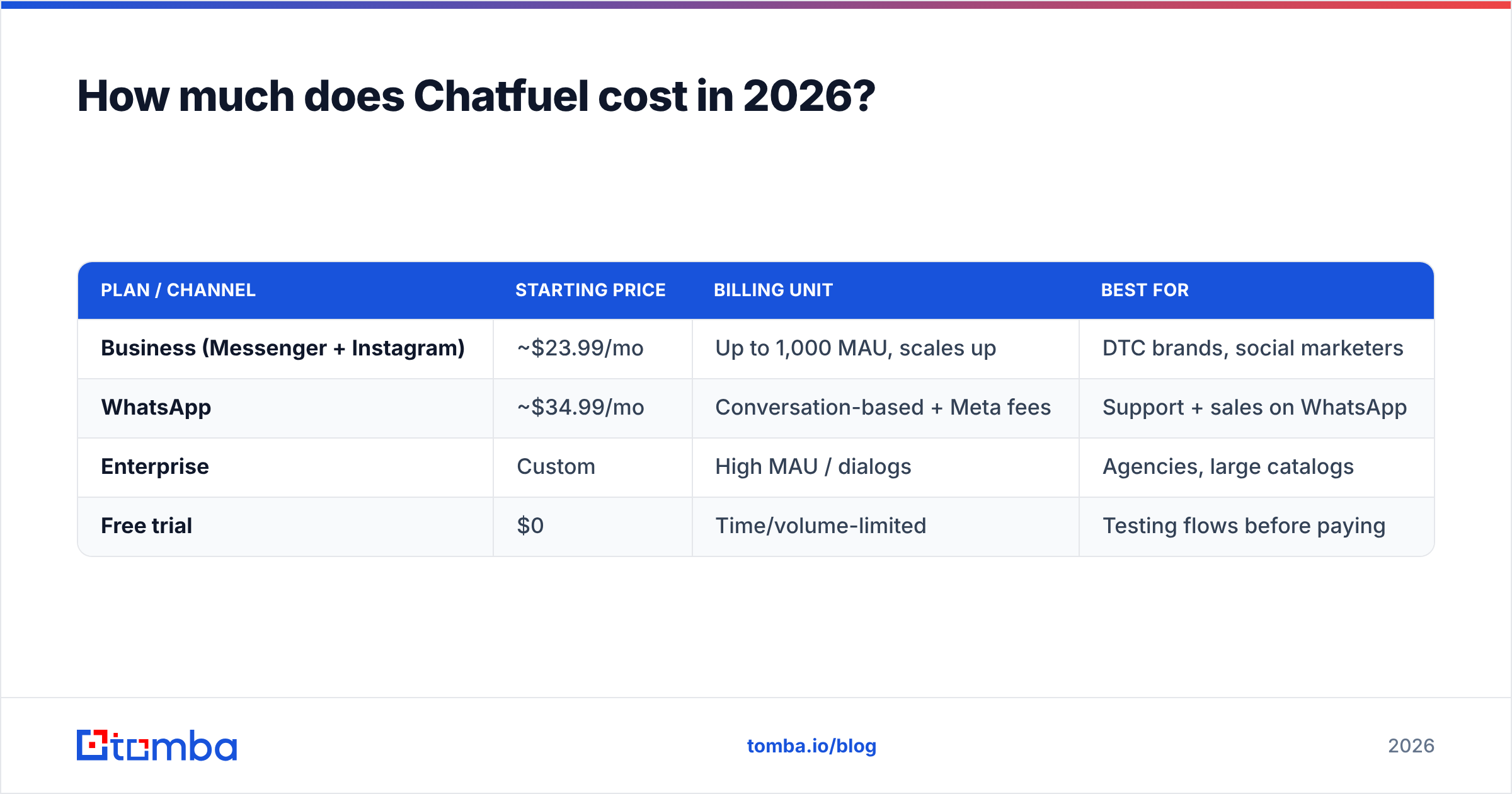
Chatfuel prices by usage, not by seat — the two levers are monthly active users (MAU) on Messenger/Instagram and conversations on WhatsApp. That model rewards small, engaged audiences and punishes large ones. Below is a representative snapshot; always check the live pricing page before you commit, because thresholds shift.
| Plan / channel | Starting price | Billing unit | Best for |
|---|---|---|---|
| Business (Messenger + Instagram) | ~$23.99/mo | Up to 1,000 MAU, scales up | DTC brands, social marketers |
| ~$34.99/mo | Conversation-based + Meta fees | Support + sales on WhatsApp | |
| Enterprise | Custom | High MAU / dialogs | Agencies, large catalogs |
| Free trial | $0 | Time/volume-limited | Testing flows before paying |
A few things that surprise new buyers:
- The headline price is a floor, not a ceiling. As MAU crosses each tier, the monthly cost steps up — a viral post can move you a bracket overnight.
- WhatsApp adds Meta's own conversation fees on top of Chatfuel's charge, so the effective cost per conversation is higher than the sticker.
- AI agent usage can consume credits or add cost depending on your plan, since each LLM reply has a real compute cost behind it.
- Annual billing typically shaves the monthly rate, the usual SaaS trade of commitment for discount.
The lesson: model your actual MAU before trusting the entry price. A 500-MAU shop and a 50,000-MAU brand are on completely different bills even though they read the same landing page.
What do Chatfuel reviews actually say?#
Aggregate sentiment on G2 and Capterra lands Chatfuel in solid-but-not-flawless territory — generally in the low-to-mid 4-star range across hundreds of reviews. Patterns repeat enough to be reliable signal:
What reviewers praise
- Speed to launch. Non-technical marketers ship a working bot in an afternoon. This is the single most common compliment.
- Native Instagram automation. Comment-to-DM flows and story-reply triggers feel first-class, not bolted on.
- E-commerce templates. Abandoned-cart nudges and product quizzes come ready to clone.
What reviewers complain about
- Pricing at scale. The most frequent gripe by far — "great until our audience grew."
- Support latency on lower tiers.
- Shallow analytics. Teams that want cohort-level attribution end up exporting data elsewhere.
- Meta lock-in. No native web-widget or SMS story, so omnichannel teams feel boxed in.
Treat star averages as a starting point, not a verdict. A 4.3 from an agency running 40 client bots means something different than a 4.3 from a solo founder. Read reviews from companies that look like yours.
What are the pros and cons of Chatfuel?#
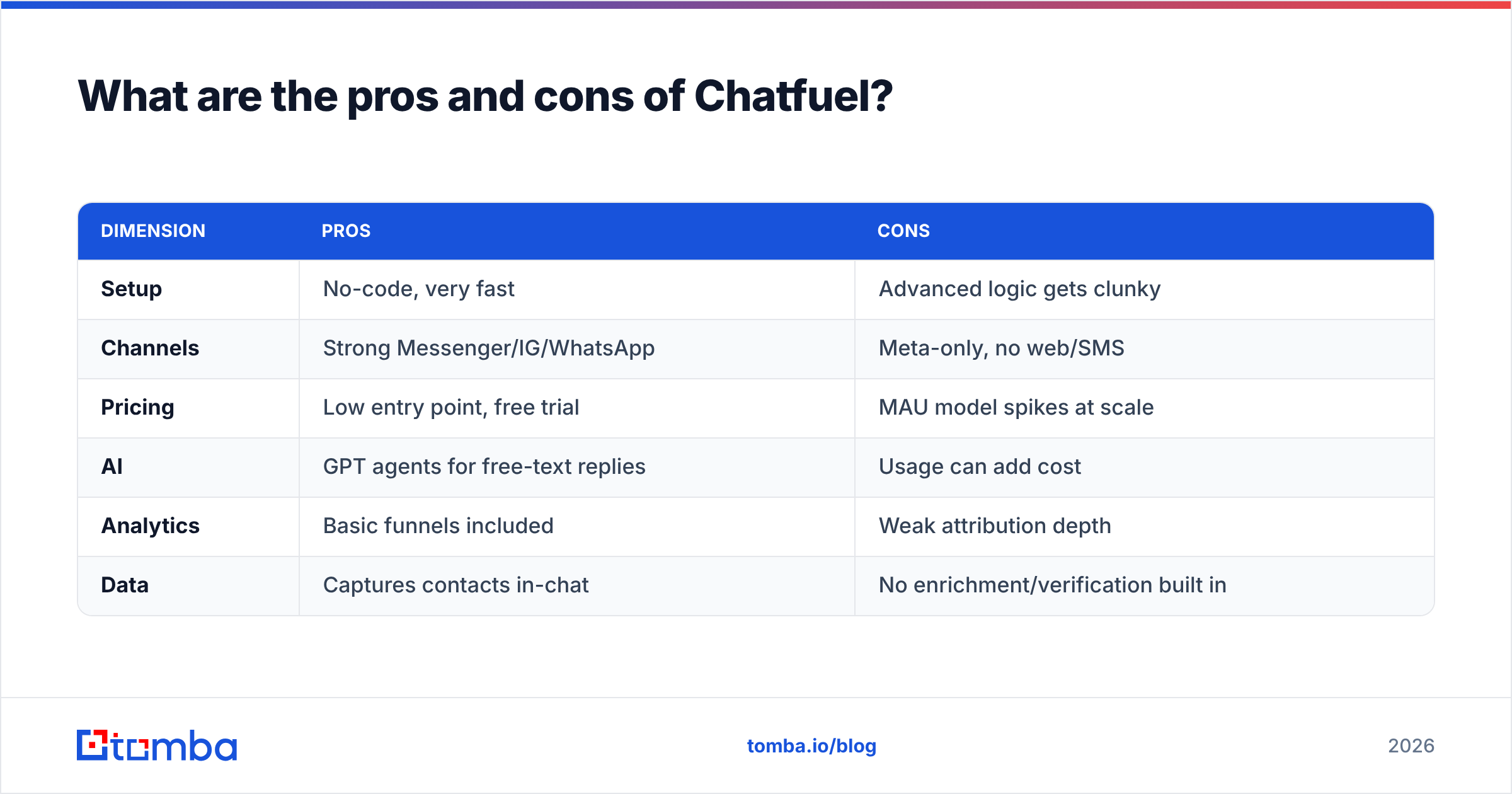
Here is the balanced ledger — the core of any honest Chatfuel pricing reviews pros and cons comparison.
| Dimension | Pros | Cons |
|---|---|---|
| Setup | No-code, very fast | Advanced logic gets clunky |
| Channels | Strong Messenger/IG/WhatsApp | Meta-only, no web/SMS |
| Pricing | Low entry point, free trial | MAU model spikes at scale |
| AI | GPT agents for free-text replies | Usage can add cost |
| Analytics | Basic funnels included | Weak attribution depth |
| Data | Captures contacts in-chat | No enrichment/verification built in |
When Chatfuel is the right call: you run a social-first DTC or content brand, your buyers DM you, and you want conversational automation live this week without hiring a developer.
When to look elsewhere: you need omnichannel reach beyond Meta, deep analytics, or — critically — a clean path from "captured a lead in chat" to "verified, enriched record ready for outreach." Chatfuel ends its job at the conversation; your CRM and data tooling pick up from there.

How does Chatfuel fit a B2B data and outreach stack?#
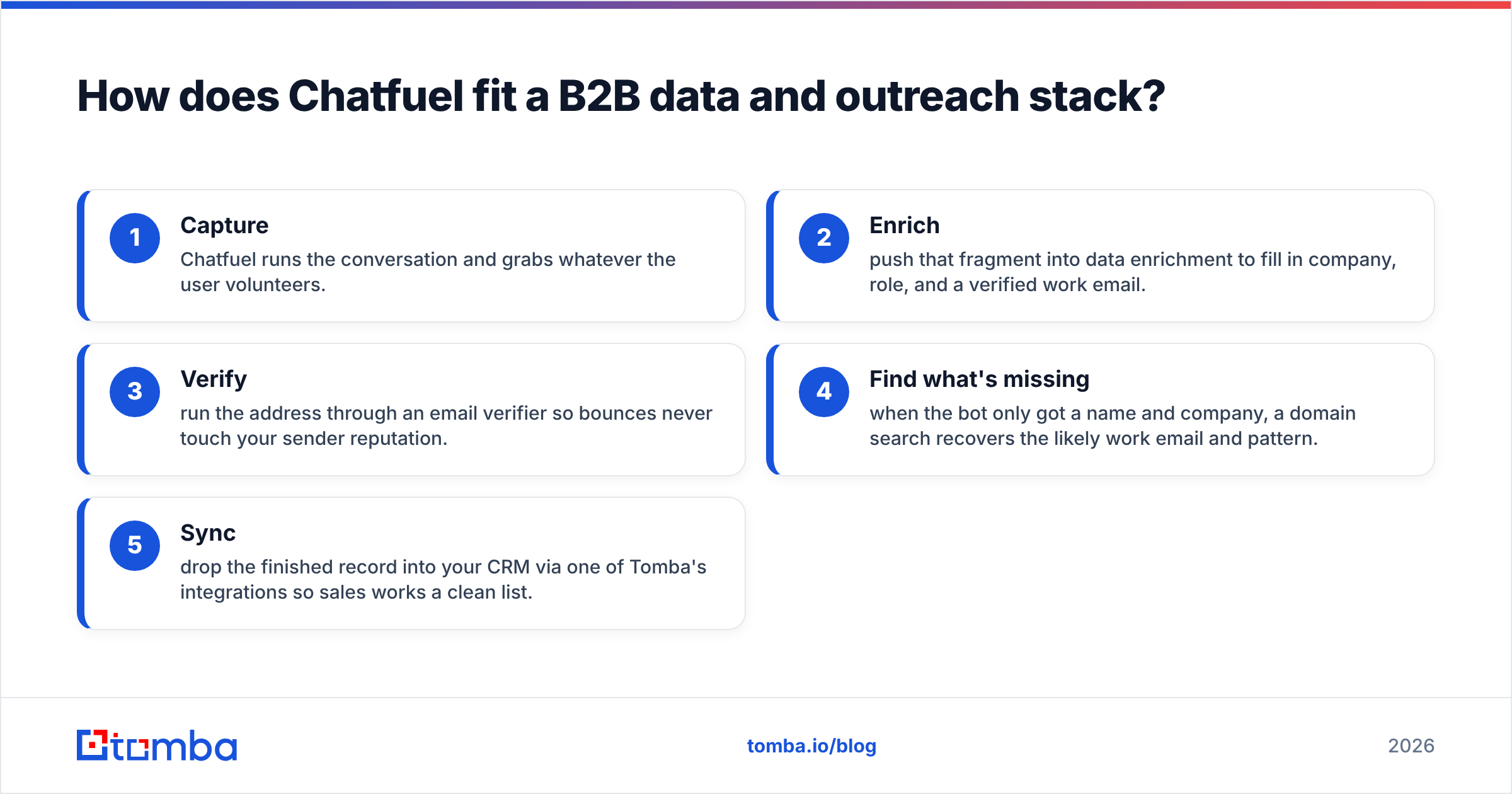
Chatfuel is a front door, not a filing cabinet. It captures intent — a name, sometimes an email, a question — inside a Meta channel. The value leaks if that intent never becomes a structured, contactable record. This is where a chatbot platform and a data platform do different jobs, and you want both.
A realistic 2026 flow looks like this:
- Capture — Chatfuel runs the conversation and grabs whatever the user volunteers.
- Enrich — push that fragment into data enrichment to fill in company, role, and a verified work email.
- Verify — run the address through an email verifier so bounces never touch your sender reputation.
- Find what's missing — when the bot only got a name and company, a domain search recovers the likely work email and pattern.
- Sync — drop the finished record into your CRM via one of Tomba's integrations so sales works a clean list.
Notice the division of labor: Chatfuel owns the conversation, the data layer owns the contact. Trying to force a chatbot to be your contact database is like asking a receptionist to also be your accountant — possible in a pinch, wrong long-term.
Chatfuel vs a contact-data approach: which problem are you solving?#
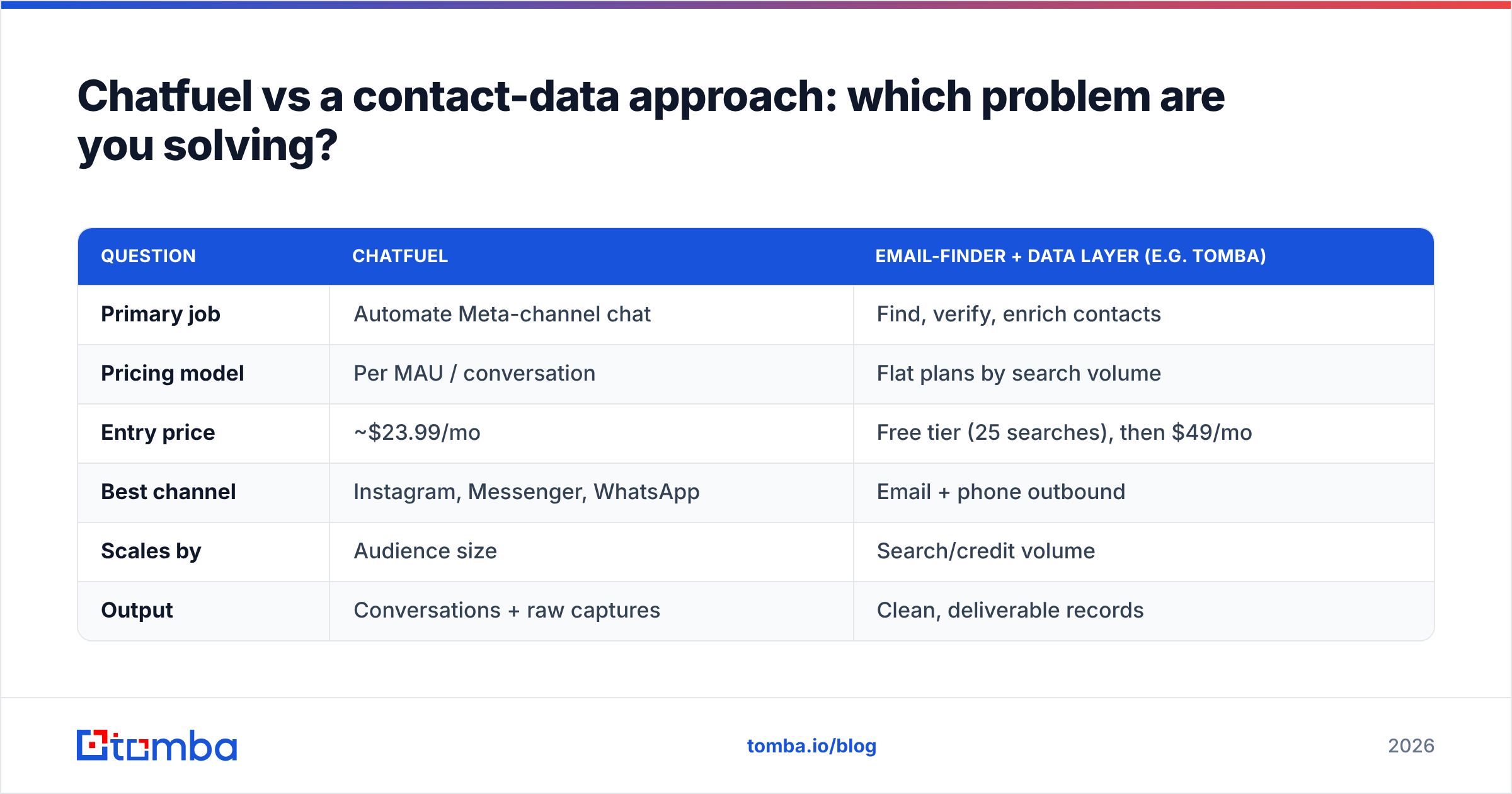
This is not strictly apples-to-apples — Chatfuel and an email-finding platform target different stages — but buyers often weigh them together when budgeting a lead-gen stack. The honest framing is "and," not "or."
| Question | Chatfuel | Email-finder + data layer (e.g. Tomba) |
|---|---|---|
| Primary job | Automate Meta-channel chat | Find, verify, enrich contacts |
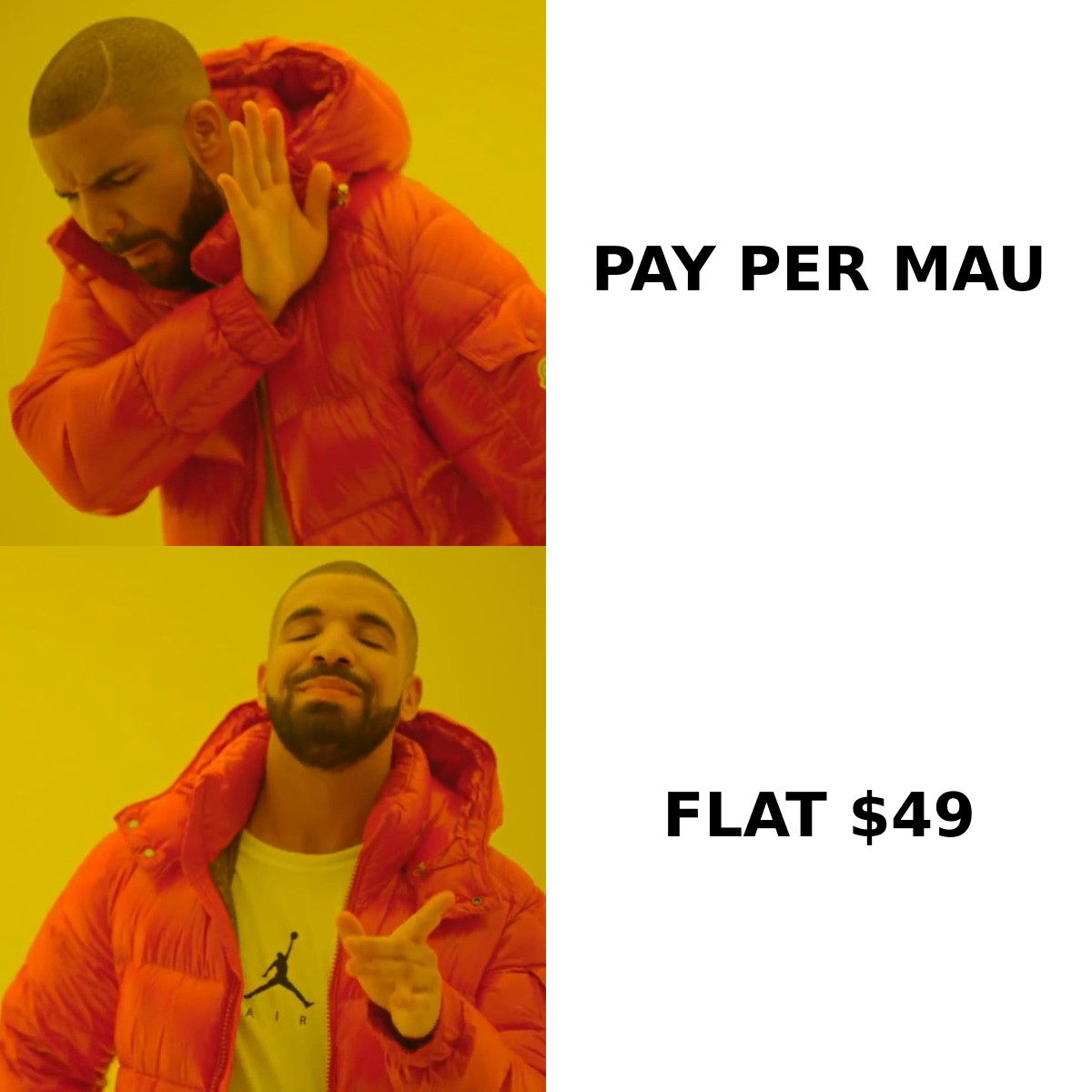
| Pricing model | Per MAU / conversation | Flat plans by search volume |
| Entry price | ~$23.99/mo | Free tier (25 searches), then $49/mo |
| Best channel | Instagram, Messenger, WhatsApp | Email + phone outbound |
| Scales by | Audience size | Search/credit volume |
| Output | Conversations + raw captures | Clean, deliverable records |
If your growth is inbound and social, Chatfuel does the heavy lifting. If your growth is outbound B2B — building target lists, reaching decision-makers by email — the data layer is the engine and Chatfuel is, at most, a supporting capture channel. Most scaling teams run both and connect them. For exact tier costs on the data side, the published Tomba pricing is straightforward: a free tier of 25 searches, Starter at $49/mo, Growth at $99/mo, and Pro at $249/mo, with flat — not MAU-driven — billing.
Is Chatfuel worth it in 2026?#
Short answer: yes, if you live on Meta channels and watch your MAU. Chatfuel remains one of the fastest ways to stand up Instagram and Messenger automation without code, and its AI agents make the 2026 version meaningfully smarter than the button-menu bots of a few years ago. The free trial means you can validate fit before paying.
The asterisks are real, though:
- Budget for growth. Re-price yourself at 5x and 20x your current MAU. If the number scares you, plan migration triggers now.
- Don't expect analytics depth. Pipe events into a real BI tool early.
- Plan the handoff. Decide today how chat-captured leads become verified CRM records — before you have 10,000 of them stuck in a Meta inbox.
Chatfuel earns its place as a conversation layer. It was never designed to be your source of truth for contact data, and judging it on that is unfair. Judge it on what it is: a quick, capable, Meta-native chatbot builder with usage-based pricing that rewards focus and penalizes sprawl.
Closing: turn chat captures into outreach-ready leads#
Chatfuel can open thousands of conversations — but a name in a DM is not a pipeline. The moment a prospect raises their hand, you need a verified work email and an enriched profile to actually follow up. That is exactly the gap the Tomba Email Finder closes: feed it a name and company (or a domain) and it returns the professional email, verified and ready for your sequence. Start on the free tier, wire it into the same CRM your bot feeds, and stop letting good conversations die as half-records. Your chatbot starts the relationship — make sure your data stack can finish it.
// get started
Find, verify and enrich your first contacts today
Start on the free plan with 25 searches a month, then scale when your team is ready.
Free plan · No credit card required · GDPR & CCPA
// about the author