Cheap Leads in 2026: How to Get Affordable B2B Leads That Convert
Cheap leads aren't the same as low-quality leads. Here's how to cut your cost per lead in 2026 without buying junk lists that wreck your deliverability.
TL;DR
- "Cheap leads" should mean a low cost per qualified lead, not a bargain-bin list of dead addresses. Those are two very different purchases.
- Bought lead lists look cheap up front but cost you 5–10x more once you count bounces, blocked domains, and a trashed sender reputation.
- The cheapest sustainable leads come from building your own targeted list with a self-serve email finder, then verifying it before you send.
- Expect a real all-in cost of $0.02–$0.30 per verified B2B contact when you self-source, versus $1–$10+ per "lead" from brokers and ad platforms.
- Cheap only works if the lead is accurate — verification and good targeting are what separate frugal from foolish.
Cheap leads are the fastest way to either save your quarter or blow up your domain. The difference is entirely in how you define "cheap." This post breaks down what affordable B2B lead generation actually costs in 2026, which sources are genuinely cheap versus fake-cheap, and how to build a high-volume pipeline without lighting money on fire.
What does "cheap leads" actually mean?#
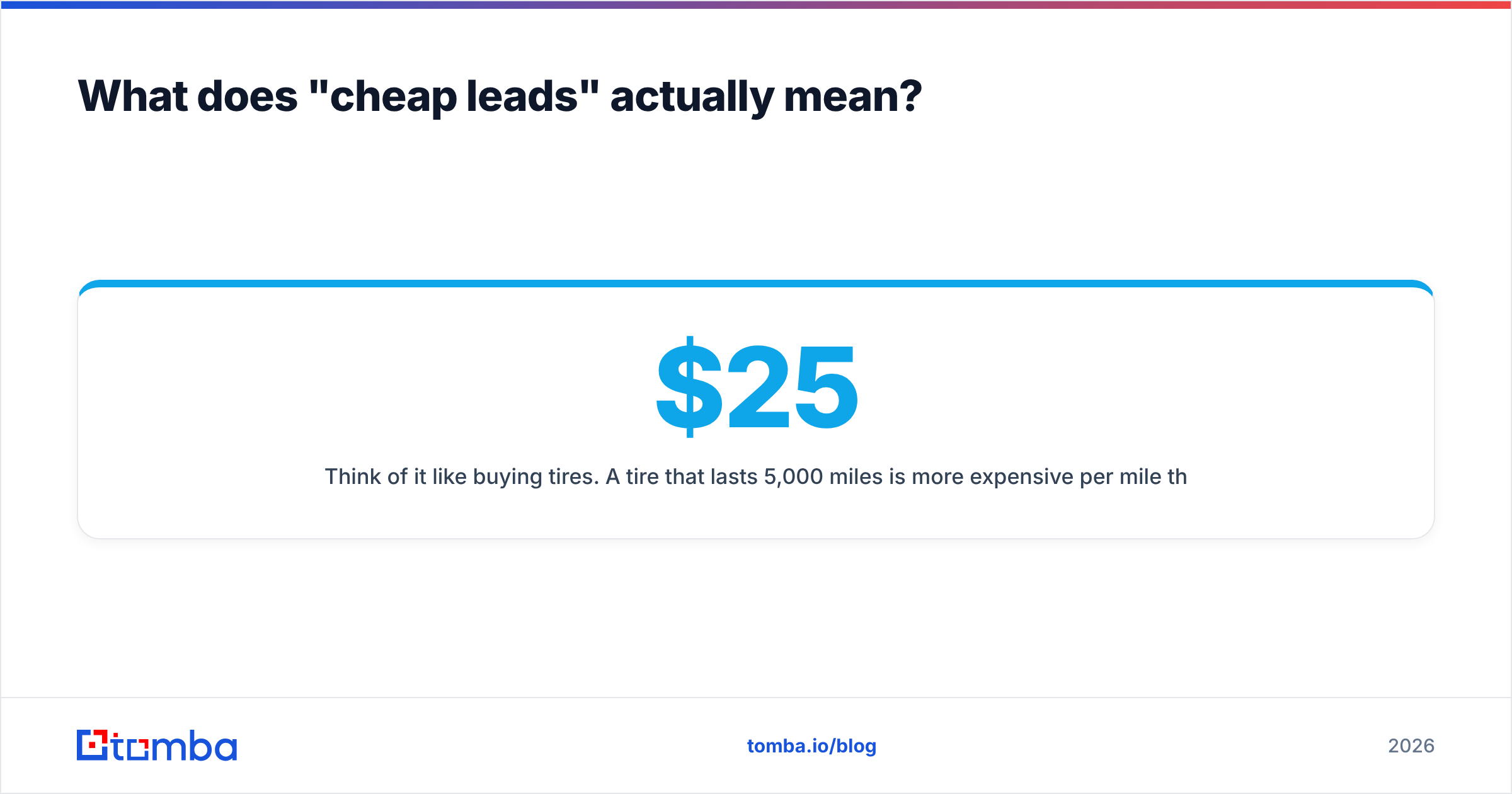
A cheap lead is one with a low cost per qualified, contactable lead — not a low sticker price.
Think of it like buying tires. A $25 tire that lasts 5,000 miles is more expensive per mile than a $120 tire that lasts 60,000. People who buy "cheap leads" by sticker price are buying the $25 tire over and over and wondering why they keep ending up on the shoulder.
In lead gen, the hidden costs that turn a "cheap" list expensive are:
- Bounce rate — invalid addresses that hurt your sender score the moment you mail them.
- Spam traps — recycled or honeypot addresses that get you blocklisted.
- Wrong-fit contacts — people who match a job title but never the buying intent.
- Rep damage — once your domain reputation drops, every email you send underperforms, including to good leads.
So the real metric is cost per verified, in-ICP, deliverable contact. Optimize for that, and "cheap" and "good" stop being enemies.
Why are bought lead lists never actually cheap?#
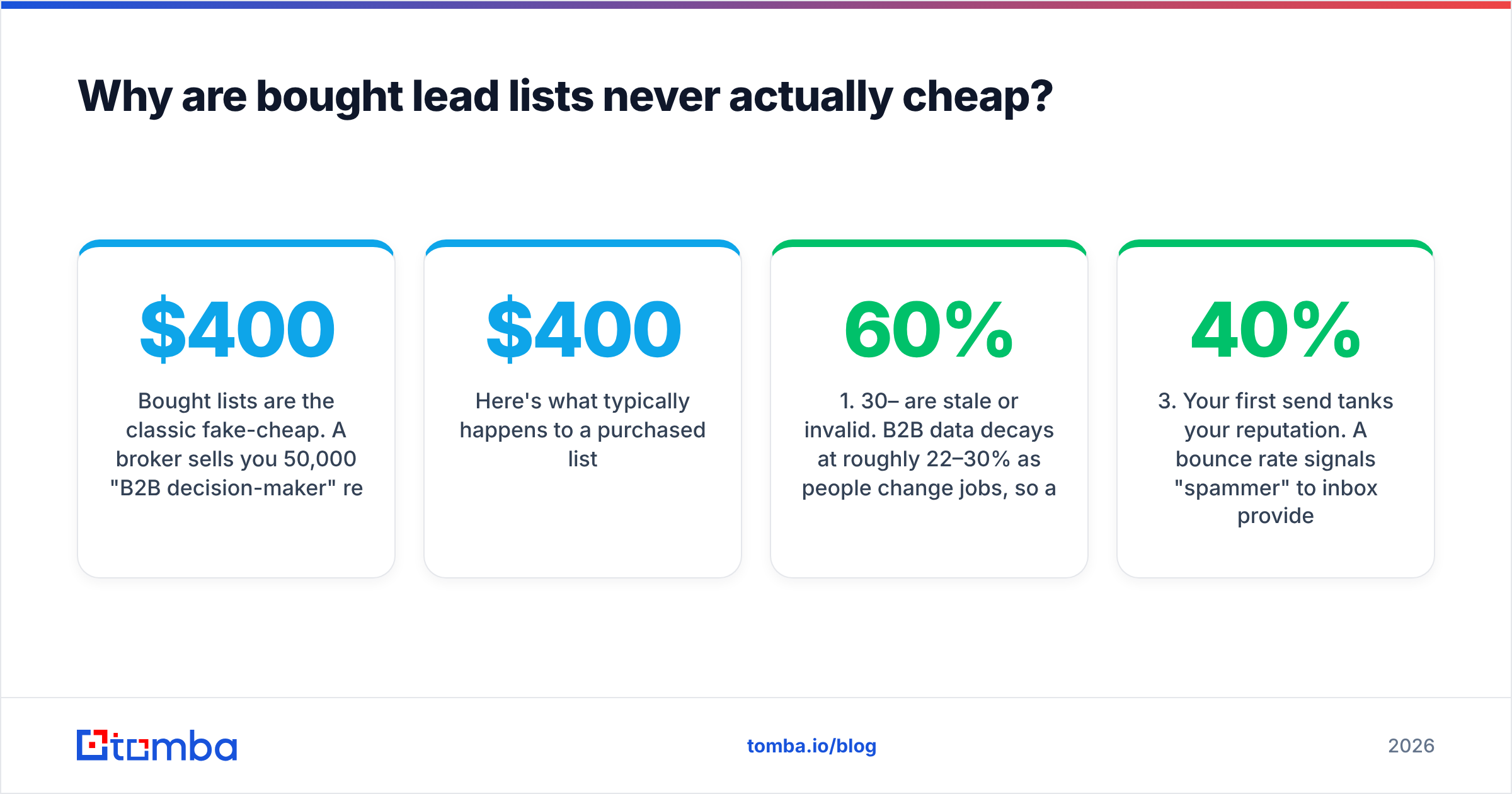
Bought lists are the classic fake-cheap. A broker sells you 50,000 "B2B decision-maker" records for $400 and it feels like a steal — $0.008 a lead. Then reality arrives.
Here's what typically happens to a $400 purchased list:
- 30–60% are stale or invalid. B2B data decays at roughly 22–30% per year as people change jobs, so a list assembled 18 months ago is already half-dead.
- You can't legally or safely mail most of it. No opt-in, no engagement history, often scraped in bulk and resold to dozens of buyers before you.
- Your first send tanks your reputation. A 40% bounce rate signals "spammer" to inbox providers, and recovery takes weeks of email deliverability repair.
- The good 10% is the same data competitors already hammered. Resold lists have zero exclusivity.
Net result: of 50,000 records you might extract a few thousand usable contacts — at a true cost far above the headline price, plus collateral damage. Industry reviews on G2 are full of buyers who learned this the hard way.
The lesson isn't "never pay for data." It's "never pay for unverified, non-exclusive, bulk-scraped data."
What are the cheapest B2B lead sources in 2026?#
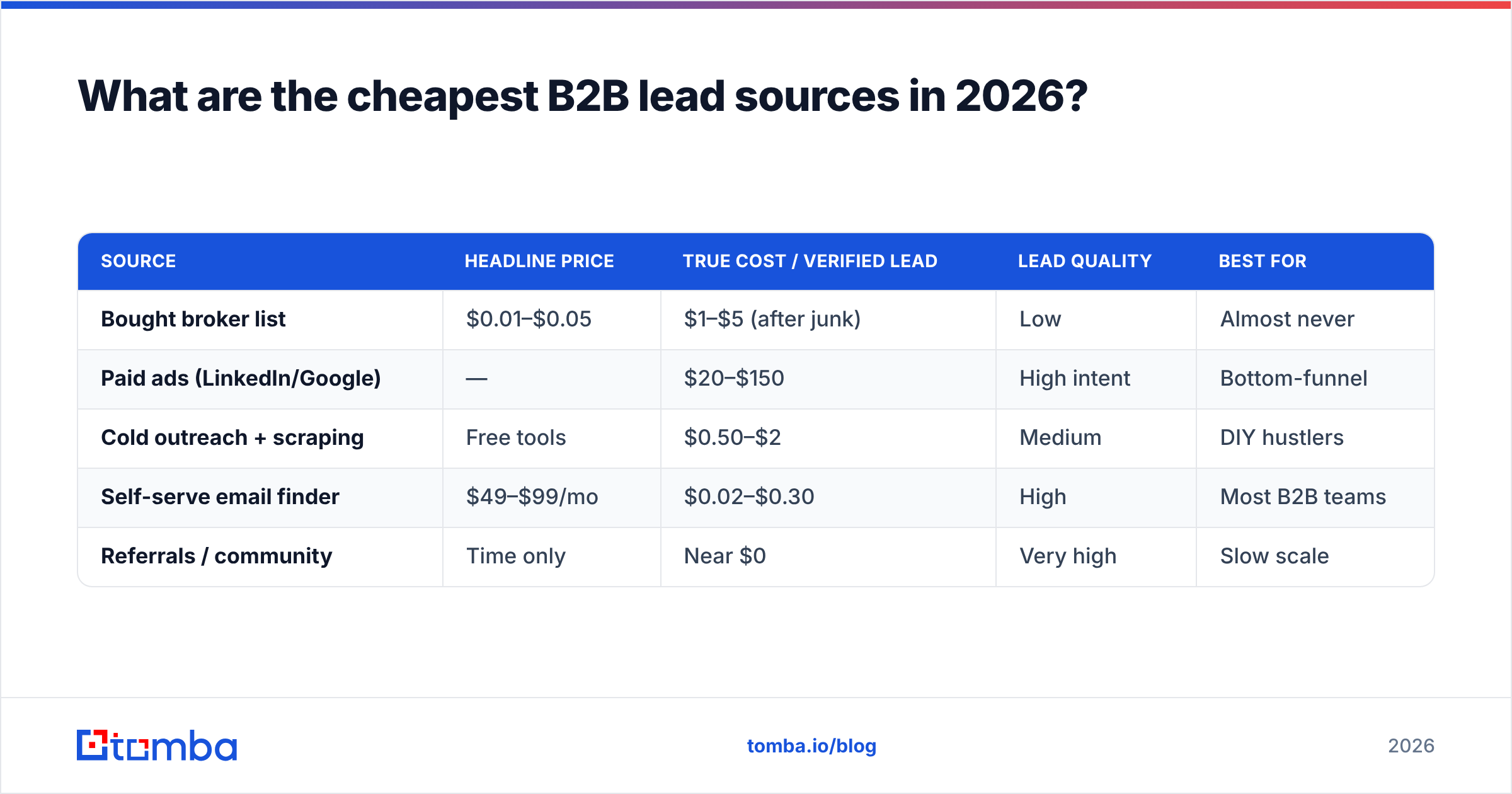
The genuinely cheap sources share three traits: you control the targeting, the data is fresh, and you can verify before you spend outreach effort. Here's how the main options stack up on real cost per usable lead.
| Source | Headline price | True cost / verified lead | Lead quality | Best for |
|---|---|---|---|---|
| Bought broker list | $0.01–$0.05 | $1–$5 (after junk) | Low | Almost never |
| Paid ads (LinkedIn/Google) | — | $20–$150 | High intent | Bottom-funnel |
| Cold outreach + scraping | Free tools | $0.50–$2 | Medium | DIY hustlers |
| Self-serve email finder | $49–$99/mo | $0.02–$0.30 | High | Most B2B teams |
| Referrals / community | Time only | Near $0 | Very high | Slow scale |
Three takeaways:
- Paid ads buy intent, not volume. They're the most expensive per lead but the leads are warm. Use them for the bottom of the funnel, not for filling a 10,000-contact outbound list.
- Self-serve email finders win on cost-efficiency. You pick exactly who you target, the data is pulled fresh, and a flat monthly fee spreads across thousands of verified contacts.
- Referrals are technically cheapest but don't scale on command. Great to maximize, impossible to forecast.
For most teams trying to keep cost per lead low and hit volume, a self-serve email finder is the workhorse. You're paying for tooling, not for someone else's stale spreadsheet.
How do you build cheap leads yourself without buying lists?#
Self-sourcing is the answer to "cheap leads that convert." The workflow is simpler than the bought-list crowd assumes, and you own every contact exclusively.
The four-step cheap-lead workflow:
Define a tight ICP. Narrow beats broad. "VP of Engineering at 50–500-person SaaS companies in North America" produces cheaper effective leads than "anyone in tech," because every contact you source is already a fit. Wasted credits on wrong-fit people are what make sloppy lists expensive.
Find emails by company, not by buying. Use a domain search to pull every reachable contact at a target company, or a name-and-company lookup to find a specific person. This is how you build a list that's fresh, targeted, and exclusively yours.
Verify before you send. Run every address through an email verifier to strip invalids and catch-alls. This single step is what protects your deliverability and keeps your effective cost per lead low — a verified list of 2,000 beats an unverified list of 20,000.
Scale with bulk + automation. Once the motion works, a bulk email finder lets you process target-account lists in batches instead of one lookup at a time, and an email finder API wires it straight into your CRM or enrichment flow.
The beauty of this approach: your cost is a predictable flat fee, and quality stays high because you chose every target. There's no mystery 40% junk rate baked in.
How cheap can leads get with a tool like Tomba?#
Cheap enough that the math embarrasses bought lists. Let's run it with real numbers.
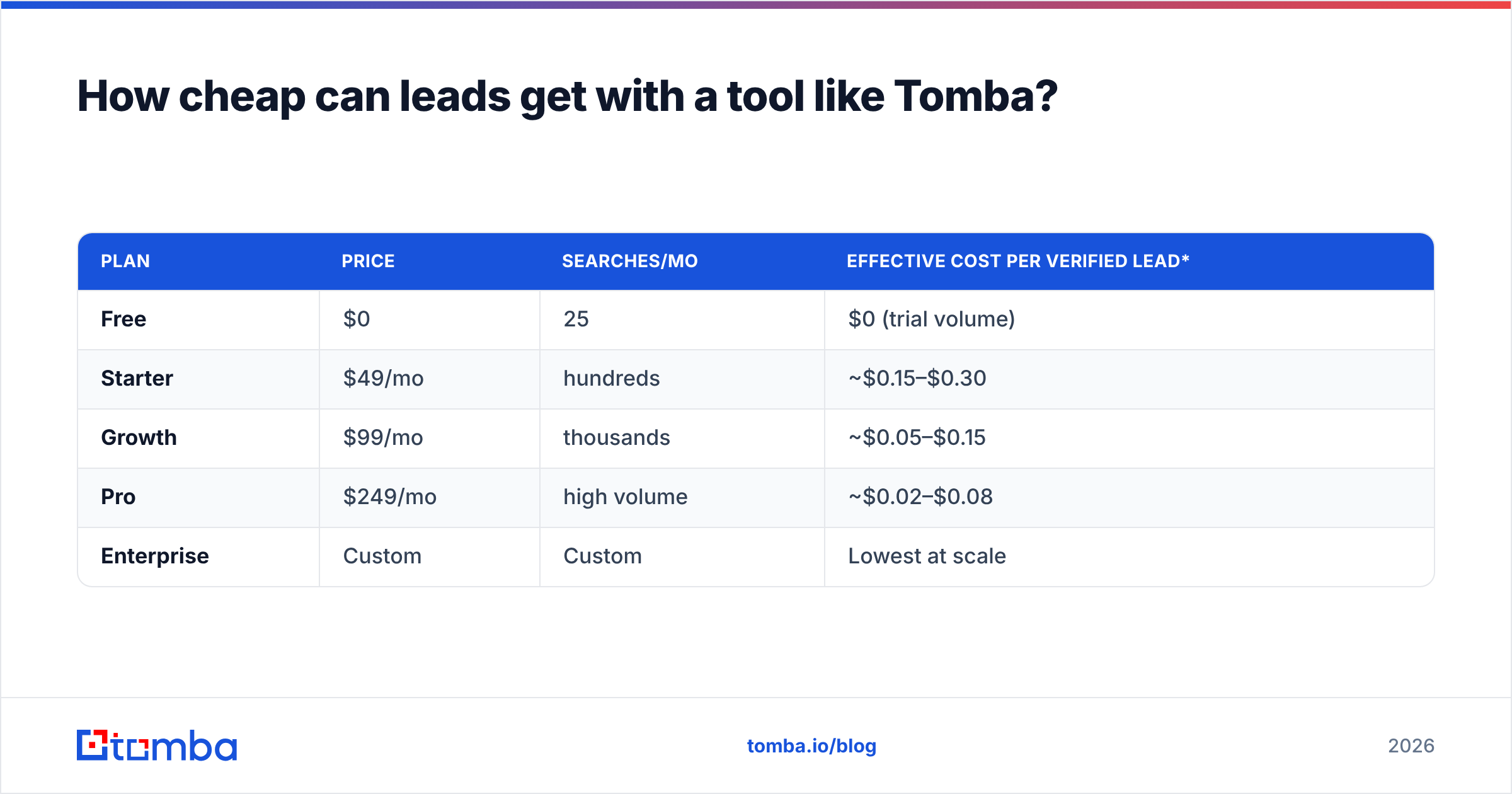
Take Tomba's Growth plan at $99/mo. Say it nets you a few thousand verified contacts in a month of focused sourcing. Even at a conservative 1,000 usable, in-ICP, verified contacts, that's about $0.10 per lead — and those are exclusive, fresh, deliverable addresses, not resold scrapings.
Compare the plans against what you actually get:
| Plan | Price | Searches/mo | Effective cost per verified lead* |
|---|---|---|---|
| Free | $0 | 25 | $0 (trial volume) |
| Starter | $49/mo | hundreds | ~$0.15–$0.30 |
| Growth | $99/mo | thousands | ~$0.05–$0.15 |
| Pro | $249/mo | high volume | ~$0.02–$0.08 |
| Enterprise | Custom | Custom | Lowest at scale |
*Effective cost depends on your targeting precision and verify rate; tighter ICPs push it lower.
Two things make this genuinely cheap rather than fake-cheap:
- Verification is built into the motion. The email verifier and catch-all verifier mean the leads you keep are the leads you can actually reach. You're not paying to mail dead addresses.
- You only source who you want. No paying for 49,000 records to find 1,000 good ones. The credit goes to contacts that match your ICP.
At the Pro tier, hitting 2–8 cents per verified B2B contact is realistic — an order of magnitude cheaper than the true cost of a broker list, with none of the reputation risk.
Are cheap leads worth it, or do you get what you pay for?#
Both, depending on what "cheap" means. Here's the honest breakdown.
Cheap by sticker price (bought lists, scraped dumps): No. You get what you pay for, and what you pay for is a deliverability problem. The "savings" evaporate the first time inbox providers flag your domain. Per HubSpot's research on email marketing, list quality and engagement are the dominant factors in whether your sends ever reach the inbox — and bought lists fail on both.
Cheap by cost-per-qualified-lead (self-sourced + verified): Absolutely. This is the only kind of cheap that compounds in your favor. Fresh data, exclusive contacts, low flat cost, and a clean sender reputation that makes every future campaign cheaper to run.
The trap to avoid is the false economy: spending a Saturday hand-scraping LinkedIn to save $49 is not cheap when you value your time at anything above minimum wage. Tools exist precisely because your hours cost more than the subscription. Browser-based tools like a Chrome extension or a Google Sheets add-on collapse the labor cost that makes "free" DIY methods secretly expensive.
A quick gut-check before you call any lead source "cheap":
- Is the data verified? If not, your real cost is hidden in your bounce rate.
- Is it exclusive? Resold data is competition you paid to join.
- Is it fresh? Anything over 12 months old is decaying fast.
- Does it match your ICP? Wrong-fit volume is the most expensive volume there is.
Pass all four and you've found leads that are cheap in the way that matters.
What's the cheapest way to start today?#
Start free, prove the math, then scale the spend. You don't need to commit a budget to find out whether self-sourced leads beat your current cost per lead.
- Day 1: Spin up the Free tier (25 searches) and run your tightest ICP against five target accounts. Verify the results.
- Week 1: Calculate your real cost per verified, in-ICP lead. Compare it honestly to whatever you're paying now.
- Month 1: If the numbers work — and they almost always do versus bought lists — move to Starter or Growth and turn on bulk sourcing.
That's the whole playbook. No mystery, no 40% junk tax, no reputation gamble.
The bottom line on cheap leads#
Cheap leads are real, but only when "cheap" means low cost per verified, exclusive, in-ICP contact. Buying lists by the headline price is the expensive choice dressed up as a deal. Self-sourcing with the right tooling is the actually-cheap choice that also happens to convert better and protect your domain.
Ready to find out what your real cost per lead could be? Start with the Tomba Email Finder on the free tier, source your tightest ICP, and verify every contact before you send. You'll build leads that are cheap in the only way that counts — and exclusively yours. When the math proves out, the Growth and Pro plans drop your cost per verified contact to a few cents at scale. That's how you keep leads cheap without ever buying junk again.
// get started
Find, verify and enrich your first contacts today
Start on the free plan with 25 searches a month, then scale when your team is ready.
Free plan · No credit card required · GDPR & CCPA
// about the author