Check Up Email: Templates and Examples That Get Replies 2026
A check up email keeps deals and relationships alive without sounding needy. Here are the templates, timing rules, and structure that actually earn replies in 2026.
Check Up Email
A check up email is the message you send to keep a conversation, deal, or relationship moving when the other side has gone quiet. Done well, it feels like a helpful nudge. Done badly, it reads as "just bumping this to the top of your inbox" and gets ignored. This guide shows you the difference.
TL;DR#
- A check up email (also called a check-in email) re-engages a contact who went silent. Its only job is to make replying easy and worthwhile.
- The "just checking in" line is dead. Every check up email needs a reason to exist: new value, a clear question, or a soft deadline.
- Timing matters more than wording. Space follow-ups 2 to 4 business days apart and cap a sequence at 4 to 6 touches.
- Use short subject lines, a single ask, and one call to action. Long check-ins kill reply rates.
- The best check up emails start with clean, accurate contact data, so your message reaches a real, monitored inbox.
What is a check up email?#
A check up email is a short, intentional follow-up sent to revive a stalled thread. Think of it like watering a plant you already planted. You are not starting a new relationship; you are keeping an existing one from drying out. The original pitch, demo, proposal, or favor already happened, and now you are nudging the next step.
Check up emails show up across almost every business workflow:
- Sales follow-up — after a demo, quote, or proposal with no response.
- Client check-ins — making sure a deliverable landed and the account is healthy.
- Recruiting — following up with a candidate after an interview.
- Networking — re-warming a contact you met months ago.
- Post-purchase — confirming a customer is getting value (and setting up the renewal).
The format barely changes across these. What changes is the reason you give for writing. That reason is the whole game.
Why do most check up emails get ignored?#
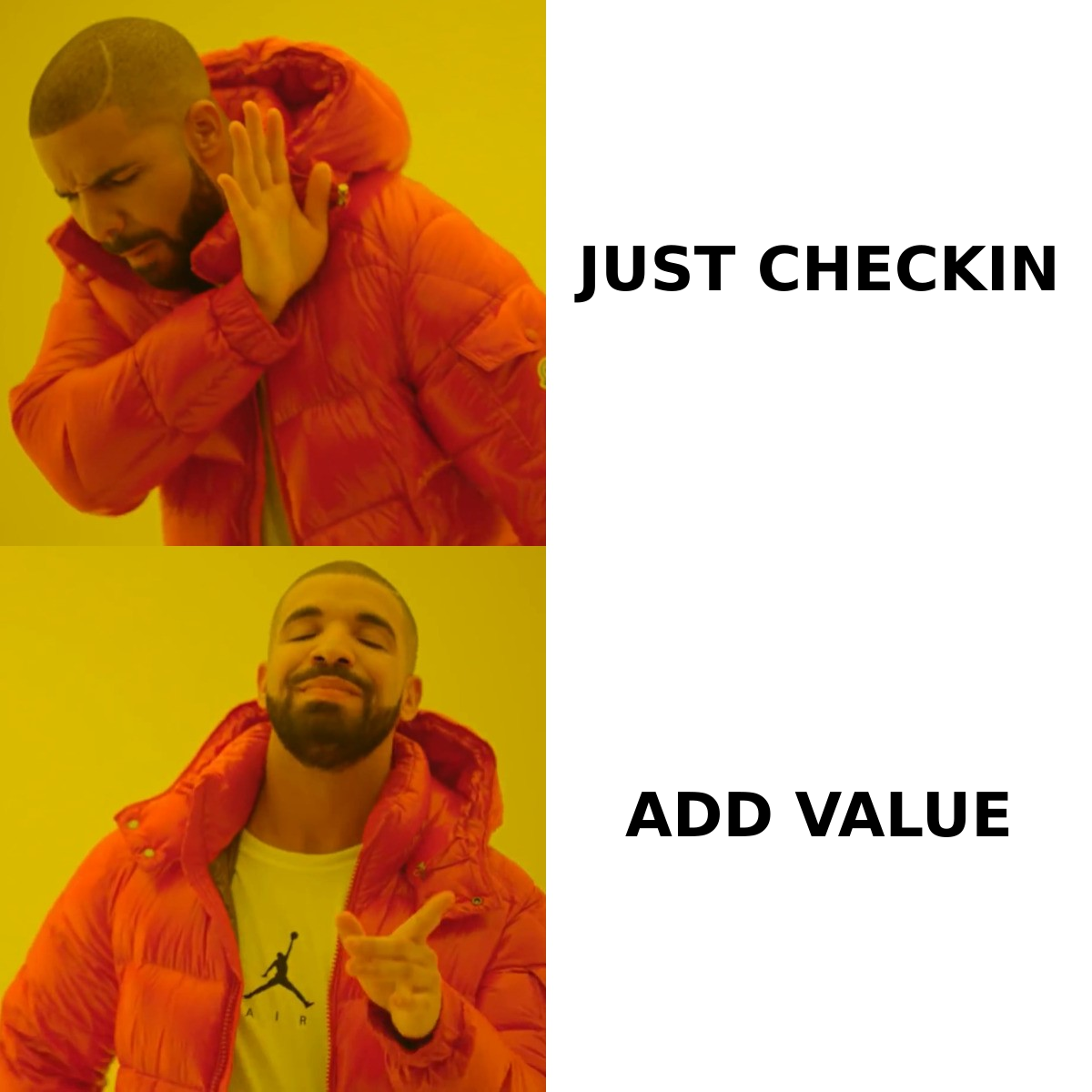
Most check up emails fail for one reason: they add zero new information. "Just circling back," "following up," and "did you see my last email?" all put the work on the reader. You are asking them to remember context, find your old message, and decide what to do, all before breakfast.
According to HubSpot's sales research, the majority of deals require five or more follow-ups, yet most reps stop after one or two. The gap is not effort; it is quality. Sending the same empty bump four times is worse than sending one thoughtful check-in.
Three silent killers:
- No new value. If the email could have been sent yesterday, last week, or next month with no change, it is filler.
- Too many asks. "Can we hop on a call, and also did you review the deck, and what did your team think?" gets nothing done.
- Bad data. If the address bounces or hits an unmonitored inbox, even the perfect copy dies. Run new lists through an email verifier before you send so you are not measuring "no reply" when the truth is "never delivered."
What does a good check up email look like?#
A strong check up email follows a tight structure. Five lines, one idea, one ask.
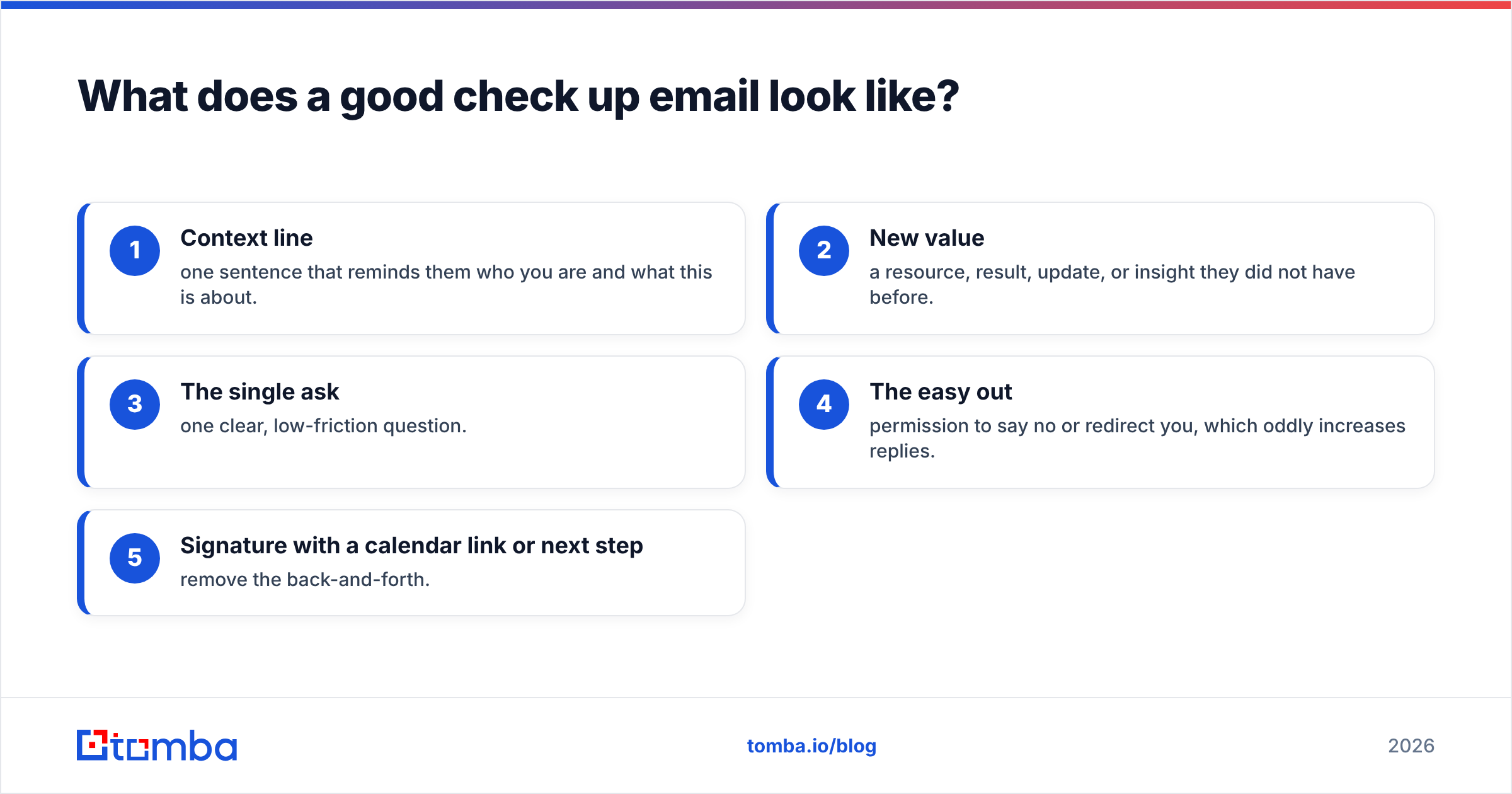
- Context line — one sentence that reminds them who you are and what this is about.
- New value — a resource, result, update, or insight they did not have before.
- The single ask — one clear, low-friction question.
- The easy out — permission to say no or redirect you, which oddly increases replies.
- Signature with a calendar link or next step — remove the back-and-forth.
Here is a sales example you can adapt:
Subject: Idea for [Company]'s Q3 pipeline
Hi [First name],
Following our demo two weeks ago, I put together a one-page breakdown of how a team your size cut response time by 22%. Thought it might be useful either way.
Worth a 15-minute call next Tuesday or Wednesday to walk through it?
If timing is off, just tell me when to check back and I will get out of your inbox.
[Name] · [calendar link]
Notice there is no "just checking in." The email earns its place because it carries something new (the breakdown) and asks one thing.
When should you send a check up email?#
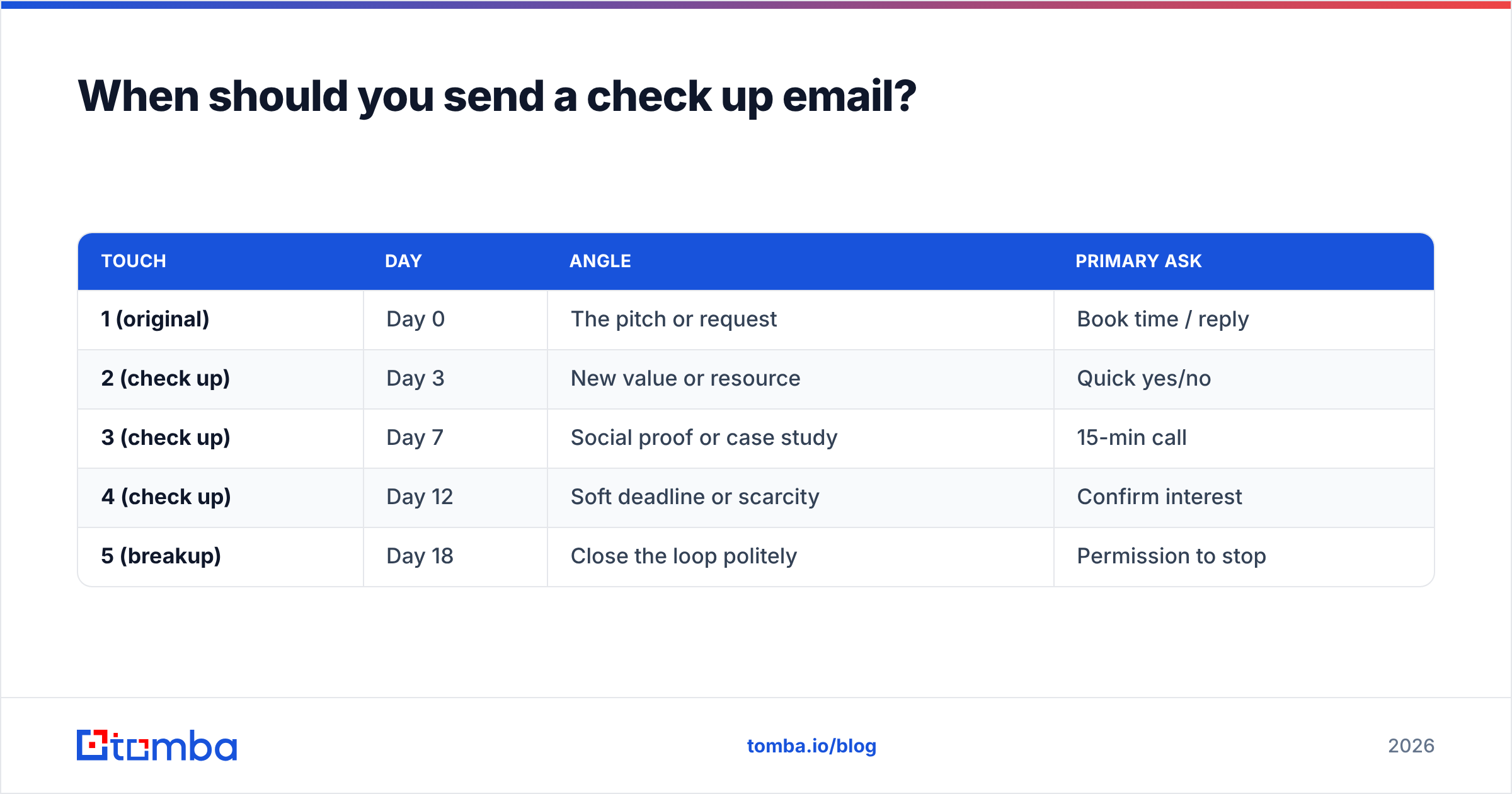
Conclusion first: send your first check up email 2 to 3 business days after the original message, then widen the gaps. Cadence beats volume.
Here is a reliable default sequence for a cold or semi-warm thread:
| Touch | Day | Angle | Primary ask |
|---|---|---|---|
| 1 (original) | Day 0 | The pitch or request | Book time / reply |
| 2 (check up) | Day 3 | New value or resource | Quick yes/no |
| 3 (check up) | Day 7 | Social proof or case study | 15-min call |
| 4 (check up) | Day 12 | Soft deadline or scarcity | Confirm interest |
| 5 (breakup) | Day 18 | Close the loop politely | Permission to stop |
A few rules that keep this from feeling like spam:
- Never send two check-ins on the same day or back to back. Give the inbox room to breathe.
- Match the channel to the relationship. A warm client might prefer one well-timed nudge over a five-touch sequence.
- Stop on a signal. An out-of-office, a "not now," or a referral all change the plan. Listen.
For deeper context on how send timing affects your response rate, test small batches before scaling a sequence.
Which type of check up email should you send?#
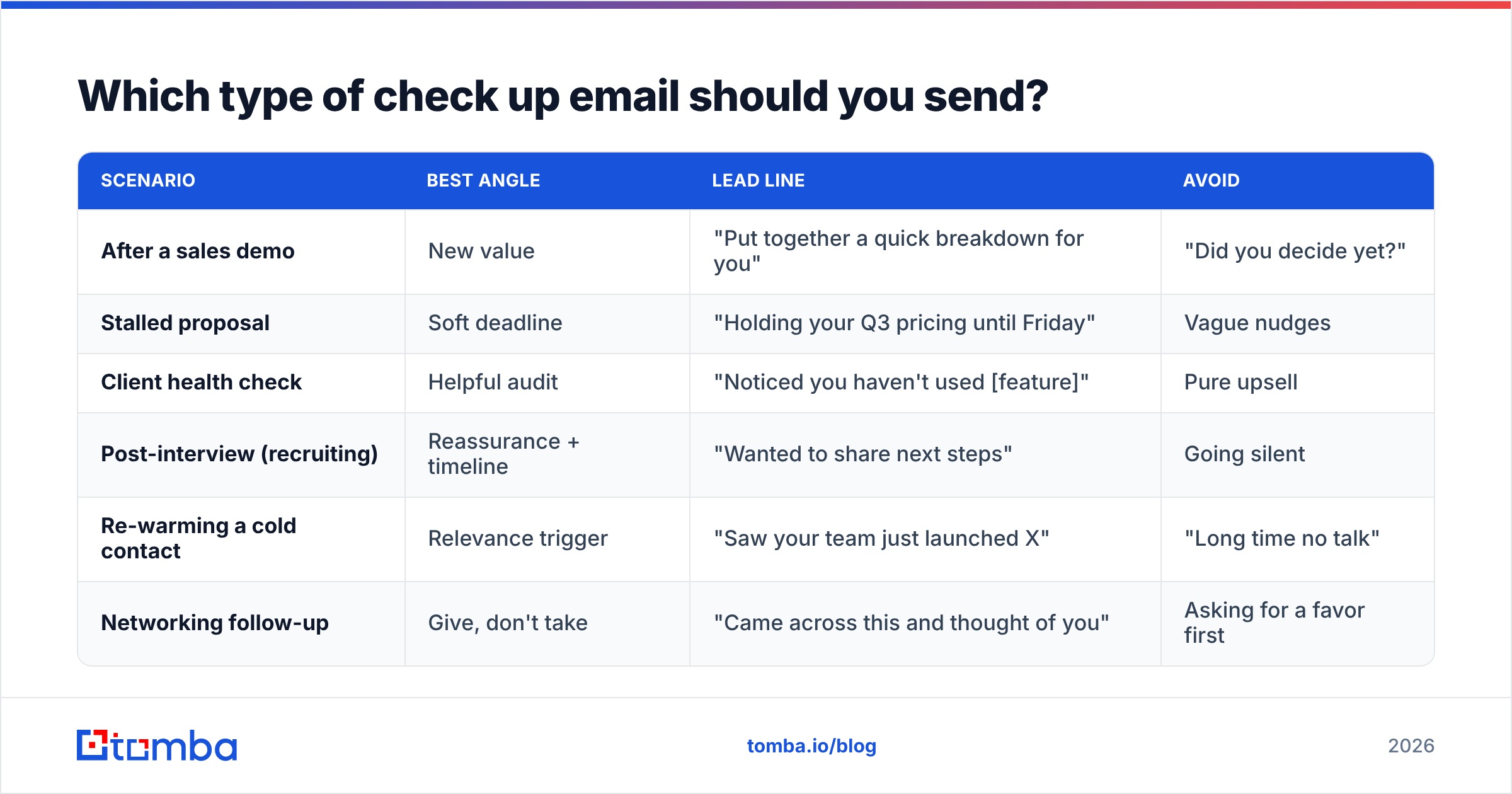
Different situations call for different angles. This comparison shows when each one fits and what to lead with.
| Scenario | Best angle | Lead line | Avoid |
|---|---|---|---|
| After a sales demo | New value | "Put together a quick breakdown for you" | "Did you decide yet?" |
| Stalled proposal | Soft deadline | "Holding your Q3 pricing until Friday" | Vague nudges |
| Client health check | Helpful audit | "Noticed you haven't used [feature]" | Pure upsell |
| Post-interview (recruiting) | Reassurance + timeline | "Wanted to share next steps" | Going silent |
| Re-warming a cold contact | Relevance trigger | "Saw your team just launched X" | "Long time no talk" |
| Networking follow-up | Give, don't take | "Came across this and thought of you" | Asking for a favor first |
The pattern is consistent: lead with what they get, not what you need.
How do you write a check up email subject line?#
The subject line decides whether the body ever gets read. For check up emails, short and specific wins.
- Keep it under 5 words. "Quick idea for [Company]" beats "Following up on our previous conversation regarding the proposal."
- Avoid the word "follow-up" in the subject. It signals a bump and invites a skip.
- Reference value, not chronology. "22% faster response time" is a reason to open; "checking in" is not.
- Skip fake urgency. "RE: RE: URGENT" tanks trust and triggers spam filters.
If you want to pressure-test options before sending, a subject line generator can give you variants to A/B test against your control. Small wording changes here move open rates more than any tweak to the body.

What mistakes should you avoid in a check up email?#
Even experienced reps repeat the same errors. Watch for these:
- Guilt-tripping. "I've reached out three times now" makes you sound resentful, not persistent.
- Walls of text. If your check-in needs scrolling, it is a new pitch, not a check-in. Trim to five lines.
- Burying the ask. One question, placed clearly. If a reader cannot tell what you want in three seconds, rewrite it.
- No personalization. A merge-tag-only email reads like a blast. Reference something specific to them.
- Ignoring deliverability. Sender reputation, authentication, and list hygiene quietly decide whether your check-in even arrives. Industry reviews on G2 consistently rank list verification as a top driver of inbox placement.
A quick way to sound human instead of automated: read the email out loud. If you would not say it to the person at their desk, do not send it.
How does data quality change check up results?#
Conclusion first: the cleanest copy in the world cannot fix a wrong or stale email address. Before you blame your messaging, confirm your data.
A check up sequence touches the same contact multiple times. If that contact's address is outdated, role-based (like info@), or a catch-all that silently drops mail, every touch is wasted and your sender reputation takes the hit. This is why teams that scale outbound pair their templates with reliable sourcing and validation.
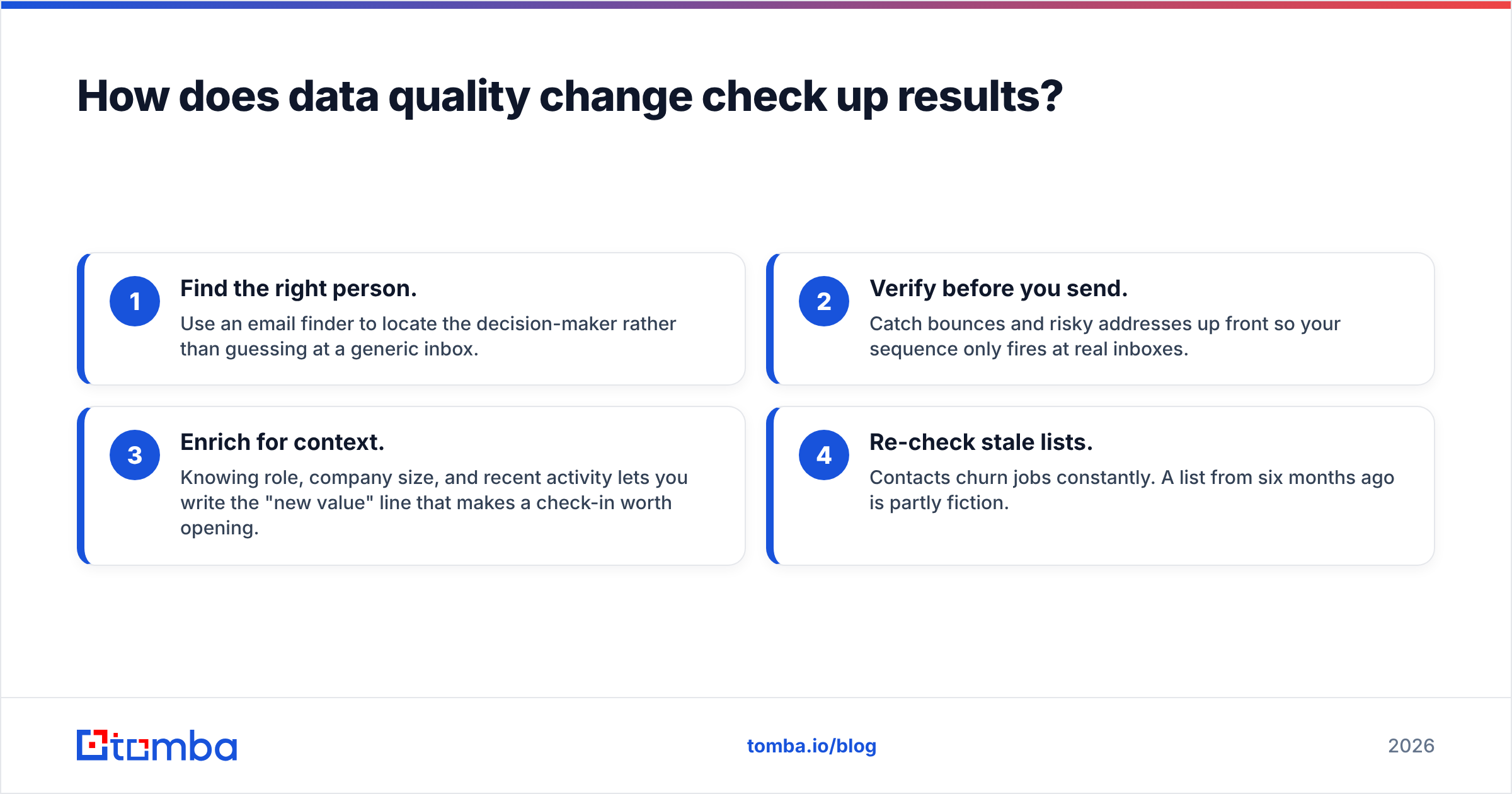
A practical pre-send checklist:
- Find the right person. Use an email finder to locate the decision-maker rather than guessing at a generic inbox.
- Verify before you send. Catch bounces and risky addresses up front so your sequence only fires at real inboxes.
- Enrich for context. Knowing role, company size, and recent activity lets you write the "new value" line that makes a check-in worth opening.
- Re-check stale lists. Contacts churn jobs constantly. A list from six months ago is partly fiction.
When your data is accurate, your check up emails get measured fairly. You learn whether the message works, not whether it got delivered. That feedback loop is how you actually improve over time.
Check up email templates you can copy#
Three ready-to-use templates. Swap the brackets and keep them short.
1. The value-add (post-demo):
Subject: One-pager for [Company]
Hi [First name], after our call I mapped out where a team like yours usually sees the fastest win. Two minutes to read. Want me to send it over, or is now not the right time?
2. The soft deadline (stalled proposal):
Subject: Holding your pricing
Hi [First name], your custom pricing is locked through Friday. Happy to extend it, just need a yes or a "not now" so I know how to plan. Which is it?
3. The graceful breakup (final touch):
Subject: Closing the loop
Hi [First name], I don't want to clutter your inbox, so this is my last note for now. If [outcome] is still a priority later this quarter, reply here and I'll pick it right back up. No hard feelings either way.
The breakup email is the most underrated of the three. Giving people an easy exit frequently produces the reply you were chasing all along.
How many check up emails are too many?#
Cap a single sequence at 4 to 6 touches, then stop. Persistence is a virtue until it becomes harassment, and the line is sharper than most reps think.
Signals to stop immediately:
- An explicit "no" or "not interested."
- Repeated opens with zero replies across three or more touches (the interest is not there).
- A bounce or spam complaint (a data and deliverability problem, not a copy problem).
When a sequence ends without a reply, the move is not to keep emailing. It is to pause, refresh the contact data, and re-approach with a genuinely new reason months later. You can layer in other channels too; pairing email with a phone finder lookup or a LinkedIn touch often breaks a stalemate that email alone cannot.
Frequently asked questions#
Is "checking in" a good subject line? No. It signals a low-value bump and invites a skip. Lead with a specific benefit or question instead.
How long should a check up email be? Five lines or fewer. One context line, one piece of new value, one ask, one easy out, and your signature.
How often should I send check-ins? Start at 2 to 3 business days after the first message, then widen the gaps to a week or more. Cap the sequence at 4 to 6 touches.
What if I never get a reply? Send a graceful breakup email, then pause. Re-verify the contact's data and re-approach later with a fresh, relevant reason.
Put it into practice#
A check up email only works when it reaches a real, monitored inbox and carries something worth reading. Nail the structure, respect the timing, and give every message a reason to exist beyond "just checking in."
The fastest fix for most underperforming check-in sequences is upstream: better contact data. Start with the Tomba Email Finder to reach the right decision-maker on the first try, then verify and enrich before your sequence fires. You can begin on the free tier (25 searches per month) and scale up through the Starter plan at $49/mo as your outbound grows. See full Tomba pricing to match a plan to your volume. Better data in, better replies out.
// get started
Find, verify and enrich your first contacts today
Start on the free plan with 25 searches a month, then scale when your team is ready.
Free plan · No credit card required · GDPR & CCPA
// about the author