How to Write a Checking In Email That Gets Replies (2026)
A "just checking in" email rarely earns a reply. Here are the templates, timing, and subject lines that turn a check-in into a real conversation in 2026.
You sent a great first email. Then silence. So you do what most reps do: you fire off a "just checking in" note and hope it works. It almost never does.
This guide breaks down why the classic checking in email fails, what to send instead, and the exact templates, timing, and subject lines that move a stalled thread forward in 2026.
TL;DR#
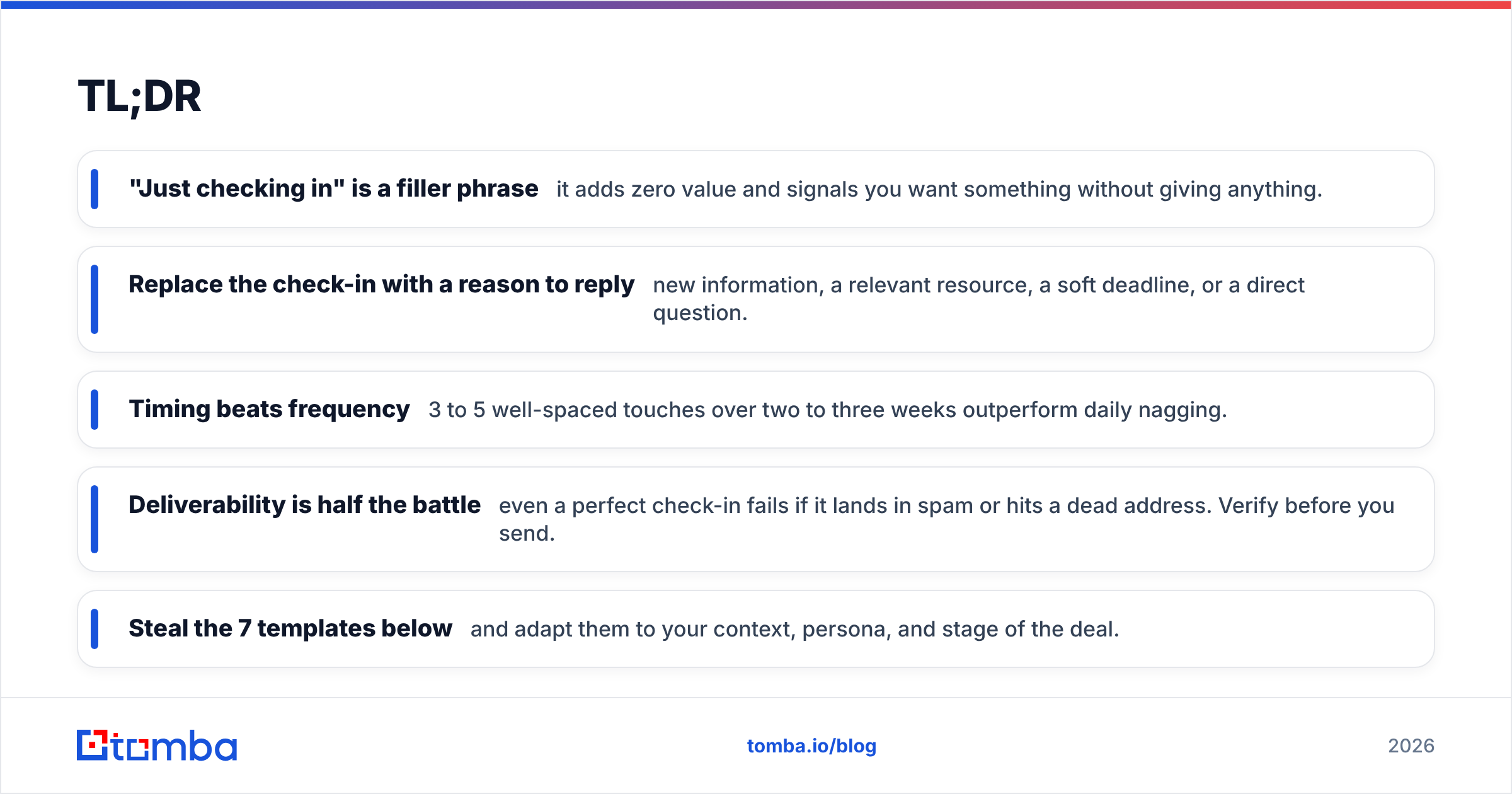
- "Just checking in" is a filler phrase — it adds zero value and signals you want something without giving anything.
- Replace the check-in with a reason to reply: new information, a relevant resource, a soft deadline, or a direct question.
- Timing beats frequency — 3 to 5 well-spaced touches over two to three weeks outperform daily nagging.
- Deliverability is half the battle — even a perfect check-in fails if it lands in spam or hits a dead address. Verify before you send.
- Steal the 7 templates below and adapt them to your context, persona, and stage of the deal.
What is a checking in email?#
A checking in email is a follow-up message you send when a previous email, meeting, or proposal got no response. Its job is to restart the conversation — but the way most people write it actively works against that goal.
Think of it like knocking on a neighbor's door. "Just seeing if you're home" is annoying and gives them no reason to open up. "I'm returning the drill I borrowed" gives them a reason to answer instantly. The second knock has a purpose. Your check-in needs the same thing.
The problem is that "just checking in" or "circling back" puts all the work on the recipient. You're asking them to remember the context, figure out what you want, and decide to act — for your benefit, not theirs. That's why these emails get ignored.
A good check-in flips the equation: it gives the reader something before it asks for anything.
Wait — that placeholder shouldn't be there. Here is the actual meme:
)
Why does "just checking in" fail?#
Three reasons, and they compound:
- No new value. The reader already saw your last email. Repeating "any thoughts?" gives them nothing new to react to.
- It centers you, not them. "I wanted to follow up" is about your needs. The reader is busy and self-interested — as they should be.
- It's easy to ignore guilt-free. A vague nudge carries no cost to skip. A specific, helpful message is harder to leave unanswered.
According to HubSpot's sales research, the majority of deals require five or more follow-ups, yet most reps stop after one or two. The reps who win aren't the ones who send the most "checking in" emails — they're the ones whose follow-ups each carry a fresh hook.
What should you send instead of "just checking in"?#
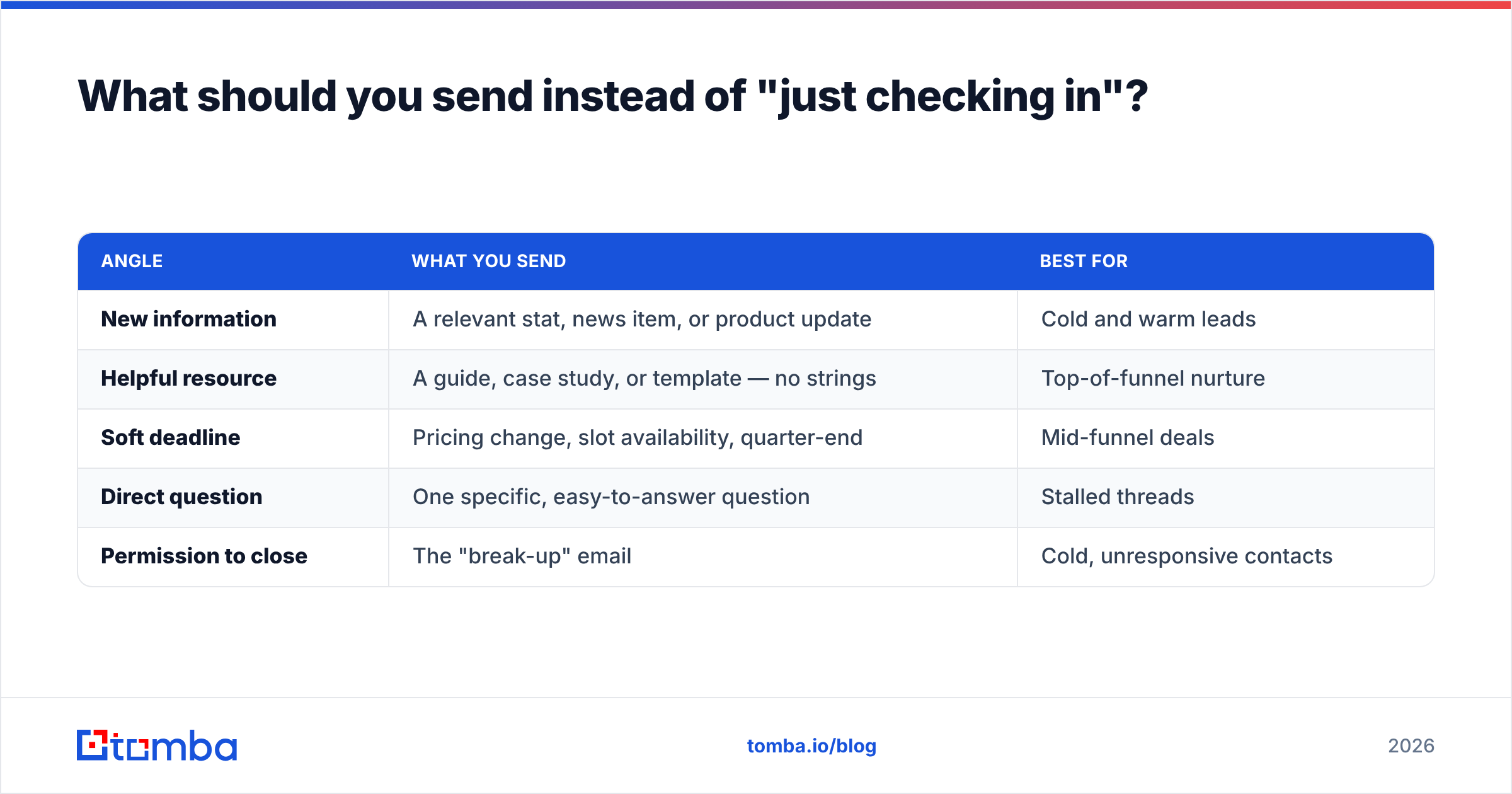
Replace the empty nudge with one of these value angles. Each gives the reader a concrete reason to reply.
| Angle | What you send | Best for |
|---|---|---|
| New information | A relevant stat, news item, or product update | Cold and warm leads |
| Helpful resource | A guide, case study, or template — no strings | Top-of-funnel nurture |
| Soft deadline | Pricing change, slot availability, quarter-end | Mid-funnel deals |
| Direct question | One specific, easy-to-answer question | Stalled threads |
| Permission to close | The "break-up" email | Cold, unresponsive contacts |
The structure of a high-performing check-in is consistent regardless of angle:
- Context line — one sentence reminding them who you are and the last touchpoint.
- Value drop — the new thing you're bringing (the whole point).
- Single ask — one clear, low-friction next step.
- Easy out — a line that respects their time and reduces pressure.
Keep the whole thing under 90 words. Long check-ins read as desperate.
What are the best checking in email templates for 2026?#
Here are seven templates mapped to common scenarios. Swap the brackets for your details.
1. The new-information check-in#
Subject: Thought of you when I saw this
Hi [Name], after our chat about [problem], I came across [stat/article] showing [specific insight]. Figured it was relevant to what your team is tackling this quarter. Worth a quick call to talk through how it applies to [Company]?
2. The resource check-in#
Subject: A template that might save your team a few hours
Hi [Name], no agenda here — we put together a [resource] on [topic] and teams like yours have found it useful. Sending it over in case it helps: [link]. Happy to walk through it if useful.
3. The soft-deadline check-in#
Subject: Quick heads up before [date]
Hi [Name], wanted to flag that [pricing/availability] changes on [date]. If [solution] is still on your radar, it's worth locking in before then. Want me to hold a slot?
4. The single-question check-in#
Subject: One quick question
Hi [Name], to point you in the right direction — is [specific obstacle] still the main blocker, or has the priority shifted? A one-line reply is all I need.
5. The social-proof check-in#
Subject: How [similar company] solved [problem]
Hi [Name], [Competitor/peer] was facing the same [challenge] and cut [metric] by [number] in [timeframe]. Two minutes and I can show you exactly how — open to it?
6. The re-engagement check-in#
Subject: Should I close your file?
Hi [Name], I haven't heard back, which usually means one of three things: you're swamped, the timing's off, or it's not a fit. A quick 1, 2, or 3 tells me how to help — or whether to step back.
7. The break-up email#
Subject: Closing the loop
Hi [Name], I don't want to clutter your inbox, so this is my last note on [topic]. If things change, you know where to find me. Wishing you and the [Company] team a strong quarter.
The break-up email is counterintuitively one of the highest-replying messages you can send — the fear of missing out often pulls a response when nothing else did.
You can pull more structures from the Tomba cold email templates library and adapt them to your sequence.
How often should you send a checking in email?#
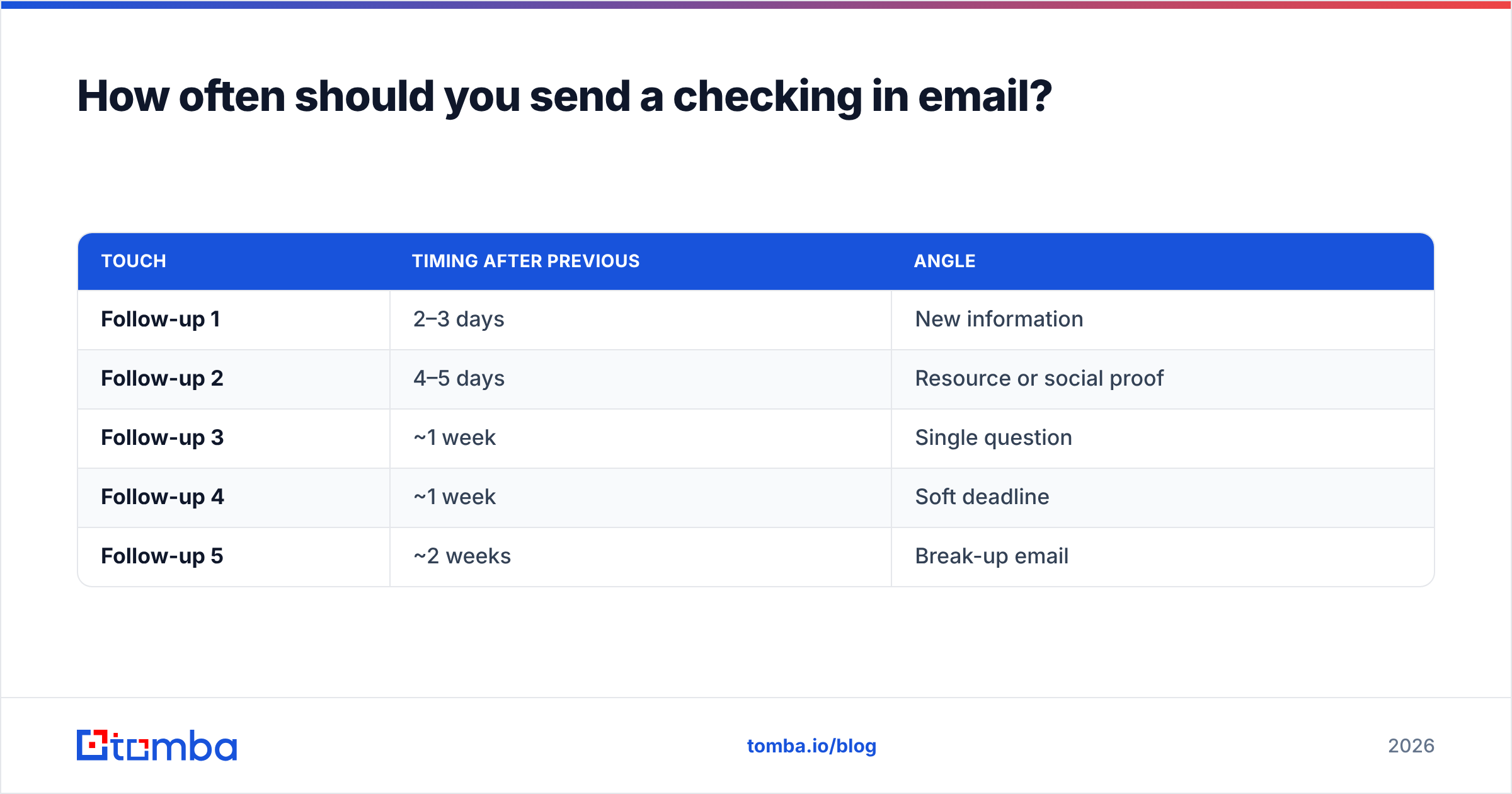
Spacing matters more than volume. The goal is to stay present without becoming noise.
| Touch | Timing after previous | Angle |
|---|---|---|
| Follow-up 1 | 2–3 days | New information |
| Follow-up 2 | 4–5 days | Resource or social proof |
| Follow-up 3 | ~1 week | Single question |
| Follow-up 4 | ~1 week | Soft deadline |
| Follow-up 5 | ~2 weeks | Break-up email |
That's roughly five touches across three to four weeks. Vary the channel where you can — a LinkedIn outreach touch between emails feels less repetitive than five messages in the same inbox.
A quick rule: never send two identical "checking in" notes back to back. If your follow-up could be copy-pasted to any prospect, it's not a follow-up — it's spam.
)
How do you write a subject line for a check-in email?#
Your subject line decides whether the rest of your work gets seen. For check-ins, you have two viable strategies:
- Reply in the existing thread so the subject stays "Re: [original]." This keeps context and signals continuity.
- Write a fresh, curiosity-driven line when the old thread has gone cold and you want a clean start.
Strong check-in subject lines are short (under 50 characters), specific, and free of "following up" language. Compare:
| Weak subject | Stronger subject |
|---|---|
| Just checking in | One quick question |
| Following up | Should I close your file? |
| Touching base | Heads up before Friday |
| Any update? | How [peer] cut churn 22% |
If you're stuck, run ideas through a subject line generator and test variants before committing. Even a small lift in open rate cascades into more replies downstream.
Why does deliverability decide whether your check-in works?#
Here's the part most "follow-up tips" articles skip: the best-written checking in email in the world earns zero replies if it lands in spam or bounces off a dead address. You're optimizing the message while ignoring the pipe it travels through.
Two failure points quietly kill check-in campaigns:
- Bad data. People change jobs constantly. The address that worked three months ago may now bounce — and a string of bounces tanks your sender reputation, which then hurts every email you send.
- Catch-all uncertainty. Many corporate domains accept everything, so you can't tell a real inbox from a black hole without proper verification.
The fix is to verify your list before you start a sequence. Run addresses through an email verifier to strip out invalid contacts, and when you're missing a contact entirely, use an email finder to source a current, verified address rather than guessing. Clean data protects your response rate and your domain health at the same time.
It's the difference between knocking on a real door and knocking on a wall. Both take effort; only one can answer.
What mistakes should you avoid?#
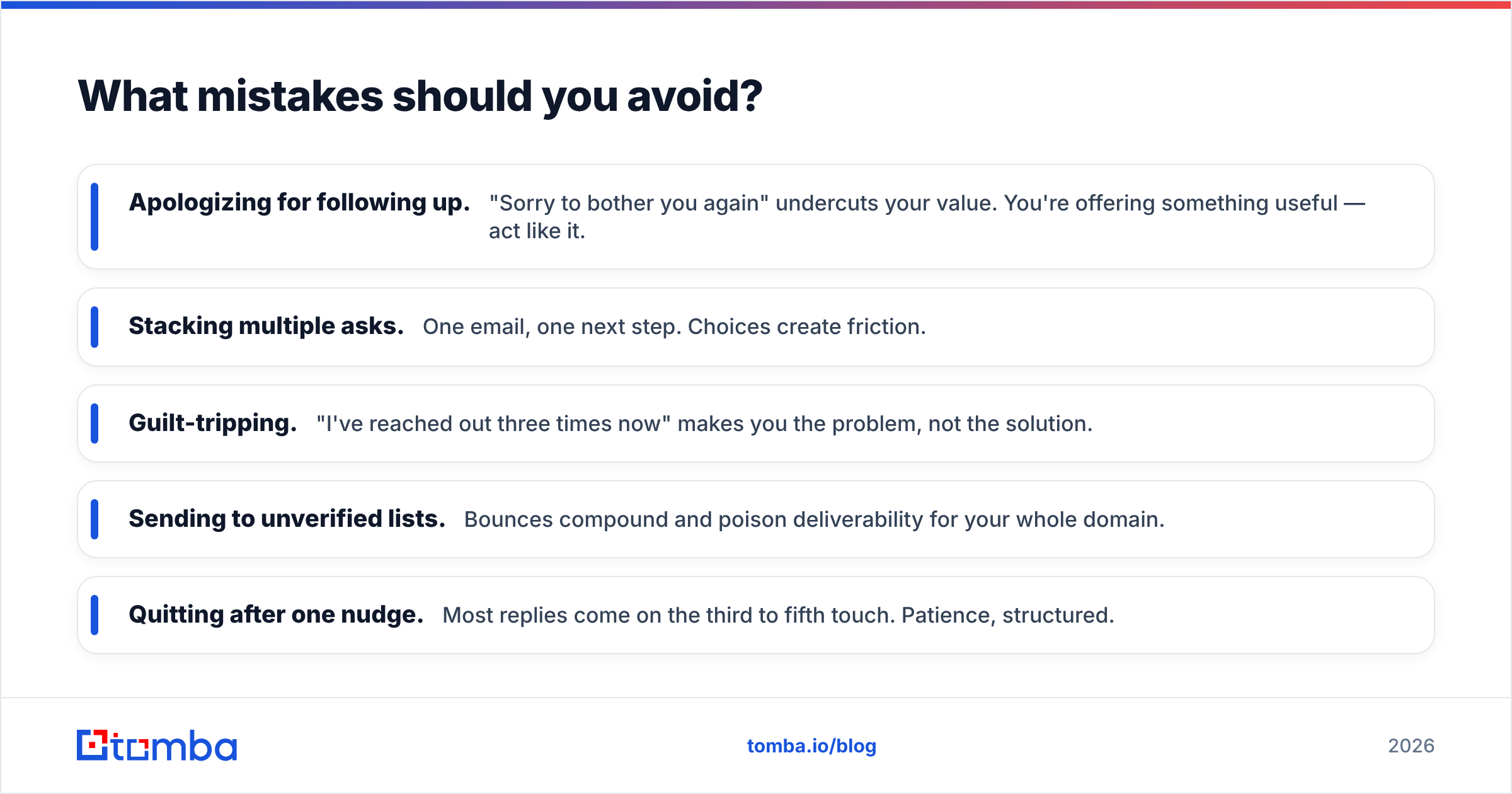
- Apologizing for following up. "Sorry to bother you again" undercuts your value. You're offering something useful — act like it.
- Stacking multiple asks. One email, one next step. Choices create friction.
- Guilt-tripping. "I've reached out three times now" makes you the problem, not the solution.
- Sending to unverified lists. Bounces compound and poison deliverability for your whole domain.
- Quitting after one nudge. Most replies come on the third to fifth touch. Patience, structured.
For a broader view of what separates high-performing outreach from noise, G2's sales engagement category is a useful, vendor-neutral place to compare approaches and tools.
Putting it together#
A checking in email is only as strong as the reason it gives someone to reply. Drop the filler, lead with value, space your touches deliberately, and — critically — make sure each message reaches a real, verified inbox. Do that and your follow-ups stop feeling like nagging and start feeling like help.
Before your next sequence, make sure every contact is reachable. Use the Tomba Email Finder to source accurate, verified professional emails by name, company, or domain — so your carefully written check-ins actually land where they can earn a reply. Start free with 25 searches a month, and check the Tomba pricing plans when you're ready to scale your outreach.
// get started
Find, verify and enrich your first contacts today
Start on the free plan with 25 searches a month, then scale when your team is ready.
Free plan · No credit card required · GDPR & CCPA
// about the author