Chief Revenue Officer Skills: The 2026 CRO Playbook
The CRO role has changed. Here are the chief revenue officer skills that actually move pipeline, retention, and net revenue in 2026 — plus how to build them.
TL;DR
- A modern chief revenue officer skills profile is no longer "best closer gets promoted." It blends forecasting rigor, RevOps fluency, data literacy, and cross-functional leadership across sales, marketing, and customer success.
- The highest-leverage skill in 2026 is owning net revenue — expansion and retention — not just new logos.
- Data hygiene is a CRO problem, not just an ops problem. Bad contact data quietly taxes every forecast and every comp plan.
- You can build most of these skills deliberately. This guide gives you a skills matrix, a self-audit, and a 90-day ramp.
- Tools matter at the edges: clean pipeline data and accurate contacts make every other skill easier to apply.
What does a chief revenue officer actually do in 2026?#
A chief revenue officer owns every dollar of revenue across its full lifecycle — acquisition, expansion, and retention. Think of the CRO as the conductor of an orchestra: the individual sections (sales, marketing, customer success, and partnerships) can each be excellent, but without one person setting tempo and balance, you get noise instead of music.
That mandate has widened sharply. Five years ago, a CRO was often a VP of Sales with a bigger title and a quota that rolled up a few teams. Today the role sits at the center of revenue operations and go-to-market strategy, accountable for unit economics that a board actually scrutinizes: net revenue retention, CAC payback, and forecast accuracy within a few points.
According to Gartner research on commercial leadership, buying groups now involve more stakeholders and longer cycles, which means the CRO has to engineer alignment across functions rather than just push harder on outbound. The skill set follows the mandate.
What are the core chief revenue officer skills?#
The core chief revenue officer skills fall into four buckets: commercial leadership, operational and data fluency, financial command, and people leadership. Most failed CRO tenures come from being strong in one or two buckets and thin in the rest.
Here is the practical breakdown, with the leading skills in each bucket:
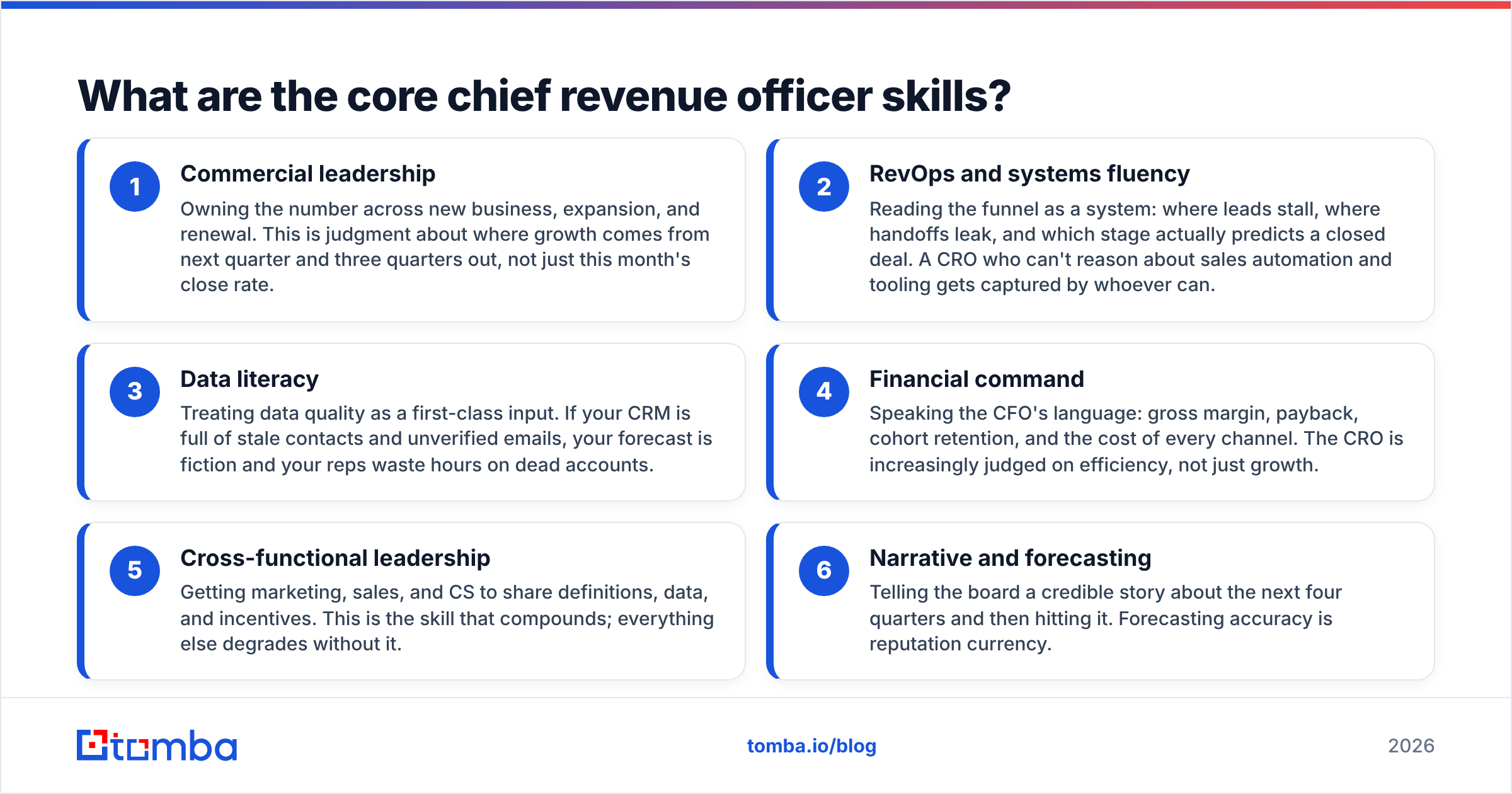
- Commercial leadership — Owning the number across new business, expansion, and renewal. This is judgment about where growth comes from next quarter and three quarters out, not just this month's close rate.
- RevOps and systems fluency — Reading the funnel as a system: where leads stall, where handoffs leak, and which stage actually predicts a closed deal. A CRO who can't reason about sales automation and tooling gets captured by whoever can.
- Data literacy — Treating data quality as a first-class input. If your CRM is full of stale contacts and unverified emails, your forecast is fiction and your reps waste hours on dead accounts.
- Financial command — Speaking the CFO's language: gross margin, payback, cohort retention, and the cost of every channel. The CRO is increasingly judged on efficiency, not just growth.
- Cross-functional leadership — Getting marketing, sales, and CS to share definitions, data, and incentives. This is the skill that compounds; everything else degrades without it.
- Narrative and forecasting — Telling the board a credible story about the next four quarters and then hitting it. Forecasting accuracy is reputation currency.
Wait — that visual makes the point bluntly: a CRO running on gut feel loses to one running on clean, verified pipeline data every quarter.
Which skills separate a great CRO from a good VP of Sales?#
The difference is scope of ownership and time horizon. A great VP of Sales optimizes the closing motion; a great CRO optimizes the entire revenue engine and plans further out. Three skills do most of the separating.
First, owning net revenue instead of new bookings. In 2026, expansion and retention often drive more enterprise-value-per-dollar than new logos. A CRO who can read churn signals, build a renewal motion, and align CS comp to expansion is operating a different machine than a pure-acquisition leader. If you track win rate but ignore net revenue retention, you're managing half the business.
Second, systems thinking over heroics. Good sales leaders rally a team to a strong quarter. Great revenue leaders design a system that produces strong quarters without heroics — predictable lead flow, clean stage definitions, and reliable data feeding the model.
Third, financial fluency under scrutiny. The CRO increasingly defends spend to a board that wants efficient growth. Being able to model CAC payback by segment, and to kill an underperforming channel without ego, is a senior skill that many strong closers never build.
How do you build a chief revenue officer skills matrix?#
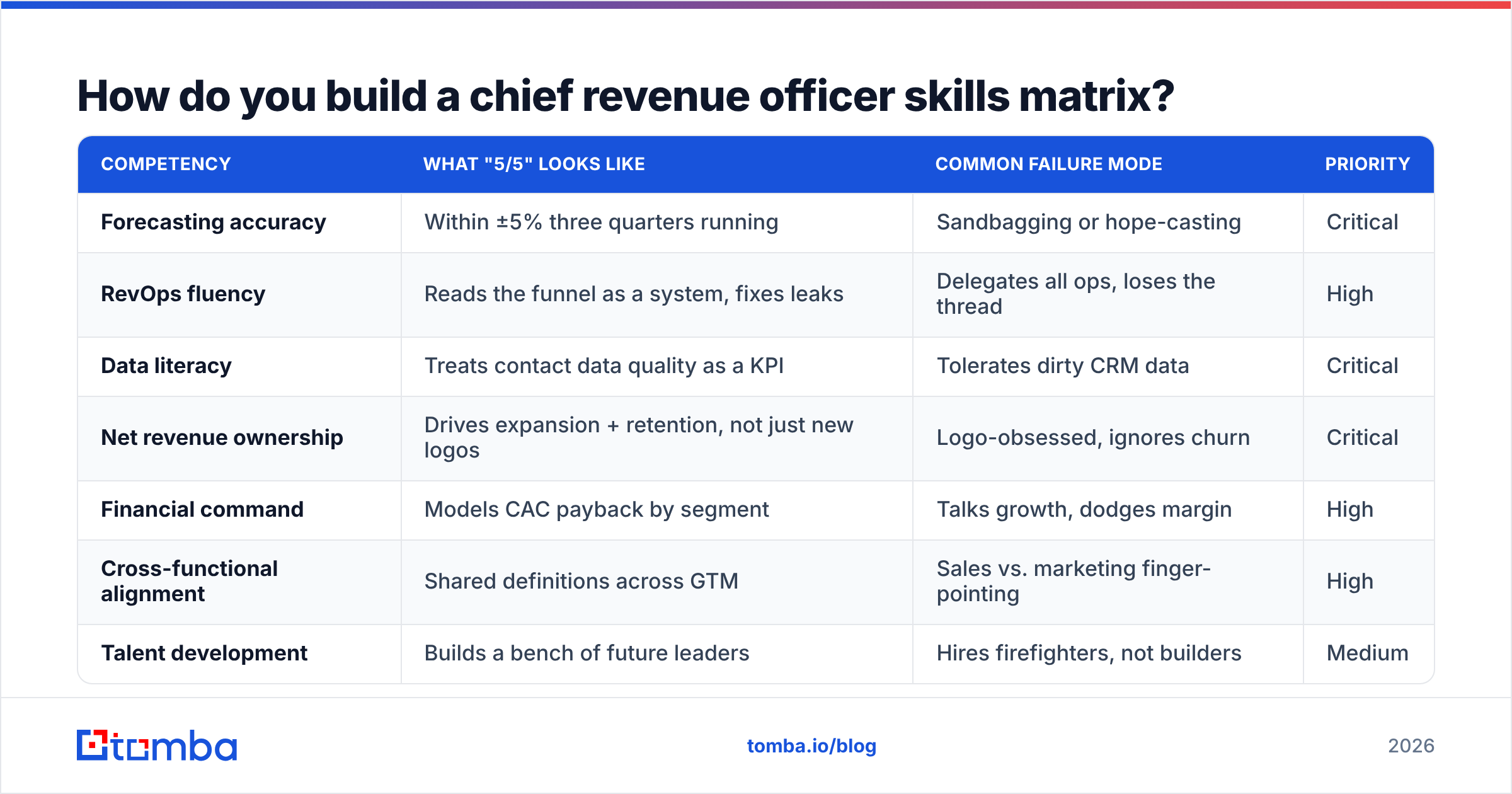
A skills matrix turns a vague "be a better leader" goal into a measurable plan. Score yourself 1–5 on each competency, weight by impact, and you get a ranked development list. Below is a CRO competency table you can adapt for hiring, self-assessment, or a development plan.
| Competency | What "5/5" looks like | Common failure mode | Priority |
|---|---|---|---|
| Forecasting accuracy | Within ±5% three quarters running | Sandbagging or hope-casting | Critical |
| RevOps fluency | Reads the funnel as a system, fixes leaks | Delegates all ops, loses the thread | High |
| Data literacy | Treats contact data quality as a KPI | Tolerates dirty CRM data | Critical |
| Net revenue ownership | Drives expansion + retention, not just new logos | Logo-obsessed, ignores churn | Critical |
| Financial command | Models CAC payback by segment | Talks growth, dodges margin | High |
| Cross-functional alignment | Shared definitions across GTM | Sales vs. marketing finger-pointing | High |
| Talent development | Builds a bench of future leaders | Hires firefighters, not builders | Medium |
| Board narrative | Credible, data-backed story | Vague vision, no numbers | Medium |
The matrix does two things at once. It shows you where you're weak, and it gives you a hiring rubric — because no CRO is a 5 everywhere, and the best ones hire deputies who cover their 2s and 3s.
Why is data literacy the most underrated CRO skill?#
Data literacy is underrated because it looks like an ops problem, but it silently corrupts every CRO decision. Your forecast, your territory design, your comp plan, and your channel ROI all sit on top of the same foundation: the contact and account data in your CRM. When that foundation rots, every number above it is wrong in ways nobody can see.
Picture a forecast built on a pipeline where 20% of the contacts have bounced emails, wrong titles, or left the company. The deals look real on the board. The reps burn hours chasing ghosts. The forecast misses, and nobody can explain why — because the data looked fine in the dashboard. This is the quiet tax that sinks otherwise sharp revenue leaders.
A CRO who treats data quality as a first-class KPI fixes this at the root. That means routine data enrichment of accounts, verified contact records before they enter a sequence, and a hard rule that unverified data doesn't get forecasted. It's unglamorous. It also separates forecasts that hold from forecasts that embarrass you on an earnings call.
The instinct to chase the next shiny tactic while ignoring rotten data is exactly backwards. The CRO who fixes data first makes every later tactic work harder.
What technical and tooling skills does a modern CRO need?#
A modern CRO doesn't need to write SQL, but does need to reason fluently about the GTM tech stack and the data flowing through it. The role has become technical enough that tool-blind leaders get steamrolled by vendors and by their own ops teams.
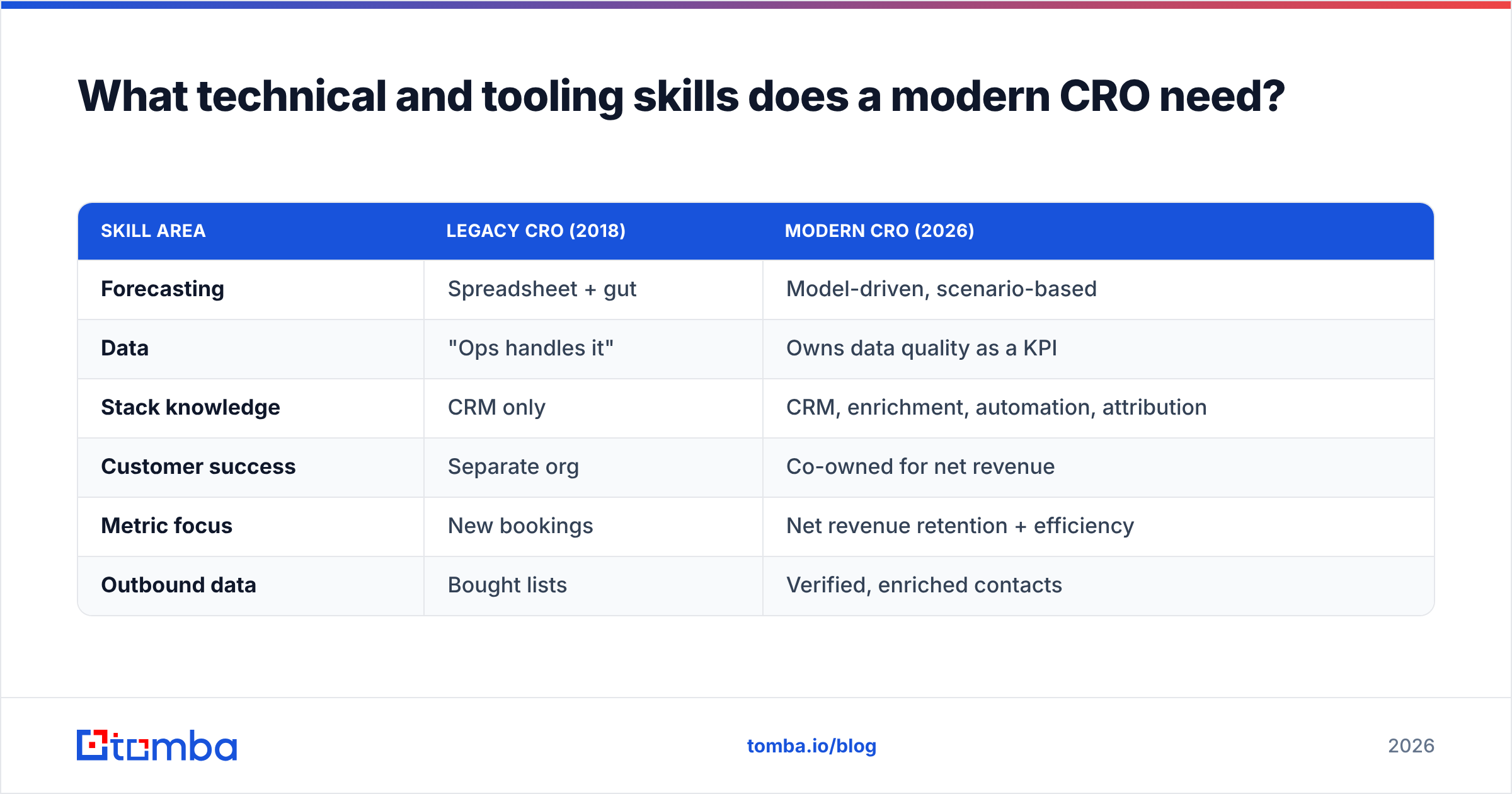
Here's how the old profile compares to what the role demands now:
| Skill area | Legacy CRO (2018) | Modern CRO (2026) |
|---|---|---|
| Forecasting | Spreadsheet + gut | Model-driven, scenario-based |
| Data | "Ops handles it" | Owns data quality as a KPI |
| Stack knowledge | CRM only | CRM, enrichment, automation, attribution |
| Customer success | Separate org | Co-owned for net revenue |
| Metric focus | New bookings | Net revenue retention + efficiency |
| Outbound data | Bought lists | Verified, enriched contacts |
You don't need to operate every tool, but you need to know what good looks like — what a healthy CRM hygiene process is, why verified email beats a purchased list, and how attribution can lie to you. Vendor docs from platforms like HubSpot and Salesforce are worth reading at a conceptual level so you can challenge your own team's assumptions instead of rubber-stamping them.
How do you develop chief revenue officer skills if you're not there yet?#
You develop CRO skills by deliberately taking on the parts of the role you don't naturally gravitate toward — usually the financial and operational ones if you came up through sales. Skill-building here is less about courses and more about reps on real decisions.
A practical 90-day ramp if you're a VP eyeing the CRO seat:
- Days 1–30: Own a forecast end to end. Build it from the data up, defend the assumptions, and track your accuracy ruthlessly. Find out how dirty your pipeline data actually is.
- Days 31–60: Cross the aisle. Spend real time inside marketing and customer success. Map where handoffs leak and where definitions diverge. Improving your response rate on outbound starts with shared data, not more activity.
- Days 61–90: Get fluent in the money. Build a CAC-payback model by segment with your finance partner. Learn to kill a losing channel and reallocate. Practice the board narrative on your own exec team first.
The reps that build a CRO are uncomfortable on purpose. If you only practice the sales motion you already mastered, you'll be a great VP of Sales forever — and that's a real ceiling.
What metrics prove your CRO skills are working?#
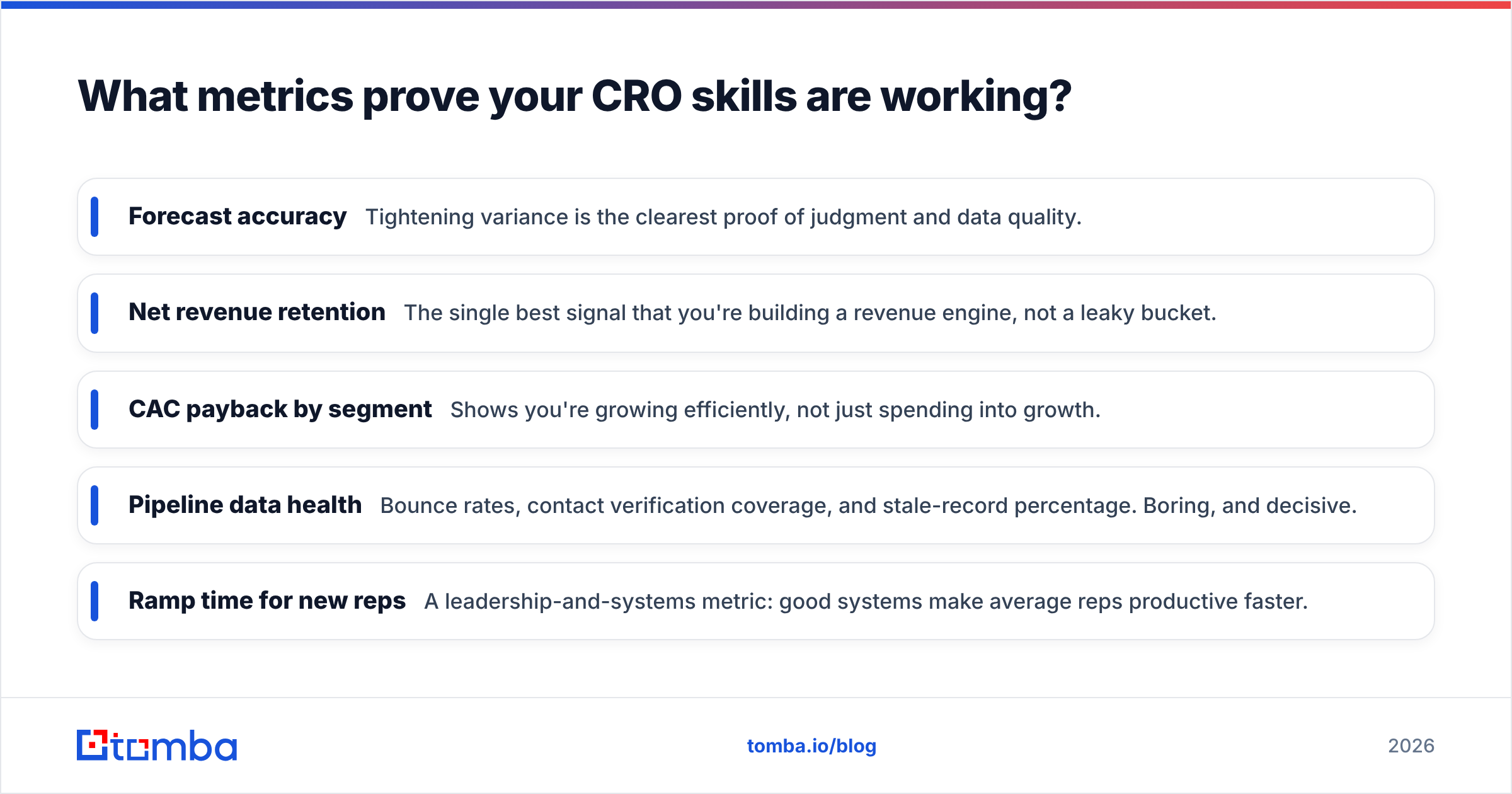
The metrics that prove CRO skill are leading indicators of durable revenue, not just this quarter's bookings. If your skills are real, these move in the right direction over multiple quarters:
- Forecast accuracy — Tightening variance is the clearest proof of judgment and data quality.
- Net revenue retention — The single best signal that you're building a revenue engine, not a leaky bucket.
- CAC payback by segment — Shows you're growing efficiently, not just spending into growth.
- Pipeline data health — Bounce rates, contact verification coverage, and stale-record percentage. Boring, and decisive.
- Ramp time for new reps — A leadership-and-systems metric: good systems make average reps productive faster.
Notice how many of these trace back to data. You can't tighten a forecast on top of a contaminated pipeline, and you can't improve net revenue retention if half your account contacts left the company a year ago. The skill and the data are the same problem wearing two hats.
How do tools support the data side of the CRO role?#
Tools support the CRO by making clean, verified data the default instead of a heroic effort. The skill is knowing data quality matters; the tooling is what makes acting on it sustainable across thousands of records.
This is where a tool like the Tomba Email Finder earns its place in a revenue leader's stack. It finds and verifies professional email addresses by domain, name, or company, so the contacts entering your sequences and your CRM are real before a rep ever touches them. Pair that with data enrichment to keep account records current, and bulk verification to clean lists at scale, and the "dirty pipeline" problem that quietly wrecks forecasts gets much smaller. Plans are straightforward — a free tier to test, then paid tiers from $49/mo as your team scales (see full Tomba pricing).
You're not buying a magic CRO skill in a box. You're removing the data tax that makes every other skill harder to apply. The forecasting, the alignment, the financial command — all of it works better when the underlying contact data is verified instead of hoped-for. If you want to start with the single highest-leverage fix, clean your pipeline data first: spin up the Tomba Email Finder, verify the contacts already sitting in your CRM, and watch how much sharper your next forecast gets.
// get started
Find, verify and enrich your first contacts today
Start on the free plan with 25 searches a month, then scale when your team is ready.
Free plan · No credit card required · GDPR & CCPA
// about the author