Best Chili Piper Alternatives for 2026: Top 7 Compared
Chili Piper is powerful but pricey. Here are the 7 best Chili Piper alternatives for 2026, compared on routing, scheduling, pricing, and the data layer that makes inbound conversion actually work.

Best Chili Piper Alternatives for 2026
Chili Piper made "book a meeting from the form" a category. But the price tag, the seat minimums, and the steep setup have a lot of revenue teams asking what else is out there. If you are evaluating Chili Piper alternatives in 2026, this guide compares the seven that actually compete on inbound routing, scheduling, and conversion — and shows where each one wins.
TL;DR#
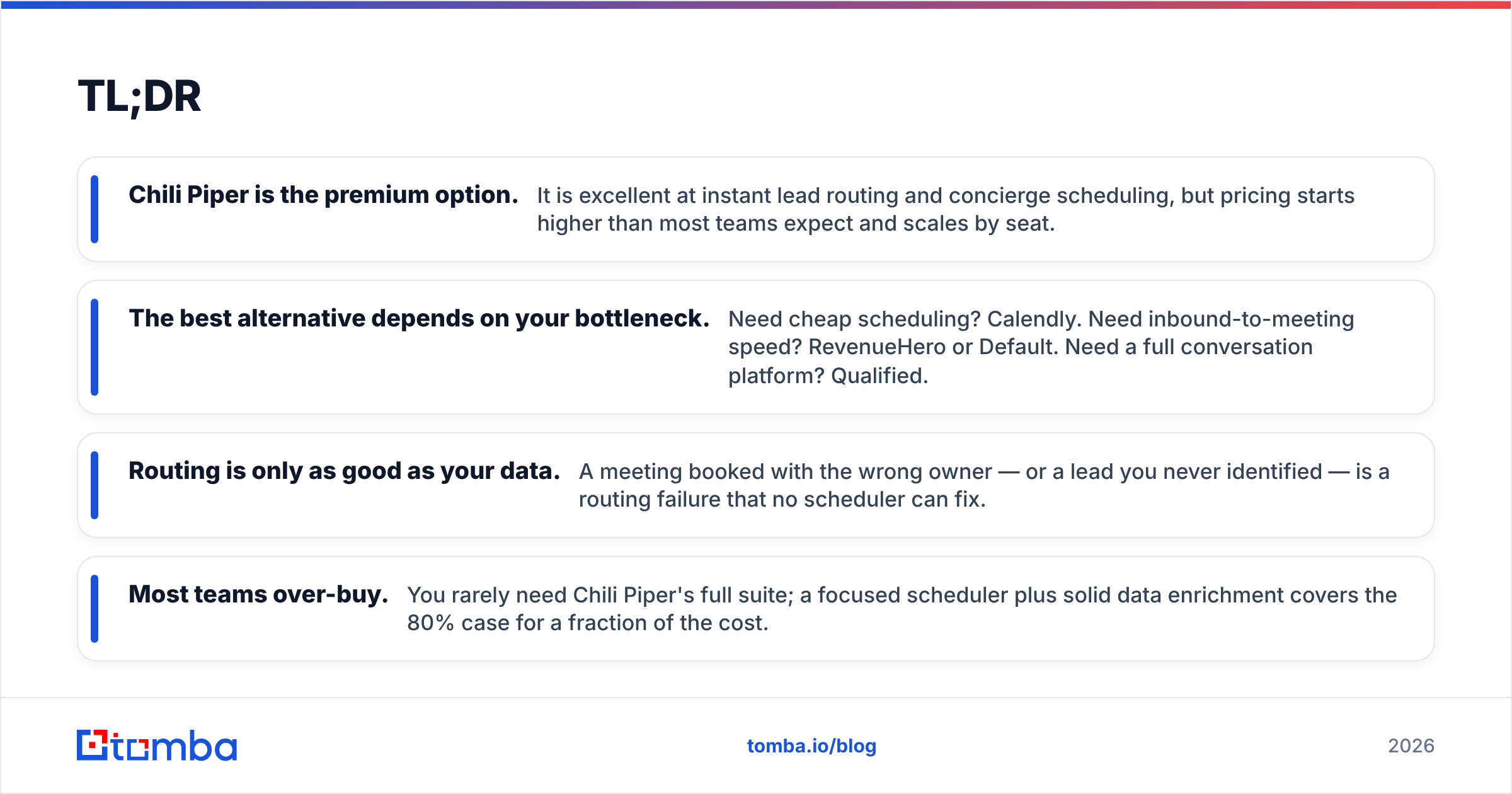
- Chili Piper is the premium option. It is excellent at instant lead routing and concierge scheduling, but pricing starts higher than most teams expect and scales by seat.
- The best alternative depends on your bottleneck. Need cheap scheduling? Calendly. Need inbound-to-meeting speed? RevenueHero or Default. Need a full conversation platform? Qualified.
- Routing is only as good as your data. A meeting booked with the wrong owner — or a lead you never identified — is a routing failure that no scheduler can fix.
- Most teams over-buy. You rarely need Chili Piper's full suite; a focused scheduler plus solid data enrichment covers the 80% case for a fraction of the cost.
What does Chili Piper actually do?#
Chili Piper is an inbound conversion platform. Its job is to shrink the gap between "a prospect fills out your form" and "that prospect is talking to the right rep." It does three things well:
- Form concierge — qualifies and routes a web lead the instant the form is submitted, then offers a calendar to book on the spot.
- Lead routing — assigns leads to the correct owner based on territory, account ownership, round-robin, or custom rules synced from your CRM.
- Scheduling and handoff — group booking, reminders, reschedules, and rep handoffs so SDR-to-AE transitions do not leak.
That speed-to-lead value is real. The friction is everything around it: pricing that climbs with seats, a setup that often needs RevOps help, and a feature surface most small teams never fully use. Those three pain points are exactly why people search for alternatives.

Why look for a Chili Piper alternative?#
Three reasons come up again and again:
- Cost. Chili Piper is positioned upmarket. For a 3–10 person team, the per-seat math gets uncomfortable fast, especially when you only need scheduling and basic routing.
- Complexity. The platform rewards heavy configuration. If you do not have a RevOps owner, time-to-value is long.
- Scope mismatch. Many buyers want one or two of Chili Piper's jobs (scheduling, or routing) — not the whole conversion suite. Paying for the suite to use a slice is poor value.
If any of those describe you, a more focused or lower-cost tool will likely serve you better.
What are the best Chili Piper alternatives in 2026?#
Here is the short list, grouped by what they replace:
- Calendly — the scheduling workhorse. Best when meetings, not routing, are the bottleneck.
- RevenueHero — purpose-built inbound speed-to-lead, often the closest like-for-like at lower cost.
- Default — modern form-to-meeting routing with a clean builder, popular with PLG and mid-market teams.
- Qualified — conversational marketing plus routing; strongest if you sell on Salesforce and want chat + meetings.
- Demodesk — scheduling and meeting intelligence in one, good for demo-heavy teams.
- Kronologic — AI scheduling that negotiates times automatically across large lead volumes.
- HubSpot Meetings — free-to-cheap scheduling baked into the HubSpot CRM you may already own.
How they compare at a glance#
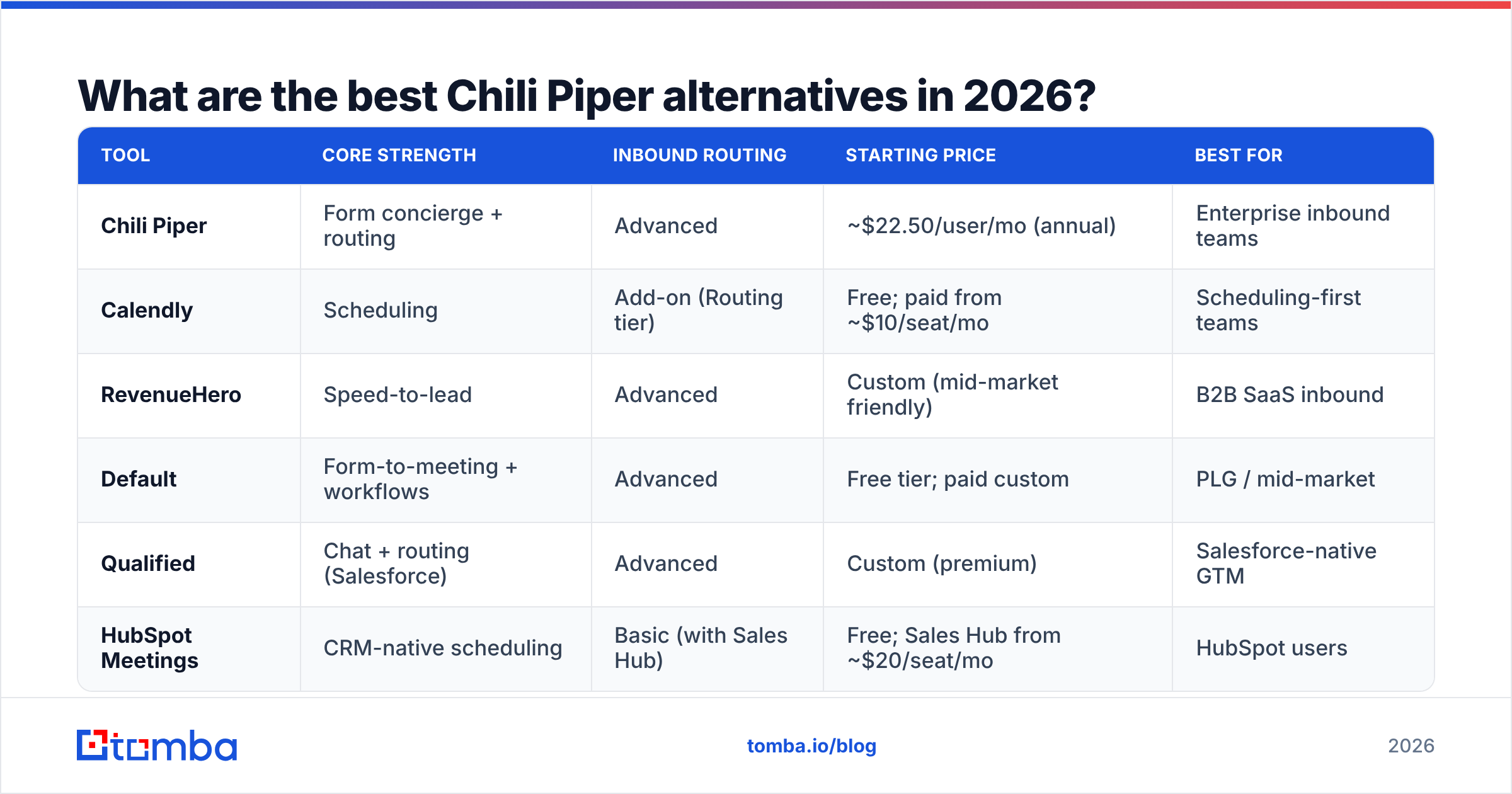
| Tool | Core strength | Inbound routing | Starting price | Best for |
|---|---|---|---|---|
| Chili Piper | Form concierge + routing | Advanced | ~$22.50/user/mo (annual) | Enterprise inbound teams |
| Calendly | Scheduling | Add-on (Routing tier) | Free; paid from ~$10/seat/mo | Scheduling-first teams |
| RevenueHero | Speed-to-lead | Advanced | Custom (mid-market friendly) | B2B SaaS inbound |
| Default | Form-to-meeting + workflows | Advanced | Free tier; paid custom | PLG / mid-market |
| Qualified | Chat + routing (Salesforce) | Advanced | Custom (premium) | Salesforce-native GTM |
| HubSpot Meetings | CRM-native scheduling | Basic (with Sales Hub) | Free; Sales Hub from ~$20/seat/mo | HubSpot users |
Prices are list/entry indicators as of 2026 and change often — confirm on each vendor's site before you buy.
Is Calendly a good Chili Piper alternative?#
Yes — if your problem is scheduling, not routing. Calendly is the most widely adopted scheduler on the market, and its higher tiers now include routing forms that send leads to the right rep and qualify before booking. It is cheaper, dramatically simpler to launch, and your prospects already know how to use it.
Where it falls short of Chili Piper: instant form concierge and CRM-driven account ownership routing are less sophisticated, and the deepest routing features sit behind the higher plans. If "speed-to-lead in seconds, routed by Salesforce account owner" is your core requirement, Calendly is a step down. For everything else, it is a better deal. You can read their plan breakdown on the Calendly site.
Which alternative is best for speed-to-lead?#
RevenueHero and Default are the two to shortlist. Both were built in the post-Chili-Piper era specifically to attack inbound speed-to-lead, and both tend to undercut Chili Piper on price while matching the core "qualify, route, and book instantly from the form" workflow.
- RevenueHero focuses tightly on inbound conversion: it identifies the visitor, checks them against your CRM, applies routing rules, and books in one motion. Teams that pick it usually want Chili Piper's flagship behavior without the flagship bill.
- Default bundles form-to-meeting routing with broader GTM workflow automation, which appeals to teams that want one tool to handle routing and downstream actions.
Both compete directly with Chili Piper's defining feature, so they belong on any serious shortlist. Compare them against the original on G2 to see current side-by-side reviews from teams your size.
What about Salesforce-native and CRM-bundled options?#
If your CRM is the center of gravity, two routes make sense:
- Qualified is the strongest choice for Salesforce-native teams that also want conversational marketing. It combines live chat, bots, and meeting booking with routing that reads directly from Salesforce — effectively a conversion platform, not just a scheduler. It is premium-priced, so it competes with Chili Piper at the top, not the bottom.
- HubSpot Meetings is the pragmatic pick if you already pay for HubSpot. Scheduling is free, it writes straight to the CRM, and Sales Hub adds basic routing. It will not match Chili Piper's routing depth, but for many teams "already owned and good enough" wins. See what is included on HubSpot, and note that Tomba offers a native HubSpot integration so enriched contacts flow in cleanly.
The thing every routing tool depends on: data#
Here is the part the comparison tables miss. Every tool above assumes you already know who the lead is and which account they belong to. Routing rules fire on company, title, territory, and CRM ownership. If those fields are missing, wrong, or stale, your shiny scheduler routes a strategic enterprise lead to the wrong rep — or to a round-robin black hole.

Two data gaps quietly break inbound conversion:
- Anonymous and partial form fills. A prospect submits a work email and nothing else. Without enrichment, your routing logic has almost no signal to work with.
- Decision-maker reach after the meeting. The form-filler is rarely the only stakeholder. To run a real deal you need the rest of the buying committee.
This is where a data layer sits underneath whichever scheduler you choose. With Tomba you can:
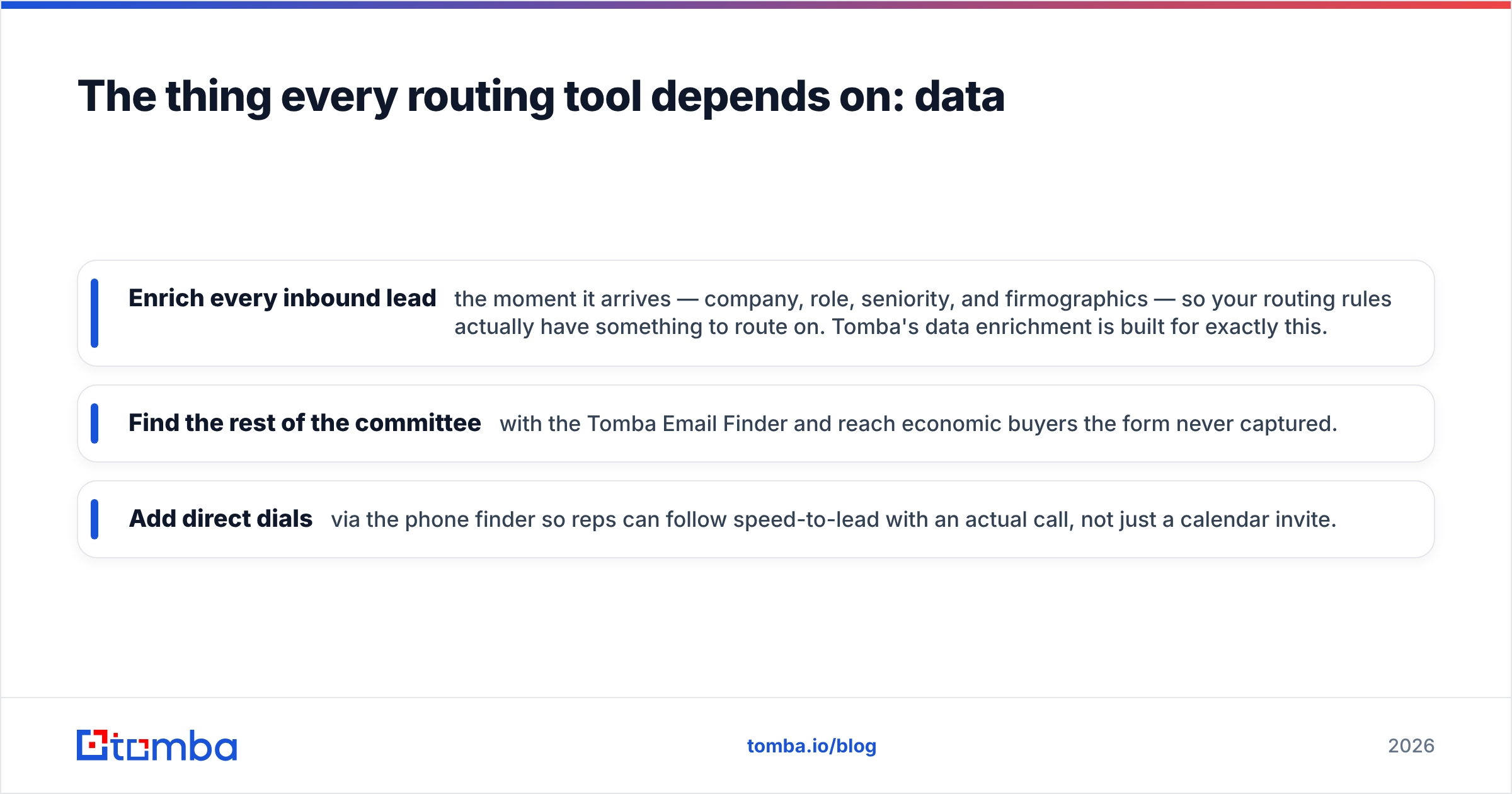
- Enrich every inbound lead the moment it arrives — company, role, seniority, and firmographics — so your routing rules actually have something to route on. Tomba's data enrichment is built for exactly this.
- Find the rest of the committee with the Tomba Email Finder and reach economic buyers the form never captured.
- Add direct dials via the phone finder so reps can follow speed-to-lead with an actual call, not just a calendar invite.
No scheduler replaces this. Chili Piper and its alternatives move leads fast; clean data decides whether they move to the right place.
How to pick: a 5-point checklist#
- Name your bottleneck. Scheduling friction → Calendly/HubSpot. Slow inbound handoff → RevenueHero/Default. Chat + routing on Salesforce → Qualified.
- Count real seats. Per-seat tools punish growing teams. Model the cost at next year's headcount, not today's.
- Audit your CRM data first. Routing on dirty data is worse than no routing. Fix enrichment before you buy a router.
- Check native integrations. Your scheduler must write to your CRM and read ownership without brittle Zapier glue.
- Demand a real trial. Run live inbound traffic through it for two weeks before committing annually.
Chili Piper vs the field: which should you choose?#
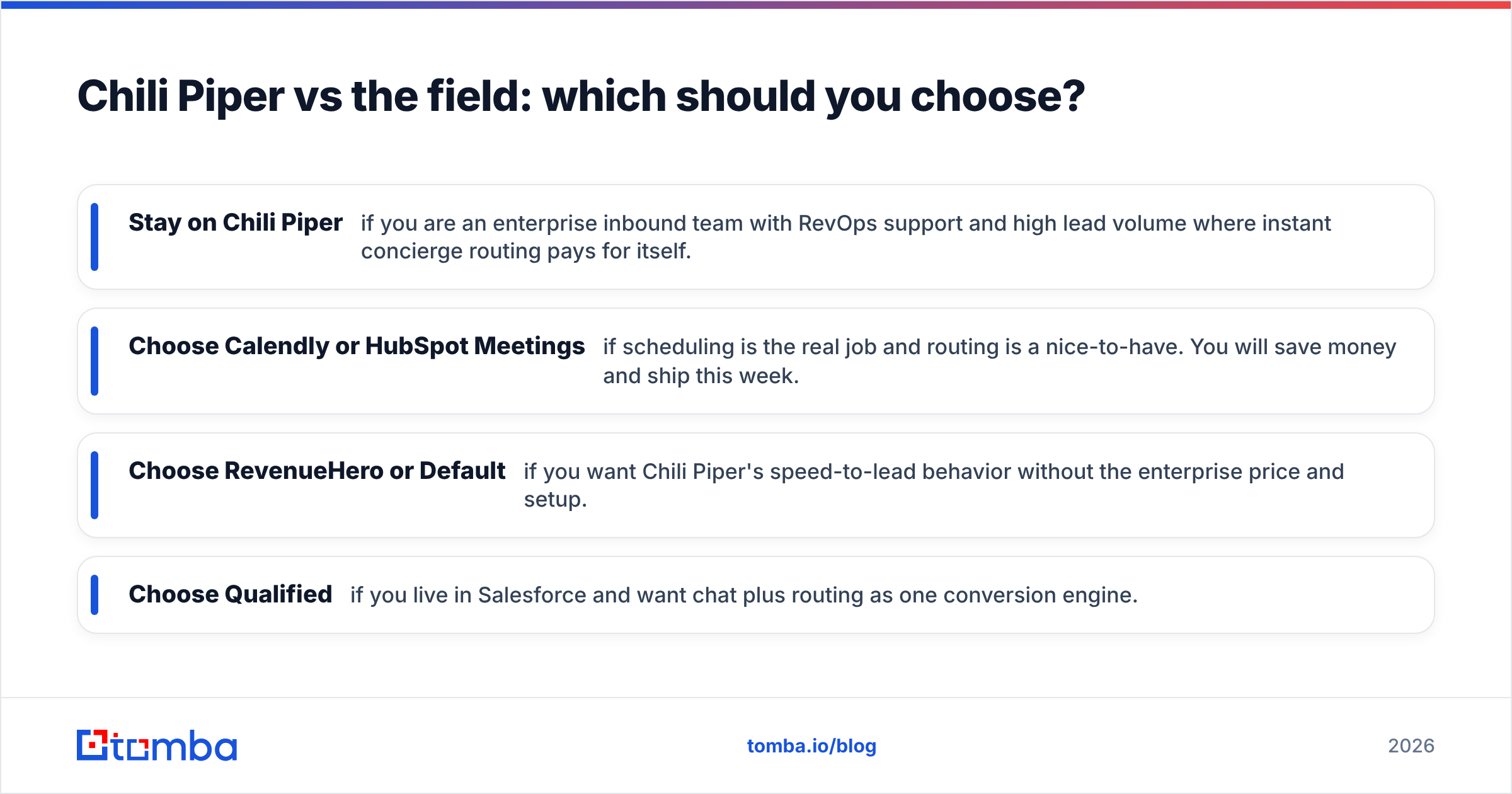
- Stay on Chili Piper if you are an enterprise inbound team with RevOps support and high lead volume where instant concierge routing pays for itself.
- Choose Calendly or HubSpot Meetings if scheduling is the real job and routing is a nice-to-have. You will save money and ship this week.
- Choose RevenueHero or Default if you want Chili Piper's speed-to-lead behavior without the enterprise price and setup.
- Choose Qualified if you live in Salesforce and want chat plus routing as one conversion engine.
Whatever you land on, remember the layer beneath all of them. A router is a traffic cop; it can only direct the cars it can see. The teams that win inbound in 2026 pair a focused scheduler with a strong identity and enrichment layer — so every form fill is identified, enriched, routed correctly, and followed up across the whole buying committee.
Start there. Use the Tomba Email Finder and enrichment to turn thin form submissions into complete, routable records, then let whichever scheduler you choose do what it does best. Spin up a free account (25 searches a month) and check current Tomba pricing — Starter is $49/mo — before you commit to any routing platform's annual contract.
// get started
Find, verify and enrich your first contacts today
Start on the free plan with 25 searches a month, then scale when your team is ready.
Free plan · No credit card required · GDPR & CCPA
// about the author