Chili Piper Pricing, Reviews, Pros and Cons (2026 Guide)
A no-fluff breakdown of Chili Piper pricing, real user reviews, and the honest pros and cons before you commit budget to inbound scheduling and lead routing in 2026.
Chili Piper turns inbound demo requests into booked meetings the moment a lead hits "submit." That speed is the whole pitch — and it is also why teams argue about whether the price tag is worth it. This guide breaks down Chili Piper pricing, the real reviews behind the marketing, and the pros and cons you should weigh before signing an annual contract in 2026.
TL;DR#
- Chili Piper pricing starts around $22.50/user/month (Instant Booker, billed annually) and climbs fast once you add routing, distribution, and handoff modules — most real deals land at $1,000+/month.
- Best for: mid-market and enterprise revenue teams with heavy inbound volume and a HubSpot or Salesforce CRM to route into.
- Pros: lightning-fast inbound scheduling, smart lead routing, strong calendar/CRM sync, and measurable conversion lift on demo forms.
- Cons: per-seat costs stack quickly, a learning curve on routing rules, annual billing pressure, and overkill for small teams that just need a booking link.
- Bottom line: great product if inbound speed-to-lead is your bottleneck; expensive if you only need calendar scheduling — and useless without clean contact data feeding it.
What is Chili Piper and what does it actually do?#
Chili Piper is a B2B "demand conversion" platform. Think of it as the bouncer and the concierge at the front door of your pipeline: when a prospect fills out a form, Chili Piper instantly qualifies them, decides which rep owns them, and books the meeting before they lose interest — all in a few seconds.
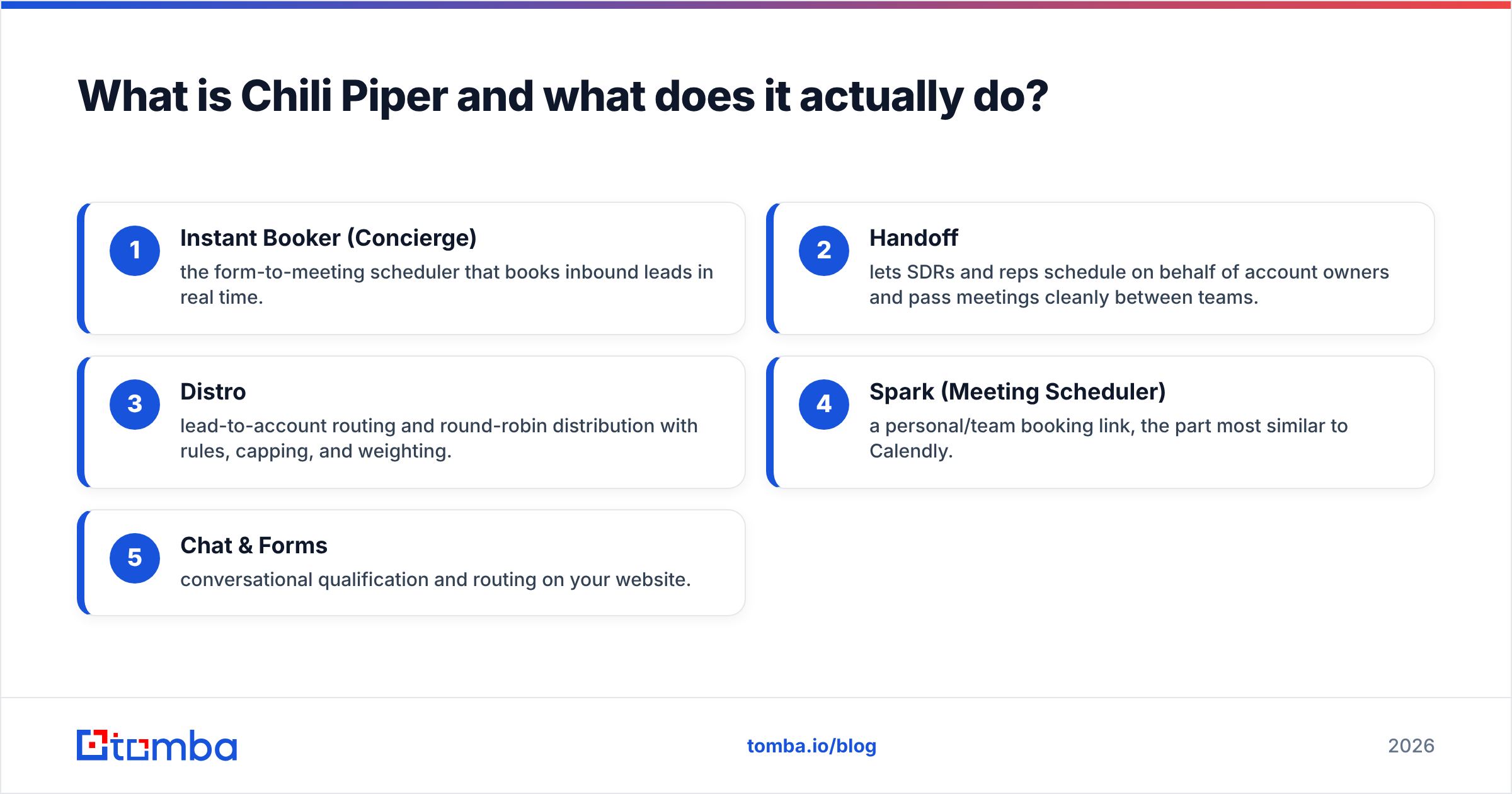
It is not a single tool. The platform is a bundle of modules, and that bundling is the key to understanding Chili Piper pricing. The main products are:
- Instant Booker (Concierge) — the form-to-meeting scheduler that books inbound leads in real time.
- Handoff — lets SDRs and reps schedule on behalf of account owners and pass meetings cleanly between teams.
- Distro — lead-to-account routing and round-robin distribution with rules, capping, and weighting.
- Spark (Meeting Scheduler) — a personal/team booking link, the part most similar to Calendly.
- Chat & Forms — conversational qualification and routing on your website.
The official breakdown lives on the Chili Piper homepage, but the short version is this: you rarely buy one module. Most teams that get value from Chili Piper combine Instant Booker with Distro, and that is where the real cost shows up.

How much does Chili Piper pricing cost in 2026?#
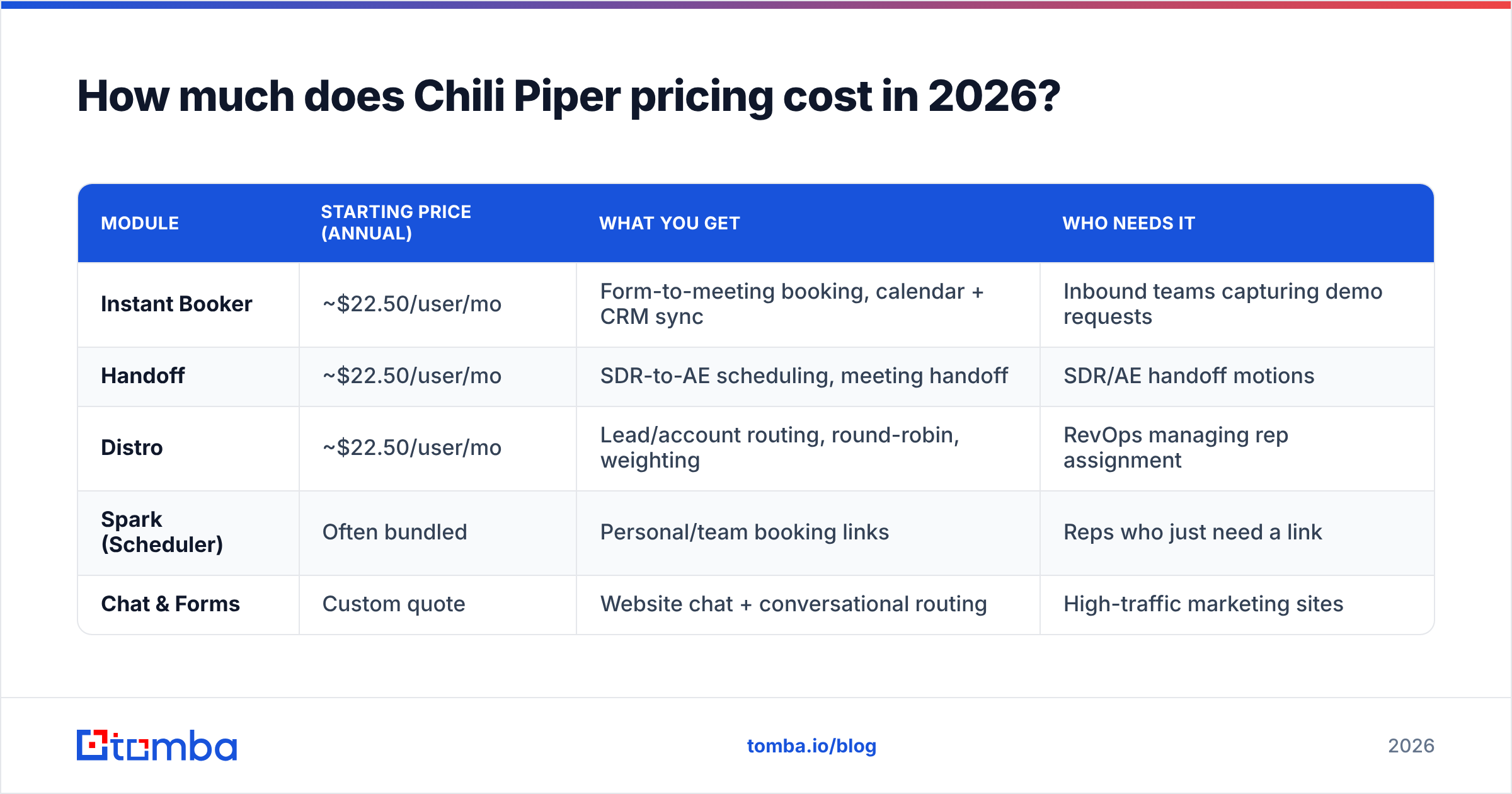
Chili Piper uses per-seat, modular pricing billed annually, and the published numbers are a floor, not a ceiling. Here is the practical breakdown most buyers see when they get a quote.
| Module | Starting price (annual) | What you get | Who needs it |
|---|---|---|---|
| Instant Booker | ~$22.50/user/mo | Form-to-meeting booking, calendar + CRM sync | Inbound teams capturing demo requests |
| Handoff | ~$22.50/user/mo | SDR-to-AE scheduling, meeting handoff | SDR/AE handoff motions |
| Distro | ~$22.50/user/mo | Lead/account routing, round-robin, weighting | RevOps managing rep assignment |
| Spark (Scheduler) | Often bundled | Personal/team booking links | Reps who just need a link |
| Chat & Forms | Custom quote | Website chat + conversational routing | High-traffic marketing sites |
A few things the price page does not shout about:
- Per-seat math compounds. At ~$22.50/user/month for one module, a 20-rep team on two modules is roughly $900/month — before chat, forms, or premium support.
- Annual billing is effectively the only sane option. Month-to-month rates are higher, and most discounts require a 12-month commitment.
- Enterprise is a custom quote. SSO, advanced security, dedicated support, and higher API limits push you into a sales conversation with no public number.
So when someone asks "what is Chili Piper pricing?" the honest answer is: budget $1,000–$3,000+/month for a real multi-module deployment on a mid-market team, and more at enterprise scale. For exact current figures, check the Chili Piper pricing page directly, since vendors adjust tiers often.
Is Chili Piper worth it? What the reviews say#
Across G2 reviews, Chili Piper consistently scores well (mid-4-star range) with a clear pattern in the feedback.
What reviewers praise:
- Speed-to-lead. The recurring theme is that booking a meeting instantly — instead of an email tag game — measurably lifts demo show rates and conversion. For teams where speed-to-lead is the constraint, the ROI is easy to defend.
- Routing accuracy. Distro's rules for territory, account ownership, and round-robin get strong marks from RevOps users who previously juggled spreadsheets.
- CRM depth. Native, reliable sync with Salesforce and HubSpot, including writing meeting data back to the right records.
What reviewers complain about:
- Price and per-seat creep. The most common criticism. Teams feel the cost grows faster than headcount because value is gated behind multiple modules.
- Setup complexity. Routing rules and handoff logic are powerful but not plug-and-play; several reviewers mention needing an admin or RevOps owner.
- Support and billing friction. Annual contracts and renewal negotiations draw occasional frustration, especially from smaller accounts.
The signal is consistent: heavy inbound teams love it, lean teams find it expensive and over-engineered for their needs.
What are the pros and cons of Chili Piper?#
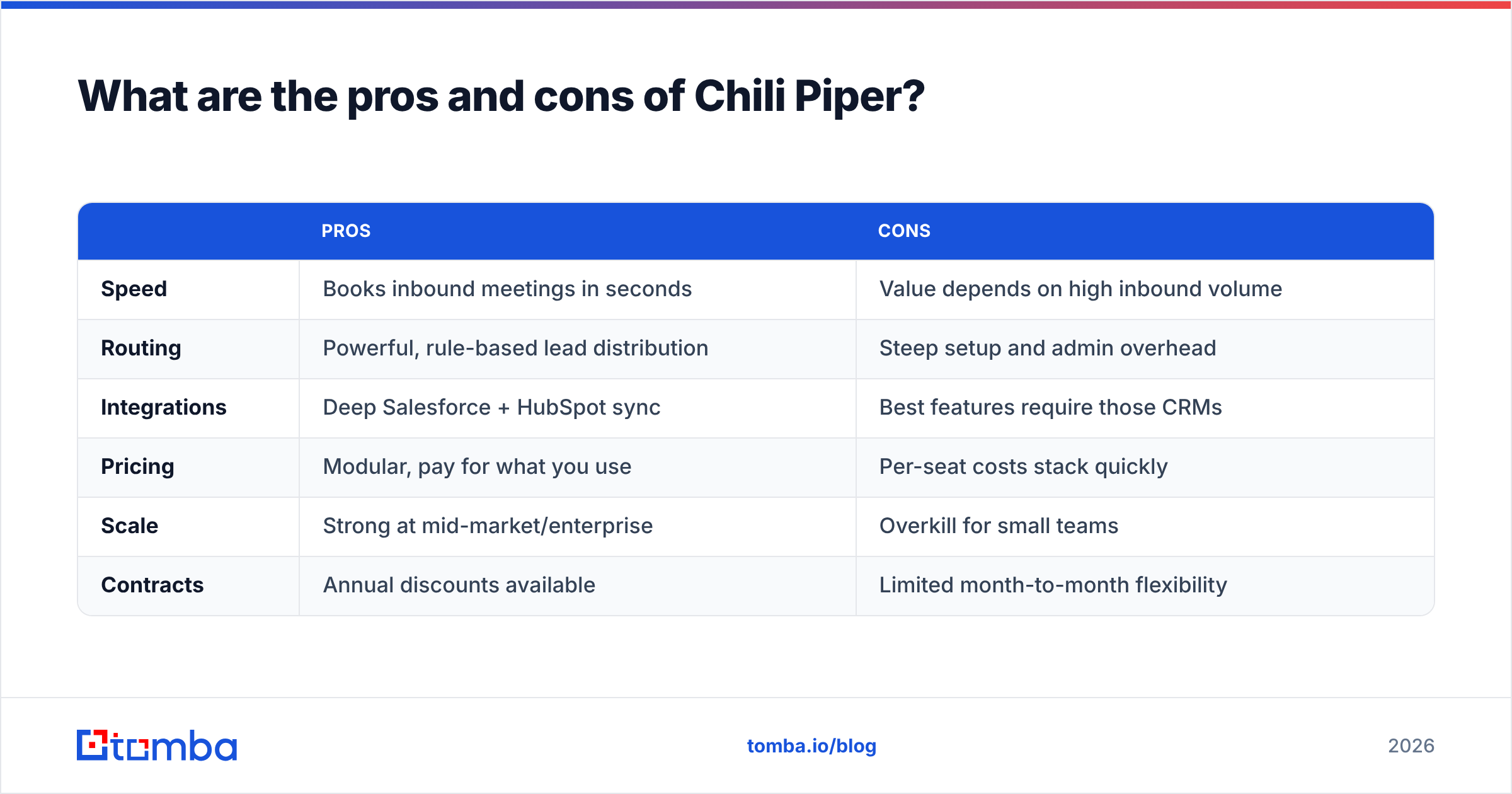
Here is the balanced view, distilled.
| Pros | Cons | |
|---|---|---|
| Speed | Books inbound meetings in seconds | Value depends on high inbound volume |
| Routing | Powerful, rule-based lead distribution | Steep setup and admin overhead |
| Integrations | Deep Salesforce + HubSpot sync | Best features require those CRMs |
| Pricing | Modular, pay for what you use | Per-seat costs stack quickly |
| Scale | Strong at mid-market/enterprise | Overkill for small teams |
| Contracts | Annual discounts available | Limited month-to-month flexibility |
Choose Chili Piper if: you run a mature inbound motion, have a CRM worth routing into, and a RevOps owner who can maintain the rules. Skip it if: you are a small team that mainly needs a personal booking link — a cheaper scheduler will do the same job.
How does Chili Piper compare to alternatives?#
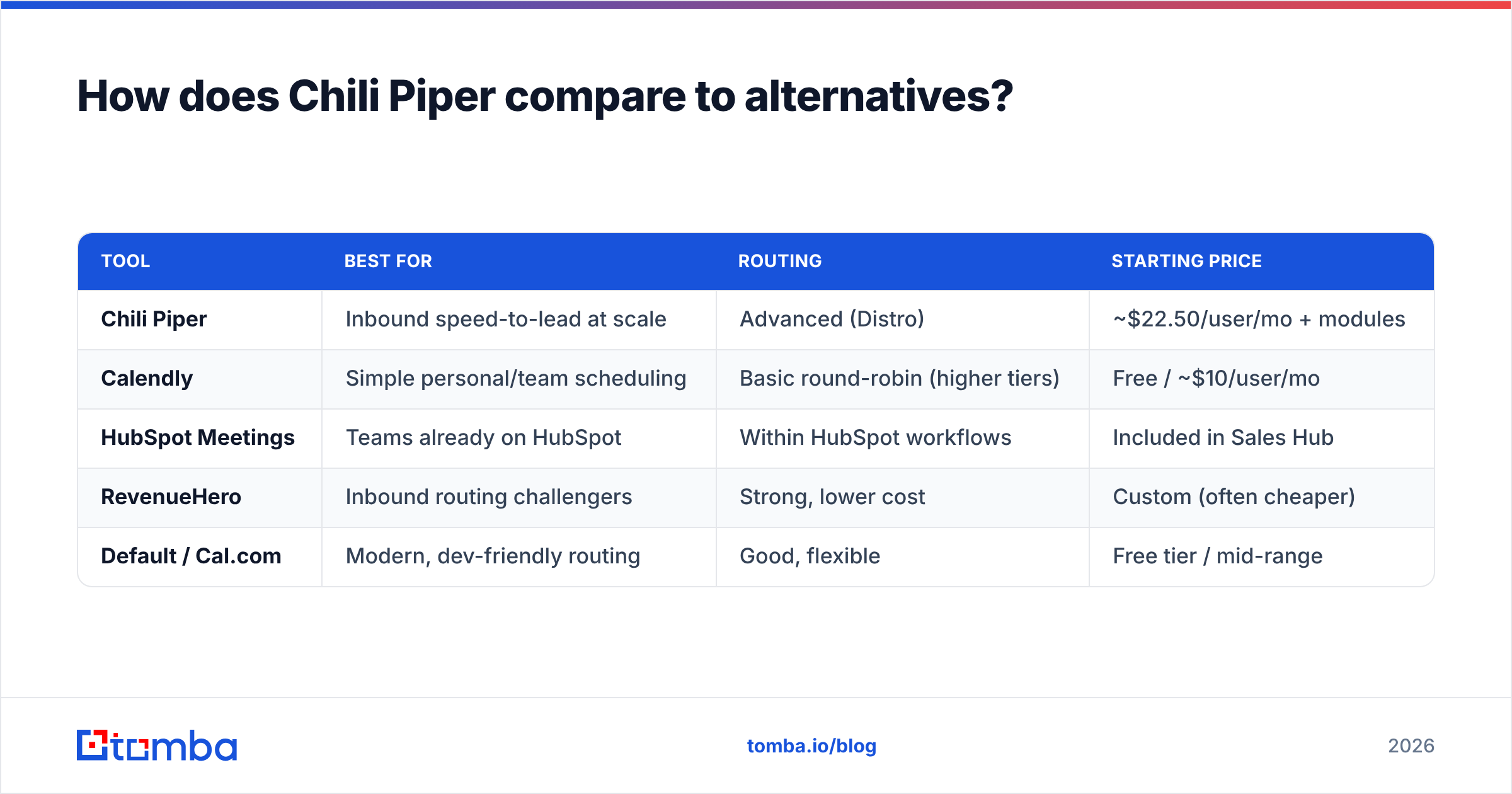
Chili Piper sits at the premium end. Depending on what you actually need, lighter or cheaper options may fit better.
| Tool | Best for | Routing | Starting price |
|---|---|---|---|
| Chili Piper | Inbound speed-to-lead at scale | Advanced (Distro) | ~$22.50/user/mo + modules |
| Calendly | Simple personal/team scheduling | Basic round-robin (higher tiers) | Free / ~$10/user/mo |
| HubSpot Meetings | Teams already on HubSpot | Within HubSpot workflows | Included in Sales Hub |
| RevenueHero | Inbound routing challengers | Strong, lower cost | Custom (often cheaper) |
| Default / Cal.com | Modern, dev-friendly routing | Good, flexible | Free tier / mid-range |
The trade-off is almost always simplicity and price vs. routing depth. Calendly and HubSpot Meetings win on ease and budget; Chili Piper wins when routing complexity and instant booking genuinely move revenue. HubSpot publishes its own scheduling capabilities on the HubSpot site if you want to compare native options before adding a third-party tool.

The hidden dependency: Chili Piper is only as good as your data#
Here is the part the pricing debate misses. Chili Piper routes and books — it does not find the people. A scheduler that instantly assigns a lead to the wrong rep, or books a meeting against a stale, unverified contact record, just automates a bad outcome faster.
Speed-to-lead only pays off when the lead is real, enriched, and correctly attributed. That means:
- Verified contact data so meetings don't bounce on dead email addresses.
- Enriched records (title, company, seniority) so routing rules fire correctly.
- Direct phone numbers for reps who follow a booked meeting with a call.
This is where a data layer earns its place upstream of any scheduler. Tomba's data enrichment fills in the firmographic and contact fields your routing rules depend on, while the email verifier keeps your inbound records clean so confirmation emails actually land. If you also work outbound, the email finder and phone finder build the contact list that feeds the top of the same funnel.
And because both platforms revolve around the CRM, the integration story matters: Tomba connects to the same systems Chili Piper books into, including HubSpot and Salesforce, so enriched contacts and verified emails flow into the records your scheduler routes on.
Does Chili Piper pricing make sense for small teams?#
Usually not. If your inbound volume is low, the per-seat, multi-module model is hard to justify. A founder-led or sub-10-rep team typically needs:
- A booking link — Calendly free or a lightweight scheduler covers this.
- Clean lead data — far more impactful at small scale than instant routing.
- A simple round-robin — available in cheaper tools or even your CRM.
Spend the Chili Piper budget on data quality and outreach first. You can always add instant scheduling once inbound volume creates a real speed-to-lead problem worth $1,000+/month to solve. Reverse the order and you are paying premium prices to route a trickle of leads.
How do you decide? A quick buying checklist#
Run through these before you commit:
- Inbound volume: Are you losing meetings to slow follow-up today? If not, hold off.
- CRM fit: Are you on Salesforce or HubSpot? If you're on neither, much of the value evaporates.
- RevOps ownership: Do you have someone to build and maintain routing rules?
- Module need: Do you truly need Distro and Handoff, or just a booking link?
- Data readiness: Is your contact data verified and enriched enough to route accurately?
- Budget horizon: Can you commit annually, and does the per-seat math still pencil out at next year's headcount?
If you answer "yes" to most of these, Chili Piper is a strong buy. If you stall on volume, CRM, or data readiness, fix those first.
Final verdict and where to start#
Chili Piper is a premium, high-performing inbound conversion platform — excellent for mature revenue teams with real speed-to-lead problems, and overpriced for everyone else. The pros (instant booking, smart routing, deep CRM sync) are real; the cons (per-seat creep, setup complexity, annual lock-in) are equally real. The deciding factor is rarely the tool itself — it's whether the leads flowing into it are accurate enough to route and book.
Before you spend on scheduling, make sure the data underneath it is solid. Start with the Tomba Email Finder to build and verify the contact records your CRM and any scheduler depend on — its free tier gives you 25 searches a month, and paid plans start at $49/month with no module-by-module upsell. Pair clean, enriched data with the right scheduler, and you get speed-to-lead that actually converts instead of just moving fast. See full Tomba pricing to size it to your team.
Ready to find emails that actually work?
Join 150,000+ professionals who stopped guessing and started sending. Free credits on signup — no credit card required.
Get the Tomba newsletter
Practical outbound tactics and product updates — once every two weeks.
About the author