Chili Piper vs LeanData 2026: Lead Routing Tools Compared
Chili Piper vs LeanData, broken down for 2026: routing logic, scheduling, pricing, and which RevOps stack actually books more meetings from your inbound leads.
Choosing between Chili Piper and LeanData is really a choice about where your revenue team feels the most pain: the speed-to-lead moment when a form gets submitted, or the messy matching logic that decides who owns that lead in the first place. Both tools sit in the same RevOps neighborhood, but they were built to solve different problems first.
This guide breaks down how they compare in 2026 — routing, scheduling, matching, pricing, and the kind of team each one fits.
TL;DR#
- Chili Piper is scheduling-first. Its flagship strength is "Concierge" — instant inbound meeting booking that qualifies and routes a lead the moment a form is submitted.
- LeanData is routing-first. It started as the lead-to-account matching and flow-builder layer on top of Salesforce, and that orchestration depth is still its core advantage.
- Pricing: both are quote-based and enterprise-leaning; expect Chili Piper around $22.50/user/mo for Instant Booker tiers and LeanData routing starting around $39/user/mo, with real costs landing far higher at scale.
- Pick Chili Piper if booking inbound meetings fast is the bottleneck. Pick LeanData if complex assignment rules, account matching, and lifecycle orchestration are the bottleneck.
- Neither fixes bad data. Routing speed is wasted if the contact record is wrong — clean enrichment upstream is what makes either tool pay off.
What is Chili Piper?#
Chili Piper is a scheduling and inbound conversion platform. Think of it as the host at a busy restaurant: the moment a guest walks in (submits a form), it checks the reservation book, decides which server is free, and walks them to the table — all before they can wander off.
Its best-known module, Concierge (now packaged under "Form Concierge" and "Instant Booker"), qualifies a web lead in real time, routes it to the right rep based on territory or round-robin rules, and drops a calendar booking widget directly into the form flow. The payoff is speed-to-lead measured in seconds, not hours.
Chili Piper also covers handoff scheduling (passing prospects between SDRs and AEs), distribution for outbound, and a "Chili Calendar" layer that competes with Calendly for individual booking links. The center of gravity, though, is converting inbound demand into booked meetings.

What is LeanData?#
LeanData is a lead-to-account matching and revenue orchestration platform built natively on Salesforce. If Chili Piper is the host at the door, LeanData is the dispatcher in the back office deciding which truck handles which delivery based on a wall of rules.
Its signature feature is the visual FlowBuilder — a drag-and-drop graph where RevOps teams design how leads, contacts, accounts, and opportunities get matched, deduplicated, and assigned. LeanData's matching engine is what lets it connect an inbound lead to an existing account record even when the email domain, company name, or spelling don't line up cleanly.
Beyond routing, LeanData layers in BookIt (its scheduling product, added to challenge Chili Piper head-on), buying-group orchestration for ABM motions, and lifecycle automation that moves records through stages. The brand reputation, though, was built on getting assignment right in complex Salesforce orgs.
Chili Piper vs LeanData: how do they compare?#
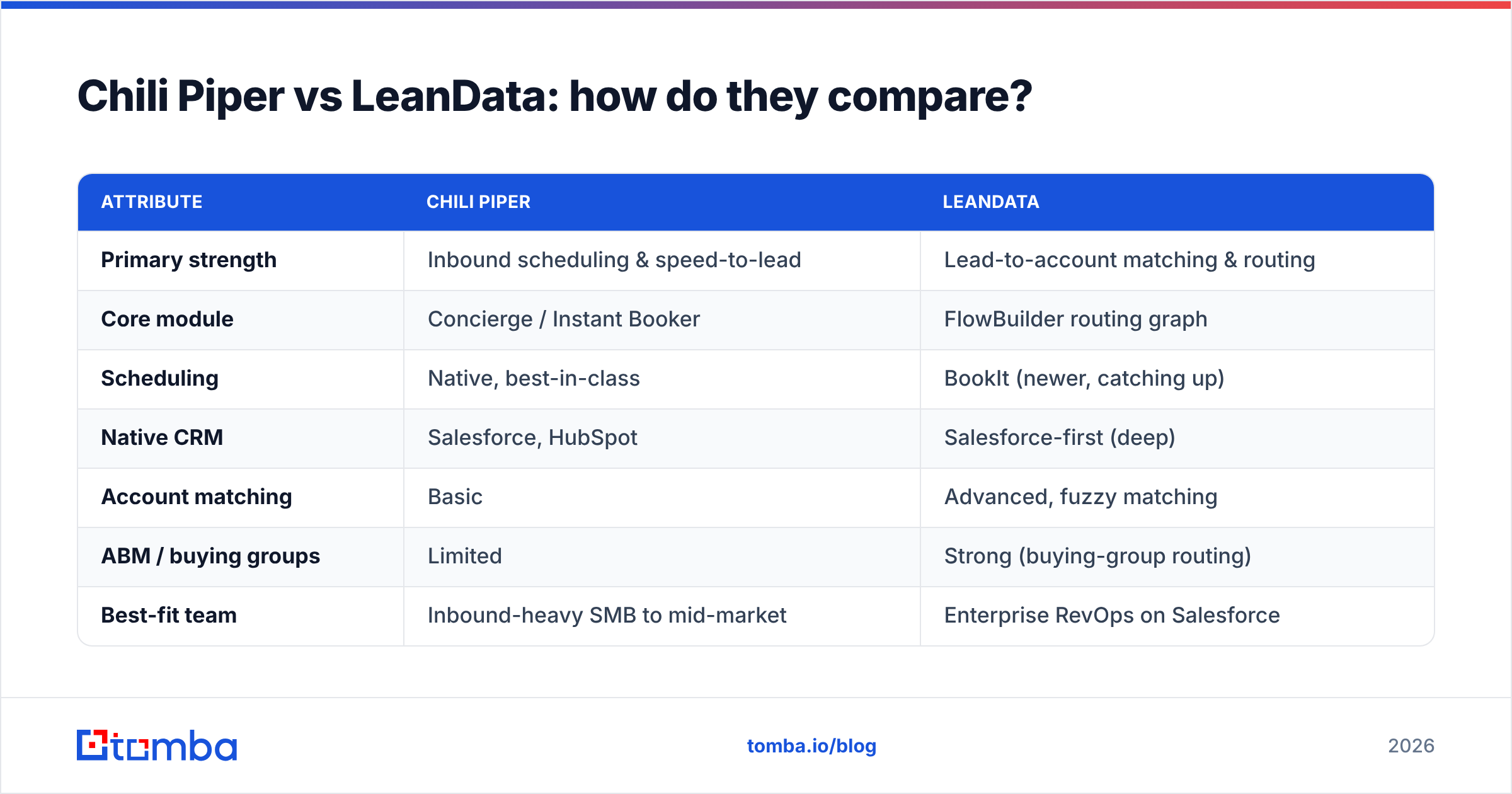
Here's the side-by-side on the attributes that actually drive a buying decision.
| Attribute | Chili Piper | LeanData |
|---|---|---|
| Primary strength | Inbound scheduling & speed-to-lead | Lead-to-account matching & routing |
| Core module | Concierge / Instant Booker | FlowBuilder routing graph |
| Scheduling | Native, best-in-class | BookIt (newer, catching up) |
| Native CRM | Salesforce, HubSpot | Salesforce-first (deep) |
| Account matching | Basic | Advanced, fuzzy matching |
| ABM / buying groups | Limited | Strong (buying-group routing) |
| Best-fit team | Inbound-heavy SMB to mid-market | Enterprise RevOps on Salesforce |
| Entry pricing (approx.) | ~$22.50/user/mo | ~$39/user/mo |
| Setup complexity | Moderate | High (rules-heavy) |
| Free trial | Limited / demo-gated | Demo-gated |
The short version: Chili Piper optimizes the moment of conversion, LeanData optimizes the logic of assignment. Many large teams actually run both — Chili Piper for the booking experience, LeanData for the routing brain underneath — which tells you they're more complementary than mutually exclusive.
Is Chili Piper better than LeanData?#
It depends on which problem is costing you pipeline. Lead with your bottleneck, not the feature list.
Choose Chili Piper when:
- Speed-to-lead is the problem. Studies on inbound response consistently show conversion odds collapse after the first five minutes. Chili Piper's instant booking removes the wait entirely.
- Your motion is inbound-heavy. Demo requests, content downloads, and "contact sales" forms are your main pipeline source.
- Scheduling experience matters to buyers. You want a polished, embedded calendar moment rather than a "we'll be in touch" auto-reply.
- You're on HubSpot or Salesforce and want a faster time-to-value.
Choose LeanData when:
- Routing rules are genuinely complex. Territories, segments, named accounts, partner overlaps, and round-robin pools that all interact.
- You run ABM and need buying-group orchestration that routes a whole committee to one account owner.
- Salesforce is your system of record and you need native, deeply auditable assignment.
- Matching is the failure point — leads landing as orphans or duplicates instead of attaching to the right account.
How does pricing compare in 2026?#
Both vendors keep pricing behind a sales conversation, which is the norm in this category — and a reason to scope your seat count carefully before the demo. Public benchmarks and review sites like G2 put Chili Piper's Instant Booker tiers in the low-$20s per user per month, with Concierge and handoff features pushing the effective price up. LeanData's routing typically starts higher per seat and scales with matching volume and add-on modules like BookIt.
A few budgeting realities:
- Per-user pricing punishes large teams. A 100-rep org feels these costs very differently than a 10-rep one. Model the fully loaded number, not the entry tier.
- Add-ons are where the bill grows. Scheduling, distribution, ABM orchestration, and premium support are frequently separate line items.
- Annual contracts are standard. Month-to-month flexibility is rare at the enterprise tier.
- Implementation has a cost too. LeanData in particular often involves a services or onboarding investment because the rules architecture is non-trivial.
If your team is small and inbound-light, both tools may be overkill — a simpler scheduler plus clean CRM hygiene can carry you until volume justifies the spend. Compare that against transparent, usage-based tools like Tomba pricing when you're weighing how much of your stack budget should go to routing versus data quality.
What do Chili Piper and LeanData not solve?#
Routing and scheduling assume the lead data is already correct. Neither tool is responsible for whether the email, company, title, or domain on a record is accurate — and that's where a surprising amount of pipeline quietly leaks.
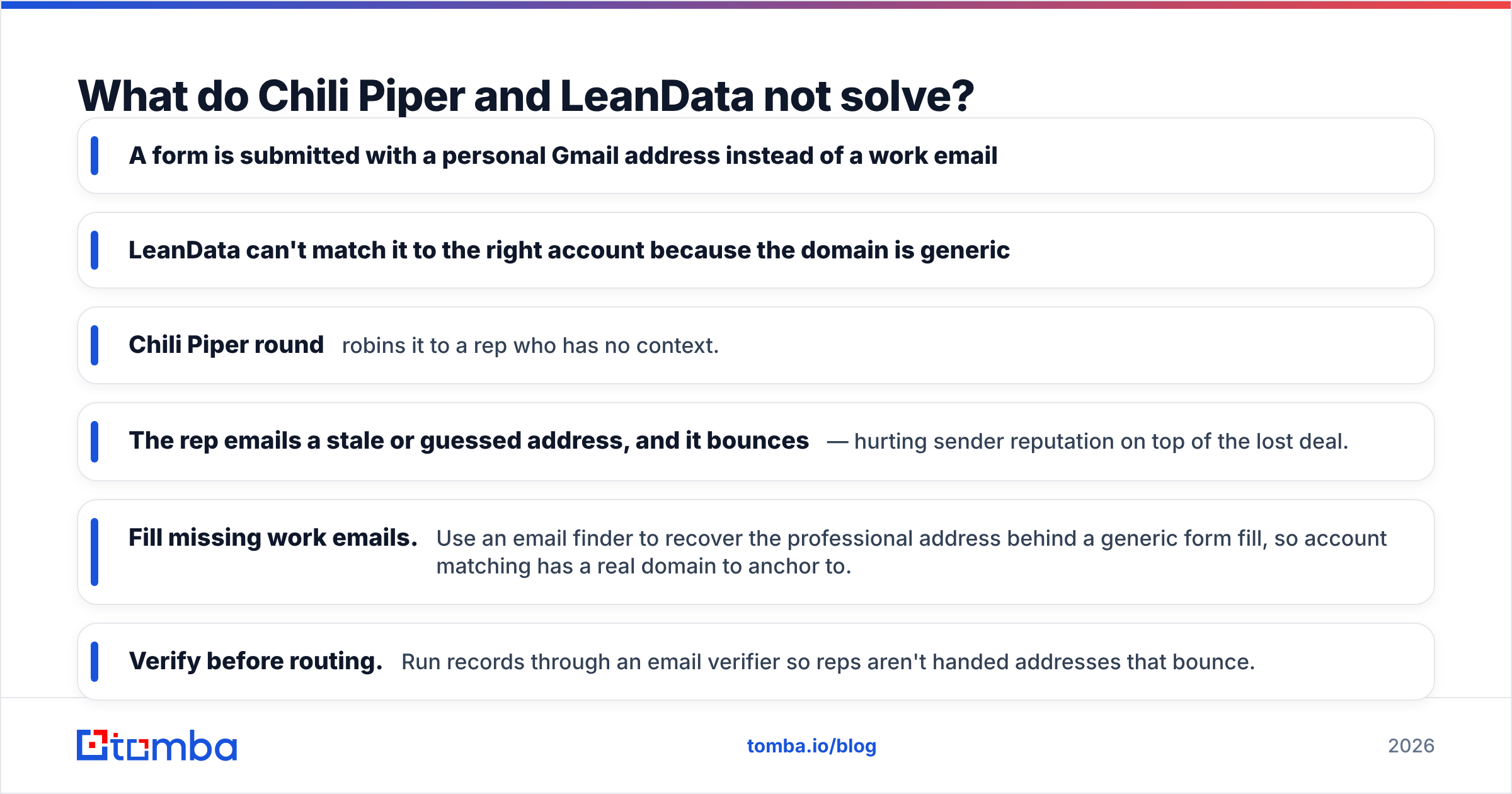
Consider the failure chain:
- A form is submitted with a personal Gmail address instead of a work email.
- LeanData can't match it to the right account because the domain is generic.
- Chili Piper round-robins it to a rep who has no context.
- The rep emails a stale or guessed address, and it bounces — hurting sender reputation on top of the lost deal.
The fix lives upstream, in the data layer. Enriching and verifying contacts before they hit your routing rules means matching engines have clean inputs to work with. A few pieces that close those gaps:
- Fill missing work emails. Use an email finder to recover the professional address behind a generic form fill, so account matching has a real domain to anchor to.
- Verify before routing. Run records through an email verifier so reps aren't handed addresses that bounce.
- Enrich the record. Add firmographics and titles with data enrichment so routing rules based on company size or seniority actually fire correctly.
This is the unglamorous half of RevOps. You can buy the fastest router on the market, but routing a bad record fast just means you reach the wrong person sooner.
Which tool fits which team?#
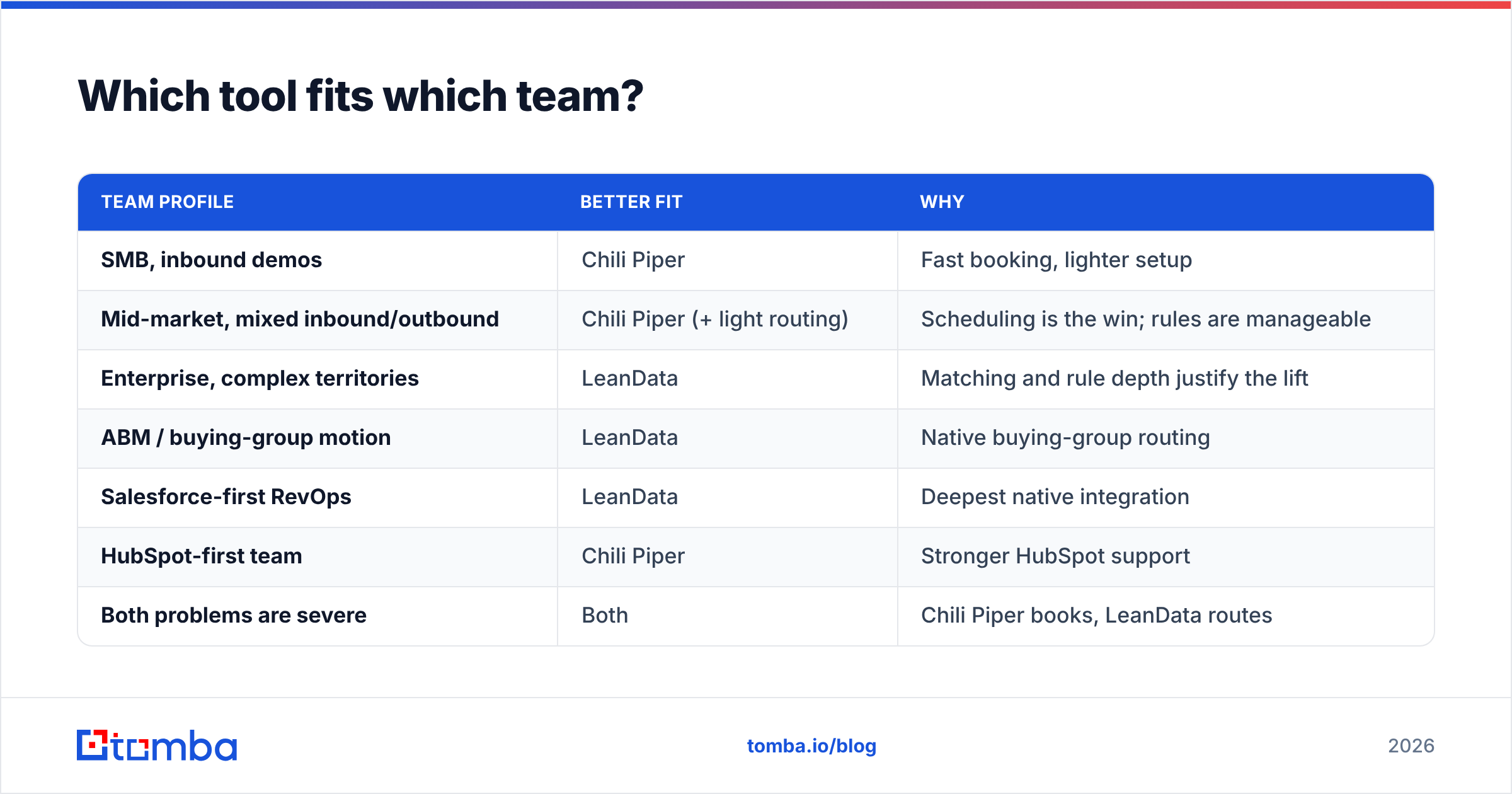
A practical decision framework, ordered by team profile:
| Team profile | Better fit | Why |
|---|---|---|
| SMB, inbound demos | Chili Piper | Fast booking, lighter setup |
| Mid-market, mixed inbound/outbound | Chili Piper (+ light routing) | Scheduling is the win; rules are manageable |
| Enterprise, complex territories | LeanData | Matching and rule depth justify the lift |
| ABM / buying-group motion | LeanData | Native buying-group routing |
| Salesforce-first RevOps | LeanData | Deepest native integration |
| HubSpot-first team | Chili Piper | Stronger HubSpot support |
| Both problems are severe | Both | Chili Piper books, LeanData routes |
The "run both" row isn't a cop-out — it's what many scaled go-to-market orgs actually do. The two products overlap less than their marketing suggests, and the seams between them (a clean lead handed from matching engine to booking widget) are where the experience gets good.
How should you evaluate before buying?#
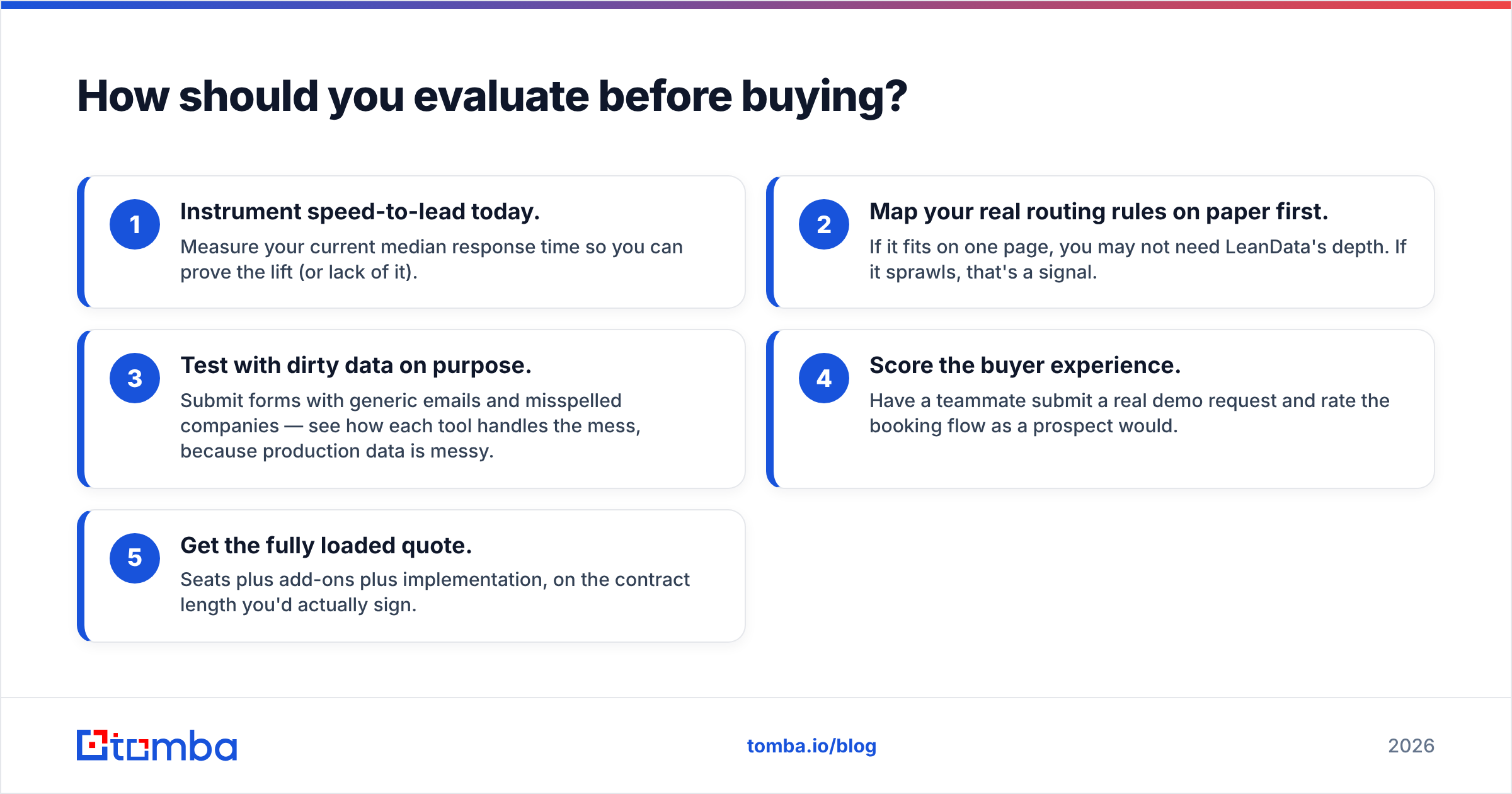
Run a structured trial rather than a feature-checklist comparison. Concretely:
- Instrument speed-to-lead today. Measure your current median response time so you can prove the lift (or lack of it).
- Map your real routing rules on paper first. If it fits on one page, you may not need LeanData's depth. If it sprawls, that's a signal.
- Test with dirty data on purpose. Submit forms with generic emails and misspelled companies — see how each tool handles the mess, because production data is messy.
- Score the buyer experience. Have a teammate submit a real demo request and rate the booking flow as a prospect would.
- Get the fully loaded quote. Seats plus add-ons plus implementation, on the contract length you'd actually sign.
Document the results against your bottleneck. The tool that moves your primary metric — booked meetings or correctly-assigned leads — is the right one, regardless of which has the longer feature page.
You can read each vendor's own positioning at chilipiper.com and leandata.com, but treat marketing claims as hypotheses to test, not conclusions.
The bottom line#
Chili Piper and LeanData aren't really rivals so much as specialists. Chili Piper wins the speed-to-lead and scheduling battle; LeanData wins the matching and orchestration battle. Pick by your bottleneck — and if you're large enough to feel both, running them together is a legitimate, common architecture.
Whichever you choose, remember the layer underneath both: routing is only as good as the data it routes. Before a lead ever reaches a rule or a calendar, make sure the contact is real, complete, and verified. Tomba's Email Finder recovers accurate work emails and pairs with verification and enrichment so your routing engine gets clean inputs — start on the free tier (25 searches/month) and scale to Starter at $49/mo when your pipeline does. Fast routing plus accurate data is the combination that actually books revenue.
// get started
Find, verify and enrich your first contacts today
Start on the free plan with 25 searches a month, then scale when your team is ready.
Free plan · No credit card required · GDPR & CCPA
Get the Tomba newsletter
Product and data updates
// about the author