Chili Piper vs RevenueHero 2026: Which Router Wins?
Chili Piper vs RevenueHero compared on speed-to-lead, routing logic, pricing, and CRM fit. See which inbound scheduler actually books more qualified demos in 2026.
TL;DR
- Chili Piper is the mature, feature-dense platform for inbound routing, scheduling, and handoff — powerful, but priced and configured for larger RevOps teams.
- RevenueHero is the leaner, faster-to-deploy challenger built around speed-to-lead and a clean form-to-meeting flow, usually at a lower entry cost.
- Pick Chili Piper if you need deep routing logic, distribution rules across many teams, and enterprise admin controls. Pick RevenueHero if you want instant qualification and booking with less setup overhead.
- Neither tool finds or verifies contact data — both route the leads you already have. Your booked-meeting rate still depends on data quality upstream.
- Run the numbers on your real inbound volume before committing; the cheaper sticker price is not always the cheaper outcome.
What do Chili Piper and RevenueHero actually do?#
Both tools solve the same core problem: an inbound lead fills out a form, and you want them talking to the right rep as fast as possible — ideally before they cool off. Think of it like a restaurant host. A great host reads the reservation, walks you straight to the correct table, and seats you with the waiter who knows your order. A bad host leaves you standing at the door while someone "checks the system." Chili Piper and RevenueHero are both trying to be the great host for your demo requests.
The mechanics are similar across both: a form captures the lead, the tool qualifies it against your rules (company size, territory, ICP fit), routes it to an owner, and offers a calendar to book a meeting on the spot. The differences are in depth, speed, price, and how much engineering time you'll spend wiring it all up.
One thing neither does: source the contact in the first place. Routing software assumes a lead already exists. If you also need to build the pipeline — finding and verifying business emails before anyone fills out a form — that's a separate layer handled by tools like the Tomba Email Finder and data enrichment. Keep that distinction clear; it changes how you budget.

How do Chili Piper and RevenueHero compare head to head?#
Here's the practical comparison most buyers care about. Treat the pricing as directional — both vendors quote per seat and adjust for volume, so confirm current numbers on their sites before you sign.
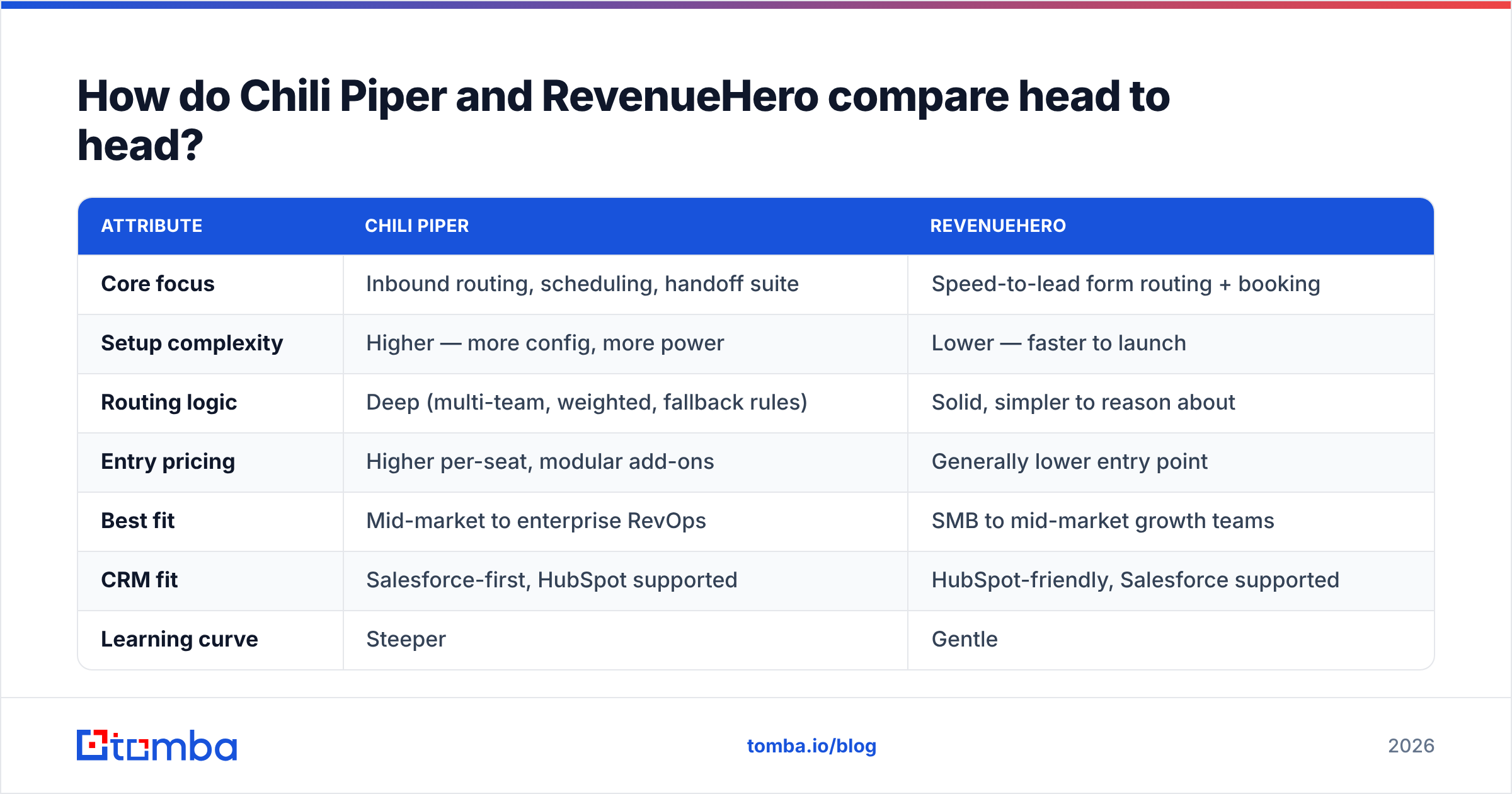
| Attribute | Chili Piper | RevenueHero |
|---|---|---|
| Core focus | Inbound routing, scheduling, handoff suite | Speed-to-lead form routing + booking |
| Setup complexity | Higher — more config, more power | Lower — faster to launch |
| Routing logic | Deep (multi-team, weighted, fallback rules) | Solid, simpler to reason about |
| Entry pricing | Higher per-seat, modular add-ons | Generally lower entry point |
| Best fit | Mid-market to enterprise RevOps | SMB to mid-market growth teams |
| CRM fit | Salesforce-first, HubSpot supported | HubSpot-friendly, Salesforce supported |
| Learning curve | Steeper | Gentle |
| Support model | Established, larger org | Hands-on, founder-era responsiveness |
The pattern is consistent: Chili Piper gives you more dials to turn, and RevenueHero gives you fewer dials but gets you booking faster. Neither is "better" in the abstract — it depends on how complex your routing actually is.
Is Chili Piper better than RevenueHero?#
Chili Piper wins when complexity is your reality, not your aspiration. If you route inbound across multiple regions, product lines, and overlapping teams, you need fallback logic, round-robin weighting, capacity caps, and account-based matching that respects existing CRM ownership. Chili Piper has spent years building those edges, and it shows in admin depth.
Consider these strengths:
- Routing depth — Multi-condition rules, ownership lookups, and tie-breakers that hold up under messy real-world data.
- Handoff tooling — Beyond booking, it supports SDR-to-AE handoffs and instant connect flows.
- Enterprise admin — Permissions, audit trails, and governance that larger orgs require.
- Ecosystem maturity — Long track record, broad integration list, and a deep Salesforce integration pattern that RevOps teams already know.
- Reporting — Granular analytics on routing outcomes and meeting conversion.
The trade-off is real, though. More power means more configuration, more ramp time, and a higher bill. Teams routinely under-use what they pay for. If your routing is "round-robin to four AEs by region," you're buying a tractor to mow a lawn. Check independent reviews on G2 and weigh the implementation notes, not just the feature checklist.
Is RevenueHero better than Chili Piper?#
RevenueHero wins on time-to-value and speed-to-lead. Its whole design philosophy is to compress the gap between "form submitted" and "meeting booked" to seconds, with as little configuration friction as possible. For teams that bleed pipeline to slow follow-up, that focus pays off quickly.
Where RevenueHero tends to shine:
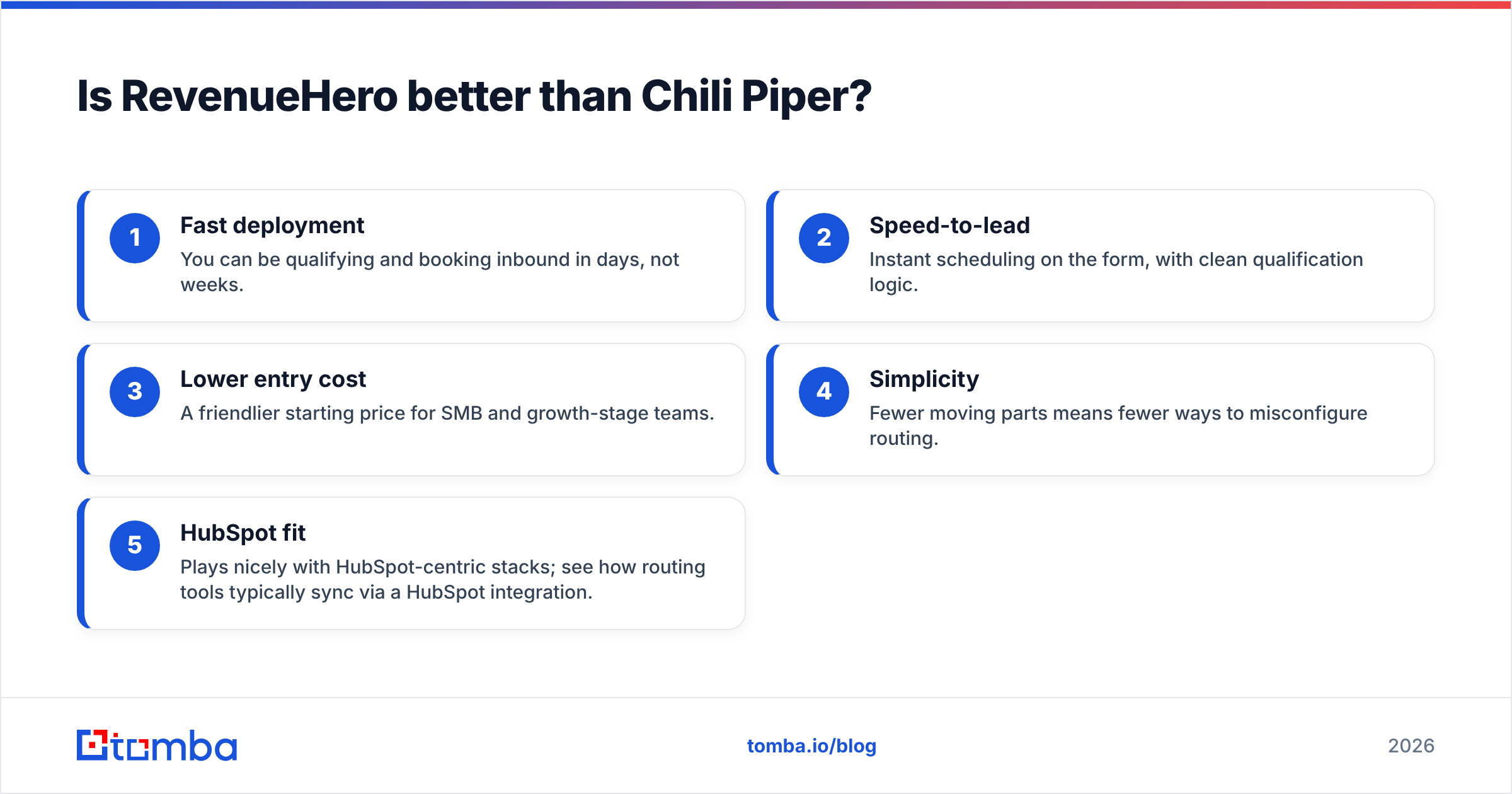
- Fast deployment — You can be qualifying and booking inbound in days, not weeks.
- Speed-to-lead — Instant scheduling on the form, with clean qualification logic.
- Lower entry cost — A friendlier starting price for SMB and growth-stage teams.
- Simplicity — Fewer moving parts means fewer ways to misconfigure routing.
- HubSpot fit — Plays nicely with HubSpot-centric stacks; see how routing tools typically sync via a HubSpot integration.
The honest limitation: when your routing logic grows genuinely complex — dozens of teams, account hierarchies, exotic fallback chains — you may eventually feel the ceiling that Chili Piper's depth was built to avoid. RevenueHero is the right call until complexity outgrows it. You can compare current packaging directly at revenuehero.io and chilipiper.com.

How should you choose between Chili Piper and RevenueHero?#
Decide based on three factors in this order: routing complexity, team maturity, and budget. Most buyers reverse that order and start with price — which is how you end up with a tool that's either overkill or under-built.
Use this quick decision frame:
- Choose Chili Piper if you have a dedicated RevOps function, route across multiple teams or territories, run a Salesforce-first stack, and need governance and deep reporting.
- Choose RevenueHero if you want speed-to-lead fast, have simpler routing rules, run lean on ops headcount, and want a lower entry price.
- Choose either if your inbound volume justifies automated booking at all — below a threshold, a calendar link and a clean process may be enough.
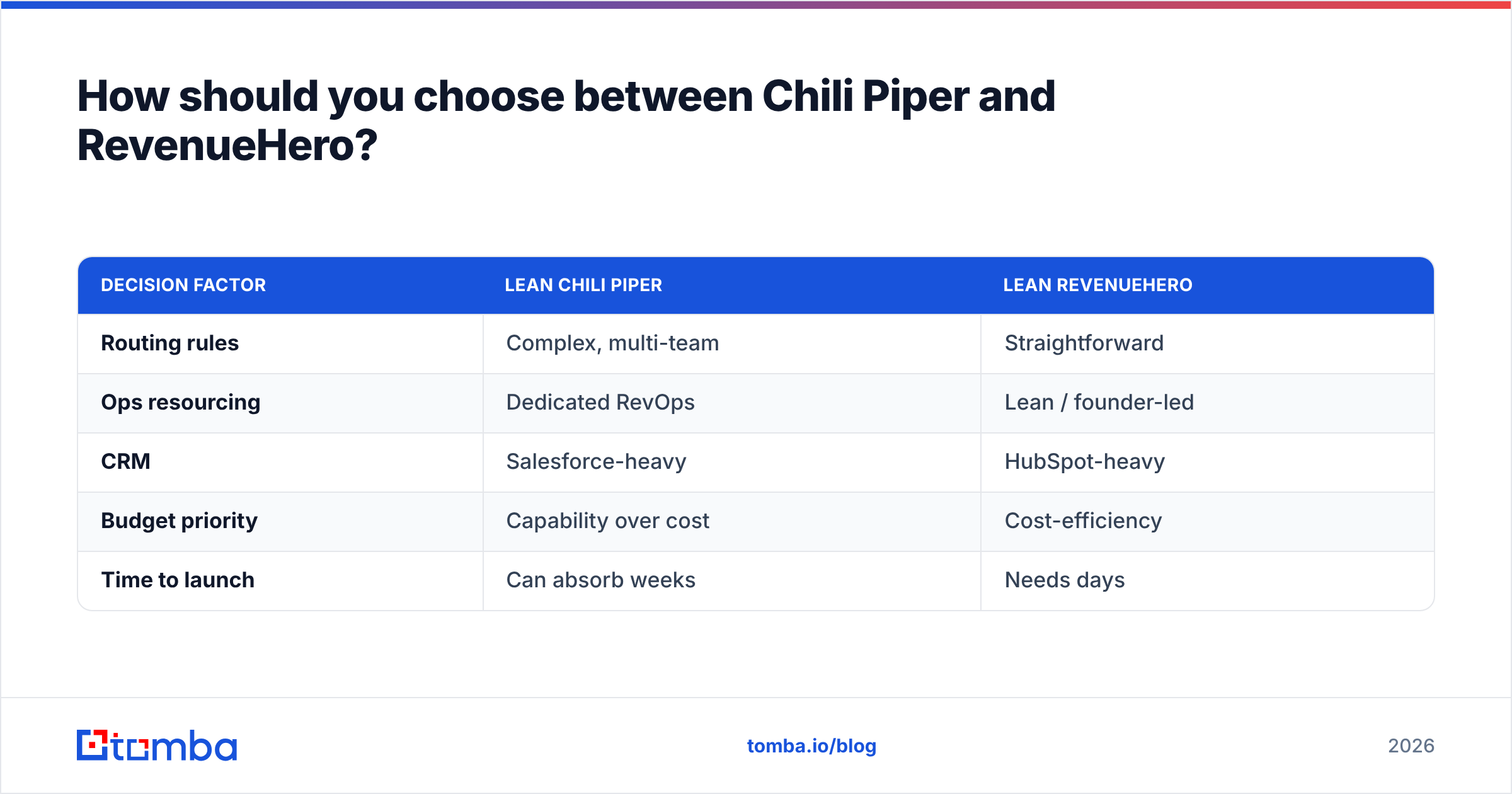
| Decision factor | Lean Chili Piper | Lean RevenueHero |
|---|---|---|
| Routing rules | Complex, multi-team | Straightforward |
| Ops resourcing | Dedicated RevOps | Lean / founder-led |
| CRM | Salesforce-heavy | HubSpot-heavy |
| Budget priority | Capability over cost | Cost-efficiency |
| Time to launch | Can absorb weeks | Needs days |
A useful gut check: list every routing rule you actually enforce today, not the ones you imagine using someday. If that list fits on a sticky note, RevenueHero's simplicity is a feature. If it spills onto a second page, Chili Piper's depth earns its keep.
What do both tools miss — and why does it matter?#
Both tools route leads; neither creates them. This is the gap that quietly caps the ROI of any scheduler. A routing tool can book a meeting in three seconds, but only if a qualified person already submitted a real, reachable contact. Garbage in, fast garbage out.
Three upstream realities affect your booked-meeting rate more than routing speed:
- Bad form data. People mistype emails, use throwaway addresses, or fat-finger their company. If you don't verify emails at or after capture, your routing system faithfully delivers junk to your reps.
- Thin lead context. Routing rules need firmographic signals. Without enrichment, "route by company size" is guesswork. Appending data turns a name and email into a routable, scoreable lead.
- Outbound starvation. Inbound routing only works on inbound. The pipeline still needs net-new contacts, which is where a bulk email finder and domain-level prospecting come in.
This is why the smartest stacks treat routing as the last mile, not the whole road. Chili Piper or RevenueHero handles the handoff; a data layer handles the supply. Confusing the two is how teams buy a great scheduler and still miss quota.
How much do Chili Piper and RevenueHero cost in 2026?#
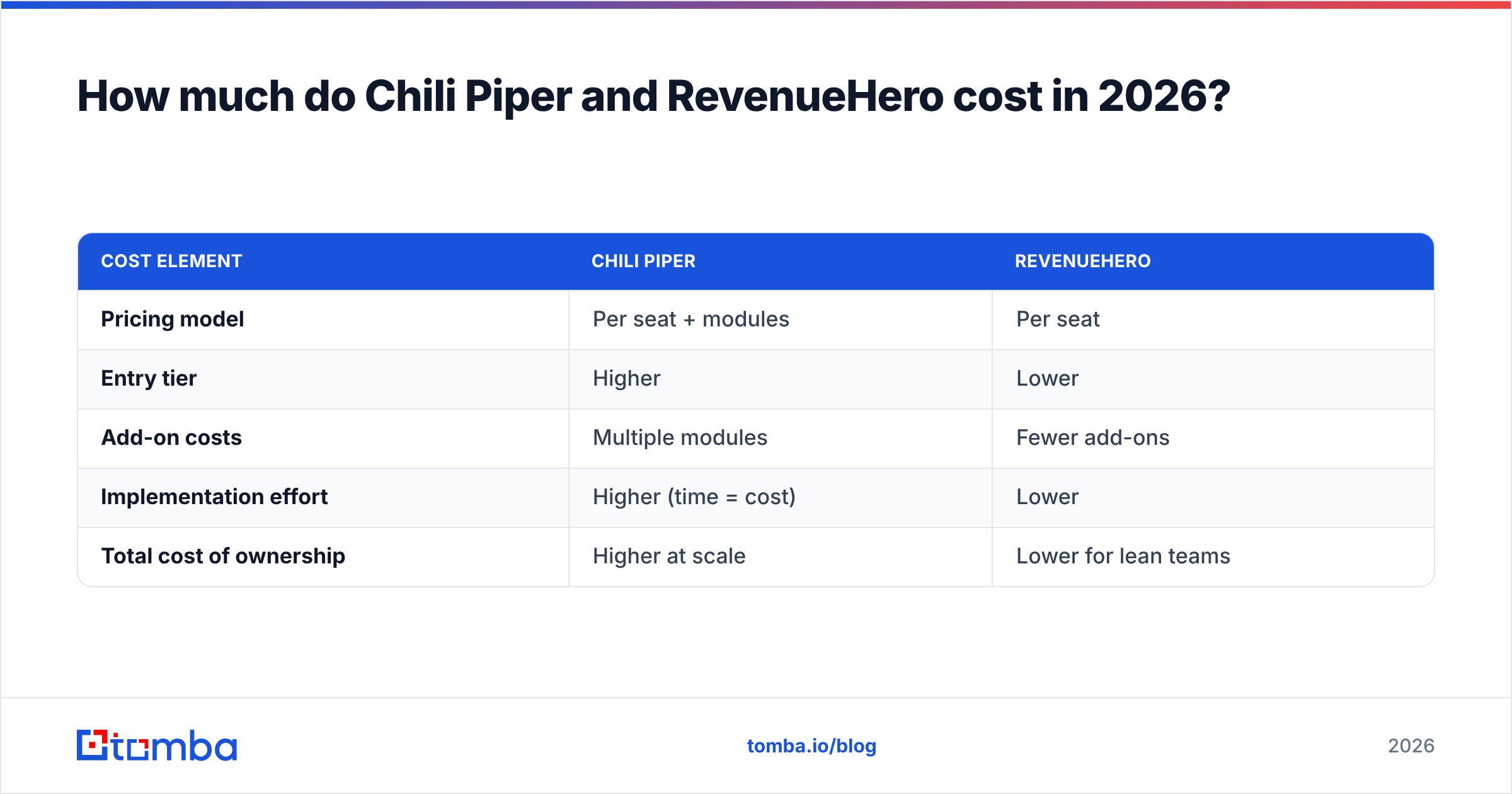
Both vendors price per seat with volume-based adjustments, and both keep exact figures behind a sales conversation for higher tiers. As a planning rule: RevenueHero typically lands at a lower entry point, while Chili Piper's modular suite climbs faster as you add capabilities and seats.
| Cost element | Chili Piper | RevenueHero |
|---|---|---|
| Pricing model | Per seat + modules | Per seat |
| Entry tier | Higher | Lower |
| Add-on costs | Multiple modules | Fewer add-ons |
| Implementation effort | Higher (time = cost) | Lower |
| Total cost of ownership | Higher at scale | Lower for lean teams |
Remember to price the whole motion, not the routing line item. If you also need data, factor that in separately. For reference on how a data layer is typically priced, Tomba pricing runs a Free tier (25 searches/month), Starter at $49/mo, Growth at $99/mo, and Pro at $249/mo — a separate budget line from your scheduler, and a much cheaper one than most teams expect.
Which integrations and workflows matter most?#
Both tools live or die by CRM sync. Chili Piper is historically Salesforce-first with strong HubSpot support; RevenueHero is comfortable in HubSpot-centric stacks and supports Salesforce. Before you choose, map your actual workflow end to end: capture, verify, enrich, route, book, log.
A realistic inbound flow looks like this:
- Capture the lead via form or chat.
- Verify the email so routing doesn't waste a slot on a bad address.
- Enrich with firmographics to power qualification rules.
- Route to the correct owner via Chili Piper or RevenueHero.
- Book instantly on the rep's calendar.
- Log everything back to the CRM for reporting.
Steps 2 and 3 sit outside both schedulers. That's deliberate — routing tools assume clean, enriched data arrives at their door. The teams that win wire those steps in with an API-driven data layer so nothing reaches the router unverified. If you build, the Tomba API handles finding and verification programmatically inside that flow.
The bottom line#
Chili Piper and RevenueHero are both good at the same job — getting inbound leads to the right rep, fast. Chili Piper is the deeper, pricier, enterprise-grade choice for complex routing and dedicated RevOps teams. RevenueHero is the leaner, faster, more affordable choice for teams that want speed-to-lead without the configuration tax. Match the tool to your actual routing complexity, not your ambitions, and you'll be fine either way.
But remember the part neither tool does: building the pipeline they route. A scheduler can only book the qualified leads you feed it. Before you optimize the last mile, make sure the data going in is real, reachable, and enriched. Start free with the Tomba Email Finder to find and verify accurate business emails by name, domain, or company — so whichever router you pick is booking real meetings, not bouncing on bad data. It's the cheapest, highest-leverage upgrade you can make to any inbound motion.
// get started
Find, verify and enrich your first contacts today
Start on the free plan with 25 searches a month, then scale when your team is ready.
Free plan · No credit card required · GDPR & CCPA
// about the author