Chorus vs Gong 2026: Which Conversation Intelligence Wins?
Chorus vs Gong, compared on accuracy, pricing, CRM sync, and coaching. See which conversation intelligence platform fits your revenue team in 2026 — and what feeds both.
Choosing between Chorus and Gong is the conversation-intelligence equivalent of picking between two flagship phones: both record, transcribe, and analyze every sales call your team makes, and both promise to turn those calls into coaching, forecasting, and deal insight. The differences are real, but they live in the details — pricing transparency, CRM depth, ZoomInfo's data layer behind Chorus, and how each one handles coaching at scale.
This guide breaks down Chorus vs Gong the way a buyer actually evaluates them: features, pricing, accuracy, integrations, and the use cases where one clearly beats the other.
TL;DR — Chorus vs Gong at a glance#
- Gong is the category leader for deal intelligence and forecasting, with the deepest analytics and a premium price tag to match.
- Chorus (owned by ZoomInfo) is strongest when you want conversation intelligence wired directly into ZoomInfo's data and GTM stack.
- Pricing for both is quote-only and seat-based — expect roughly $1,200–$1,600 per user per year plus a platform fee.
- Neither tool finds contacts. They analyze conversations you already have — you still need clean contact data to book those calls in the first place.
- Pick Gong for forecasting depth and rep coaching; pick Chorus if you already run on ZoomInfo and want one vendor.
What is conversation intelligence, and why compare Chorus vs Gong?#
Conversation intelligence is software that records sales calls and meetings, transcribes them, and uses AI to surface patterns — which objections kill deals, which talk tracks win, and which reps need coaching. Think of it like game film for sales teams: instead of replaying every call manually, the platform tags the important moments and tells the coach where to look.
Chorus and Gong are the two names that dominate this space. Both were founded in the mid-2010s, both raised enormous funding rounds, and both are now embedded in thousands of revenue orgs. Chorus was acquired by ZoomInfo in 2021 and folded into its broader go-to-market platform. Gong stayed independent and pushed hard into "Revenue Intelligence," expanding from call analysis into forecasting and deal management.
That history matters for your decision. Buying Chorus increasingly means buying into the ZoomInfo ecosystem. Buying Gong means betting on a best-of-breed standalone platform that integrates with whatever stack you already run.
How do Chorus and Gong compare on features?#
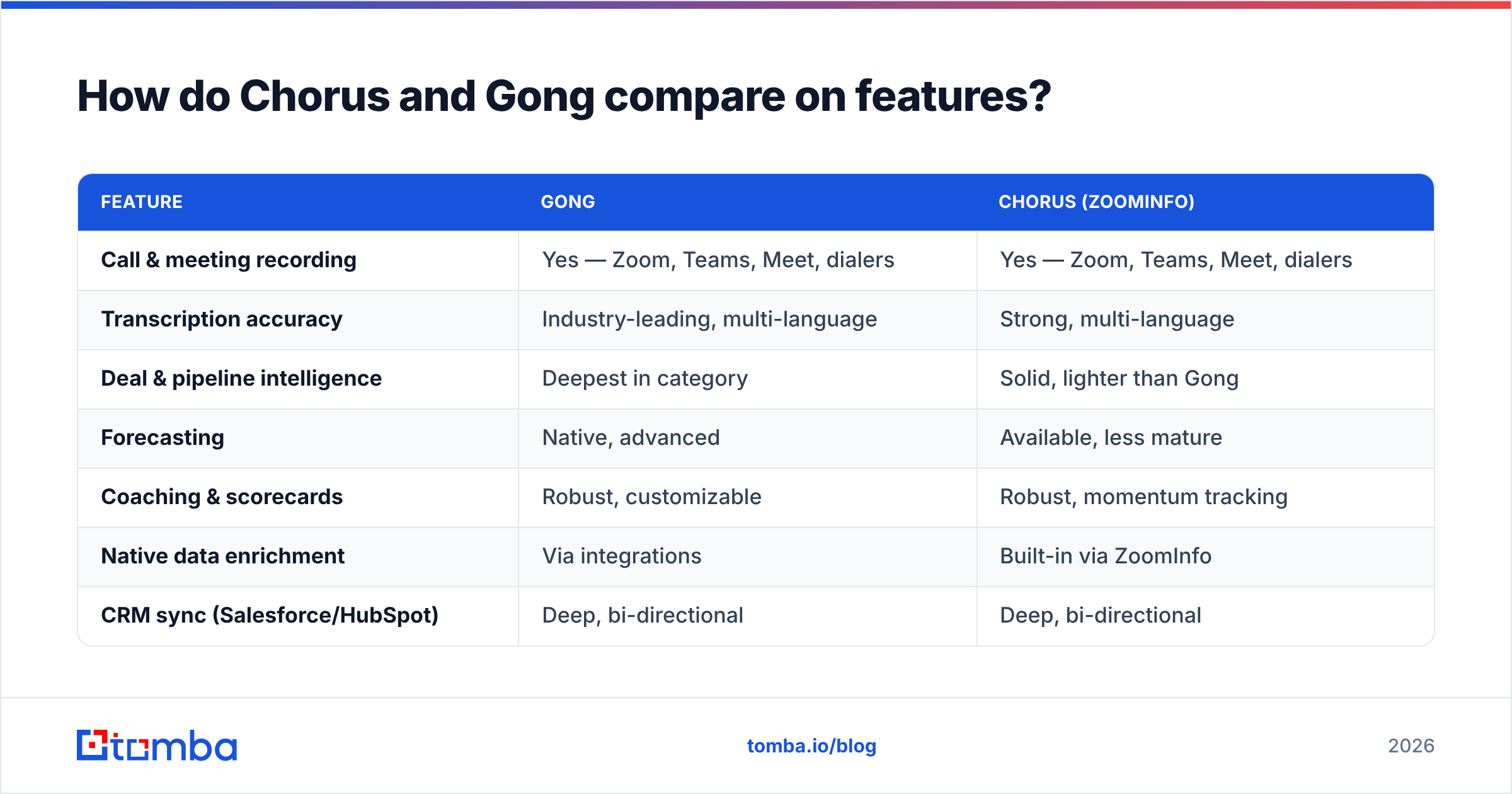
At the core, the two products do the same four things: capture calls, transcribe them, analyze them, and feed insights back into your CRM. Where they diverge is depth and emphasis.
Here's a side-by-side on the attributes most buyers weigh:
| Feature | Gong | Chorus (ZoomInfo) |
|---|---|---|
| Call & meeting recording | Yes — Zoom, Teams, Meet, dialers | Yes — Zoom, Teams, Meet, dialers |
| Transcription accuracy | Industry-leading, multi-language | Strong, multi-language |
| Deal & pipeline intelligence | Deepest in category | Solid, lighter than Gong |
| Forecasting | Native, advanced | Available, less mature |
| Coaching & scorecards | Robust, customizable | Robust, momentum tracking |
| Native data enrichment | Via integrations | Built-in via ZoomInfo |
| CRM sync (Salesforce/HubSpot) | Deep, bi-directional | Deep, bi-directional |
| Pricing transparency | Quote-only | Quote-only |
| Best-fit team size | Mid-market to enterprise | SMB to enterprise on ZoomInfo |
The short version: Gong wins on analytical depth and forecasting. Chorus wins on bundled data and being one throat to choke if you're already a ZoomInfo customer.
Where Gong pulls ahead#
Gong's deal intelligence is the reason enterprise revenue teams pay a premium. It scores pipeline health, flags deals going dark, and ties conversation signals to forecast categories. If your VP of Sales lives in a forecast spreadsheet on Thursday nights, Gong's "Reality" platform is built to replace that ritual. Its analytics on talk ratios, patience, and competitor mentions are also more granular than most teams will ever fully use.
Where Chorus pulls ahead#
Chorus's advantage is the ZoomInfo data layer. Because Chorus can enrich the people on a call with ZoomInfo's contact and company database, you get account context without bolting on a separate enrichment vendor. Chorus's "Momentum" view for tracking deal engagement over time is clean and intuitive, and its coaching tooling is genuinely competitive with Gong's. For teams already paying ZoomInfo, Chorus is the path of least resistance.
Is Gong better than Chorus for forecasting?#
Yes — Gong is generally better for forecasting, and it's not especially close at the enterprise level. Gong invested years into pipeline and revenue prediction, and independent reviews on G2 consistently cite forecasting and deal management as its standout strengths. Chorus forecasts competently, but the feature set is younger and leans on ZoomInfo's broader platform rather than standing alone.
If forecasting accuracy is your single most important criterion, Gong is the safer bet. If forecasting is a "nice to have" and you care more about cost and data consolidation, the gap narrows fast.
How much do Chorus and Gong cost in 2026?#
Both vendors keep pricing behind a sales conversation, which makes apples-to-apples comparison frustrating. Based on publicly reported buyer data, here's the realistic shape of the deal:
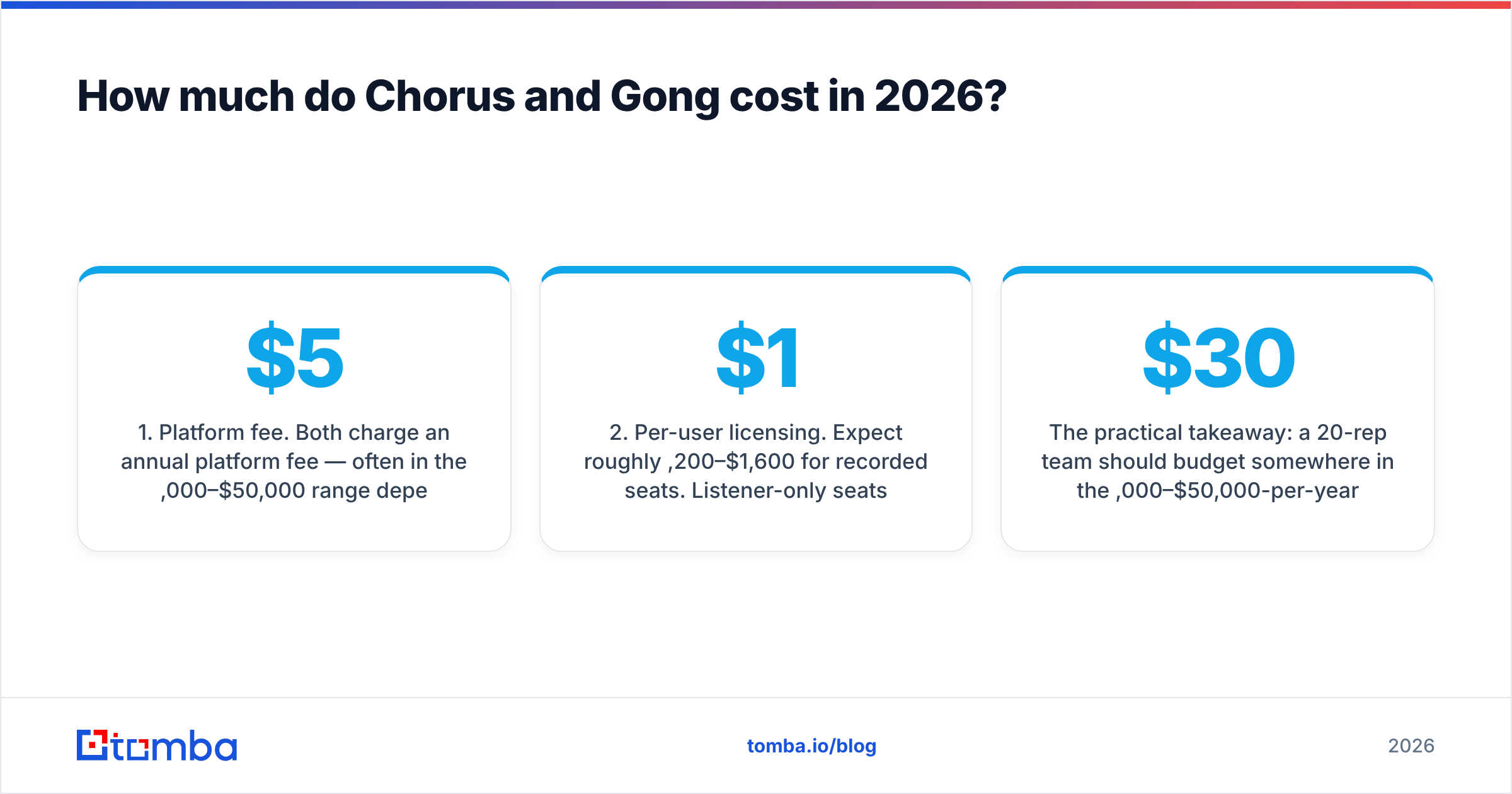
- Platform fee. Both charge an annual platform fee — often in the $5,000–$50,000 range depending on company size — before per-seat licensing.
- Per-user licensing. Expect roughly $1,200–$1,600 per user per year for recorded seats. Listener-only seats may be cheaper.
- Annual contracts. Both push annual commitments; month-to-month is rare.
- Add-ons. Forecasting modules, extra integrations, and premium support can raise the total materially.
- Negotiation room. Both discount for multi-year deals and larger seat counts — never accept the first quote.
The practical takeaway: a 20-rep team should budget somewhere in the $30,000–$50,000-per-year range for either tool once platform fees and seats are combined. Gong tends to land at the higher end. Neither is a tool you adopt casually — they're investments justified by deal size and rep headcount.
What neither Chorus nor Gong does: find the contacts#
Here's the gap nobody mentions in a Chorus vs Gong debate: these platforms analyze conversations you already have. They don't create them. Before a single call gets recorded, someone had to find the prospect's email or phone number, verify it, and book the meeting. Conversation intelligence sits at the bottom of the funnel; it's useless if the top of the funnel is empty.
This is where a contact-data layer becomes the unsung prerequisite. You can spend $40,000 a year on Gong, but if your reps are working off stale lists and bouncing emails, you're recording fewer calls and coaching a smaller sample. Clean inputs make every downstream analytics dollar work harder.
That's the role a tool like Tomba plays alongside — not instead of — your conversation intelligence stack:
- Use an email finder to source verified work emails for target accounts before outreach.
- Run a phone finder to get direct-dial numbers so your dialer-recorded calls actually connect.
- Push everything through data enrichment so the contact records Gong or Chorus syncs back to your CRM are complete, not half-empty.
Chorus partly papers over this with ZoomInfo's built-in data, which is one more reason teams already on ZoomInfo lean Chorus. But if you run Gong — or want a dedicated, accuracy-focused data source independent of either platform — you need a finder and verifier layer feeding the machine.
Which integrations matter most?#
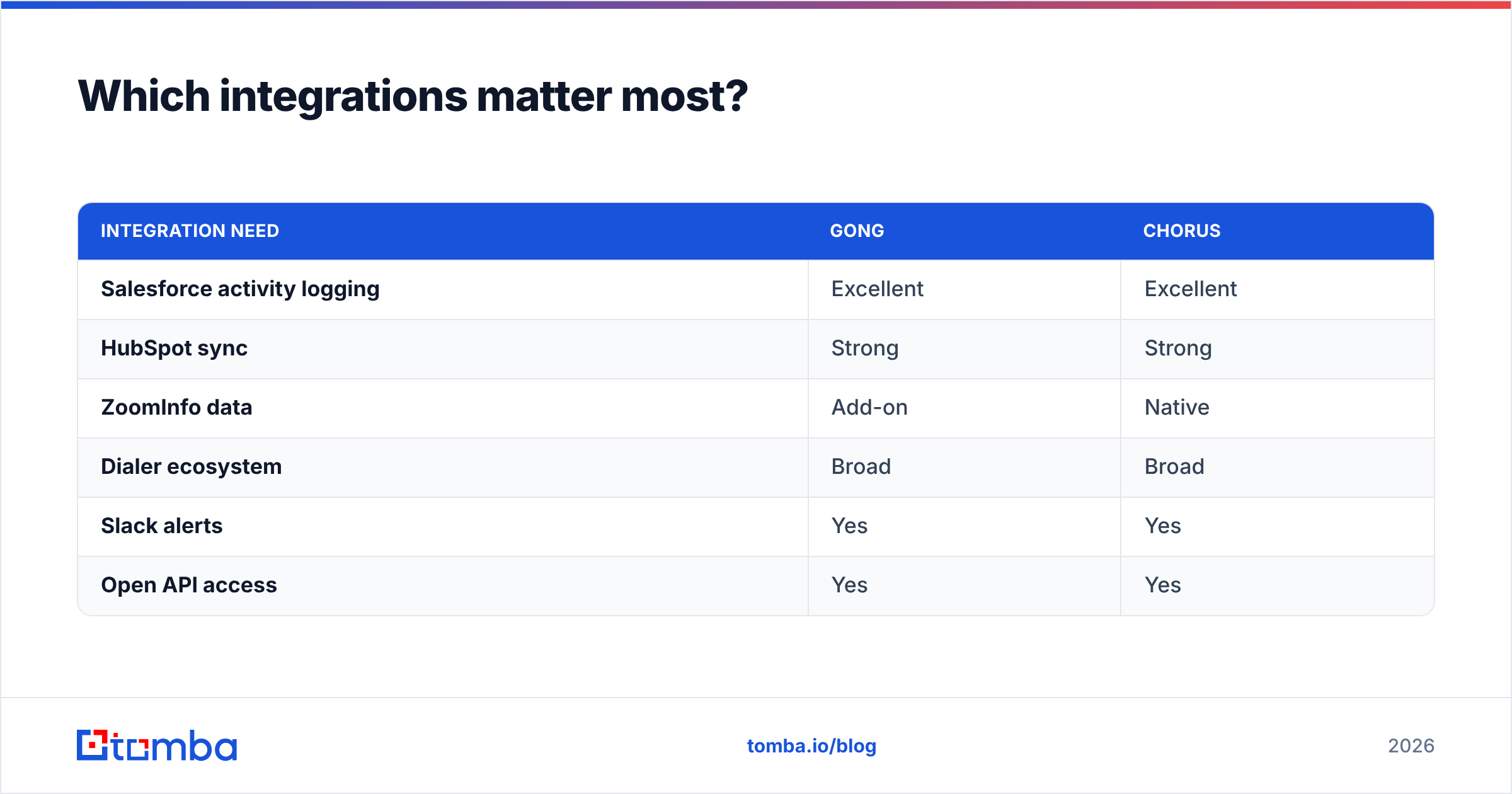
Both tools integrate with Salesforce, HubSpot, the major dialers, and the big video conferencing platforms. The deciding factor is usually which CRM you run and how deep the sync needs to go.
| Integration need | Gong | Chorus |
|---|---|---|
| Salesforce activity logging | Excellent | Excellent |
| HubSpot sync | Strong | Strong |
| ZoomInfo data | Add-on | Native |
| Dialer ecosystem | Broad | Broad |
| Slack alerts | Yes | Yes |
| Open API access | Yes | Yes |
If you're a heavy ZoomInfo shop, Chorus's native tie-in removes integration overhead. If you run a mixed stack with best-of-breed tools, Gong's neutrality is an advantage — it doesn't try to pull you into a single vendor's ecosystem. For data hygiene across either, an independent enrichment source and a healthy B2B database keep the records flowing into your CRM accurate regardless of which platform you pick.
Chorus vs Gong: which should you choose?#
The decision comes down to three questions:
1. Are you already a ZoomInfo customer? If yes, Chorus is the obvious starting point. Consolidating conversation intelligence and contact data under one vendor simplifies procurement, billing, and support — and you avoid a second enrichment contract.
2. Is forecasting your top priority? If your leadership team lives and dies by pipeline prediction, Gong's depth justifies the premium. It's the most mature forecasting engine in the category.
3. How big is your team, and what's your budget? Both are enterprise-grade investments. Smaller teams that want conversation intelligence without the heaviest forecasting modules may find Chorus's bundled-with-ZoomInfo positioning more cost-effective, while teams scaling rapidly often standardize on Gong for its analytics ceiling.
There's no universally "right" answer — only the right fit for your stack, budget, and whether forecasting or data consolidation drives the purchase. What is universal: whichever you choose, the platform only analyzes the calls your reps actually make. Feeding the top of that funnel with accurate, verified contacts is what makes the spend pay off.
Frequently asked questions#
Is Chorus the same as ZoomInfo? Not exactly — Chorus is a product owned by ZoomInfo. It's the conversation intelligence module within ZoomInfo's broader go-to-market platform, which is why it integrates so tightly with ZoomInfo's contact and company data.
Does Gong integrate with HubSpot? Yes. Gong syncs call activity, deal signals, and engagement data bi-directionally with HubSpot and Salesforce, logging recorded interactions against the right records automatically.
Can I use Chorus or Gong without a CRM? Technically yes, but you'd lose most of the value. Both tools are built to enrich and update CRM records, so running them without Salesforce or HubSpot strips out the forecasting and pipeline intelligence that justify the cost.
Do Gong or Chorus find email addresses or phone numbers? No. They record and analyze conversations — they don't source new contacts. You need a dedicated email verifier and finder layer to build the lists your reps call in the first place.
The bottom line#
Gong and Chorus are both excellent, and most teams would succeed with either. Choose Gong for the deepest forecasting and deal intelligence, and Chorus if you're standardizing on ZoomInfo and want one vendor for data plus conversation analysis. Match the tool to your stack and your budget rather than chasing a feature you'll never fully use.
Just remember the part the comparison charts leave out: conversation intelligence is only as valuable as the conversations you can start. Before you invest five figures in analyzing calls, make sure your reps have accurate contacts to dial. Start with the Tomba Email Finder to source and verify the work emails behind your target accounts — then let Gong or Chorus do its job on the calls that follow. Check Tomba pricing to see how a free tier of 25 searches a month can feed your pipeline before you ever hit a paywall.
// get started
Find, verify and enrich your first contacts today
Start on the free plan with 25 searches a month, then scale when your team is ready.
Free plan · No credit card required · GDPR & CCPA
Get the Tomba newsletter
Product and data updates
// about the author