Circle Prospecting Real Estate Scripts That Convert in 2026
Steal the exact circle prospecting real estate scripts top agents use to turn one listing into ten conversations — plus the data and dialing stack that makes them work in 2026.
Circle prospecting is the fastest way to turn a single transaction into a neighborhood full of conversations — but only if your script and your data both pull their weight. Most agents blame the script when calls flop. The real culprit is usually a stale list, a wrong number, or an opener that sounds like every other agent who called that week.
This guide gives you the word-for-word scripts that work in 2026, plus the contact-data and dialing stack that gets those scripts in front of live humans instead of disconnected lines.
TL;DR#
- Circle prospecting means calling 50–100 homeowners around a "trigger" property (a just-listed, just-sold, or open-house home) with a reason to talk that has nothing to do with hard selling.
- The best circle prospecting real estate scripts lead with the neighborhood event, ask a low-pressure question, and aim for a single yes — permission to follow up.
- Scripts convert 3–5x better when paired with accurate phone data. Verify numbers before you dial so you're not burning your day on disconnects.
- Use a phone finder to source mobile numbers and a phone validator to scrub them, then enrich leads with email so you can follow up across channels.
- Track your connect rate, conversation rate, and appointment rate separately — they tell you whether the problem is your list, your opener, or your close.
What is circle prospecting in real estate?#
Circle prospecting is the practice of "circling" a property on the map and calling the homeowners around it. The pitch is simple: something just happened nearby — a home sold over asking, a new listing hit the market, an open house is this weekend — and you're letting neighbors know.
Think of it like a restaurant that just got a glowing review putting a sign in the window. You're not chasing strangers; you're talking to people who already have a stake in what's happening on their street. Technically, you're using a local market event as a permission-based reason to start a conversation with high-intent homeowners.
It works because it solves the cold-calling trust problem. According to the National Association of Realtors, referrals and repeat business drive the majority of agent transactions — and circle prospecting is how you manufacture that local familiarity at scale before the referral ever exists.
The core circle prospecting workflow#
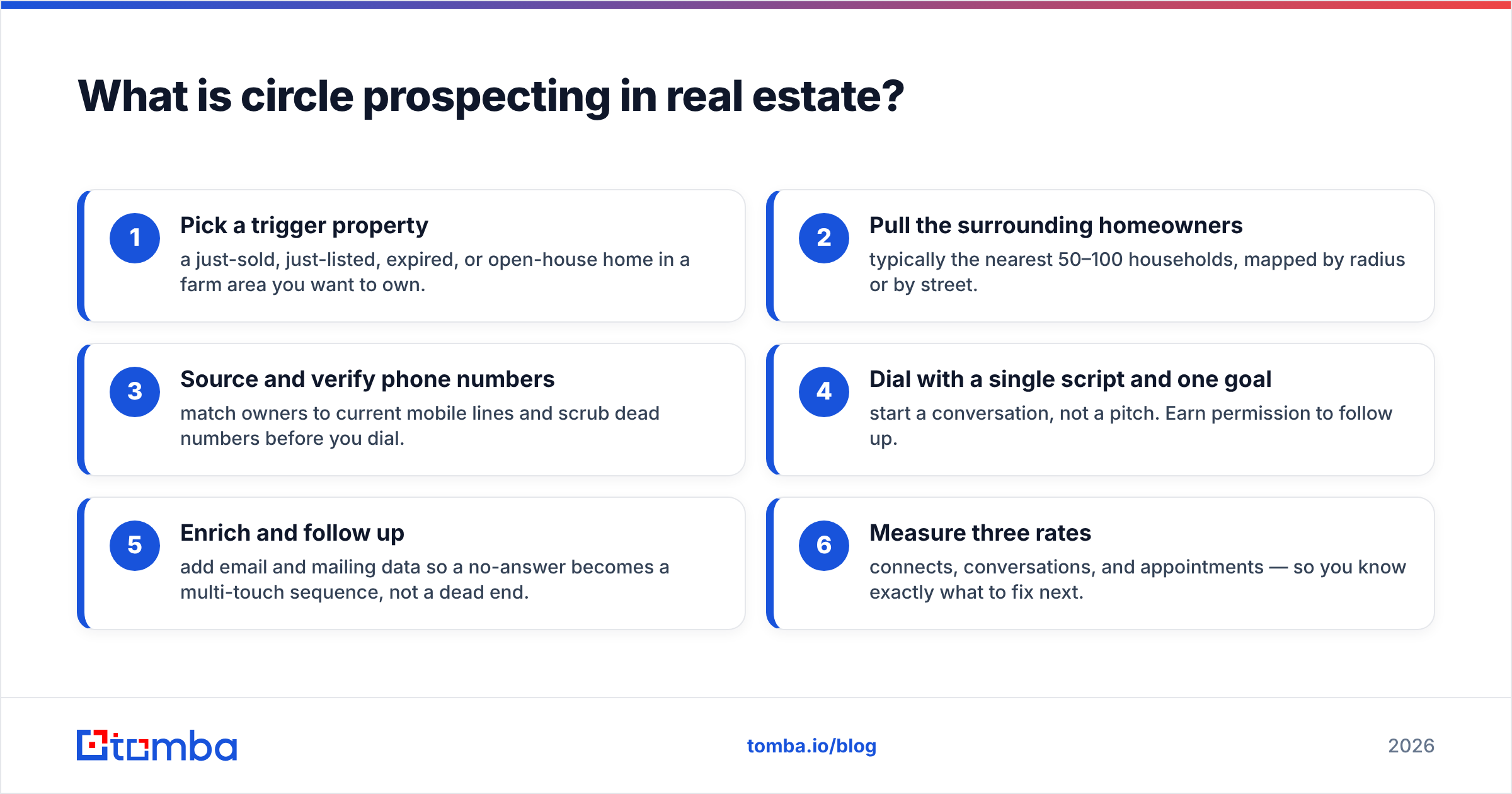
Before any script matters, your process has to be repeatable. Here is the loop top producers run every week:
- Pick a trigger property — a just-sold, just-listed, expired, or open-house home in a farm area you want to own.
- Pull the surrounding homeowners — typically the nearest 50–100 households, mapped by radius or by street.
- Source and verify phone numbers — match owners to current mobile lines and scrub dead numbers before you dial.
- Dial with a single script and one goal — start a conversation, not a pitch. Earn permission to follow up.
- Enrich and follow up — add email and mailing data so a no-answer becomes a multi-touch sequence, not a dead end.
- Measure three rates — connects, conversations, and appointments — so you know exactly what to fix next.
Skip step 3 and the best script in the world dies on disconnected lines. That's why your data stack is part of your script.
What makes a circle prospecting script actually convert?#
A converting script does three things in the first ten seconds: it names the local event, it makes a low-pressure ask, and it gives the homeowner an easy exit. The exit is what builds trust — when people feel they can hang up, they stay on.
Avoid the two classic mistakes. First, leading with "Are you thinking of selling?" — it triggers an instant no. Second, sounding scripted. Read your lines out loud until they sound like you talking to a neighbor, not reading a teleprompter.
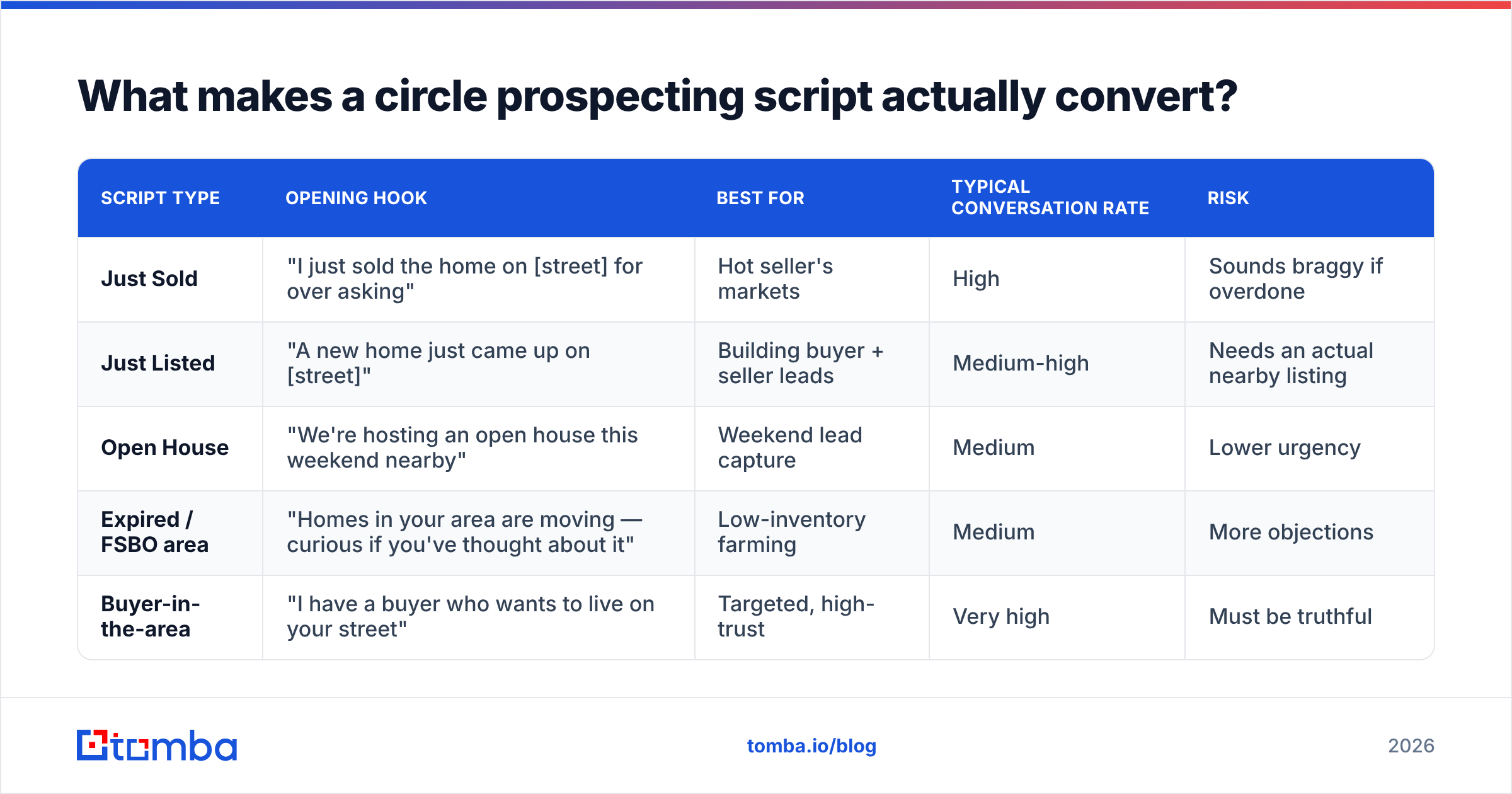
Here is a quick comparison of script styles and where each one wins:
| Script type | Opening hook | Best for | Typical conversation rate | Risk |
|---|---|---|---|---|
| Just Sold | "I just sold the home on [street] for over asking" | Hot seller's markets | High | Sounds braggy if overdone |
| Just Listed | "A new home just came up on [street]" | Building buyer + seller leads | Medium-high | Needs an actual nearby listing |
| Open House | "We're hosting an open house this weekend nearby" | Weekend lead capture | Medium | Lower urgency |
| Expired / FSBO area | "Homes in your area are moving — curious if you've thought about it" | Low-inventory farming | Medium | More objections |
| Buyer-in-the-area | "I have a buyer who wants to live on your street" | Targeted, high-trust | Very high | Must be truthful |
The "buyer in the area" angle converts best because it flips the dynamic — you're bringing demand, not asking for supply. Just make sure the buyer is real. Fabricated buyers destroy trust the moment a homeowner asks a follow-up question.
What are the best circle prospecting real estate scripts for 2026?#
Below are field-tested scripts. Use the brackets as placeholders and rehearse until they sound natural.
The "Just Sold" script#
"Hi, is this [name]? Great — this is [your name] with [brokerage]. I'll be quick. I just helped a family sell the home over on [street], and it sold for [result] in [days] days. Because there's so much interest in your neighborhood right now, I'm reaching out to a few neighbors. Out of curiosity, do you have any plans to move in the next year or so?"
If they say no plans: "Totally fair. Would it be helpful if I sent you what your home is worth in today's market — no obligation, just so you have the number?"
The "Buyer in the area" script#
"Hi [name], this is [your name] with [brokerage]. I'm calling because I'm working with a buyer who specifically wants to be on [street] or close to it. I know it's a long shot — but do you know anyone on the block who's even casually thought about selling?"
This script works because it asks about neighbors, which lowers defenses. Half the time, the person you called is the one thinking about selling.
The "Just Listed" script#
"Hi [name], [your name] with [brokerage]. A home just came on the market over on [street] at [price]. New listings tend to set the tone for a whole neighborhood's values, so I wanted to make sure you and your neighbors knew. Were you aware homes in your area were selling in this range?"
Objection handlers you'll use every day#
- "I'm not interested." → "No problem at all — I'm not asking you to do anything today. Can I just text you the recent sales on your street so you have them?"
- "How did you get my number?" → "It's public record for the property — I only call neighbors of homes I'm actively working. I'm happy to take you off my list if you'd prefer."
- "We're not selling." → "Good to know, and I'll mark that. Quick question — do you plan to stay long term, or is this more of a 'someday' home?"
- "Call me in six months." → "Perfect, I'll do exactly that. What changes in six months that I should know about?"
The goal of every handler is the same: keep the conversation alive long enough to earn permission for one follow-up. You're playing for the next touch, not the listing agreement on call one.
Why does your data matter more than your script?#
Here's the uncomfortable truth: you can have a perfect script and still fail if 30% of your numbers are disconnected, wrong, or on the Do Not Call registry. Connect rate is the multiplier on everything else. A 20% connect rate with a great script beats a 60% connect rate with a mediocre one — but a great script on a 5% connect rate beats neither, because you never reach a human.
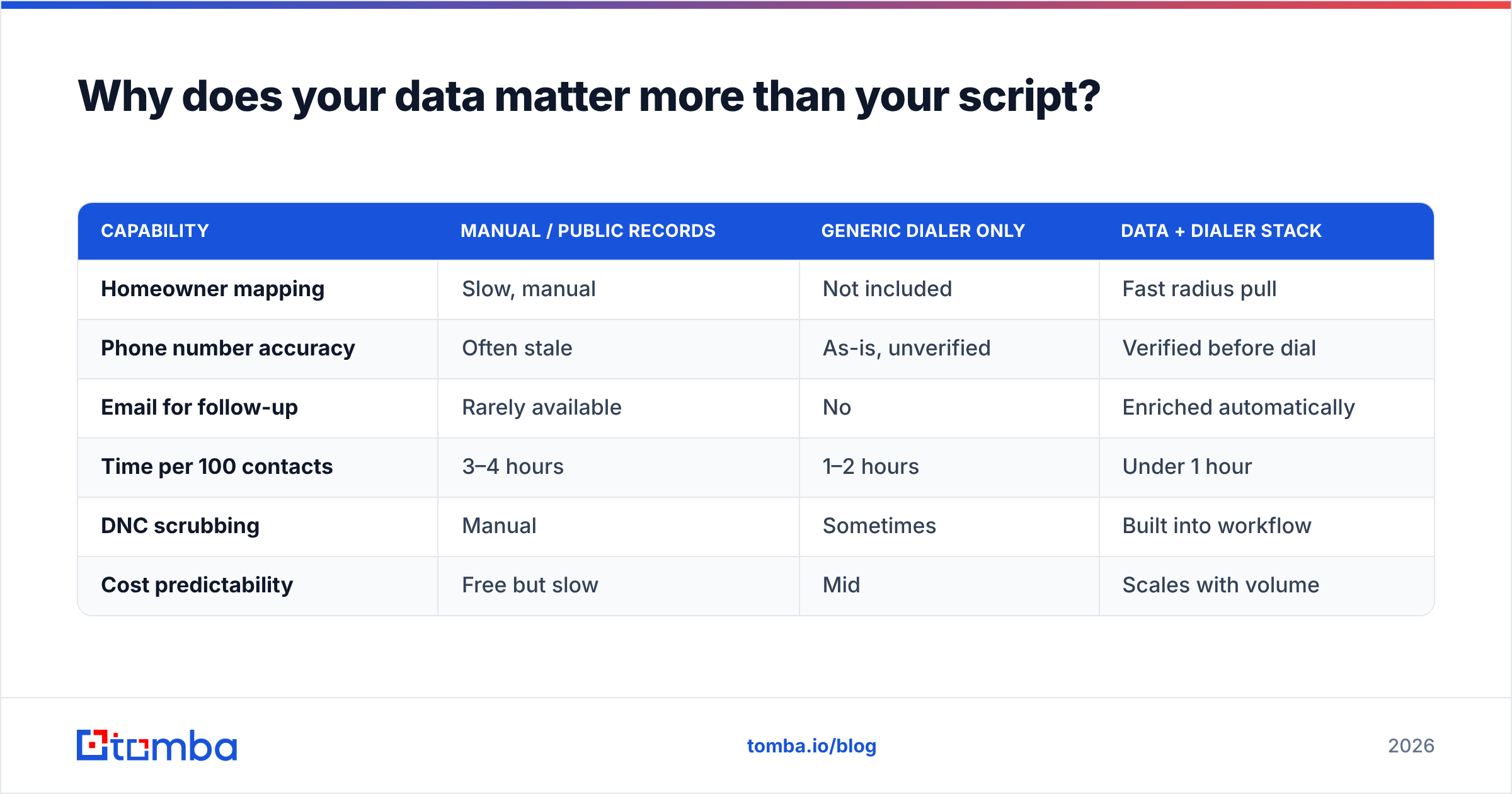
Modern circle prospecting separates the list-building problem from the calling problem. You source homeowner records, match them to current contact info, validate the numbers, and only then dial. Tools like a phone finder help you match owners to mobile lines, while a phone validator flags dead or invalid numbers before they waste a dial. Layering in data enrichment gets you email and social profiles so a missed call becomes a three-channel follow-up.
Build vs. buy: where circle prospecting tools fit#
| Capability | Manual / public records | Generic dialer only | Data + dialer stack |
|---|---|---|---|
| Homeowner mapping | Slow, manual | Not included | Fast radius pull |
| Phone number accuracy | Often stale | As-is, unverified | Verified before dial |
| Email for follow-up | Rarely available | No | Enriched automatically |
| Time per 100 contacts | 3–4 hours | 1–2 hours | Under 1 hour |
| DNC scrubbing | Manual | Sometimes | Built into workflow |
| Cost predictability | Free but slow | Mid | Scales with volume |
The "data + dialer" column is where serious farmers live. You're not paying for the dialer; you're paying to never waste a dial. For deliverability on the email side of follow-up, brush up on sender reputation before you blast a fresh list — a clean list protects both your phone time and your inbox placement.
How do you measure if your circle prospecting is working?#
Track three rates separately, because each one points to a different fix:
- Connect rate = live conversations ÷ dials. Low? Your data is stale. Fix the list, not the script.
- Conversation rate = meaningful talks ÷ connects. Low? Your opener is weak. Rewrite the first ten seconds.
- Appointment rate = appointments ÷ conversations. Low? Your close or follow-up is the gap.
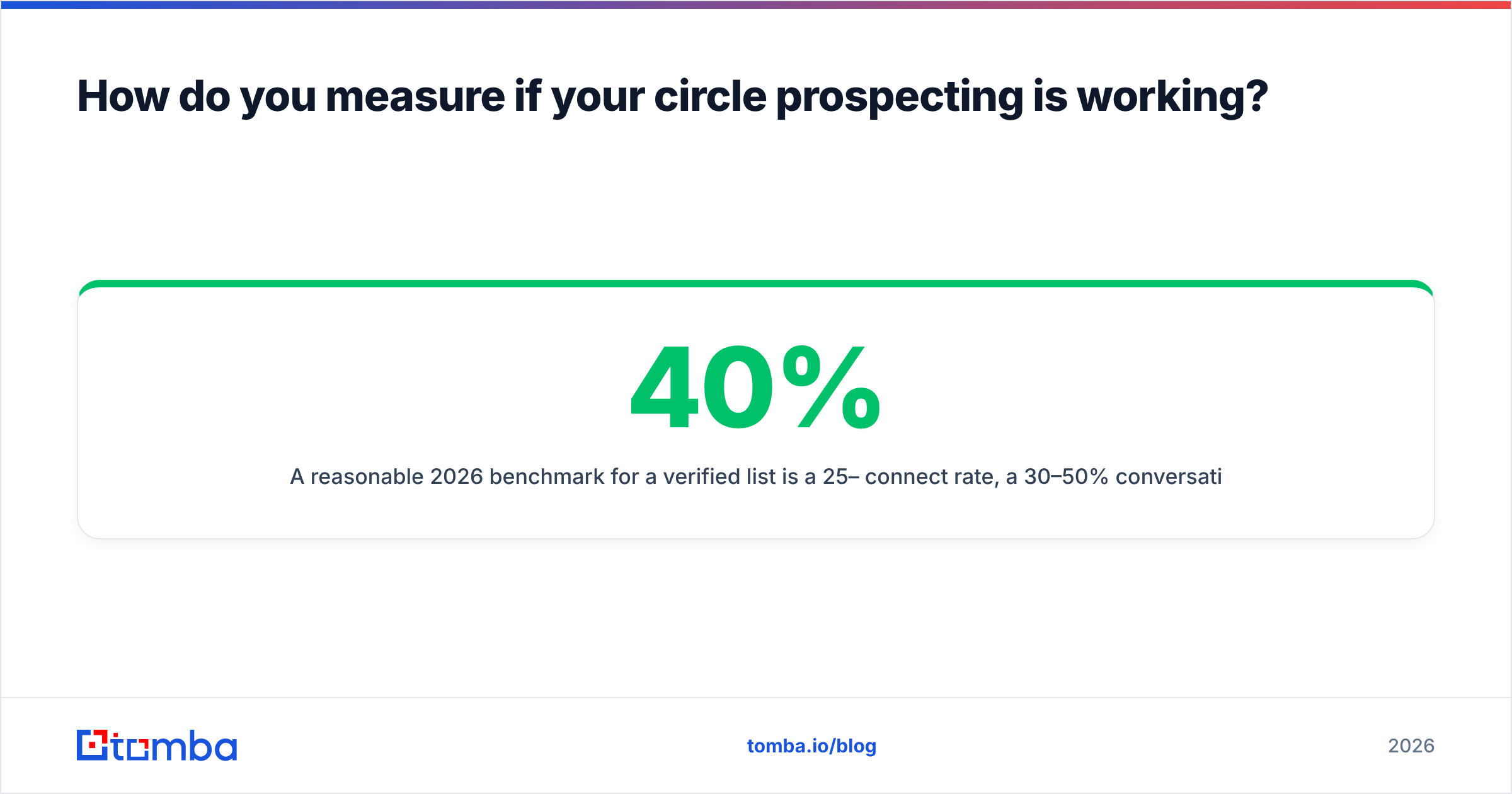
A reasonable 2026 benchmark for a verified list is a 25–40% connect rate, a 30–50% conversation rate on connects, and a 5–10% appointment rate on conversations. If your connect rate sits under 15%, stop tweaking scripts — your numbers are the problem. For context on broader outreach efficiency, HubSpot's sales benchmarks are a useful sanity check against your own funnel.
Compliance matters too. Cold outreach to mobile numbers is regulated, and the rules tightened again recently. Review the basics of cold calling regulations for your region, scrub against the Do Not Call registry, and keep records of consent and opt-outs. A single complaint is cheaper to prevent than to defend.
A simple weekly cadence#
- Monday: Pick the week's trigger property and pull 100 surrounding owners.
- Monday PM: Source phone numbers, validate, enrich with email, scrub DNC.
- Tuesday–Thursday: Dial in 90-minute blocks, same script, log every outcome.
- Friday: Follow up no-answers by text and email; review your three rates.
- Repeat: Rotate to a new trigger property each week to keep the territory warm.
Consistency beats intensity. Ten focused dials a day, every day, outperforms a once-a-month marathon — both for your numbers and for your sanity.
How is AI changing circle prospecting scripts?#
AI hasn't replaced the script — it's compressed the prep. In 2026, agents use AI to draft neighborhood-specific openers from recent sales data, to summarize a homeowner's likely situation from enriched records, and to A/B test which opener lines earn the longest conversations. The human still does the talking; the machine does the homework.
The smart move is to let AI handle list research and personalization while you keep the conversation human. A homeowner can tell within two sentences whether they're talking to a person who knows their street or a bot reading a generic pitch. Use the data to sound more local, not more robotic.
What AI won't fix is bad source data. If the underlying phone and owner records are wrong, AI just helps you sound confident while dialing dead lines faster. Get the data accuracy right first, then let automation scale what already works.
Frequently asked questions#
How many homes should I circle around one property? Start with the nearest 50–100 households. Fewer than 50 and you don't get enough conversations to learn; more than 100 and you can't follow up consistently.
Is circle prospecting better than door knocking? It's higher volume and lower friction per contact, but door knocking builds deeper local recognition. Most top agents do both — calls for reach, doors for relationships.
What's the single biggest mistake agents make? Dialing an unverified list. You'll spend half your block on disconnects and conclude "the script doesn't work." Verify first.
How fast should I follow up after a conversation? Within 24 hours. Send the comps or home value you promised on the call, by text and email, while the conversation is still fresh.
Start with data that actually connects#
The script gets the credit, but the data does the work. Before your next prospecting block, build a clean list: find current homeowner mobile numbers, validate them, and enrich each record with an email so no conversation dies on a single missed call. Tomba's phone finder and phone validator handle the sourcing and scrubbing, and data enrichment rounds out each contact for multi-channel follow-up. Plans start with a free tier (25 searches/month) and scale to Starter at $49/mo — see full Tomba pricing to match your dialing volume.
Pick your trigger property, build the verified list, and run one script all week. The agents who own their territory aren't using secret words — they're calling clean lists, consistently, with a reason to talk. Give your next 100 calls a real chance to connect.
// get started
Find, verify and enrich your first contacts today
Start on the free plan with 25 searches a month, then scale when your team is ready.
Free plan · No credit card required · GDPR & CCPA
// about the author