9 Best Claap Alternatives in 2026 (Compared & Ranked)
Claap is solid for async video and call recording, but it's not the only option. Here are 9 Claap alternatives compared on features, pricing, and the data layer that actually fills your pipeline.
(title rendered separately)
Claap is a strong async video and meeting-recording tool, but it is rarely the only thing a revenue team needs. If you are evaluating Claap alternatives in 2026, the real question is not "which tool records calls best" — it is "which tool fits the rest of my stack, from prospecting data to CRM sync to AI follow-up."
This guide compares nine credible Claap alternatives, what each one is genuinely good at, where it falls short, and how to think about the layer Claap doesn't touch at all: the contact data that fills your pipeline in the first place.
TL;DR#
- Claap is best for async video updates, call recording, and lightweight team collaboration — but it is not a prospecting or data tool.
- Best all-round alternatives: tl;dv and Fathom for meeting AI, Loom for async video, Grain and Gong for revenue intelligence.
- Pricing varies wildly — from genuinely free (Fathom, Loom free tier) to enterprise-only quotes (Gong).
- The gap Claap can't fill: none of these tools find or verify the email addresses you need to book the meeting. Pair your chosen tool with an email finder for a complete workflow.
- Pick based on your primary job-to-be-done: async updates, AI note-taking, or full revenue intelligence — not feature-count.
What is Claap and what is it actually for?#
Claap is an async video and meeting tool built for teams that want to cut down on live meetings. It records screen and webcam, transcribes and summarizes calls, captures action items, and lets teammates comment on video threads instead of scheduling another sync.
In practice, people reach for Claap for three jobs: recording sales and customer calls, sharing async product or status updates, and building a searchable library of recorded knowledge. It is genuinely good at all three.
What Claap is not: a sales-engagement platform, a CRM, or a data provider. It records the conversation — it does not help you find the person, verify their email, or enrich their record. That distinction matters when you are choosing an alternative, because half the "Claap competitors" people list solve a different problem.
Why look for a Claap alternative in 2026?#
A few honest reasons teams switch:
- Pricing fit — Claap's per-seat model can get expensive as a team scales, and some alternatives offer a more generous free tier.
- Deeper CRM and revenue intelligence — if you want deal scoring, pipeline risk, and coaching, dedicated revenue platforms go further.
- Best-in-class AI notes — meeting-AI specialists like Fathom and tl;dv have pushed transcription and summary quality hard.
- Async-video focus — if you mostly need Loom-style screen sharing, a purpose-built recorder is simpler.
- The data gap — none of these record-and-summarize tools help you build a target list. Teams increasingly want a stack that starts with accurate contact data, not just call cleanup afterward.
What are the best Claap alternatives?#
Here is the shortlist, grouped by the job they do best.
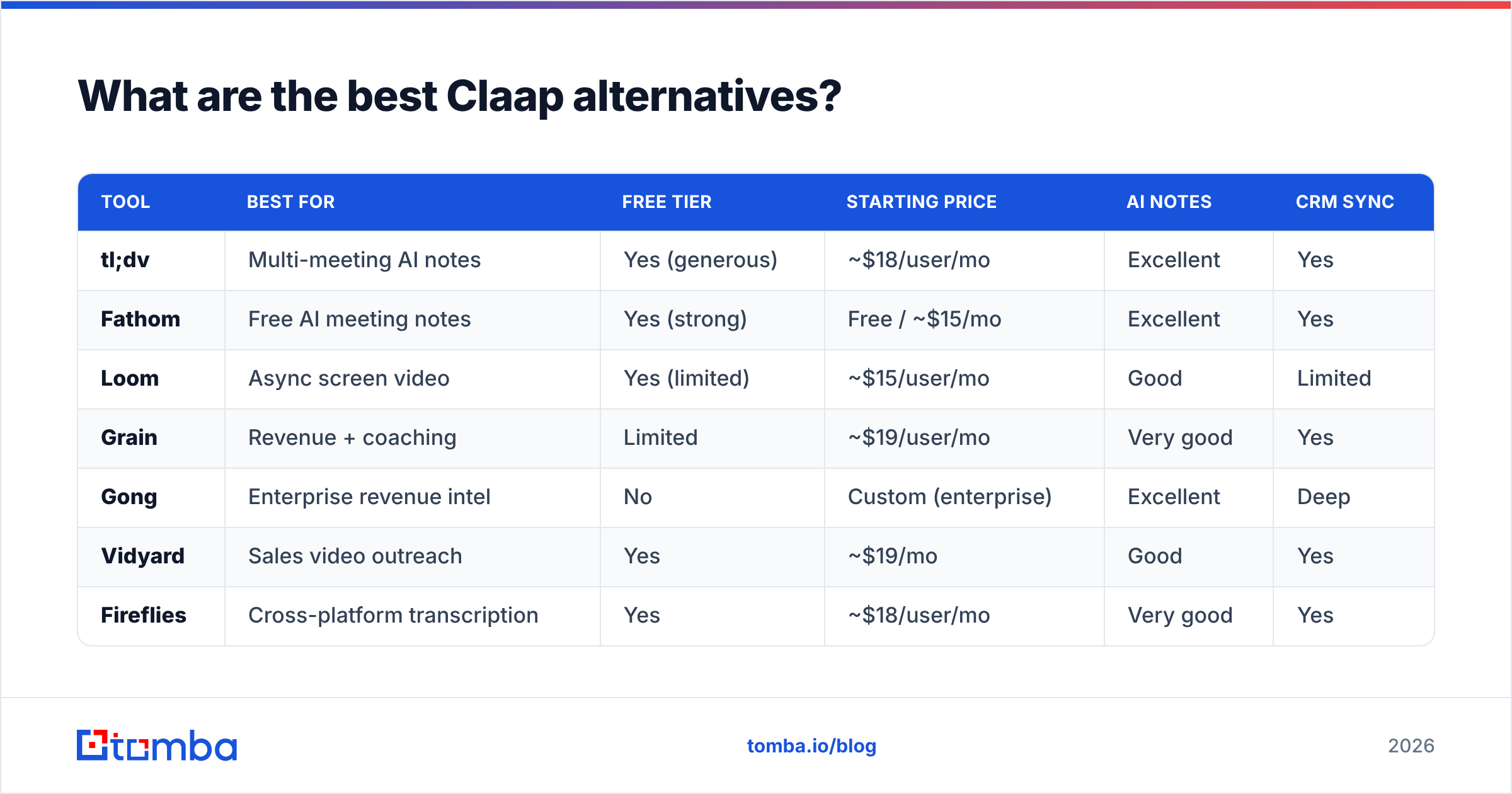
| Tool | Best for | Free tier | Starting price | AI notes | CRM sync |
|---|---|---|---|---|---|
| tl;dv | Multi-meeting AI notes | Yes (generous) | ~$18/user/mo | Excellent | Yes |
| Fathom | Free AI meeting notes | Yes (strong) | Free / ~$15/mo | Excellent | Yes |
| Loom | Async screen video | Yes (limited) | ~$15/user/mo | Good | Limited |
| Grain | Revenue + coaching | Limited | ~$19/user/mo | Very good | Yes |
| Gong | Enterprise revenue intel | No | Custom (enterprise) | Excellent | Deep |
| Vidyard | Sales video outreach | Yes | ~$19/mo | Good | Yes |
| Fireflies | Cross-platform transcription | Yes | ~$18/user/mo | Very good | Yes |
| Avoma | Coaching + scheduling | Limited | ~$19/user/mo | Very good | Yes |
| Scribe | Step-by-step doc capture | Yes | ~$23/user/mo | N/A (docs) | No |
Prices are indicative list prices for 2026 and change frequently — always confirm on the vendor's own pricing page before you buy.
tl;dv#
tl;dv is the closest like-for-like alternative for the meeting-AI side of Claap. It records Zoom, Google Meet, and Teams, generates timestamped AI notes, and pushes summaries into your CRM. Its multi-meeting reporting — asking questions across dozens of calls at once — is a standout. If your main use of Claap is "record the call and summarize it," tl;dv is the first tool to trial. See their official site for current limits.
Fathom#
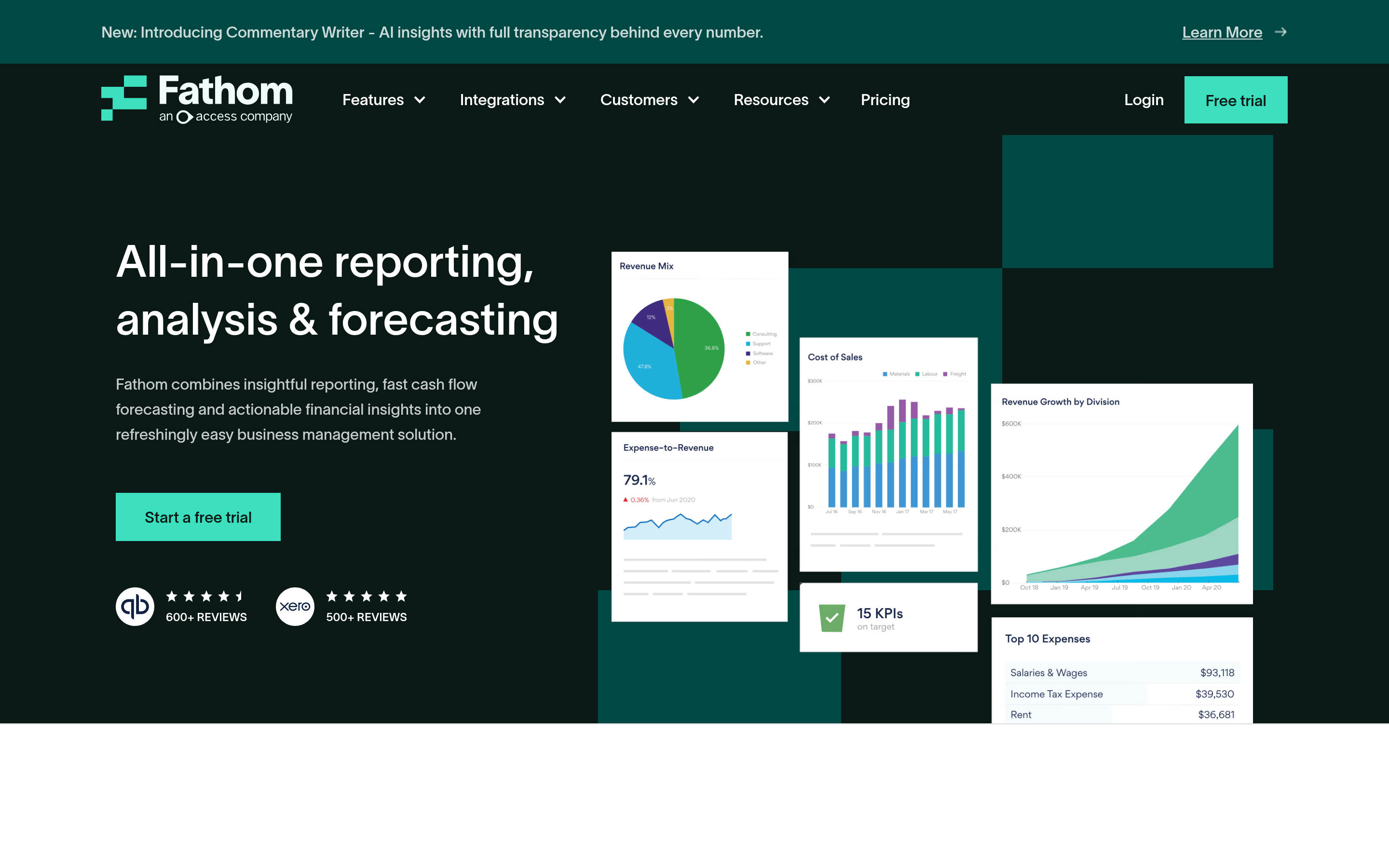
Fathom built its reputation on a genuinely usable free plan. AI summaries are fast and accurate, and the paid tiers add team analytics. For solo sellers, founders, and small teams who balked at Claap's pricing, Fathom is often the pragmatic pick.
Loom#
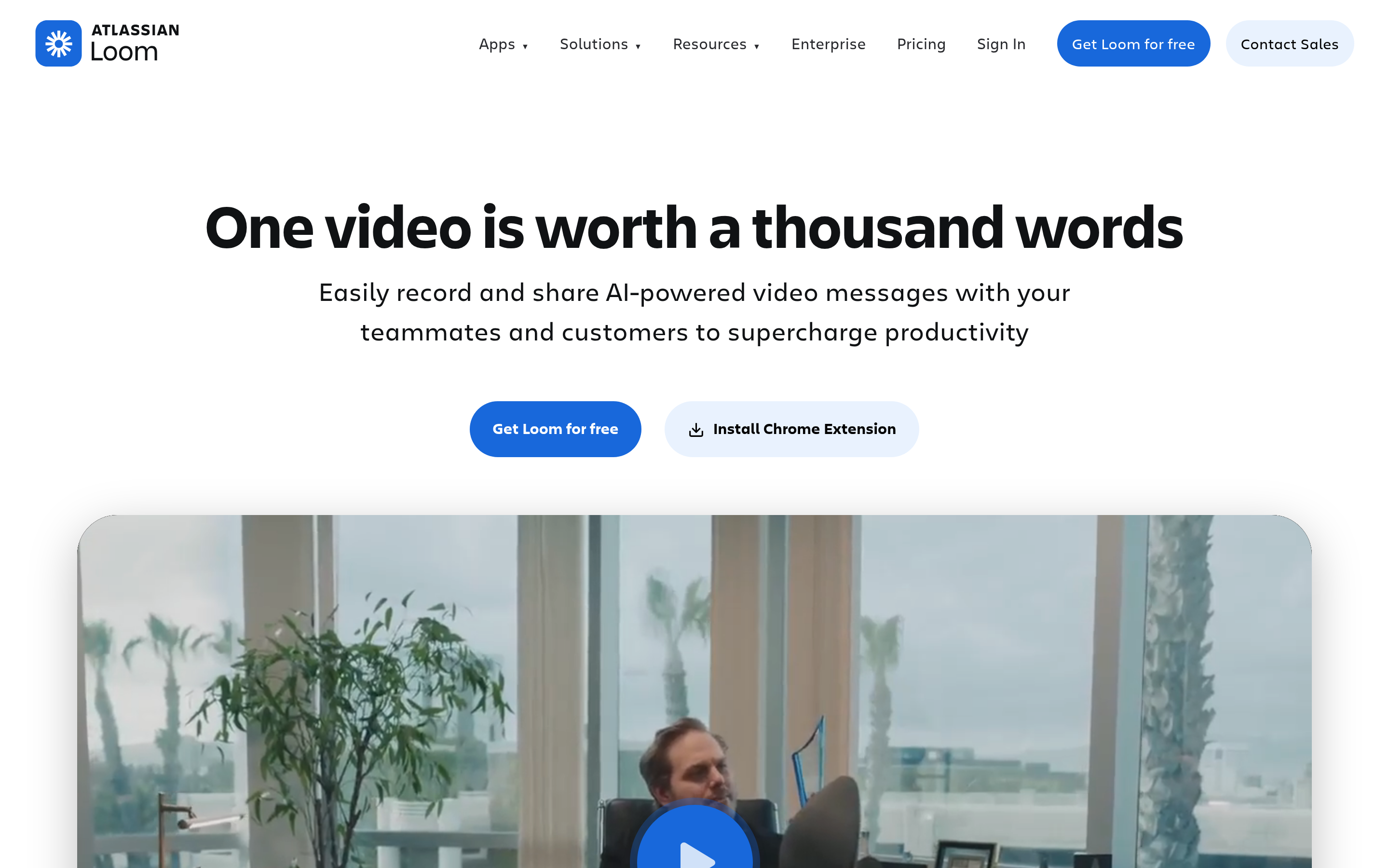
If you primarily use Claap for async screen-and-webcam updates rather than live-call intelligence, Loom is the category leader. It is simpler, faster to share, and embeds everywhere. It is weaker on meeting transcription and CRM workflows, so it is an alternative only for the async-video use case.
Grain and Gong#
Both push past recording into revenue intelligence. Grain is the more affordable, mid-market option for call coaching and deal insights. Gong is the enterprise standard — deep conversation analytics, pipeline risk, and forecasting — but it is quote-only and priced accordingly. You can read independent reviews on G2 before committing to either.
How do Claap alternatives compare on the things that matter?#
Feature checklists hide the real decision. Here is what to weigh:
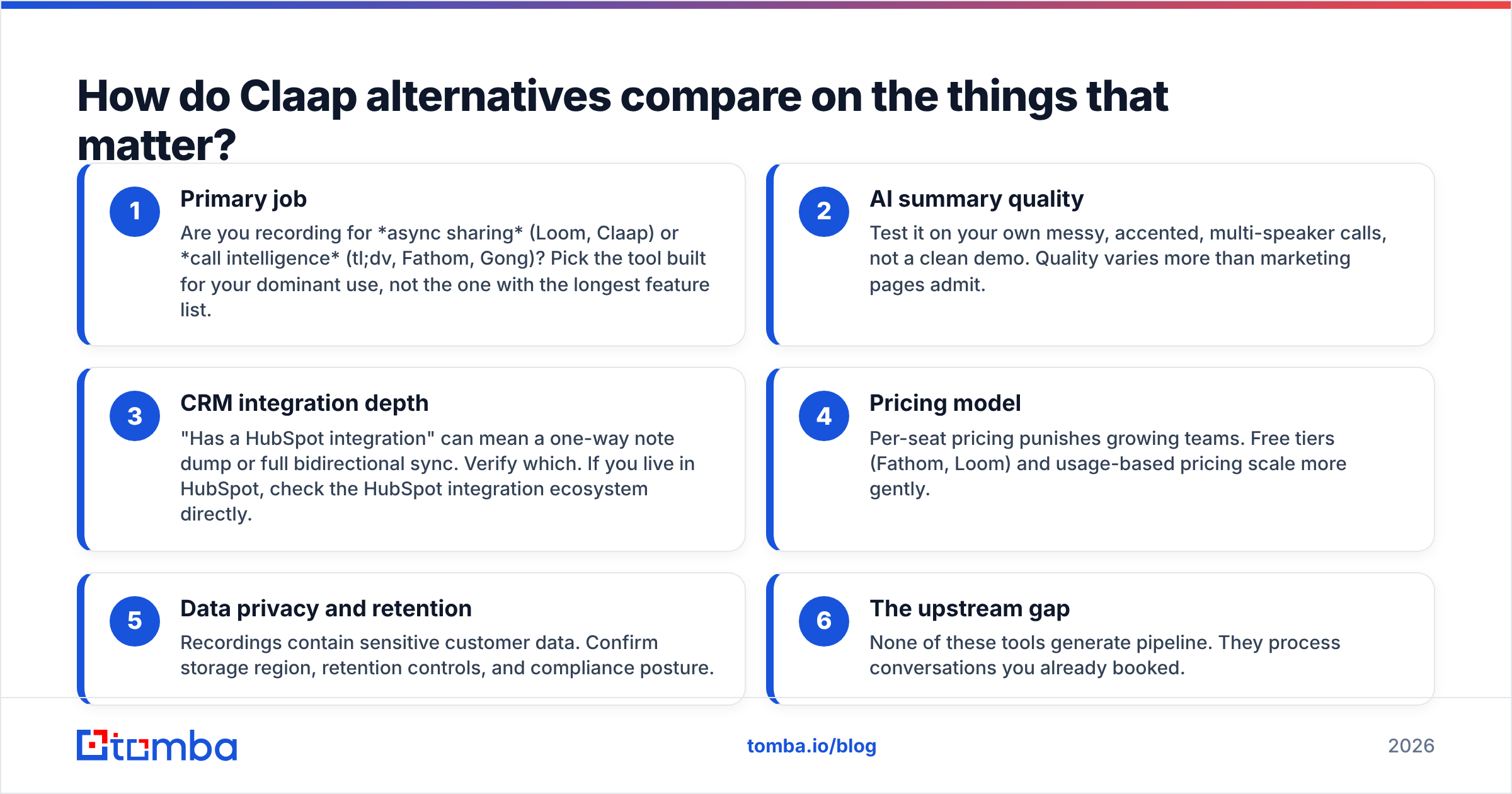
- Primary job — Are you recording for async sharing (Loom, Claap) or call intelligence (tl;dv, Fathom, Gong)? Pick the tool built for your dominant use, not the one with the longest feature list.
- AI summary quality — Test it on your own messy, accented, multi-speaker calls, not a clean demo. Quality varies more than marketing pages admit.
- CRM integration depth — "Has a HubSpot integration" can mean a one-way note dump or full bidirectional sync. Verify which. If you live in HubSpot, check the HubSpot integration ecosystem directly.
- Pricing model — Per-seat pricing punishes growing teams. Free tiers (Fathom, Loom) and usage-based pricing scale more gently.
- Data privacy and retention — Recordings contain sensitive customer data. Confirm storage region, retention controls, and compliance posture.
- The upstream gap — None of these tools generate pipeline. They process conversations you already booked.

What none of these Claap alternatives actually solve#
Here is the conclusion first: every tool above improves what happens after you get the meeting. None of them helps you get it.
Claap, tl;dv, Fathom, Loom, Grain, Gong — they all assume the prospect is already on the call. But the hard part of B2B selling in 2026 is upstream: finding the right person, getting a deliverable email address, and enriching the record before you reach out. A recording tool with an empty calendar is just a very nice camera.
This is the layer where a data platform belongs in your stack. Before any video tool earns its seat license, you need:
- Accurate contact discovery — finding decision-makers by name, role, or company domain.
- Verified email addresses — so your outreach lands instead of bouncing and torching your sender reputation. (Bounces directly damage email deliverability.)
- Enrichment — filling in title, company, and social data so your message is relevant.
That is exactly what Tomba does, and it is complementary to whichever Claap alternative you choose. Use Tomba to build and verify the list; use your video tool to run and summarize the conversation.
Where Tomba fits in the workflow#
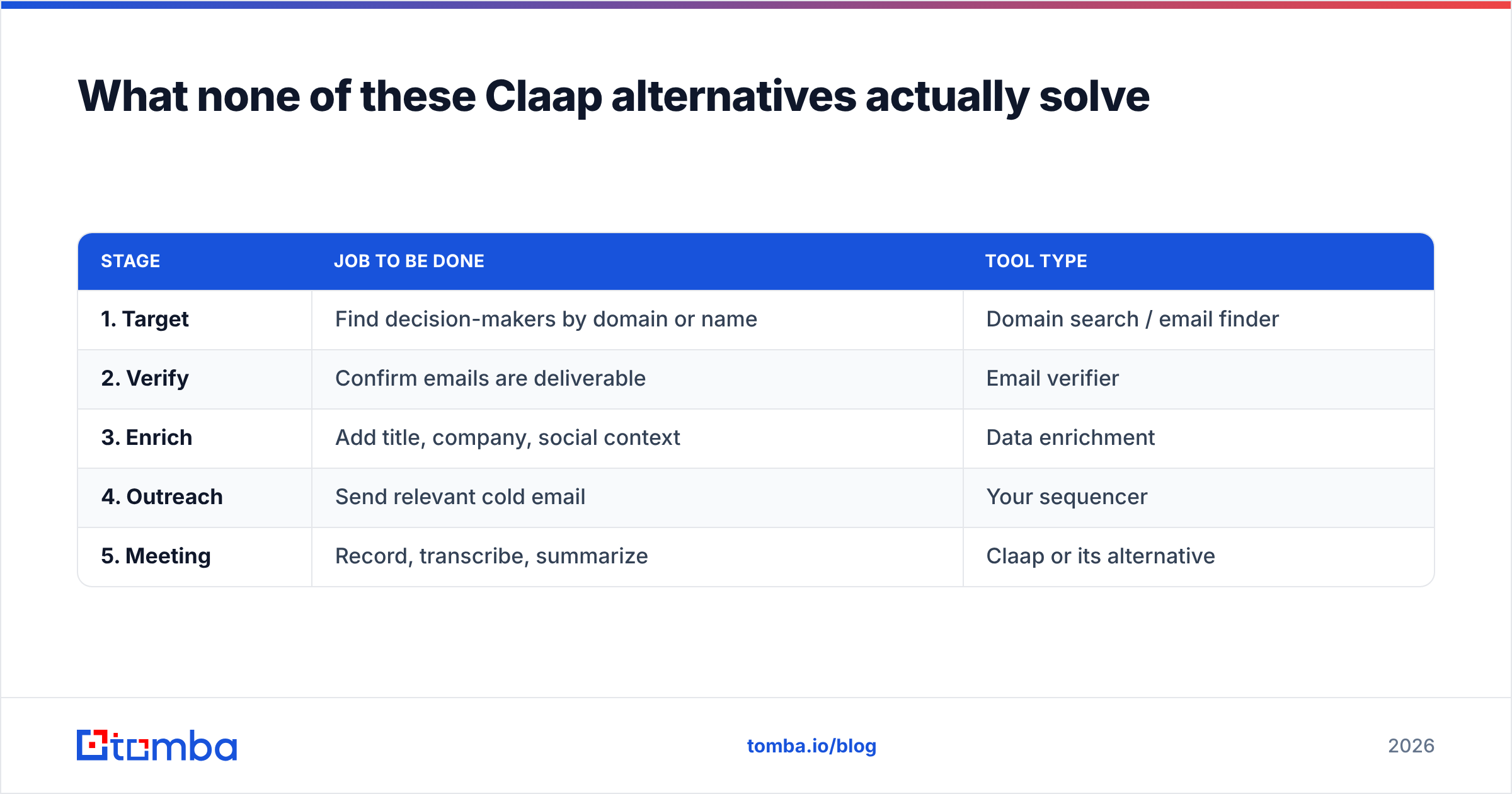
| Stage | Job to be done | Tool type |
|---|---|---|
| 1. Target | Find decision-makers by domain or name | Domain search / email finder |
| 2. Verify | Confirm emails are deliverable | Email verifier |
| 3. Enrich | Add title, company, social context | Data enrichment |
| 4. Outreach | Send relevant cold email | Your sequencer |
| 5. Meeting | Record, transcribe, summarize | Claap or its alternative |
Steps 1–3 are where most pipelines actually break. A video tool fixes step 5 — but step 5 never happens if step 2 is full of bounced addresses.
How much do Claap alternatives cost?#
Cost ranges from free to enterprise five-figures:
- Free or near-free: Fathom (strong free plan), Loom (limited free tier), tl;dv (generous free plan).
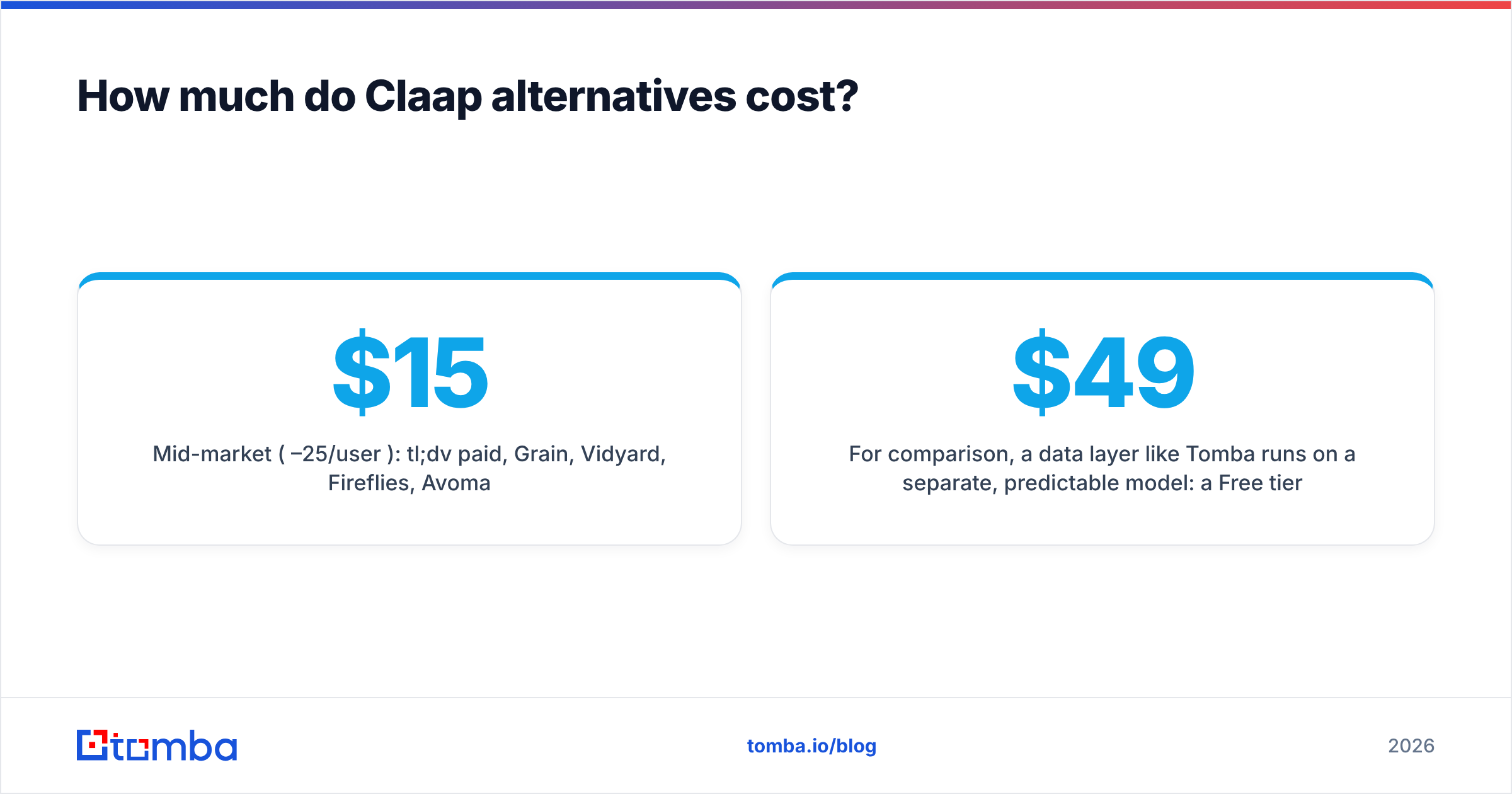
- Mid-market ($15–25/user/mo): tl;dv paid, Grain, Vidyard, Fireflies, Avoma.
- Enterprise (custom quote): Gong, and Claap's own higher tiers.
For comparison, a data layer like Tomba runs on a separate, predictable model: a Free tier with 25 searches/month, Starter at $49/mo, Growth at $99/mo, and Pro at $249/mo. Because it solves a different problem, it is additive — not a replacement for your meeting tool. Full Tomba pricing is on the site.
The practical takeaway: budget for both a conversation tool and a data tool. Teams that only buy the recording side wonder why their beautiful call library has so few calls in it.
Which Claap alternative should you choose?#
Decide by your dominant job:
- You mostly do async video updates → Loom.
- You want the best free AI meeting notes → Fathom.
- You want deep multi-meeting AI and CRM sync → tl;dv.
- You need coaching and deal insight on a budget → Grain.
- You are enterprise and need full revenue intelligence → Gong.
- You do video prospecting outreach → Vidyard.
- You need cross-platform transcription → Fireflies.
Then — regardless of which one you pick — add a contact-data layer so the calendar that feeds it stays full.
Frequently asked questions#
Is there a free Claap alternative? Yes. Fathom and tl;dv both offer genuinely usable free plans for AI meeting notes, and Loom has a free tier for async video. They are the best starting points if budget is the main reason you are leaving Claap.
What is the best Claap alternative for sales teams? For pure call intelligence and coaching, Grain (mid-market) or Gong (enterprise) lead. But sales teams should also fix the upstream data problem with an email finder and email verifier, since recording tools don't generate pipeline.
Can I replace Claap with Loom? Only if your main use is async screen-and-webcam sharing. Loom is weaker on live-call transcription and CRM workflows, so it is not a full replacement if you rely on Claap's meeting-AI features.
Do any of these tools find email addresses? No. Claap and all of its alternatives process conversations you have already booked. To find and verify contact emails, you need a dedicated tool like Tomba, used alongside your video platform.
Build the pipeline before you record it#
Pick the Claap alternative that matches your dominant job — async video, AI notes, or revenue intelligence — and don't overpay for features you won't use. But remember the recording tool is the last step, not the first.
Before any meeting gets recorded, someone has to be on it. The Tomba Email Finder finds and verifies the professional email addresses that fill your calendar, so your shiny new video tool actually has conversations to capture. Start free with 25 searches a month, then scale on a plan that fits — and let your Claap alternative do what it does best: handle the call once you've booked it.
// get started
Find, verify and enrich your first contacts today
Start on the free plan with 25 searches a month, then scale when your team is ready.
Free plan · No credit card required · GDPR & CCPA
// about the author