Best Clari Alternatives in 2026: 7 Revenue Tools Compared
Clari is powerful but pricey and forecast-heavy. Here are 7 Clari alternatives for 2026 — compared on forecasting, pipeline data, pricing, and fit.
Best Clari Alternatives in 2026
Clari built its name on revenue forecasting and pipeline visibility, and for a lot of enterprise RevOps teams it earned that reputation. But "best-known" is not the same as "best fit." If you are paying enterprise pricing for features your team never touches, or your forecast is only as good as the messy CRM data feeding it, it is worth looking at what else is out there before you sign another annual contract.
TL;DR#
- Clari is strong but expensive and forecast-centric. If you mostly need conversation intelligence, deal inspection, or clean pipeline data, you are likely overpaying.
- The best Clari alternative depends on your bottleneck: Gong and Salesloft win on conversation/engagement data, BoostUp and Aviso compete head-on for forecasting, and HubSpot covers SMB/mid-market RevOps at a fraction of the cost.
- No forecast tool fixes bad inputs. Garbage contact and account data sinks accuracy no matter which platform you choose — fix data quality first.
- Tomba is not a Clari competitor; it is the upstream layer that keeps your CRM accounts and contacts accurate so any forecasting tool can do its job.
- Use the comparison table below to match a tool to your actual gap, then trial two before committing.
What does Clari actually do, and why look for alternatives?#
Clari is a revenue operations and forecasting platform. Its core jobs are projecting where the quarter will land, flagging at-risk deals, and giving leaders a roll-up view of pipeline health. Over time it added conversation intelligence (Clari Copilot, formerly Wingman) and deal-inspection workflows.
So why do teams shop around? A few recurring reasons:
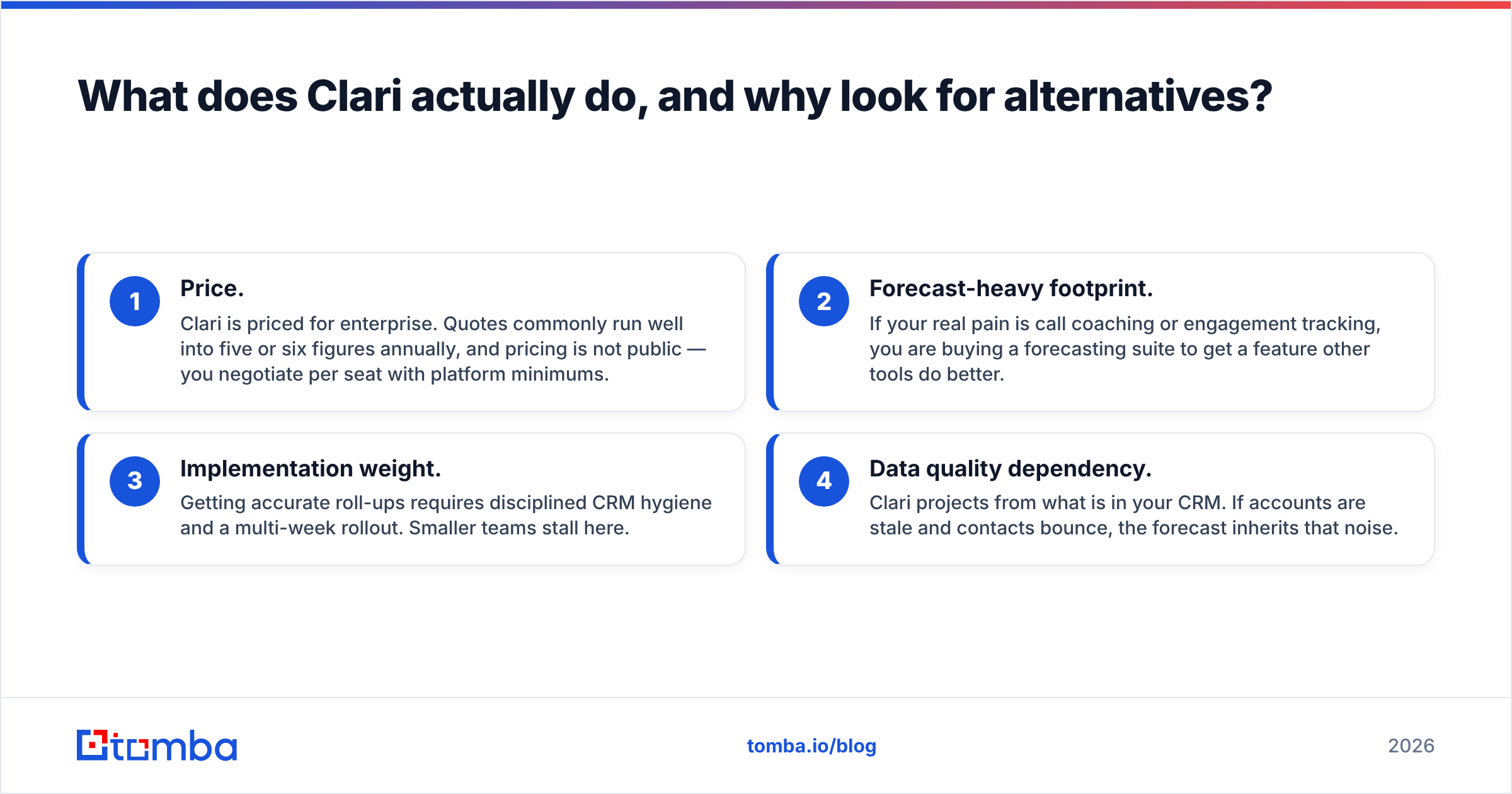
- Price. Clari is priced for enterprise. Quotes commonly run well into five or six figures annually, and pricing is not public — you negotiate per seat with platform minimums.
- Forecast-heavy footprint. If your real pain is call coaching or engagement tracking, you are buying a forecasting suite to get a feature other tools do better.
- Implementation weight. Getting accurate roll-ups requires disciplined CRM hygiene and a multi-week rollout. Smaller teams stall here.
- Data quality dependency. Clari projects from what is in your CRM. If accounts are stale and contacts bounce, the forecast inherits that noise.
That last point matters more than vendors admit. A forecasting engine is a calculator — feed it wrong numbers and it confidently returns wrong answers.
)
What should you evaluate in a Clari alternative?#
Before comparing logos, get specific about the gap you are filling. Score every candidate against these:
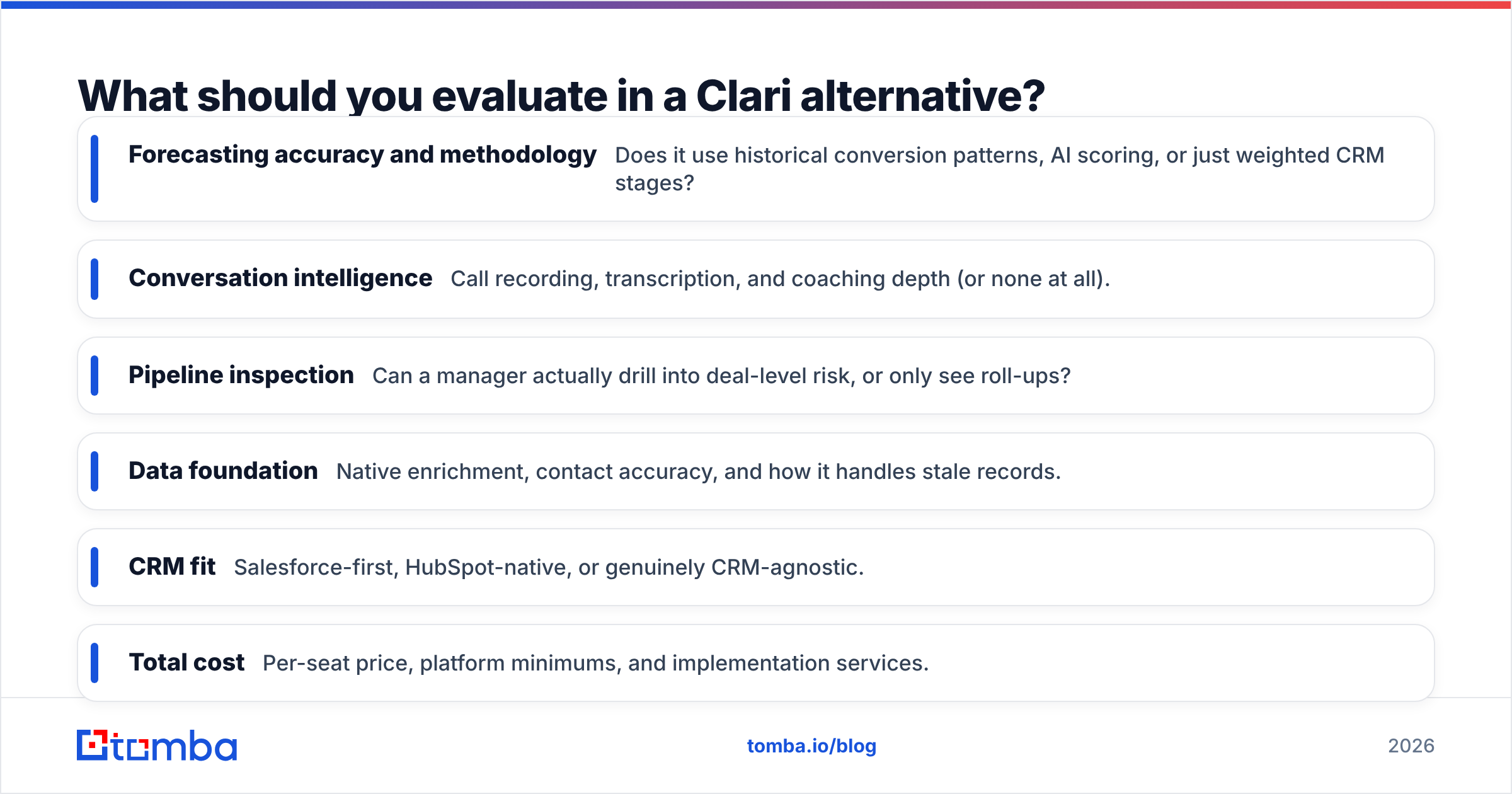
- Forecasting accuracy and methodology — Does it use historical conversion patterns, AI scoring, or just weighted CRM stages?
- Conversation intelligence — Call recording, transcription, and coaching depth (or none at all).
- Pipeline inspection — Can a manager actually drill into deal-level risk, or only see roll-ups?
- Data foundation — Native enrichment, contact accuracy, and how it handles stale records.
- CRM fit — Salesforce-first, HubSpot-native, or genuinely CRM-agnostic.
- Total cost — Per-seat price, platform minimums, and implementation services.
- Time to value — Days to a working dashboard versus a multi-quarter rollout.
Write down which three of these matter most to you. The "best" tool is whichever wins on your top three, not on the longest feature list.
Which tools are the best Clari alternatives in 2026?#
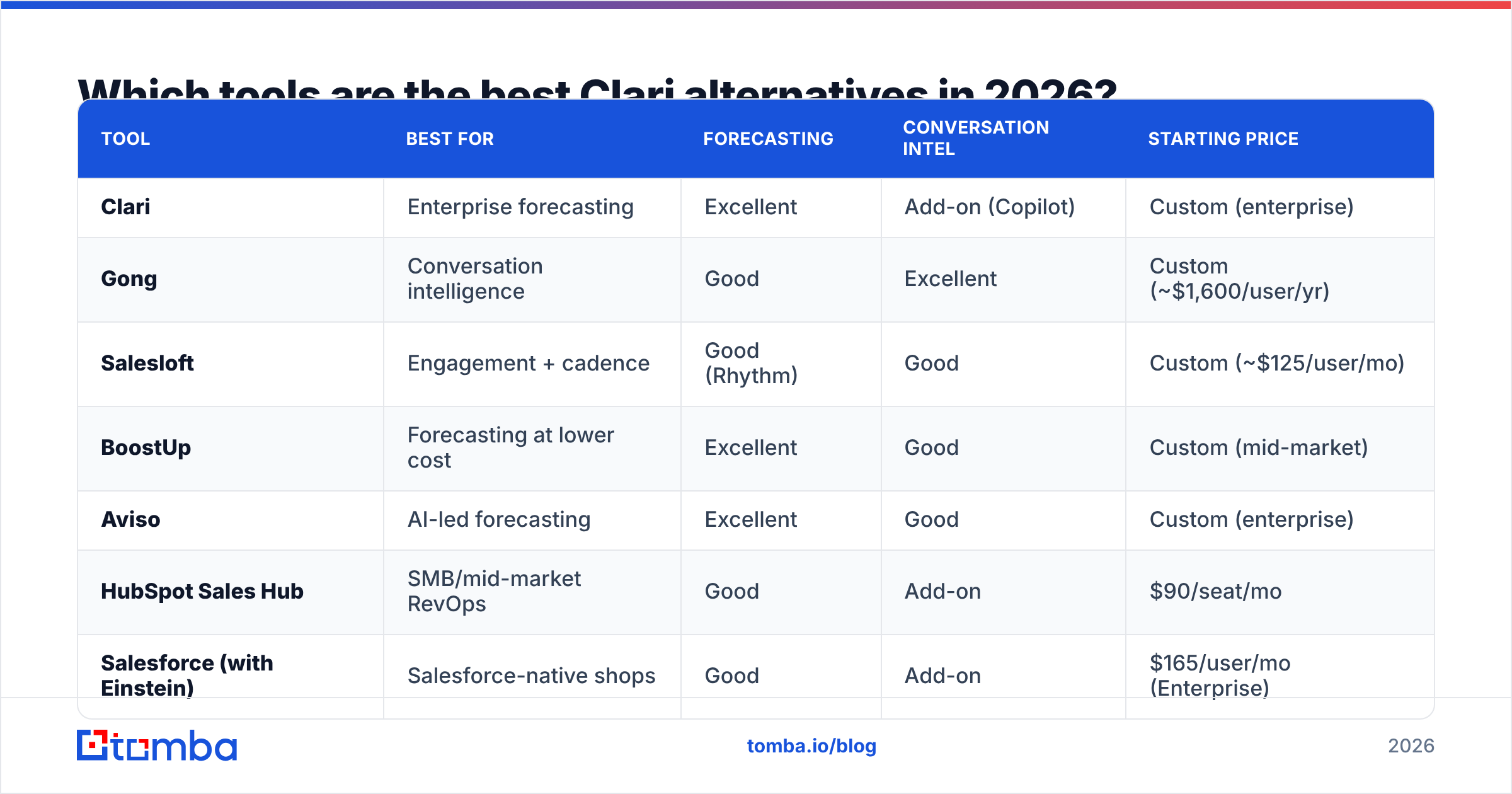
Here is the head-to-head. Prices are list/estimate where public; enterprise tools quote custom, so treat those as "expect to negotiate."
| Tool | Best for | Forecasting | Conversation intel | Starting price |
|---|---|---|---|---|
| Clari | Enterprise forecasting | Excellent | Add-on (Copilot) | Custom (enterprise) |
| Gong | Conversation intelligence | Good | Excellent | Custom (~$1,600/user/yr) |
| Salesloft | Engagement + cadence | Good (Rhythm) | Good | Custom (~$125/user/mo) |
| BoostUp | Forecasting at lower cost | Excellent | Good | Custom (mid-market) |
| Aviso | AI-led forecasting | Excellent | Good | Custom (enterprise) |
| HubSpot Sales Hub | SMB/mid-market RevOps | Good | Add-on | $90/seat/mo |
| Salesforce (with Einstein) | Salesforce-native shops | Good | Add-on | $165/user/mo (Enterprise) |
A quick read on each:
Gong — The strongest pick if your bottleneck is what happens inside calls. Gong's conversation analytics and deal intelligence are best-in-class, and its forecasting has matured. If coaching reps matters more than CFO-grade roll-ups, start here. See independent reviews on G2 before committing.
Salesloft — A sales engagement platform that grew into forecasting via its Rhythm signal engine. Good if you want cadences, dialer, and pipeline guidance in one place rather than a pure forecasting tool.
BoostUp — Frequently shortlisted directly against Clari for forecasting, usually at a friendlier price point for mid-market. Strong deal-grid inspection and configurable forecast models.
Aviso — AI-first forecasting with "Nina" guidance. Leans heavily on predictive scoring; appeals to teams that want the model to do more of the judgment.
HubSpot Sales Hub — The pragmatic choice for SMB and mid-market. You will not get Clari-depth forecasting, but HubSpot bundles forecasting, pipeline, and reporting into a CRM many teams already run, and you can connect it through a HubSpot integration.
Salesforce + Einstein — If you are already all-in on Salesforce, Einstein forecasting and Revenue Intelligence may close the gap without adding another vendor. Tie it together with a Salesforce integration.
Is Clari better than Gong, or are they solving different problems?#
They overlap, but they start from opposite ends. Clari starts with the forecast and works down to the deal; Gong starts with the conversation and works up to the forecast. Clari answers "will we hit the number?" Gong answers "why are these deals stalling, and how do reps need to change?"
If leadership lives in the forecast and you have clean CRM discipline, Clari's roll-ups are hard to beat. If your forecast is fine but your reps need coaching and your deals die in silence, Gong delivers more. Many enterprises run both — which is exactly why budget-conscious teams look for a single tool that covers their primary gap instead of two premium subscriptions.
Why does data quality decide your forecast accuracy?#
Here is the part most "Clari vs X" articles skip: the platform almost never decides accuracy — the data does. A forecast model trained on duplicate accounts, contacts who left the company, and bounced emails will misjudge deal stages and account coverage no matter how clever the AI is.
Think of it like a GPS. The routing algorithm can be flawless, but if the map is three years out of date it will still send you down a road that no longer exists. Revenue forecasting works the same way — the engine is only as trustworthy as the underlying map of who your buyers are and where they work.
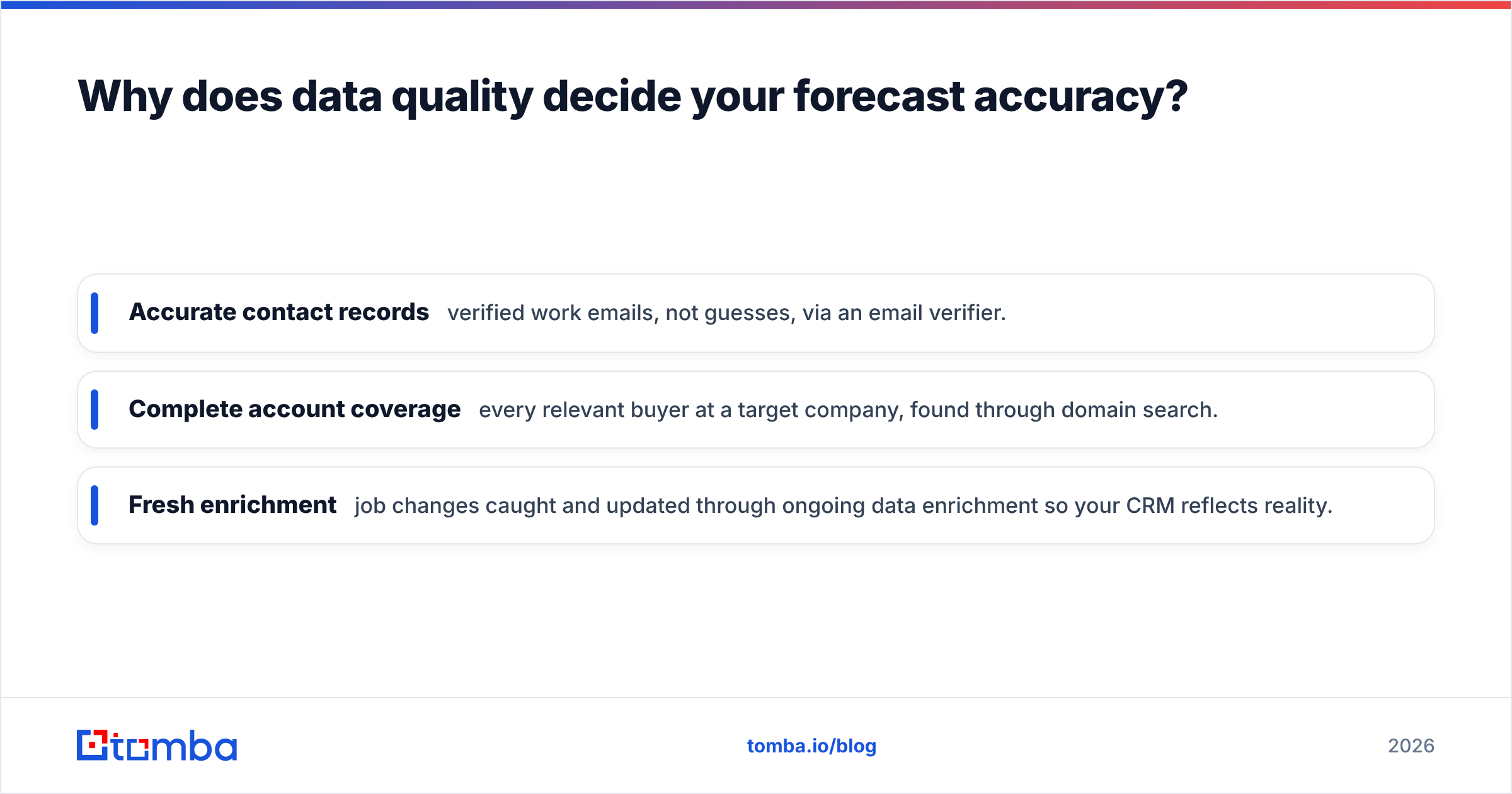
This is where an upstream data layer earns its place in the stack. Before your revenue operations tooling crunches anything, you want:
- Accurate contact records — verified work emails, not guesses, via an email verifier.
- Complete account coverage — every relevant buyer at a target company, found through domain search.
- Fresh enrichment — job changes caught and updated through ongoing data enrichment so your CRM reflects reality.
Tomba sits here. It is not trying to replace Clari's forecast — it makes sure the records Clari (or Gong, or HubSpot) forecasts from are real. Clean inputs are the cheapest accuracy upgrade you can buy.
)
How do you choose the right Clari alternative for your team?#
Match the tool to your stage and your single biggest gap:
| Your situation | Recommended path |
|---|---|
| Enterprise, forecast is the priority, budget exists | Stay on Clari or trial BoostUp/Aviso for cost relief |
| Forecast is fine, reps need coaching | Gong |
| Want engagement + cadences + forecasting in one | Salesloft |
| SMB / mid-market, cost-sensitive | HubSpot Sales Hub |
| Already deep in Salesforce | Einstein / Revenue Intelligence |
| Forecast is wrong because data is messy | Fix inputs with Tomba, then pick any of the above |
Two practical rules. First, trial two tools, not one — you only learn a forecasting platform's real fit by loading your own pipeline into it. Second, audit your CRM data before the trial, not after. If you evaluate three platforms on top of dirty data, you are really just comparing how gracefully each one fails.
For a deeper look at where contact and account data comes from and how it is validated, the data sources breakdown is a useful reference, and you can see plan-level limits on the Tomba pricing page.
What are the real trade-offs to expect?#
No alternative is a free win. Be honest about the costs:
- Switching cost is real. Migrating forecast history and retraining managers takes a quarter. Budget for it.
- Cheaper tools mean shallower forecasting. HubSpot will not match Clari's enterprise roll-up depth — that is the deal you are accepting for the price.
- Conversation-first tools assume reps record calls. Adoption is the hidden tax; a tool nobody logs into forecasts nothing.
- Every option still needs clean data. This is the constant across all seven. Skip it and accuracy suffers everywhere.
Per Gartner-style guidance on revenue tech, consolidation usually beats best-of-breed sprawl for teams under a few hundred reps — fewer tools, fewer integration seams, fewer places for data to rot. You can read vendor positioning directly on Clari's site to confirm where its strengths land for your size.
The bottom line#
The best Clari alternative in 2026 is the one that fixes your actual bottleneck — Gong for conversations, BoostUp or Aviso for cheaper forecasting, HubSpot for mid-market, Salesforce-native for existing shops. But whichever forecasting engine you choose, it will only be as accurate as the contact and account data underneath it.
Start there. Use the Tomba Email Finder to find and verify the real decision-makers at every account in your pipeline, enrich your CRM so stale records stop poisoning your forecast, and then let your RevOps platform do the math. Clean data is the upgrade that makes every other tool on this list work better — and it is the one you control. Spin up a free Tomba account, audit one segment of your pipeline, and watch how much your forecast inputs actually change.
// get started
Find, verify and enrich your first contacts today
Start on the free plan with 25 searches a month, then scale when your team is ready.
Free plan · No credit card required · GDPR & CCPA
Get the Tomba newsletter
Product and data updates
// about the author