Clay vs ZoomInfo 2026: Which B2B Data Platform Wins?
Clay automates enrichment from 100+ sources; ZoomInfo sells one deep database. We compare pricing, data accuracy, and workflows to pick the right fit for 2026.
Clay vs ZoomInfo 2026: Which B2B Data Platform Wins?
Choosing between Clay and ZoomInfo isn't a feature-by-feature fight — it's a choice between two philosophies. ZoomInfo sells you one massive, proprietary database. Clay sells you a workflow engine that pulls from 100+ sources (including ZoomInfo-style providers) and stitches the results together. Pick wrong and you either overpay for coverage you don't use, or you buy a flexible tool your team never operationalizes.
This guide breaks down pricing, data accuracy, ideal use cases, and where a leaner email-finding stack beats both.
TL;DR#
- ZoomInfo is a single deep database with intent data, org charts, and enterprise compliance — powerful but expensive (often $15k+/year) and locked into annual contracts.
- Clay is a spreadsheet-style automation layer that runs "waterfall enrichment" across many data vendors, so you pay per credit and only for data you actually find.
- Clay is better for lean, technical GTM teams that want custom workflows and pay-as-you-go data. ZoomInfo is better for large sales orgs that need one governed source of truth plus intent signals.
- Neither is the cheapest way to just find and verify B2B emails — a focused tool like Tomba Email Finder starts at $49/mo versus enterprise-tier contracts.
- The smart 2026 stack is often hybrid: a primary email finder for core contact data, plus Clay or ZoomInfo only where you genuinely need depth.
What is Clay and what is ZoomInfo?#
Think of it like buying produce. ZoomInfo is the giant supermarket — everything under one roof, consistent quality, but you pay membership fees and walk past a lot of aisles you'll never use. Clay is the meal-kit service — it sources ingredients from dozens of specialist suppliers, only charges you for what's in tonight's recipe, and lets you customize every step.
ZoomInfo is a B2B data and intelligence platform with a proprietary contact and company database, buying-intent signals (via its Bombora partnership and its own web tracking), org charts, technographics, and a workflow suite (Engage, Chorus, Copilot). It's built for mid-market and enterprise revenue teams that want governance, compliance, and scale.
Clay is a data-orchestration tool that looks like a smart spreadsheet. Each column can call an API — enrichment vendors, scrapers, AI models — and "waterfall" through providers until it finds an answer. Instead of owning data, Clay routes you to it and automates the busywork of building targeted lists.
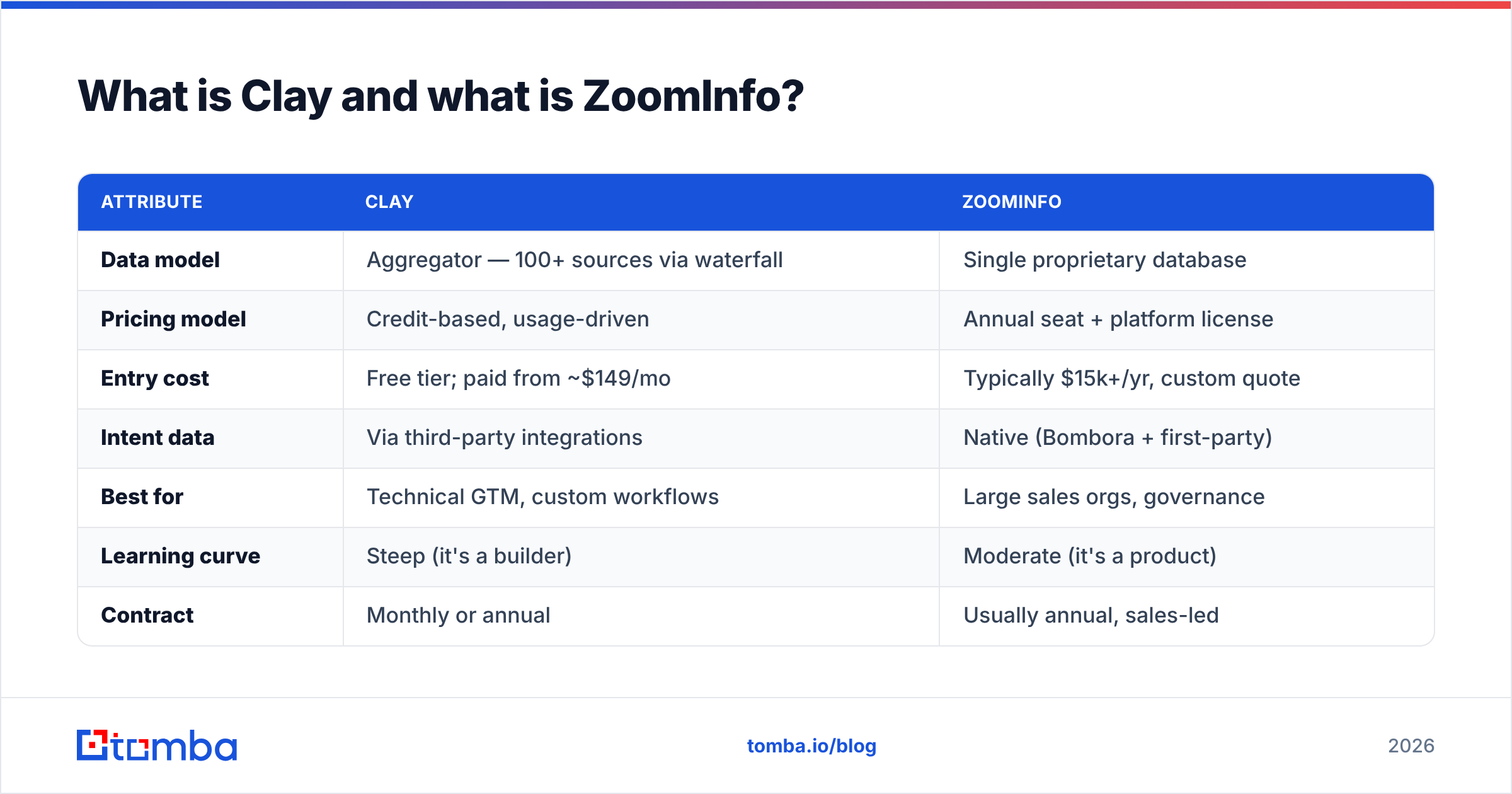
Here's how the two philosophies line up on the attributes that actually change your buying decision:
| Attribute | Clay | ZoomInfo |
|---|---|---|
| Data model | Aggregator — 100+ sources via waterfall | Single proprietary database |
| Pricing model | Credit-based, usage-driven | Annual seat + platform license |
| Entry cost | Free tier; paid from ~$149/mo | Typically $15k+/yr, custom quote |
| Intent data | Via third-party integrations | Native (Bombora + first-party) |
| Best for | Technical GTM, custom workflows | Large sales orgs, governance |
| Learning curve | Steep (it's a builder) | Moderate (it's a product) |
| Contract | Monthly or annual | Usually annual, sales-led |
How does data accuracy compare between Clay and ZoomInfo?#
Accuracy is where the "one database vs many sources" debate gets real.
ZoomInfo is known for breadth and freshness in North American B2B, especially mid-to-large companies. Its scale means strong coverage of titles, direct dials, and org structure. The trade-off: it's still one source, so when ZoomInfo is wrong or stale on a contact, you have no fallback inside the platform — and users frequently report decay on smaller companies and non-US regions.
Clay flips the model. Because it waterfalls across providers, a single contact can be checked against five or ten vendors. If the first misses, the next fills the gap. In practice this often produces higher fill rates on hard-to-find contacts — but accuracy now depends on which vendors you wire up and in what order. Clay is only as good as the stack you build inside it.
The catch both platforms share: email validity. Aggregated or proprietary, raw emails go stale fast. Whatever you choose, run results through a dedicated email verifier before you send, and a catch-all verifier for the domains that won't give a clean SMTP answer. Skipping that step is the fastest way to tank your sender reputation.
According to G2 reviews, ZoomInfo's most common complaint is contract rigidity and price, not raw data quality — which tells you the real decision is economic as much as technical.
Clay vs ZoomInfo pricing: what will you actually pay?#
Conclusion first: ZoomInfo costs more and commits you longer; Clay scales with usage but gets expensive at high volume.
ZoomInfo doesn't publish prices. Real-world quotes for a sales team typically start around $15,000/year and climb quickly with seats, intent data, and add-ons like Engage or Chorus. Contracts are annual and sales-negotiated.
Clay uses credit-based tiers:
- Free — a few hundred credits to test the builder.
- Starter — around $149/mo, good for solo operators and small lists.
- Explorer / Pro — mid-tier with more credits and higher concurrency.
- Enterprise — custom, for teams running large automated campaigns.
The hidden cost in Clay: third-party enrichment credits. Many premium data vendors inside Clay bill separately on top of your Clay subscription, so a heavy waterfall can multiply your effective per-record cost.
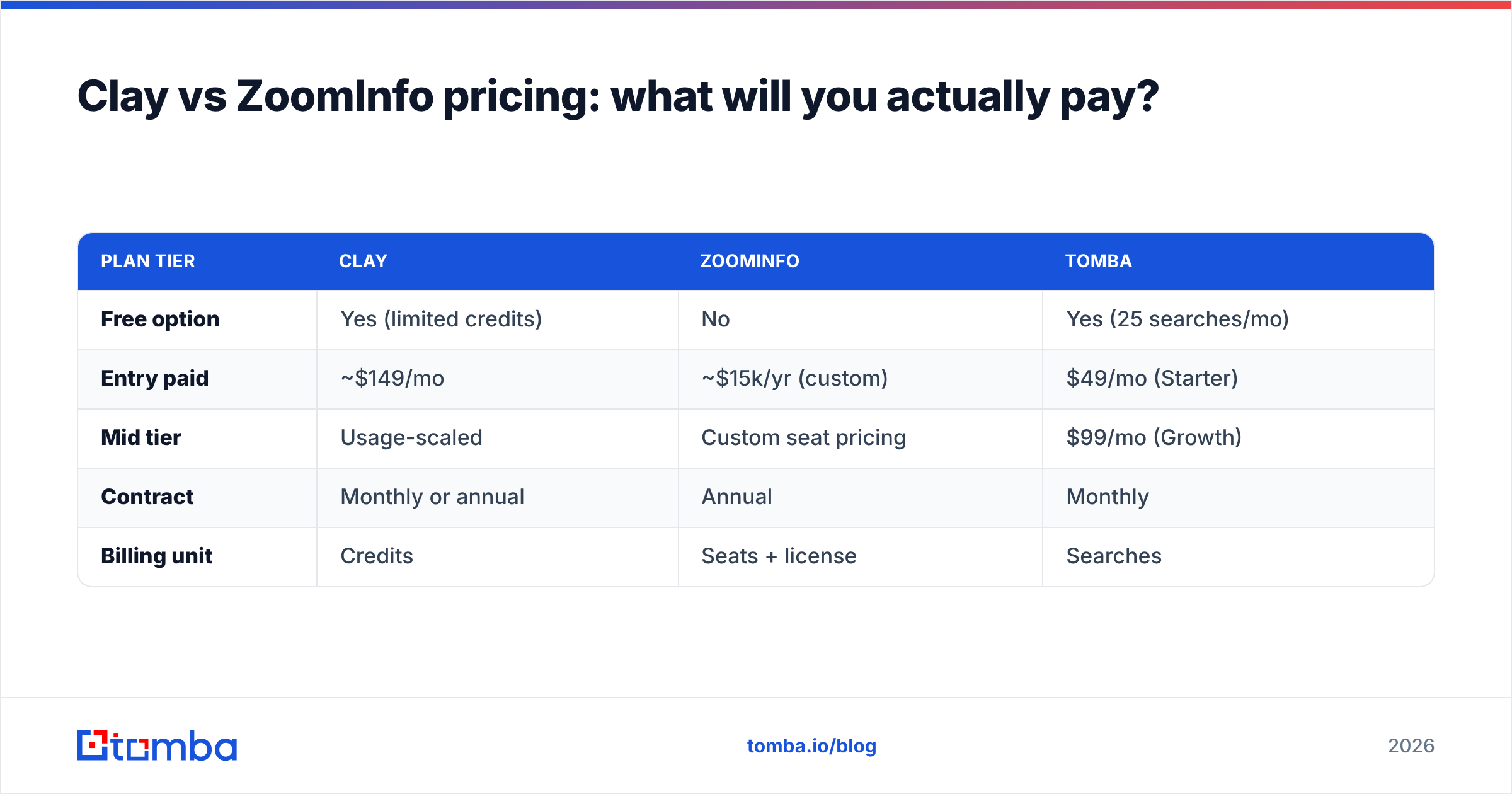
| Plan tier | Clay | ZoomInfo | Tomba |
|---|---|---|---|
| Free option | Yes (limited credits) | No | Yes (25 searches/mo) |
| Entry paid | ~$149/mo | ~$15k/yr (custom) | $49/mo (Starter) |
| Mid tier | Usage-scaled | Custom seat pricing | $99/mo (Growth) |
| Contract | Monthly or annual | Annual | Monthly |
| Billing unit | Credits | Seats + license | Searches |
If your core need is contact discovery rather than a full data warehouse, the gap is stark. Compare full Tomba pricing against an enterprise ZoomInfo quote and the math usually favors the focused tool for early-stage and mid-market teams.
Is Clay better than ZoomInfo for your team?#
It depends on who's driving and what you're building. Use this decision frame:
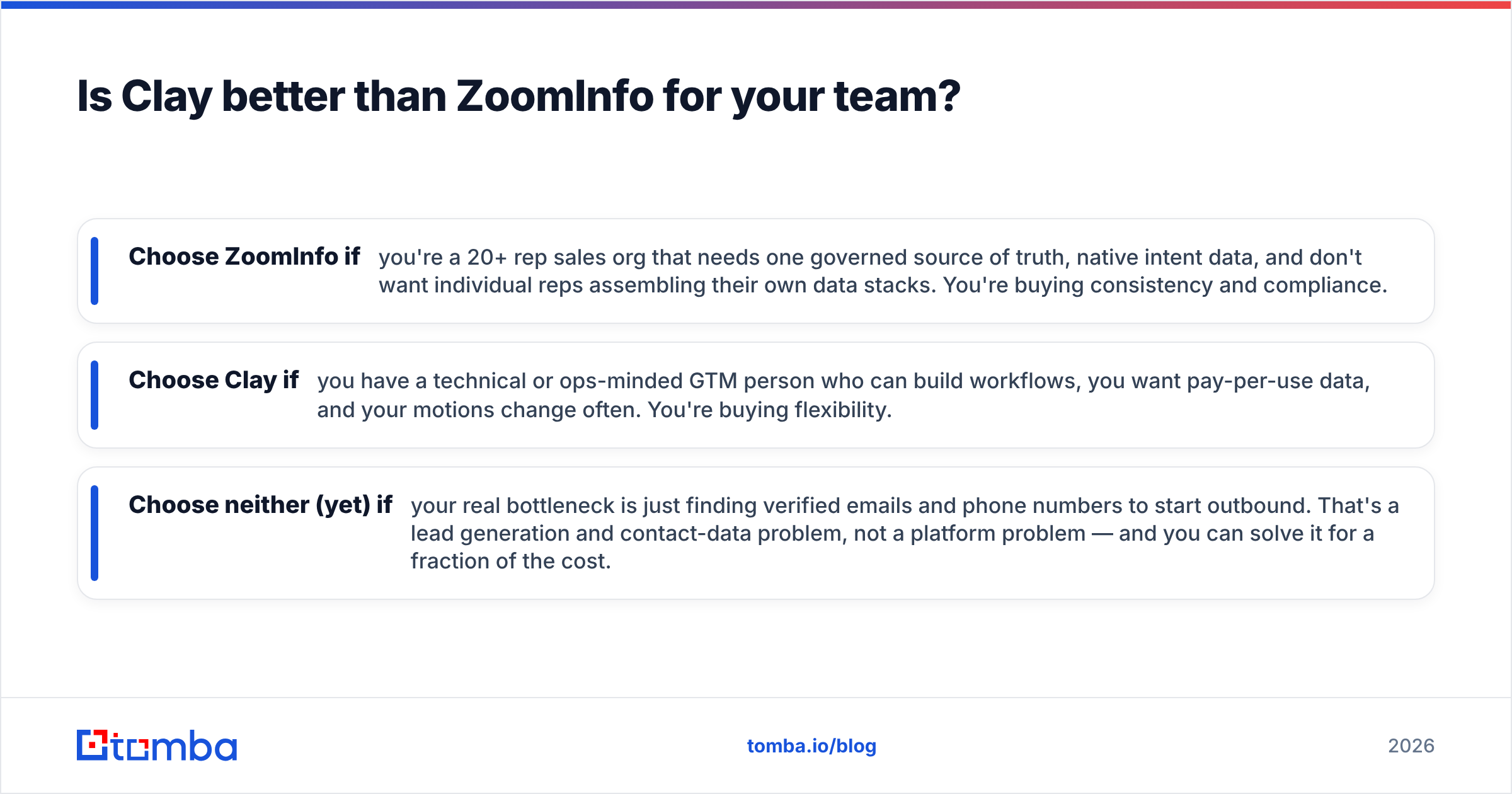
- Choose ZoomInfo if you're a 20+ rep sales org that needs one governed source of truth, native intent data, and don't want individual reps assembling their own data stacks. You're buying consistency and compliance.
- Choose Clay if you have a technical or ops-minded GTM person who can build workflows, you want pay-per-use data, and your motions change often. You're buying flexibility.
- Choose neither (yet) if your real bottleneck is just finding verified emails and phone numbers to start outbound. That's a lead generation and contact-data problem, not a platform problem — and you can solve it for a fraction of the cost.
A practical wrinkle: Clay's power is also its tax. It's a builder, not a turnkey product, so onboarding takes real time. ZoomInfo is more point-and-click but locks you into a year and a big invoice before you've proven ROI. Many teams underestimate both costs.
How do Clay and ZoomInfo handle workflows and integrations?#
ZoomInfo ships an opinionated suite: Engage for sequencing, Chorus for conversation intelligence, Copilot for AI account prioritization, plus native syncs to Salesforce, HubSpot, and Outreach. It's a closed, coherent ecosystem — great if you live inside it, limiting if you want to route data your own way.
Clay is the opposite: it's an open canvas. It connects to hundreds of tools and exposes everything via tables you can push anywhere — CRM, sequencer, data warehouse, or webhook. If you can describe a workflow, you can usually build it in Clay.
For teams that just want enrichment inside the tools they already use, neither giant is required. Tomba offers direct HubSpot integration, a Google Sheets add-on, and a developer-friendly email finder API — so you can enrich and verify contacts without standing up an entire platform or learning a new builder.
Where does a focused email finder beat both?#
Conclusion first: for top-of-funnel contact discovery and verification, a dedicated email finder is faster, cheaper, and easier to govern than either Clay or ZoomInfo.
The most common GTM job-to-be-done is simple: given a name and a company, get me a deliverable email (and ideally a phone number). You don't need intent graphs or a waterfall builder for that. You need accuracy, verification, and a price that doesn't require a procurement cycle.
That's the lane Tomba sits in:
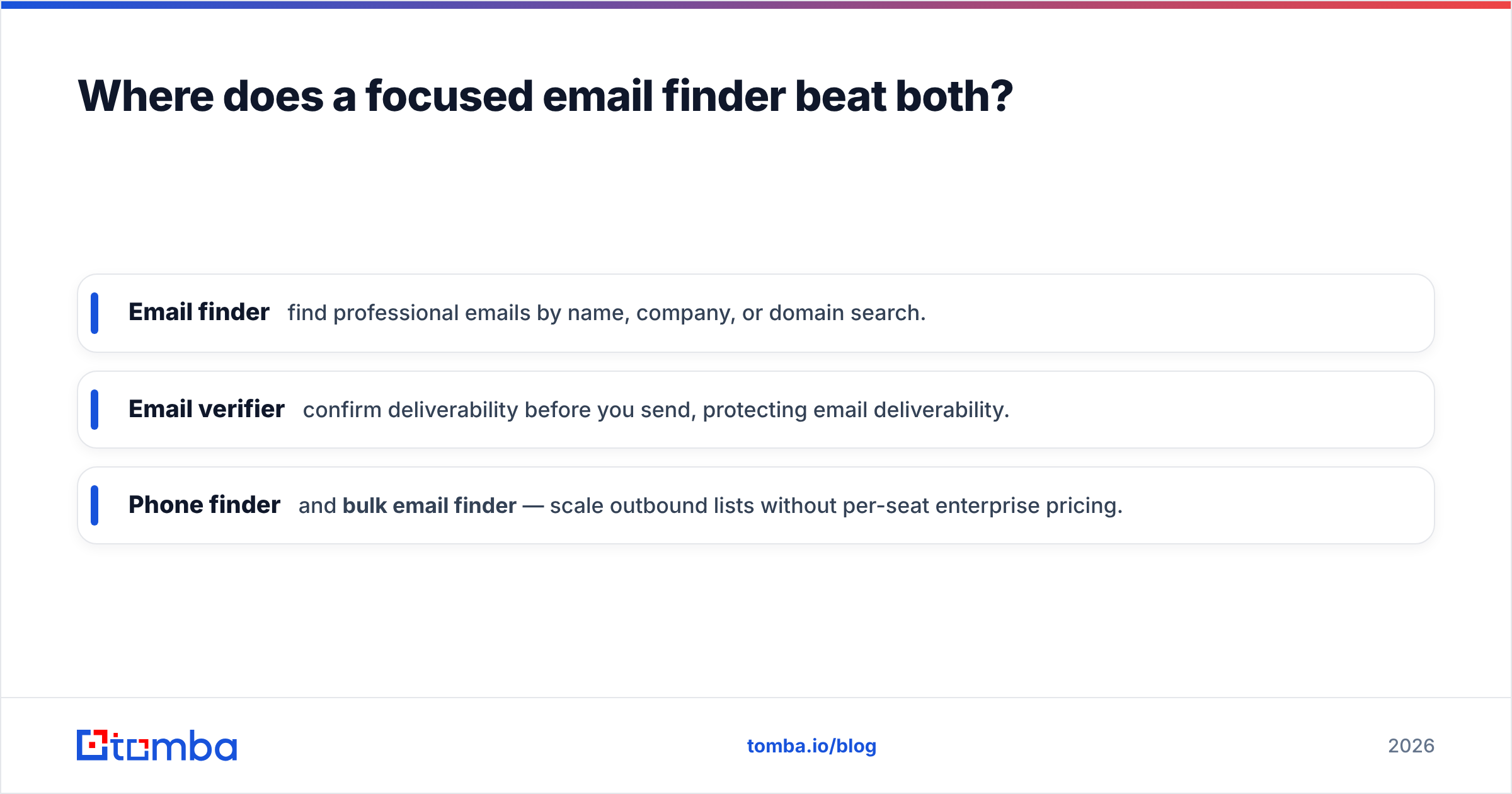
- Email finder — find professional emails by name, company, or domain search.
- Email verifier — confirm deliverability before you send, protecting email deliverability.
- Phone finder and bulk email finder — scale outbound lists without per-seat enterprise pricing.
A realistic 2026 stack for many teams: use a focused finder/verifier as the always-on layer, and add Clay or ZoomInfo only where you've proven you need their depth — intent signals, org charts, or heavy custom enrichment. Buying the platform first and figuring out the use case later is how data budgets balloon.
Clay vs ZoomInfo: the verdict#
There's no universal winner — there's a winner for your stage and team:
- Lean, technical, experimental GTM → Clay. Pay for what you use, build what you need, accept the learning curve.
- Large, governed, intent-driven sales org → ZoomInfo. One source of truth, native signals, enterprise compliance, big bill.
- Early-stage or contact-data-first → start with a dedicated email finder, then layer a platform on only when the ROI is obvious.
The mistake is treating this as Clay or ZoomInfo when the honest answer for most teams is "a focused contact-data tool, plus one of them later, maybe." Don't pay enterprise prices to solve an email-finding problem.
Find and verify B2B contacts without the enterprise contract#
If your real goal is reaching the right people — not administering a data platform — start where the cost and complexity are lowest. Tomba Email Finder gives you accurate, verified professional emails by name or domain, with a free tier (25 searches/mo) and paid plans from $49/mo — no annual lock-in, no waterfall to configure. Pair it with the built-in email verifier and data enrichment, and you'll have a clean, deliverable list before a ZoomInfo rep even returns your quote. Try it free, then add Clay or ZoomInfo only where the depth genuinely pays for itself.
// get started
Find, verify and enrich your first contacts today
Start on the free plan with 25 searches a month, then scale when your team is ready.
Free plan · No credit card required · GDPR & CCPA
// about the author