Clearalist Pricing, Reviews, Pros and Cons (2026 Guide)
A straight-talking 2026 breakdown of Clearalist pricing, reviews, pros and cons — real costs, accuracy limits, and the alternatives worth testing before you buy.
You found Clearalist on a "best email cleaning tools" list, the homepage looks clean, and now you want to know one thing before you reach for a credit card: is it worth it? This guide gives you the Clearalist pricing, reviews, pros and cons in plain language, plus the alternatives that are worth a side-by-side test.
TL;DR — Is Clearalist worth it in 2026?#
- What it is: Clearalist is an email list cleaning and verification tool aimed at marketers and sales teams who want to cut bounces before a send.
- Pricing shape: Credit/pay-as-you-go style billing with monthly subscription tiers. Costs scale with list volume, and unused credits are the thing to watch.
- The good: Simple uploads, bulk processing, and a low barrier to a first cleaning run.
- The catch: Accuracy on catch-all and role-based addresses is where most list-cleaning tools struggle, and reviews reflect that.
- Bottom line: Fine as a one-off list scrubber, but if you also need to find and enrich contacts, a combined platform like Tomba usually costs less than stitching two tools together.
What is Clearalist?#
Clearalist is an email verification and list-hygiene tool. Think of it as a water filter for your contact database: you pour in a messy list of addresses, it runs each one through a series of checks, and what comes out the other side is supposed to be safe to send to.
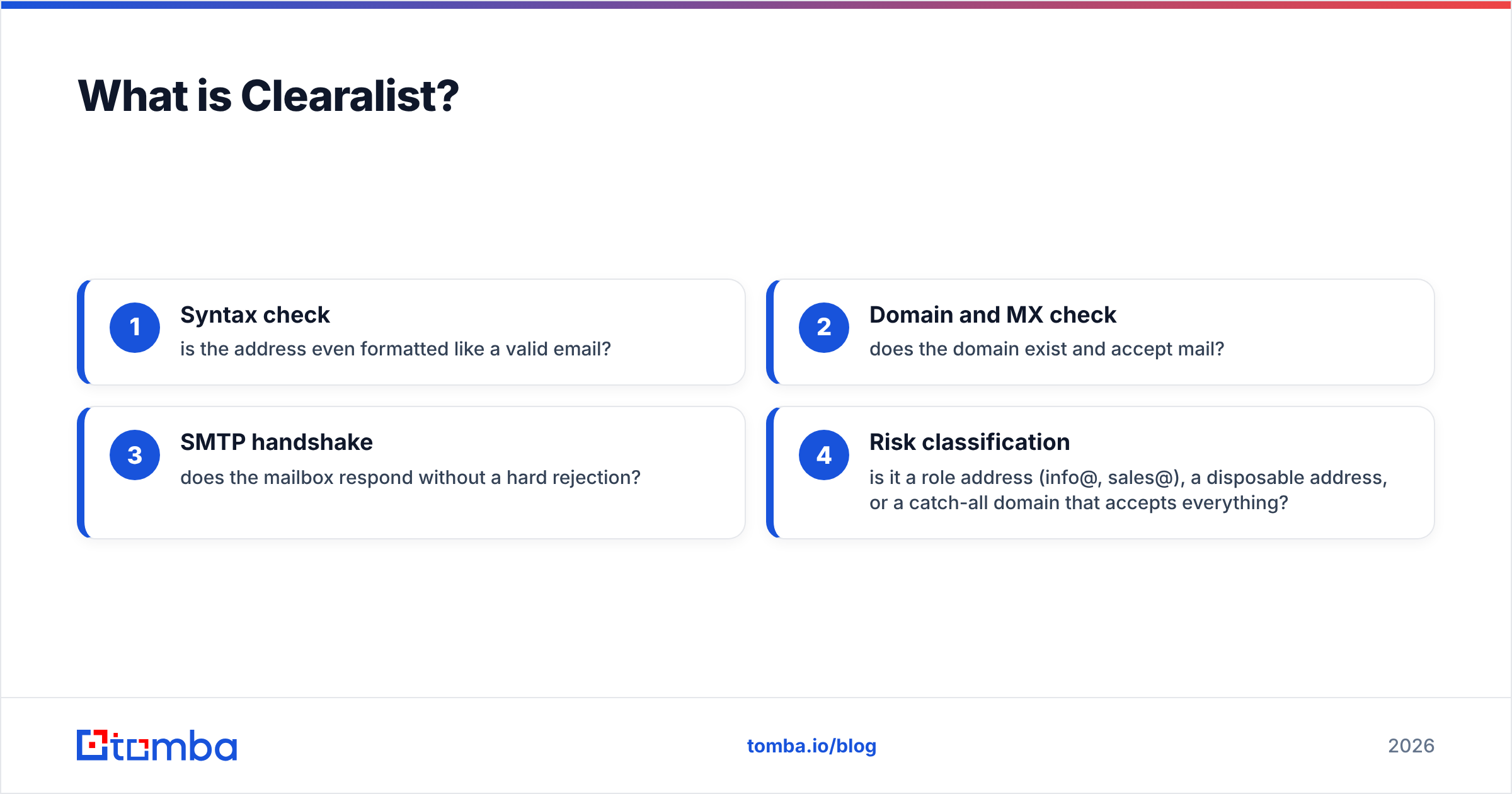
Under the hood, an email verifier like this typically runs four checks in sequence:
- Syntax check — is the address even formatted like a valid email?
- Domain and MX check — does the domain exist and accept mail?
- SMTP handshake — does the mailbox respond without a hard rejection?
- Risk classification — is it a role address (info@, sales@), a disposable address, or a catch-all domain that accepts everything?
The output is a status for each row — valid, invalid, risky, or unknown — so you can delete the dead weight before it hits your sending platform. If you want the textbook version of why this matters, our email deliverability glossary entry covers how bounce rates feed sender reputation.
)
Here is the honest framing: Clearalist is a verifier, not a finder. It cleans the list you already have. It does not build you a new one. That distinction drives most of the pricing and pros-and-cons analysis below, so keep it in mind.
How much does Clearalist cost?#
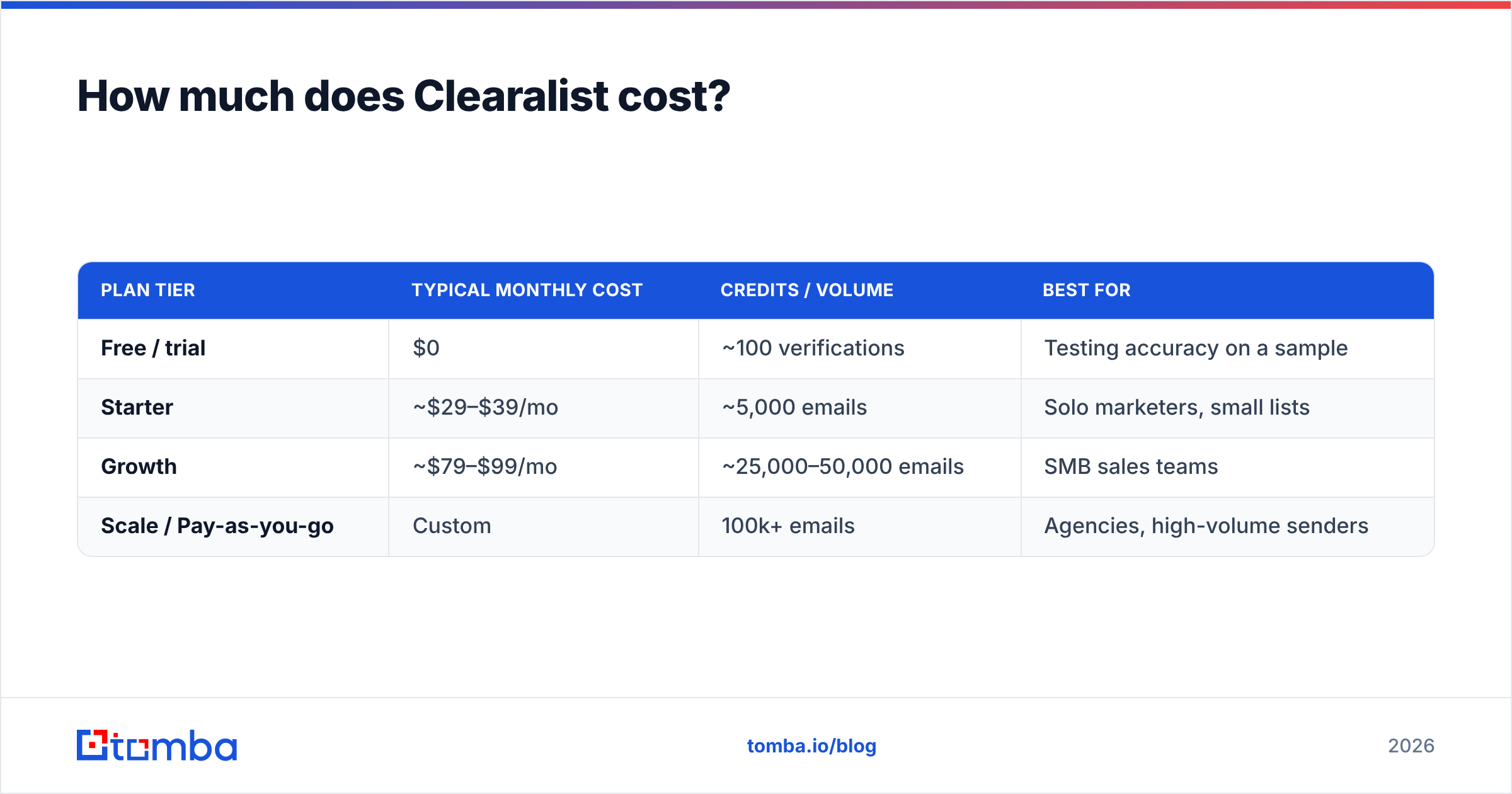
Clearalist uses a credit-based model layered on top of monthly plans, which is standard for the category. You buy a bucket of verification credits; one credit verifies one email. The more you commit to per month, the lower the per-email rate.
Because vendors adjust list-cleaning pricing frequently, treat the table below as a representative shape rather than a locked quote — always confirm the live numbers on the vendor's own page and on a review marketplace before you buy.
| Plan tier | Typical monthly cost | Credits / volume | Best for |
|---|---|---|---|
| Free / trial | $0 | ~100 verifications | Testing accuracy on a sample |
| Starter | ~$29–$39/mo | ~5,000 emails | Solo marketers, small lists |
| Growth | ~$79–$99/mo | ~25,000–50,000 emails | SMB sales teams |
| Scale / Pay-as-you-go | Custom | 100k+ emails | Agencies, high-volume senders |
A few cost mechanics worth understanding before you commit:
- Credits usually expire. Monthly plans often reset unused credits, so a "cheap per email" rate is meaningless if you only clean a list once a quarter. Pay-as-you-go packs are friendlier for irregular use.
- "Unknown" results still cost a credit. When a server times out or a catch-all domain won't confirm, you still spent the credit but got no usable answer.
- Verification ≠ enrichment ≠ finding. If you later need phone numbers, job titles, or new contacts, that's a separate tool and a separate bill.
That last point is where buyers get surprised. Compare it against Tomba pricing, where the Free tier covers 25 searches/mo, Starter is $49/mo, Growth is $99/mo, and Pro is $249/mo — but those plans include finding, verifying, domain search, and enrichment in one bucket. One subscription instead of three.
What do Clearalist reviews say?#
Pull together the common threads from review sites and the picture is consistent. Here is the balanced read.
What reviewers praise:
- Speed of setup. Most users get from signup to a cleaned list in minutes. No onboarding call, no learning curve.
- Bulk handling. Uploading a CSV and getting a categorized export back is the core job, and it does it reliably for standard B2C and B2B lists.
- Clear result labels. Valid / invalid / risky buckets make the export easy to action.
What reviewers complain about:
- Catch-all uncertainty. The single most common gripe across every verifier, not just this one. Catch-all domains accept everything at the SMTP layer, so no tool can confirm the individual mailbox without sending. Reviews ding tools that mark these "valid" and then bounce.
- Credit expiry frustration. Buyers who clean lists occasionally feel they lose value when monthly credits reset.
- No contact discovery. Reviewers who expected to find emails, not just clean them, leave disappointed — which is a positioning issue more than a quality one.
When you read reviews on G2 or Capterra, weight them by reviewer use case. A solo affiliate marketer cleaning a scraped list has very different needs from a RevOps team feeding a CRM, and they rate the same tool two stars apart for opposite reasons.
What are the pros and cons of Clearalist?#
Here is the head-to-head summary you came for.
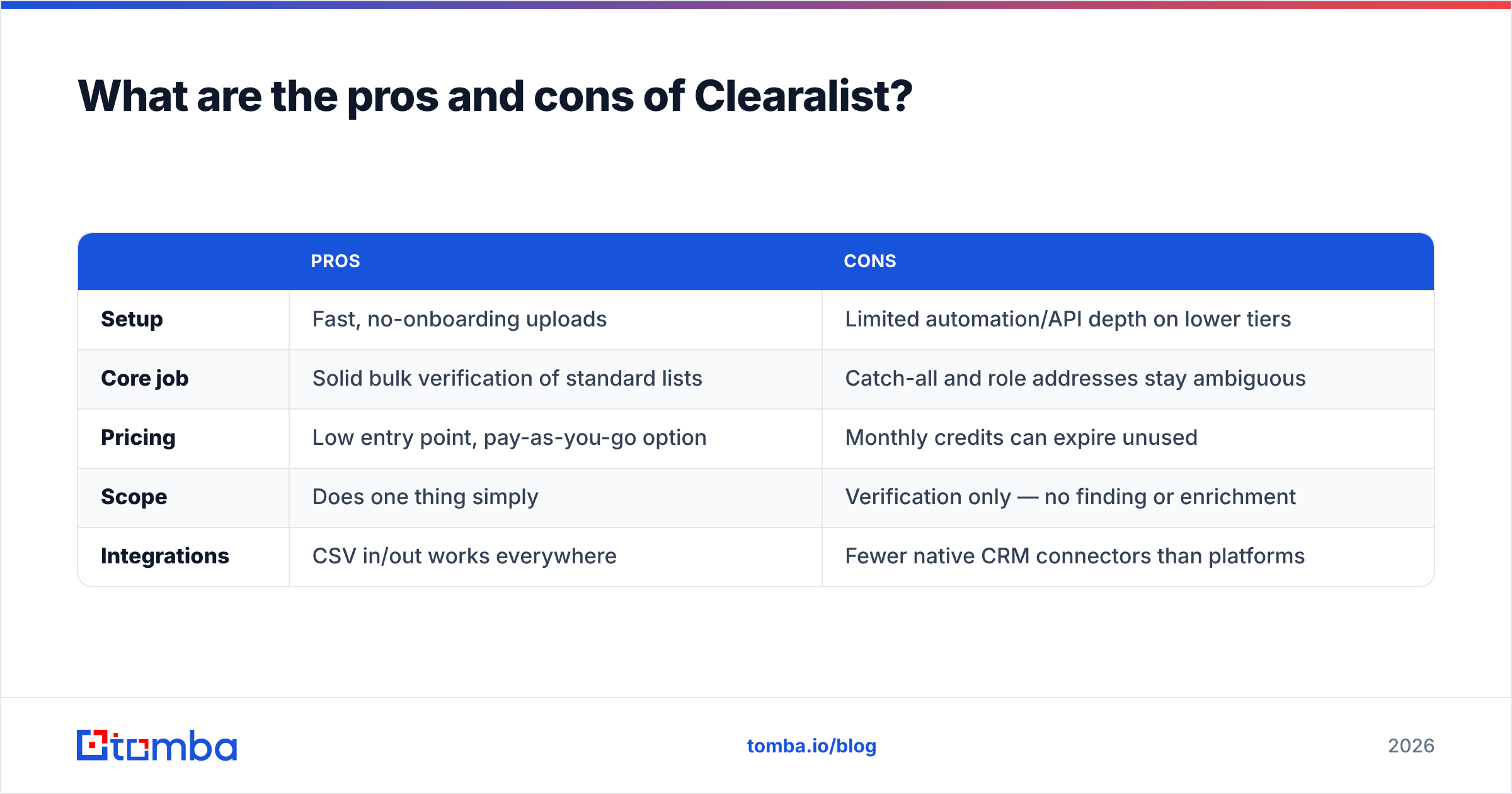
| Pros | Cons | |
|---|---|---|
| Setup | Fast, no-onboarding uploads | Limited automation/API depth on lower tiers |
| Core job | Solid bulk verification of standard lists | Catch-all and role addresses stay ambiguous |
| Pricing | Low entry point, pay-as-you-go option | Monthly credits can expire unused |
| Scope | Does one thing simply | Verification only — no finding or enrichment |
| Integrations | CSV in/out works everywhere | Fewer native CRM connectors than platforms |
The pattern is clear: Clearalist is a focused single-purpose tool. That's a genuine strength if list cleaning is the only job you have. It becomes a weakness the moment your workflow needs a second or third capability, because each addition is another login, another contract, and another data sync to maintain.
)
Is Clearalist accurate enough?#
Accuracy depends almost entirely on what kind of addresses are on your list — and this is true of every verifier on the market, so judge the tool fairly.
- Standard mailboxes (a person at a normal domain): high accuracy across all reputable verifiers, Clearalist included. The SMTP handshake gives a confident yes/no.
- Catch-all domains: no verifier can guarantee an individual mailbox here. The honest tools label it "risky" or "accept-all" instead of pretending. If you send to these, do it slowly and watch bounces.
- Role and disposable addresses: good tools flag these clearly so you can decide whether to keep them.
The smarter play for catch-all domains is to verify and cross-reference against a known-good data source. That's where a catch-all verifier that combines SMTP signals with a real B2B dataset pulls ahead of a pure-SMTP cleaner. If your list is heavy on catch-all corporate domains — common in enterprise B2B — single-method verification alone will leave you guessing.
A practical accuracy test before you buy any tool, Clearalist or otherwise:
- Take 200 known-good addresses (your own team, current customers).
- Mix in 50 known-bad ones (typos, dead domains you control).
- Run the sample through the free tier.
- Score how many of the 50 bad ones it caught and how many good ones it wrongly killed.
Whatever scores best on your data wins, regardless of marketing claims.
How does Clearalist compare to the alternatives?#
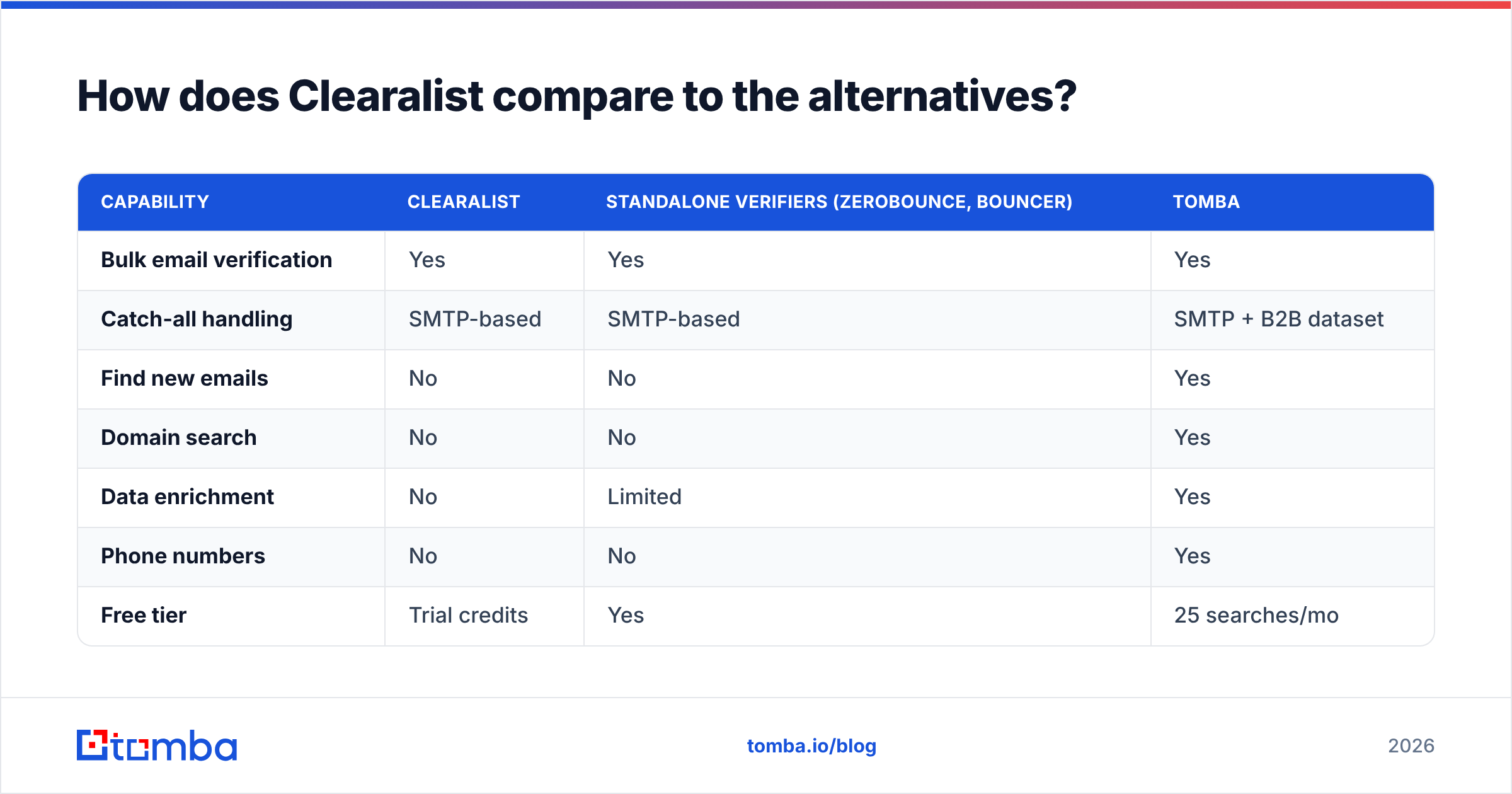
If list cleaning is genuinely all you need, several tools do it well. The real decision is whether you want a single-purpose verifier or a platform that also finds and enriches contacts. Here's how the options stack up.
| Capability | Clearalist | Standalone verifiers (ZeroBounce, Bouncer) | Tomba |
|---|---|---|---|
| Bulk email verification | Yes | Yes | Yes |
| Catch-all handling | SMTP-based | SMTP-based | SMTP + B2B dataset |
| Find new emails | No | No | Yes |
| Domain search | No | No | Yes |
| Data enrichment | No | Limited | Yes |
| Phone numbers | No | No | Yes |
| Free tier | Trial credits | Yes | 25 searches/mo |
| Entry price | ~$29–$39/mo | ~$15–$49/mo | $49/mo (Starter) |
A few honest takeaways:
- If you only ever clean lists, a dedicated verifier (Clearalist, ZeroBounce, or a Bouncer alternative) is a reasonable, cheap choice.
- If you also prospect, paying separately for a finder and a verifier usually costs more than one combined platform. Run the math on your actual monthly volume.
- If catch-all domains dominate your list, prioritize a tool that backs SMTP checks with a real dataset, and use bulk verify to process at scale.
For the broader category, browse independent comparisons on G2 rather than trusting any single vendor's "we're #1" graphic — including ours.
Who should use Clearalist — and who shouldn't?#
Good fit:
- Solo marketers and affiliates cleaning purchased or scraped lists.
- Teams whose only recurring data job is bounce reduction before a campaign.
- Anyone who wants a no-commitment, pay-as-you-go scrub a few times a year.
Poor fit:
- Sales and RevOps teams who also need to find and enrich contacts — you'll end up buying a second tool anyway.
- Heavy enterprise B2B senders with lots of catch-all domains, where SMTP-only verification leaves too many "unknowns."
- Anyone wanting deep CRM automation; single-purpose cleaners keep integrations light.
If you recognize your team in the "poor fit" list, the consolidation math is straightforward: one platform that does finding, verifying, domain search, and enrichment removes two recurring bills and one data-sync headache.
Frequently asked questions#
Does Clearalist offer a free trial? Most list-cleaning tools, including Clearalist, offer a small batch of free credits so you can test accuracy. Use it on a sample with known-good and known-bad addresses before paying.
Will Clearalist find new email addresses? No. It verifies and cleans addresses you already have. To discover new contacts you need an email finder or domain search tool.
Do unused Clearalist credits roll over? On monthly subscription tiers, credits typically reset each cycle. Pay-as-you-go packs are the better choice if you clean lists irregularly.
Is a verified list guaranteed not to bounce? No tool can promise zero bounces, especially on catch-all domains. Verification dramatically reduces bounces but pair it with gradual sending and reputation monitoring.
The bottom line#
Clearalist is a competent, narrow tool: it cleans lists fast and cheaply, and reviews back that up. Its limits — catch-all ambiguity, expiring credits, and verification-only scope — are the same limits every single-purpose cleaner shares. So the right question isn't "is Clearalist good?" but "do I only need cleaning?"
If you also need to find, verify, and enrich contacts from one place, start with the Tomba Email Finder and its built-in email verifier. The Free tier lets you test accuracy on your own data at no cost, and a single Starter plan at $49/mo replaces the finder-plus-verifier stack most teams end up paying for twice. Clean lists are the floor — finding the right people is what actually fills the pipeline.
// get started
Find, verify and enrich your first contacts today
Start on the free plan with 25 searches a month, then scale when your team is ready.
Free plan · No credit card required · GDPR & CCPA
// about the author