Clearalist vs Apollo.io (2026): Which B2B Data Tool Wins?
A neutral, hands-on breakdown of Clearalist vs Apollo.io in 2026 — data accuracy, pricing, email quality, and which tool actually fits your outbound stack.
Choosing between Clearalist and Apollo.io comes down to one question: do you want a lean, accuracy-first contact tool, or an all-in-one sales platform that bundles data with sequencing? Both can fill a CRM with emails. They get there very differently, and the wrong pick burns budget on credits and seats you never use.
This is a neutral, hands-on comparison. We'll look at data accuracy, pricing, database coverage, deliverability impact, and the specific situations where each tool earns its keep — plus where a focused alternative beats both.
TL;DR#
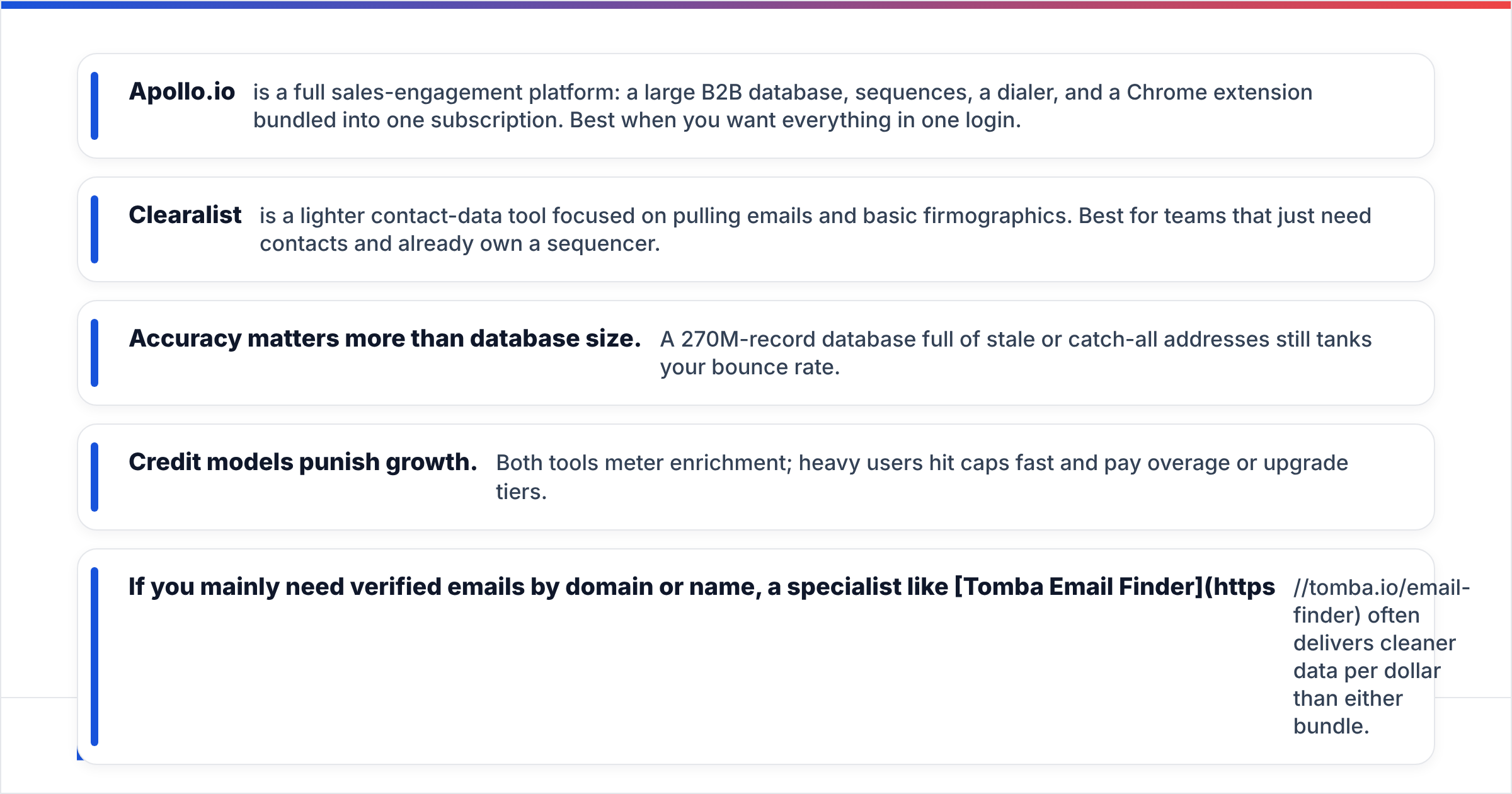
- Apollo.io is a full sales-engagement platform: a large B2B database, sequences, a dialer, and a Chrome extension bundled into one subscription. Best when you want everything in one login.
- Clearalist is a lighter contact-data tool focused on pulling emails and basic firmographics. Best for teams that just need contacts and already own a sequencer.
- Accuracy matters more than database size. A 270M-record database full of stale or catch-all addresses still tanks your bounce rate.
- Credit models punish growth. Both tools meter enrichment; heavy users hit caps fast and pay overage or upgrade tiers.
- If you mainly need verified emails by domain or name, a specialist like Tomba Email Finder often delivers cleaner data per dollar than either bundle.
What are Clearalist and Apollo.io?#
Think of it like buying a car versus buying a single high-quality engine. Apollo.io is the car — database, navigation, and cruise control all wired together. Clearalist is closer to the engine: it does the core job of surfacing contact data and gets out of the way.
Apollo.io combines a contact and company database with outbound tooling. You can search 200M+ contacts, build a list, push leads into a multi-step email sequence, and dial prospects without leaving the app. It markets itself as an end-to-end "go-to-market" platform and is one of the most widely reviewed tools on G2.
Clearalist positions itself as a contact-data and email-finding tool. The pitch is simplicity: search, find emails, export, done. It appeals to founders and small teams who find Apollo's feature sprawl overwhelming and just want clean rows in a spreadsheet.
Neither is "better" in the abstract. The right answer depends on whether the data is your bottleneck or the workflow is.

How do Clearalist and Apollo.io compare on data accuracy?#
Accuracy is where these tools live or die, and it's the metric most buyers underweight. A bigger database is not a more accurate one — it usually means more catch-all domains, role-based addresses, and contacts who left two jobs ago.

Three things actually drive deliverable data:
- Real-time verification — does the tool re-check the SMTP server at export time, or serve a cached guess from months ago?
- Catch-all handling — domains that accept every address are the silent killer of bounce rates. A good tool flags them instead of passing them off as valid. If you don't have one, run exports through a dedicated catch-all verifier.
- Source transparency — you should be able to see where a record came from, not just trust a confidence score.
Apollo's database is enormous and broadly useful for North American B2B, but users frequently report stale rows and catch-all emails counted as "verified." Clearalist's smaller index can be cleaner in niches but thins out fast outside core tech and SaaS verticals. Whichever you choose, verify before you send — pair any finder with an email verifier so a bad list never reaches your sending domain.
Clearalist vs Apollo.io: full feature and pricing comparison#
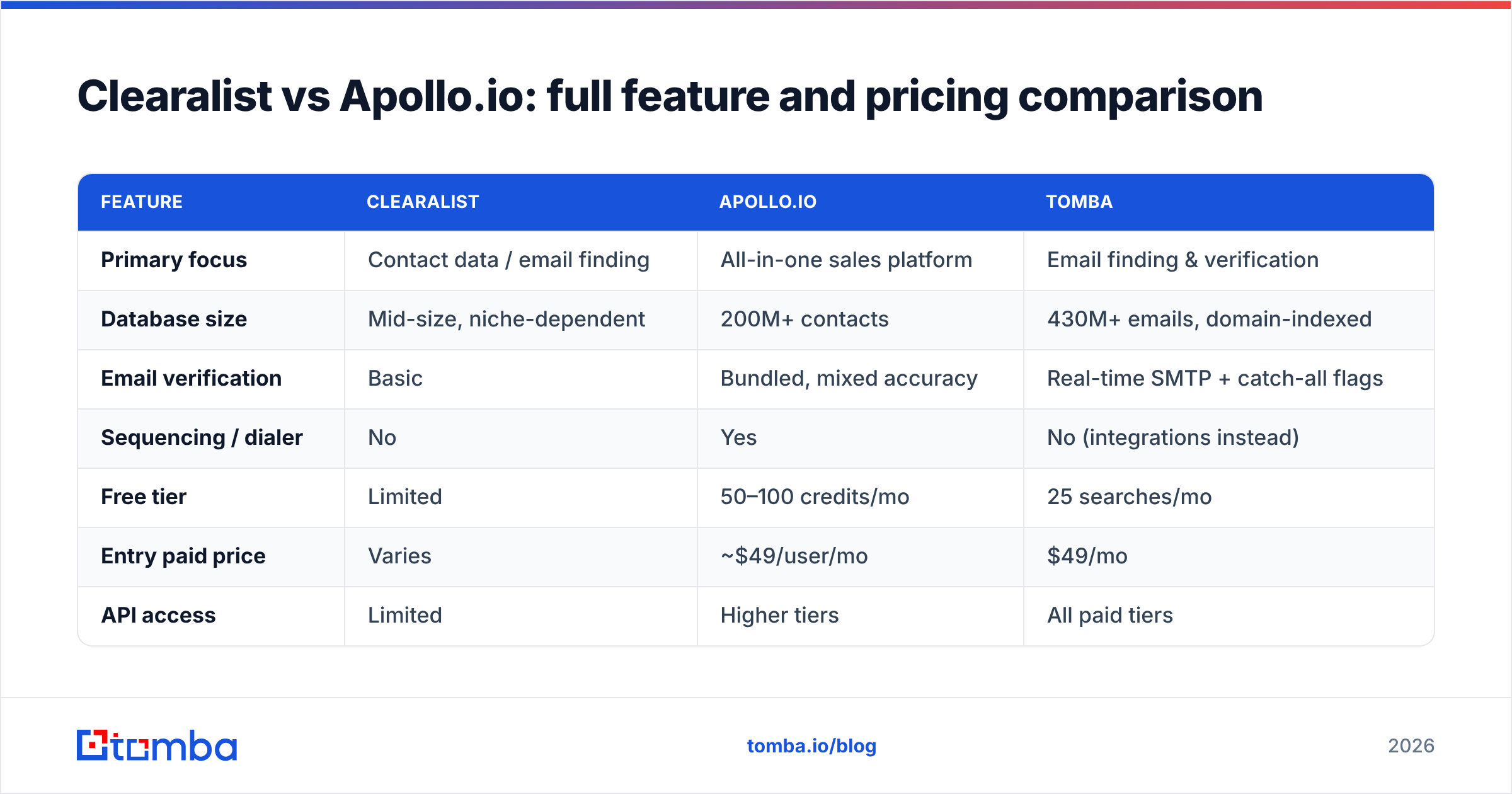
Here's the side-by-side. Treat pricing as directional — both vendors revise tiers, and seat-based versus credit-based costs are hard to compare on the sticker alone.
| Feature | Clearalist | Apollo.io | Tomba |
|---|---|---|---|
| Primary focus | Contact data / email finding | All-in-one sales platform | Email finding & verification |
| Database size | Mid-size, niche-dependent | 200M+ contacts | 430M+ emails, domain-indexed |
| Email verification | Basic | Bundled, mixed accuracy | Real-time SMTP + catch-all flags |
| Sequencing / dialer | No | Yes | No (integrations instead) |
| Free tier | Limited | 50–100 credits/mo | 25 searches/mo |
| Entry paid price | Varies | ~$49/user/mo | $49/mo |
| API access | Limited | Higher tiers | All paid tiers |
| Best for | Lean list building | Bundled outbound | Accuracy-first enrichment |
A few honest takeaways:
- Apollo wins on breadth. If you want one tool for data plus sending, nothing here matches it. The trade-off is per-seat pricing that scales painfully across a team.
- Clearalist wins on simplicity. Fewer features, gentler learning curve, less to pay for that you won't touch.
- Credit math is the trap. Both meter enrichment. Map your real monthly volume against included credits before you commit — see how transparent metering looks on the Tomba pricing page as a reference point.
Is Apollo.io better than Clearalist for cold outbound?#
It depends on what's already in your stack. Apollo is better if you have nothing — it gives you data and a sequencer in one purchase, which is genuinely convenient for a solo founder or a brand-new SDR team. You trade some data quality and a steeper interface for that consolidation.
Clearalist is better if you already run a dedicated sending tool you trust. Layering Apollo's sequencer on top of an existing one is redundant spend, and Apollo's deliverability is only as good as your warmup and domain hygiene. In that case you want clean contacts, not another sender.
A few realities that apply to both:
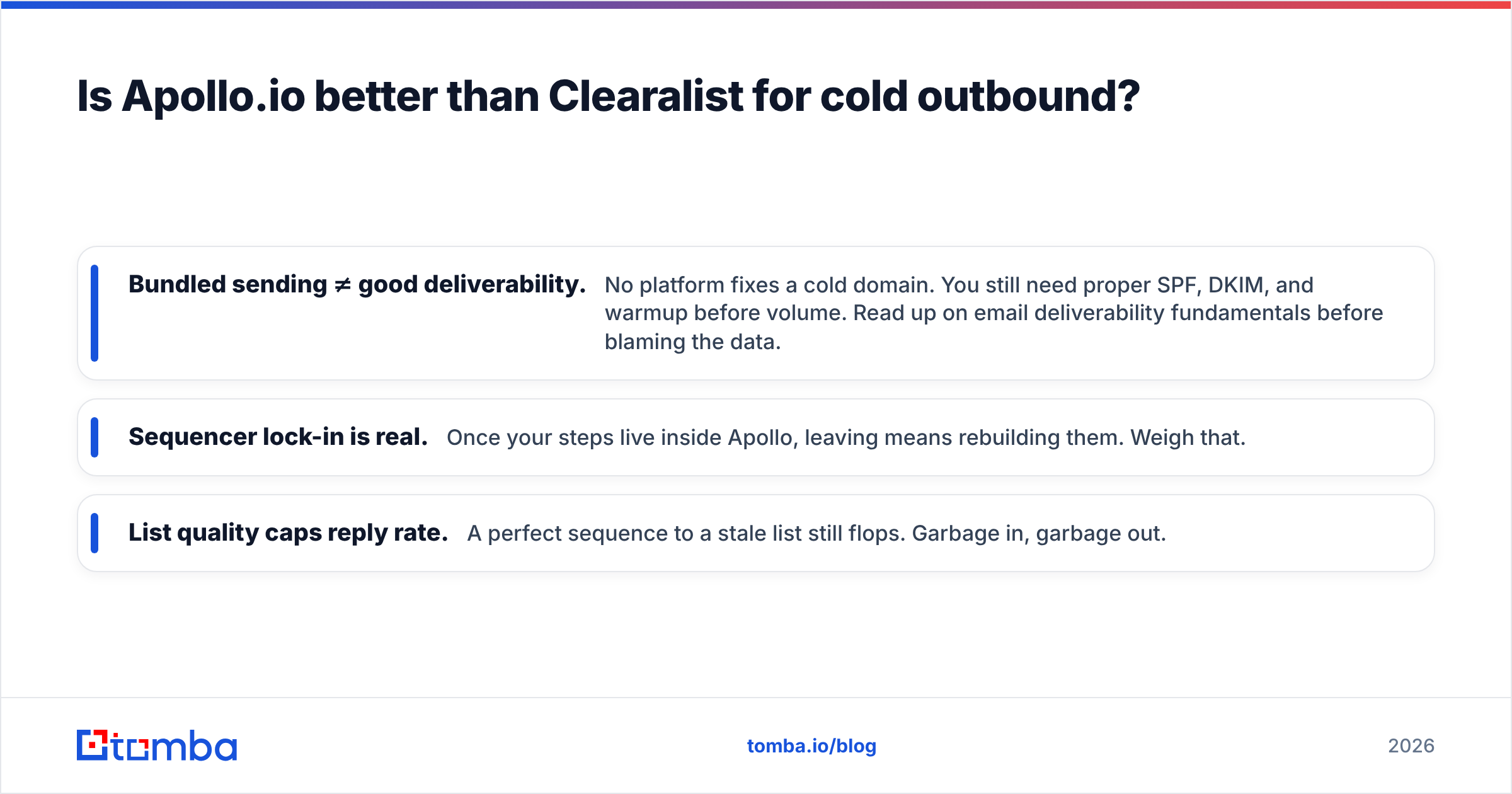
- Bundled sending ≠ good deliverability. No platform fixes a cold domain. You still need proper SPF, DKIM, and warmup before volume. Read up on email deliverability fundamentals before blaming the data.
- Sequencer lock-in is real. Once your steps live inside Apollo, leaving means rebuilding them. Weigh that.
- List quality caps reply rate. A perfect sequence to a stale list still flops. Garbage in, garbage out.
For teams that separate "find the contact" from "send the email," a focused finder plus your sequencer of choice is often cleaner than one bundle trying to do both.
Which tool fits your use case?#
Match the tool to the bottleneck, not the marketing.
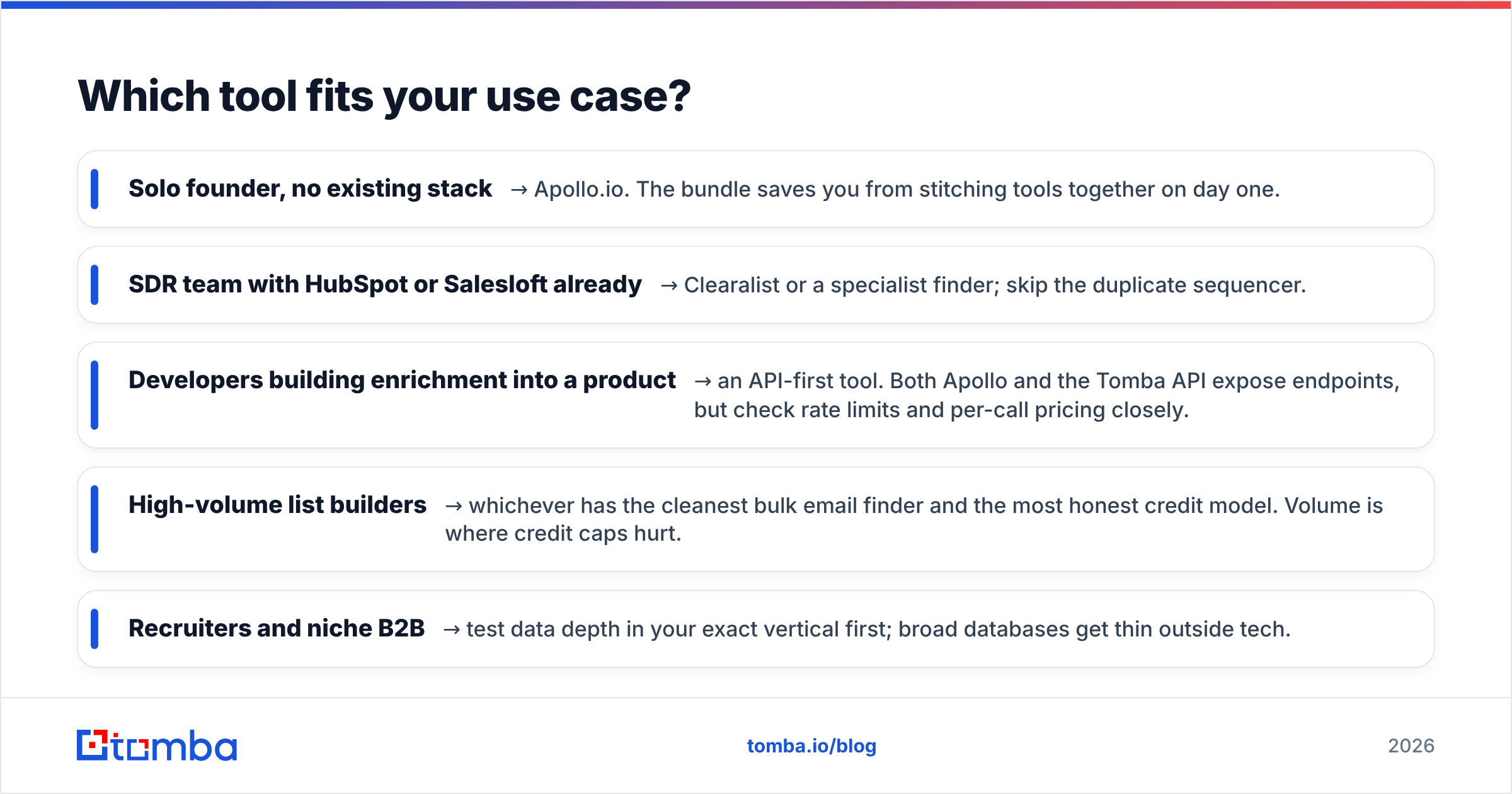
- Solo founder, no existing stack → Apollo.io. The bundle saves you from stitching tools together on day one.
- SDR team with HubSpot or Salesloft already → Clearalist or a specialist finder; skip the duplicate sequencer.
- Developers building enrichment into a product → an API-first tool. Both Apollo and the Tomba API expose endpoints, but check rate limits and per-call pricing closely.
- High-volume list builders → whichever has the cleanest bulk email finder and the most honest credit model. Volume is where credit caps hurt.
- Recruiters and niche B2B → test data depth in your exact vertical first; broad databases get thin outside tech.
The honest move is to run the same 50 target accounts through each tool's free tier and measure two things: how many contacts you get, and how many bounce after you verify them independently. That second number decides the winner more often than any feature list.
Where does a specialist alternative fit in?#
If your core problem is "I need accurate emails for specific people and companies," a dedicated finder usually beats a platform's bundled data. Specialists invest entirely in one thing: matching a name and domain to a deliverable address and proving it's real.
That's the gap Tomba targets. Instead of paying for a sequencer and a dialer you may not need, you get domain search to map every address at a company, real-time verification with catch-all detection, and data enrichment to fill in the rest — then push it into the sequencer you already trust. The free email checker lets you spot-test quality before you commit a credit.
It's not the right tool if you want one login for everything; Apollo is. But if data accuracy is the metric that actually moves your reply rate, a focused finder is hard to beat on cost-per-verified-contact.
Frequently asked questions#
Is Clearalist or Apollo.io more accurate? Neither is reliably more accurate across all verticals. Apollo has more volume; Clearalist can be cleaner in niches. Always verify exports independently before sending, regardless of which you pick.
Which is cheaper? At low volume they're comparable. Apollo's per-seat model gets expensive across a team, while credit-based tools get expensive at high enrichment volume. Map your real usage to the included credits.
Can I use these tools without a sequencer? Yes for both, but you're paying for Apollo's sequencer whether you use it or not. If you already have a sender, a data-only tool avoids that overlap.
Do they handle catch-all domains? Apollo often counts catch-all addresses as valid, which inflates bounce risk. Run questionable rows through a dedicated catch-all check before adding them to a campaign.
The bottom line#
Pick Apollo.io if you want one platform for data, sequencing, and dialing and you're willing to pay per seat for that consolidation. Pick Clearalist if you want a lighter, simpler contact tool and already own your sending stack.
But if the real goal is verified emails that don't bounce — and a credit model that doesn't punish you for growing — start with a specialist. Tomba Email Finder gives you domain-indexed search, real-time verification, and API access on every paid plan starting at $49/mo, with a free tier of 25 searches to test accuracy on your own target list first. Find the contacts that matter, verify them before you send, and keep your sender reputation intact.
// get started
Find, verify and enrich your first contacts today
Start on the free plan with 25 searches a month, then scale when your team is ready.
Free plan · No credit card required · GDPR & CCPA
// about the author