Clearalist vs Clodura.ai 2026: Which B2B Data Tool Wins?
Clearalist and Clodura.ai both promise clean B2B contact data and faster pipeline. We compare accuracy, pricing, coverage, and workflow fit so you can pick the right prospecting stack for 2026.
Choosing between Clearalist and Clodura.ai usually comes down to one question your spreadsheet can't answer: which one feeds your reps contacts that actually convert, without bleeding your budget on credits you never use? Both pitch themselves as all-in-one B2B sales intelligence platforms. Both promise verified emails, direct dials, and intent signals. But they make very different trade-offs on data depth, pricing, and how much of your workflow they try to own.
This guide breaks down where each tool wins, where each one frustrates teams, and when a focused email-finding layer beats paying for a bloated suite.
TL;DR — Clearalist vs Clodura.ai at a glance#
- Clodura.ai is the more mature, feature-dense platform: a large built-in database, intent data, sales cadences, and a sequencer baked in — better for teams that want one tool to find and engage prospects.
- Clearalist is leaner and positions itself around clean, deliverability-first contact data with simpler list building — better for teams that mostly need accurate emails and want less software to learn.
- Pricing favors Clodura.ai's free tier for testing, but per-credit costs climb fast on both once you scale outbound volume.
- Accuracy is the real differentiator. Neither database is perfect; both rely on a mix of crawled and contributed data, so verification before send is non-negotiable.
- If you only need verified emails on demand without a full suite, a dedicated email finder like Tomba is cheaper and easier to plug into your existing CRM.
What are Clearalist and Clodura.ai?#
Both are B2B sales-intelligence platforms, but they grew up solving slightly different problems.
Clodura.ai is a sales prospecting and engagement suite. It pairs a contact database (the company advertises a large pool of direct dials and verified emails) with built-in sequencing, a buyer-intent layer, and org-chart mapping. The idea is that a rep logs in, builds a list, and launches a multi-step cadence without ever leaving the tool. You can see how the broader category works in our B2B database overview.
Clearalist leans toward the data-hygiene end of the spectrum. It emphasizes clean, deliverability-checked contact records and straightforward list exports. The pitch is less "run your whole outbound motion here" and more "get reliable contacts you can drop into the tools you already use." That makes it lighter to adopt, but it also means you'll bolt on a separate sequencer or dialer.
Here's the practical split: Clodura.ai wants to be your prospecting and outreach hub. Clearalist wants to be the trustworthy source of the contacts. Knowing which job you're actually hiring the tool for is half the decision.
)
How do Clearalist and Clodura.ai compare on features?#
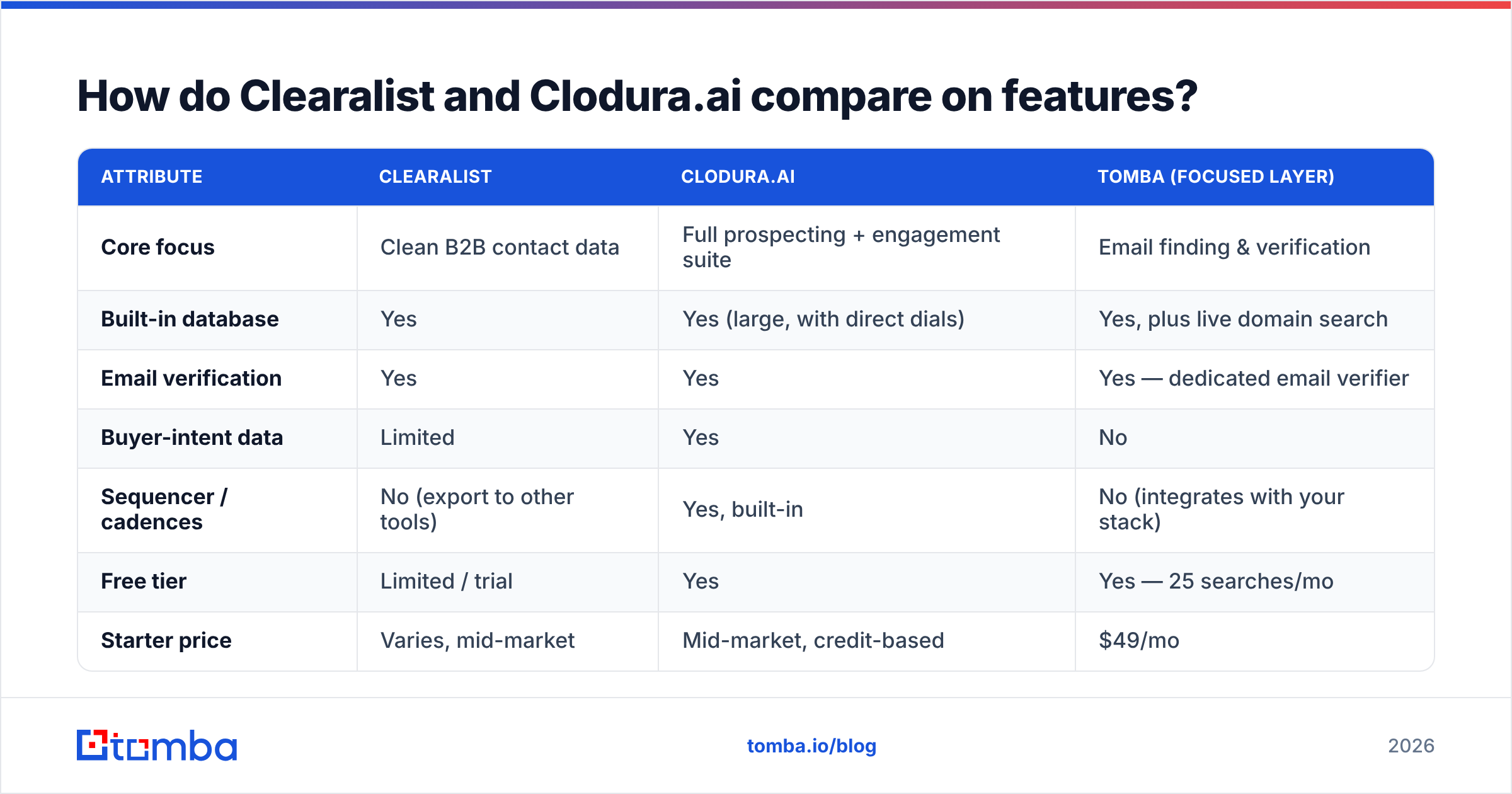
The fastest way to see the gap is side by side. The table below maps the attributes most teams actually evaluate during a trial.
| Attribute | Clearalist | Clodura.ai | Tomba (focused layer) |
|---|---|---|---|
| Core focus | Clean B2B contact data | Full prospecting + engagement suite | Email finding & verification |
| Built-in database | Yes | Yes (large, with direct dials) | Yes, plus live domain search |
| Email verification | Yes | Yes | Yes — dedicated email verifier |
| Buyer-intent data | Limited | Yes | No |
| Sequencer / cadences | No (export to other tools) | Yes, built-in | No (integrates with your stack) |
| Free tier | Limited / trial | Yes | Yes — 25 searches/mo |
| Starter price | Varies, mid-market | Mid-market, credit-based | $49/mo |
| Best for | Teams wanting clean lists | All-in-one outbound teams | Teams needing accurate emails fast |
A few takeaways from this matrix:
- Clodura.ai is broader. If you want intent signals and a sequencer in the same login, it covers more surface area than Clearalist.
- Clearalist is simpler. Fewer moving parts means faster onboarding and less risk of paying for modules nobody touches.
- Neither is cheap at scale. Suite pricing assumes you'll use most modules. If you won't, you're subsidizing features you don't need.
- A focused tool can replace the data layer of either. When your bottleneck is "find and verify the right email," a specialist often beats a generalist on both accuracy and cost.
Which has better data accuracy?#
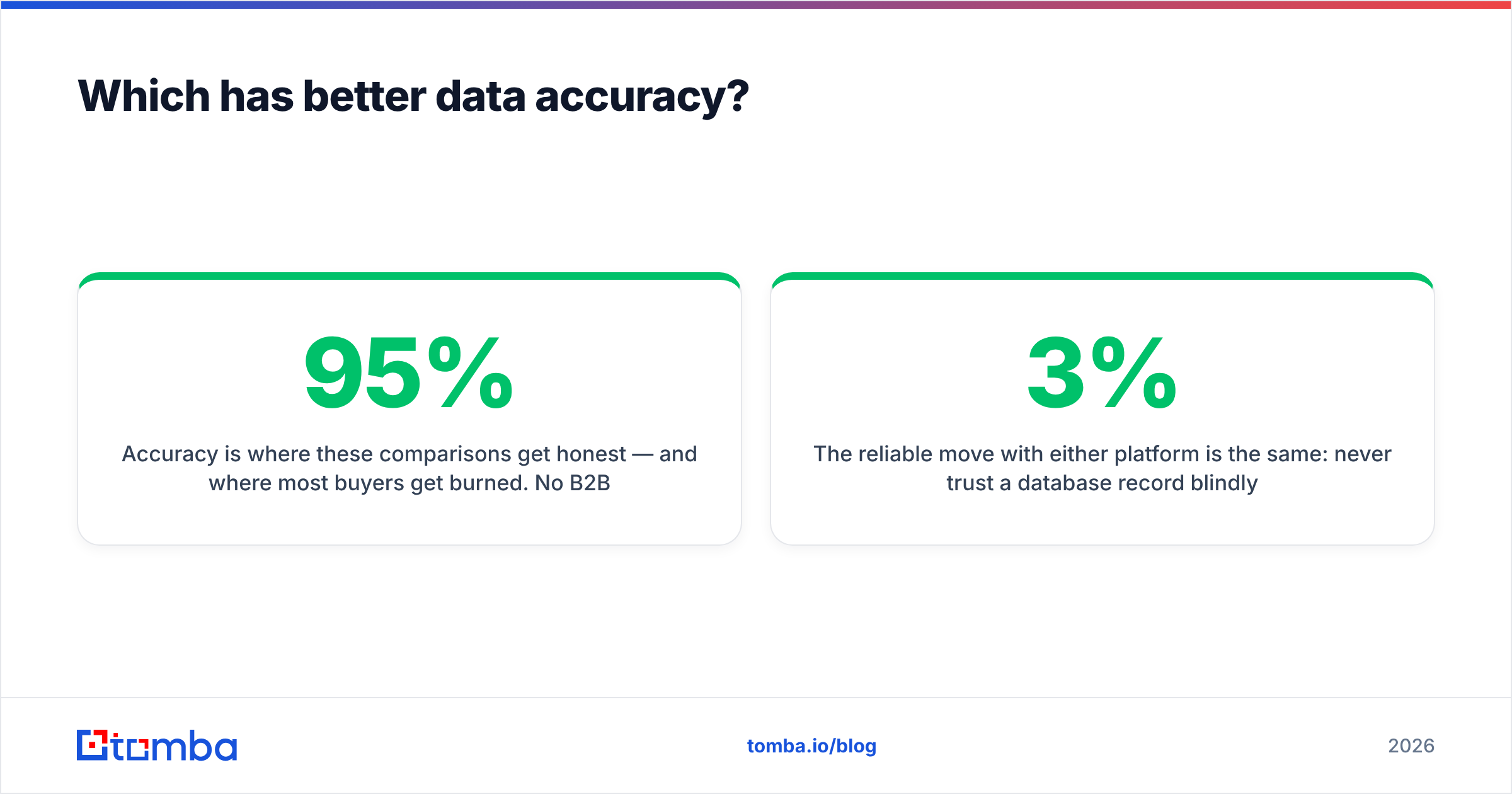
Accuracy is where these comparisons get honest — and where most buyers get burned. No B2B database is 95%+ accurate across every region and seniority level, regardless of marketing claims. Data decays roughly 22–30% per year as people change jobs, which is why Gartner and other analysts consistently flag data quality as the top CRM hygiene problem.
Clodura.ai's strength is breadth: a large pool of contacts and direct dials means you'll usually find someone at a target account. The trade-off with breadth is staleness — bigger databases carry more outdated records unless they're aggressively re-verified.
Clearalist's pitch is the opposite emphasis: smaller, cleaner, deliverability-first. If the records you pull are genuinely fresher, your bounce rate drops and your sender reputation stays healthy. But "cleaner" only helps if coverage is deep enough for your specific market.
The reliable move with either platform is the same: never trust a database record blindly before a campaign. Run exports through a verification pass, and treat catch-all domains with extra caution since they accept everything at the SMTP layer and hide invalid mailboxes. Bounces above 2–3% start dragging your domain reputation, and a clean list is the cheapest deliverability insurance you can buy. For the mechanics behind that, see email deliverability in our glossary.
If you want a second opinion on data vendors generally, independent reviews on G2 are useful for spotting consistent complaints about coverage gaps or billing — patterns no vendor will surface on its own pricing page.
How do Clearalist and Clodura.ai pricing compare?#
Both platforms sell on a credit or seat model, which makes apples-to-apples pricing harder than it should be. Clodura.ai offers a free tier that's genuinely useful for kicking the tires, then scales through paid plans tied to credit volume and feature access. Clearalist runs a more streamlined paid structure aimed at teams that primarily want exportable, clean contacts.
The trap with both is the same one every suite shares: you pay for the whole platform even if you only use the data. If your reps live in your CRM and a dedicated sequencer, you're paying for a sequencer twice. If you don't touch intent data, that line item is pure overhead.
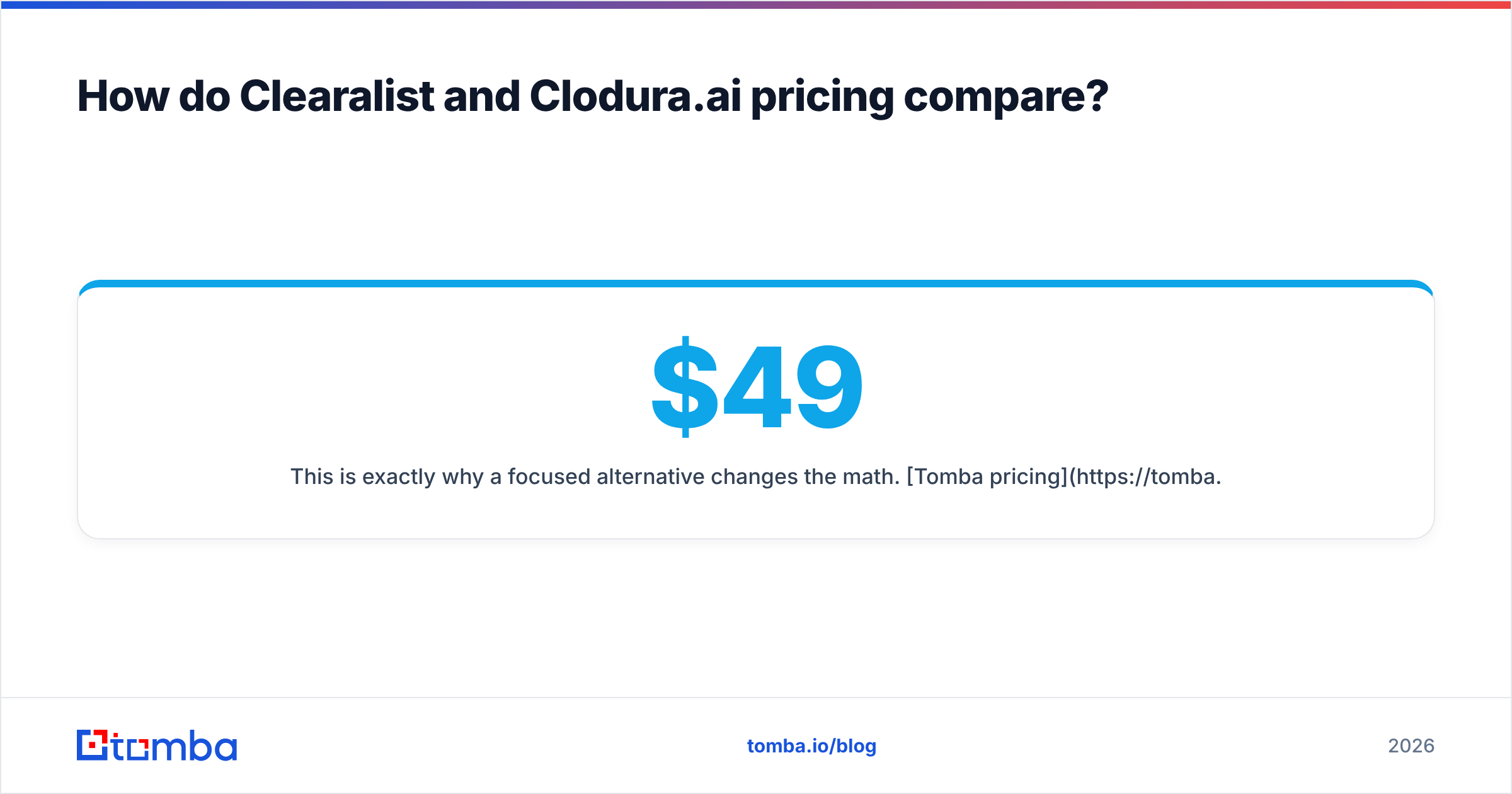
This is exactly why a focused alternative changes the math. Tomba pricing starts at a free tier with 25 searches per month, then $49/mo for Starter, $99/mo for Growth, $249/mo for Pro, and custom Enterprise pricing. You're paying for finding and verifying contacts — not for modules you'll never open. For teams whose real need is "accurate emails, plugged into the tools we already run," that's a cleaner cost structure than a full suite.
)
Is an all-in-one suite better than a focused email finder?#
It depends entirely on your motion — and being honest about it saves you a lot of money.
Choose an all-in-one suite (Clodura.ai-style) when:
- Your reps need intent signals, list building, and sequencing in one place.
- You don't already own a sequencer or dialer and want to consolidate.
- Your team is large enough that per-seat suite pricing actually pays off in saved tool-switching.
Choose a lean data tool (Clearalist-style) when:
- You already have an outreach platform you like.
- You mainly need clean, exportable contacts.
- You want minimal onboarding and fewer features to govern.
Choose a focused email finder (Tomba-style) when:
- Your bottleneck is specifically finding and verifying the right email.
- You want to enrich records on demand inside your existing CRM, Sheets, or app via an email finder API.
- You'd rather pay for accuracy than for a suite of features your team won't adopt.
Most teams overestimate how much of a suite they'll use. If your last quarter's reality was "we mostly exported lists and sent them through HubSpot," you didn't need the sequencer — you needed reliable contacts and an integration. Speaking of which, both HubSpot and a focused finder connect cleanly, so you keep your engagement layer and swap only the data source.
What workflow does each tool fit best?#
Think of these three approaches like transportation. A suite is a tour bus — everything's included, but you go where the route goes. A lean data tool is a rental car — you drive, you bring your own playlist. A focused finder is a precise rideshare — you call it exactly when you need a contact, pay for that trip, and skip the parking.
Clodura.ai fits outbound teams that want a single cockpit: research the account, pull the contact, see intent, fire the cadence. The cost is complexity and price; the payoff is fewer tools and a unified reporting view.
Clearalist fits teams with a settled stack who treat data as a component, not a platform. You get clean lists and route them wherever your process already lives.
A focused finder fits anyone whose first job is "get me the verified email for this person at this company." With Tomba you can run a domain search to pull every public email pattern at a target account, verify in bulk, and enrich straight into your CRM — without committing to a whole ecosystem. For high-volume work, the bulk email finder processes lists in one pass rather than one lookup at a time.
The honest framing: Clearalist and Clodura.ai are competing to own more of your workflow. A focused tool competes to own less of it, better. Both are valid strategies — the wrong choice is paying suite prices for component needs.
Common mistakes when picking between these tools#
A few patterns trip up buyers during trials:
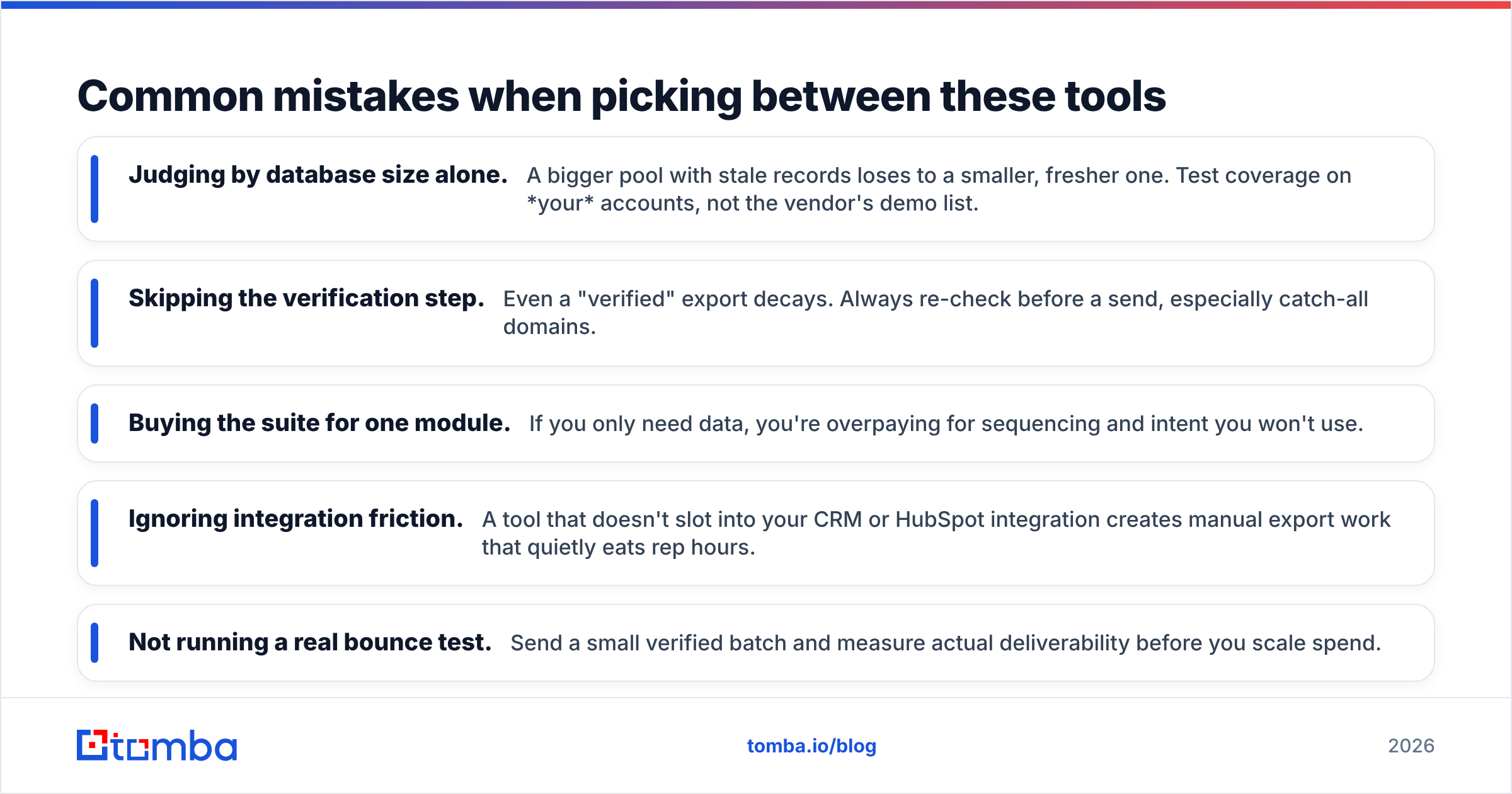
- Judging by database size alone. A bigger pool with stale records loses to a smaller, fresher one. Test coverage on your accounts, not the vendor's demo list.
- Skipping the verification step. Even a "verified" export decays. Always re-check before a send, especially catch-all domains.
- Buying the suite for one module. If you only need data, you're overpaying for sequencing and intent you won't use.
- Ignoring integration friction. A tool that doesn't slot into your CRM or HubSpot integration creates manual export work that quietly eats rep hours.
- Not running a real bounce test. Send a small verified batch and measure actual deliverability before you scale spend.
Run a structured 14-day trial on both, scored against the same target account list, and the right answer usually becomes obvious — often it's "we needed less platform than we thought."
Verdict: Clearalist vs Clodura.ai#
Pick Clodura.ai if you want a genuine all-in-one: large database, intent data, and built-in sequencing for a team that wants to consolidate outbound into one login and will actually use the engagement modules.
Pick Clearalist if you want clean, deliverability-first contact data with minimal overhead and you already own the tools you use to reach prospects.
Pick a focused finder if your real need is accuracy at the contact layer — verified emails, on demand, plugged into the stack you already trust — without paying for a suite. That's the lane where a specialist consistently wins on both cost and data quality.
The platforms differ on philosophy more than on any single feature. Match the tool to the job you're actually hiring it for, verify everything before you send, and you'll avoid the most expensive mistake in B2B data: paying premium suite prices for contacts that bounce.
Get accurate B2B emails without the suite tax#
If your bottleneck is finding and verifying the right contacts — not running a whole engagement platform — start with the Tomba Email Finder. Search by domain, name, or company, verify in bulk, and enrich directly into your CRM through the API or native integrations. The free tier gives you 25 searches a month to test accuracy on your own target accounts before you spend a cent, and paid plans start at $49/mo — a fraction of full-suite pricing. Prove the data on your list first, then scale only what you actually use.
// get started
Find, verify and enrich your first contacts today
Start on the free plan with 25 searches a month, then scale when your team is ready.
Free plan · No credit card required · GDPR & CCPA
// about the author