Clearalist vs DealSignal 2026: B2B Data Tool Comparison
Clearalist vs DealSignal compared on data accuracy, coverage, pricing, and workflow fit — plus where a credit-based email finder beats both for lean B2B teams in 2026.
Choosing between Clearalist vs DealSignal comes down to one question: do you need a heavyweight B2B data platform with intent signals and managed enrichment, or do you just need accurate contact data without an annual contract and a sales call? This guide breaks down both tools on accuracy, coverage, pricing, and workflow fit — then shows where a leaner, credit-based approach wins.
TL;DR#
- DealSignal is an enterprise-leaning B2B data platform built around verified contacts, firmographics, and intent — strong for RevOps teams that want managed, on-demand data appends.
- Clearalist positions itself as a lighter prospecting and list-building tool, attractive to SMB sales teams that want speed over scale.
- Both lean on annual or sales-gated pricing, which slows down small teams that just need emails this week.
- For accuracy-per-dollar on contact data, a credit-based email finder like Tomba often beats both for teams under 50 reps.
- Pick DealSignal for intent + enrichment at scale, Clearalist for fast SMB list-building, and Tomba when you want verified emails without a contract.
What are Clearalist and DealSignal?#
Both tools live in the B2B data and intelligence category, but they aim at different buyers.
DealSignal is a data-as-a-service platform. Instead of selling you a static list, it focuses on on-demand, verified contact and account data — emails, direct dials, titles, firmographics, and buying intent — refreshed at the point you need it. Its pitch is data accuracy guaranteed through continuous verification, which appeals to revenue operations and demand-gen teams feeding a CRM or marketing automation stack.
Clearalist is the lighter-weight option. It's built for prospecting and list-building: search for companies and people, pull contact details, and export to your outreach tool. The appeal is simplicity and speed for smaller sales teams that don't want to negotiate an enterprise agreement.
Think of it like buying a vehicle. DealSignal is a fully serviced fleet lease — managed, comprehensive, and priced for organizations. Clearalist is a compact car you drive off the lot quickly. Neither is wrong; they fit different jobs.

How do Clearalist and DealSignal compare on the core attributes?#
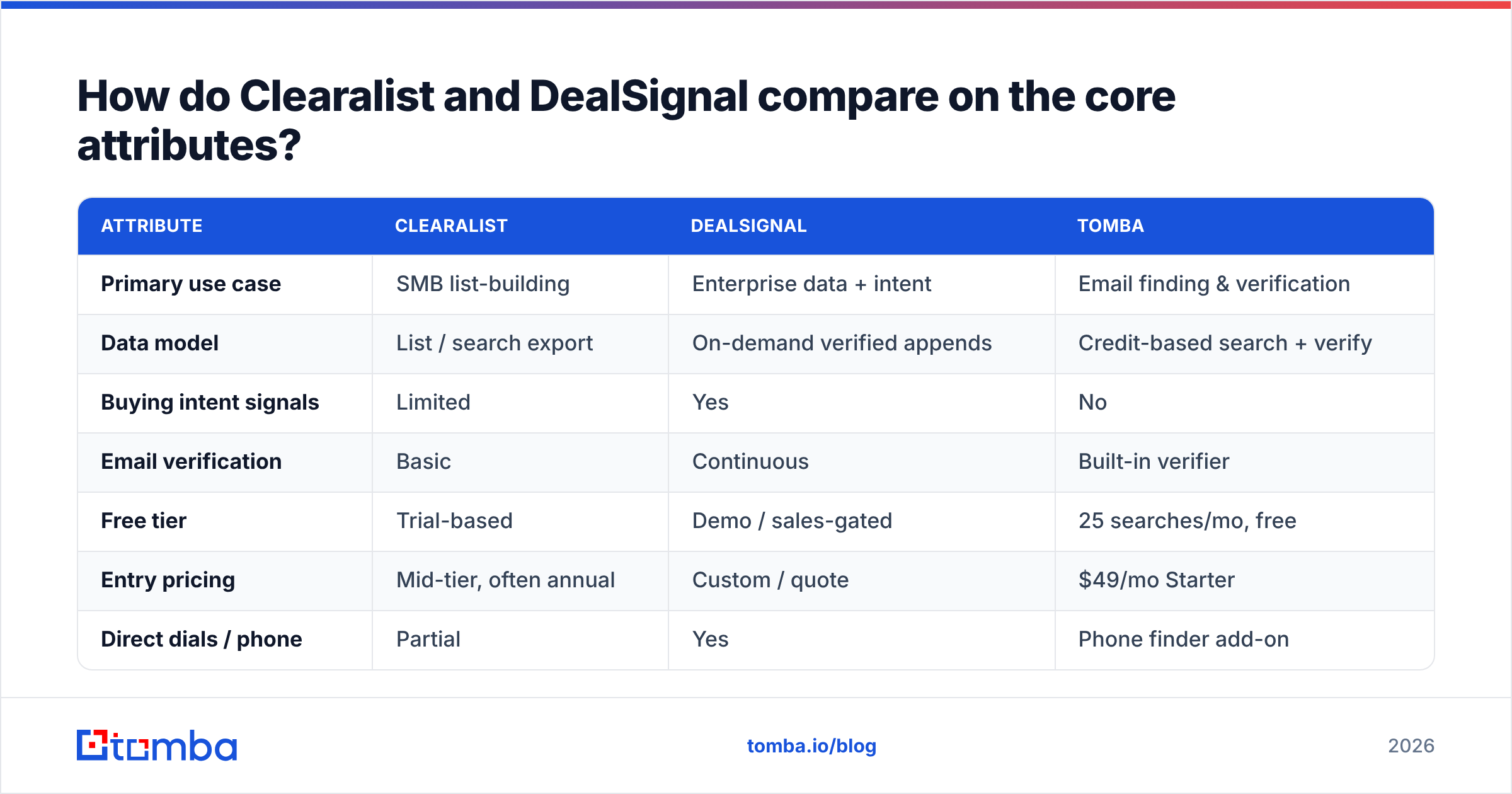
Here's the side-by-side on the attributes that actually drive a buying decision. (Vendor pricing for both shifts with seats and data volume, so treat dollar figures as directional and confirm on their sites.)
| Attribute | Clearalist | DealSignal | Tomba |
|---|---|---|---|
| Primary use case | SMB list-building | Enterprise data + intent | Email finding & verification |
| Data model | List / search export | On-demand verified appends | Credit-based search + verify |
| Buying intent signals | Limited | Yes | No |
| Email verification | Basic | Continuous | Built-in verifier |
| Free tier | Trial-based | Demo / sales-gated | 25 searches/mo, free |
| Entry pricing | Mid-tier, often annual | Custom / quote | $49/mo Starter |
| Direct dials / phone | Partial | Yes | Phone finder add-on |
| Best for | Small sales teams | RevOps & demand gen | Lean B2B & founders |
The pattern is clear: DealSignal goes wide and deep but gates entry behind a quote, Clearalist trims scope for SMB speed, and a focused finder competes on cost-per-verified-contact.
Which tool has better data accuracy?#
DealSignal generally wins on raw accuracy claims, but accuracy is only useful if you can afford the volume. DealSignal's continuous re-verification model is its headline feature — contacts are checked at delivery, which reduces bounce rates on large appends. That's genuinely valuable when you're loading thousands of records into HubSpot or Salesforce and can't afford a 20% bounce rate.
Clearalist's accuracy is adequate for SMB prospecting but leans on broader aggregated sources, so you'll want to run exports through a dedicated email verifier before any cold campaign.

Accuracy is not a single number, though. It breaks into three things you should test before committing:
- Match rate — of the contacts you search, how many return any email at all? Wide databases win here.
- Deliverability rate — of the emails returned, how many actually land? This is where continuous verification matters most.
- Freshness — how recently was the record confirmed? A 98%-accurate database from 18 months ago still bounces today.
A smart workflow is to treat your finder and your verifier as separate quality gates. Even with a premium platform, running a final email verification pass before send is the cheapest insurance against domain reputation damage.
How does pricing compare for Clearalist vs DealSignal?#
This is where small teams feel the friction. DealSignal pricing is quote-based and oriented toward annual commitments — expected for an enterprise data platform, but a real barrier if you want to test data quality this week. Clearalist is more accessible but still nudges you toward annual plans to unlock its better rates.

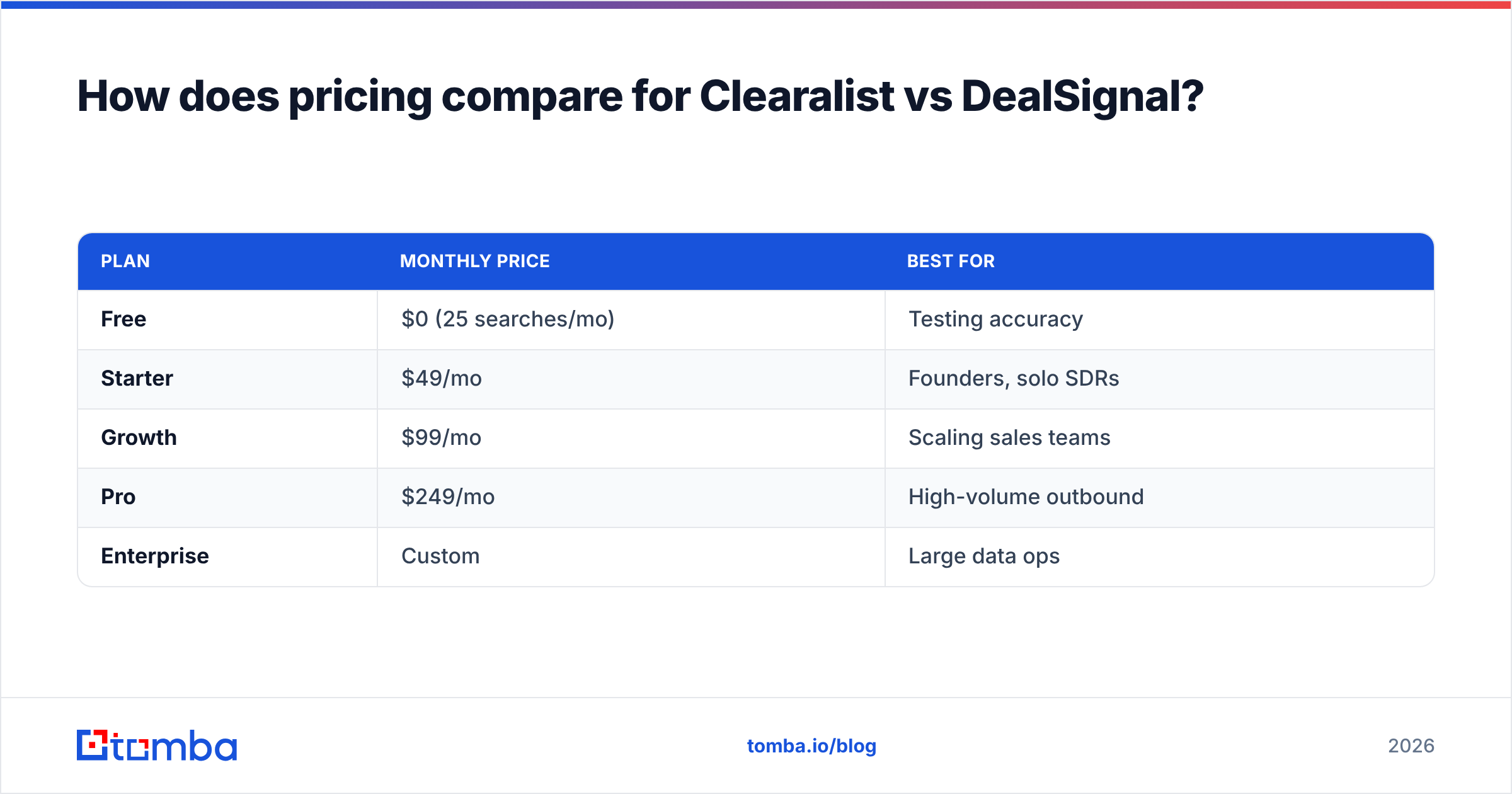
Compare that to a transparent, credit-based model. Tomba's pricing is published and self-serve:
| Plan | Monthly price | Best for |
|---|---|---|
| Free | $0 (25 searches/mo) | Testing accuracy |
| Starter | $49/mo | Founders, solo SDRs |
| Growth | $99/mo | Scaling sales teams |
| Pro | $249/mo | High-volume outbound |
| Enterprise | Custom | Large data ops |
The strategic difference: with a credit model you pay for results, not seats or a year of access you may not use. For a team running 500–2,000 lookups a month, that often lands well below a DealSignal annual contract while delivering verified emails for the same campaigns. You can also pull contacts directly with domain search when you know the company but not the person.
Is DealSignal better than Clearalist for enterprise teams?#
Yes — if you need intent data and managed enrichment at scale, DealSignal is the stronger fit. Its value compounds when you're orchestrating account-based campaigns, scoring leads on buying signals, and keeping a large CRM enriched automatically. RevOps teams that have a budget line for data infrastructure will get more from DealSignal's depth than from a lighter tool.
Clearalist struggles to match that depth. It's not trying to. Where Clearalist wins is the first 90 days of a small sales motion: a rep needs a list of 200 plausible prospects, wants to export them today, and doesn't care about intent scoring yet. For that job, Clearalist's simplicity is a feature, not a limitation.
Look at independent reviews on G2 and Capterra and the split holds: DealSignal reviewers praise data depth and accuracy; lighter tools get credit for ease of use and time-to-value. Read those reviews for your exact segment — a tool that's great for a 200-person org can be overkill for a 6-person startup. You can confirm DealSignal's current capabilities on the vendor's own site at dealsignal.com.
When should you choose a dedicated email finder instead?#
Choose a focused finder when contact data is the bottleneck and you don't need intent or managed enrichment. A large share of B2B teams don't actually need a full data platform — they need accurate emails for the accounts they've already identified. Paying enterprise platform prices for that is overkill.
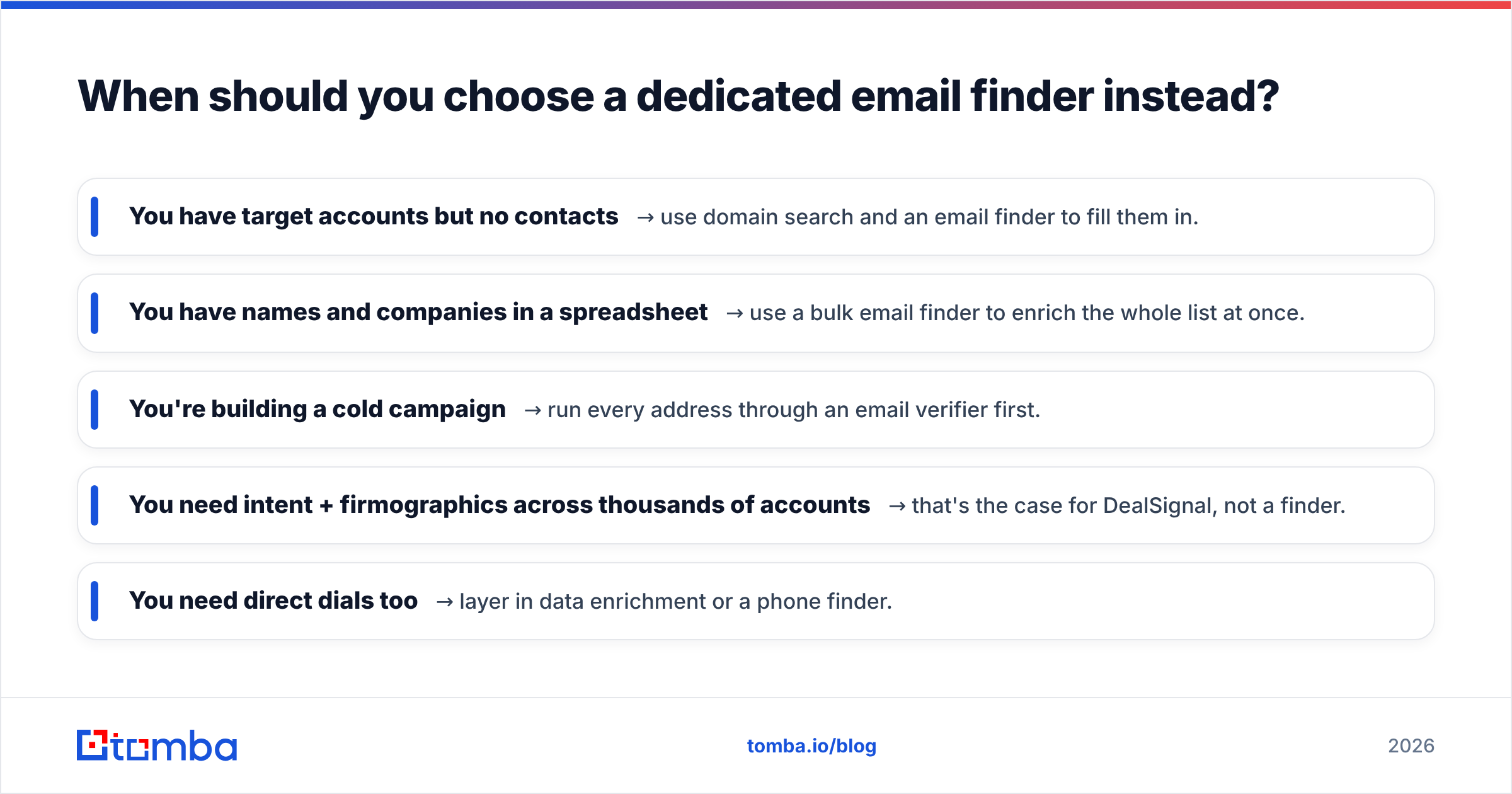
Here's the decision in plain terms:
- You have target accounts but no contacts → use domain search and an email finder to fill them in.
- You have names and companies in a spreadsheet → use a bulk email finder to enrich the whole list at once.
- You're building a cold campaign → run every address through an email verifier first.
- You need intent + firmographics across thousands of accounts → that's the case for DealSignal, not a finder.
- You need direct dials too → layer in data enrichment or a phone finder.
This is also where the cost math flips. A founder-led or sub-50-rep team rarely uses enough of an enterprise platform to justify the contract. A self-serve finder with a free tier lets you validate data quality on your own ICP before spending a dollar — something neither sales-gated platform makes easy.

What about integrations and workflow fit?#
All three connect to the standard stack, but the depth differs. DealSignal emphasizes CRM and marketing-automation syncs (Salesforce, HubSpot, Marketo) because its value is keeping those systems enriched. Clearalist focuses on export-to-outreach simplicity. A finder-first tool like Tomba spreads across the touchpoints where reps actually work — a Chrome extension, Google Sheets add-on, and a developer API for custom pipelines.
If your team lives in spreadsheets and a sequencer rather than a heavyweight CRM, the lighter integration surface is usually enough — and far less to maintain.
Clearalist vs DealSignal: which should you pick?#
Match the tool to the job, not the hype:
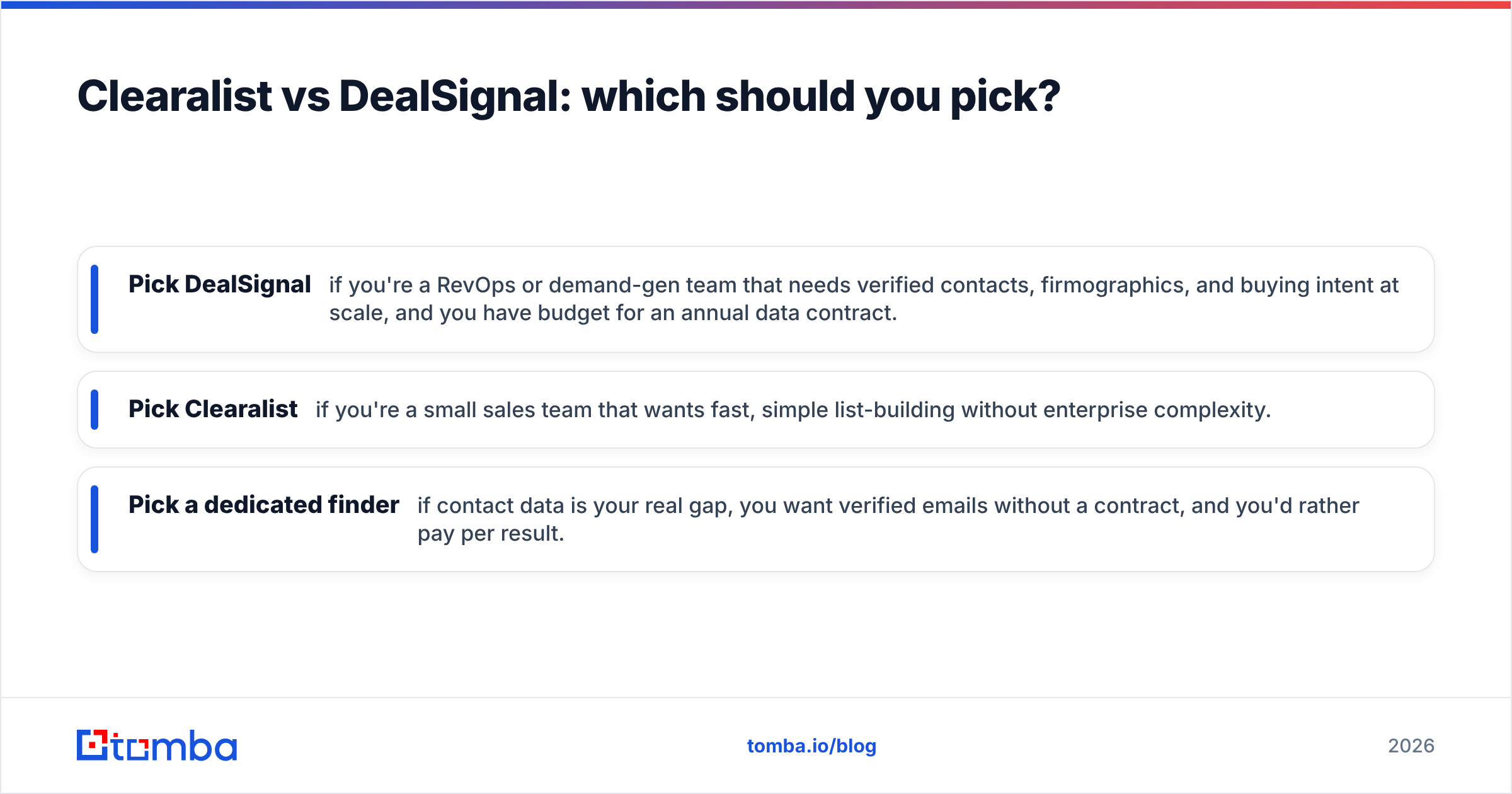
- Pick DealSignal if you're a RevOps or demand-gen team that needs verified contacts, firmographics, and buying intent at scale, and you have budget for an annual data contract.
- Pick Clearalist if you're a small sales team that wants fast, simple list-building without enterprise complexity.
- Pick a dedicated finder if contact data is your real gap, you want verified emails without a contract, and you'd rather pay per result.
Most teams overestimate how much data platform they need. Start by proving you can reach your ICP accurately and affordably, then graduate to intent and enrichment when your pipeline justifies it.
The bottom line#
DealSignal and Clearalist solve real problems — one with enterprise depth, the other with SMB speed. But both ask you to commit before you've validated the data against your own list. If your immediate need is accurate, verified email addresses you can use this week, start with a tool built for exactly that.
Try the Tomba Email Finder free — 25 searches a month, no contract, no sales call. Find verified emails by name, company, or domain, run them through the built-in verifier, and see the accuracy on your own prospects before you ever pay. When you outgrow the free tier, the $49/mo Starter plan keeps you moving without an annual lock-in. Test it against your ICP today and let the bounce rate decide.
Ready to find emails that actually work?
Join 150,000+ professionals who stopped guessing and started sending. Free credits on signup — no credit card required.
Get the Tomba newsletter
Practical outbound tactics and product updates — once every two weeks.
About the author