Clearalist vs Generect: Which Lead Tool Wins in 2026?
Clearalist vs Generect compared on data accuracy, pricing, integrations, and real workflows — plus where a dedicated email finder beats both for B2B outreach in 2026.
Clearalist vs Generect: Which Lead Tool Wins in 2026?
Choosing between Clearalist and Generect comes down to one question: do you need a curated list-building workflow or a real-time LinkedIn-driven data engine? Both promise clean B2B contacts. Neither is a pure email-finder, and that gap matters more than their marketing pages admit.
TL;DR
- Clearalist leans into pre-built, filterable lead lists and bulk export — good for marketers who want volume fast.
- Generect leans into LinkedIn-sourced, real-time enrichment with stronger API access — good for builders and RevOps teams.
- Accuracy is the real differentiator, and both leak when you scale past a few thousand contacts.
- Pricing favors Generect for API-heavy use; Clearalist is friendlier for one-off list pulls.
- For teams whose core job is finding and verifying email addresses, a dedicated tool like the Tomba Email Finder plus a real email verifier usually beats both on cost-per-valid-contact.
What are Clearalist and Generect?#
Think of these two like grocery delivery services. Clearalist is the one that ships you a pre-packed box of ingredients filtered by your diet. Generect is the one that lets you build the cart yourself, item by item, pulling fresh stock from the shelf in real time. Both feed you. The difference is control, freshness, and how much assembly you do.
Clearalist is a B2B lead-generation platform built around list discovery. You set filters — industry, headcount, geography, title — and it returns a list of companies and contacts you can export. The pitch is speed: skip the manual prospecting and get a CSV you can drop into your sequencer.
Generect positions itself as a lead-data API and enrichment layer with heavy LinkedIn sourcing. Instead of a static catalog, it emphasizes real-time lookups: feed it a domain or a LinkedIn profile and it returns enriched contact data, often through an API rather than a UI-first export.
Here's the honest framing most comparison posts skip: both tools are data brokers with an outreach skin. Their value is the underlying database and how fresh it is. That's also where both struggle, because B2B contact data decays at roughly 2.5% per month as people change jobs.

How do Clearalist and Generect compare on core features?#
Below is the head-to-head on the attributes that actually change your results, not the feature-list theater.
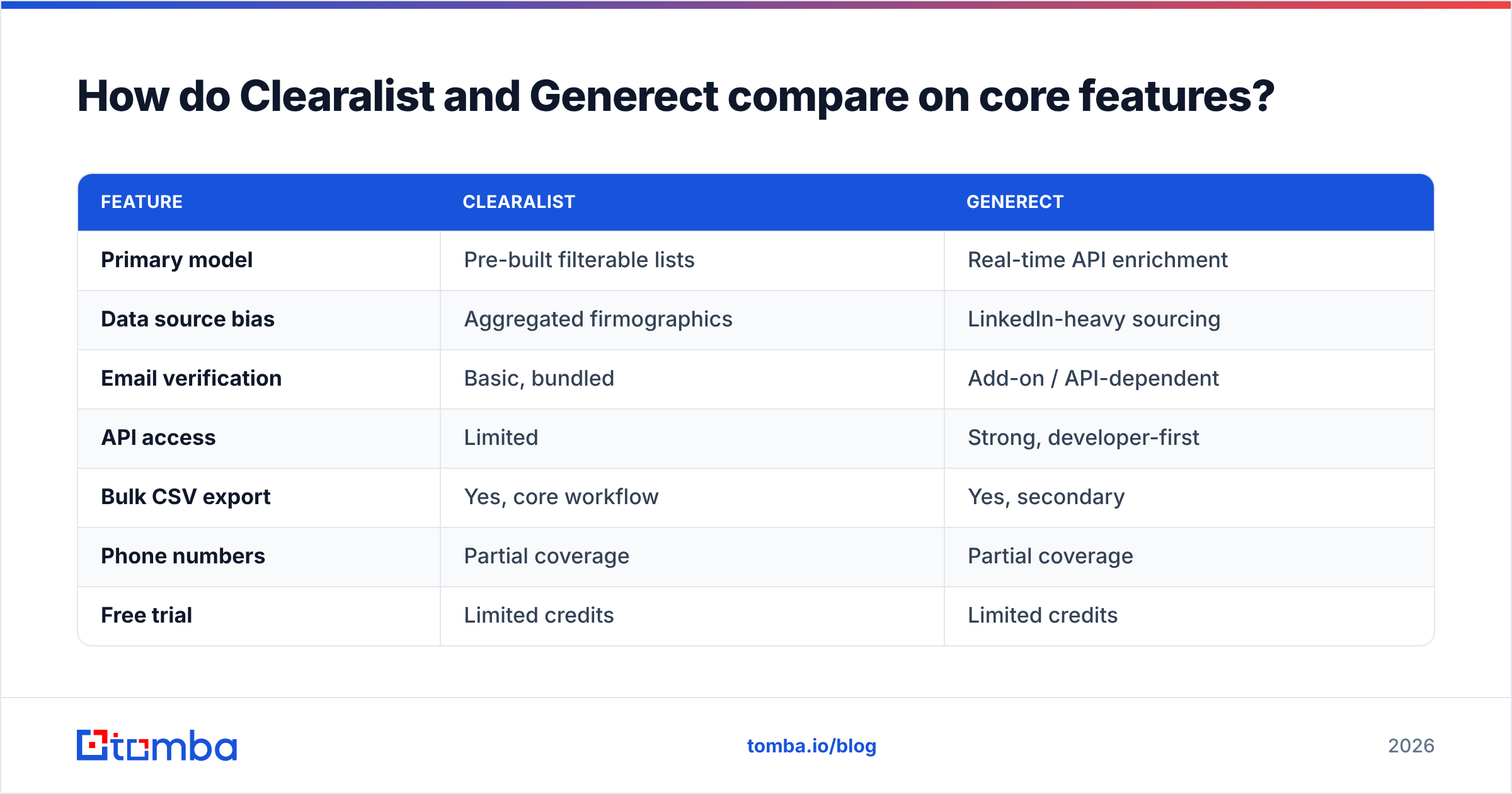
| Feature | Clearalist | Generect |
|---|---|---|
| Primary model | Pre-built filterable lists | Real-time API enrichment |
| Data source bias | Aggregated firmographics | LinkedIn-heavy sourcing |
| Email verification | Basic, bundled | Add-on / API-dependent |
| API access | Limited | Strong, developer-first |
| Bulk CSV export | Yes, core workflow | Yes, secondary |
| Phone numbers | Partial coverage | Partial coverage |
| Free trial | Limited credits | Limited credits |
| Best for | Marketers, list buyers | RevOps, engineers |
The pattern is clear. Clearalist optimizes for the person who wants a list now and doesn't want to write code. Generect optimizes for the team embedding lead data into a CRM or product through an email finder API style workflow.
Neither leads on verification, and that's the quiet tax. A list of 5,000 contacts at 80% deliverability means 1,000 of your sends hit dead inboxes — which damages your sender reputation and drags down every campaign after it.
Which has better data accuracy?#
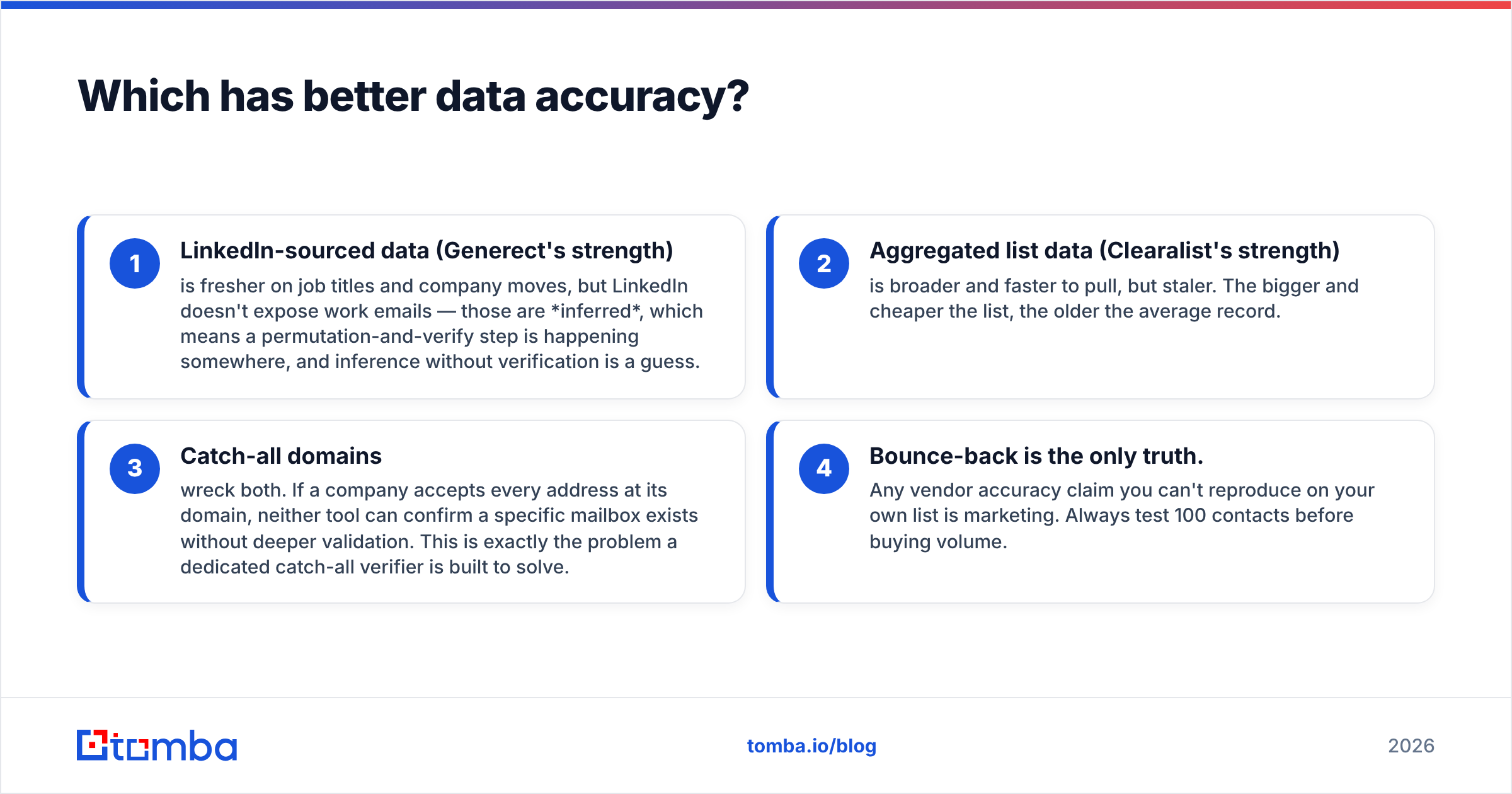
Accuracy is where the comparison gets uncomfortable, because both vendors quote numbers under ideal conditions. Real-world accuracy depends on three things: how recently the record was sourced, whether the email was SMTP-validated, and how the tool handles catch-all domains.
A few practical observations from comparing this category:
- LinkedIn-sourced data (Generect's strength) is fresher on job titles and company moves, but LinkedIn doesn't expose work emails — those are inferred, which means a permutation-and-verify step is happening somewhere, and inference without verification is a guess.
- Aggregated list data (Clearalist's strength) is broader and faster to pull, but staler. The bigger and cheaper the list, the older the average record.
- Catch-all domains wreck both. If a company accepts every address at its domain, neither tool can confirm a specific mailbox exists without deeper validation. This is exactly the problem a dedicated catch-all verifier is built to solve.
- Bounce-back is the only truth. Any vendor accuracy claim you can't reproduce on your own list is marketing. Always test 100 contacts before buying volume.
The takeaway: treat the email addresses from either tool as candidates, not confirmed. Run them through a real email verification pass before they touch your sequencer. According to HubSpot's research on email engagement, list hygiene is one of the largest controllable factors in deliverability — and it sits entirely on your side of the fence, regardless of which data tool you choose.
How do Clearalist and Generect pricing compare?#
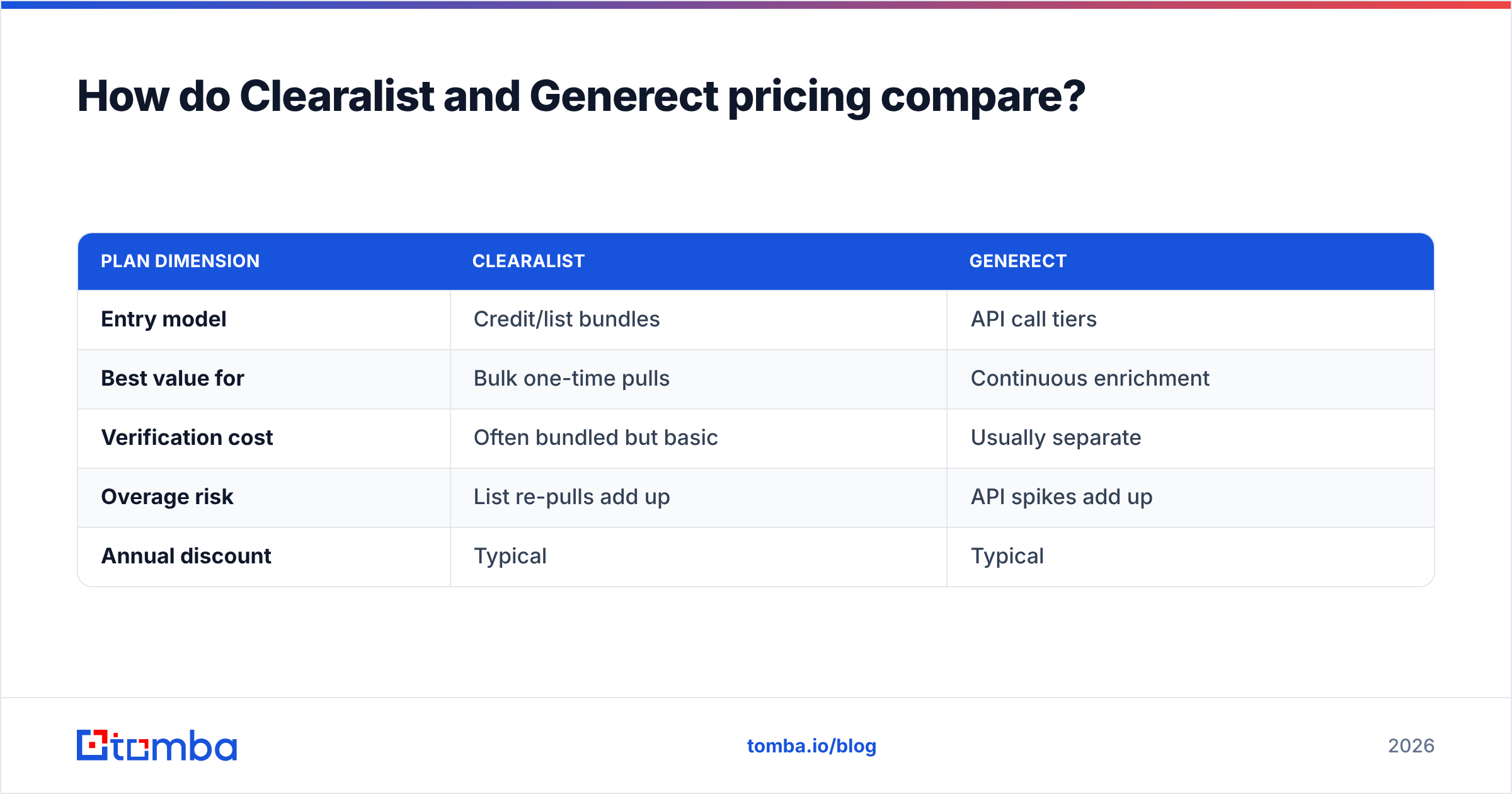
Pricing models differ enough that a flat price comparison misleads. Clearalist tends to price around list volume and export credits. Generect tends to price around API calls and enrichment depth. Your real cost is cost per valid, deliverable contact, not the sticker price per credit.
| Plan dimension | Clearalist | Generect |
|---|---|---|
| Entry model | Credit/list bundles | API call tiers |
| Best value for | Bulk one-time pulls | Continuous enrichment |
| Verification cost | Often bundled but basic | Usually separate |
| Overage risk | List re-pulls add up | API spikes add up |
| Annual discount | Typical | Typical |
Here's the math that matters. If a tool charges you per record but delivers 80% deliverability, your effective price per usable contact is 25% higher than the headline. A cheaper raw credit with worse data is the more expensive choice once bounces are counted.
This is why teams increasingly split the stack: use one tool for discovery, then a specialized, accuracy-first tool for finding and confirming the actual email. You can see how that economics plays out on the Tomba pricing page, where the free tier gives 25 searches a month, Starter is $49/mo, Growth $99/mo, and Pro $249/mo — priced around verified results rather than raw, unchecked rows.

Is Generect better than Clearalist for outbound?#
It depends on who's pressing the buttons.
Choose Generect if: you have a developer or RevOps person who wants to wire lead data directly into your CRM or app. The API-first design and LinkedIn freshness make it the stronger pick for continuous, automated enrichment. If you're building a workflow where new leads get enriched the moment they enter your pipeline, Generect's model fits.
Choose Clearalist if: you're a marketer or founder who wants a usable list this afternoon without touching code. The list-first UI and bulk export get you from filter to CSV in minutes. For campaign-by-campaign prospecting where you pull, send, and move on, Clearalist's simplicity wins.
But notice what neither answer addresses: the quality of the actual email. Both decisions are about delivery mechanism — API versus CSV — not about whether the contact data will land in an inbox. That's the part outbound teams underestimate, and it's the part that determines whether your campaign produces replies or spam complaints.
A quick reframe with a Drake-style preference: rejecting guessed-and-unverified contacts, approving SMTP-confirmed ones. That single discipline change moves deliverability more than swapping vendors ever will.
What's the smarter alternative for email-first teams?#
If your bottleneck is reliably finding and verifying business emails — not browsing lists — a purpose-built email finder is the better tool for the job. Lead-list platforms are generalists. They're decent at discovery and mediocre at the last mile of confirming a specific person's working email.
A dedicated stack typically looks like this:
- Find the email by name and company domain, or sweep a whole company with domain search to pull every public address pattern at once.
- Verify before you send so catch-all and stale records get filtered out instead of bouncing.
- Enrich and dedupe with bulk lead generation when you're working from a CSV of names you already have.
- Plug into your tools through native integrations — HubSpot, Pipedrive, Sheets, Zapier — so verified contacts flow where you work.
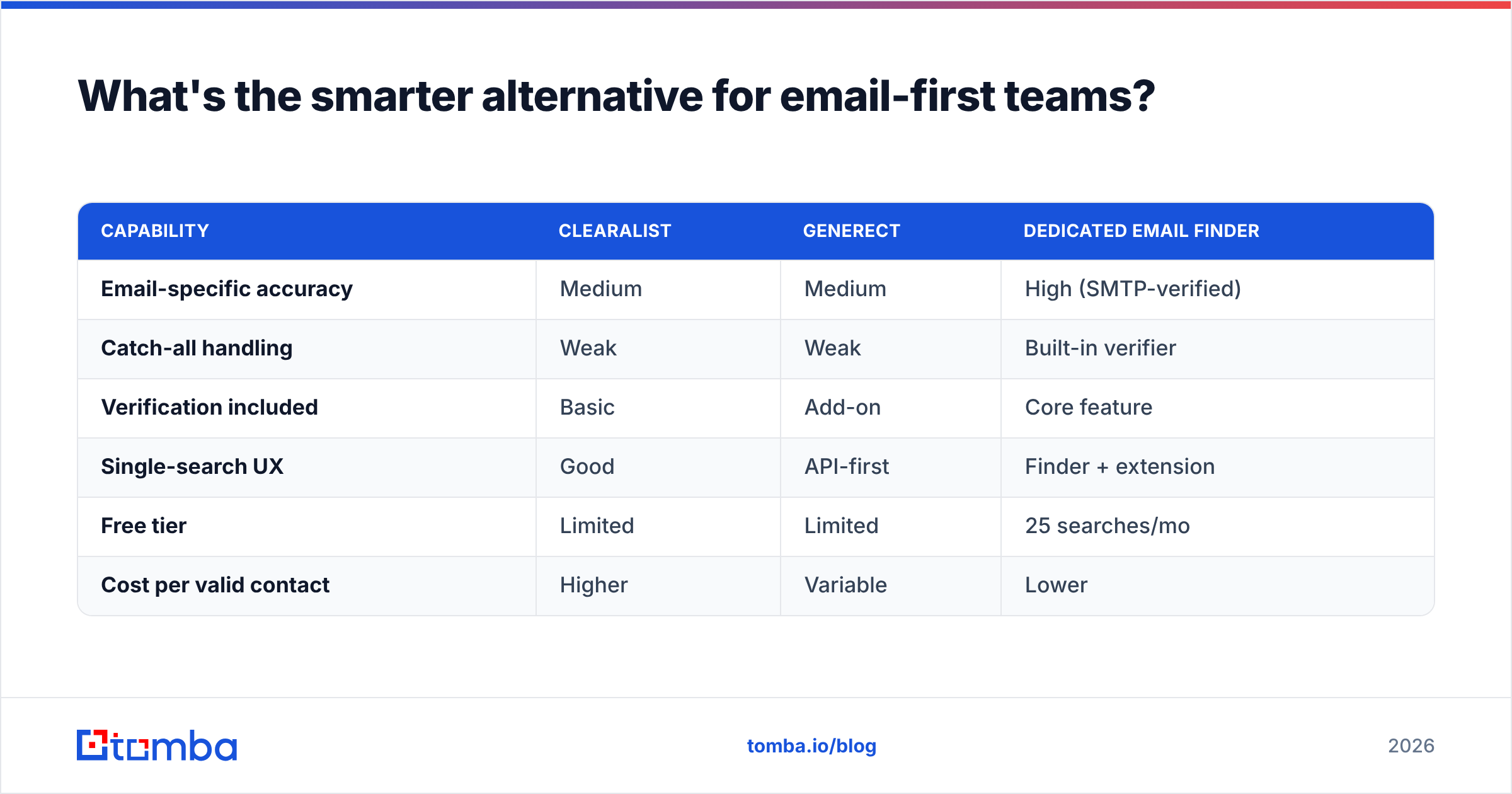
Here's how a focused email finder stacks against the two list tools on the dimensions that drive deliverability:
| Capability | Clearalist | Generect | Dedicated email finder |
|---|---|---|---|
| Email-specific accuracy | Medium | Medium | High (SMTP-verified) |
| Catch-all handling | Weak | Weak | Built-in verifier |
| Verification included | Basic | Add-on | Core feature |
| Single-search UX | Good | API-first | Finder + extension |
| Free tier | Limited | Limited | 25 searches/mo |
| Cost per valid contact | Higher | Variable | Lower |
The point isn't that Clearalist or Generect are bad. It's that they're solving "give me a list" while many teams actually have the problem "give me this person's confirmed email." Those are different jobs, and the tool built for the second one will outperform a generalist on it every time.
For deliverability-sensitive outbound — where one bad batch can tank your email deliverability for weeks — accuracy compounds. Authoritative sources like G2's lead intelligence category consistently show that buyers rank data accuracy and verification above raw database size when they re-evaluate tools after the first year.
How should you actually choose in 2026?#
Run a 100-contact bake-off before committing a dollar. The process:
- Pull the same 100 target accounts from each tool you're testing.
- Export the emails and run every one through an independent verifier.
- Send a small, warmed campaign and measure real bounce rate, not the vendor's claimed accuracy.
- Calculate cost per valid contact, not cost per credit.
- Check job-change freshness by spot-verifying 20 records against current LinkedIn profiles.
Whichever tool wins that test for your market and titles is your answer — and it may differ by region or seniority. Enterprise C-suite data behaves differently from SMB practitioner data.
What stays constant across every scenario is the verification step. Discovery tools get you names; verification is what protects your domain. Skipping it to save a few cents per record is the most expensive shortcut in outbound.
Clearalist vs Generect: the verdict#
For most buyers, the decision splits cleanly: Generect for API-driven, LinkedIn-fresh, automated enrichment; Clearalist for fast, code-free list pulls. Both are reasonable picks for their respective users, and both share the same weakness — email verification is an afterthought, not the foundation.
If the address quality is what actually determines your reply rate — and for cold outbound, it always does — pair your discovery tool with a finder built around accuracy, or replace both with one. Start with the Tomba Email Finder to find professional emails by name, domain, or company, then let the built-in verifier and catch-all finder strip out the records that would have bounced. You get verified contacts, a free tier of 25 searches a month to test it on your own list, and pricing that scales with results instead of raw rows. Run the 100-contact bake-off above against your current tool — let the bounce rate, not the marketing, pick the winner.
// get started
Find, verify and enrich your first contacts today
Start on the free plan with 25 searches a month, then scale when your team is ready.
Free plan · No credit card required · GDPR & CCPA
// about the author