Clearalist vs Kipplo 2026: Which Email Finder Wins?
Clearalist vs Kipplo, broken down for 2026: accuracy, pricing, catch-all handling, and integrations — plus where Tomba quietly beats both on data quality.
Clearalist vs Kipplo: The 2026 Email Finder Comparison
Choosing between Clearalist and Kipplo usually comes down to three things: how many emails you find, how many of them bounce, and how much you pay for the privilege. Both tools promise verified B2B contacts. Both have slick dashboards. But the gap shows up the moment you push a real prospecting list through them.
This breakdown compares Clearalist and Kipplo on accuracy, pricing, catch-all handling, integrations, and support — then shows where a third option, Tomba, changes the math.
TL;DR — Clearalist vs Kipplo at a glance#
- Clearalist leans toward enrichment and CRM sync. Strong UI, weaker on raw email discovery for smaller or non-US domains.
- Kipplo is cheaper at entry and faster to set up, but its verification is shallow — expect higher bounce rates on catch-all domains.
- Accuracy is the real differentiator. A 5% swing in deliverability matters more than a $20 price gap once you send at volume.
- Neither wins on data depth. If you care about source transparency and a real email verifier, Tomba is the honest third name to test against both.
- Run the same 100-contact list through all three before committing. Free tiers make this trivial.
What do Clearalist and Kipplo actually do?#
Both are B2B contact-data platforms. You give them a name and a company (or a domain), and they return a professional email address, often with a confidence score, job title, and sometimes a phone number.
Where they differ is philosophy:
- Clearalist positions itself as an enrichment-first tool. The pitch is "fill in the gaps in your CRM" — you upload records, it appends emails and firmographics. Discovery is a feature, not the headline.
- Kipplo is discovery-first. The pitch is "find anyone fast." It optimizes for speed and a low entry price, which appeals to solo founders and small SDR teams.
- The overlap is the email itself — and that is exactly where buyers get burned, because a found email is worthless if it bounces.

The trap with both tools is treating "found" and "valid" as the same thing. They are not. A platform can return an address with 95% confidence and still hand you a catch-all domain that accepts everything and confirms nothing.

Is Clearalist more accurate than Kipplo?#
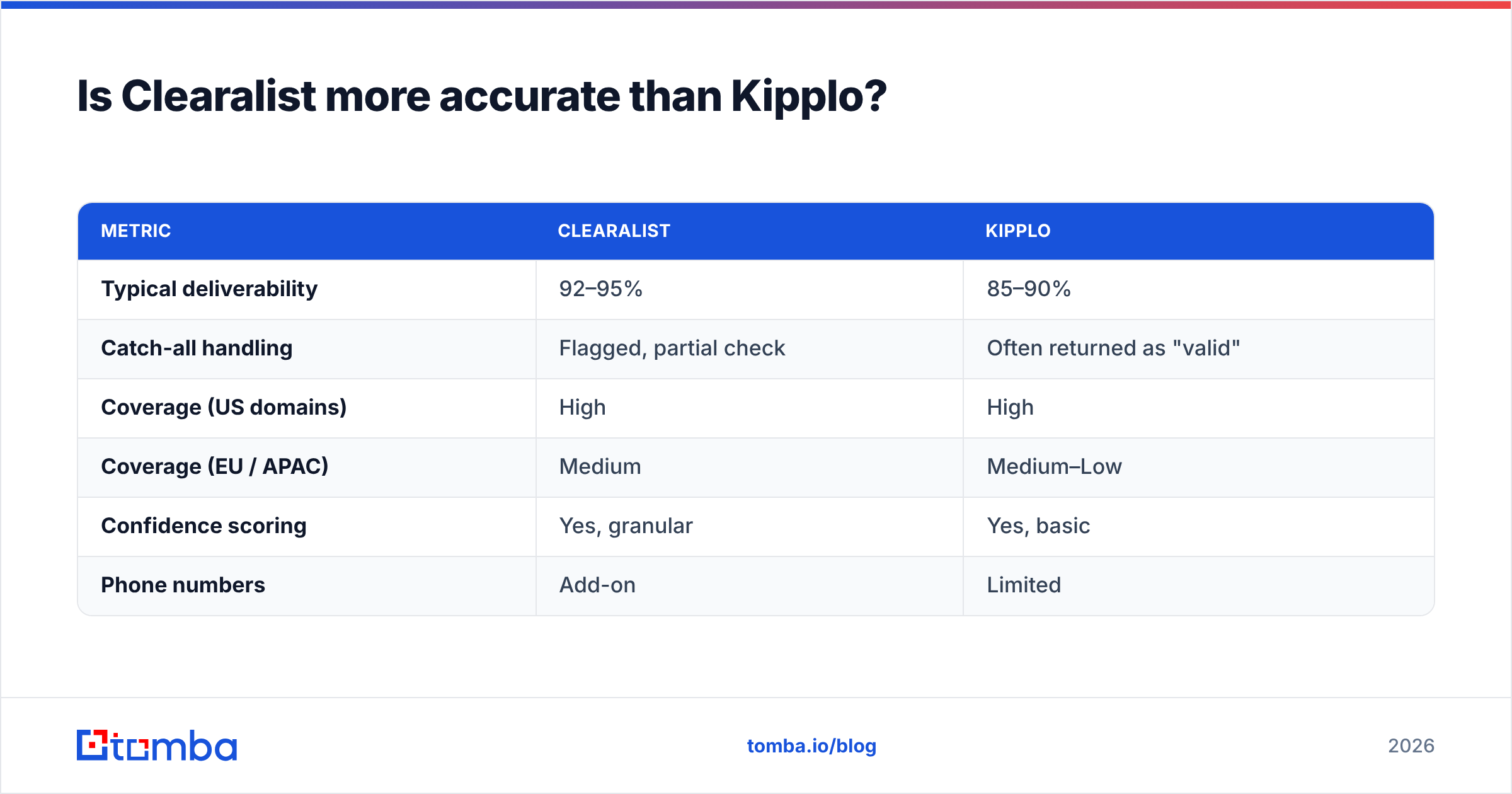
On paper, Clearalist usually edges out Kipplo on accuracy — but the reason matters. Clearalist runs a heavier verification pass before returning a result, which trims the list but raises deliverability. Kipplo returns more addresses faster, and some of those addresses are guesses dressed up as finds.
Here is how the two tend to compare on the metrics that decide whether your campaign lands.
| Metric | Clearalist | Kipplo |
|---|---|---|
| Typical deliverability | 92–95% | 85–90% |
| Catch-all handling | Flagged, partial check | Often returned as "valid" |
| Coverage (US domains) | High | High |
| Coverage (EU / APAC) | Medium | Medium–Low |
| Confidence scoring | Yes, granular | Yes, basic |
| Phone numbers | Add-on | Limited |
The headline number — deliverability — is the one to anchor on. A list that is 90% deliverable instead of 95% means five extra bounces per hundred sends. At scale, that drags your sender reputation down and pushes more of your genuine emails into spam folders. The cost of a bad finder is not the subscription; it is the deliverability tax on everything else you send.
Independent reviews on G2 and Capterra echo the pattern: users praise both tools for ease of use, then complain about bounce rates when they scale past a few hundred contacts a month. Read the 3-star reviews, not the 5-star ones — that is where the catch-all complaints live.
How do Clearalist and Kipplo handle catch-all domains?#
This is the single biggest hidden difference. A catch-all (or "accept-all") domain is configured to accept mail for any address, so a standard SMTP check can't confirm whether a specific mailbox exists.
- Kipplo tends to mark catch-all results as deliverable. That inflates its "found" count and its bounce rate at the same time.
- Clearalist flags catch-all domains and applies a secondary heuristic, so you at least know which results carry risk.
- Neither exposes a dedicated workflow for resolving catch-alls — you take the flag or you don't.
If a meaningful slice of your target market sits on catch-all domains (common in enterprise and education), this is where you need a tool with a real catch-all verifier rather than a binary valid/invalid guess. Treating catch-all as a solved problem is how clean-looking lists still bounce at 12%.
Clearalist vs Kipplo pricing: which is cheaper?#
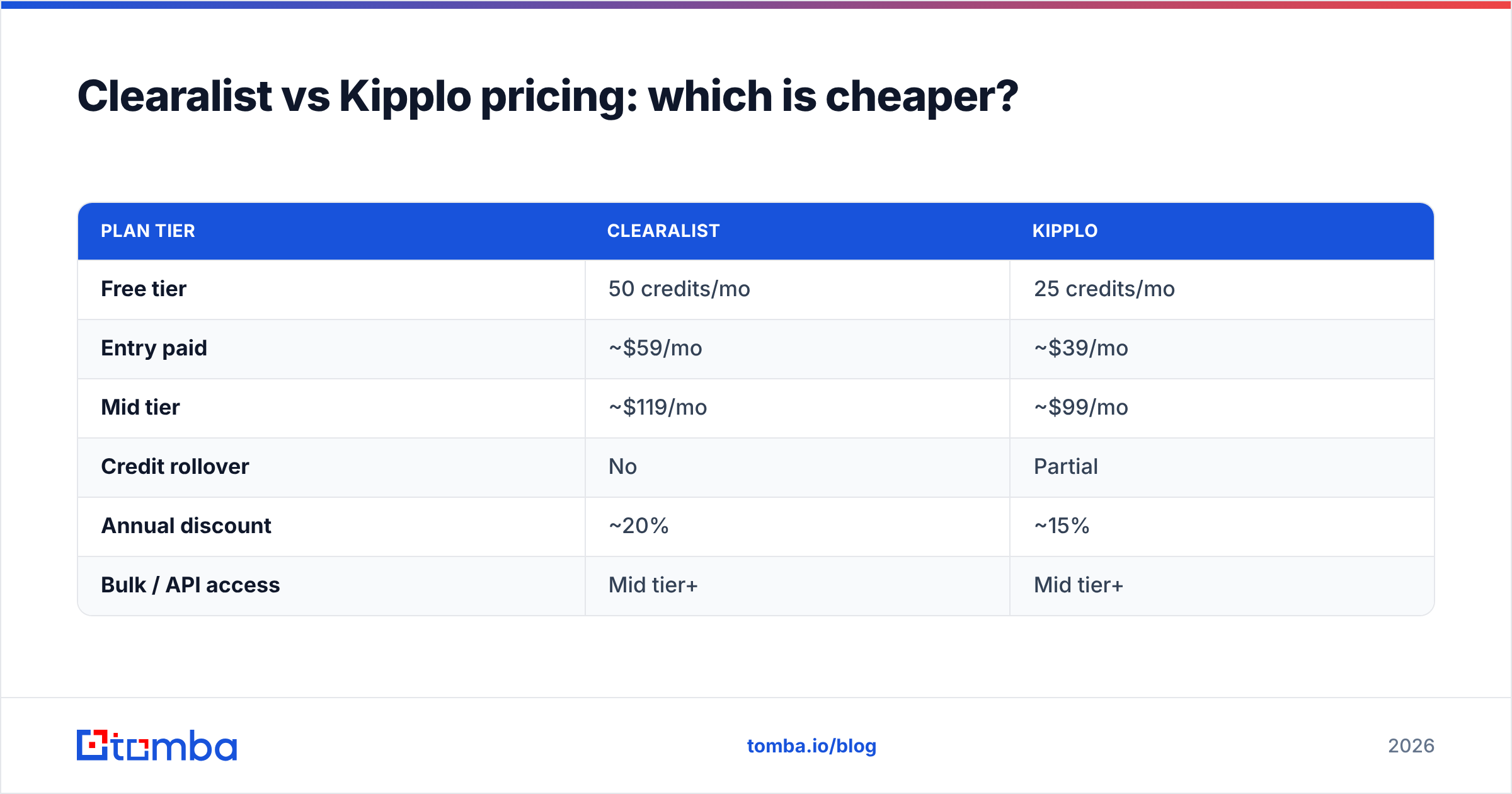
Kipplo wins the sticker-price battle at entry. Clearalist wins on credit value once you account for verification depth. Here is the simplified picture (always check each vendor's current page — pricing pages move).
| Plan tier | Clearalist | Kipplo |
|---|---|---|
| Free tier | 50 credits/mo | 25 credits/mo |
| Entry paid | ~$59/mo | ~$39/mo |
| Mid tier | ~$119/mo | ~$99/mo |
| Credit rollover | No | Partial |
| Annual discount | ~20% | ~15% |
| Bulk / API access | Mid tier+ | Mid tier+ |
The honest read: if you are running fewer than 200 lookups a month and tolerate some bounce, Kipplo's entry price is attractive. If deliverability is tied to revenue — outbound sales, recruiting, partnerships — Clearalist's extra verification usually pays for itself by avoiding wasted sends and reputation damage.
But "cheaper per credit" is a misleading metric when half the difference is bounce risk. Price the deliverable email, not the returned email. A $39 plan that gives you 200 risky addresses can cost more than a $49 plan that gives you 180 clean ones.
Where does Tomba fit between Clearalist and Kipplo?#
Tomba is the third name worth putting on the same test list, and it competes directly on the weakness both tools share: data transparency and verification depth.
A few concrete reasons to benchmark it head-to-head:
- Accuracy with receipts. Tomba publishes where its data comes from instead of treating sources as a black box, and its email finder is paired with verification rather than bolted on after.
- Real catch-all logic. The catch-all finder and verifier give you a graded outcome, not a coin flip dressed up as "valid."
- Domain-level discovery. Domain search returns every public address pattern for a company, which neither Clearalist nor Kipplo does as cleanly.
- Predictable pricing. A free tier of 25 searches/mo, then Starter at $49/mo, Growth at $99/mo, and Pro at $249/mo — no surprise credit math.
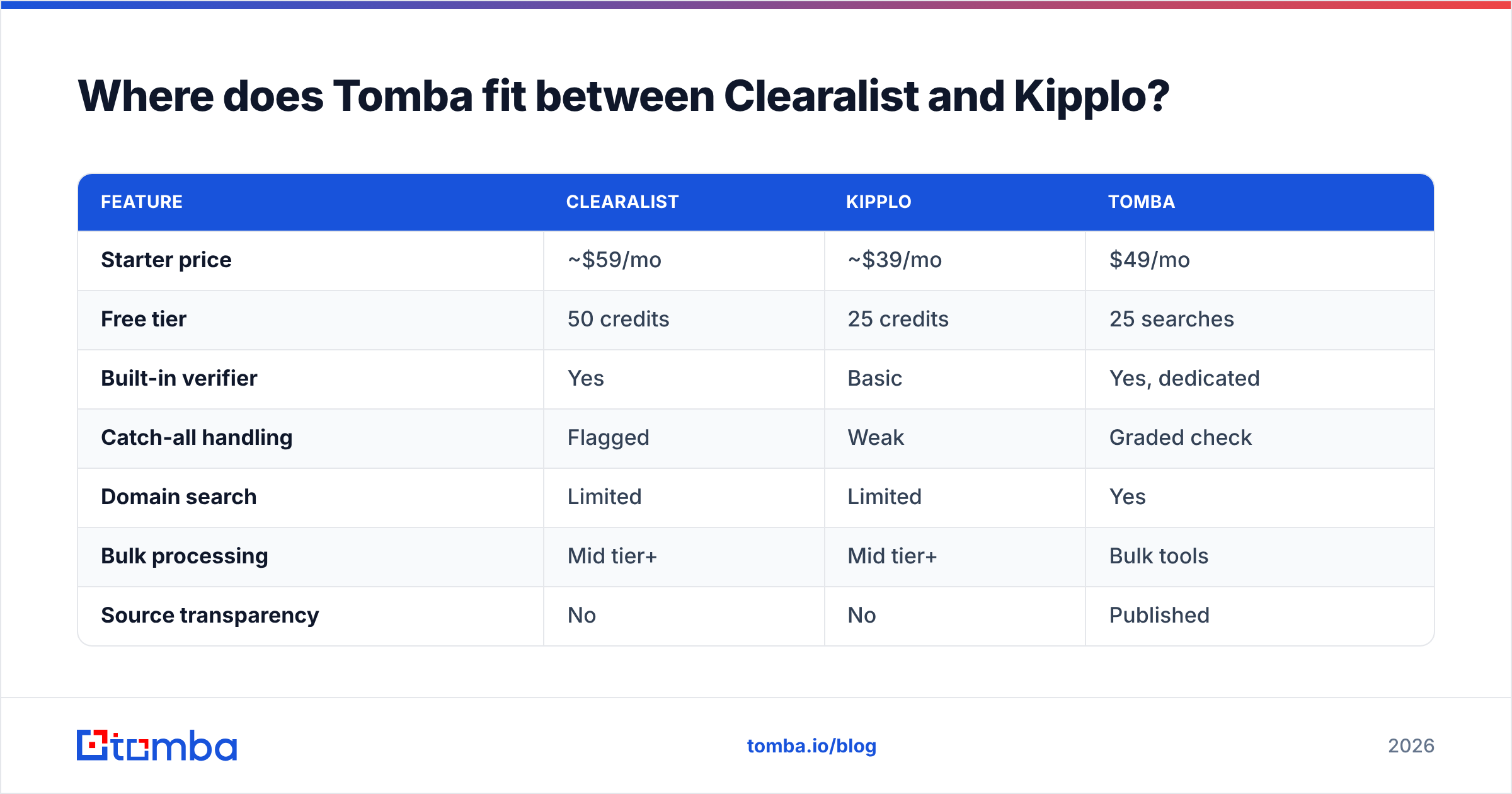
Here is how the three line up on the attributes that actually move your reply rate.
| Feature | Clearalist | Kipplo | Tomba |
|---|---|---|---|
| Starter price | ~$59/mo | ~$39/mo | $49/mo |
| Free tier | 50 credits | 25 credits | 25 searches |
| Built-in verifier | Yes | Basic | Yes, dedicated |
| Catch-all handling | Flagged | Weak | Graded check |
| Domain search | Limited | Limited | Yes |
| Bulk processing | Mid tier+ | Mid tier+ | Bulk tools |
| Source transparency | No | No | Published |
| Public API | Yes | Yes | Full API |
The point is not that Tomba is automatically the right pick for you — it is that "Clearalist vs Kipplo" is a false binary. Both are fine tools; neither is the only alternative, and the deliverability differences between all three are large enough to test rather than assume.
Which integrations and workflows should you check?#
Tooling only matters if it fits your stack. Map your workflow before you compare feature lists.
- CRM sync — Clearalist's enrichment-first design makes CRM push smooth; confirm it supports your CRM natively. Tomba covers the major ones, including HubSpot and Salesforce.
- Spreadsheets — if your team lives in Sheets or Excel, you want a native add-on, not a CSV round-trip. Check for a Google Sheets or Excel path.
- Automation — Zapier and Make connectors let you trigger lookups from forms or new CRM rows without code.
- Browser extension — for one-off prospecting on LinkedIn or company sites, a Chrome extension saves more time than any bulk feature.
- API depth — if you are building enrichment into a product, read the rate limits and response schema, not the marketing page.
A tool that wins on accuracy but can't reach your CRM will lose to a slightly weaker tool that fits your workflow. Score integrations as heavily as you score the data.

What about data privacy and compliance?#
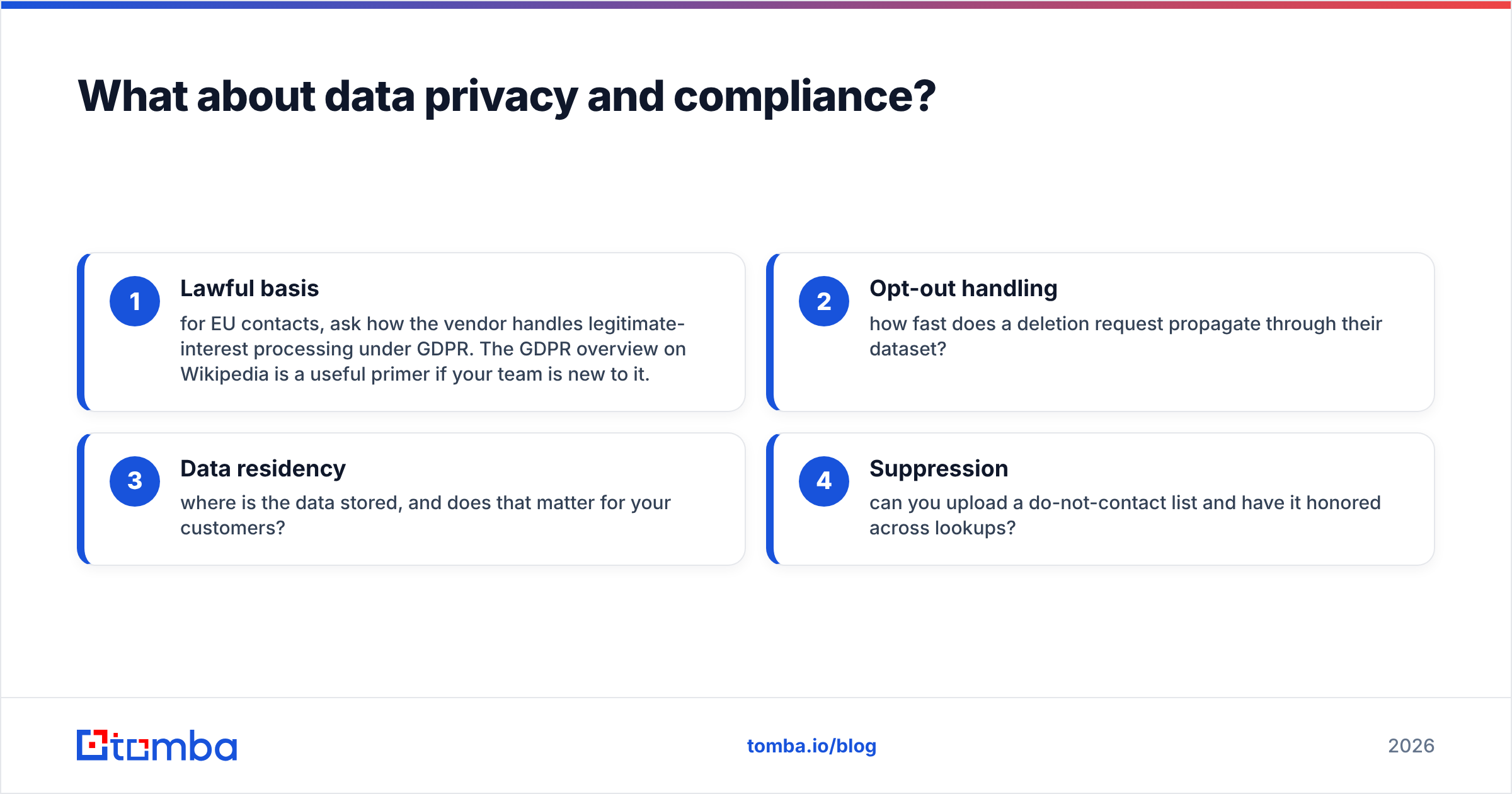
Both Clearalist and Kipplo aggregate B2B contact data, which means you inherit their compliance posture. Before you buy, confirm:
- Lawful basis — for EU contacts, ask how the vendor handles legitimate-interest processing under GDPR. The GDPR overview on Wikipedia is a useful primer if your team is new to it.
- Opt-out handling — how fast does a deletion request propagate through their dataset?
- Data residency — where is the data stored, and does that matter for your customers?
- Suppression — can you upload a do-not-contact list and have it honored across lookups?
None of this is exciting, but a compliance gap is the kind of problem that surfaces at the worst possible time. Get clear answers in writing from whichever vendor you pick.
So which one should you choose: Clearalist or Kipplo?#
Conclusion first: pick by your tolerance for bounce, not by sticker price.
- Choose Kipplo if you are early, budget-constrained, prospecting at low volume, and willing to verify results yourself before sending.
- Choose Clearalist if enrichment and CRM sync are central to your workflow and you want fewer bad addresses out of the box.
- Test Tomba alongside both if deliverability is tied to revenue and you want source transparency plus a dedicated verifier rather than a confidence score you have to trust blindly.
The smartest move costs you nothing: run the same 100-contact list through all three free tiers, then measure bounce rate after you send. The winner is whichever list ends in the most inboxes — not the one with the prettiest dashboard or the lowest price per credit.
The bottom line#
Clearalist and Kipplo are both legitimate email finders with real trade-offs: Kipplo for speed and price, Clearalist for verification and enrichment. But the metric that decides your campaign's fate — deliverable, inbox-landing emails — is exactly where both leave room on the table.
If you want to see what a transparency-first finder does to your bounce rate, start with the Tomba Email Finder. The free tier gives you 25 searches a month, the verifier is built in rather than sold separately, and you can benchmark it against your Clearalist and Kipplo results on the same list before you commit a dollar. Test all three, send to a real audience, and let the inbox decide.
// get started
Find, verify and enrich your first contacts today
Start on the free plan with 25 searches a month, then scale when your team is ready.
Free plan · No credit card required · GDPR & CCPA
// about the author