Clearalist vs Reachfast (2026): Which Email Finder Wins?
A neutral, data-driven breakdown of Clearalist vs Reachfast — accuracy, pricing, verification, and where a third option quietly beats both in 2026.
Choosing between two email finders usually comes down to three numbers: how often the address is right, how much you pay per verified contact, and how many of your real prospects the database actually covers. Clearalist vs Reachfast is exactly that kind of decision — two tools that look similar on a feature grid but behave very differently once you push real volume through them.
This is a neutral teardown. Both tools have genuine strengths, and you'll see where each one wins. You'll also see where a third option — Tomba — quietly outperforms both on the metrics that decide cost-per-meeting.
TL;DR: Clearalist vs Reachfast at a glance#
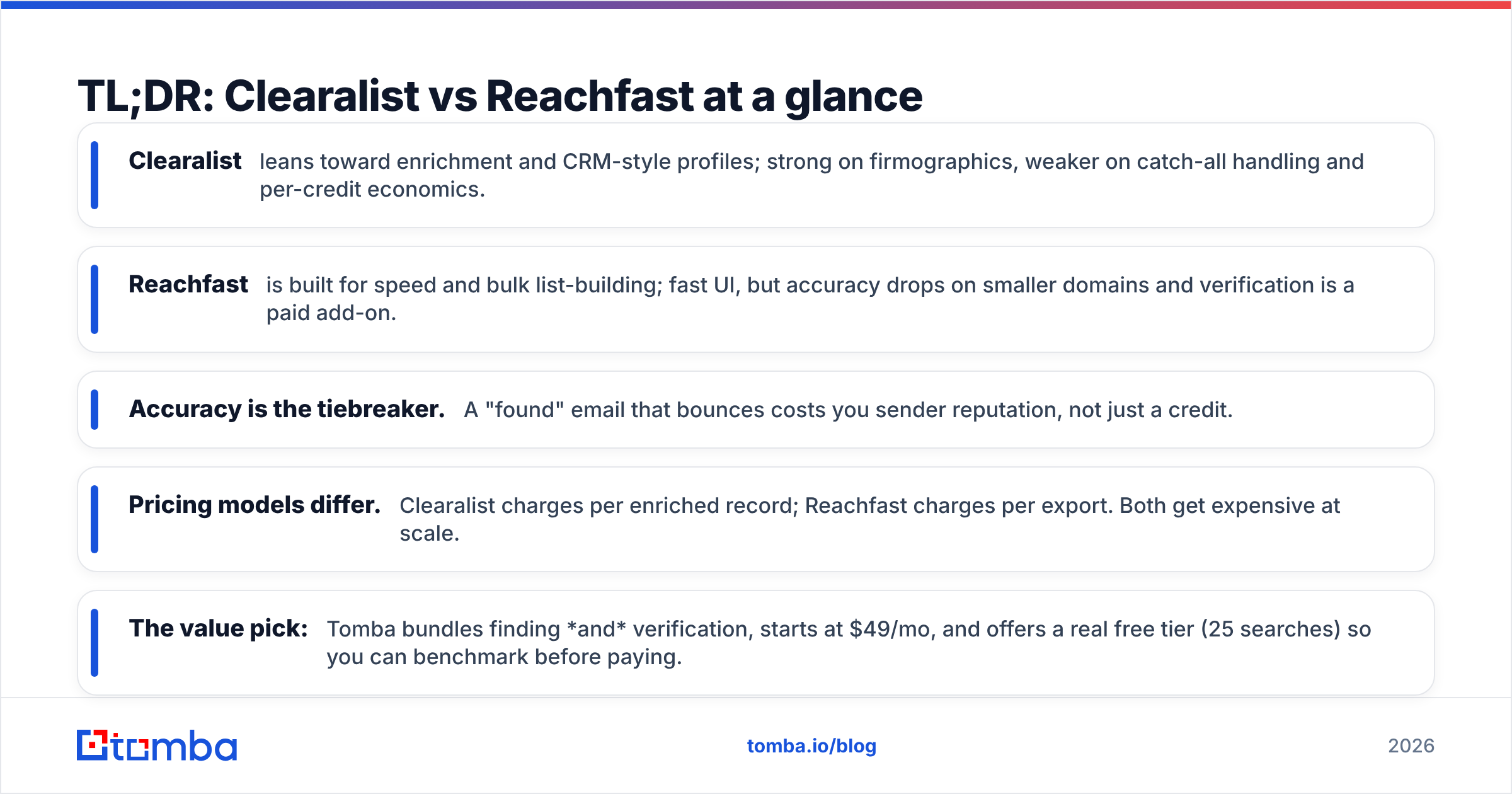
- Clearalist leans toward enrichment and CRM-style profiles; strong on firmographics, weaker on catch-all handling and per-credit economics.
- Reachfast is built for speed and bulk list-building; fast UI, but accuracy drops on smaller domains and verification is a paid add-on.
- Accuracy is the tiebreaker. A "found" email that bounces costs you sender reputation, not just a credit.
- Pricing models differ. Clearalist charges per enriched record; Reachfast charges per export. Both get expensive at scale.
- The value pick: Tomba bundles finding and verification, starts at $49/mo, and offers a real free tier (25 searches) so you can benchmark before paying.
What are Clearalist and Reachfast?#
Both are B2B contact-data tools that turn a name and a company into a work email address. The category matters because the wrong tool silently taxes every campaign you run.
Clearalist positions itself as an enrichment platform first and an email finder second. You feed it a domain or a partial profile, and it returns a fuller contact record — title, seniority, social links, and a best-guess email. That's useful when your CRM is half-empty and you want to fill gaps in bulk.
Reachfast is the opposite emphasis: a fast prospecting front-end. Search by company, filter by role, export a list. The pitch is throughput — get a thousand contacts into a spreadsheet before your coffee's cold.
Here's the catch with both: finding an email and proving it lands are two separate jobs. If you skip the second one, your email deliverability erodes one bounce at a time. That's why how each tool handles verification — not just discovery — is the real story.

How do Clearalist and Reachfast compare on accuracy?#
Accuracy is where the marketing pages get quiet and the invoices get loud. An email finder's headline "coverage" number tells you how often it returns something. The number that matters is how often that something is correct and deliverable.
Three factors drive real-world accuracy:
- Source diversity — tools that blend SMTP checks, crawled public data, and contributed records beat single-source guessers.
- Catch-all handling — domains that accept every address are where weak tools quietly inflate their "found" rate with un-verifiable guesses.
- Built-in verification — if the tool verifies before it bills you, you stop paying for bounces.
Clearalist's enrichment focus means it's strong on large, well-documented companies and softer on SMBs with thin web footprints. Reachfast's speed-first model tends to return more results overall, but a chunk of those are pattern-guesses on catch-all domains that never get verified unless you buy the add-on. If you want to understand why that's risky, a catch-all verifier is the piece most bulk tools leave out.
)
The practical test: run the same 100 known contacts through each tool and count verified hits, not raw returns. Most teams are shocked at the gap between "found" and "actually deliverable."
Clearalist vs Reachfast: feature and pricing comparison#
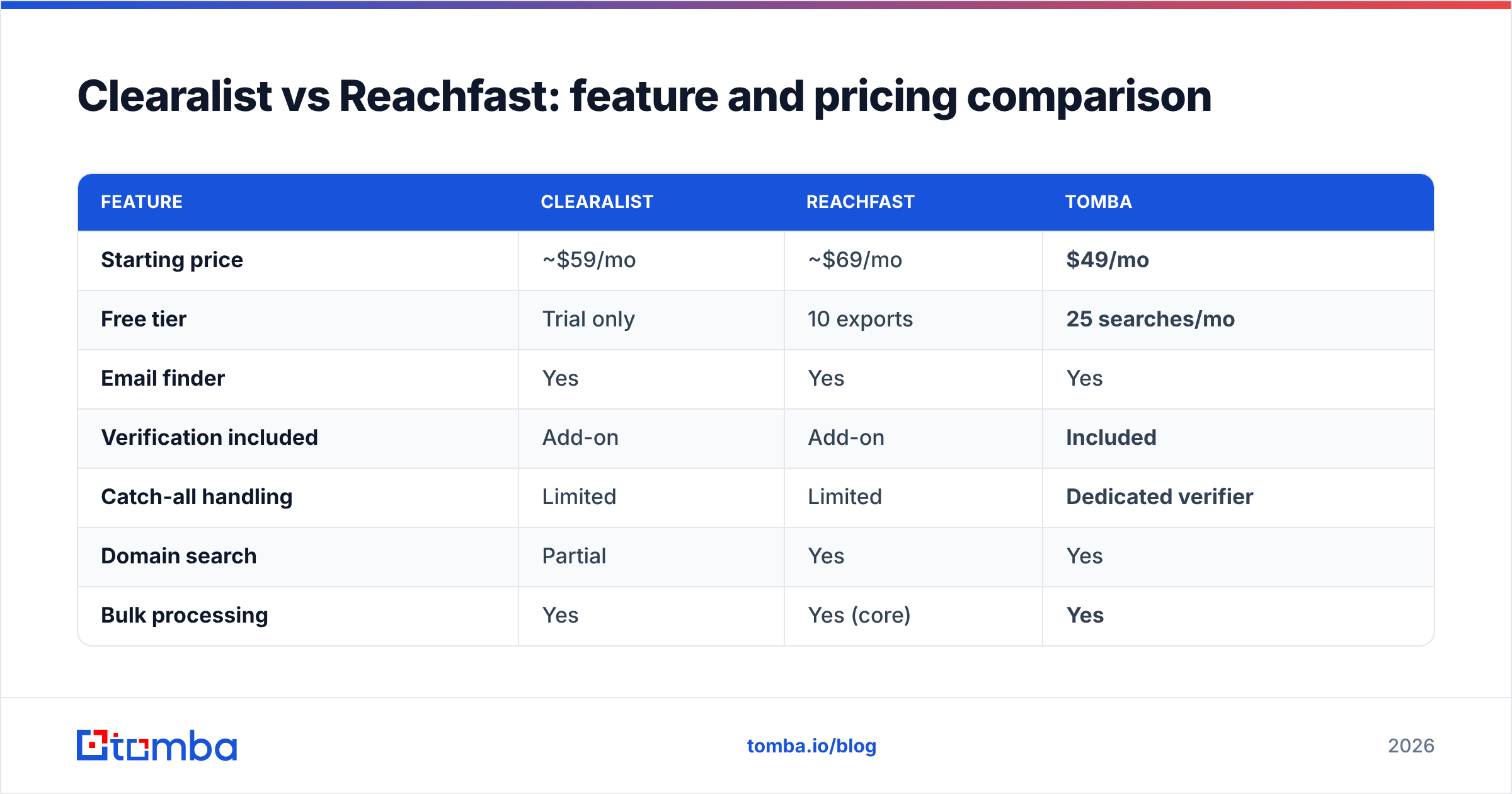
| Feature | Clearalist | Reachfast | Tomba |
|---|---|---|---|
| Starting price | ~$59/mo | ~$69/mo | $49/mo |
| Free tier | Trial only | 10 exports | 25 searches/mo |
| Email finder | Yes | Yes | Yes |
| Verification included | Add-on | Add-on | Included |
| Catch-all handling | Limited | Limited | Dedicated verifier |
| Domain search | Partial | Yes | Yes |
| Bulk processing | Yes | Yes (core) | Yes |
| Phone numbers | Add-on | No | Yes |
| Native API | Yes | Limited | Yes |
| Best for | CRM enrichment | Fast list exports | Verified outreach |
Prices reflect publicly listed entry plans as of 2026 and change often — confirm on each vendor's site before buying.
Two things stand out. First, both Clearalist and Reachfast treat verification as a separate purchase, which means the sticker price understates the real cost-per-deliverable-email. Second, free tiers differ sharply: a real free allowance lets you benchmark accuracy on your list before committing budget. You can compare current Tomba pricing against both to see how the bundled model changes the math.
Which tool has better data coverage?#
It depends on who you sell to — and that's not a cop-out, it's the actual answer.
Sell to enterprise? Clearalist's enrichment depth is a genuine advantage. Big companies have rich public footprints, and Clearalist stitches them into clean profiles. If your ICP is Fortune 5000 directors, its firmographic layer earns its keep.
Sell to SMBs and mid-market? This is where coverage gets thin for both. Smaller companies have fewer public signals, so pattern-guessing dominates — and that's exactly where unverified results bounce. A tool with a strong domain search that maps a company's real email pattern from confirmed addresses will beat a tool that just permutes first.last@.
Run global outbound? Check regional coverage explicitly. Many US-built databases thin out fast in EMEA and APAC. Reachfast's speed doesn't help if half your German prospects come back empty.
For an independent read on coverage and satisfaction, cross-reference user reviews on G2 and Capterra rather than trusting any vendor's own case studies — including this one.
Is Clearalist or Reachfast better for cold outreach?#
For outreach specifically, the winner is whichever tool keeps your bounce rate under 2% — because mailbox providers treat bounces as a spam signal, and your sender reputation is the asset you're actually protecting.
Reachfast's bulk-export speed is seductive for cold email, but speed without verification is how teams torch a sending domain in a week. If you go this route, you must run every export through a standalone email verifier before the first send. That's an extra step, an extra tool, and an extra bill.
Clearalist is gentler on reputation because enrichment-grade data tends to be cleaner — but its per-record pricing punishes the high-volume, low-cost-per-touch model that cold outreach depends on.
)
The cleaner workflow is a tool that finds and verifies in one pass, so the list you export is the list you can safely send to. That single design choice eliminates the "found vs deliverable" gap that quietly inflates cost-per-meeting on both Clearalist and Reachfast.
Where does Tomba fit in the Clearalist vs Reachfast decision?#
Tomba sits in the gap both tools leave open: verified discovery at a transparent price. Three differences matter when you're stuck between Clearalist and Reachfast.
- Verification is bundled, not bolted on. Every result runs through SMTP-level checks, so you're not paying twice to find and then prove an address. Catch-all domains get their own catch-all verification path instead of a silent guess.
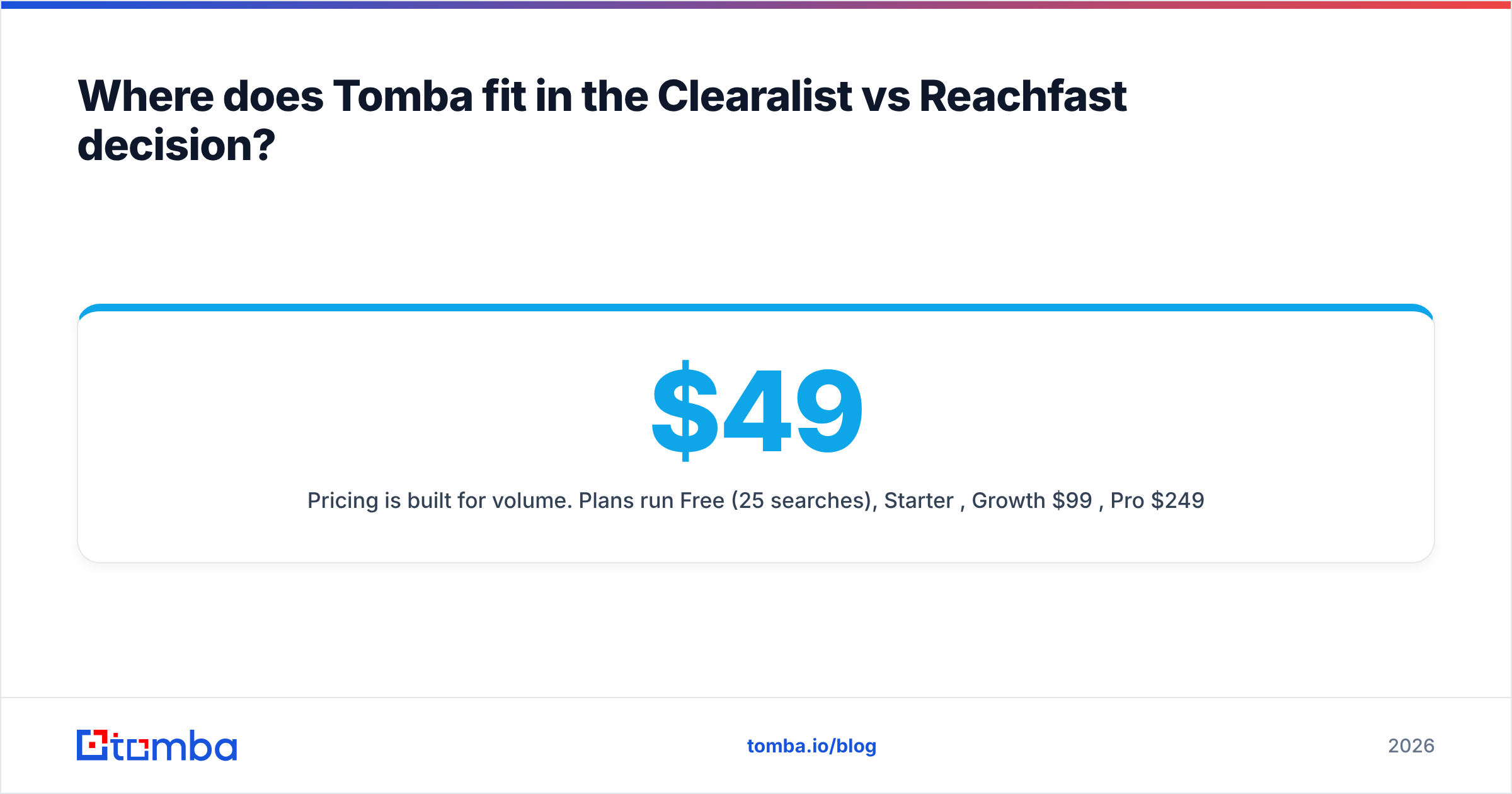
- Pricing is built for volume. Plans run Free (25 searches), Starter $49/mo, Growth $99/mo, Pro $249/mo, and Enterprise. The free tier is the part that matters — you can benchmark Tomba against Clearalist and Reachfast on your own list before spending a cent.
- It plugs into your stack. A documented email finder API, plus native HubSpot integration and bulk tools, means it fits whether you're a solo SDR or a RevOps team automating enrichment.
This isn't a claim that Tomba wins every category — Clearalist's enterprise enrichment depth and Reachfast's raw export speed are real. It's a claim that for verified B2B email at a predictable cost, the bundled model removes a tax the other two leave in place.

How should you choose between them?#
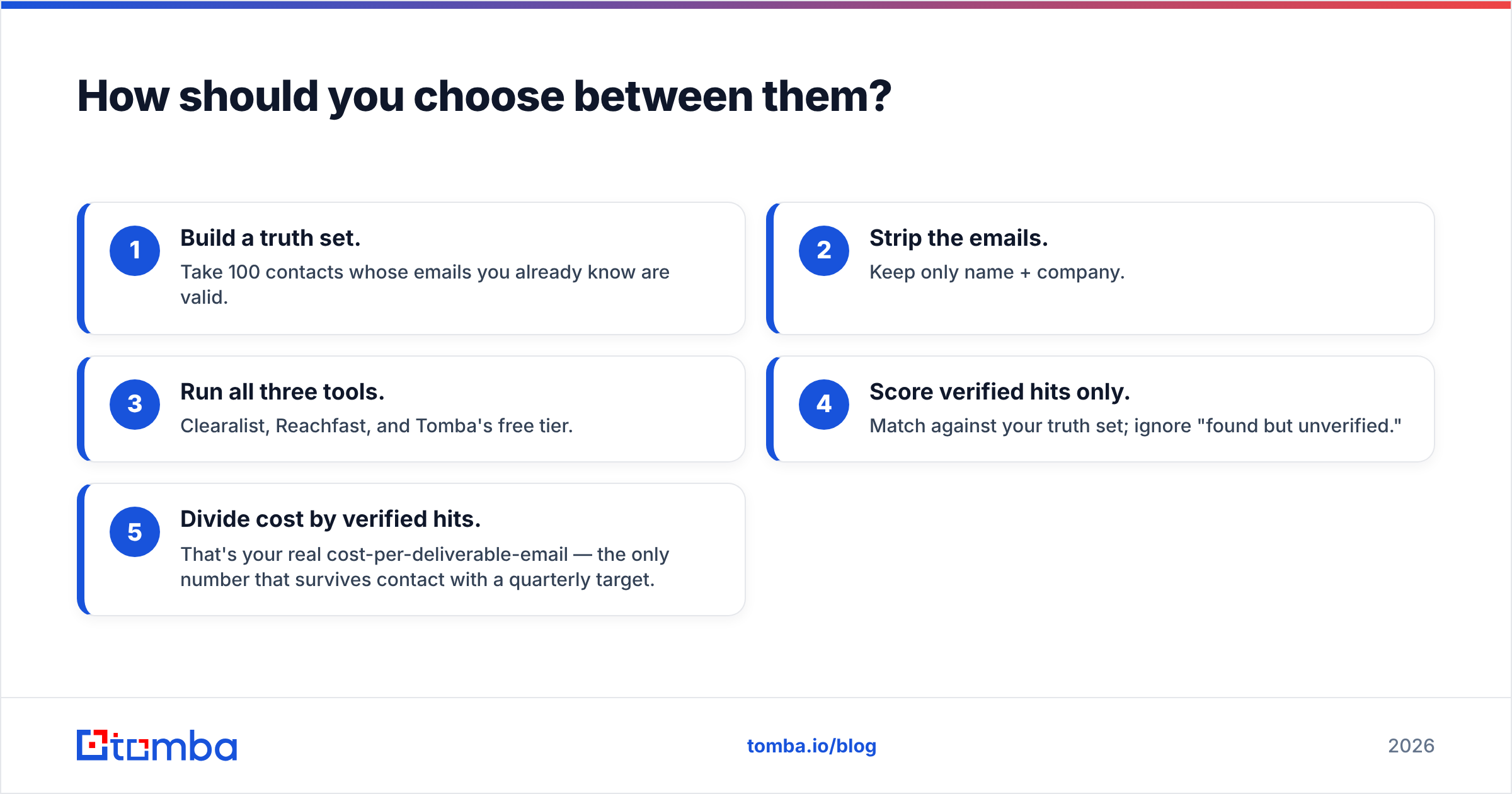
Run a 60-minute bake-off instead of reading another comparison post (including this one). Here's the protocol:
- Build a truth set. Take 100 contacts whose emails you already know are valid.
- Strip the emails. Keep only name + company.
- Run all three tools. Clearalist, Reachfast, and Tomba's free tier.
- Score verified hits only. Match against your truth set; ignore "found but unverified."
- Divide cost by verified hits. That's your real cost-per-deliverable-email — the only number that survives contact with a quarterly target.
Whichever tool wins your test on your ICP is the right answer, full stop. Vendor benchmarks — again, this one included — are directional at best.
Frequently asked questions#
Is Clearalist or Reachfast more accurate? Clearalist tends to edge ahead on large enterprise contacts thanks to its enrichment depth; Reachfast returns more results overall but a higher share are unverified catch-all guesses. Measure verified hits on your own list before deciding.
Do Clearalist and Reachfast include email verification? Both treat verification as a paid add-on rather than a bundled step. Budget for the extra cost, or run exports through a dedicated verifier before sending.
What's the cheapest way to compare all three? Use the free tiers. Tomba offers 25 free searches per month, Reachfast offers limited exports, and Clearalist is trial-only — enough to run a small accuracy bake-off.
Which is best for cold email at scale? Whichever keeps your bounce rate lowest. A bundled find-and-verify tool reduces the risk of sending to unverified addresses, which is the fastest way to damage sender reputation.
The bottom line#
Clearalist and Reachfast both solve half the problem well — Clearalist enriches, Reachfast exports fast — but each leaves verification (and its cost) on you. If your priority is verified email at a transparent price, start with the Tomba Email Finder: bundled SMTP verification, a real 25-search free tier to benchmark against both competitors, and pricing from $49/mo that doesn't penalize volume. Run the 100-contact bake-off, score verified hits only, and let your own data pick the winner.
// get started
Find, verify and enrich your first contacts today
Start on the free plan with 25 searches a month, then scale when your team is ready.
Free plan · No credit card required · GDPR & CCPA
// about the author