Clearalist vs Salesbot 2026: Which B2B Sales Tool Wins?
A neutral, side-by-side breakdown of Clearalist vs Salesbot in 2026 — pricing, data accuracy, workflows, and where a dedicated email finder still beats both.
Clearalist vs Salesbot: The 2026 Comparison
Choosing between Clearalist and Salesbot usually comes down to one question your demo never answers: which one actually puts a working contact in front of your reps without burning a week of setup? This breakdown skips the marketing copy and compares both on the things that move pipeline — data accuracy, pricing, workflow fit, and the gaps each one leaves you to fill.
TL;DR — Clearalist vs Salesbot at a glance#
- Clearalist leans toward data enrichment and account intelligence — strong for teams that already have a CRM full of leads and want them cleaned, scored, and prioritized.
- Salesbot leans toward outbound automation — sequences, AI reply drafting, and multichannel cadences for teams pushing volume.
- Neither is a true email-finding specialist. Both bundle contact data, but accuracy and verification are where bundled tools tend to slip.
- Pricing is close at entry level but diverges fast once you add seats, credits, or automation volume.
- If your bottleneck is getting accurate, verified emails at the top of the funnel, a focused tool like the Tomba Email Finder plus either platform beats paying one vendor to do everything poorly.
What is Clearalist?#
Clearalist positions itself as a B2B data and account-intelligence platform. Think of it as the librarian for your pipeline: it doesn't write your outreach, but it tells you which accounts are worth chasing, fills in missing firmographics, and scores leads so reps stop wasting hours on dead-end records.
The core jobs Clearalist is built around:
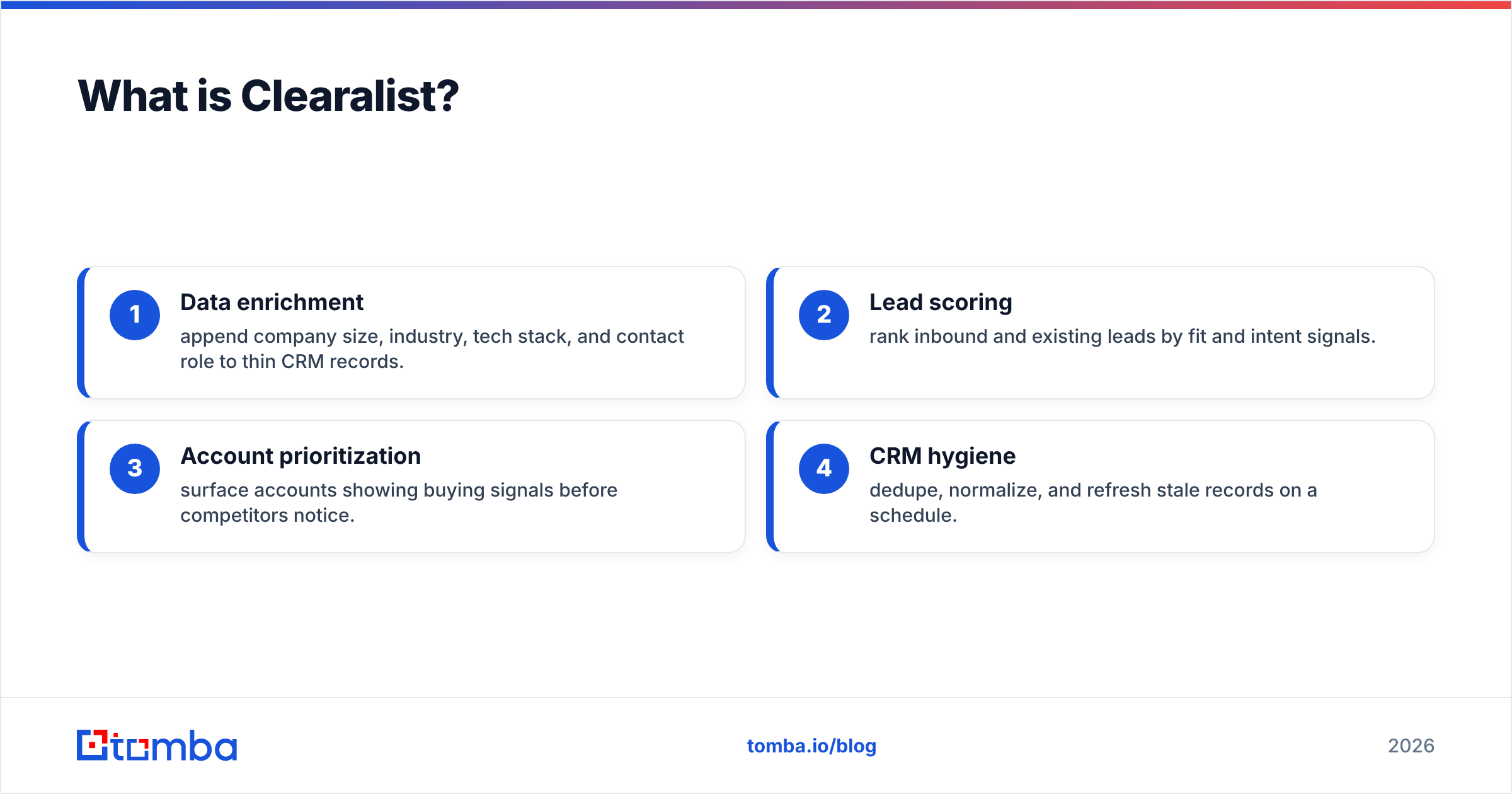
- Data enrichment — append company size, industry, tech stack, and contact role to thin CRM records.
- Lead scoring — rank inbound and existing leads by fit and intent signals.
- Account prioritization — surface accounts showing buying signals before competitors notice.
- CRM hygiene — dedupe, normalize, and refresh stale records on a schedule.
If your team already generates leads but drowns in messy data, this is the lane Clearalist plays in. Where it gets thinner is net-new contact discovery — finding people who aren't in your system yet.
What is Salesbot?#
Salesbot is an outbound automation platform. If Clearalist is the librarian, Salesbot is the assembly line: it takes a list of contacts and runs them through email sequences, LinkedIn touches, and AI-assisted replies at scale.
Its strengths cluster around execution:
- Multichannel sequences — email, LinkedIn, and calls in one cadence.
- AI reply drafting — generate first-draft responses to inbound replies.
- A/B testing — rotate subject lines and copy automatically.
- Inbox rotation and sending controls — spread volume across mailboxes to protect deliverability.
The catch is the same one every automation tool shares: it's only as good as the list you feed it. Send to unverified addresses and your email deliverability tanks no matter how clever the sequencing is.
)
Clearalist vs Salesbot: side-by-side comparison#
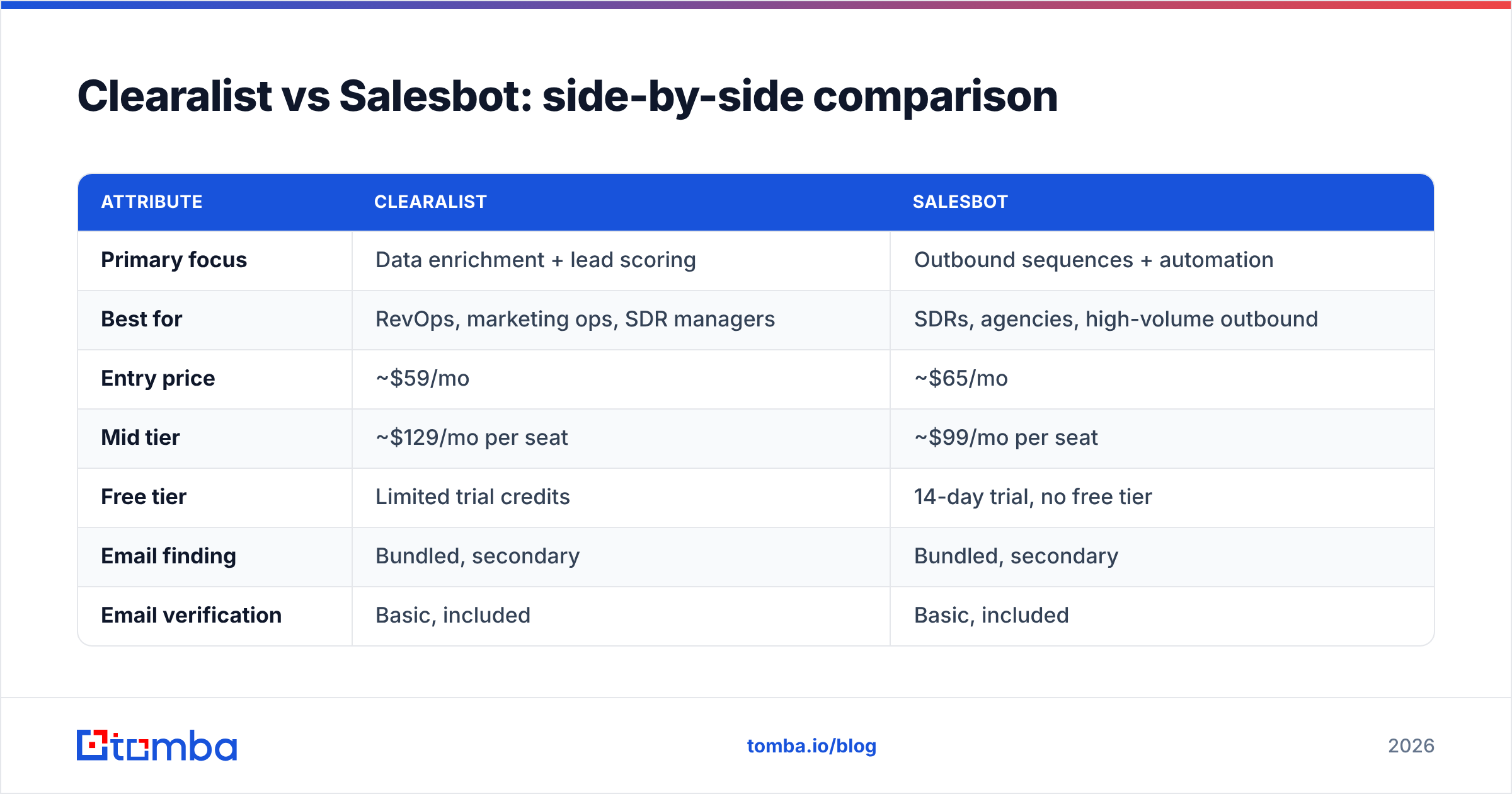
Here's the honest head-to-head. Treat exact prices as directional — both vendors adjust tiers and credit bundles, so confirm on their own pages before you buy.
| Attribute | Clearalist | Salesbot |
|---|---|---|
| Primary focus | Data enrichment + lead scoring | Outbound sequences + automation |
| Best for | RevOps, marketing ops, SDR managers | SDRs, agencies, high-volume outbound |
| Entry price | ~$59/mo | ~$65/mo |
| Mid tier | ~$129/mo per seat | ~$99/mo per seat |
| Free tier | Limited trial credits | 14-day trial, no free tier |
| Email finding | Bundled, secondary | Bundled, secondary |
| Email verification | Basic, included | Basic, included |
| Multichannel outreach | No | Yes |
| CRM enrichment | Strong | Partial |
| AI features | Scoring models | Reply drafting, copy |
| API access | Higher tiers | Higher tiers |
The pattern is clear: these tools solve different problems. The "vs" framing is mostly a function of overlapping marketing, not overlapping capability. A team buying Clearalist to run cadences will be disappointed, and a team buying Salesbot to clean a CRM will be too.
Which is more accurate on contact data?#
Neither wins decisively, and that's the point. Both Clearalist and Salesbot treat contact data as a feature rather than their reason to exist. Bundled email data is convenient, but it's rarely re-verified at send time, which is exactly when accuracy matters most.
Two failure modes show up repeatedly with all-in-one tools:
- Stale records. A contact who changed jobs six months ago still resolves to the old company email. Your sequence "delivers" to a dead mailbox and quietly inflates your bounce rate.
- Catch-all confusion. Domains that accept everything report as "valid" when they're really a black box. Without a proper catch-all verifier, you can't tell a real inbox from a trap.
This is where a dedicated layer earns its keep. Running discovered contacts through a standalone email verifier before they enter any sequence is the single highest-ROI habit in outbound. It protects sender reputation, which is the asset both platforms quietly depend on and neither fully protects for you.
)
Pricing: which costs less in practice?#
Sticker price misleads here. The real cost is cost per usable contact, and it's driven by three multipliers neither pricing page advertises:
- Seats. Salesbot's per-seat model scales linearly with headcount. A five-rep team pays five times the per-seat rate. Clearalist's enrichment tiers can be shared across a team more cheaply, but credit caps bite once you enrich at volume.
- Credits and overages. Both meter usage. Burn through your monthly allotment and you're buying top-ups at a premium, or your reps sit idle until the reset.
- Wasted sends. Every bounce from unverified data is paid-for volume that produced nothing — and it compounds by dragging down inbox placement for the good addresses too.
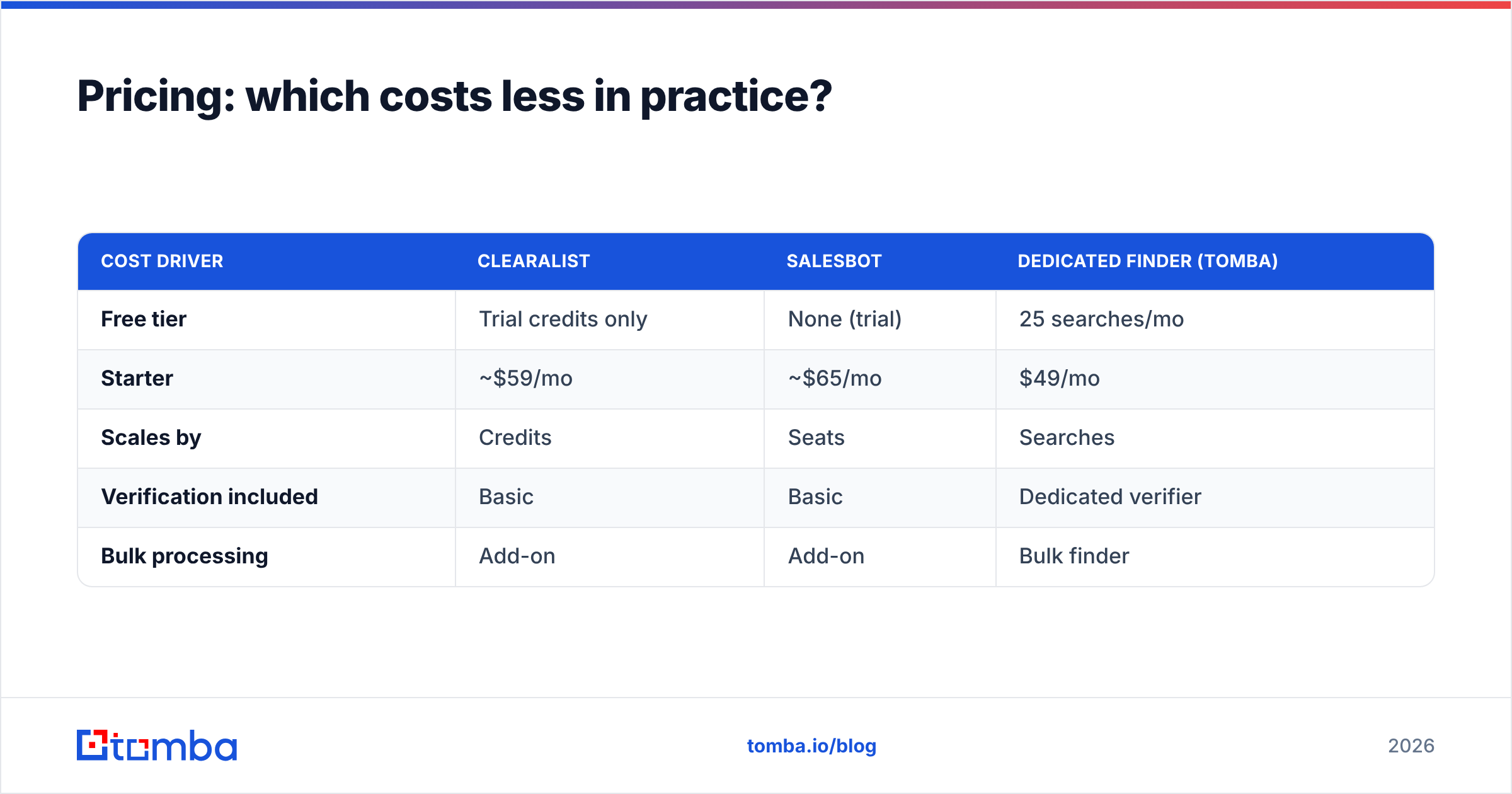
For reference, a focused finder-and-verifier approach is transparent by comparison. Tomba pricing runs a free tier at 25 searches/month, then Starter at $49/mo, Growth at $99/mo, and Pro at $249/mo — so you can isolate the cost of accurate contact discovery instead of paying for it buried inside an enrichment or automation bill.
| Cost driver | Clearalist | Salesbot | Dedicated finder (Tomba) |
|---|---|---|---|
| Free tier | Trial credits only | None (trial) | 25 searches/mo |
| Starter | ~$59/mo | ~$65/mo | $49/mo |
| Scales by | Credits | Seats | Searches |
| Verification included | Basic | Basic | Dedicated verifier |
| Bulk processing | Add-on | Add-on | Bulk finder |
Which one fits your workflow?#
Match the tool to your actual bottleneck, not the louder demo.
Choose Clearalist if:
- Your CRM is full but dirty, and reps waste time on bad-fit accounts.
- You run an inbound-heavy motion that needs scoring and routing.
- RevOps owns the stack and wants enrichment plus hygiene in one place.
Choose Salesbot if:
- You already have clean lists and need to execute high-volume, multichannel outbound.
- Your team lives in sequences and wants AI to draft replies.
- You're an agency running many sending domains and need inbox rotation.
Choose neither (or pair it with a finder) if:
- Your real gap is net-new contacts — people not yet in any system.
- Bounce rates are creeping up and you suspect your data, not your copy.
- You need verified emails and B2B phone numbers for a multichannel play, sourced fresh rather than recycled.
The strongest stacks in 2026 aren't single-vendor. They put a precise top-of-funnel layer in front of whatever platform runs the motion. You can read independent user breakdowns on G2 and Capterra to sanity-check vendor claims against real reviews — and you'll notice the recurring complaint across all-in-one tools is the same one: the bundled data ages faster than anyone admits.
How do you fill the data gap both leave?#
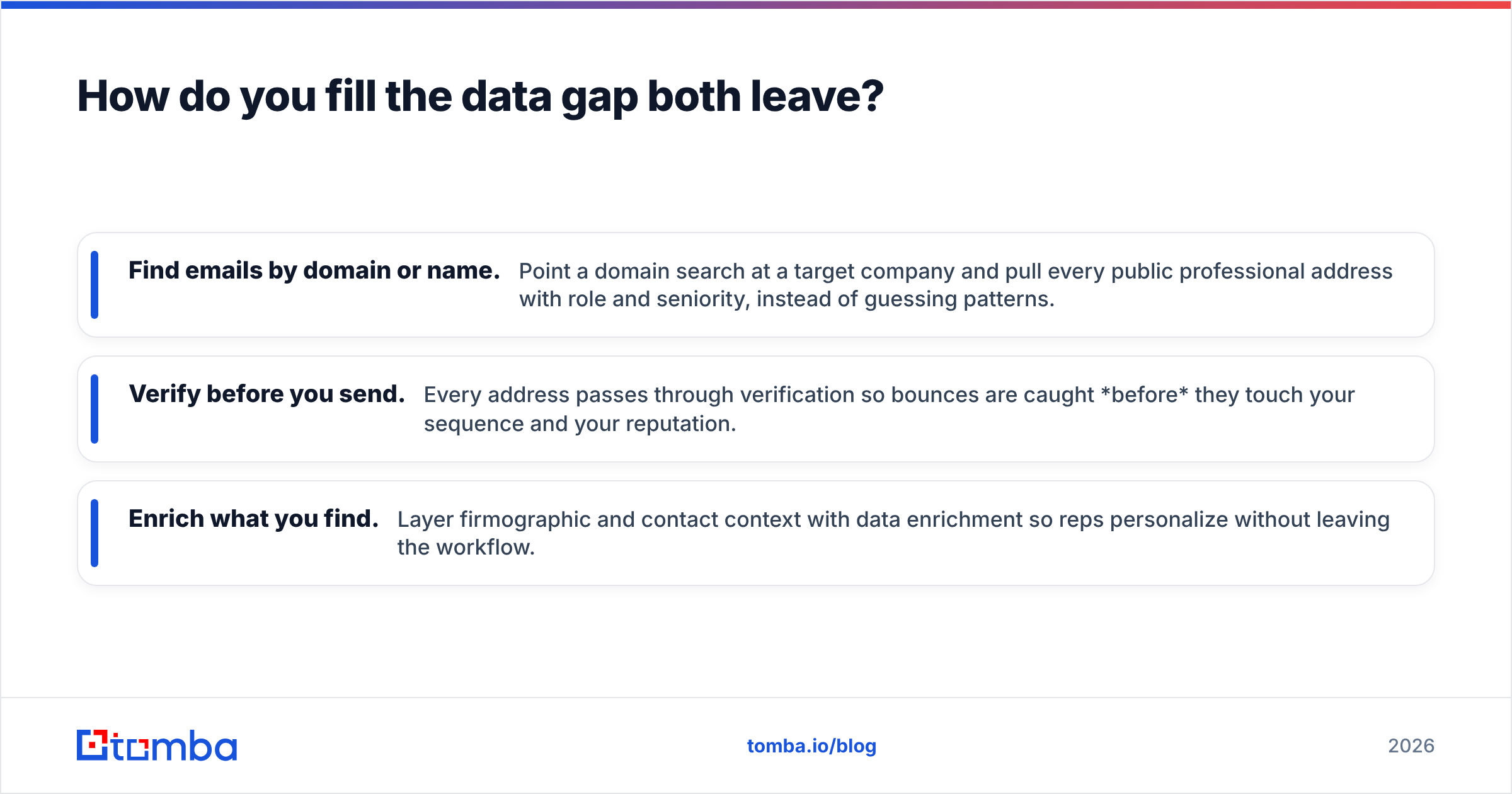
Both platforms assume you arrive with a list. The question is where that list comes from and whether it's clean. A reliable top-of-funnel layer does three things neither Clearalist nor Salesbot specializes in:
- Find emails by domain or name. Point a domain search at a target company and pull every public professional address with role and seniority, instead of guessing patterns.
- Verify before you send. Every address passes through verification so bounces are caught before they touch your sequence and your reputation.
- Enrich what you find. Layer firmographic and contact context with data enrichment so reps personalize without leaving the workflow.
Plug that into a CRM via HubSpot's own integration ecosystem — see the HubSpot integrations directory for how a clean contact layer feeds scoring and sequencing — and you get the accuracy a finder provides with the automation a platform like Salesbot runs. That's the combination, not the either/or.
Clearalist vs Salesbot: the verdict#
There's no universal winner because they're not really competing for the same job. Clearalist wins on data hygiene and account intelligence; Salesbot wins on outbound execution. Pick based on which problem is actually costing you pipeline this quarter.
But notice the gap that sits underneath both verdicts: accurate, verified, net-new contact data. Bundle it into an enrichment tool and it ages. Bundle it into an automation tool and it bounces. The teams getting the most out of either platform in 2026 treat contact discovery as its own discipline and feed clean data into whichever platform runs their motion.
If that top-of-funnel gap is your real constraint, start there. The Tomba Email Finder finds professional emails by domain, name, or company, verifies them before they ever reach a sequence, and ships with a free tier so you can test accuracy against your own target accounts before committing a dollar. Pair it with Clearalist's scoring or Salesbot's cadences and you stop paying one vendor to do a second job badly — and start sending to addresses that actually land.
// get started
Find, verify and enrich your first contacts today
Start on the free plan with 25 searches a month, then scale when your team is ready.
Free plan · No credit card required · GDPR & CCPA
// about the author